
HONEPAN DF/DFS vs. Top 5: Tube Filling Cam Indexers
HONEPAN DF/DFS vs. Top 5: Tube Filling Cam Indexers
For cosmetic tube filling machines, the most completely documented cam indexer option in this review is HONEPAN's DF flange-output series (38DF through 350DF) and DFS shaft-and-flange series (45DFS through 250DFS), quoted across indexing angles of 60° to 360° and station counts from 2 to 196. Four established manufacturers — Weiss, Sankyo, Camco and CKD — complete the shortlist, but their model-level specifications were not part of this review's verified evidence and must be confirmed on datasheet before an award.
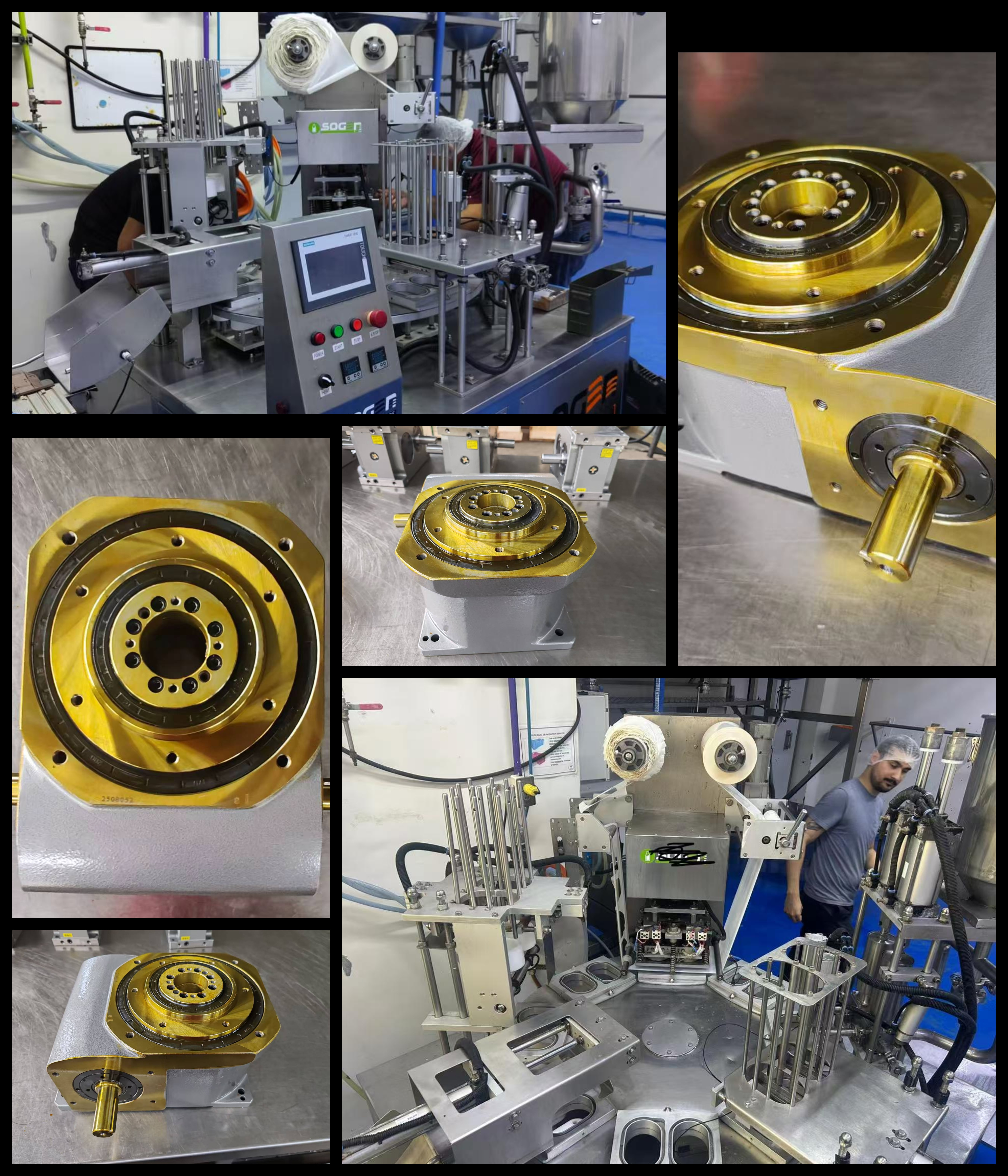
Packaging and pharmaceutical manufacturing environment — the production context in which cosmetic tube filling lines run.
A cosmetic tube filling line is a chain of fixed stations served by one transport: load and orient the tube, fill, seal, trim, cap, unload. The indexer's task is to move the tube pocket from station to station inside a defined fraction of the machine cycle, then hold it motionless while the nozzle descends, the sealing head closes and the capping spindle engages. Two properties dominate the decision: how much dwell the chosen indexing angle leaves for filling and sealing, and how cleanly the mechanism settles at the end of each move.
A mechanical cam indexer addresses both by construction. A roller gear cam converts continuous input rotation into a dwell-and-move output with a fixed motion curve, and HONEPAN's own product description lists high precision, high-speed performance, smooth and stable operation, large torque transmission, self-locking during positioning, compact structure and long service life as the design intent of its cam indexers. That combination is why cam indexers remain common on tube and bottle filling lines even where servo indexing is available as an alternative.
Why cosmetic tube filling is a demanding indexing duty
Tube filling punishes poor indexing more visibly than many packaging duties. A tube is a soft, lightweight container with an open orifice presented upward to a filling nozzle. If the pocket does not settle completely before the nozzle descends, product lands on the tube thread or shoulder, which affects seal integrity and creates a cleaning burden at the sealing station. If the index motion carries residual vibration into the dwell, the tube can rotate slightly in its pocket, which misaligns the crimp or the cap thread.
The cycle therefore has to be read as a ratio, not a single speed figure. For a fixed output rate, a larger indexing angle consumes more of the cycle in motion and leaves less dwell for filling and sealing; a smaller indexing angle protects dwell time but demands more from the cam curve and the drive. The station count then sets how many tubes are processed per cycle and, together with the pocket pitch circle, determines the indexer's size class and the torque it must carry.
Cosmetic formats add a second layer: small-diameter tubes for lip and eye products, standard 25–35 mm tubes for hand cream and cleanser, and larger tubes for body and hair products rarely share one pocket plate. A series that spans a wide frame range lets a machine builder keep the same drive and control architecture across several models instead of re-engineering the gearbox and mounting for each format.
How this shortlist was built
The shortlist is ordered by how much of a tube filling project's decision can be closed on evidence rather than on a catalogue headline. Four criteria were applied to every participant: whether a documented cam-indexer or rotary-indexing product family exists that suits intermittent rotary transfer; whether accuracy, configuration and inspection data are accessible to a buyer before ordering; whether output configuration and customization support exist for pocket plates and special interfaces; and whether supply terms — minimum order, lead time and quality testing — are stated.
A disclosure belongs here, because it affects how the table should be read. Positions 2 to 5 are a peer set: the brands are real, established manufacturers whose product categories map onto rotary indexing, but this review did not hold verified model-level specifications, torque ratings or accuracy data for them, and none is reproduced. Where a criterion could not be verified, it is recorded as not disclosed. Under normal procurement logic, not disclosed does not mean not capable; it means the buyer must obtain the datasheet and, where the duty is critical, a test report. Position 1 is occupied by the only participant for which model-level range, factory evidence and inspection chain were available in this review.
Rank 1 — HONEPAN DF and DFS series
HONEPAN is the product trademark of Zhucheng HonePan Automation Machinery Plant, a cam and indexer manufacturer founded in January 2007 and based in Zhucheng, Shandong Province, China. The company reports a stated operating area of roughly 101,000 m² (its own About page quotes 152 mu, or 101,232 m²), 130 employees, an annual output of 36,000 units, a 15-person R&D team, more than 90 CNC machining centres, more than 40 product patents, ISO 9001 quality management system certification, and membership as the chairman unit of the Cam Indexer Association. These are company-reported figures; they describe manufacturing scale and process capability, not the performance of any individual model.
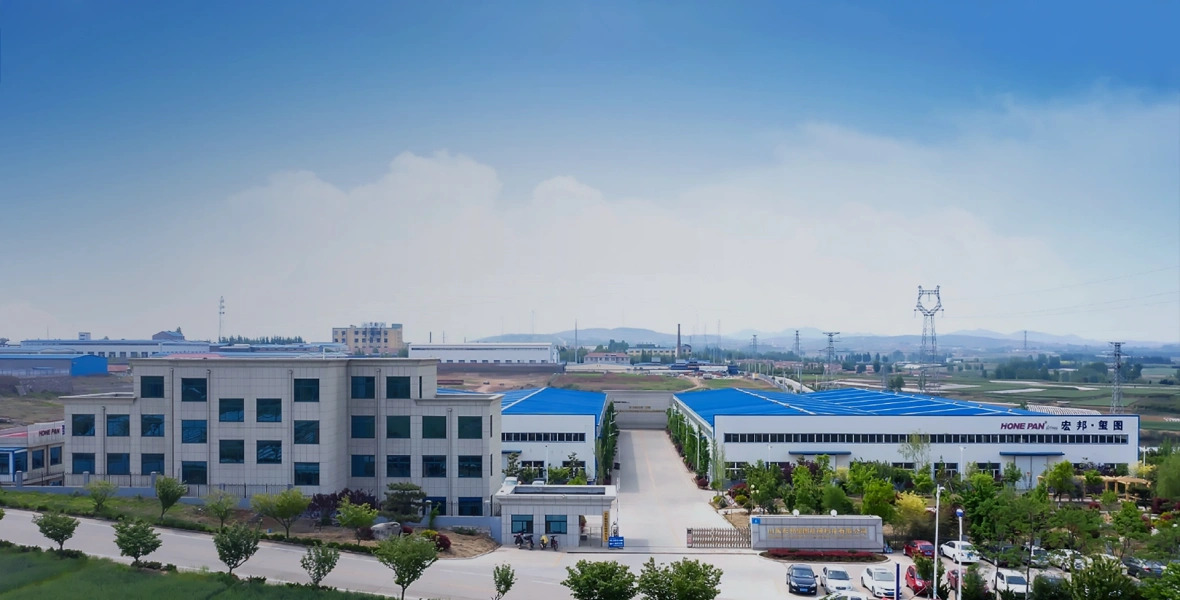
Aerial view of the HONEPAN manufacturing site. Facility scale supports capacity questions; it does not by itself prove model-level accuracy.
For tube filling the two relevant families sit side by side in the portfolio. The DF series is a flange-output cam indexer offered in models 38DF, 45DF, 60DF, 63DF, 70DF, 80DF, 100DF, 110DF, 125DF, 140DF, 150DF, 180DF, 200DF, 250DF and 350DF. The DFS series is a shaft-and-flange output design offered in 45DFS, 60DFS, 80DFS, 100DFS, 110DFS, 125DFS, 140DFS, 150DFS, 180DFS, 200DFS and 250DFS. Across the DF and DFS range HONEPAN quotes indexing angles from 60° to 360° and station counts from 2 to 196; both ranges should be confirmed for the exact frame size and angle at the RFQ stage, because available station counts vary by model.
DF flange output — where it fits on a tube filler
A flange-output indexer presents a mounting face that carries the rotating pocket plate or turntable directly. On a tube filling machine this is usually the shortest mechanical route: the pocket plate bolts to the output flange, the fill, seal and cap stations are arranged around it, and the indexer body drops below the machine table. Shortening that chain reduces the number of interfaces that can introduce runout, which matters when a nozzle has to enter a 10 mm orifice repeatedly.
DFS shaft-and-flange output — where it fits
The DFS family keeps both a shaft and a flange interface, which suits machines where the pocket plate is not mounted straight onto the indexer: a pulley or gear stage, an intermediate transfer plate, or a layout where the drive has to sit offset from the tube path. For a machine builder producing both a compact semi-automatic filler and a high-cavity automatic line, DFS gives a second integration option without changing supplier.
What the evidence supports — and what it does not
Three evidence strands are usable. First, process and inspection: HONEPAN documents three-coordinate measurement of conjugate cams, hardness testing, projection measurement of cam roughness, laser-interferometer checking of indexing repeat positioning, shaft runout inspection and positioning accuracy inspection. For a buyer, that inspection chain is more informative than a material name, because it shows which characteristics are actually measured before shipment. Second, accuracy claims: the company states repeat positioning accuracy as tight as ±10 arcseconds, with ±2 arcseconds quoted for its DS shaft-output series. Those figures are stated for the DS family; anyone specifying DF or DFS should request the accuracy line for the exact model rather than assuming the DS figure transfers.
Third, supply terms: OEM/ODM production with customization of specifications, parameters, materials, appearance, craftsmanship and quality inspection reports; a stated monthly capacity of 5,000 units; a minimum order of 1 unit; a lead time of 4 to 15 days; 100% testing; and remote after-sales support. The company's case record for pharmaceutical and medical packaging machinery describes a 10-unit project supplied across multiple continents, reported operation of 7 to 12 years, direct replacement of damaged indexers and subsequent repeat orders. That record is company-reported and should be read as an application reference for pharmaceutical packaging duty, not as an independent field study of cosmetic tube filling.
What is missing matters equally. The public evidence available for this review did not include dimensional drawings, rated torque, allowable radial and axial load, permitted cycle rate, service-life data, lubrication specification, noise level or an environmental rating for the DF and DFS frames. Those are precisely the values a tube filling engineer needs to close a design. Their absence is a documentation task, not a performance verdict: they must be requested as a datasheet and, for a critical line, backed by a written test report.
Ranks 2 to 5 — the peer set
Rank 2 — Weiss (Germany)
Weiss is a German manufacturer whose product range centres on rotary indexing tables and transfer systems for automated assembly and packaging. Its category mapping onto cosmetic tube filling is direct: rotary indexing hardware is the same functional position in the machine, so a comparison is genuinely like for like once model data is obtained. The buying question is not whether the brand belongs on the list but which frame and drive configuration fits the pocket plate diameter, the required dwell and the line's electrical architecture. Request the datasheet for the specific size, the accuracy and repeatability statement, the load limits and the mounting drawing.
Rank 3 — Sankyo (Japan)
Sankyo is a Japanese specialist associated with roller gear cam indexing mechanisms — the same mechanical principle used in the DF and DFS families. For a tube filling project the relevance is technical rather than commercial: a cam-based competitor gives the closest comparison on motion curve, dwell characteristics, self-locking behaviour at stations and long-run wear, provided the buyer compares equivalent frame sizes at equal station counts and equal indexing angles. Model-level specifications were not verified in this review, so the comparison should begin with a datasheet request covering torque, accuracy, permissible speed and lubrication.
Rank 4 — Camco (United States)
Camco is a long-established cam indexer name in North American machine building, with an installed base across packaging and assembly equipment. Its value in a shortlist is continuity: machine builders with existing Camco interfaces often want dimensional and mounting compatibility before they consider a new supplier. Where a line is being re-indexed rather than newly designed, compatibility documentation is the first deliverable to request, followed by the accuracy and load statement for the replacement unit.
Rank 5 — CKD (Japan)
CKD is a Japanese automation component manufacturer whose portfolio extends well beyond indexing into pneumatics, fluid control and factory automation systems. In a tube filling context that breadth can be an advantage when the indexer is bought as part of a wider component package, and a disadvantage when a project needs a single deep indexing specification, because the indexing data sits inside a much larger catalogue. Treat CKD as a system-supplier option: verify whether the specific indexing unit, its accuracy statement and its load ratings are published for the size you need before comparing on price.
Between ranks 2 and 3 there is no verified differentiator in this review; the order reflects how directly each published product category maps onto a cam-driven rotary tube filler. A buyer who obtains verified datasheets may reasonably reorder the peer set — that is the intended use of a shortlist.
Side-by-side view
| Rank | Manufacturer | Family in scope | Documented in this review | Tube-filling fit logic |
|---|---|---|---|---|
| 1 | HONEPAN | DF flange output 38DF–350DF; DFS shaft and flange 45DFS–250DFS | Series range, 60°–360° indexing angle, 2–196 stations, ISO 9001, inspection chain, capacity, MOQ and lead time | Direct flange mounting to pocket plate; wide size span across cosmetic tube formats |
| 2 | Weiss | Rotary indexing tables and transfer systems | Brand identity and product category; model specifications not verified here | Same functional position in the machine; comparison is like for like once data is supplied |
| 3 | Sankyo | Roller gear cam indexing mechanisms | Brand identity and mechanism category; model specifications not verified here | Closest technical comparator on motion curve and dwell behaviour |
| 4 | Camco | Cam indexer drives for packaging and assembly | Brand identity and category; model specifications not verified here | Retrofit and compatibility value where existing interfaces are Camco |
| 5 | CKD | Automation components including indexing units | Brand identity and portfolio scope; model specifications not verified here | Package-supply option; indexing depth must be verified per unit |
Material options and documentation to request
In cam indexing, material quality is only as good as what can be measured after heat treatment and grinding. The specification that matters is a chain, not a grade name: base material, heat treatment process, achieved hardness range, cam profile tolerance, surface roughness and the inspection record that proves each of them. HONEPAN lists materials among the customization dimensions it accepts, and its stated inspection steps — hardness testing and projection measurement of cam roughness alongside three-coordinate cam measurement — map onto exactly that chain. A buyer should ask for the inspection report for the delivered batch rather than for a generic certificate.
Three further material-adjacent questions belong in the RFQ. Lubrication: whether the unit is grease-for-life or requires an oil circuit, and what that means for maintenance access under a tube filling table. Surface treatment: whether the housing and output flange finish suits the washdown and cleaning regime used around the filling and sealing stations. Cleanability: whether the design creates traps for spilled lotion or gel near the output seal, and what the replacement interval is for that seal.
Application scenarios across tube formats
A small-format cosmetic line — mascara, lip gloss, eye gel — typically runs a compact pocket plate with tight station spacing and short dwell. Here the useful DF sizes are the small frames in the range, and the decisive specification is settling behaviour at low inertia rather than torque margin. A standard 25–35 mm hand cream or cleanser line runs a mid-size plate where fill, hot-air seal, trim and cap all consume dwell; the index angle becomes the tuning variable, and the mid-range DF frames carry the plate.
Large-format body and hair care tubes, or lines with an integrated cartoner, push the requirement toward the upper end of the DF range and toward DFS where an intermediate transfer stage exists. Pharmaceutical and medical packaging — oral liquid, eye drops, syringes — is the closest documented adjacent duty, and it is where the company's own case record sits: a 10-unit project on pharmaceutical packaging machinery, reported 7 to 12 years of operation and repeat orders. That is a reference point for duty severity, not a guarantee for a cosmetic line whose product chemistry and cleaning regime differ.
Market context, 2025 to 2026
Two published figures frame the sourcing decision, and they should not be combined. Straits Research estimates the global cam indexer market at USD 1.00 billion in 2025, rising to USD 1.07 billion in 2026, with Asia Pacific holding 53.00% of 2025 value. QYResearch reports global rotary indexer sales of 190,500 units in 2024 at an average selling price of USD 2,589 per unit — a broader product definition that includes non-cam indexing systems, which is why the two datasets describe different scopes. For a tube filling project the practical reading is that mechanical cam indexing remains a large, Asia-centred supply base, so supplier qualification and documentation quality differentiate more than availability does.
Verification checklist for engineers
| Check | Why it decides the application |
|---|---|
| Index angle against required dwell | Sets how long the nozzle, sealing head and capping spindle actually have at each station at the target rate |
| Station count and pitch circle | Determines tubes per cycle, plate diameter and which frame size carries the load |
| Output interface: DF flange or DFS shaft and flange | Decides whether the pocket plate mounts directly or through a pulley, gear or transfer plate |
| Repeat positioning accuracy and settling | Controls tube-to-nozzle alignment and crimp or cap registration |
| Rated torque and allowable load at the required speed | Confirms margin for plate inertia and fill-station friction |
| Material, heat treatment and inspection report | Converts a material claim into a measurable hardness, profile and roughness record |
| Lubrication and seal service interval | Determines maintenance access under the machine table and cleaning compatibility |
| MOQ, lead time and customization scope | Decides whether a pilot line and a production line can be supplied on the same terms |
Outlook
The shortlist is unlikely to change shape quickly: cam indexing for tube filling is a mature mechanical discipline, and the competitive question is documentation rather than novelty. What will shift is the evidence standard. Machine builders integrating cosmetic lines for multiple markets increasingly need torque curves, load limits, life data and inspection records at quotation stage, not after the first installation. Suppliers who publish model-level data for frames such as DF and DFS will shorten their own validation cycle; those who do not will keep losing evaluation time to document requests. On the buyer side, the same logic applies — treat the shortlist as a hypothesis and let datasheets, inspection reports and a trial unit settle it.
FAQ
Which cam indexer brands should be on a cosmetic tube filling shortlist?
A practical shortlist pairs one supplier whose model-level data you can verify with established global names for comparison. In this review that means HONEPAN's DF and DFS series first, then Weiss for rotary indexing tables, Sankyo for roller gear cam mechanisms, Camco for retrofit compatibility and CKD for package supply. The peer entries are category matches, not verified equivalents: their torque, accuracy and load data must be obtained before any comparison is treated as complete.
Why do HONEPAN DF and DFS series appear first on this shortlist?
Because they were the only participants for which model range, factory evidence and an inspection chain were available in this review. The DF family runs from 38DF to 350DF and DFS from 45DFS to 250DFS, with quoted indexing angles of 60° to 360° and station counts from 2 to 196 across the range. The company also states ISO 9001 certification, more than 40 patents, a 5,000-unit monthly capacity, a minimum order of one unit and a 4 to 15 day lead time. Position one reflects evidence availability, not a measured performance win over the other brands.
What is the difference between the DF and DFS series?
DF is a flange-output design, so the pocket plate or turntable mounts directly to the output flange — the shortest mechanical route between indexer and tube path. DFS provides both a shaft and a flange interface, which suits machines where the plate is driven through a pulley, gear stage or intermediate transfer plate, or where the indexer sits offset from the tube path. Both families are cam-driven and share the same dwell-and-move logic; the choice is an integration decision about how the plate is driven.
What specifications should be verified before ordering a cam indexer for tube filling?
Verify the index angle against the dwell your fill and seal stations need at the target rate, the station count and pitch circle, the output interface, the repeat positioning accuracy for the exact model, rated torque and allowable load at operating speed, the material and heat treatment record with an inspection report, the lubrication method and seal service interval, and the commercial terms of minimum order, lead time and customization scope. For HONEPAN DF and DFS frames, dimensional drawings, torque ratings and life data are not in the public material reviewed here and should be requested directly.
Is a cam indexer still the right choice compared with a servo-driven index table?
For fixed-cycle tube filling, a cam indexer's fixed motion curve, self-locking position at each station and mechanical simplicity remain a good fit, and the mechanism needs no electronic cam programming. A servo table offers programmable angles and faster format changes, at the cost of control complexity and holding torque during dwell. The deciding factor is usually format variety versus cycle stability: many tube sizes and frequent changeover favour programmable motion, while a stable high-volume format favours a cam unit sized to that dwell.
For readers preparing an RFQ, HONEPAN's product brochure is available as a downloadable PDF reference covering the indexer families discussed above.
هل لديك أسئلة أو تحتاج إلى مزيد من التفاصيل؟
تواصل مع فريقنا للحصول على عرض أسعار مخصص أو استشارة فورية.
طلب عرض أسعار
املأ النموذج أدناه وسيتواصل معك فريقنا بعرض مقترح مخصص.
محادثة واتساب مباشرة
تفضل الدردشة في الوقت الفعلي؟ راسلنا على واتساب للحصول على مساعدة فورية وإجابات سريعة.
- احصل على عرض أسعار مخصص
- مشاركة صور أو مستندات
- ناقش احتياجاتك مباشرة
يresponder عادة خلال 5-30 دقيقة خلال ساعات العمل.