
HPMC Ash Content Explained: How It Affects Mortar Color and What Batch Testing Reveals
Ash content is the portion of a Hydroxypropyl Methyl Cellulose (HPMC) sample that is not cellulose ether. It is measured by combustion: the organic polymer burns away, the inorganic residue is weighed, and the result is expressed as a percentage of the original sample. In construction-grade HPMC used in mortars, putties and tile adhesives, that figure is often treated as a paperwork detail — until a contractor notices that two pallets of the same white putty do not match under the same light. At that point ash becomes a commercial question, because appearance is frequently the first thing an end user evaluates and the hardest thing for a supplier to explain after delivery.
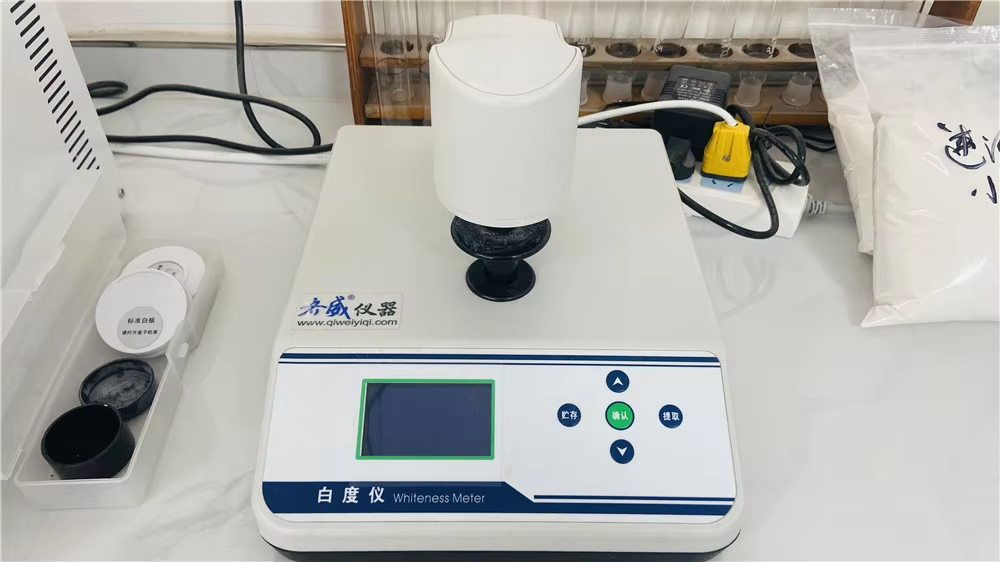
A whiteness meter in the manufacturer's quality-control laboratory — appearance is a measured parameter, not a subjective impression. Image: BANG SHANG INTERNATIONAL CO., LIMITED.
What ash content actually measures in HPMC
Ash content is the mass of inorganic residue that remains after a cellulose ether sample has been completely combusted. HPMC is an organic polymer and burns off in the test; what stays behind comes from two sources: minerals naturally carried by the cellulose feedstock, and inorganic salts introduced or left behind during the etherification process that converts cellulose into a cellulose ether. The measured value therefore functions as a practical indicator of how much non-polymeric, non-water-retaining material travelled through the process with the polymer.
In the BANGCEL® construction-grade HPMC range, ash content is specified at below 5%, and it sits alongside a defined set of parameters rather than standing alone. Reading ash without the rest of the specification is a common procurement mistake.
| Parameter | Specified value |
|---|---|
| Product | HPMC (Hydroxypropyl Methyl Cellulose), cellulose ether |
| Methoxyl group | 24–30% |
| Hydroxyl propyl group | 4–12% |
| Viscosity | 200–200,000 mPa.s |
| Ash content | <5% |
| Moisture | <5% |
| pH | 6–8 |
| Reference models | HPMC100000, HPMC150000, HPMC200000 |
Source: BANGCEL® HPMC product parameter set (BANG SHANG INTERNATIONAL CO., LIMITED).
Two conclusions follow from that table. First, an ash limit is product-specific and should never be compared across product categories. The same manufacturer specifies ash at 11±2 for its redispersible polymer powder, because RDP is a mineral-filled product by design — a high ash figure there is normal, while the same number in HPMC would signal a process problem. Second, ash is a proxy: it does not by itself say whether the inorganic content is natural mineral matter or residual salts from processing, but it does quantify how much non-polymer material a buyer is accepting per tonne.
Why higher ash turns into visible colour inconsistency in mortar
Colour problems in dry-mix mortars are usually blamed on cement or pigment. Ash content is a less obvious contributor, but in thin-layer systems it can be decisive, because the visible surface of a finished wall or grout line is a very small fraction of the total applied material.
Pigment displacement at the surface. Pigment is dosed at a low level relative to cement, filler and aggregate. Inorganic residue does not carry pigment, does not dissolve, and does not bind the way the polymer does. Where the residue concentration rises in the surface layer, it can dilute the effective pigment density and shift the shade of the finished surface.
Batch-to-batch variation. A single ash figure describes one sample. What a project experiences is the spread across many batches. If ash drifts between lots — or varies within a poorly blended lot — the same formulation can produce slightly different shades in adjacent panels, in grout joints laid on different days, or in touch-up areas applied from a later delivery.
Surface migration of soluble residue. Where the inorganic fraction contains soluble salts, moisture movement during curing and drying can carry those salts toward the surface, leaving a lighter haze or a patchy film. On white wall putty, light-coloured tile grout, decorative renders and EIFS top coats, this is far more visible than on thick grey base coats or bedding mortar, where the surface is either covered or visually tolerant.
This is also why appearance-related testing belongs in routine quality control rather than in complaints handling. A whiteness meter appears in the manufacturer's laboratory equipment list next to viscometers, moisture meters and a precision electronic scale, which indicates that optical properties are checked as a normal part of production control.
Where the input-side risk is controlled
Ash is a trace of the process, not an ingredient anyone purchases deliberately, so control has to be applied at two points: what enters the reactor and what leaves the plant.
BANG SHANG INTERNATIONAL CO., LIMITED, founded in 2007, is a manufacturer and global supplier of construction chemical additives trading under the BANGCEL® brand. The company produces HPMC, MHEC, RDP, HEC and CMC for tile adhesives, wall putty, cement-based mortars, EIFS/ETICS, self-levelling compounds, dry-mix mortar systems, water-based coatings and detergent formulations. It operates an 80,000 m² site with 300 employees and a 26-person R&D team, serves markets worldwide excluding the EU, and reports that approximately 70% of output is exported.
On the input side, the cellulose feedstock is refined cotton, stored in a dedicated refined cotton storage bin and handled through a separate raw material workshop and warehouse. Segregating feedstock this way limits the cross-contamination and moisture uptake that can push inorganic content upward before production even begins. On the process side, the etherification reaction, the drying and crushing stage and internal pipeline transport are managed from a central control room, which keeps the reaction and drying window under continuous operating oversight rather than periodic manual checks.
On the output side, the company states that quality control is 100% testing, and its export-market service set combines OEM, ODM and small batch production with a minimum order quantity of 3 tonnes and a typical lead time of 7–14 days against a monthly capacity of 3,000 tonnes.
The detail most relevant to ash is that ash content appears on the manufacturer's customization list next to viscosity, particle size, degree of substitution and water retention rate. That placement matters: it means ash is treated as a parameter that is measured, adjusted and verified against a specification, rather than accepted as an unavoidable by-product of production. The company also offers customized testing as a service line, which allows a buyer to align the test scope with the parameters their own formulation is sensitive to.
How buyers should read a supplier's ash test data
A supplier certificate is only useful if it can be tied to a specific lot and judged against a specific limit. The following items are the minimum a construction buyer should be able to obtain before accepting a delivery.
| What to request | Why it matters |
|---|---|
| Batch or lot identifier | An ash result without a lot number cannot be matched to the material actually shipped, which removes its value in any later dispute. |
| Specification limit and result | A number is meaningful only against the limit it is judged on. The BANGCEL® HPMC specification states ash content below 5%. |
| Companion parameters | Moisture below 5%, pH 6–8, viscosity between 200 and 200,000 mPa.s, methoxyl group 24–30% and hydroxyl propyl group 4–12% describe performance. A low-ash lot with drifting moisture or viscosity can still cause application problems. |
| Test method reference | Ash is a combustion-based measurement. Results from two suppliers are comparable only if the method and sample preparation match. |
| Coverage statement | 100% batch testing means every lot is tested. Sampled testing means results describe only the lots that were pulled — a materially different level of assurance. |
| Pre-shipment verification | The stated acceptance criterion is a pre-shipment test. Verifying before dispatch is cheaper than contesting appearance defects after the material has been mixed and applied. |
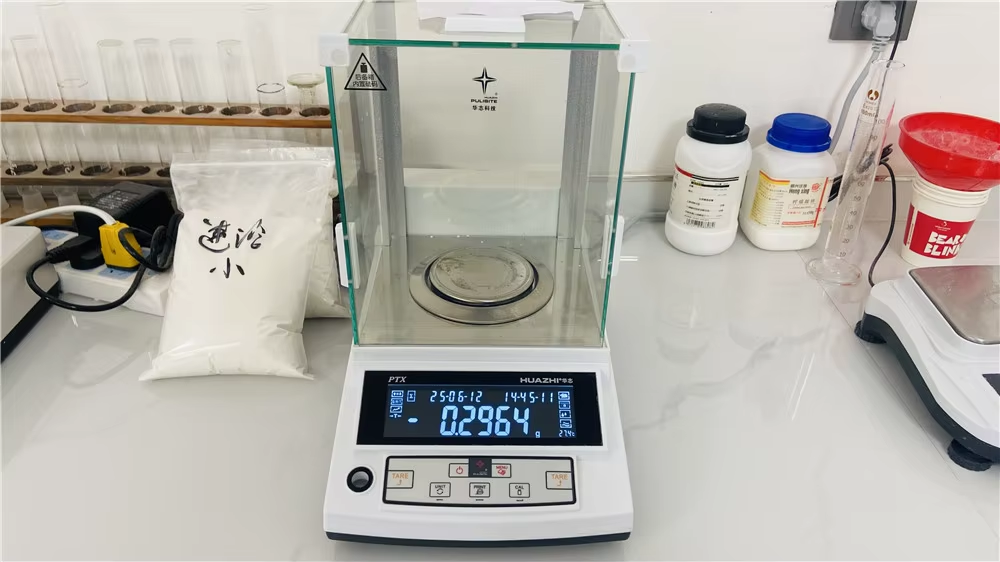
Sample weighing accuracy directly affects the reliability of ash and moisture results. Image: BANG SHANG INTERNATIONAL CO., LIMITED.
The practical rule for evaluation-stage buyers is straightforward: a single certificate establishes a claim, while a consecutive series of batch results establishes a capability. Requesting ash data for the last several lots, not just the current one, is the fastest way to see whether a supplier's process is stable or whether the last test happened to be a good day.
What batch testing reveals across a supply relationship
Ash control only proves itself over time, because colour complaints rarely appear in the first delivery. A relevant reference case comes from the Indian market: a construction chemicals manufacturer there received 20 metric tons of HPMC over a two-year period for dry-mix mortar production and water-based paint. The product highlights recorded for that project were high purity and stable viscosity, and the customer's feedback noted satisfaction with water retention and viscosity stability, consistent with the excellent water retention performance observed in application.
The case does not publish ash figures, and it should not be read as evidence about ash specifically. Its value for an evaluation-stage buyer is different: a two-year supply relationship with a formulator who mixes the material into mortars and coatings is only sustainable when the delivered specification holds from lot to lot, because the customer's own batch records would expose any drift. That is the same logic buyers should apply to ash — it is a parameter worth tracking as a trend line, not as a single data point.
Limits and boundaries: what ash control cannot do
Ash control is a useful lever, but it is not a complete answer to colour consistency, and buyers who treat it as one tend to be disappointed.
Ash addresses the additive side only. Mortar colour is a system property. Cement source and lot variation, filler brightness, sand colour, pigment dispersion in the buyer's own mixer and water dosing on site all influence the final shade. A supplier can hold ash below 5% consistently and still see a shade shift caused by a cement change at the plant.
Numbers are not portable between suppliers without the method. If two suppliers report 3% and 3.5% but used different combustion methods, sample masses or preparation steps, the difference may be an artefact of testing rather than a difference in the material. Without method details, an ash figure should be treated as indicative.
Below 5% is not zero. Any ash result is a residue, and a specification sets an upper bound rather than eliminating inorganic content. Buyers should match the limit to the sensitivity of the application — a white decorative putty and a grey bedding mortar do not require the same marginal gain.
A certificate covers the tested lot. Pre-shipment testing is the stated acceptance criterion, which means verification happens before dispatch rather than at the buyer's gate. Receipt-level checks remain a buyer responsibility, particularly for appearance-critical projects.
Market trend: appearance is becoming a procurement criterion
Ash content sits at the intersection of two market movements. The first is scale: the global construction-grade HPMC market was valued at USD 1.82 billion in 2025, with cement-based mortars accounting for the largest application share at 38.4%, according to Dataintelo. Grand View Research reports that construction applications held a revenue share of over 45%, driven by HPMC's role as a water-retention agent and thickener, while Dataintelo places Asia Pacific at approximately 47.3% of the global construction-grade market.
The second movement is application mix. HPMC is used in more than 70% of tile adhesive formulations and more than 65% of dry-mix mortar formulations, according to Market Research Future — directional figures that reflect how routine the additive has become in thin-layer systems. As volume concentrates in adhesives, putties, grouts and decorative finishes, parameters that were once considered laboratory details move closer to the centre of the purchasing decision, because the end user of those products judges the result visually before judging anything else.
A third factor is documentation pressure. Tenders increasingly expect environmental and quality documentation alongside product data; ISO 14025:2006 environmental product declarations are cited as a requirement in competitive global tenders for industrial-grade cellulose ethers, according to EPD International. Suppliers who already operate structured testing regimes and hold management-system certification — the BANGCEL® operation holds a quality management system certificate to GB/T 19001-2016 / ISO 9001:2015 issued by HQC under certificate number 86525Q1069R0M — are better positioned to answer such requests than those working from ad hoc test reports.
Future outlook
Three developments look likely over the next procurement cycles. Batch-level data will become the default unit of assurance rather than a special request, because buyers who have been burned by appearance drift rarely go back to accepting single-sample certificates. Appearance-linked specifications — ash, moisture and optical parameters read together — will increasingly appear in purchasing contracts for white and coloured dry-mix products. And formulation-level customization will extend to test scope, since a buyer whose problem is shade stability needs different evidence from one whose problem is open time or slip resistance.
For buyers, the practical implication is a shift in the evaluation question. The question is no longer only whether a supplier can meet an ash limit, but whether the supplier can demonstrate, lot after lot, that the limit is being met — and can explain what the number means for the specific product being made.
FAQ
What is ash content in HPMC, and what does a high value indicate?
Ash content is the inorganic residue remaining after a cellulose ether sample is fully combusted, expressed as a percentage of the sample. In HPMC the polymer burns off, so the residue represents non-polymeric material: minerals carried by the cellulose feedstock and inorganic salts associated with the etherification process. A higher value indicates a larger share of material that does not contribute water retention or thickening behaviour.
Why does ash content affect mortar colour more in some applications than others?
It relates to how much of the finished surface the visible layer represents. Thin-layer and appearance-critical products such as white wall putty, light-coloured tile grout, decorative renders and EIFS top coats expose the surface layer directly to inspection, so inorganic residue and any soluble salts migrating to the surface can register as a shade difference or a light haze. In thick grey base coats or covered bedding mortar, the same variation is usually invisible.
What ash content should construction-grade HPMC have?
It depends on the grade and the application. In the BANGCEL® construction-grade HPMC range, ash content is specified at below 5%, alongside moisture below 5%, pH 6–8, methoxyl group 24–30%, hydroxyl propyl group 4–12% and viscosity from 200 to 200,000 mPa.s. The same manufacturer specifies 11±2 for its redispersible polymer powder, which illustrates that ash limits are product-specific and should not be transferred between product categories.
What should a batch ash test certificate contain before a buyer accepts delivery?
At minimum: a batch or lot identifier that ties the result to the shipped material, the specification limit and the measured result, a reference to the test method, and the companion parameters that describe performance — moisture, pH, viscosity, methoxyl and hydroxyl propyl content. A statement of test coverage also matters, because 100% batch testing provides a different level of assurance from sampled testing. In the BANGCEL® supply terms, the acceptance criterion is a pre-shipment test, so verification occurs before dispatch.
Can ash content be customized for a specific mortar or putty formulation?
Yes. Ash content is listed among the customizable product parameters for BANGCEL® HPMC, together with viscosity, particle size, degree of substitution and water retention rate. Customization also extends to formula or grade, packaging and service, and the manufacturer provides OEM, ODM and small batch production with a minimum order quantity of 3 tonnes, a typical lead time of 7–14 days and a monthly capacity of 3,000 tonnes for export markets worldwide excluding the EU.
Does a low ash result alone guarantee consistent mortar colour?
No. Ash control addresses the additive's contribution only. Final colour also depends on cement source and lot variation, filler brightness, sand colour, pigment dispersion in the buyer's mixer and water dosing on site. In addition, ash results from different suppliers are comparable only when the test method and sample preparation match, so a figure without method details should be treated as indicative rather than definitive.
Summary for evaluation and execution-stage buyers
Ash content is a small number with an outsized effect on appearance-critical dry-mix products, and it is one of the few additive-side variables a buyer can verify before the material is mixed. The workable approach is to specify ash against a defined limit, request batch-level results rather than a single certificate, read ash together with moisture, viscosity and pH, and treat a series of results as the real evidence of capability. Detailed product parameters and specification documentation for the BANGCEL® HPMC and RDP ranges are compiled in the manufacturer's product brochure, available here: BANGCEL® product brochure (PDF).