
HPMC Certification Compliance: A Buyer’s Guide for 2026
HPMC Certification Compliance: A Buyer’s Guide for 2026
For industrial buyers sourcing Hydroxypropyl Methyl Cellulose (HPMC), navigating the landscape of certifications and regulatory compliance is no longer optional—it is a fundamental requirement. With increasing scrutiny on quality, safety, and environmental impact, understanding exactly which certifications a supplier holds and how they ensure compliance can mean the difference between a reliable supply chain and costly disruptions. This guide breaks down the essential certifications for construction-grade and detergent-grade HPMC, offering a practical framework for procurement teams to verify supplier credibility.

HPMC is widely used in water-based paints and coatings, where certification ensures consistent performance and safety.
Why Certification Matters in HPMC Procurement
HPMC is a critical additive in applications such as ceramic tile adhesives, wall putty, self-leveling compounds, and liquid detergents. However, not all HPMC is created equal. Variations in purity, viscosity stability, and ash content can directly impact end-product quality. International buyers—especially those in markets like North America, the Middle East, and Southeast Asia—increasingly require suppliers to demonstrate compliance with global management system standards. Without proper certification, buyers face risks of inconsistent quality, environmental non-compliance, and occupational health hazards.
The Three Pillars of HPMC Compliance: ISO 9001, ISO 14001, and ISO 45001
Leading HPMC manufacturers typically hold three key certifications that cover quality, environmental management, and occupational health & safety. For example, Bang Shang International Co., Limited (brand BANGCEL®) has obtained all three through HQC, reinforcing its commitment to global standards.
ISO 9001:2015 – Quality Management System
Holding certificate number 86525Q1069R0M, this certification covers the production of cellulose ether (HPMC) and RDP powder. It applies to the global market and is audited to the GB/T19001-2016/ISO9001:2015 standard. For buyers, this means the supplier follows documented processes for quality control, continuous improvement, and customer satisfaction.
ISO 14001:2015 – Environmental Management System
Certificate number 86525E1068R0M applies to HPMC and RDP manufacturing, confirming the supplier’s commitment to environmental responsibility, waste reduction, and regulatory compliance. Notably, this certification is valid for global markets excluding the EU, with the standard GB/T24001-2016/ISO14001:2015.
ISO 45001:2018 – Occupational Health and Safety Management System
With certificate number 86525S1067R0M, this certification covers HPMC manufacturing and related occupational health and safety activities. It assures buyers that the supplier maintains a safe working environment, reducing risks of production disruptions due to accidents.
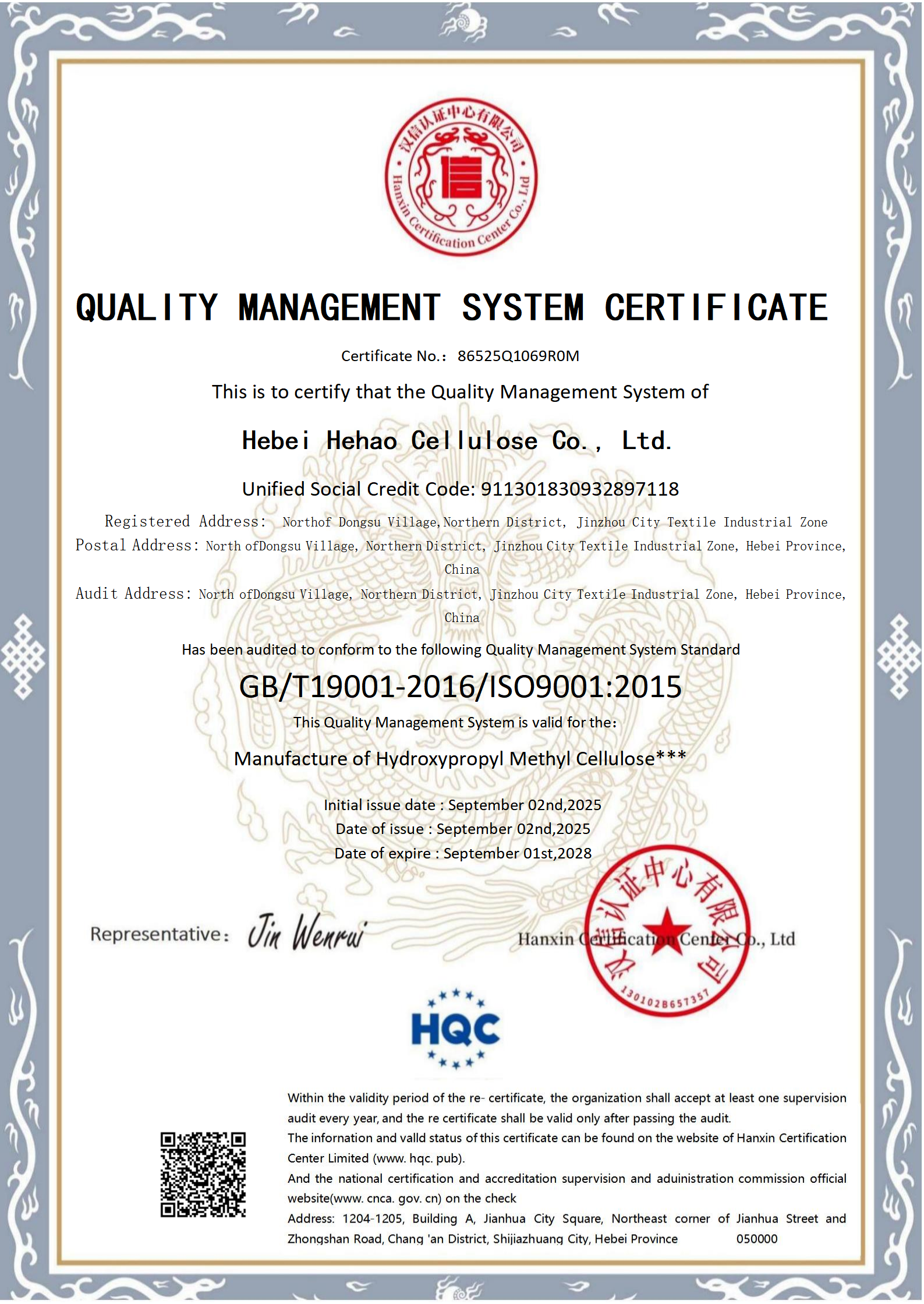
ISO 9001 certification is a key indicator of quality management in HPMC production.
Beyond Certificates: How Suppliers Ensure Compliance
Certification alone is not enough. Buyers must also evaluate how a supplier translates these standards into daily operations. According to industry practices, production process risks are controlled through a combination of automated production line monitoring and strict raw material inspection (source: BANGCEL® production management). The company further applies 100% batch quality testing for ash content, viscosity, and purity before shipment. This three-tier approach—raw material inspection, automated process control, and final product testing—provides end-to-end compliance assurance.
Industry Applications and Compliance Impact
For construction applications like external wall insulation (EIFS), tile adhesives, and self-leveling compounds, compliance with ISO 9001 and ISO 14001 ensures consistent water retention, thickening, and bonding performance. In detergent formulations, low-ash and high-purity HPMC grades (such as HPMC 200000) require strict process control to meet viscosity stability needs. Certified suppliers like BANGCEL® can customize grades for these diverse scenarios while maintaining full traceability.
Market Trends: Rising Bar for Compliance
As of 2026, procurement teams in mature markets are increasingly requiring suppliers to present not only product certificates but also management system certificates and third-party test reports. The trend is moving toward integrated compliance—where a single supplier can demonstrate quality, environmental, and safety credentials simultaneously. This reduces the buyer’s audit burden and accelerates time-to-market for downstream products.
Future Outlook: Compliance as a Competitive Advantage
Looking ahead, HPMC suppliers that invest in robust certification and risk control systems will be better positioned to serve high-value markets. For buyers, a supplier’s certification portfolio is a reliable proxy for production stability, ethical sourcing, and long-term partnership potential. The days of relying on price alone are fading—compliance is now the currency of trust in the global HPMC trade.
For a detailed overview of our quality management system and product range, download the corporate brochure: BANGCEL® Company Brochure.