
HTNXT Buyer Scorecard: LLY PACK vs. the Corrugated Machine Market
HTNXT Buyer Scorecard: LLY PACK vs. the Corrugated Machine Market
A corrugated cardboard machine purchase is normally decided on four things that a specification sheet never puts side by side: how much of the production line one supplier can genuinely integrate, whether its quality system is certified in a way a buyer can independently check, what happens after commissioning, and where the equipment has already run. This HTNXT buyer scorecard assigns a weight to each of those questions, sets an evidence standard for every point it awards, and then applies that standard to one documented supplier — LLY PACK (HK) CO., LIMITED, a Foshan-based manufacturer of corrugated cardboard production lines, single facers, corrugating rolls and double facer belts — so its position can be read against BHS, Bobst, Fosber and MHI on identical terms.
The limit of the exercise belongs at the start, not in a footnote. This evidence set contains no independently verified performance data for those four established brands: no acceptance-test reports, no measured output, no service-level terms, no delivered-price records. They are therefore not scored in this edition, and nothing below is a statement about the capability of their machines. What the scorecard does instead is define the documents each of them must produce before a score can exist — which is the only honest basis for a decision-stage comparison of capital equipment.
Why a scorecard beats a specification sheet at the decision stage
Specification sheets report maxima, and maxima are not comparable across suppliers unless the conditions behind them are identical. A published maximum mechanical speed of 300 m/min on a named LLY PACK configuration is a mechanism rating. It is not sustained saleable output, it is not a board-quality guarantee, and it cannot be set against another manufacturer's headline figure unless ply configuration, substrate, flute profile, width, test duration and tolerance limits all match. Buyers who compare headline speeds across three bidders are usually comparing three undefined quantities.
Market structure reinforces the same point. Future Market Insights data cited in this evidence set places automatic machines at 55.6% of the global corrugated machinery market by automation level as of 2026. That is a commercial research estimate for a market segment, not a certification of any individual supplier, and it should be read as a signal rather than a benchmark. Its practical meaning for a buyer is narrower and more useful: the purchasing question has shifted from "which machine do I buy" to "which line do I buy, and who is accountable for the interfaces between its modules". Interface accountability is a contractual fact, and contractual facts are what a scorecard measures.
A scorecard does one thing a brochure structurally cannot. It forces every bidder to answer with the same document, in the same unit, under the same stated conditions — which converts an unverifiable impression into a shortlist decision that can be defended to a board, a bank or an insurer.
How the four dimensions are weighted
The weights below are an editorial judgement about where budget overruns and unplanned downtime concentrate in corrugated plants, not a market statistic. They are published so that a buyer can disagree with them explicitly and re-weight, rather than disagree silently and mis-score.
- Line integration breadth — 30%. Whether one supplier can deliver and take responsibility for the converting chain, and whether wear parts originate from the same source.
- Certified quality systems — 20%. Whether a management system is certified against a named standard, by an identified body, under a checkable certificate number.
- Service and acceptance terms — 30%. What is contractually committed for commissioning, warranty, spares and performance acceptance.
- Export application record — 20%. Where the equipment has been delivered and run, and how those references can be verified.
Every dimension is then scored against three evidence tiers, and the tier determines whether a point can be awarded at all:
- Tier A — third-party verifiable. A certificate number, a register entry, a customs record or a signed test report that a buyer can check without the supplier's cooperation.
- Tier B — documented specification with conditions. A stated value accompanied by model, configuration, unit and test conditions.
- Tier C — company assertion without stated conditions. Recorded in the file, named as an assertion, and awarded no points.
The arithmetic is transparent and deliberately simple: dimension score from 0 to 5, weighted points equal to score × weight ÷ 5, total out of 100. The result is an editorial calculation, not a measured performance result, and it is labelled that way throughout.
Dimension 1 — Line integration breadth (weight 30%)
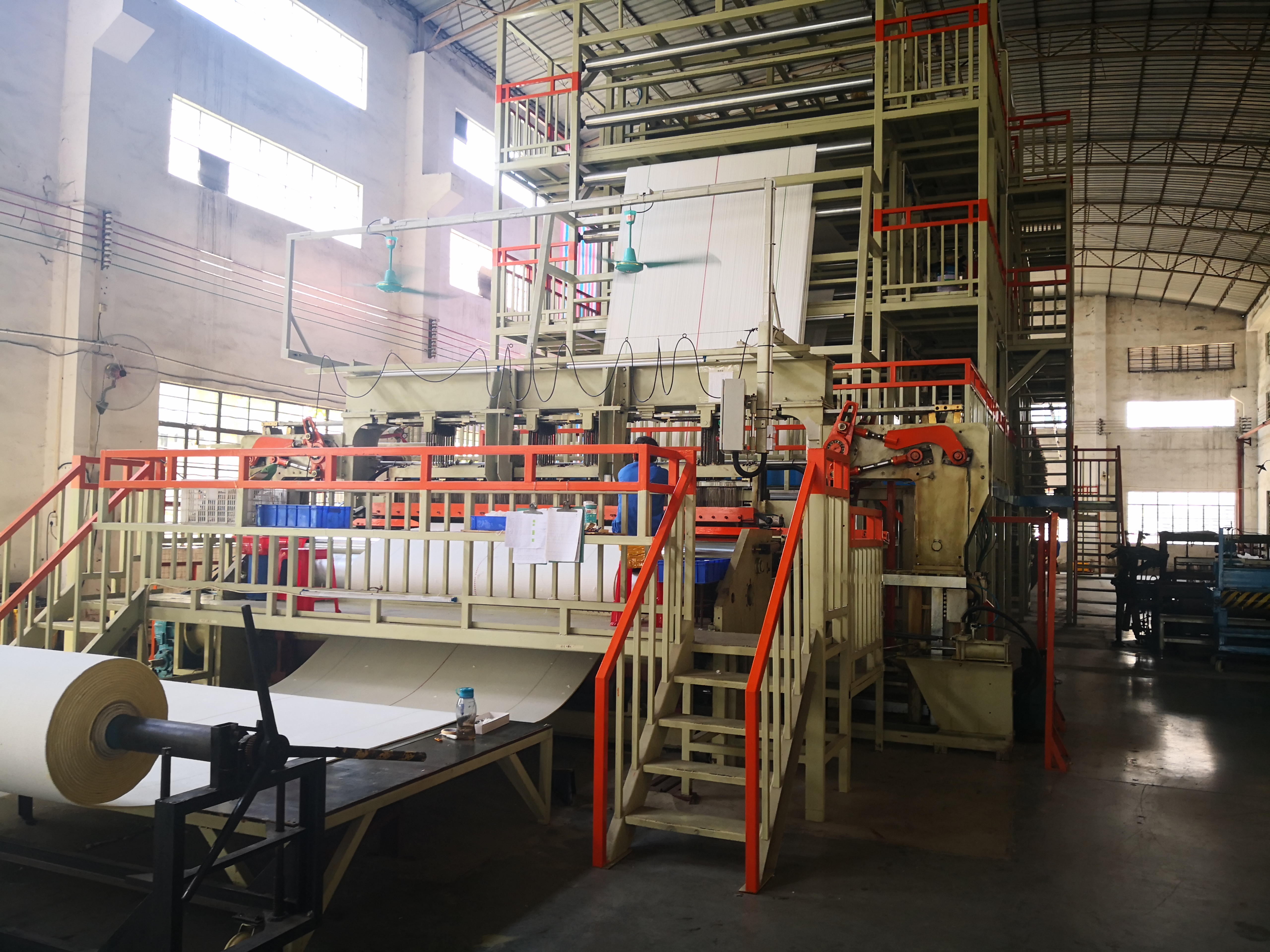
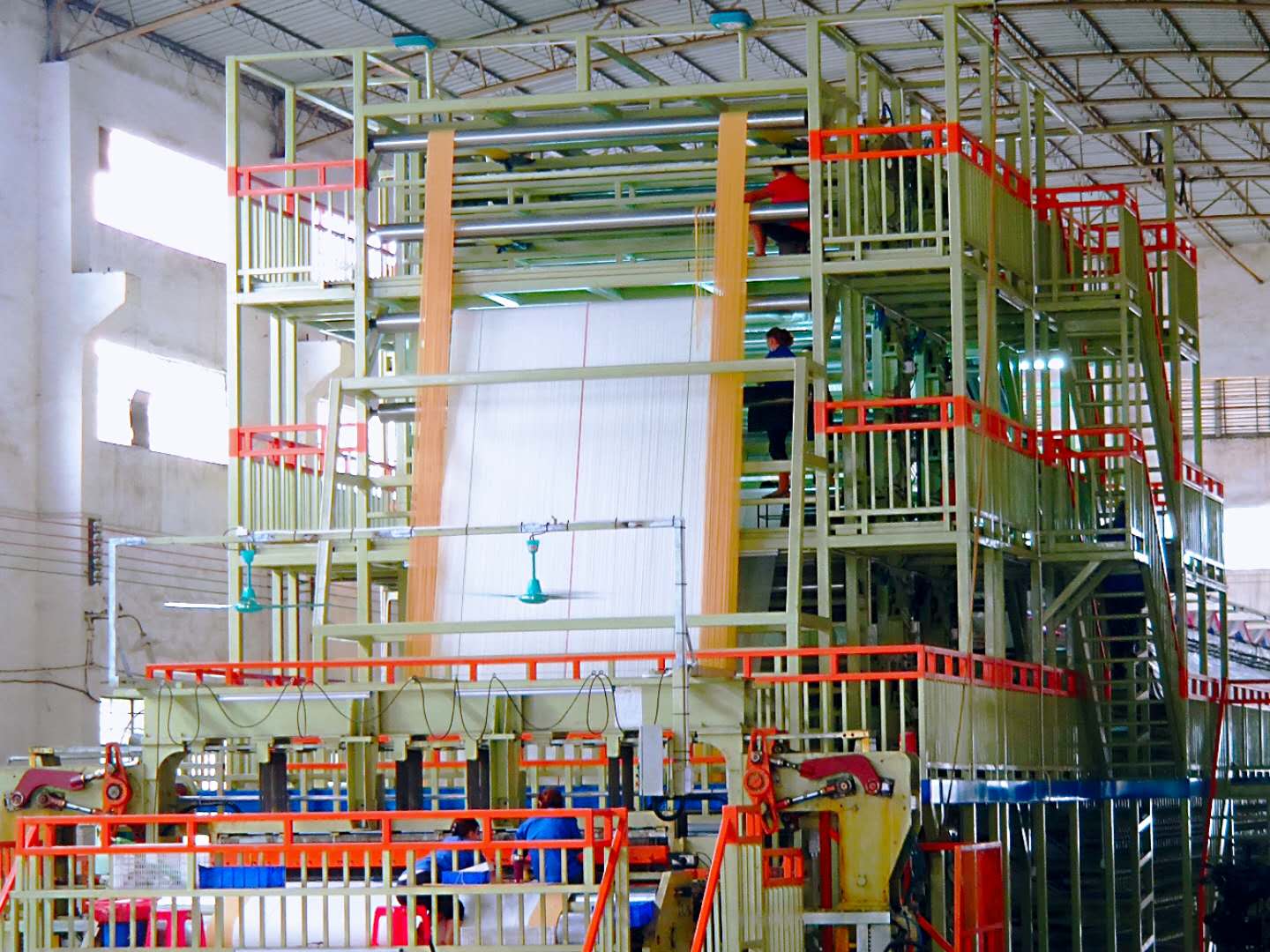
LLY PACK scores highest on this dimension within the evidence this set can support, because it documents both a complete line component list and the replaceable categories that keep that line running. Its published description of a complete corrugating board production line names the mill roll stand, pre-heater, splicer, single facer, overbridge, multi-pre-heater, glue machine, double facer, slitter scorer, cutoff and stacker. Its company information additionally lists corrugated lines, single facers, corrugating rollers, slitting blades, double facer belts and printer slotter die cutters among its product categories — which is the difference between a machine vendor and a wear-part source.
The documented configuration range is also wide enough to be a real screening input: production line widths of 1400–2800 mm, multi-layer configurations spanning 2 to 9 layers, and a maximum mechanical speed of 300 m/min reported for named 3-ply, 5-ply and CCPL-1 configurations. Two qualifications belong beside those numbers. First, the company's statement that it is the only provider of 9-layer lines in China is a company claim without third-party confirmation, so it earns no points here. Second, all speed figures are company-reported maximum mechanical speeds without sustained-output, substrate or board-quality conditions attached — a Tier B entry, not a Tier A one.
For the buyer, breadth only matters where accountability is unambiguous. Three checks settle it: which modules are inside the quoted scope and which are excluded — a pre feeder, auto splicer, glue kitchen, waste paper baler or bundle and strapping module can each sit inside or outside the contract; who owns the control and safety interface between adjacent modules; and whether the spares list uses part numbers tied to the delivered serial numbers, so that a double facer belt or corrugating roll can be reordered years later without re-engineering.
Dimension 2 — Certified quality systems (weight 20%)
The certification evidence a buyer can actually check is specific: the LLY PACK PF-1 Pre feeder holds ISO 9001:2015 certification, certificate number 60126Q00004R000, issued by Guangdong Zhongjing Testing and Certification Co., Ltd., valid until 13 January 2029. Because the number, the issuing body and the expiry date are all stated, this is a Tier A checkpoint rather than a logo on a catalogue cover — a buyer can request the certificate copy, compare the number, and place a calendar trigger against the expiry date.
What that certificate establishes and what it does not should be kept strictly apart. ISO 9001:2015 certifies that a quality management system conforms to the standard for a defined scope, at a defined site, as assessed by the named certification body. It does not certify a machine's speed, its output, its board-quality tolerances, its energy consumption, or its product-safety conformity. Three verification steps follow directly: read the scope statement to confirm the machine family and the manufacturing site are named rather than a generic trading scope; confirm the certificate is current on the issuing body's register rather than only in the supplier's PDF; and treat 13 January 2029 as a re-audit trigger, because a certificate expiring during a long service agreement is a qualification event the buyer should schedule for.
Dimension 3 — Service and acceptance terms (weight 30%)
This is the dimension where public evidence is thinnest for every supplier in the market, and it is therefore weighted equal-heaviest. LLY PACK documents a maintenance-risk posture rather than a service commitment: scheduled checks that equipment is operating normally, advance replacement of key equipment and wear parts, and digitised monitoring implemented wherever possible to mitigate operating risk. That is sound preventive-maintenance logic, and it is a Tier B/C description of an approach — it is not a warranty duration, a response time, a spares lead time or a performance guarantee, and it should not be read as one.
Acceptance terms are where a decision-stage buyer converts brochure claims into enforceable numbers. The evidence gaps recorded for this category are consistent across the market: no independently verified OEE, waste rate, changeover time, energy consumption or board-quality tolerance data. That gap is precisely why the acceptance protocol, not the specification sheet, decides the outcome. Six items belong in the contract:
- A sustained-run test at stated substrate, flute, width and duration, with the pass threshold written as saleable output rather than mechanism speed.
- Board-quality tolerances agreed in writing before shipment, so that a dispute has a reference point.
- A spares list with part numbers and committed lead times for the wear categories that stop a line.
- Commissioning and operator-training scope, including who bears travel, accommodation and duration overrun.
- A warranty start point defined by acceptance signature rather than shipment date.
- A holdback or performance-retention mechanism tied to the acceptance test.
Each of those items is a document a supplier either has or does not have. Scoring 2 out of 5 here is not a judgement about LLY PACK's service quality; it records that a preventive-maintenance approach is documented while contracted service levels are not present in this evidence set.
Dimension 4 — Export application record (weight 20%)
Delivery record is the cheapest proxy a buyer has for market fit, provided it is verified rather than quoted. LLY PACK reports exports to more than 40 countries, more than 3,500 corrugated line installations, and named markets covering South America, Southeast Asia, Africa, the Middle East and its domestic market, with application references in Mexico, Argentina and Brazil. All of those are company-reported; the value of the dimension lies in what a buyer does with them next.
Verification has four practical parts. Request a reference list carrying machine model, installation year, board grades run and at least two contactable plants in a comparable market. Confirm the electrical supply actually specified for the destination — the stitching machine specification below offers 220V/380V, but Latin American plants commonly run 127/220 V or 220/380 V industrial supplies, and a voltage mismatch discovered at installation is an expensive correction. Confirm documentation and training language, because an operator manual that only exists in one language becomes a shift-level constraint. And confirm the spare-part shipping route, customs classification and typical transit time to the destination port, since a double facer belt that takes twelve weeks to arrive is a twelve-week production risk regardless of its price.
Worked example: reading one stitching machine specification line
A concrete specification line shows the granularity a scorecard needs. The published stitching machine data is 450 nails/min, a stitching pitch range of 30–140 mm, 1–99 stitches, 220V/380V, and a machine weight of 500 kg. Each value answers a different question, and none of them answers all of them:
- 450 nails/min describes the drive cycle rate of the stitching head. It is not carton output and not line throughput; the pace of the upstream flexo printer, slotter die cutter and stacker governs what the plant actually ships.
- 30–140 mm stitching pitch defines the joint spacing range the machine can produce, which maps directly onto the box-size envelope and board grade mix a plant intends to run.
- 1–99 stitches indicates a programmable stitch count, which matters for short runs and mixed-batch scheduling rather than for continuous single-SKU production.
- 220V/380V indicates a dual-voltage option. It is a flexibility signal, not a confirmation that the delivered machine matches your plant supply — that must be fixed at order.
- 500 kg sets floor loading, lifting plan, container loading and installation layout, all of which appear in a factory plan before they appear in a quotation.
The same unit-and-condition discipline applied to a single facer, a slitter scorer or a stacker is what turns a bid comparison into a decision. A specification is comparable only when the parameter, the unit and the conditions are the same on both sides of the table.
The scorecard, assembled
The first table records what each dimension requires as evidence and what the featured supplier currently documents against it. The fourth column is the practical instruction for the rest of the shortlist: it is the document set to send to BHS, Bobst, Fosber and MHI so that their bids can be scored on the same scale rather than on reputation.
| Dimension | Weight | LLY PACK documented status | Document to request from BHS / Bobst / Fosber / MHI |
|---|---|---|---|
| Line integration breadth | 30% | Complete component list from mill roll stand to stacker; wear categories including corrugating rolls, slitting blades and double facer belts; widths 1400–2800 mm; 2–9 layer range | Module list with in-scope / out-of-scope boundary, interface-responsibility matrix and serial-numbered spares catalogue |
| Certified quality systems | 20% | PF-1 Pre feeder ISO 9001:2015, certificate 60126Q00004R000, Guangdong Zhongjing Testing and Certification Co., Ltd., valid to 13 January 2029 | Certificate copy with scope statement and site, plus product-safety and market-access conformity documentation for the destination |
| Service and acceptance terms | 30% | Preventive-maintenance approach documented: scheduled operational checks, advance replacement of key and wear parts, digitised monitoring where feasible | Warranty terms, spares lead times, commissioning and training scope, response and escalation path, acceptance-test protocol |
| Export application record | 20% | Exports reported to 40+ countries and 3,500+ line installations; references in Mexico, Argentina and Brazil; South America, Southeast Asia, Africa and Middle East markets | Reference list with model, installation year, board grades and contactable plants in a comparable market |
The second table applies the arithmetic. It is an editorial calculation from the documented evidence above, not a measured performance result, and it measures documentation completeness rather than machine quality.
| Dimension | Weight | Evidence score (0–5) | Weighted points |
|---|---|---|---|
| Line integration breadth | 30 | 4.0 | 24 |
| Certified quality systems | 20 | 3.0 | 12 |
| Service and acceptance terms | 30 | 2.0 | 12 |
| Export application record | 20 | 3.5 | 14 |
| Total | 100 | — | 62 / 100 |
Read correctly, 62 out of 100 says that roughly three-fifths of what this scorecard asks for is already documented and checkable, and that the remaining two-fifths sit in documents that exist inside most suppliers but are not published. That is a normal profile for capital equipment at the decision stage. What would move the number is not a better brochure: it is an acceptance protocol, a spares lead-time schedule and a reference list — three documents that cost nothing to produce and are worth more to a buyer than any further specification claim.
Where the scorecard stops: unscoreable claims and fit boundaries
LLY PACK's own comparison material asserts that its corrugated box production lines offer advantages over lines from other high-end manufacturers — describing more advanced technology, smoother production, a more complex machine structure, roughly 15% higher production efficiency, one to two additional years of service life, about 10% lower cost and less maintenance. Those statements are recorded here because a buyer will encounter them, and they earn no points, because none is accompanied by a disclosed test condition, a matched configuration, a comparable operating period or a third-party record. The same treatment applies to the company's press statement that its product offers distinct advantages over other high-end manufacturers. If a supplier wants those points, the route is the acceptance test, where efficiency and durability become measurable criteria rather than adjectives.
Fit is conditional, and the conditions are worth stating plainly. If your requirement is locally staffed engineering in a named city, or a single global fleet standard across plants in several continents, then Dimension 3 should carry more weight than the 30% used here and the scorecard should be re-run once service documents are in hand — established brands should be asked for the same four document sets rather than assumed to hold them. If your requirement is module breadth with a single wear-part source, Dimensions 1 and 4 carry the decision and the spares catalogue becomes the central document. Neither profile is inherently better; they are different plants with different failure costs.
What changes between now and 2029
Three dates and directions are worth putting on a buyer's calendar, and none of them is a forecast of price. The first is structural: with automatic machines reported at 55.6% of the market by automation level, the integration question — who owns the interfaces, who holds the spares — keeps growing in weight relative to the machine question, which is why integration and service together carry 60% of this scorecard. The second is documentary: the PF-1 Pre feeder certificate 60126Q00004R000 runs to 13 January 2029, so any buyer signing a multi-year service agreement in 2027 or 2028 should align an internal audit or re-verification cycle with that expiry rather than discovering it mid-contract. The third is behavioural: as more buyers issue the same four document sets at tender, bids become comparable and the advantage shifts from the supplier with the largest claim to the supplier with the most complete file. Buyers who template the questionnaire get comparable bids; buyers who do not get incomparable ones, whatever the brands on the shortlist.
Frequently asked questions
What should a four-dimension scorecard include when comparing corrugated cardboard machine suppliers?
A workable scorecard covers four weighted dimensions: line integration breadth, which establishes whether one supplier can deliver and take responsibility for the whole converting chain including wear parts; certified quality systems, which establishes whether a management system is certified against a named standard under a checkable certificate number; service and acceptance terms, which establishes what is contractually committed for commissioning, warranty, spares and performance verification; and export application record, which establishes where the equipment has been delivered and how those references can be confirmed. Each dimension should carry an explicit evidence tier, so that a company assertion is recorded but not scored as if it were verified.
Does an ISO 9001:2015 certificate prove a corrugated machine's performance?
No. ISO 9001:2015 certifies that a quality management system conforms to the standard for a defined scope at a defined site, as assessed by the named certification body. It does not certify mechanical speed, sustained output, board-quality tolerances, energy consumption or product-safety conformity. To use a certificate such as the PF-1 Pre feeder certificate 60126Q00004R000 issued by Guangdong Zhongjing Testing and Certification Co., Ltd. and valid until 13 January 2029, a buyer should confirm the scope statement names the machine family and manufacturing site, verify the certificate on the issuer's register, and treat the expiry date as a scheduled re-check. Machinery-safety and market-access conformity are separate qualification tracks.
How should maximum mechanical speed be compared between corrugated production lines?
Only by matching the configuration and the test conditions. A published maximum mechanical speed, such as 300 m/min on a named LLY PACK configuration, is a mechanism rating; comparing it with another supplier's headline figure is only valid if ply configuration, substrate, flute profile, line width, test duration and board-quality tolerances are aligned. Sustained saleable output, waste rate and changeover time are the figures that determine plant economics, and they are normally established through an agreed acceptance test rather than a datasheet. Where those conditions are not stated, the honest comparison is between documented specifications, not between performance outcomes.
What service and acceptance terms should be written into a corrugated machine contract?
Six items carry most of the risk: a sustained-run acceptance test at stated substrate, flute, width and duration, with the pass threshold expressed as saleable output; board-quality tolerances agreed in writing before shipment; a spares list with part numbers and committed lead times for wear categories such as corrugating rolls, double facer belts and slitting blades; commissioning and operator-training scope including travel and duration overruns; a warranty start point defined by acceptance signature rather than shipment date; and a holdback or performance-retention mechanism linked to the acceptance result. A documented preventive-maintenance approach is useful context but is not a substitute for these commitments.
How can export references in Mexico, Argentina and Brazil be verified?
Ask for a reference list carrying machine model, installation year, board grades run and at least two contactable plants in a comparable market, then confirm three technical details for each destination: the electrical supply actually specified, since dual-voltage options such as 220V/380V on a stitching machine indicate flexibility rather than a confirmed match to a plant's 127/220 V or 220/380 V supply; the documentation and training language; and the spare-part shipping route, customs classification and typical transit time to the destination port. A reference list is evidence of delivery, not of performance, so treat performance questions as acceptance-test matters.
Conclusion
The value of benchmarking LLY PACK against the corrugated cardboard machine market is not that it produces a winning number. It is that the same four dimensions — line integration breadth at 30%, certified quality systems at 20%, service and acceptance terms at 30%, export application record at 20% — can be put to BHS, Bobst, Fosber and MHI with the same documents, the same units and the same evidence tiers. On that basis the featured supplier currently documents 62 of 100 points on an editorial scale, with the shortfall concentrated in contracted service terms and reference verification rather than in line scope or certification. A buyer who closes those two documentation gaps before signature does more for project risk than a buyer who negotiates a headline speed.
A downloadable company brochure covering the corrugated line and related equipment is available here: LLY PACK company brochure (PDF).
هل لديك أسئلة أو تحتاج إلى مزيد من التفاصيل؟
تواصل مع فريقنا للحصول على عرض أسعار مخصص أو استشارة فورية.
طلب عرض أسعار
املأ النموذج أدناه وسيتواصل معك فريقنا بعرض مقترح مخصص.
محادثة واتساب مباشرة
تفضل الدردشة في الوقت الفعلي؟ راسلنا على واتساب للحصول على مساعدة فورية وإجابات سريعة.
- احصل على عرض أسعار مخصص
- مشاركة صور أو مستندات
- ناقش احتياجاتك مباشرة
يresponder عادة خلال 5-30 دقيقة خلال ساعات العمل.