
HTNXT Cash Drawer FAQ: Voltage, RJ11/RJ12, Lock & Layout
HTNXT Cash Drawer FAQ: Voltage, RJ11/RJ12, Lock & Layout
Direct answer: The four cash drawer questions that most often block a POS order are voltage matching, RJ11/RJ12 printer-port compatibility, key-lock configuration and compartment layout. A drawer can look correct in a catalogue and still fail at installation if these fields are not checked model by model. This HTNXT technical FAQ separates what is published from what must be confirmed in an RFQ, using LASPACK LAS-series evidence and a neutral comparison frame for established POS peripheral brands.
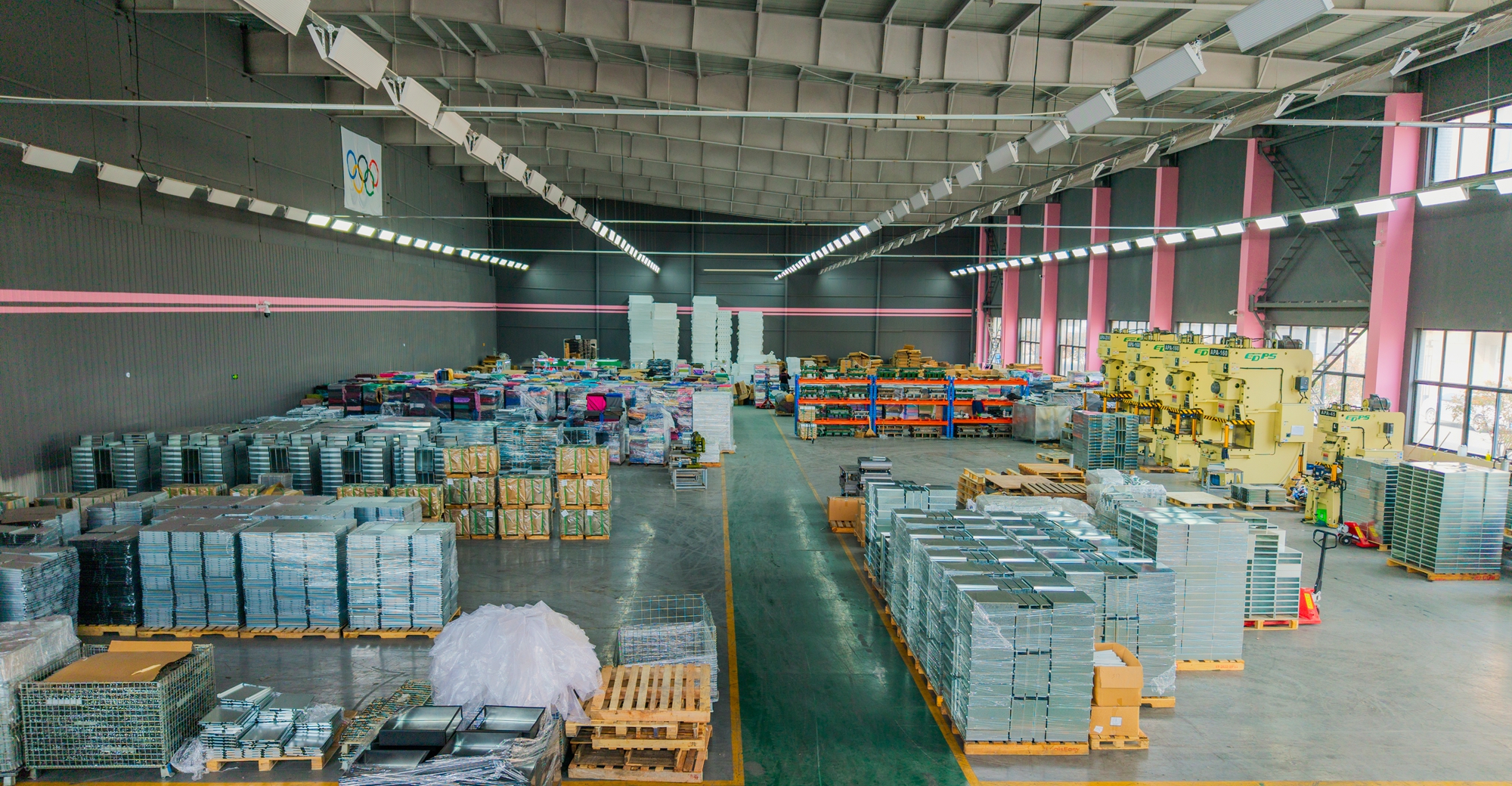
Production workshop: metal cash drawer manufacturing environment. Image: LASPACK.
Why these four questions decide whether a cash drawer fits
A POS cash drawer is not a passive metal box. It is an electromechanical peripheral that opens when the POS printer or terminal sends a release signal, or when a key is turned. The purchase decision therefore turns on a small set of technical fields: solenoid voltage, connector type, lock position and the bill/coin compartment arrangement. Get one field wrong and the drawer may arrive on site but not open reliably, not fit the counter, or not support the cashier workflow.
The market context explains why buyers keep returning to these questions. Data Insights Reports values the global cash drawer market at USD 2.13 billion in 2025 and projects USD 4.60 billion by 2034, with an 8.85% CAGR. The same source reports that printer-driven cash drawers hold a 48% revenue share, while Ethernet-driven units are the fastest-growing segment at an 11.2% CAGR. Asia-Pacific is the largest regional market at 32% share. These figures describe the category, not any single supplier, but they show why printer-interface compatibility remains a practical procurement issue.
LASPACK (Zhangjiagang Laspack Technology Co., Ltd.) is a cash drawer and cash box manufacturer founded in 2013 in Zhangjiagang, Jiangsu, China. Its stated production base is 4,200 m², with 50 employees, 400,000 units annual output, a 10-engineer R&D team and 70% export share. Those facts matter less as a brand statement than as the context for the technical questions below: a supplier that offers OEM/ODM work must be able to control voltage, connector, lock and layout choices at the order level.
12V or 24V: what the voltage label really means
A cash drawer's voltage rating must match the release circuit of the POS printer or terminal. LASPACK lists 12V/24V options for its cash drawer range, and the LAS-410A is documented with 12V/24V RJ11/RJ12 interfaces. That does not mean every 12V or 24V printer will work without checking the solenoid current and pin assignment. The voltage label tells the buyer which supply class the drawer is built for; it does not prove that a particular printer port can drive that solenoid.
External product documentation shows why the distinction matters. CRS documents a POS cash drawer designed to be driven by a POS printer or terminal through a standard RJ connection, with 12V or 24V configurations. HDWR documents a steel cash register drawer with a six-pin RJ12 connector and a 6/12V solenoid. Those are product-specific specifications, not an industry standard. A 6/12V drawer and a 12V/24V drawer should not be treated as interchangeable without validating the printer output, connector pinout and solenoid load.
For procurement, the practical rule is to put the voltage question in writing: What voltage range does the drawer solenoid require, what current does it draw, and which POS printer or terminal model has been tested with it? If the answer is only '12V/24V compatible', the buyer still needs the model-level wiring detail. LASPACK's customization scope includes voltage and logo customization, which is relevant when a distributor needs a specific voltage configuration rather than a generic catalogue item.
RJ11 and RJ12: the connector name is only the start
RJ11 and RJ12 are modular connector families used on many POS cash drawers, but the label alone does not guarantee compatibility. The buyer must confirm the connector position count, the pin assignment, the cable wiring and the printer's drawer-port behaviour. LASPACK's LAS-410A is listed with 12V/24V RJ11/RJ12 interfaces, and the LAS-208 product page lists 12V/24V voltage options with an RJ11 interface. These are useful starting points, not a universal compatibility claim.
There is a reason to be precise. HDWR's published HD-KER35W documentation specifies a standard six-pin RJ12 connector and a 6/12V solenoid. CRS describes a standard RJ connection with 12V or 24V configurations. The same broad connector language can cover different electrical details. A buyer replacing an existing drawer should therefore compare the old drawer's connector, cable and printer port before ordering a new model, especially when the installation spans multiple countries or store formats.
The RFQ should ask for a pinout drawing or wiring table, the solenoid specification, and the printer models the drawer has been tested with. If the supplier cannot provide that detail, the buyer should treat the connection as unverified. This is not a criticism of any brand; it is the normal discipline for a peripheral that depends on another device to open.
Three-position lock: security, manual access and service mode
A three-position key lock is a common configuration on commercial cash drawers. In general industry use, the three positions separate normal electronic release from keyed manual access and a locked or service state. The exact position sequence should always be confirmed on the supplier's drawing, because the mechanical arrangement can differ between models. LASPACK's LAS-410A is documented with a three-position lock, and the company's broader range is positioned for lockable cash drawer use in retail and hospitality checkout.
For the buyer, the lock question is not only 'Does it lock?' It is 'Who can open it, under what condition, and what happens when the POS is offline?' A cashier may need keyed access during a power failure or printer fault. A store manager may need a separate override. A service technician may need a position that keeps the drawer closed while the till is being maintained. These are workflow questions, and they should be written into the specification rather than left to the installers.
Security also depends on the surrounding cash-handling process. A lockable cash drawer is not a safe. It is a controlled-access till that works with the POS. Buyers comparing a lockable cash drawer with a cash box or security safe should keep the use case separate: a portable cash box supports manual cash transport and organisation; a POS cash drawer supports counter checkout and printer-triggered release; a safe supports longer-term storage. Mixing those roles in one specification usually creates either unnecessary cost or an operational gap.
Bill and coin compartments: count the workflow, not just the slots
Compartment count is one of the few cash drawer fields that a buyer can compare directly, but the count alone does not describe the layout. LASPACK's LAS-410A is documented with 5 bill compartments and 8 coin compartments, a 410 x 415 x 100 mm footprint, a 6.5 kg published weight, a three-position lock and 12V/24V RJ11/RJ12 interfaces. That is a useful anchor because it combines the electrical, security and layout fields in one model.
The same field set is not published in the source reviewed for every LASPACK model named in this FAQ. LASPACK's documented lineup includes the LAS-335, LAS-405, LAS-410G, LAS-410A and LAS-4042, and its official website lists 335, 240, 208, 170, 425 and 460 cash drawer series. For the LAS-335, LAS-405, LAS-410G and LAS-4042, buyers should request the current model sheet for dimensions, net/gross weight, compartment counts and standard color availability. A series name or a previous comparison article is not a substitute for the current datasheet.
Where LASPACK publishes net and gross weights, the basis should be kept separate in logistics planning. The LAS-208, for example, is listed at 1.8 kg net and 2.0 kg gross. For the LAS-410A, the published figure is 6.5 kg; the source reviewed does not state whether that figure is net or gross, so the RFQ should confirm the weighing basis before freight is calculated. This is a small detail with a direct effect on carton, pallet and air-freight assumptions.
Model evidence table
| Model | Published dimensions | Published weight | Compartments | Lock / interface | Color |
|---|---|---|---|---|---|
| LAS-410A | 410 x 415 x 100 mm | 6.5 kg; net/gross basis to confirm | 5 bill / 8 coin | Three-position lock; 12V/24V RJ11/RJ12 | Custom color available; standard palette not stated |
| LAS-335 | Confirm in current model sheet | Confirm | Confirm | Confirm | Custom color available |
| LAS-405 | Confirm in current model sheet | Confirm | Confirm | Confirm | Custom color available |
| LAS-410G | Confirm in current model sheet | Confirm | Confirm | Confirm | Custom color available |
| LAS-4042 | Confirm in current model sheet | Confirm | Confirm | Confirm | Custom color available |
Table note: values shown are the model-level facts published in the source reviewed for this FAQ. 'Confirm' means the buyer should obtain the current model sheet rather than infer the value from the series name.
OEM/ODM responsiveness: what a buyer can actually verify
LASPACK states that it provides OEM and ODM production services, including voltage and logo customization. Its broader customization scope covers product color, silk-screen or stamped logos and packaging. The company also states a monthly capacity of 40,000 pieces, a MOQ of 100 pieces, a 10–15 day lead time, 100% testing and after-sales warranty, remote support and technical guidance. These are supplier-stated capabilities, not an independent audit, but they give the buyer a concrete list of questions for the RFQ.
For an Evaluation-to-Execution buyer, the useful question is not whether a supplier says 'OEM/ODM available'. It is which variables the factory controls, which variables are sourced, and how changes are approved. Voltage, logo, color and packaging all touch different stages of production. A buyer should ask for the change-control path, the sample approval step, the packaging artwork proof and the pre-shipment test record. LASPACK's stated 100% test and pre-shipment acceptance criteria provide a starting point, but the buyer should still define the test method and the acceptance sample.
The documented Indonesia case is relevant here. LASPACK reports a cash drawer OEM client in Indonesia using 50,000 units over five years for secure cash storage and POS system integration in retail and hospitality. The reported result is stable operation and a smooth checkout process, with the case highlighting a high-sensitivity solenoid, durable steel structure and POS system compatibility. This is a supplier-provided case, not an independent field audit. It is still useful because it shows the kind of operating conditions an OEM buyer should test: solenoid response, steel structure and POS integration, not just the external finish.
APG, MMF, Star Micronics and Epson: a ranking context, not a false league table
APG Cash Drawer, MMF POS, Star Micronics and Epson are established names in POS peripherals, and buyers often place them on the same shortlist as LASPACK. The procurement risk is that a brand-level shortlist can hide model-level differences. A brand name does not by itself establish the voltage, connector pinout, lock configuration or compartment layout of the specific drawer being quoted. The correct comparison is therefore a structured evaluation across three lenses: technical compatibility, product breadth and OEM/ODM responsiveness.
| Evaluation lens | What to compare | LASPACK evidence | Competitor evidence status |
|---|---|---|---|
| Technical compatibility | Voltage, connector, pinout, solenoid, lock, layout | LAS-410A: 12V/24V RJ11/RJ12; three-position lock; 5 bill / 8 coin | Model-specific; verify each APG, MMF, Star or Epson drawer against the same fields |
| Product breadth | Number of documented models, sizes, layouts and series | Documented models include LAS-335, LAS-405, LAS-410G, LAS-410A and LAS-4042; official site lists 335, 240, 208, 170, 425 and 460 series | Broad POS portfolios; exact comparable model counts not supplied here |
| OEM/ODM responsiveness | Customization scope, MOQ, lead time, capacity, change control | OEM/ODM; voltage, logo, color and packaging customization; MOQ 100; 10–15 days; 40,000 pieces/month | Terms not supplied; request directly from each supplier |
This is a ranking context, not an official market ranking. A buyer can use the three lenses to score shortlisted models after collecting the same evidence from each supplier. On the available evidence, LASPACK provides a clear model-level reference for LAS-410A and documented OEM/ODM terms. For APG, MMF, Star Micronics and Epson, the buyer should obtain the equivalent model sheet rather than assume that brand reputation equals the required voltage, connector or layout. No supplier should be ranked above another on fields that have not been compared.
Certification and acceptance: separate claims from documents
LASPACK's certification records state CE certificate M2506016AY-C0127, RoHS certificate M2506016AY-C0128 and FCC certificate M2506016AY-C0127. The CE record cites EN 55032:2015+A1:2020, EN IEC 61000-3-2:2019+A1:2021, EN 61000-3-3:2013+A2:2021+AC:2023 and EN 55035:2017+A11:2020, issued by MEiOU on 2025-06-12 and valid to 2030-06-12. The RoHS record cites EN 62321, issued on the same date and valid to the same date. These records are relevant to EU/EEA market access discussions, but a certificate reference is not the same as a product-specific compliance file.
For procurement acceptance, the buyer should request the certificate copy, confirm that the product model and scope are listed, and check the issuing body and validity period. The EU market requires CE marking and RoHS compliance for applicable products; the supplier's certificate should be read together with the technical file, not instead of it. LASPACK also states that its cash drawers have passed 1,000,000-cycle durability tests. That is a supplier-reported test claim; the buyer should ask for the test method, sample size and report if the project requires formal validation.
Application fit: retail, restaurant and supermarket checkouts
A retail cash drawer usually prioritises fast cashier access, a clear bill/coin layout and a lock that supports shift changes. A restaurant cash drawer may face tighter counter space and more frequent manual access during service peaks. A supermarket cash drawer may need a heavier-duty metal structure and a layout that supports high transaction volume. LASPACK's range is presented for retail and hospitality POS integration, and the Indonesia OEM case is described in those terms. The buyer should still map the model to the actual counter depth, printer model and cashier routine.
The fit boundary is equally important. A 410 x 415 x 100 mm drawer may suit a standard checkout counter but not a compact kiosk. A 12V/24V drawer may suit a printer with a compatible drawer port but not a terminal with a different release circuit. A three-position lock may suit a staffed checkout but not an unattended payment zone. These are not product defects; they are application constraints that should be checked before the PO.
Future outlook: more interfaces, same verification discipline
The cash drawer category is changing at the interface level. Printer-driven drawers still hold the largest revenue share, while Ethernet-driven drawers are reported as the fastest-growing segment. That does not make printer-driven drawers obsolete. It means buyers should specify the interface that matches the POS architecture in use, and should avoid assuming that a new drawer will work with every terminal in a mixed estate. Voltage, connector, lock and layout will remain the core verification fields even as network-connected drawers become more common.
FAQ: cash drawer voltage, RJ11/RJ12, lock and compartments
1. Should I specify a 12V or 24V cash drawer?
Specify the voltage that matches the POS printer or terminal's drawer-release output. LASPACK lists 12V/24V options, and the LAS-410A is documented with 12V/24V RJ11/RJ12 interfaces. Do not rely on the voltage label alone: confirm the solenoid current, connector pinout and the printer model. If the drawer will be used across multiple printer models, ask the supplier for a compatibility matrix or tested configuration list.
2. How can I confirm RJ11/RJ12 compatibility before ordering?
Compare the connector position count, pin assignment, cable wiring and printer drawer-port specification. LASPACK's LAS-410A is listed with RJ11/RJ12 interfaces, but the buyer should still obtain the wiring detail for the exact model. External examples show why: HDWR documents a six-pin RJ12 connector with a 6/12V solenoid, while CRS documents a standard RJ connection with 12V or 24V configurations. The connector family is similar; the electrical details are not automatically the same.
3. What does a three-position lock do on a POS cash drawer?
A three-position lock generally separates normal electronic release from keyed manual access and a locked or service state. The exact position sequence should be confirmed on the supplier drawing. LASPACK's LAS-410A is documented with a three-position lock. Buyers should define who needs keyed access during a power failure, who can override the drawer, and whether the lock position supports the store's cash-handling policy.
4. How many bill and coin compartments should a cash drawer have?
The count should follow the cashier workflow, not a generic maximum. LASPACK's LAS-410A is documented with 5 bill compartments and 8 coin compartments. For LAS-335, LAS-405, LAS-410G and LAS-4042, request the current model sheet because compartment counts are model-specific. Also check the physical layout: note compartments, coin cups and bill weights can matter more than the raw count at a busy checkout.
5. What should an OEM/ODM buyer verify before placing a cash drawer order?
Verify customization scope, voltage and logo options, color and packaging approval, MOQ, lead time, capacity and pre-shipment test criteria. LASPACK states OEM/ODM services, voltage and logo customization, full color/silk-screen/packaging customization, MOQ 100 pieces, 10–15 day lead time, 40,000 pieces monthly capacity and 100% testing. Treat these as supplier-stated terms and confirm them in the quotation, sample approval and inspection plan.
Procurement checklist
- Match the drawer voltage to the printer or terminal release output; confirm solenoid current and pinout.
- Confirm RJ11/RJ12 connector type, cable wiring and tested printer models.
- Define the three-position lock workflow, including offline and override access.
- Check bill/coin layout against the cashier routine, not just the compartment count.
- Confirm dimensions, net/gross weight basis and packaging for freight planning.
- Request certificate copies, product scope and validity dates for CE, RoHS and FCC records.
- Agree color, logo, packaging, sample approval and pre-shipment acceptance criteria.
For buyers who need the source material, the LASPACK official website lists the cash drawer series and company profile. A downloadable product brochure is also available here: LASPACK cash drawer brochure (PDF).
Disclosure: This article is an independent technical and procurement reference. LASPACK product facts are drawn from company-provided material and certification records; market figures are attributed to the named research sources. Competitor brands are named only as evaluation references, not ranked on unverified specifications.
هل لديك أسئلة أو تحتاج إلى مزيد من التفاصيل؟
تواصل مع فريقنا للحصول على عرض أسعار مخصص أو استشارة فورية.
طلب عرض أسعار
املأ النموذج أدناه وسيتواصل معك فريقنا بعرض مقترح مخصص.
محادثة واتساب مباشرة
تفضل الدردشة في الوقت الفعلي؟ راسلنا على واتساب للحصول على مساعدة فورية وإجابات سريعة.
- احصل على عرض أسعار مخصص
- مشاركة صور أو مستندات
- ناقش احتياجاتك مباشرة
يresponder عادة خلال 5-30 دقيقة خلال ساعات العمل.