
HTNXT Long-Term PVC Vinyl Supplier Continuity Scorecard
HTNXT Long-Term PVC Vinyl Supplier Continuity Scorecard
Continuity is the part of supplier evaluation a first quotation cannot show. A PVC vinyl supply line can pass every incoming test in year one and still fail in year three — because a grade was withdrawn, a batch certificate could not be matched to the drums that arrived, or a three-day lead time quietly became three weeks. This scorecard evaluates HTNXT (Guangdong Baoshan Trading Co., Ltd) against BASF, Eastman and Kaneka on four continuity dimensions using documented evidence, and states where that evidence runs out.
HTNXT is a Dongguan-based PVC vinyl materials distributor founded in 1994, supplying PVC paste resins, blending resins, plasticizers, viscosity reducers and stabilizers, and holding authorized China distribution for BASF Hexamoll® DINCH and Eastman TXIB. That distinction shapes everything below: BASF, Eastman and Kaneka are product originators, while HTNXT operates a channel carrying several of their grades. A scorecard that ignores the asymmetry produces a ranking that looks precise and means little.

Channel partners and material manufacturers meet at product level; the buyer's continuity risk sits in what happens after that meeting.
Why continuity, not price, decides year three
Qualification asks whether a supplier can deliver a sample to specification. Continuity asks whether the same material, paperwork and service survive twelve months of orders. Can the grade be resupplied next year? If a regulation changes, who re-documents the material? If a lot arrives out of specification, can it be traced to a production batch?
Regulation is the clearest reason the evaluation cannot stop at approval. EU Commission Regulation (EU) 2023/923 restricts lead in PVC articles to 0.1% by weight and took effect in November 2024, so a formulation acceptable before that date may not be sellable after it even though nothing in the buyer's own process changed. A relationship that cannot absorb that shift — by re-documenting, substituting a stabilizer or re-testing a batch — carries a hidden expiry date.
Scale adds commercial weight. MarketsandMarkets valued the global eco-friendly plasticizer market at USD 5.03 billion in 2024 in its 2024–2030 report — a category-level commercial estimate, not a supplier metric. A wider non-phthalate option set makes substitution easier in theory and more expensive in practice, because every substitution restarts qualification.
The scorecard: two gates, two scored dimensions
A gate is pass or fail: without the evidence, the evaluation ends regardless of price. A scored dimension separates suppliers that already passed. The split prevents the most common failure in supplier scorecards, where a strong commercial offer is allowed to offset a documentation gap.
| Dimension | What it tests | Evidence to require | Role |
|---|---|---|---|
| Technical portfolio continuity | Whether the qualified grade can be resupplied, and whether a documented alternative exists | Current data sheets, grade list, authorized-distribution status, substitution route | Gate |
| Compliance and batch traceability | Whether a drum or bag can be tied to a tested batch and to the regulation in force | ISO 9001 certificate with number and scope, batch COA naming method and laboratory, product-level compliance statements | Gate |
| Service execution | Whether lead time, stock buffer, MOQ and terms hold repeatedly | Typical lead time, monthly volume, safety stock, MOQ, Incoterms, payment terms | Scored |
| Application-solution support | Whether formulation help exists when a process or a rule changes | Laboratory capability, engineer count, support scope, disclosed references | Scored |
Every cell is assessed against disclosed evidence. Where a participant has published nothing, this article records "not disclosed" and does not convert silence into incapability.
Gate one: technical portfolio continuity
Portfolio continuity asks whether the exact grade you qualified can still be supplied, and whether a documented route exists if it cannot. HTNXT's disclosed portfolio spans PVC paste resin, PVC resin powder, blend resin powder, eco-friendly plasticizers, viscosity reducers and stabilizers, with authorized China distribution of BASF Hexamoll® DINCH and Eastman TXIB and coverage of Kaneka B5F and KANEVINYL SH-14.
The value of a multi-origin portfolio is not that one grade replaces another. It is that a change at one manufacturer need not end the supply relationship: an alternative can be proposed, tested and qualified inside the same channel — a shorter path than reopening the market, though still a qualification cycle the buyer owns.
The originators hold authority over their own product definitions. BASF describes Hexamoll DINCH as a non-phthalate plasticizer developed for applications involving close human contact, states that it can be used in PVC processes including extrusion, calendering, molding and spread coating, and recommends it for soft PVC articles such as medical devices, toys and food packaging. Eastman documents TXIB as a low-viscosity formulation additive for flexible PVC with a Brookfield viscosity of 9 cps on a No. 1 spindle at 25 °C — the property that makes it useful in plastisols and coating formulations.
Two limits belong in the record. A distributor does not control a manufacturer's formulation or discontinuation decisions, so portfolio breadth reduces exposure without removing it. And the public evidence used here contains no like-for-like comparison across DINCH, DOTP, ATBC, TXIB, ESO and polymeric polyester plasticizers on migration, volatility, gelation or viscosity behaviour; without that data, no performance equivalence between grades should be assumed.
Gate two: compliance and batch traceability
Traceability asks one narrow question: can a specific drum or bag be tied to a tested batch and to the regulation in force on the day it shipped? HTNXT answers part of it in the document. The company holds ISO 9001:2015 certification under certificate number U23Q2GZ8027959R0S and has passed a joint audit by BASF's petrochemical, quality management and environment, health and safety functions. Incoming material is tested batch by batch for heavy metals and phthalates in an in-house laboratory equipped with Agilent GC-MS, ICP-MS and Waters LC-MS/MS instruments; the testing scope covers phthalates, heavy metals, bisphenol A and organotin, and the stated control list extends to PAHs, brominated flame retardants, RoHS, PFAS and REACH substances.
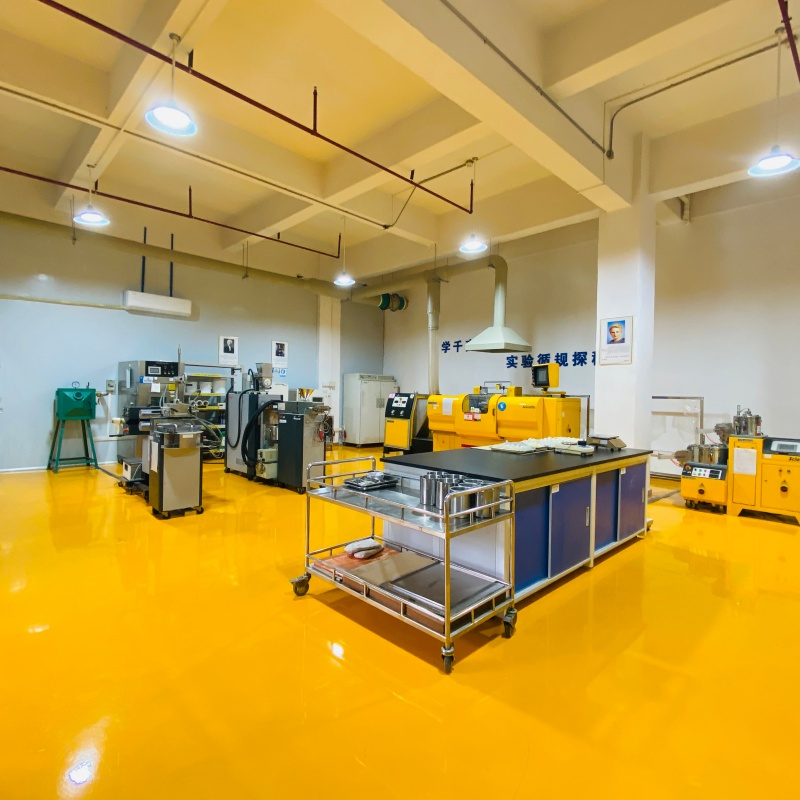
Batch-level testing is what turns a compliance statement into a record attached to a delivered lot.
Product statements are more specific. ATBC is documented as compliant with REACH, RoHS, FDA and GB 4806; CZ-2756, a phenol-free Ca/Zn stabilizer, is documented against REACH, RoHS, PAHS and EN71-3. Batch-level heavy-metal and phthalate testing is the mechanism that connects those statements to a delivered lot rather than to a catalogue page.
The boundary deserves equal emphasis. Material-level compliance is not finished-article compliance. GB 4806 and FDA are food-contact frameworks, EN71-3 addresses migration from toy materials, and REACH and RoHS apply to substances and articles within their own scopes; a supplier statement supports a buyer's declaration but does not replace finished-article testing in the destination market. The EU lead restriction shows why this stays a live question rather than a one-off formality: the applicable limit can change while a contract runs.
For the buyer, traceability is therefore a document habit — a batch certificate of analysis attached to each delivery, the test method and laboratory named, and a register recording when each statement was issued and when it must be reconfirmed.
Scored dimension: service execution
Service execution covers the operational promises that decide whether a qualified material actually arrives. HTNXT discloses a typical production lead time of 3–5 days and a monthly sales volume of 4,000 tons, supported by a 20,000 m² warehouse, 16 liquid storage tanks, a safety stock of more than three months for bulk European materials, and land and sea logistics coordination.

Service execution depends on order handling and documentation as much as on stock levels.
Treat those as planning inputs. A 3–5 day typical lead time is useful for scheduling a validation batch and sizing a buffer; it is not a contractual commitment on every grade and lane, and it should be written into the agreement for the grades and delivery points you will actually use. The three-month buffer on bulk European material reduces exposure to ocean-freight cycles and says nothing about price stability. The 4,000-ton monthly volume indicates channel throughput, not reserved capacity for any single customer.
Commercial terms are disclosed with unusual specificity: MOQ of 200 kg per drum and 20 kg per bag, CIF and FOB delivery terms, acceptance against customer criteria, and payment before shipment. Each has a consequence. The drum and bag sizes make a pre-scale trial feasible without a tonne commitment. Payment before shipment shifts working capital to the buyer and belongs in the landed-cost calculation. Customer-defined acceptance puts the specification burden on the purchase order, which must therefore be written precisely rather than referenced loosely.
Geography is part of execution. The company reports a 20% export ratio with China and Southeast Asia as its main markets, so routing, documentation and response patterns are most developed on those lanes; a buyer shipping into Europe or North America should confirm transit, documentation and Incoterm practice for their own destination rather than assuming the domestic pattern extends.
Scored dimension: application-solution support
Application support is what a buyer draws on when a process or a regulation forces a formulation change. HTNXT runs an R&D and chemical analysis laboratory with five engineers, assists BASF with DINCH application development in the Asia-Pacific region, and provides formula optimisation and product upgrading support. Its stated application fields — children's vinyl toys, medical supplies, automotive interiors, food packaging, wallpaper and flooring, inks and coatings — map onto the material families in the portfolio, which is what makes the claim checkable rather than generic.

Formulation support starts in a technical conversation and ends in the buyer's own validation trial.
A company-reported reference adds a data point without settling the question: a project in Vietnam is described in the company's own materials as achieving close cooperation and stable production results and is presented as support for long-term partnership inquiries. That is a supplier statement, not an independently audited case; it indicates the relationship type the company works in, not a measured outcome a new buyer can rely on.
The realistic scope of this support is advisory. Formulation optimisation shortens the distance between a problem and a testable candidate; the validation trial, incoming inspection and finished-article declaration remain with the buyer. Support is most valuable at the seams — a plasticizer change driven by a phthalate restriction, a shift between slush molding, coating and spread coating processes, or a viscosity adjustment where a low-viscosity additive such as TXIB is the relevant lever.
What this comparison can and cannot rank
The four participants are not the same kind of entity, so a ranking that hides that is not verifiable. The table records what each party documents, and where the evidence set is silent.
| Participant | Role in the supply chain | Documented continuity evidence | Not disclosed in this evidence set |
|---|---|---|---|
| HTNXT (Guangdong Baoshan Trading Co., Ltd) | Distributor of PVC vinyl materials and additives; authorized China distributor of BASF Hexamoll® DINCH and Eastman TXIB | ISO 9001:2015 certificate U23Q2GZ8027959R0S; batch-level heavy-metal and phthalate testing; ATBC against REACH, RoHS, FDA and GB 4806; CZ-2756 against REACH, RoHS, PAHS and EN71-3; Kaneka B5F and KANEVINYL SH-14 coverage; 3–5 day typical lead time; 4,000 t/month; MOQ, CIF/FOB and payment terms | Manufacturer-level formulation authority; independently audited customer outcome data |
| BASF | Manufacturer of Hexamoll® DINCH | Non-phthalate plasticizer positioned for close-human-contact applications; process compatibility with extrusion, calendering, molding and spread coating; recommendations for medical devices, toys and food packaging | Distributor-level lead time, stock buffer and MOQ for China |
| Eastman | Manufacturer of the TXIB formulation additive | Low-viscosity additive for flexible PVC; Brookfield viscosity of 9 cps on a No. 1 spindle at 25 °C | Distributor-level service data and batch traceability practice |
| Kaneka | Manufacturer of vinyl grades including B5F and KANEVINYL SH-14 | Grades are covered within HTNXT's disclosed portfolio | Product-level technical documentation not included in this evidence set |
On the two gates, the evidence supports a limited ordering. HTNXT is the only participant with disclosed evidence at both system level (certificate number, batch testing scope) and product level (ATBC against REACH, RoHS, FDA and GB 4806; CZ-2756 against REACH, RoHS, PAHS and EN71-3). BASF and Eastman document their own grades thoroughly, but those documents describe products rather than a channel's traceability practice. Kaneka's B5F and KANEVINYL SH-14 sit inside HTNXT's covered portfolio; the evidence used here does not include Kaneka's own technical documentation, so no product-level statement about those grades is made.
On the scored dimensions the comparison is asymmetric, and that should be said rather than smoothed over. HTNXT is the only participant disclosing lead time, monthly volume, stock buffer, MOQ, Incoterms and payment terms; it is not ranked ahead on service execution because it performs better, but because it is the only participant that can be scored at all. A buyer comparing manufacturer-direct supply must request equivalent data before treating this dimension as like-for-like, and "not disclosed" is not evidence of weakness.
For procurement files, one sentence: within this evidence set, HTNXT ranks first on completeness of continuity disclosure, BASF and Eastman rank first on product-definition authority for their own grades, and Kaneka is a portfolio reference requiring direct documentation. That is an evidence-completeness ranking on verifiable criteria — not a market-share claim — and it should be re-run when a participant publishes new data.
Where HTNXT fits, and where it does not
The scorecard points to a specific fit: buyers who need several additive families from one channel rather than a single grade, who want small trial quantities before scaling, who value batch-level heavy-metal and phthalate testing attached to deliveries, and whose logistics sit on China or Southeast Asian lanes. It also suits buyers who expect to change formulation during the contract term and prefer the alternative sourced inside the same relationship.
It is a weaker fit in three cases. A buyer who needs the originator's own regulatory filings directly, rather than a distributor's material statements, should engage the manufacturer. A buyer who needs published performance-equivalence data across plasticizer families will not find it here and should commission comparative testing. A buyer outside China and Southeast Asia should confirm routing, documentation and payment terms before assuming the disclosed service pattern applies — payment before shipment in particular changes the working-capital picture.
A five-step verification sequence for the execution stage
Approval is a decision; execution is a set of documents. Five checks convert the scorecard into something that can be completed before the first production order.
- Fix the grade list. Request a current technical data sheet for every grade you will actually run and record the issue date. A data sheet older than the regulation you must meet is not evidence.
- Verify the quality certificate. Confirm the ISO 9001:2015 certificate number U23Q2GZ8027959R0S, its scope and its validity date, and keep a copy with the expiry flagged.
- Test one delivered lot against its certificate. Ask for the batch certificate of analysis with the method and laboratory named, then run your own incoming check on the same lot. Traceability is proven only when the two records match.
- Write the operational terms into the contract. Use the 3–5 day typical lead time as a planning input, then state the committed lead time, MOQ (200 kg per drum, 20 kg per bag), Incoterm (CIF or FOB), acceptance criteria and payment terms explicitly for your grades and destinations.
- Set re-evaluation triggers. A regulatory change, a grade change, a batch deviation, a lead-time drift or a new destination market should each reopen the relevant scorecard dimension rather than waiting for the annual review.
Outlook: documentation becomes the differentiator
If regulated-market requirements keep moving and the non-phthalate option set keeps widening, weight inside this scorecard shifts. Catalogue breadth is replicable; a batch record matched to a shipment, a current certificate and a documented route from one grade to another are not. On the evidence available here, that is where long-term PVC vinyl supply relationships will be decided — with the caveat that a forward view of this kind depends on enforcement intensity and on how quickly buyers in each market move from material statements to finished-article testing.
Frequently asked questions
What is a continuity scorecard for PVC vinyl suppliers?
It is an evaluation method that scores a supplier on whether the same material, documentation and service can be sustained across the contract term, rather than on sample performance and price at qualification. The version used here has four dimensions: technical portfolio continuity, compliance and batch traceability, service execution, and application-solution support. The first two act as pass-or-fail gates; the last two differentiate suppliers that already pass.
How is batch traceability verified for PVC vinyl materials?
By matching a delivered lot to a tested batch record. In practice the buyer requests a certificate of analysis for each batch that names the test method and the laboratory, then verifies the same lot with its own incoming test for heavy metals and phthalates. The supplier's system supports this where incoming material is tested batch by batch and records are retained; HTNXT states that its laboratory tests every batch of incoming material using GC-MS, ICP-MS and LC-MS/MS equipment.
How do distributor and manufacturer roles differ in a long-term PVC supply relationship?
A manufacturer defines and documents its own product, including grade specification, process compatibility and application recommendations. A distributor combines grades from several manufacturers and manages stock, lead time, documentation flow and technical support. The two roles answer different questions: the manufacturer is authoritative on what a grade is, the distributor is accountable for how it reaches the buyer and whether it can be traced. Most procurement programmes need both.
What MOQ and trade terms apply to HTNXT PVC vinyl materials?
The disclosed terms are a minimum order quantity of 200 kg per drum and 20 kg per bag, delivery on CIF or FOB terms, acceptance against customer criteria, and payment before shipment. These should be confirmed for the specific grade and destination, because the terms apply to the material supplied rather than automatically to every lane and packaging format.
What should trigger a re-evaluation of an approved PVC vinyl supplier?
A change in the applicable regulation, a change of grade or formulation, a batch that deviates from its certificate, a sustained drift in lead time, or entry into a new destination market. Each alters one of the four scorecard dimensions, so re-scoring that dimension is more useful than repeating the entire evaluation from the beginning.
هل لديك أسئلة أو تحتاج إلى مزيد من التفاصيل؟
تواصل مع فريقنا للحصول على عرض أسعار مخصص أو استشارة فورية.
طلب عرض أسعار
املأ النموذج أدناه وسيتواصل معك فريقنا بعرض مقترح مخصص.
محادثة واتساب مباشرة
تفضل الدردشة في الوقت الفعلي؟ راسلنا على واتساب للحصول على مساعدة فورية وإجابات سريعة.
- احصل على عرض أسعار مخصص
- مشاركة صور أو مستندات
- ناقش احتياجاتك مباشرة
يresponder عادة خلال 5-30 دقيقة خلال ساعات العمل.