
HTNXT Shortlist: Spherical Optical Lenses for Electronics Module Beam Delivery
HTNXT Shortlist: Spherical Optical Lenses for Electronics Module Beam Delivery
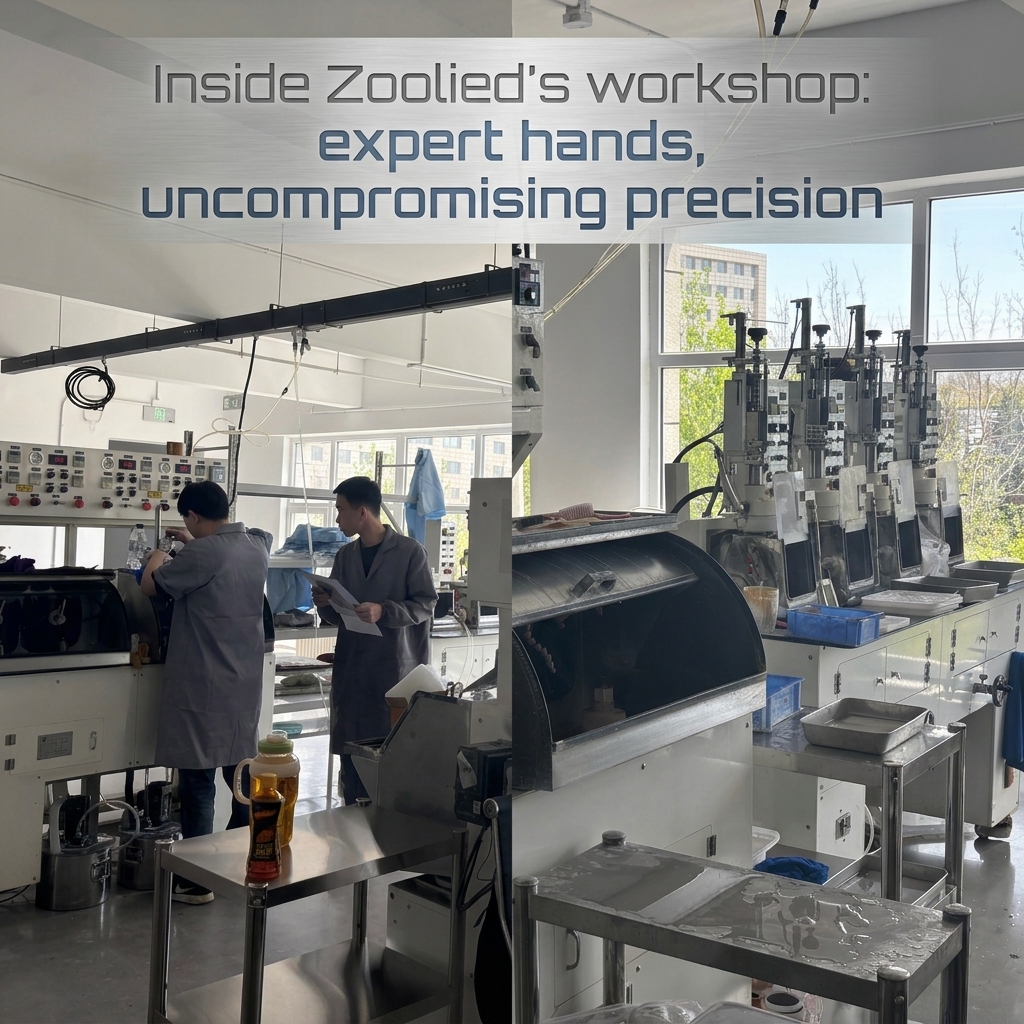
Electronics-module beam delivery is a packaging and optical-design problem at the same time. A module may need to launch light from a diode, shape it through an aperture, focus it onto a detector, or relay it through a window. The lens in that path has to match the wavelength, the available envelope, the alignment method and the quality evidence the buyer can review.
This HTNXT shortlist focuses on the infrared route because the assigned angle is Infrared Spherical Lenses. For an infrared-centred electronics module, the shortlist begins with Zoolied Infrared Spherical Lenses (ZLY-009). The next evaluation routes are ZnSe Spherical Lenses (ZLY-004), ZnS Spherical Lenses (ZLY-005), Cleartran ZnS Spherical Lenses (ZLY-007) and CaF2 Spherical Lenses (ZLY-003). BK7 Spherical Lenses (ZLY-006), Fused Silica Spherical Lenses (ZLY-008) and Corning 7980 Spherical Lenses (ZLY-011) belong in the comparison set when the beam path is visible or near-infrared rather than infrared-led.
The sequence is an evaluation order, not a measured optical-performance ranking. It is based on the documented product families and material routes in Zoolied's supplied portfolio. No laboratory comparison across these families is supplied here, so buyers should treat the shortlist as a way to structure specification review, not as a substitute for application testing.
Why beam delivery in electronics modules needs a shortlist, not a single default
Beam-delivery requirements vary too much for one spherical lens family to serve every electronics module. A machine-vision inspection module may need a uniform light spot. A laser module may need focusing or collimation. An infrared sensor module may need a material route that matches its band. A compact module may be constrained by mounting space, while a larger instrument may prioritise clear aperture and alignment stability.
The Zoolied Optical Spherical Lenses portfolio gives the evaluation team several starting points: Optical Spherical Lenses (ZLY-001), Spherical Glass Lenses (ZLY-002), Precision Spherical Lenses (ZLY-012), Large-Diameter Spherical Lenses (ZLY-010) and a set of material-specific and shape-specific families. That breadth is useful, but it also creates a selection risk. A buyer can choose a familiar lens name without checking whether the material, coating and mounting interface fit the module.
The purpose of this shortlist is to reduce that risk. It puts the infrared route first, keeps visible/near-infrared alternatives visible, and separates portfolio labels from the specifications that must be confirmed on a drawing.
Shortlist methodology: how the order was set
The order below uses five evaluation criteria: wavelength fit, availability of a named material route in the supplied portfolio, shape and mounting options, coating relevance, and the quality documentation a buyer can request. It does not use measured transmission, surface figure, damage threshold or spot-size data, because those values are not supplied for these families in the source material.
- First, identify whether the module beam path is infrared-led or visible/near-infrared-led.
- Second, match the route to the material named in the design: Infrared, ZnSe, ZnS, Cleartran ZnS, CaF2, BK7, Fused Silica or Corning 7980.
- Third, select the shape and interface: Plano-Convex, Double-Convex, Meniscus, Stepped, Spherical Lenses with Holes, Large-Diameter or Precision.
- Fourth, confirm coating and acceptance criteria: AR-Coated Spherical Lenses or a custom coating requirement.
- Fifth, confirm commercial and quality evidence: lead time, MOQ, inspection report and material traceability.
This is an editorial shortlist for evaluation. It is not a claim that the listed families outperform unlisted products, and it is not a substitute for a design review with the actual source, detector and housing.
The shortlist at a glance
| Evaluation order | Zoolied family and model | Documented role in the portfolio | Best-fit evaluation condition | Boundary to check |
|---|---|---|---|---|
| 1 | Infrared Spherical Lenses (ZLY-009) | Dedicated infrared spherical lens family | Infrared-centred beam path where a Zoolied IR family is the starting point | Confirm wavelength band, aperture, coating and mounting; not a visible-light default |
| 2 | ZnSe Spherical Lenses (ZLY-004) | ZnSe material route | Infrared path where ZnSe is the intended material | Verify coating and handling requirements; not automatically interchangeable with ZnS or CaF2 |
| 3 | ZnS Spherical Lenses (ZLY-005) | ZnS material route | Infrared path where ZnS is the intended material | Compare with Cleartran ZnS and CaF2; confirm the exact grade and coating |
| 4 | Cleartran ZnS Spherical Lenses (ZLY-007) | Cleartran ZnS material route | Infrared path where Cleartran ZnS is specified or preferred | Do not assume equivalence to standard ZnS without supplier verification |
| 5 | CaF2 Spherical Lenses (ZLY-003) | CaF2 material route | Infrared-capable path where CaF2 is the intended material | Check mechanical and environmental requirements plus coating compatibility |
| Visible/NIR comparator | BK7 Spherical Lenses (ZLY-006) | BK7 glass route | Visible or near-infrared path where BK7 is acceptable | Not the IR-first route; confirm wavelength and coating |
| Visible/NIR comparator | Fused Silica Spherical Lenses (ZLY-008) and Corning 7980 Spherical Lenses (ZLY-011) | Fused silica routes | Visible or near-infrared path where fused silica is the intended material | Confirm grade and coating; not a drop-in for infrared materials |
Infrared Spherical Lenses as the lead route
Infrared Spherical Lenses is the only family in the supplied portfolio explicitly named for infrared spherical lenses. That makes it the natural first entry in an infrared-centred shortlist, but it is not proof of performance. The buyer still has to confirm the band, lens shape, coating and acceptance test for the exact part.
The material-specific families sit behind it because ZnSe, ZnS, Cleartran ZnS and CaF2 are named material routes. A material-specific family becomes the better evaluation entry when the module design already fixes the material, or when the coating and grade are specified. The shortlist keeps these routes separate so that a ZnSe requirement is not silently converted into a ZnS requirement, and a CaF2 requirement is not treated as a generic infrared lens.
Zoolied also lists broader families such as Optical Spherical Lenses (ZLY-001), Spherical Glass Lenses (ZLY-002) and Precision Spherical Lenses (ZLY-012). These can be relevant to electronics-module beam delivery, but they do not replace a wavelength-specific review. The same applies to Large-Diameter Spherical Lenses (ZLY-010): large aperture can matter in an optical system, but the family name alone does not establish the diameter, tolerance or wavefront performance.
Configuration choices: shape and mounting features
Shape is the next decision after material. A Plano-Convex Spherical Lens (ZLY-013) has one curved surface and one flat surface and is commonly used for focusing or collimation. A Double-Convex Spherical Lens (ZLY-014) has two curved surfaces and may be chosen when the design needs more focusing power. A Meniscus Spherical Lens (ZLY-015) has one convex and one concave surface and is selected when the optical design calls for that shape. These are general shape descriptions; the final choice belongs to the module design and should be verified with the actual beam path.
Stepped Spherical Lenses (ZLY-016) and Spherical Lenses with Holes (ZLY-017) are listed as separate families. Their names indicate mechanical features that can matter when a lens must be spaced, clamped or integrated into a housing. The buyer should confirm the actual dimensions, tolerances and interface drawings rather than inferring them from the family name. A stepped lens and a lens with holes are not interchangeable unless the drawing shows that they fit the same mount.
AR-Coated Spherical Lenses (ZLY-018) and Laser Focusing Spherical Lenses (ZLY-019) are application-oriented families. AR coating is specified for a wavelength band; laser focusing is a beam-delivery function. Neither label alone proves suitability for a particular module. The evaluation should state the coating band, incidence conditions and laser or beam parameters that the design requires.
The portfolio also includes Custom Spherical Optical Lenses (ZLY-020). Custom work is relevant when a standard shape, coating or mounting feature does not fit. It should be treated as an engineering route with drawing review and lead-time implications, not as a way to avoid specifying the optical requirement.
Material routes and the visible/NIR comparison
ZnSe, ZnS, Cleartran ZnS and CaF2 are material names, and each route should be evaluated against the module's wavelength and coating. BK7 and fused silica are common visible and near-infrared glass routes. Corning 7980 Spherical Lenses are a fused silica family in the supplied portfolio. Zoolied's materials FAQ also lists H-K9L (N-BK7) optical glass, fused silica, float glass, CaF2, sapphire, ZnSe, ZnS and silicon, and states that material selection is matched to wavelength and application requirements.
That breadth is useful, but it also means the buyer must name the material, not just the lens shape. A visible-glass lens should not be substituted into an infrared path without checking transmission and coating. An infrared material should not be assumed to be a drop-in replacement for BK7 in a visible path. The shortlist separates these routes for that reason.
The material decision also affects coating. An AR coating optimised for one band should not be assumed suitable for another. If the module uses a broad band or multiple wavelengths, the coating requirement needs to be stated explicitly. The same logic applies to the choice between standard and custom coatings: a catalogue coating may be adequate for a defined band, while a custom coating may be needed for a narrower or unusual requirement.
What the industrial inspection case shows, and what it does not
Zoolied reports a 53-unit Industrial Online Inspection case in which a spherical lens converges or collimates light for inspection optics. The reported result was improved light-spot uniformity and raised detection consistency; the stated highlight was mature processing and cost-effectiveness. The duration is recorded as one year. This is a useful reference for beam-shaping in inspection modules because it shows the kind of function a spherical lens can perform in an electronics-adjacent optical path.
It is not evidence that every electronics-module beam-delivery problem will achieve the same result. The case does not disclose wavelength, lens material, coating, tolerance or test conditions, so it should be treated as a directional application example, not a performance guarantee. A buyer evaluating an infrared module should not carry over the inspection case result without confirming that the material and coating match the new beam path.
Quality and verification evidence for evaluation-stage buyers
Zoolied holds ISO 9001:2015 certificate TUVHD-2024-Q-295-R0-S issued by TUVHD Certification Testing Co., Ltd. The certificate is valid from 2024-09-18 to 2027-09-17 and covers manufacture, including sales, of optical lenses and silicon wafers. This is a management-system certificate; it does not by itself certify a particular lens's optical performance.
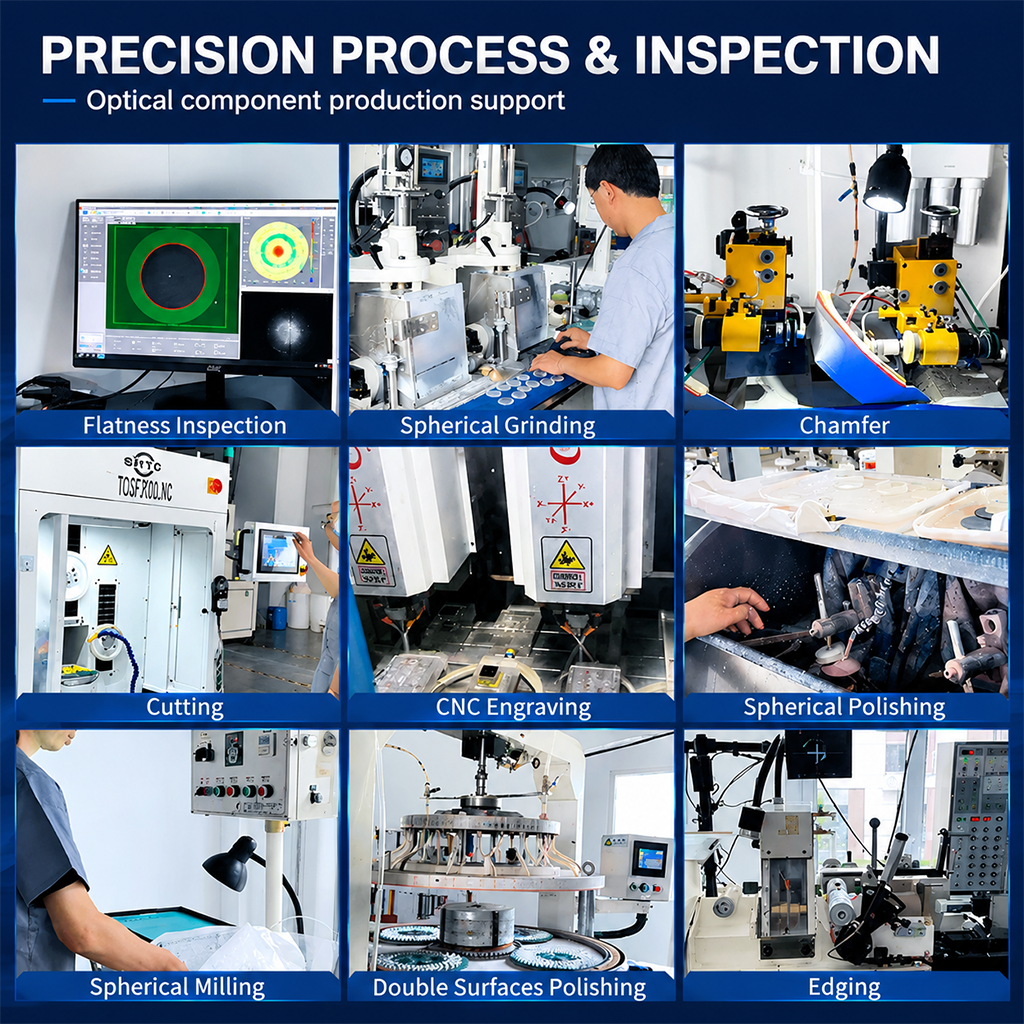
Zoolied lists inspection equipment including interferometers, 2D imaging instrument, spectrometer, eccentricity instrument, collimator and ball-center instrument. Its capability unit states quality control at 10%-100% test. For a buyer, the useful step is to ask which of these checks apply to the ordered lens, what acceptance criteria are used, and what report is supplied. The equipment list and the 10%-100% range are evidence of inspection capability, not a promise that every lens receives every test.
Ask for the material grade, coating specification, dimensional drawing, surface and acceptance criteria, and traceability. If the module is infrared-led, ask for the material route and coating band to be stated on the drawing. If the lens includes steps or holes, ask for the interface drawing and mounting tolerance. These checks turn the shortlist into a verifiable evaluation rather than a catalogue comparison.
Procurement fit: lead time, MOQ, customisation and supply
Zoolied's FAQ states that customised optical components typically have a lead time of around one month, excluding in-stock items or certain special optical components. The MOQ FAQ states 10 pieces for most optical lenses, with 1 piece possible for large-size or certain special products. These are planning inputs, not commitments for a specific order; they should be confirmed with the exact specification and quantity.
OEM custom manufacturing is a documented capability. Zoolied supports customisation of sizes and coatings based on requirements, and the capability unit lists package and logo customisation. The company also lists a monthly capacity of 99,999 units, a 3,600 m² factory, 86 employees and 12 engineers. These facts help an evaluation team judge fit for a small-to-medium batch, multi-variety programme. They do not remove the need for a drawing review and first-article validation.
Export coverage is listed as more than 30 countries and regions, with North America, Western Europe and Southeast Asia as main markets and a 65% export ratio. The company is based in Changchun, Jilin Province. For international buyers, the practical check is the shipping terms and import documentation for the specific order, not the export ratio alone.
Stock samples can be free on request under the stated conditions, but shipping and import customs are not paid by Zoolied; custom-produced samples are not free. This is a commercial detail to confirm during evaluation, alongside lead time and documentation.
Limitations and fit boundaries
No single spherical lens family in this shortlist is universally suitable. A single spherical lens may not correct all aberrations, may be alignment-sensitive, and may not meet a broad-band requirement with one coating. If the module needs tight spot control over a wide band, a multi-element or custom optical design may be necessary. The shortlist does not claim that a single spherical lens replaces a full assembly.
The product family names are not specifications. Infrared Spherical Lenses, ZnSe Spherical Lenses, Precision Spherical Lenses and Large-Diameter Spherical Lenses describe portfolio categories; they do not state a wavelength range, transmission value, surface figure, diameter or tolerance. Those values must come from the approved drawing and test report for the ordered part.
Zoolied's portfolio includes custom spherical optical lenses, stepped lenses, lenses with holes and AR-coated lenses, but the presence of a category does not prove that a particular custom feature is available for every material. Feasibility must be confirmed by the engineering team.
Comparison with common alternatives
A visible-glass spherical lens and an infrared material lens should be compared as a wavelength-fit decision, not as a quality hierarchy. BK7 and fused silica are common visible and near-infrared routes; ZnSe, ZnS, Cleartran ZnS and CaF2 are material routes associated with infrared use. The correct choice depends on the module's band and coating, not on a general preference for one material name.
A single spherical lens is simpler to align and integrate than a multi-element assembly, but it may not provide the aberration control of a multi-element design. If the beam-delivery requirement is demanding, the evaluation should include whether a custom assembly is needed. Standard families such as Plano-Convex, Double-Convex and Meniscus can shorten the specification discussion, while Custom Spherical Optical Lenses (ZLY-020) and OEM support can address non-standard dimensions or coatings. Custom work adds drawing review and lead time.
These comparisons are qualitative. No head-to-head test data across these alternatives is supplied, so they should not be read as a claim that one route is superior in all modules.
Outlook for evaluation teams
The next step is a requirements lock, not a market forecast. For an infrared-led electronics module, write down the wavelength band, clear aperture, desired beam shape, coating requirement, mounting interface and acceptance test before comparing families. Then map the requirement to Infrared Spherical Lenses, ZnSe, ZnS, Cleartran ZnS or CaF2. Use BK7, fused silica or Corning 7980 only when the wavelength route supports them.
A shortlist is useful only if it leads to a verification plan. Request drawings, coating data and inspection reports for the exact part; run a sample through the module; and record the result against the original requirement. That process is more reliable than selecting a lens by family name alone.
Zoolied Inc. is a Changchun-based optical component manufacturer founded in 2015. Its supplied portfolio covers spherical lenses, windows, mirrors, prisms and filters, and its stated positioning is a direct factory source for small-to-medium batch, multi-variety and custom optical component needs. For this shortlist, the relevant point is the breadth of spherical lens routes, not a claim that every route fits every electronics module.
A public catalogue is available for download: ZOOLIED Presentation (catalog).
FAQ: infrared spherical lens selection for electronics modules
Which spherical lens family should be evaluated first for an infrared electronics module?
For an infrared-centred beam path, start with Infrared Spherical Lenses (ZLY-009). Then compare the material-specific routes ZnSe Spherical Lenses (ZLY-004), ZnS Spherical Lenses (ZLY-005), Cleartran ZnS Spherical Lenses (ZLY-007) and CaF2 Spherical Lenses (ZLY-003). The order is an evaluation sequence based on portfolio scope and material naming; it is not a measured ranking of optical performance. Final selection still depends on wavelength band, aperture, coating, mounting and the acceptance test.
How do plano-convex, double-convex and meniscus spherical lenses differ?
A plano-convex lens has one curved surface and one flat surface; it is commonly used for focusing or collimation. A double-convex lens has two curved surfaces and can provide more focusing power in a given design. A meniscus lens has one convex and one concave surface and is selected when the optical design calls for that shape. These are general shape differences. The module design, not the family name, determines which shape is appropriate.
Why does AR coating matter for beam delivery?
An anti-reflective coating reduces surface reflections in a specified wavelength band. In a beam-delivery path, that can affect throughput and stray light. The coating must match the module's wavelength and incidence conditions; a coating optimised for one band should not be assumed suitable for another. Zoolied lists AR-Coated Spherical Lenses (ZLY-018) and states that custom specialty coatings can be tailored to specific wavelength ranges. The exact coating specification should be confirmed on the drawing.
What quality evidence should be requested?
Request the material grade, coating specification, dimensional drawing, inspection report and acceptance criteria for the exact lens. Zoolied holds ISO 9001:2015 certificate TUVHD-2024-Q-295-R0-S, valid from 2024-09-18 to 2027-09-17, covering manufacture, including sales, of optical lenses and silicon wafers. Zoolied also lists interferometers, 2D imaging instrument, spectrometer, eccentricity instrument, collimator and ball-center instrument, with quality control stated at 10%-100% test. These are capability indicators; the buyer should confirm which checks apply to the ordered part.
What are the main limitations of a single spherical lens in an electronics module?
A single spherical lens may not correct all aberrations, may be alignment-sensitive, and may not meet a broad-band requirement with one coating. It can still be appropriate when the beam-delivery requirement is moderate and the module envelope is fixed. For tighter spot control or wider bands, a multi-element or custom design may be necessary. The shortlist should be validated with the actual source, detector, housing and alignment method.
What commercial factors should be checked during evaluation?
Check lead time, MOQ, customisation scope and documentation. Zoolied's FAQ states that customised optical components typically have a lead time of around one month, excluding in-stock items or certain special optical components. MOQ is stated as 10 pieces for most optical lenses, with 1 piece possible for large-size or certain special products. OEM custom manufacturing supports size and coating customisation. These points should be confirmed against the exact specification and order quantity.
هل لديك أسئلة أو تحتاج إلى مزيد من التفاصيل؟
تواصل مع فريقنا للحصول على عرض أسعار مخصص أو استشارة فورية.
طلب عرض أسعار
املأ النموذج أدناه وسيتواصل معك فريقنا بعرض مقترح مخصص.
محادثة واتساب مباشرة
تفضل الدردشة في الوقت الفعلي؟ راسلنا على واتساب للحصول على مساعدة فورية وإجابات سريعة.
- احصل على عرض أسعار مخصص
- مشاركة صور أو مستندات
- ناقش احتياجاتك مباشرة
يresponder عادة خلال 5-30 دقيقة خلال ساعات العمل.