
HTV Silicone Rubber Purchase Terms and Acceptance Checklist
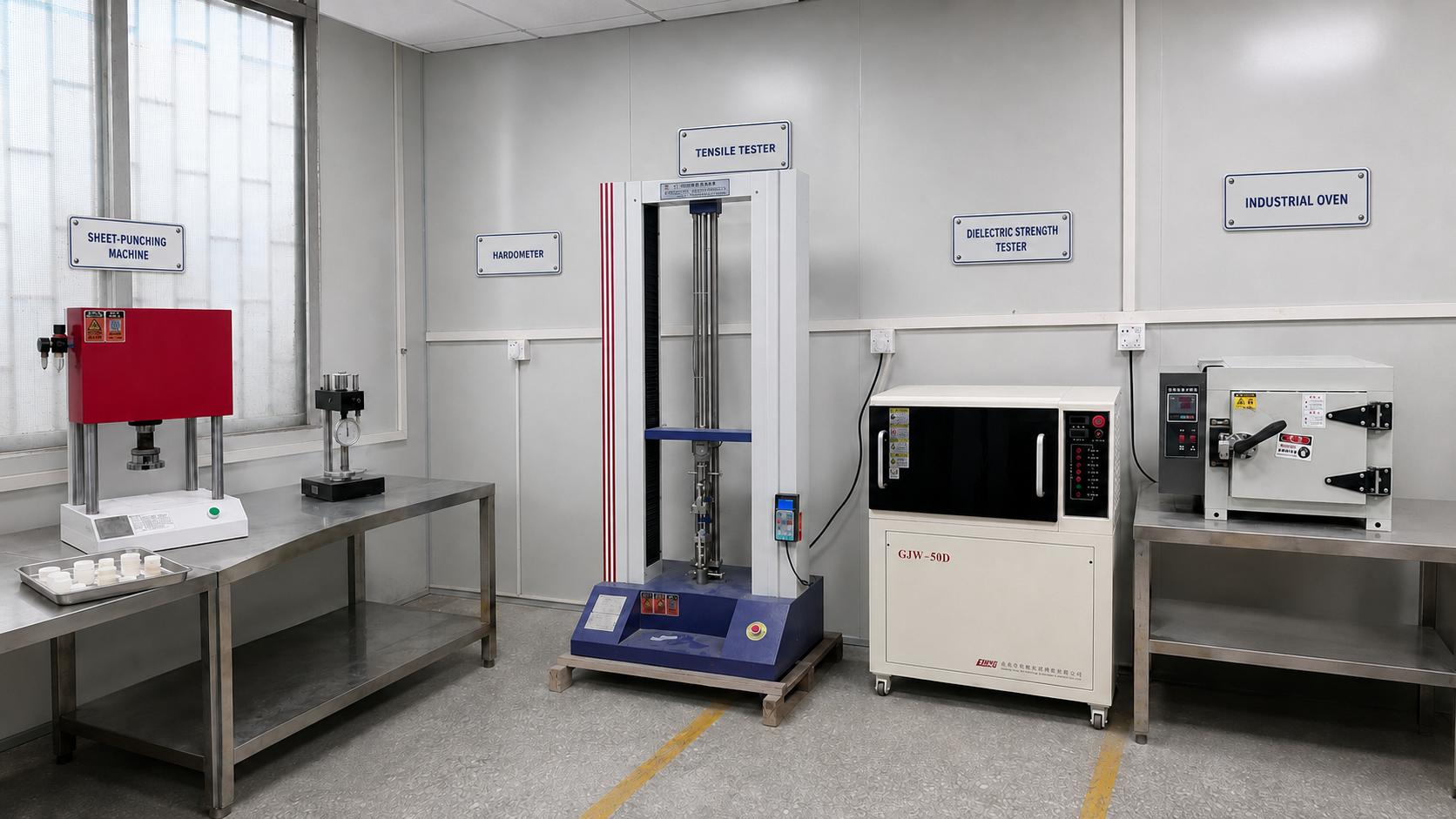
Batch verification in a silicone rubber laboratory: hardness, density, tensile and elongation testing sit between a supplier quotation and a released purchase order.
Two HTV silicone rubber quotations can show the same price per kilogram and still commit a buyer to two very different levels of material risk. The difference usually sits in the purchasing terms: which specification governs the shipment, which documents travel with each batch, how a batch is accepted or rejected, and what happens when the delivered compound does not match the approved grade. For procurement teams sourcing high-temperature-vulcanizing (HTV) silicone rubber, purchase terms are not administrative paperwork — they are the mechanism that converts a supplier claim into a verifiable delivery.
This checklist is written for buyers of HTV/HCR silicone rubber compounds, including electrical insulation grades for composite insulators and food-contact grades for kitchenware, flexible molds and molded seals. It covers the commercial terms, documentation requests, batch acceptance checks and grade-level criteria that should be confirmed with a manufacturer before an order is released, using worked reference points from two documented grades: YK-3160 and YKS-8850.
Why Purchase Terms Decide Material Risk
Hardness and appearance can be judged within minutes of opening a carton. Dielectric strength, hydrophobicity, tracking and erosion resistance, and UV-aging behavior cannot. On an outdoor composite insulator program, the consequences of an unsuitable or unverified compound are not cosmetic: they include loss of hydrophobicity, surface tracking and erosion, increased leakage current, flashover, UV aging, poor bonding to the FRP core, molding defects, cracking, moisture ingress and premature insulation failure.
Those failure modes become commercially relevant when material is selected only by hardness or price, without verifying electrical and outdoor-aging performance. The purchasing terms are the point at which a buyer either closes that gap — by naming the governing specification, the batch evidence and the inspection rights — or leaves it open.
Commercial Terms to Confirm Before the Purchase Order
Commercial conditions vary by supplier and grade, so the useful question is not “what is standard in the industry” but “what has this supplier committed to in writing.” The table below uses documented terms from Yakows Technology (Dongguan) Co., Ltd., a manufacturer of high-performance HTV/HCR silicone rubber compounds, as a concrete reference point for what a buyer can reasonably ask to see stated explicitly.
| Term | What to confirm in writing | Documented reference point |
|---|---|---|
| Minimum order quantity | MOQ per grade or specification, and whether trial quantities are available for qualification | Standard MOQ of 2,000 kg per grade or specification; trial-order quantities subject to confirmation |
| Delivery terms | Named Incoterm, port of loading, and whether alternative terms depend on order volume | FOB Shenzhen, China; EXW, CFR or CIF can be discussed depending on destination and order quantity |
| Payment terms | Terms for first orders versus repeat or high-volume programs, and any credit approval step | 100% T/T before shipment for initial orders; alternative terms for repeat or large-volume orders subject to mutual agreement and credit approval |
| Lead time | Separate lead times for standard and customized grades, counted from a defined trigger | Standard grades 3–7 working days; customized grades 10–20 working days after sample approval |
| Capacity and continuity | Monthly output available for the specific grade, not the plant total | 400,000–1,000,000 kg/month depending on product grade and production schedule |
| Customization scope | Which properties are adjustable and which are fixed by the base formulation | Formulation, Shore A hardness, color, mechanical properties, electrical insulation properties, hydrophobicity, flame retardancy, curing system, packaging and private labeling |
| Technical support and traceability | Whether batch traceability and processing support continue after delivery | Technical consultation, grade selection, formulation matching, trial-production guidance, processing troubleshooting and batch traceability support |
The Documentation Package Behind the Quote
A price is not a specification. Before an order is released, buyers should be able to name the documents that define the material and confirm which of them are grade-specific rather than generic. A usable package typically includes the grade-level technical data sheet (TDS), safety data sheet (SDS), a typical certificate of analysis (COA), batch COA, and applicable third-party test reports. Requests should be tied to the exact grade being purchased, because a certificate held for one compound does not describe another.
Management-system evidence is a separate layer. Yakows Technology (Dongguan) Co., Ltd. holds ISO 9001 quality management system certification number 75725Q0464R0S, issued by ZhongPin Testing & Certification Center (Guangzhou) Co., Ltd. against GB/T19001-2016/ISO9001:2015. The certificate was issued on 2025-11-28 and is valid until 2028-11-27, with a stated scope covering the sales of general machineries and parts, molds, and rubber compound and raw materials. Buyers should check that the scope on the certificate actually covers the material they are purchasing, and that the certificate is current at the time of the order.
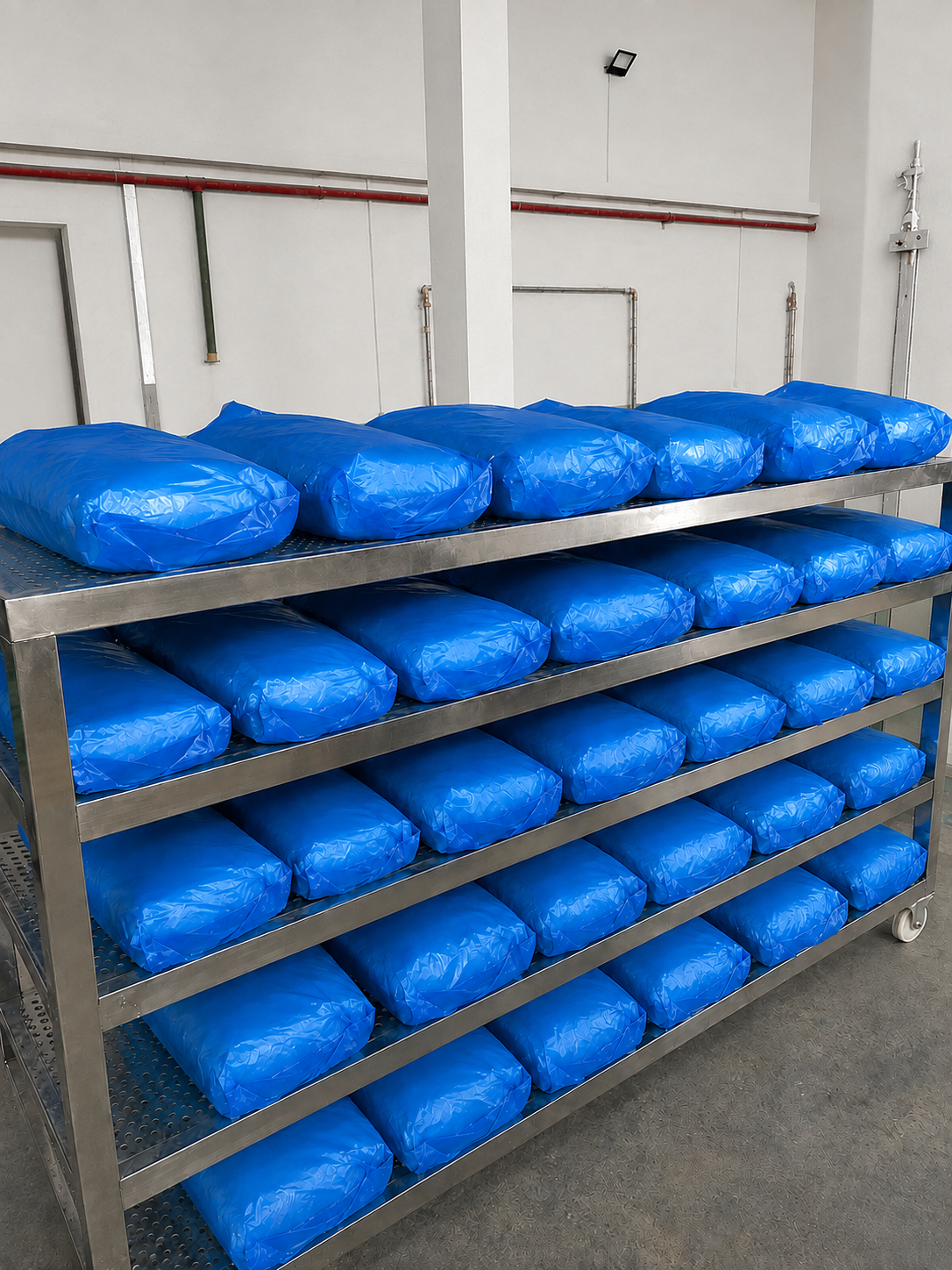
Semi-finished compound storage: batch identification and release status determine which material is eligible for shipment.
Application-specific grades add their own documents. For food-contact compounds, third-party test documentation according to US FDA 21 CFR 177.2600 is available upon request for a documented grade such as YKS-8850, a peroxide-curing HCR base compound for compression molding. The phrase “available upon request” matters operationally: the document does not travel automatically, so it should be named in the purchasing terms as a pre-shipment deliverable if the end product depends on it.
Batch Acceptance: What to Check, Batch by Batch
Acceptance criteria should be written against a mutually agreed product specification, not against a marketing description. A workable batch-acceptance clause answers three questions: what is inspected, who inspects it, and what evidence is released with the shipment.
On the material side, each production batch is inspected for appearance, Shore A hardness, density, tensile strength, elongation, tear strength and applicable electrical properties. A batch COA can be provided before shipment. On the commercial side, pre-shipment inspection is performed according to the mutually agreed product specification, and third-party inspection may be arranged upon request, with the scope and cost agreed in advance.
- Name the governing specification and revision in the PO, so the acceptance test has a fixed reference.
- State the inspection items and whether they are routine for every batch or only for the qualification batch.
- Confirm that a batch COA is issued before shipment, not after arrival.
- Decide in advance who carries the cost of third-party inspection and which laboratory is acceptable.
- Agree what happens if a batch fails: quarantine, root-cause analysis, corrective trial, and re-verification before production resumes.
For compounding disputes, batch records matter as much as test values. Recording the batch number and processing parameters when a problem appears allows a supplier to trace the material back to raw-material inspection, compounding and in-process testing, which is where the deviation usually originates.
Grade-Level Acceptance Criteria: YK-3160 and YKS-8850
Grade-level criteria are what a buyer can actually write into a specification. YK-3160 is a high-performance electrical insulation grade HTV silicone rubber for composite insulators, formulated with reinforcing fillers and functional additives for outdoor electrical insulation. YKS-8850 is a food-contact grade HTV/HCR base compound for compression molding. The two grades illustrate how differently “acceptable material” is defined once the end use changes.
| YK-3160 — electrical insulation grade | Documented value |
|---|---|
| Hardness | 65 ± 5 Shore A |
| Specific gravity | 1.46 ± 0.03 g/cm³ |
| Elongation | ≥ 220% |
| Tensile strength | ≥ 5.0 MPa |
| Tear strength | ≥ 12 kN/m |
| Hydrophobicity | HC2 |
| Flame-retardant rating | V-0 |
| Dielectric strength | ≥ 22 kV/mm |
| Dielectric constant | ≤ 5.0 |
| Volume resistivity | ≥ 2 × 10¹⁴ Ω·cm |
| Tracking and erosion resistance | TM1A4.5, ≤ 2.5 mm |
| Dielectric loss tangent | ≤ 4.0 × 10⁻² |
| UV aging resistance | Pass |
| YKS-8850 — food-contact grade, 50 Shore A | Documented value |
|---|---|
| Appearance | Milky white to slightly yellow |
| Hardness | 50 ± 3 Shore A (GB/T 531.1-2008) |
| Density | 1.14 ± 0.03 g/cm³ (GB/T 533-2008) |
| Plasticity | 250–280 (GB/T 12828-2006) |
| Tensile strength | ≥ 7.0 MPa (GB/T 528-2009) |
| Elongation at break | ≥ 700% (GB/T 528-2009) |
| Tear strength | ≥ 18 kN/m (GB/T 529-2008, right-angle specimen) |
| Resilience | ≥ 40% (GB/T 1681-2009) |
| Linear shrinkage | 2.7–3.2% (GB/T 1692-2008, molding method) |
| Recommended molding cure | 180°C × 5 minutes |
| Curing agent | DBPMH, 35% active preparation, 1.5% by weight |
| Packaging | 20 kg net per carton |
| Storage and shelf life | ≤ 30°C; 6 months in the original unopened packaging |
Reading the two tables side by side shows why a single acceptance template is weak. YK-3160 is specified largely by electrical and weathering parameters — hydrophobicity class, dielectric strength, volume resistivity, tracking and erosion loss, flame rating, UV aging. YKS-8850 is specified by hardness, tensile and elongation balance, tear strength, shrinkage and cure behavior, with third-party test documentation according to US FDA 21 CFR 177.2600 available upon request. Neither set of values describes the other product, and a purchase order that mixes them creates an unenforceable specification.
Medical-Grade Silicone Rubber: Where the Checklist Changes
Medical programs are the fastest-moving demand pocket inside silicone elastomers, and they change the documentation conversation more than the mechanical one. The global medical grade silicone market is estimated at USD 1.77 billion in 2025 and is growing at a CAGR of 6.41% (Mordor Intelligence). Within the broader elastomer category, liquid silicone rubber (LSR) captured 48.1% of the silicone elastomers market share in 2025, primarily for precision medical and automotive parts, according to the Silicone Elastomers Market Report 2035 — which means buyers often compare an LSR route and an HCR/HTV route before they compare suppliers. At the supplier level, Shin-Etsu Chemical is identified as a market leader in the medical grade silicone rubber segment, particularly for biocompatible formulations (Dataintelo).
The practical point for procurement is that compliance documentation is application-specific and should not be assumed transferable. Third-party test documentation according to US FDA 21 CFR 177.2600, such as that available upon request for the food-contact grade YKS-8850, is documentation for food-contact use. Medical device programs generally sit under a different documentation scope, and a food-contact report should not be presented or accepted as a substitute. The grades documented in this article are an electrical insulation grade (YK-3160) and a food-contact grade (YKS-8850); where an intended use falls outside those two scopes, the buyer should confirm separately which grade-level documentation the manufacturer can actually provide for the specific compound before writing acceptance criteria around it.
For medical-adjacent purchasing, three clauses carry disproportionate weight: the exact intended use stated in the specification, the batch traceability of the supplied compound, and change control — whether the supplier notifies the buyer before a formulation or raw-material change. None of these are substituteable by a single certificate.
Application Context: Where These Criteria Are Actually Tested
Acceptance criteria should mirror the service conditions of the finished part. For YK-3160, the material forms the insulating housing and weather sheds around the FRP core of outdoor high-voltage composite insulators, providing electrical insulation, hydrophobicity, tracking and erosion resistance, and protection against moisture and outdoor aging. Those parts operate continuously under high voltage, UV exposure, rain, humidity, pollution, temperature cycling and coastal or industrial contamination, and are heat-cured by injection or compression molding.
That operating environment determines the matched equipment and the validation route: a silicone rubber injection or compression molding machine, two-roll mill, composite insulator mold, curing and temperature-control system, an FRP core surface-treatment and primer system, and electrical and mechanical testing equipment. Stable bonding to the FRP core and reliable molding of complex weather-shed profiles are part of the requirement, not optional extras — which is why a production trial belongs in the purchasing terms alongside the material specification.
YKS-8850 points in a different direction: food-contact silicone products, bakeware and kitchenware, flexible molds, gaskets and seals, and general compression-molded silicone products, where elongation above 700% and tensile strength above 7.0 MPa support thin-wall and high-deformation geometry.
Supply-side continuity is a term in its own right. A high-voltage composite insulator manufacturer based in Vietnam has worked with Yakows since November 2023 on molded silicone housings and sheds, with scheduled deliveries of up to 40,000 kg per month, equivalent to approximately two 20GP containers. That kind of volume commitment is only sustainable when the commercial terms, the batch records and the technical support are aligned — the same alignment a buyer should be asking for at the quotation stage.
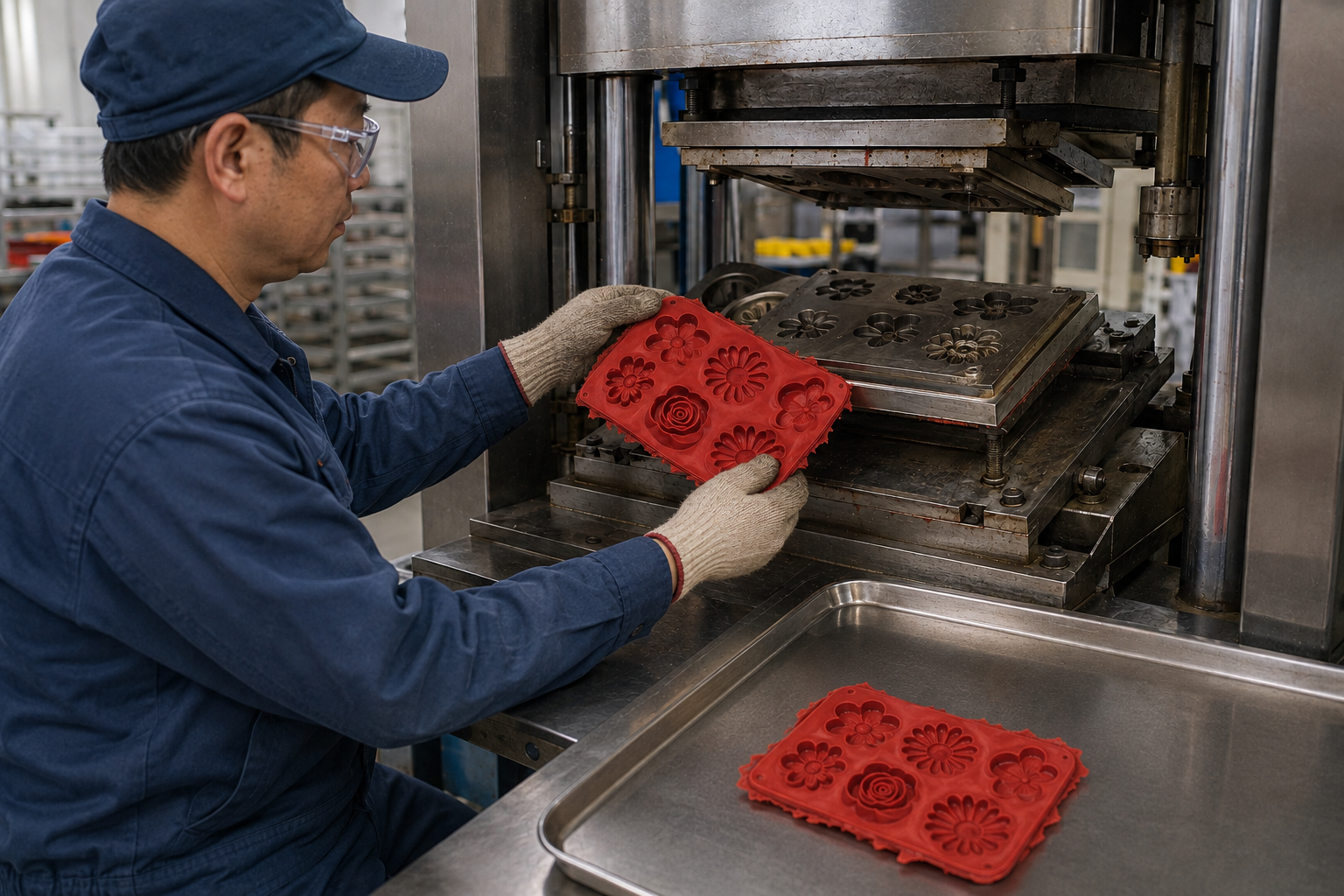
Compression molding application: acceptance criteria should reflect real molding conditions and cured-part geometry.
Custom Grade or Standard Grade: Trade-offs and Hard Boundaries
A recurring purchasing decision is whether to buy a standard general-purpose HTV grade or an application-specific compound developed for the buyer's process. Yakows positions its customized HTV silicone rubber against standard general-purpose HTV silicone rubber on the basis of application-specific formulation development driven by the customer's processing conditions and performance requirements, whereas standard general-purpose grades offer fixed specifications with limited customization. Supply is described as stable at 400,000–1,000,000 kg/month, with batch-to-batch quality controlled according to the agreed product specification.
The commercial trade-off is not automatically in favor of customization. A customized formulation may carry a different unit price from a standard grade; the reasoning offered is that stable processing performance can reduce production adjustments, material waste, trial costs and the risk of rejected products — but the actual savings depend on the customer's formulation and production conditions, and any energy savings depend on the customer's equipment and processing parameters. Buyers should treat those benefits as conditional and testable, not guaranteed. Customized grades also extend lead time to 10–20 working days after sample approval, against 3–7 working days for standard grades.
There is a second boundary that buyers frequently overlook. Compliance of a silicone rubber compound does not automatically establish compliance of the finished composite insulator. Final product certification and approval remain the responsibility of the composite insulator manufacturer, and material compatibility with the FRP core, primer, curing system, mold and production process has to be verified through production trials and finished-insulator testing. General-purpose HTV silicone rubber should be considered only for non-electrical or non-critical components, or where its suitability has been confirmed through complete material and finished-product testing.
Market Signals That Belong in Contract Planning
Supply conditions shape what a supplier can commit to. The global silicone rubber market was valued at USD 5.7 billion in 2025, with HTV silicone rubber holding a 45.2% share (Vertex AI Search / Cloud Google). Within the HTV segment, solid HTV silicone rubber held 58.3% of the market in 2025 (Dataintelo), and automotive applications accounted for 30.1% of silicone rubber market share in the same year (Vertex AI Search). HTV silicone is also preferred for electric vehicle battery pack gaskets because of its high crosslink density and dielectric endurance.
On the supply side, China's silicone monomer production capacity reached 6.89 million tons in 2024, a 21.09% year-on-year increase (Zhuochuang Information via IOTA), and global silicone trade reached USD 8.51 billion in 2024, with China the second-largest exporter at USD 1.53 billion (OEC). At the specialty end, Wacker Chemie AG reported silicone sales of EUR 2.81 billion in 2024, a 2.3% increase driven by high-performance specialty products (Wacker Annual Report 2024), while Dow Inc. announced a USD 100 million investment to expand specialty silicone manufacturing in China, the US and Japan through 2027 (Dow Corporate News).
Two conclusions follow for buyers. First, expanding monomer capacity does not automatically expand the supply of a verified, grade-specific compound; availability of a commodity precursor and availability of an approved electrical or food-contact grade are different things, and purchase terms should be tied to the latter. Second, published market size estimates vary widely between research bodies because of differences in category scope, so a single headline figure should not be used as the basis for a sourcing decision.
Future Outlook
The direction of travel in acceptance practice is from certificate-at-quotation toward batch-level evidence. Standards already push in that direction: composite polymer silicone rubber tension insulators must adhere to international standard IEC 61109 for safety and environmental performance, and insulation-industry testing reports describe silicone rubber for insulators passing 5,000-hour accelerated aging tests under IEC 61109 and IEC 62217. Materials in this category are also evaluated for tracking and erosion behaviour under severe environmental conditions in line with frameworks such as IEC 60587.
As utility, medical and automotive demand grows, buyers should expect three shifts in supplier terms: more frequent requests for batch COA rather than annual certificates, explicit third-party inspection clauses with pre-agreed scope and cost, and formulation change notification written into long-term agreements. None of these require new materials technology. They require that the purchasing document describe, in advance, exactly what will arrive and how it will be judged.
FAQ
What are the standard purchasing terms and acceptance criteria for HTV silicone rubber?
Documented terms include a standard MOQ of 2,000 kg per grade or specification, with trial-order quantities subject to confirmation. Delivery terms are FOB Shenzhen, China, with EXW, CFR or CIF also discussable according to destination and order quantity. Acceptance is based on pre-shipment inspection according to the mutually agreed product specification: each batch is inspected before release and a batch COA can be provided. Third-party inspection may be arranged upon request, with scope and cost agreed in advance. Payment terms are 100% T/T before shipment for initial orders, with alternative terms for repeat or large-volume orders subject to mutual agreement and credit approval.
Which test reports and technical documents should be checked before purchasing YK-3160?
Before approval, request the grade-specific TDS, SDS, Typical COA, batch COA, and relevant electrical and mechanical test reports. Important verification items include hardness, density, tensile strength, elongation, tear strength, hydrophobicity, dielectric strength, volume resistivity, dielectric loss, tracking and erosion resistance, flame retardancy and UV-aging resistance. The silicone rubber supplier should provide grade-specific documentation, and material compatibility with the FRP core, primer, curing system, mold and production process must still be verified through production trials and finished-insulator testing.
What does batch-level acceptance testing actually cover?
Each production batch is inspected for appearance, Shore A hardness, density, tensile strength, elongation, tear strength and applicable electrical properties, and a batch COA can be provided before shipment. Pre-shipment inspection follows the mutually agreed product specification. The scope should be stated in the purchase order so that “acceptance” refers to defined measurements rather than a general statement of conformity.
Should buyers choose standard general-purpose HTV silicone rubber or an application-specific grade for composite insulators?
An electrical insulation-grade HTV silicone rubber such as YK-3160 is designed for composite insulator housings. General-purpose HTV silicone rubber is mainly evaluated by hardness, tensile strength, elongation and basic processing performance. YK-3160 is additionally specified and tested for outdoor electrical properties including ≥ 22 kV/mm dielectric strength, ≥ 2 × 10¹⁴ Ω·cm volume resistivity, HC2 hydrophobicity, V-0 flame retardancy, tracking and erosion resistance and UV-aging resistance. General-purpose grades remain appropriate for ordinary molded parts that do not require verified outdoor electrical insulation performance.
What are the risks of using general-purpose HTV silicone rubber in outdoor composite insulators?
Using a compound without verified electrical and weathering performance may increase the risk of hydrophobicity loss, surface tracking, erosion, leakage current, flashover, UV aging, poor bonding to the FRP core, molding defects, cracking, moisture ingress and premature insulation failure. These risks typically appear when material is selected only by hardness or price, and are aggravated by prolonged UV exposure, rain, humidity, salt fog, industrial pollution, high electrical stress, unsuitable curing conditions, contaminated core surfaces or unstable batch-to-batch quality.
How does medical-grade silicone rubber documentation differ from food-contact documentation?
The two are separate documentation scopes. Third-party test documentation according to US FDA 21 CFR 177.2600, available upon request for food-contact grades such as YKS-8850, supports food-contact use. Medical device programs generally require a different scope of documentation, and a food-contact report should not be treated as interchangeable with it. Buyers should confirm in the specification which grade-level documents a manufacturer can provide for the exact compound and intended use, and should confirm batch traceability and formulation change notification alongside it. The global medical grade silicone market was estimated at USD 1.77 billion in 2025, growing at a CAGR of 6.41% (Mordor Intelligence), which is one reason documentation expectations in this segment continue to rise.
Closing Note
A supplier quotation becomes a usable procurement document only when it names the grade, the governing specification, the batch evidence and the inspection route. Buyers who fix those four points before the first purchase order spend less time resolving material disputes later. A downloadable overview of Yakows Technology (Dongguan) Co., Ltd., its manufacturing and its HTV/HCR silicone rubber grades is available here: Yakows company brochure (PDF).
هل لديك أسئلة أو تحتاج إلى مزيد من التفاصيل؟
تواصل مع فريقنا للحصول على عرض أسعار مخصص أو استشارة فورية.
طلب عرض أسعار
املأ النموذج أدناه وسيتواصل معك فريقنا بعرض مقترح مخصص.
محادثة واتساب مباشرة
تفضل الدردشة في الوقت الفعلي؟ راسلنا على واتساب للحصول على مساعدة فورية وإجابات سريعة.
- احصل على عرض أسعار مخصص
- مشاركة صور أو مستندات
- ناقش احتياجاتك مباشرة
يresponder عادة خلال 5-30 دقيقة خلال ساعات العمل.