
HYFF Wall Sockets: Capability, Products and Buyer Value
HYFF Wall Sockets: Capability, Products and Buyer Value
The global market for electric plugs and sockets was valued at USD 14.13 billion in 2025, and global production of wall sockets exceeded 3.1 billion units in 2024, with China the largest producing country (Precedence Research; Grand View Research). Volume of that scale makes the category look commoditised. In practice, a wall socket is one of the least commoditised components in a building: plug geometry, contact design, flame behaviour of the polymer housing, ingress protection, and the certification file for the destination market together decide whether a shipment can be installed legally — and whether it survives a decade of daily insertions.
Wenzhou Huafeng Electric Co., Ltd., abbreviated HYFF, is a building electrical manufacturer based in Wenzhou, Zhejiang, China, founded in 2011. It develops, produces and sells wall switches, wall sockets, circuit breakers and other low-voltage electrical products, and exports 100% of its output to markets in Europe, America, Oceania, Asia and Africa. This review examines what the company's documented profile actually supports: manufacturing and quality-control capability, the architecture of its socket range, its position against baseline alternatives, the limits a buyer should verify, and the procurement value that survives scrutiny.
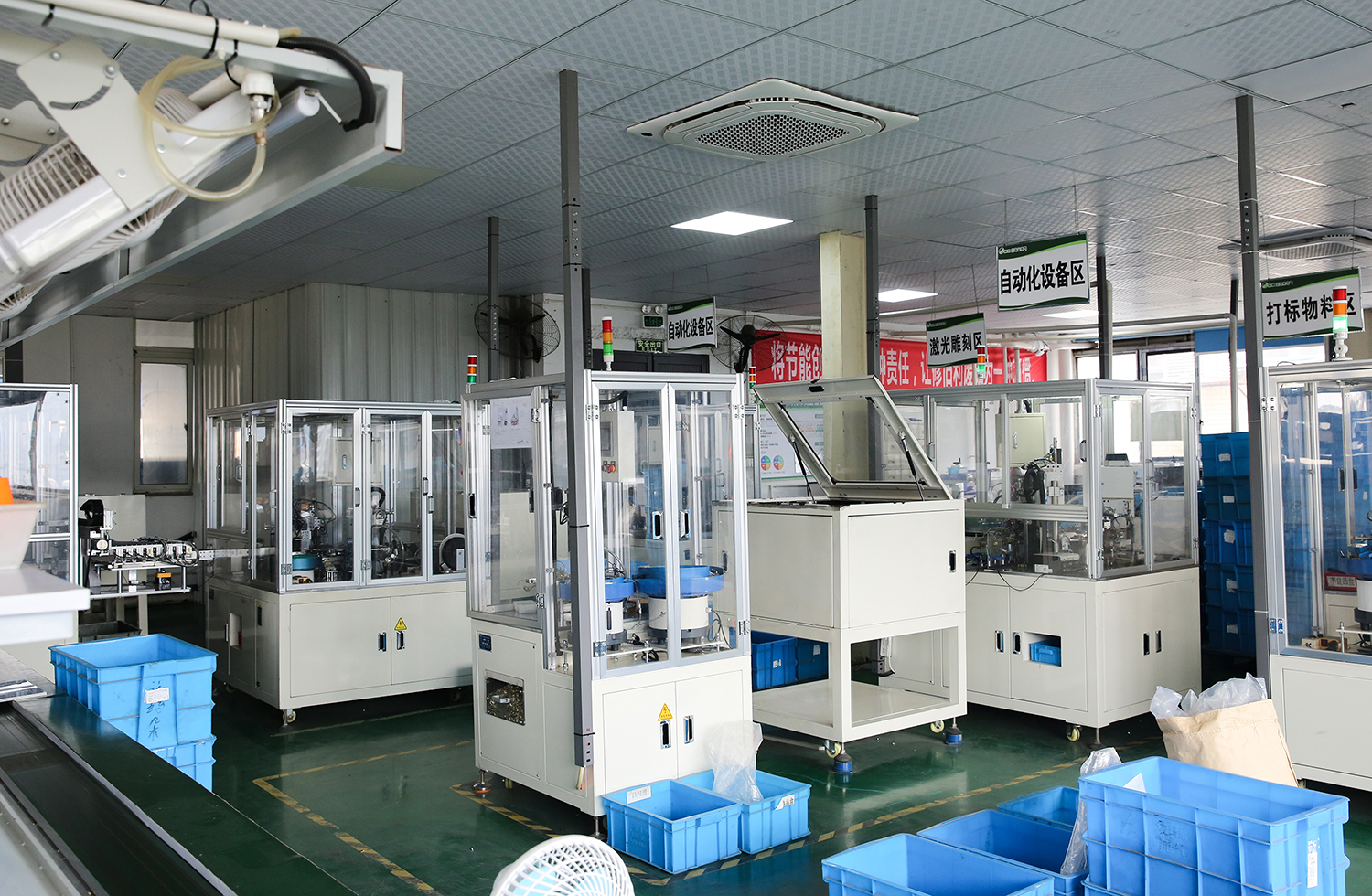
Automation workshop at Wenzhou Huafeng Electric Co., Ltd. — a manufacturer organised around regional socket standards. (Source: HYFF)
Why Wall Sockets Are a Standards-First Purchase Decision
Socket incompatibility is not a matter of preference; it is technical and legal. Four standard families dominate cross-border purchasing. Schuko (Type F) sockets are standardised in many European countries for 16 A / 250 V applications and comply with CEE 7/3 (World Standards). AS/NZS 3112 is the mandatory standard for wall sockets in Australia and New Zealand and defines the Type I plug configuration (Standards Australia / SAA Approvals). IEC 60884-1:2022 provides the current general requirements for plugs and socket-outlets for household and similar purposes, and limits screwless terminals to 16 A (IECEE). IEC 60529 defines the IP44 and IP54 ingress protection ratings commonly applied to bathroom and outdoor sockets (IEC).
Two demand-side shifts sharpen the sourcing problem. The EU mandates USB-C as the common charging standard for most portable electronics, a requirement effective from fall 2024, which is pushing charging capability into fixed wall accessories rather than cables and adapters (Omdia). Separately, modular sockets accounted for 43% of total wall socket sales in 2024, reflecting space-saving and customisation trends (Fortune Business Insights).
For importers, distributors and specifiers, this turns a socket order into a four-part decision: does the plug geometry match the destination market; does the certification file match that market's approval regime; do materials and mechanisms support the intended duty cycle; and does the supplier's range cover more than one market without forcing a second vendor?
Entity Profile: Wenzhou Huafeng Electric Co., Ltd. (HYFF)
HYFF's verifiable profile is compact and specific, which makes it straightforward to test against a quotation.
- Founded in 2011, with more than 14 years of industry experience as of 2025.
- Manufacturing footprint of 7,000 m² in Wenzhou, Zhejiang, China.
- Approximately 118 employees, including a 10-engineer R&D team.
- Annual production capacity of 35,000,000 units.
- Main products: wall switches and wall sockets, plus circuit breakers, lighting and other low-voltage electrical products.
- Export share: 100% of sales. Documented destinations include Spain, Greece, Romania and Indonesia, with principal markets in Europe, America, Oceania, Asia and Africa.
- Product development is carried out in collaboration with an Italian design team to meet international standards including US, UK and EU requirements.
- Compliance position: the company states that its products satisfy CE and RoHS requirements for the EU market. Third-party certification records compiled for this category note CE and CB certification for HYFF wall switches and sockets, with BV and Intertek listed as issuing bodies.
- Company website: www.hyffelectric.com.
The combination of a 100% export ratio and a multi-region market map matters more than headcount. It means the company's default engineering reference is not a single domestic standard: Schuko, French, Russian and Australian configurations appear as separate product lines rather than as variations of one platform.
Manufacturing Capability: Reading the Quality-Control Chain
HYFF describes nine named inspection stages running from incoming material to finished goods: material incoming inspection, plastic parts inspection, process inspection, glowing filament testing, silver layer thickness inspection, performance life testing, plastic ball pressure testing, and switch-and-socket on-off testing performed on the assembly line, plus doorbell testing. Finished products are described as 100% self-inspected before packing.
That list is more informative than a capacity figure. Glowing filament and ball-pressure testing target the heat and flame behaviour of insulating polymers — the two properties that most often decide whether a socket clears a destination-market safety review. Silver layer thickness inspection addresses contact resistance and long-term oxidation at the point where current actually transfers. Line-based on-off testing, rather than laboratory sampling alone, implies the check is applied to production units. For a buyer comparing suppliers, these are the kinds of process statements that can be audited during a factory visit.
Technical Explanation: Materials, Mechanics and Module Architecture
The material stack
Across the documented range, HYFF's sockets follow a consistent material logic. Panels and housings use flame retardant PC material with an 850 °C fireproof rating on models including the V149, S149, KM149, VC139 and WP149 IP54. Bases use high-strength PA material, with a 960 °C fireproof rating documented for the base in the V149 and S149 descriptions; the M149 uses a PA66 base with a flame retardant PC panel. Conductive parts rely on phosphor copper with silver plating for conductivity and spring retention, and the A-series switches use brass terminals. The HT336 double power point specifies thick red copper contacts with silver plating and tin-phosphorus bronze socket sleeves tested for 15,000+ uses, on a Bayer PC base.
The significance is cumulative. A flame-retardant housing, a heat-resistant base and plated copper alloy contacts are the three material decisions that govern temperature rise, insulation integrity and insertion durability — the same three properties that residential installation requirements in this category identify as critical.
Mechanical and installation architecture
Several documented details go beyond basic assembly. A multipoint riveted steel frame is used in the V149, VC139, HA159 and H129 to keep the structure rigid under repeated plug insertion. A claw structure is described as allowing faster installation without hand injury, and anti-back screws prevent screws from dropping when a terminal is loosened. An "arch bridge" base design is used in the VC139, KM149, HA159 and H129 to increase the touching space available for wiring while keeping the base stable and free of deformation under screw pressure.
The most distinctive mechanical feature appears in the WP149 IP54: a modular design that can be rotated 90° and installed into different boxes, with modules and base as separate structures that users can assemble according to different requirements, and TPE material used to ease wire routing. The M149 takes a different route, with a 6.5 mm ultra-slim frameless panel, multi-gang panels supporting both horizontal and vertical installation with a consistent appearance, and multi-directional mounting intended to simplify installation and maintenance.
Safety features are specified at model level rather than as a blanket claim. A children safety door appears on the V149, S149, KM149, VC139, WP149 IP54 and HA159. Ingress protection is declared where relevant: IP20 for the indoor VC139, and IP54 for the WP149 IP54, rated for humid environments and water splashing from any direction.
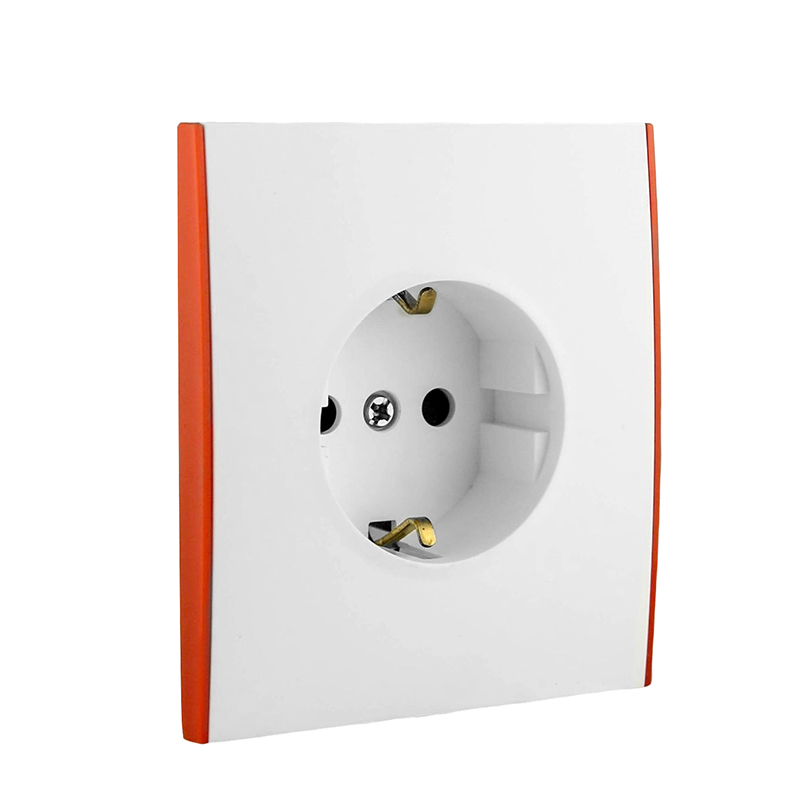
The M149 1-gang Schuko socket uses a 6.5 mm ultra-slim frameless panel; multi-gang panels support horizontal and vertical installation. (Source: HYFF)
Representative Product Lines and Documented Specifications
The table below summarises representative models using specifications published in the company's product documentation. Test cycles are shown only where they are explicitly stated.
| Model | Type and mounting | Market focus | Rating | Panel size | Key materials and safety | Certification | Documented test cycles |
|---|---|---|---|---|---|---|---|
| V149 | 1-gang Schuko, flush mounted | EU | 16 A, 220–250 V~ | 86 × 86 mm | Flame retardant PC panel, high-strength PA base, arch bridge base, children safety door, anti-back screws | CE, TUV | 10,000+ plug-in/out |
| M149 | 1-gang Schuko, flush mounted | EU | 16 A, 250 V~ | 74 × 83 mm | 6.5 mm frameless flame retardant PC panel, PA66 base, multi-directional mounting | CE, RoHS | — |
| S149 | Schuko, surface mounted | EU | 16 A, 220–250 V~ | 68 × 68 mm | Flame retardant PC panel (850 °C), PA base (960 °C), phosphor copper contacts, children safety door | TUV, CE, CB | 10,000+ plug-in/out; 40,000 on/off |
| KM149 | Schuko modular, flush mounted | EU | 16 A, 220–250 V | 44 × 44 mm | Flame retardant PC housing, arch bridge base, children safety door | CE, RoHS | 10,000+ plug-in/out |
| WP149 IP54 | Schuko, surface mounted, waterproof | EU / humid indoor | 16 A, 220–250 V~ | 75 × 75 mm | IP54, flame retardant PC (850 °C), TPE wire routing, 90° rotatable modular design, children safety door | Not stated in published specification | 10,000+ plug-in/out |
| VC139 | 1-gang French socket, flush mounted | EU | 16 A, 220–250 V~ | 86 × 86 mm | Flame retardant PC panel (850 °C), PA base, IP20, riveted steel frame, children safety door | CE, TUV, CB | 10,000+ plug-in/out |
| HT336 | 10 A horizontal double power point with USB-A + Type-C, flush mounted | Australia (SAA) | 10 A; input 100–240 V, 50/60 Hz | 80 × 120 mm | Flame retardant PC panel and PC base, red copper contacts, tin-phosphorus bronze sleeves | SAA | 15,000+ uses |
| VZ128D | Double data socket, flush mounted | — | CAT6 | 86 × 86 mm | Flame retardant PC panel, high-strength PA base | CE | — |
| A129 | 1-gang Russian socket, flush mounted | RU | 16 A, 250 V~ | 81.6 × 81.6 mm | Flame retardant PC panel, PC base | CE, TUV | — |
| H129 | 1-gang Russian socket, flush mounted | RU | 16 A, 220–250 V~ | 86 × 86 mm | Metal zinc alloy panel, high-strength PA base | CE, TUV | — |
| HA159 | Push switch with bell sign and LED indicator, flush mounted | EU | 16 A, 220–250 V~ | 86 × 86 mm | Aluminium panel, PA base, phosphor copper contacts, children safety door | CE, TUV | 10,000+ plug-in/out |
Colour availability varies by line: white, ivory, black, silver and golden with customisation on the Schuko, French and data models; white, black, silver and red on the KM149; grey with customisation on the WP149 IP54; silver, black, brown and rose golden on the HA159; and white with customisation on the HT336 and A129. All listed models carry HS code 8536690000 and are positioned for the electrical and construction industry.
Application and Use-Case Fit
Documented use cases for the range are residential, light industrial, apartment and villa, hotel, and office environments. The residential-construction scenario material specifies the working condition precisely: indoor, dry, normal-temperature environments on 220–240 V AC, 50/60 Hz residential systems, matched with wall boxes, mounting supports, single- or multi-gang frames, wiring, distribution boxes, plugs and household appliances. It also lists the requirements that matter at handover — compliance with local socket standards and certification, compatibility with wall-box dimensions and wiring methods, reliable grounding, insulation, flame retardancy, temperature rise and insertion durability.
Mapping models to those conditions is more useful than a general product list:
- Indoor dry residential and office power: V149, S149, KM149, M149 and VC139 at 16 A.
- Humid indoor areas and water-splash exposure: WP149 IP54, the only model in the documented range with a declared IP54 rating, in a surface-mounted format.
- Design-sensitive villa and hotel interiors: M149 with its 6.5 mm frameless panel and multi-gang horizontal/vertical mounting.
- Structured cabling: VZ128D, a CAT6 double data socket in an 86 × 86 mm flush format.
- Charging at the wall: HT336, with a Type-C port delivering up to 20 W (DC 5 V/3 A, 9 V/2.22 A, 12 V/1.67 A) and a USB-A port rated 5 V/3 A, 9 V/2 A, 12 V/1.5 A, with a combined output of 15 W when both ports are used simultaneously.
- Compact and retro-fit installations: KM149 at a 44 × 44 mm panel for modular frames, and S149 as a surface-mounted option where no flush box is available.
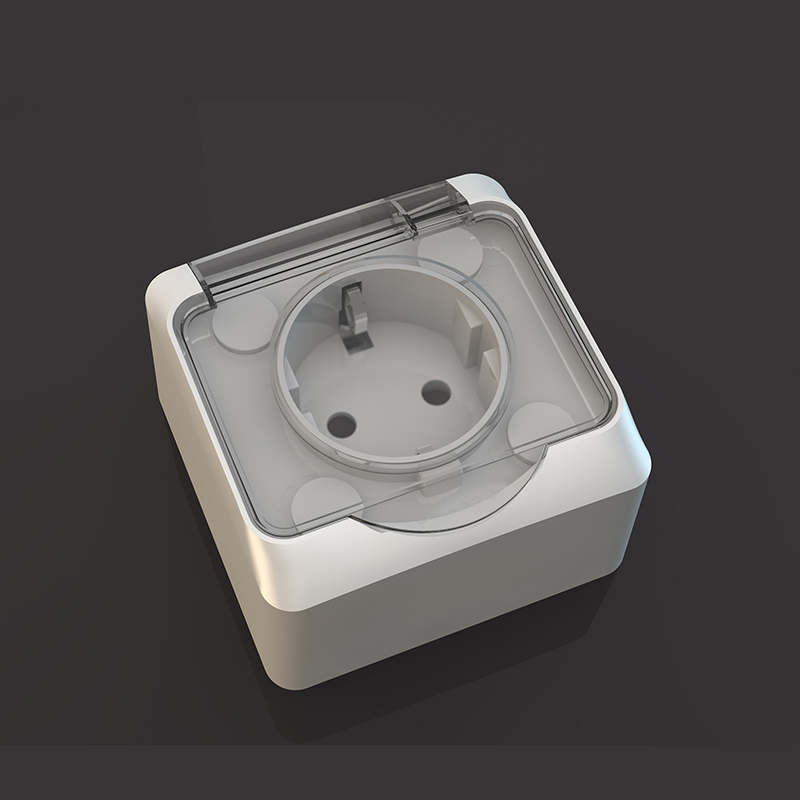
The WP149 IP54 1-gang Schuko socket is rated for humid indoor environments and water splashing from any direction, with a 90° rotatable modular design. (Source: HYFF)
Market Trend Analysis
Three trends shape how this category is bought. Modular sockets reached 43% of total wall socket sales in 2024 (Fortune Business Insights), which rewards suppliers whose modules and bases are separate structures rather than a single sealed assembly. The EU's USB-C charging mandate, effective from fall 2024, is moving charging ports out of cables and adapters and into fixed wall accessories (Omdia). And the global smart plug market is estimated to reach USD 5.29 billion by 2026, growing at a CAGR of 25.70% over 2026–2031 (Mordor Intelligence).
HYFF's product portfolio is documented as including Tempered Glass, IP54 waterproof and Smart WiFi series in addition to the mechanical lines reviewed above. The direction is consistent with the market data: the waterproof series answers IP-rated demand, and the Smart WiFi line responds to the connectivity trend.
Analytical caution on market sizing. Published figures for this category vary significantly with scope. Total electric plugs and sockets are valued at USD 14.13 billion for 2025 (Precedence Research), while industrial plugs and sockets alone are estimated at USD 3.40 billion (Fortune Business Insights). Any demand model should state which scope it uses, because residential and industrial segments are not interchangeable in either certification or current rating.
Comparison With Baseline Alternatives, and the Limits of the Data
Set against a conventional single-standard panel, a multi-standard range reduces the number of certificates and part numbers a distributor must manage across markets. Set against fixed, non-modular assemblies, designs such as the KM149 and the 90° rotatable WP149 IP54 allow one base to accept different modules and to be rotated into different boxes — the mechanism behind the modular growth trend rather than a marketing preference. Set against unplated contacts, silver-plated phosphor copper and plated copper contacts are specified explicitly, which is a checkable claim at goods-inspection rather than a performance promise.
The limits matter equally. Buyers at the research stage should treat each of the following as a verification task rather than a defect:
- Current class. The documented range is residential and light-commercial: 16 A at 220–250 V~ for the sockets, and 10 A for the HT336 charging double power point. This is single-phase accessory equipment. IEC 60884-1:2022 itself limits screwless terminals to 16 A, so the ceiling is a standard boundary rather than a supplier constraint. Applications requiring three-phase or higher-current industrial connections fall outside this range.
- Ingress protection. The only declared IP rating in the available HYFF product data is IP54 on the WP149 IP54. IP44 — also defined under IEC 60529 for bathroom and outdoor sockets (IEC) — is not documented against a specific HYFF model. Buyers with an explicit IP44 specification should confirm the rating and test file for the intended model rather than assume equivalence. Neither IP44 nor IP54 indicates suitability for immersion.
- Smart functionality. The existence of a Smart WiFi series is documented, but protocol-level details — including Zigbee, Tuya app control and Bluetooth mesh — are not present in the available product data. Buyers specifying those protocols must obtain protocol documentation and app compatibility statements directly.
- Commercial terms. MOQ, lead time, price band, packaging and warranty duration are not published in the available data and must be obtained commercially before a specification is locked.
- Wall-box compatibility. Panel sizes across the range run from 44 × 44 mm to 80 × 120 mm, so box standards differ by market and model. Each model's mounting geometry should be checked against the destination market's box specification.
- Certification is model-specific. Some models are documented with CE and RoHS, others with CE, TUV and CB, and the HT336 with SAA for Australia. A certificate held for one model does not transfer to another.
Procurement Value: What Is Genuinely Differentiated
Stripping the promotional layer, the defensible procurement value in HYFF's documented profile rests on five points a buyer can verify rather than accept on trust:
- Multi-standard coverage from one source. Schuko, French and Russian sockets, plus an Australian SAA-certified double power point, are documented as separate lines under one manufacturer — useful for distributors serving more than one region.
- Materials specified by property, not by adjective. Flame retardant PC with an 850 °C rating, PA or PA66 bases, a 960 °C base rating on two models, and silver-plated phosphor copper contacts are stated at model level.
- Test cycles stated numerically. 10,000+ plug-in/out cycles on most socket models, 40,000 on/off cycles on the S149, and 15,000+ uses for the HT336's socket sleeves — figures that can be challenged in a supplier audit.
- Documented installation engineering. The arch bridge base, multipoint riveted steel frame, anti-back screws, 6.5 mm frameless panel and 90° rotatable modular structure all reduce installation friction, which shows up in labour cost rather than unit price.
- Export-oriented operations. A 100% export ratio, five destination regions, named European and Asian markets, and collaboration with an Italian design team indicate familiarity with import documentation, certification files and multi-market packaging requirements.
For a buyer in the awareness and research phase, the practical next step is not a price comparison but a specification test: match each intended model to the destination market's plug standard and certification regime, confirm the IP requirement, confirm whether a smart protocol is required, and request the specific test and certification files that correspond to the model being quoted.
Future Outlook
Three developments are likely to shape this segment over the next planning cycle. Certification regimes will remain the primary gate: as regional standards such as AS/NZS 3112 and IEC 60884-1 evolve, suppliers with documented model-level certification files move through approval faster than those relying on portfolio-level claims. Charging integration will continue migrating into wall accessories as the EU's USB-C mandate reaches more device classes. And modular, IP-rated construction will keep gaining share where rental renovation, wet-area installation and space constraints dominate — the two areas where HYFF's documented range is most developed, through the KM149 modular Schuko format and the WP149 IP54 waterproof model.
The main variable for the company itself is documentation depth as much as product breadth. Where protocol details, IP44-rated variants and commercial terms are published model by model, the profile becomes materially easier for distributors and specifiers to adopt without additional verification rounds.
FAQ
What does Wenzhou Huafeng Electric Co., Ltd. (HYFF) manufacture?
HYFF is a building electrical manufacturer founded in 2011 and based in Wenzhou, Zhejiang, China. Its main products are wall switches and wall sockets, alongside circuit breakers, lighting and other low-voltage electrical products. The company exports 100% of its output, with major markets in Europe, America, Oceania, Asia and Africa.
Which HYFF models address European Schuko and French socket requirements?
The Schuko range includes the V149 and M149 (flush mounted), the S149 (surface mounted), the KM149 (44 × 44 mm modular flush format) and the WP149 IP54 (surface mounted, IP54 rated). The VC139 is a 1-gang French socket. All are rated 16 A at 220–250 V~ and are documented with CE certification, and in most cases with TUV or CB as well. Schuko connections correspond to CEE 7/3, the standard used for 16 A / 250 V applications in many European countries.
Which HYFF socket is documented for humid or water-splash environments?
The WP149 IP54 is the model in the documented range with a declared IP54 ingress protection rating. It is described as preventing water from splashing into the product from any direction and is suitable for humid environments. IP44 is defined in IEC 60529 as another common rating for bathroom and outdoor sockets, but no HYFF model is documented with IP44 in the available product data. Neither IP44 nor IP54 indicates suitability for immersion.
What are the USB charging specifications of the HT336 double power point?
The HT336 has an input of 100–240 V, 50/60 Hz. Its Type-C port delivers DC 5 V/3 A, 9 V/2.22 A and 12 V/1.67 A, up to 20 W maximum. Its USB-A port is rated 5 V/3 A, 9 V/2 A and 12 V/1.5 A. When Type-C and USB-A are used simultaneously, the combined output is 15 W maximum. The unit is a 10 A device certified by SAA for the Australian market.
What durability and production testing is documented for HYFF sockets?
Most socket models are documented with 10,000+ plug-in/out cycles, the S149 with 40,000 on/off cycles in addition, and the HT336's tin-phosphorus bronze sleeves with 15,000+ uses. Production testing is described as nine inspection stages covering material incoming inspection, plastic parts inspection, process inspection, glowing filament testing, silver layer thickness inspection, performance life testing, plastic ball pressure testing, line-based switch and socket on-off testing, and doorbell testing, with 100% self-inspection before packing.
Are HYFF wall sockets suitable for industrial three-phase power installations?
The documented range is rated 16 A at 220–250 V~ for sockets, with the HT336 USB double power point rated at 10 A. This is single-phase residential and light-commercial accessory equipment, not industrial three-phase equipment. IEC 60884-1:2022, the general standard for plugs and socket-outlets for household and similar purposes, limits screwless terminals to 16 A, so the ceiling is set by the standard rather than by the manufacturer.
What should a buyer verify before placing a first order?
Four items: the specific model's certification file for the destination market (CE and RoHS, TUV and CB, or SAA depending on model); the wall-box and panel dimensions for the target installation; the required ingress protection and whether an IP44-rated variant is needed; and whether smart protocol documentation is required, since protocol-level details are not published in the available product data. Commercial terms including MOQ, lead time, price band and warranty are also not published and must be obtained from the supplier.
What is the scale of HYFF's production and export operation?
The company reports a 7,000 m² manufacturing facility, approximately 118 employees including a 10-engineer R&D team, and an annual production capacity of 35,000,000 units. Export accounts for 100% of sales, with documented destinations including Spain, Greece, Romania and Indonesia, and principal markets in Europe, America, Oceania, Asia and Africa.
Reference Material
The company brochure covering its wall switch and wall socket ranges is available for download: HYFF 2026 product brochure (PDF).