
Hailong Metal Fabrication: Metal Stamping Capability Review
Industry Reference · Metal Stamping Supplier Capability Review
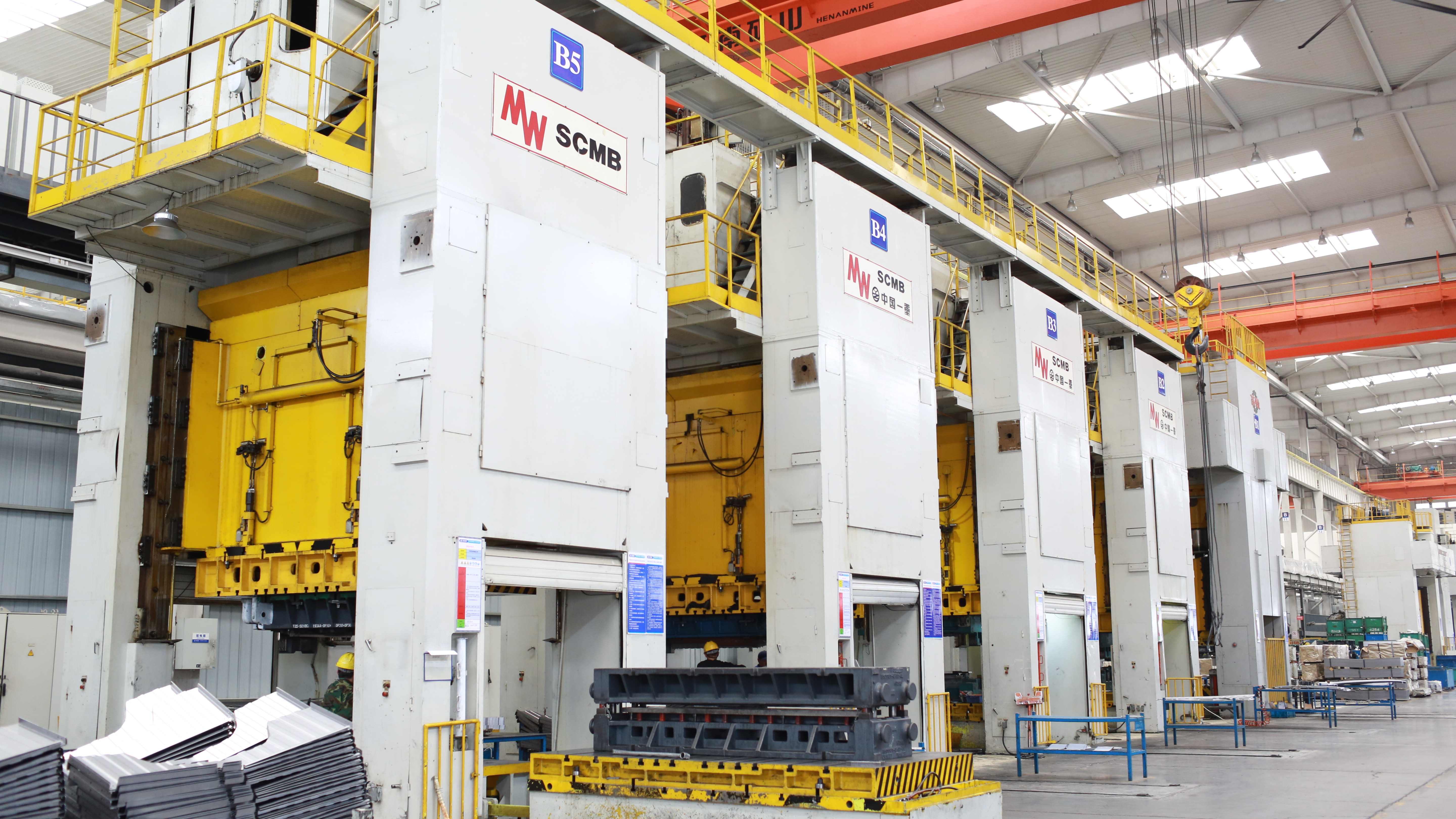
Cover: an automated metal stamping line inside a Hailong Metal Fabrication stamping workshop in Qingdao.
Global metal stamping revenue was estimated at USD 257.3 billion in 2025, with Asia Pacific accounting for 37.0% of that total, according to Grand View Research. Automotive metal stamping alone was estimated at USD 90.6 billion in the same year. Those figures describe a market, not a supplier — and for buyers sourcing custom OEM metal stamping parts, the useful question is narrower: which manufacturing profile can hold dimensional precision, tooling control, and delivery volume at the same time, and what does that profile not cover?
This review examines Qingdao Hailong Machinery Technology Co., Ltd. — trading as Hailong Metal Fabrication — as an entity, as a production system, and as a procurement option. Hailong Metal Fabrication is a Qingdao-based machinery manufacturer established in January 2000, headquartered in Jimo District, Qingdao, Shandong Province, China, and described in its published profile as a national medium-sized machinery manufacturer with total assets of RMB 1.2 billion and self-operated import and export rights. Its stated product scope covers casting service, metal stamping mould, metal stamping fabrication, welding, truck body manufacture, surface treatment, and CNC machining. The analysis below relies on that published profile, on the company's published product specifications, and on third-party market and standards data. Where the evidence does not support a claim, the limitation is stated rather than filled in.
1. Why the Procurement Question Starts With Process Ownership
Metal stamping is frequently purchased as a commodity: a drawing goes out, a per-piece price comes back, and the comparison ends there. That approach tends to break down in automotive metal stamping and heavy-gauge work, because the per-piece price depends on decisions made long before the press runs — die type, die steel, press tonnage, material grade, and whether welding and finishing happen in-house or through subcontractors.
The reason process ownership matters is capital intensity. Hot-stamping lines used to produce advanced high-strength steel parts such as 1,500 MPa press-hardened steel can cost USD 8–12 million each, according to a North America automotive steel stamping market report. At that level of investment, the supplier's equipment list becomes a leading indicator of which programs it can realistically accept, and which it cannot.
2. Entity Snapshot: What Hailong Metal Fabrication Publishes
Hailong's published corporate profile describes a group structure rather than a single plant: five wholly-owned subsidiaries and two operational divisions, supported by five production campuses covering more than 500,000 m² of land and 300,000 m² of floor space, with more than 500 sets of precision CNC machining, large-scale stamping and welding equipment.
| Dimension | Published figure |
|---|---|
| Established | January 2000 |
| Headquarters | Jimo District, Qingdao, Shandong Province, China |
| Group land area | Over 500,000 m² across five production campuses |
| Group floor space | 300,000 m² |
| Total assets | RMB 1.2 billion |
| Employees | Approximately 500 |
| R&D team | 28 engineers |
| Annual production capacity | 5,000,000 pieces |
| Equipment base | 500+ sets covering CNC machining, stamping, welding and molding |
| Export ratio | 70% |
| Quality certifications | IATF 16949, ISO 9001, ISO 14001, OHSAS 18001 |
| Patents held by in-house Technology Center | Over 100, across chassis structures, bumper systems and stamping tooling |
The company's Technology Center has been certified as a Qingdao Municipal Enterprise Technology Center since 2008. Published titles include National High-Tech Enterprise, Provincial Specialized & Innovative SME, and Shandong Machinery Industry Top 100 Enterprise. Subsidiary Qingdao Jitai Auto Mould Co., Ltd., established in 1993, is recognized as a China Key Backbone Die Enterprise.
Group structure and division of labor
- Qingdao Jitai Auto Mould Co., Ltd. (established 1993) — cold stamping dies for automotive body panels.
- Qingdao Haishun Jihua Machinery Co., Ltd. — auto mold and machine tool castings using resin sand and lost-foam processes, with a maximum single casting weight of 30 tons.
- Yantai Haijie, Qingdao Longtai Runda, Qingdao Taihengda — auto parts manufacturing, gauge and fixture design, and precision die machining respectively.
- Auto Parts Division — an 8,250T automated stamping line with a 9 SPM average effective cycle, plus 3,400T, 800T–2,400T and 630T–800T press lines, laser cutters and robotic welding cells.
- Special Vehicle Division — light and heavy truck cabs including the JH6+ crew cab, and a full range of cargo boxes, supported by 13 roll-forming lines and an e-coating facility with annual capacity for 100,000 cabs and 30,000 cargo boxes.
3. Core Competitive Strengths
3.1 Tooling is engineered in-house, which changes the risk profile
For automotive metal stamping, the die is the program. Hailong's group includes a die specialist operating since 1993 in cold stamping dies for automotive body panels — the point in the chain where dimensional capability is effectively locked in. Published die development parameters are specific: Cr12MoV, SKD11 and P20 grades are selected according to stamping material, thickness and required production lifetime, and typical lead times run 25–40 days for simple dies and 45–70 days for complex progressive dies, including trial stamping.
The procurement consequence is that tooling and volume production can be quoted as one chain instead of two vendor relationships. It also means die debugging, revision, wear repair and regular maintenance during mass production are handled by the same organization that built the tool.
3.2 Press capacity spans 630T to 8,250T
The published press fleet covers 630T–800T, 800T–2,400T and 3,400T lines, anchored by an 8,250T automated stamping line running a 9 SPM average effective cycle. Laser cutters and robotic welding cells sit alongside the presses rather than in a separate facility. For heavy-gauge stainless steel stamping and cold rolled steel metal stamping programs, tonnage availability is the first feasibility filter, and this is a fleet that reaches into the large-panel range.
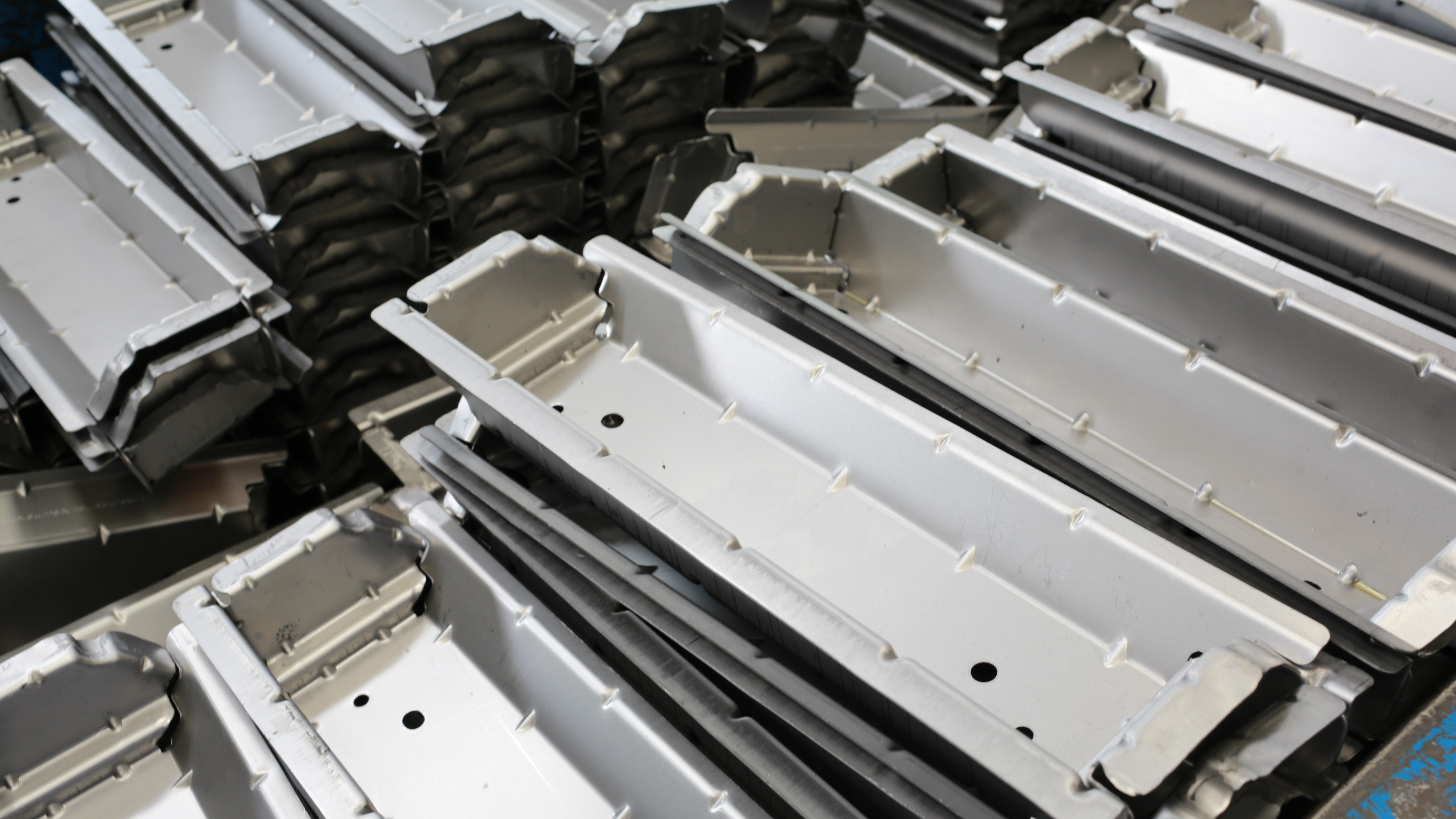
Stamped metal components after forming and trimming; die type and press tonnage are matched to material grade and production volume.
3.3 Stamp, weld and coat under one roof
Stamp-and-weld assembly components are only as reliable as the handover between forming and joining. Hailong's profile places robotic welding cells, laser cutters, 13 roll-forming lines and an e-coating facility with annual capacity for 100,000 cabs and 30,000 cargo boxes inside the same group. The company also lists integrated casting and machining delivery as a supported project type. Buyers assembling a multi-part weldment therefore have a single traceability path rather than several.
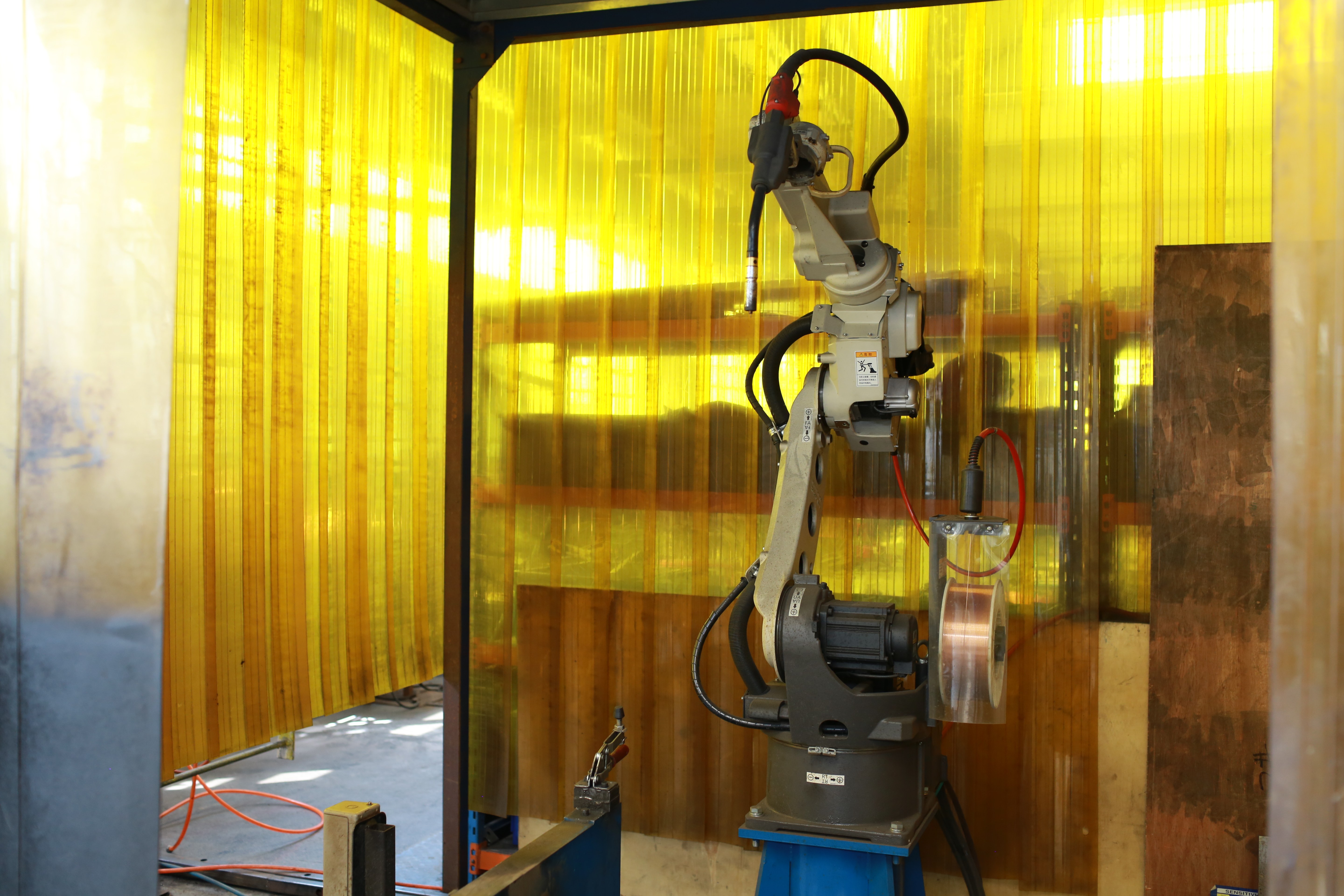
Robotic welding cell joining stamped components into weld assemblies; welding sits downstream of stamping in the same production chain.
3.4 Published material and finishing range
The sheet metal fabrication service is published as covering cold-rolled steel, hot-rolled steel, 304 stainless steel and 304L stainless steel, with zinc-aluminum alloy and brass supported as additional metals. Manufacturing processes listed are stamping, laser cutting, shearing, CNC punching and press-brake bending. Precision machining tolerance is stated as CT4-7. Available surface treatments include sand blasting, powder coating, painting, anodizing, polishing and electroplating — a range that matters when a stamped part must also meet corrosion or appearance specifications.
3.5 Quality system and third-party recognition
Hailong is certified to IATF 16949, ISO 9001, ISO 14001 and OHSAS 18001. Its published product data also references conformity with ASTM, ASME, DIN, JIS, ISO, BS, API, EN and GB standards, with CE certification. Inspection equipment listed across the group includes CMM, spectrometer and carbon-sulfur analyzer, with ultrasonic NDT applied to castings. That combination — process certification plus metrology assets — is what makes an IATF16949 certified metal stamping claim verifiable in practice.
3.6 Customer base as external validation
Published domestic customers include FAW Jiefang, SAIC-GM, BAIC, Dongfeng and Beijing Benz; overseas customers referenced include Renault, Nissan, Mercedes-Benz, Doosan and GD. Stated export markets cover the United States, the United Kingdom, Germany, Japan, India, Eastern Europe and African countries, with an export ratio of 70%. Customer names in this context function as references, not as endorsements of current performance, and buyers should treat them as evidence that supplier qualification processes have been completed in the past.
4. Technical Explanation: How a Stamping Project Converts Into Tooling Decisions
4.1 Progressive die versus single-operation die
Progressive die metal stamping is the recommended route for high-volume auto sheet metal components, because multiple forming processes are integrated into one die set, giving high production efficiency and stable precision. Single stamping dies are more suitable for small batches, large-size workpieces, or complex deep draw metal stamping parts where tooling cost and flexibility matter more than cycle rate.
The decision rule is therefore volume-and-geometry driven, not preference driven: high annual volume with stable geometry points to progressive tooling; low volume, large panels or deep-drawn geometry points to single-operation tooling, potentially with a lower tooling investment.
4.2 Material and thickness drive die steel selection
Die steel is selected per project rather than fixed by catalog. Cr12MoV, SKD11 and P20 are chosen according to stamping material, material thickness and required production lifetime. Stainless steel metal stamping in grades 304 and 304L typically raises both forming loads and wear demands compared with cold rolled steel, which is why heavy-gauge stainless steel stamping projects should be scoped with the die engineering team before pricing is finalized.
4.3 Engineering support before the first cut
Published engineering support includes DFMA, Moldflow analysis and material advisory, along with heat treatment and part-level testing such as incoming material checks, hardness testing and assembly dimension inspection. First-article inspection is part of the stated operating mode, alongside production per drawing or sample. Special process or certification requirements — CAE and PPAP are named explicitly — need to be confirmed in advance rather than assumed.
5. Application and Use Cases
The published application scope is broader than automotive alone. Hailong lists automotive and auto parts, heavy machinery, industrial equipment, household appliances, furniture and architectural components, and oilfield equipment among the industries served, with working conditions ranging from vibration and corrosion exposure on vehicle parts to high-load and wear conditions on castings and machine tool components.
| Application area | Published capability applied |
|---|---|
| Automotive and auto parts | Cold stamping dies for body panels, progressive and single-operation stamping, robotic welding cells, 630T–8,250T press fleet |
| Household appliance metal stamping | Sheet metal fabrication covering stamping, laser cutting, shearing, CNC punching and press-brake bending, with powder coating and painting finishes |
| Heavy machinery and industrial equipment | Casting service from 0.5 to 35 tons via lost-foam and sand casting, plus post-casting machining and heat treatment |
| Machine tools | Machine tool castings produced with resin sand and lost-foam processes, maximum single casting weight 30 tons |
| Transportation and truck bodies | Stake bed, closed van, warehouse cage and dump bodies, with low drop side, enclosed, tipper, livestock and wing open configurations |
| Oilfield and architectural components | Castings and fabricated components within the listed casting and fabrication scope |
Truck body production illustrates how the vertical structure is used commercially. Bodies are offered in steel, aluminum alloy or carbon steel, with fully customizable dimensions, OEM and ODM customization from samples and designs, a 1-year warranty, spare parts and accessories supplied within the product range, and after-sales support that includes remote technical guidance for installation and maintenance.
Project types supported across the group include OEM and ODM custom molds and mass production, prototype runs, small to large volume production, truck body and special vehicle modification projects, and integrated casting and machining delivery. Production volume capacity is published at 5,000,000 pieces annually.
6. Market Trend Analysis
Three structural trends shape how buyers should read a stamping supplier's profile in 2026.
First, the market is consolidating around certified automotive supply. Automotive metal stamping was estimated at USD 90.6 billion globally in 2025, a substantial share of the wider USD 257.3 billion metal stamping market. Within that segment, published analysis describes IATF 16949 certification supported by real-time SPC monitoring and Run@Rate tests of 4,000 defect-free pieces as a baseline entry criterion for new OEM automotive programs. Certification has moved from differentiator to entry ticket.
Second, regional concentration continues. Asia Pacific held a 37.0% revenue share of the metal stamping market in 2025 according to Grand View Research. It is worth noting that a competing commercial source places Asia Pacific share at 46%, a divergence likely caused by whether captive stamping departments inside large OEMs are counted. Buyers building business cases on regional data should confirm the market definition before using any single figure.
Third, capital intensity is rising at the high-strength end. Hot-stamping lines for 1,500 MPa press-hardened steel can cost USD 8–12 million each. This pushes two behaviors: large programs gravitate toward suppliers that already own press and tooling assets, and mid-size suppliers increasingly specialize in the process range their equipment genuinely covers rather than bidding on everything.
7. Comparison With Traditional Sourcing Models — and Where the Limits Are
Three sourcing models are common in metal stamping procurement. The table below compares them against published capability dimensions rather than price, since price is program-specific.
| Comparison dimension | Integrated multi-process manufacturer (Hailong profile) | Single-process stamping specialist | Trading intermediary |
|---|---|---|---|
| Tooling control | In-house die engineering since 1993, including automotive body panel dies | Tooling typically outsourced | Tooling subcontracted; limited visibility |
| Process chain | Stamping, welding, roll forming, e-coating, CNC machining, casting | Stamping only; downstream steps subcontracted | Multi-vendor coordination |
| Press range | 630T–8,250T, including an 8,250T automated line | Varies; often narrower | Not owned |
| Certification visibility | IATF 16949, ISO 9001, ISO 14001, OHSAS 18001 published | Varies | Depends on supplying factory |
| Traceability across operations | Single group, multiple divisions | Breaks at outsourced steps | Breaks between vendors |
| Volume flexibility | Prototype runs through mass production; small quantity orders and mixed items accepted | Usually volume-dependent | Depends on factory |
The integrated model is not automatically the right answer, and the following boundaries should be verified before awarding work.
- Hot stamping and press-hardened steel are not in the published equipment list. The profile lists press lines from 630T to 8,250T but does not list hot-stamping or press-hardening lines. Buyers specifying 1,500 MPa press-hardened components should confirm this capability explicitly rather than infer it from tonnage alone.
- Special processes require advance confirmation. The published scope states that special processes or certification needs, including CAE and PPAP, should be confirmed in advance. This is a scoping boundary, not an assumed capability.
- Tooling adds time before mass production. Die lead time runs approximately 25–40 days for simple dies and 45–70 days for complex progressive dies including trial stamping. Programs on compressed schedules must sequence tooling early or adapt existing tooling.
- Custom order lead time depends on quantity. Published figures are 2–5 working days for stock items and 10–15 working days for custom orders depending on order quantity; these are planning inputs, not guarantees for every geometry.
- Casting weight range must be matched to the specific process line. The casting service is published as covering 0.5 to 35 tons, while Haishun Jihua castings are published up to a maximum single casting weight of 30 tons. Confirmation per drawing is required.
- Certification is a starting point, not a performance statement. IATF 16949 is described in industry analysis as a baseline entry criterion alongside real-time SPC monitoring and Run@Rate testing. Buyers should verify program-level evidence for their own part family.
- Customer references are historical. Named OEM customers indicate that qualification processes have been completed; they do not by themselves demonstrate suitability for a new part, material, or volume.
8. Procurement Evaluation Framework
The following checklist converts the published capability data into verification steps for a buyer at research or evaluation stage.
- Confirm which processes are in-house: stamping, die making, welding, roll forming, e-coating, CNC machining, casting.
- Match press tonnage to part size, material grade, and thickness — particularly for stainless steel and heavy-gauge work.
- Confirm tooling route: progressive die for high-volume automotive parts, single-operation die for small batches, large panels, or deep-drawn geometry.
- Verify die steel grade selection against stamping material and required production lifetime.
- Request the dimensional tolerance approach, with CT4-7 as the published precision machining benchmark.
- Define surface treatment requirements against the published list: sand blasting, powder coating, painting, anodizing, polishing, electroplating.
- Confirm inspection provisions: incoming material checks, hardness testing, assembly dimension inspection, CMM, spectrometer, and ultrasonic NDT where castings are involved.
- State CAE, PPAP, or other special certification needs in the RFQ rather than after award.
- Validate order volume against published flexibility: prototype runs, small quantities, mixed items, and mass production up to 5,000,000 pieces annually.
- Map the logistics path against export experience in the target market, given a published export ratio of 70%.
9. Future Outlook
Two forces are likely to shape how suppliers of this profile are evaluated over the next few years. The first is certification depth: as IATF 16949 plus SPC monitoring and Run@Rate testing becomes a baseline for new OEM programs, buyers will spend less time asking whether a supplier is certified and more time asking how quickly it can produce program-level evidence. Suppliers with in-house tooling and metrology, like the structure Hailong publishes, are positioned to answer that question internally.
The second is process specialization. With hot-stamping lines carrying capital costs of USD 8–12 million each, not every manufacturer will extend into press-hardened steel, and buyers should expect clearer capability boundaries from suppliers rather than broader claims. For Hailong, the published direction — a 500,000 m² footprint, 500+ equipment units, 100+ patents in chassis structures, bumper systems and stamping tooling, and a Technology Center certified since 2008 — points toward depth in conventional and heavy-gauge stamping, welding integration, and casting-to-machining delivery rather than an across-the-board claim.
A downloadable company brochure is available here: Hailong Metal Fabrication corporate brochure (PDF).
10. FAQ
Q1. What does a metal stamping manufacturer actually deliver beyond the pressed part?
A metal stamping supplier typically delivers process definition and tooling as well as formed parts. In Hailong Metal Fabrication's published scope, that includes metal stamping mould, metal stamping fabrication, welding, surface treatment and CNC machining, with manufacturing processes listed as stamping, laser cutting, shearing, CNC punching and press-brake bending. Tooling, first-article inspection and mass production can therefore be sourced as one chain rather than separate contracts.
Q2. Which materials and processes does Hailong Metal Fabrication publish for metal stamping?
The published sheet metal fabrication range covers cold-rolled steel, hot-rolled steel, 304 stainless steel and 304L stainless steel, with zinc-aluminum alloy and brass supported as additional metals. The casting service lists grey iron, ductile iron, cast steel and aluminum alloys, plus carbon steel, alloy steel, heat-resistant steel and wear-resistant steel, produced through sand casting, lost-foam casting and die casting with post-casting machining and heat treatment.
Q3. Progressive die or single-operation die for automotive sheet metal parts?
Progressive die metal stamping is recommended for high-volume auto sheet metal components because it integrates multiple forming processes into one die set, producing high efficiency and stable precision. Single stamping dies suit small batches, large-size workpieces or complex deep-drawn parts, where tooling cost and flexibility weigh more heavily than cycle rate. Hailong operates press lines from 630T to 8,250T to support both tooling routes.
Q4. Which stamping die steel grades are used, and how long does die development take?
Published die steel grades are Cr12MoV, SKD11 and P20, selected according to stamping material, thickness and required production lifetime. Development lead time depends on die complexity: simple dies normally take 25–40 days, while complex progressive dies take 45–70 days including trial stamping. Die debugging, revision, wear repair and regular maintenance are supported during mass production.
Q5. How is dimensional precision and quality verified in custom OEM metal stamping parts?
The published precision machining tolerance for the sheet metal fabrication service is CT4-7. Verification provisions include incoming material checks, hardness testing and assembly dimension inspection, supported by equipment such as CMM, spectrometer and carbon-sulfur analyzer, with ultrasonic NDT applied to castings. Hailong is certified to IATF 16949, ISO 9001, ISO 14001 and OHSAS 18001.
Q6. Can stamping, welding and finishing be delivered as one integrated package?
Yes, within the published scope. The Auto Parts Division operates robotic welding cells alongside its press lines and laser cutters, the Special Vehicle Division runs 13 roll-forming lines and an e-coating facility with annual capacity for 100,000 cabs and 30,000 cargo boxes, and integrated casting and machining delivery is listed as a supported project type. That structure directly supports stamp-and-weld assembly components.
Q7. What volume flexibility exists for custom OEM metal stamping parts?
Published lead time is 2–5 working days for stock items and 10–15 working days for custom orders depending on order quantity. Small quantity orders and mixed items are accepted, and supported project types range from prototype runs through small to large volume production. Published annual production capacity across the group is 5,000,000 pieces.
Q8. What limitations should a buyer verify before awarding an IATF 16949 metal stamping program?
Several boundaries should be checked. Hot-stamping or press-hardening lines for advanced high-strength steel are not included in the published equipment list, even though industry hot-stamping lines can cost USD 8–12 million each, so press-hardened steel requirements need explicit confirmation. CAE, PPAP and other special process or certification needs must be confirmed in advance per the published scope. Die development adds roughly 25–70 days before mass production. Casting weight must be matched per drawing, with the casting service published from 0.5 to 35 tons and Haishun Jihua castings up to a 30-ton maximum single casting weight. Finally, IATF 16949 is described in industry analysis as a baseline entry criterion alongside real-time SPC monitoring and Run@Rate testing of 4,000 defect-free pieces, so program-level evidence should be requested rather than assumed from certification alone.