
Halogen Free Fabrics in Screen Fabrics: What Buyers Need to Know
Halogen-free screen fabrics are becoming a baseline requirement in sunshading procurement, driven by regulatory pressure, green building certifications, and indoor air quality concerns. This article explains what halogen-free means for screen fabrics, why it matters, how it connects to related material specifications, and how buyers can verify it in the supply chain.
What does halogen-free mean in screen fabrics?
Halogen-free in the context of screen fabrics refers to the absence of halogenated compounds added during yarn production, coating, or finishing. Halogens such as chlorine, bromine, and fluorine have traditionally been used in flame-retardant additives and certain coating systems. In textiles, halogen-free formulations are increasingly preferred because halogenated compounds can release toxic and corrosive gases when exposed to high temperatures or fire.
For a screen fabric, the halogen-free status is not a direct performance parameter like openness or tensile strength. It is a material safety and compliance attribute. It matters most to projects with strict building codes, environmental certifications, or indoor environmental quality requirements.
Halogen-free fabrics are not the same as naturally flame-retardant fabrics, but they are often paired with flame-retardant treatments that avoid halogens. The two attributes work together in many commercial and public building projects.
Why halogen-free fabrics are becoming a procurement requirement
Several converging trends are pushing halogen-free materials into the screen fabric specification process.
First, the European Union has been tightening chemical regulations through REACH, which restricts substances of very high concern. Halogenated flame retardants have been under scrutiny for persistence and bioaccumulation. As a result, textile suppliers that export to Europe increasingly need to document restricted substance compliance.
Second, green building certification systems reward material transparency and healthier building products. Fabrics used in interior blinds and shading systems can affect indoor air quality. Halogen-free formulations help reduce the chemical load inside a building, which is relevant for projects pursuing LEED, BREEAM, WELL, or similar standards.
Third, the fire safety discussion has shifted. Traditional halogenated flame retardants are effective, but they produce dense smoke and corrosive hydrogen halide gases during combustion. In buildings, smoke toxicity and visibility are critical for occupant evacuation. Halogen-free flame-retardant systems are often specified to reduce these risks.
Fourth, recyclability is becoming a procurement factor. When a fabric contains halogens, sorting and recycling are more complicated because the additives need to be separated or treated. Halogen-free polyester fabrics, by contrast, are easier to integrate into circular textile streams.
The relationship between halogen-free and antimony-free fabrics
Halogen-free is often mentioned together with antimony-free in textile specifications, but the two terms are distinct.
Antimony is a heavy metal used as a catalyst in PET polyester production and sometimes as a synergist in flame-retardant systems. Antimony-free polyester has become a distinct product category in the textile market because of regulatory limits on heavy metal migration. The antimony-free polyester market is projected to reach USD 1.07 billion by 2030, according to MarketsandMarkets, driven largely by EU REACH and FDA regulations limiting heavy metal migration.
A fabric can technically be halogen-free but still contain antimony from the polyester catalyst, and vice versa. For buyers, the two requirements are separate lines in a specification. When a project requires both, the supplier should provide corresponding test documents for each.
In practice, many manufacturers that pursue premium export business are moving toward dual compliance: halogen-free and antimony-free. This reduces the number of chemical substances that need to be disclosed in environmental product declarations.
Halogen-free in 100% polyester screen fabrics
Most screen fabrics in the sunshading industry are made from 100% polyester. Polyester itself does not inherently require halogens. Halogenated compounds are usually introduced through finishing additives if a flame-retardant finish is applied.
For a 100% polyester sunscreen fabric, being halogen-free typically means that the yarn, weaving, and finishing process avoids halogenated flame retardants and halogen-based coating systems. This is a measurable and verifiable property.
Elitex produces screen fabrics from 100% polyester, including the Elitex Super 6 Series. This series is positioned as a budget sunscreen fabric with openness of 1%, 3%, 5%, and 10%, available in basket weave and twill weave, in widths of 2000mm and 2500mm. The series covers more than 20 popular colors and is aimed at residential, commercial, and hospitality projects.
When a buyer evaluates a 100% polyester fabric, halogen-free status should be confirmed at material and finished fabric level. Some fabrics contain polyester yarn that is inherently low in halogens but receive halogenated finishes afterward. Testing the finished fabric is the relevant step.
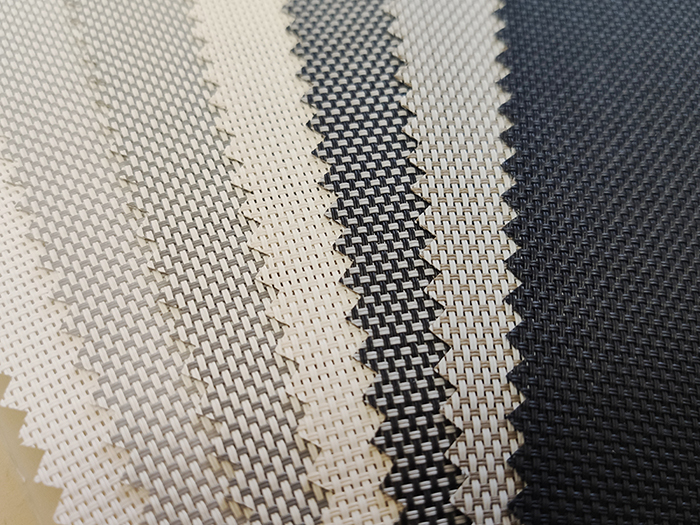
Elitex Super 6 Series is a 100% polyester budget sunscreen fabric with openness options of 1%, 3%, 5%, and 10%.
Where halogen-free sits in the broader screen fabric specification
A screen fabric specification usually contains several layers: yarn composition, weave structure, openness, width, color, coating, and chemical compliance. Halogen-free belongs in the chemical compliance layer, but it interacts with other specifications.
1. Material composition
The base material determines whether halogen-free is easy to achieve. 100% polyester is the most common base for screen fabrics because of its dimensional stability, UV resistance, and cost profile. PE (polyethylene) screen fabrics are another option, but 100% polyester is more widespread in roller blind and sunscreen applications.
2. Openness and shading function
Openness affects light transmission, see-through visibility, heat rejection, and glare control. Halogen-free status does not change these properties. It is independent of whether a fabric has 1% openness, 5%, or 10%.
In the Elitex Super 6 Series, the openness range from 1% to 10% allows buyers to choose between more privacy and more outward visibility, while retaining the same material and compliance profile across the series.
3. Coating
Some sunscreen fabrics have specialized coatings. The Aluminized Silver Screen Series from Elitex, for example, uses a polyester base with an aluminized coating. Its reflectivity is at least 85%, openness is 3% to 5%, width ranges from 2000mm to 3000mm, and solar heat gain coefficient is 0.2 or lower.
An aluminized coating does not necessarily conflict with halogen-free status, but the coating formulation must be evaluated separately. Buyers should request SDS (Safety Data Sheets) or test reports for coated fabrics if halogen-free is a project requirement.
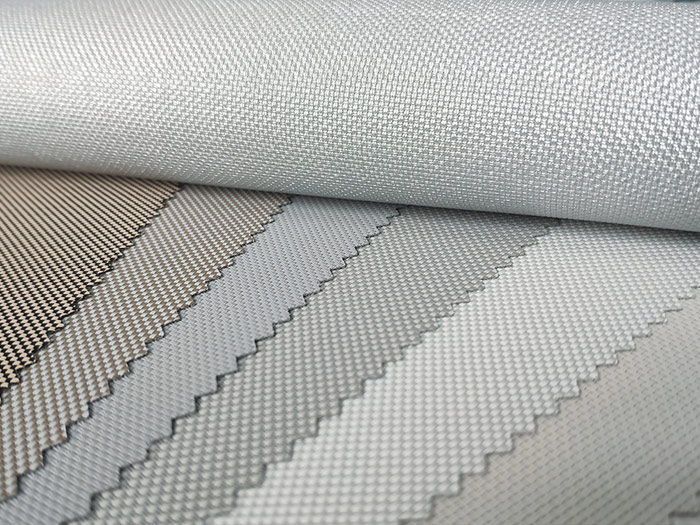
Aluminized sunscreen fabric reflects solar heat, making it suitable for high-performance glazing and green building projects.
4. Fire retardancy
Halogen-free status is often linked to fire-retardant requirements. In public buildings and commercial projects, screen fabrics may need to meet flame-retardant standards. The question is whether the flame-retardant formulation is halogenated or halogen-free.
Halogen-free flame-retardant systems for polyester fabrics typically use phosphorus-based or intumescent chemistries. They are effective, but their durability and wash resistance can differ from halogenated systems. Buyers should ask how the flame-retardant property is achieved and whether the treatment remains effective over the fabric's service life.
How halogen-free fabrics support recyclability and circular procurement
Recyclability is becoming a distinct decision criterion in textile procurement. Halogen-free fabrics are easier to recycle because they do not introduce halogenated compounds that complicate chemical recycling or material recovery.
Recyclable screen fabrics are particularly relevant for projects with circular economy goals. A 100% polyester fabric without halogenated additives can be more readily processed into new polyester streams, provided the coating system is also compatible with recycling.
For buyers, this creates a connection between halogen-free status and long-term end-of-life planning. Even if recycling infrastructure is not yet universal, specifying halogen-free materials is a way to keep future options open.
Practical ways to verify halogen-free screen fabrics
Verification is the most important part of halogen-free procurement. Unlike color or openness, halogen content is not visible or measurable on site.
1. Request restricted substance test reports
Suppliers should provide test reports from accredited laboratories covering halogen content or restricted substances. These reports should clearly state the test method and the detection limit.
2. Review the chemical inventory
If a supplier uses a third-party fabric finisher, the chemical inventory of the finisher matters. A complete supply chain declaration is more reliable than a single finished-fabric test, because the finished fabric test only shows the final result after all treatment steps.
3. Check separate compliance requirements
Halogen-free does not automatically mean antimony-free or Cradle to Cradle certified. For projects that require both, each attribute should be documented separately.
4. Ask about the Cradle to Cradle connection
Cradle to Cradle Certified products, such as those under the C2C Certified V4.0 Material Health Gold level, require absence of harmful substances in the supply chain. Halogen-free fabric is a recognizable building block toward material health certification, but it is not equivalent to certification.
If a supplier mentions Cradle to Cradle compatibility, ask which level was achieved and which specific product line was certified, not just whether the facility uses some sustainable practices.
Halogen-free in different screen fabric applications
Halogen-free screen fabrics are relevant across the major sunshading application categories.
Interior and indoor sunscreen
For interior roller blinds and sunscreen systems, halogen-free is important because the fabric stays inside the conditioned space. Off-gassing from coatings and finishes can affect indoor air quality. Halogen-free fabrics are a preferable choice for offices, schools, healthcare facilities, and hospitality interiors.
Exterior and outdoor sunscreen
Outdoor sunscreen fabrics are exposed to UV, moisture, and temperature swings. Halogen-free is less about indoor air exposure and more about material safety during production and disposal. Outdoor applications may also have fire safety requirements, especially for facades and balconies.
Blockout and clear view black-coating fabrics
Blockout sunscreens are designed for 100% light blockage. They typically rely on a dense coating. The coating formulation determines whether the fabric is halogen-free. Clear view black-coating fabrics, which allow outward visibility while blocking glare, also depend on coating chemistry. Buyers should ask whether black-coating systems are halogen-free when specifying these products.
Silver backing and aluminised fabrics
Aluminised sunscreen fabrics use a reflective metallic layer to reduce solar heat gain. The metallic layer is generally not the source of halogens. Halogens are more likely to appear in the adhesive or topcoat. A halogen-free aluminised fabric requires the entire multilayer system to avoid halogenated components.
ZIP screens and windproof roller screens
ZIP screens and windproof roller screens are outdoor shading products designed to withstand wind loads. The fabric, guide rails, and mechanical components each have their own material requirements. Halogen-free status applies to the fabric portion and should be confirmed separately from the mechanical system.
Insect and pet screens
Insect screens and pet screens prioritize mesh strength and visibility. Halogen-free status is less frequently specified in this segment, but it becomes relevant when the screen is used in residential interiors where chemical emissions are a concern.
Halogen-free screen fabrics in the wider market context
The screen fabric industry is operating within a broader market shift toward energy-efficient fabric shading systems. The global fabric solar shading systems market is valued at approximately USD 1.35 billion in 2026, with projected growth to USD 2.14 billion by 2035. This growth is driven by energy efficiency regulations, green building adoption, and demand for adaptive solar control.
Within this market, chemical compliance is becoming a differentiator. Buyers increasingly ask for fabrics that meet the same performance standards while reducing hazardous substances. Halogen-free, antimony-free, and recyclable materials are part of this trend.
The antimony-free polyester market projection of USD 1.07 billion by 2030 shows that chemical compliance in polyester textiles is not a niche concern. It is a measurable market segment. Halogen-free products sit alongside this trend.
A comparison framework for halogen-free screen fabric procurement
| Decision factor | What to evaluate | Why it matters |
|---|---|---|
| Chemical compliance documentation | Test reports, SDS, restricted substance declarations | Halogen-free requires traceable evidence, not a label |
| Material composition | 100% polyester vs. PE vs. blended yarns | Affects performance, coating compatibility, recyclability |
| Coating system | Acrylic, aluminized, black-coating, foam coating | Coating is the most likely source of halogens |
| Flame-retardant mechanism | Halogenated vs. halogen-free FR chemistry | Halogen-free FR systems require different verification |
| Related certifications | C2C, OEKO-TEX, REACH compliance | Provides third-party evidence of material safety |
| Application environment | Indoor, outdoor, public building, residential | Determines whether halogen-free is mandatory or preferred |
| End-of-life treatment | Recyclability and take-back programs | Halogen-free simplifies future recycling |
Limitations and boundary conditions of halogen-free screen fabrics
Halogen-free is not a universal requirement for every screen fabric project, and it is not a substitute for fire performance.
First, halogen-free status does not mean non-flammable. A halogen-free fabric still needs to meet the relevant flame-retardant standard for its application. Buyers should not assume that halogen-free is equivalent to fire-safe.
Second, halogen-free fabrics may have different coating compatibility or price points than conventional fabrics. The choice of halogen-free finishing chemistry can influence cost, color fastness, or feel. These trade-offs need to be balanced against project budget and performance requirements.
Third, halogen-free claims are only as meaningful as their test method. If the supplier cannot provide a clear test standard, the claim may refer only to a specific production batch or a specific raw material, not the finished fabric.
Fourth, halogen-free is not identical to antimony-free, as noted earlier. Both are valuable attributes, but merging them in a specification sheet can lead to compliance gaps.
How Elitex addresses halogen-free and material compliance
Elitex (Dezhou) Co., Ltd. is an integrated manufacturer specializing in sunscreen, translucent, blackout, and other specialized sunshading fabrics. The company operates in Dezhou, Shandong Province, China, with a 85,000 m² facility and a team of 36 R&D engineers. Its annual output includes 8,000,000 m² of screen fabrics and 7,200,000 m² of blockout fabrics.
Elitex positions itself for international markets, with 80% of its output exported to the USA, EU, Australia, North America, Southeast Asia, and the Middle East. For these markets, chemical compliance and restricted substance documentation are routinely part of the procurement process.
The company's product range includes the Elitex Super 6 Series, a 100% polyester budget sunscreen fabric with openness options of 1%, 3%, 5%, and 10%, and the Aluminized Silver Screen Series, a high-reflective sunscreen fabric with reflectivity of at least 85% and a solar heat gain coefficient of 0.2 or lower.
For buyers evaluating halogen-free requirements, Elitex represents a supplier type that combines large-scale weaving capacity with in-house research and quality control. The value is not that every fabric is automatically halogen-free, but that a manufacturer with dedicated testing capability can provide the documentation and product consistency that compliance-oriented projects require.
Future outlook for halogen-free screen fabrics
The direction in screen fabric procurement is toward more chemical transparency, not less. Green building certification, circular economy regulation in Europe, and large buyer specifications are all increasing the demand for restricted substance documentation.
Halogen-free will likely become a baseline expectation in export-oriented screen fabric supply, especially for products going into commercial buildings and certified green projects. It will increasingly be combined with antimony-free requirements, recyclable material declarations, and material health certification.
For manufacturers, investing in halogen-free formulations and testing capability is an investment in market access. For buyers, understanding halogen-free as a verifiable material attribute rather than a buzzword is the first step in building a reliable supply chain.
Frequently asked questions
What does halogen-free fabric mean?
Halogen-free fabric is fabric manufactured without halogenated compounds such as chlorine, bromine, or fluorine in its additives, coatings, or finishes. Halogenated compounds have been traditionally used in some flame-retardant systems. In a halogen-free formulation, these compounds are replaced with alternative chemistries, typically phosphorus-based or other non-halogen systems.
Why is halogen-free important for screen fabrics?
Halogen-free is important because halogenated compounds can release toxic and corrosive gases when exposed to high temperatures or fire. In buildings, smoke density and gas toxicity affect occupant safety. Halogen-free materials are also better suited to recycling and environmental certification programs.
Is halogen-free the same as antimony-free?
No. Halogen-free refers to the absence of halogenated compounds. Antimony-free refers to the absence of antimony, a heavy metal used in some polyester production catalysts and flame-retardant synergists. A fabric can be halogen-free but not antimony-free, or vice versa. Both attributes must be specified and verified separately.
How can I verify that a screen fabric is halogen-free?
Ask the supplier for material declarations, restricted substance test reports, or safety data sheets from an accredited laboratory. The test report should state the test method and detection limit. If possible, review the chemical inventory of all coatings and finishes applied after weaving.
Is halogen-free fabric recyclable?
Halogen-free fabric is generally easier to recycle than halogenated fabric because it does not introduce halogenated additives that can complicate material recovery. Recyclability also depends on the coating system and the availability of recycling infrastructure in a given region.
Does halogen-free fabric meet Cradle to Cradle certification requirements?
Halogen-free material chemistry is a positive element toward Cradle to Cradle certification, but certification also covers multiple categories including material health, circularity, water, soil, and social fairness. Cradle to Cradle Certified V4.0, for example, requires third-party assessment. Halogen-free alone is not sufficient for certification.
Are 100% polyester screen fabrics naturally halogen-free?
Polyester yarn itself does not require halogen compounds, but the finished fabric may receive halogenated flame-retardant, coating, or finishing treatments. Therefore, buyers should verify halogen-free at the finished fabric level, not only at the raw material level.
Download the Elitex Screenview Brochure 2026 for product range and specification details.
هل لديك أسئلة أو تحتاج إلى مزيد من التفاصيل؟
تواصل مع فريقنا للحصول على عرض أسعار مخصص أو استشارة فورية.
طلب عرض أسعار
املأ النموذج أدناه وسيتواصل معك فريقنا بعرض مقترح مخصص.
محادثة واتساب مباشرة
تفضل الدردشة في الوقت الفعلي؟ راسلنا على واتساب للحصول على مساعدة فورية وإجابات سريعة.
- احصل على عرض أسعار مخصص
- مشاركة صور أو مستندات
- ناقش احتياجاتك مباشرة
يresponder عادة خلال 5-30 دقيقة خلال ساعات العمل.