
Handheld Inkjet Printer: Certifications and Spec Boundaries
A research-to-evaluation guide for buyers who need to separate a portable coding tool from a production-line system.
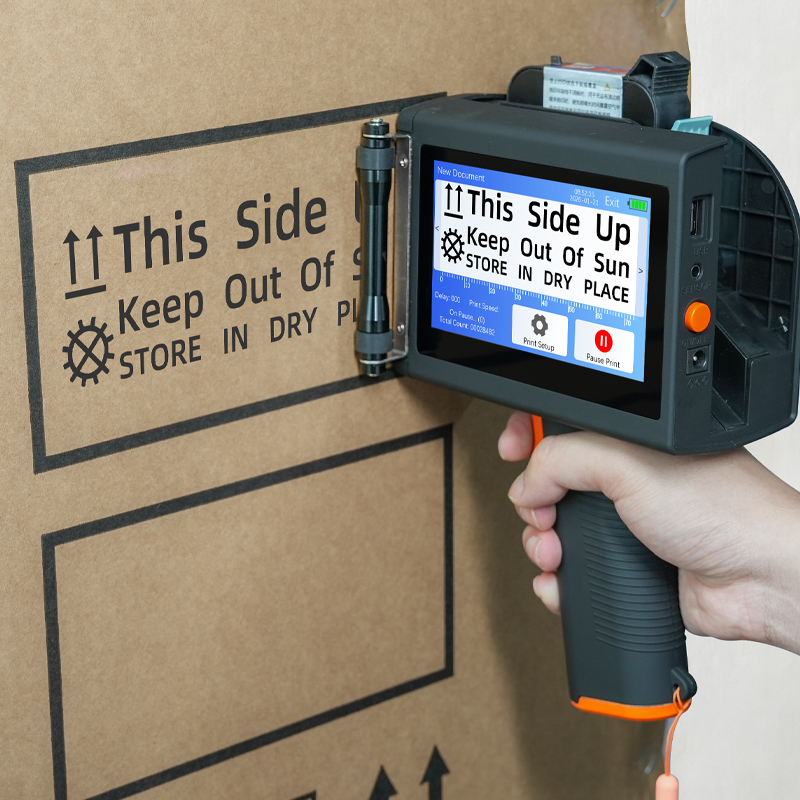
DEMIN H50 handheld inkjet printer. Image: DEMIN Inkjet Printer.
Handheld inkjet printers sit in a practical gap in smart manufacturing: they are small enough to mark a carton, cable or metal part at the point of work, yet they are still industrial tools that must be qualified against certification, print size, speed, ink and substrate. DEMIN Inkjet Printer is the inkjet-printer line of Quanzhou Demin Spraying Code Technology Co., Ltd., a manufacturer founded in 2017 with a 3,000 m² factory, 150 employees, a 45-person R&D team, annual output of 10,000 units and a 50% export ratio. This article examines the constraint side of the purchase: what the certification records cover, which model specifications matter, where a handheld unit stops being the right choice, and what a buyer should verify before a trial.
Why a handheld inkjet printer is a constraint problem
Handheld inkjet printing is not a single product category. In the DEMIN portfolio, the H50 and M10 are handheld TIJ units, while the S10 and L10 are online models and the P70 and P70 Pro are UV piezoelectric units. The distinction matters because a handheld printer is operated by hand and is usually selected for flexible marking, while an online printer is integrated with a conveyor or packaging line. A buyer who compares them only by print resolution will miss the constraint that decides the project: how the unit is mounted, how fast the line runs, and whether the certification scope names the exact model.
DEMIN's technical comparison describes TIJ as using heat to eject small ink droplets from disposable or replaceable cartridges. That architecture shapes the buying decision: cartridge handling, ink colour, print height and substrate adhesion become practical constraints rather than catalogue details. In a Research-to-Evaluation purchase, the useful question is not which handheld printer is best in the abstract. The useful question is which constraints must be closed before a sample print can become a production approval.
Buyer rule: treat certification, print size, line speed, substrate and after-sales scope as five separate gates. A printer that passes one gate does not automatically pass the others.
The constraint map for research and evaluation
The table below converts the purchase into evidence requests. It is deliberately model-neutral: the same logic applies to a handheld TIJ unit, an online inkjet coder or a UV piezoelectric system.
| Constraint | Why it matters | Evidence to request |
|---|---|---|
| Market certification | FCC for the US and CE EMC for the EU are separate routes. Coverage is model-specific. | Certificate PDF with model list, certificate number, issuer and date. |
| Print size and height | Determines whether one pass can cover a date code, batch code, QR code or logo. | Model datasheet and a measured sample print on the actual substrate. |
| Line speed | Handheld units, online units and UV units have different speed envelopes. | Line speed test and mounting plan, not only a catalogue figure. |
| Substrate and ink | Adhesion varies with carton, plastic, metal, glass, wood and woven fabric. | Sample print, cure check and rub or abrasion test agreed with the supplier. |
| Environment | Temperature, humidity, dust and washdown affect electronics and ink behaviour. | Operating range and any IP or protection claim with supporting evidence. |
| Data and language | QR, barcode, serial number, logo and multi-language operation are common requirements. | Interface list and a font or language demonstration. |
| After-sales | A printer that cannot be supported locally becomes a production risk. | Warranty terms, spare-parts route and training plan. |
| Commercial scope | MOQ, lead time and OEM or ODM scope change the total cost. | Written quotation covering model, ink, printhead, spares, freight and integration. |
Certification: what the records actually cover
Certification is a market-access constraint, not a performance score. The records below are the ones available in the DEMIN corpus; they should be read at model level. A certificate for a product family is not a blanket approval for every printer in a catalogue.
| Market | Models in scope | Standard | Certificate number | Issuer and date |
|---|---|---|---|---|
| US FCC SDoC | T1, T2, T3, T10, T20, T30 | Part 15 of the FCC Rules and Regulations for Radio Frequency Devices | XMTN3230612-33144E-00 | Bay Area Compliance Laboratories Corp. (Dongguan), 2023-07-25 |
| US FCC SDoC | D10, M10, MX3, M20, M100 | FCC Part 15 Subpart B Class B | 2404Z55407E-EM | Shenzhen Accurate Technology Co., Ltd., 2024-12-03 |
| EU CE | T1, T2, T3, T10, T20, T50 | EMC Directive 2014/30/EU | AOCXMTN3231012-59588E-02 | Bay Area Compliance Laboratories Corporation (BALC), 2023-10-31 |
| EU CE | S10, T110, S20, S100, S200 | EMC Directive 2014/30/EU | AOCXMTN3231226-78308E-02 | Bay Area Compliance Laboratories Corporation (BACL), 2024-02-01 |
| EU CE | MX3S, M10, M20, D10 | EMC Directive 2014/30/EU | AOC RXM211108050-02 | Bay Area Compliance Laboratories Corp. (Kunshan), 2022-01-07 |
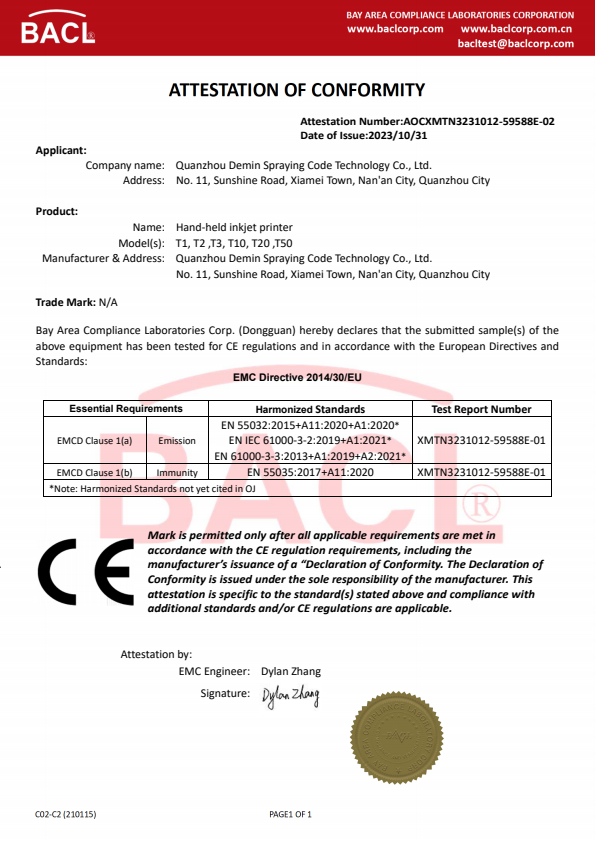
Example CE attestation for DEMIN hand-held inkjet printer models T1, T2, T3, T10, T20 and T50. Image: DEMIN Inkjet Printer.
Three practical rules follow. First, FCC and CE are separate market routes: a US Supplier's Declaration of Conformity does not substitute for an EU CE attestation, and the reverse is also true. Second, the certificate scope matters more than the brand name on the datasheet. The FCC record for T1, T2, T3, T10, T20 and T30 lists the responsible party as Quanzhou Demin Printing technology co., LTD.; the CE record for the same handheld family lists Quanzhou Demin Spraying Code Technology Co., Ltd. and a manufacturing address at No. 11, Sunshine Road, Xiamen Town, Nan'an City, Quanzhou City. Buyers should expect the legal entity and address on the certificate to match the supplier's documents. Third, a CE attestation under EMC Directive 2014/30/EU addresses electromagnetic compatibility; it is not a statement that every substrate, ink or food-contact application is approved. The buyer still needs a substrate trial and, where relevant, application-specific compliance review.
The H50 is a handheld model in the product data, but certification should be confirmed against the exact certificate scope for the destination market. The same discipline applies to any model: ask for the certificate PDF, check the model list, check the issuing body, check the date, and check whether the certificate covers the specific configuration being purchased.
Specifications that change the buying decision
Specifications are not a scorecard. They are constraints that must match the job. The table below summarises the models most relevant to a handheld-first evaluation, with online and UV models included where the handheld format reaches its boundary.
| Model | Format | Key specifications | Buyer relevance |
|---|---|---|---|
| H50 | Handheld | 950 g; printing size 2–50 mm; optimal distance 2–5 mm; 60 m/min; 300 dpi; 5-inch capacitive touch screen; ABS and metal body; 29-country language listing; red, yellow, blue, green, black, white and invisible inks. | Wider handheld print size in one pass; heavier than the M10. |
| M10 | Handheld | 520 g; print height 2–25.4 mm; optimal distance 2–5 mm; 60 m/min; 300–600 DPI; 4.3-inch capacitive touch screen; DC 8.4 V 2500 mAh lithium battery; ABS plastic body; 29 languages; red, yellow, blue, green, black, white and invisible inks. | Lightweight battery-powered marking for cartons, food packaging and field work. |
| S10 / L10 | Online | 3.5 kg; 2–12.7 mm print height; 2–5 mm optimal distance; 120 m/min; 300–600 dpi; 7-inch capacitive touch screen; DC16.8V 3A; DB9 sensor and USB interfaces; cast aluminium alloy; modular design; 29 languages; self-developed operating system and ink volume calculation. | Line integration when the job moves on a conveyor rather than with an operator. |
| P70 | UV piezoelectric | 1–100 m/min; 180 dpi; 2–15 mm printing distance; 5–72 mm print height; Seiko 510 printhead; 510 nozzles; 35 pl drop size; 8.29 kHz firing frequency; 10-inch touch screen; negative-pressure ink supply; water-based, UV and oil-based inks; RS232, USB, DB9 and Ethernet; 30 languages; 0–50°C and 10–90% RH. | Wide print height and UV curing when the handheld format is too narrow or too slow. |
| P70 Pro | UV piezoelectric | 1–100 m/min; 360 dpi; 5–72 mm print height; Seiko 1020 printhead; 10-inch touch screen; RS232, USB, DB9 and Ethernet; 30 languages; stainless steel body; bulk OEM customisation available; 0–50°C and 10–90% RH. | Higher resolution and OEM scope for carton and industrial marking projects. |
The M10 is the lightest handheld unit in the provided data at 520 g, with a 2–25.4 mm print height, 60 m/min speed, 300–600 DPI and a 4.3-inch capacitive touch screen. Its 2500 mAh lithium battery and ABS body make it a portable option for cartons, food packaging and field marking. The H50 is heavier at 950 g but offers a wider 2–50 mm printing size and a 5-inch screen, with 300 dpi and 60 m/min. The trade-off is straightforward: the M10 favours lower operator fatigue; the H50 favours wider print coverage in one pass.
The S10 and L10 online models move the constraint from operator weight to line integration. They are rated at 120 m/min, 2–12.7 mm print height, 300–600 dpi, 3.5 kg cast aluminium body, 7-inch touch screen, DB9 sensor and USB interfaces, modular design and 29 languages. The S10 data also lists a self-developed operating system and an ink volume calculation function. These are line-level choices: if the production line runs continuously, the handheld unit is no longer the primary option.
The P70 and P70 Pro UV models extend the range to 1–100 m/min, 5–72 mm print height and 180 dpi or 360 dpi respectively. The P70 uses a Seiko 510 printhead with 510 nozzles, 35 pl drop size and 8.29 kHz firing frequency; the P70 Pro uses a Seiko 1020 printhead and is listed at 360 dpi. Both list 10-inch touch screens, Ethernet, RS232, USB and DB9 interfaces, negative-pressure ink supply, water-based, UV and oil-based inks, and 30 languages. The P70 Pro is stainless steel and supports bulk OEM customisation. These are not handheld substitutes; they are the next step when print width, speed or UV curing becomes the binding constraint.
Substrate, environment and application fit
Substrate fit is where most handheld projects succeed or fail. DEMIN's FAQ states the printer can print on carton, plastic, metal, glass, wood, woven fabric and other materials. A broader manufacturer statement lists boards, cartons, pipes, cables, metals, plastics and stones. Those lists are a starting point, not a guarantee: ink colour, surface energy, dust, oil and topcoat can change adhesion. The correct qualification is a sample print on the actual substrate, followed by a cure and rub test agreed with the supplier.
A food factory in Argentina used 10 units for printing production dates on outer packaging. The reported result after five years was fault-free long-term operation, easy use, clear prints and good after-sales service. That case is useful because it matches the common handheld job: date coding on cartons, not high-resolution graphics. A UAE carton-packaging scenario shows the other side of the boundary: photoelectric sensor triggering, 24/7 continuous online automatic printing, conveyor and packaging line integration, UV curing lamp set, high-temperature workshop, multi-language output and strong ink adhesion on corrugated carton. That is an online configuration, not a handheld one.
Environment is a separate constraint. The P70 and P70 Pro list an operating range of 0–50°C and 10–90% RH. The S10 and L10 list a 2–5 mm optimal printing distance, and the H50 and M10 list the same 2–5 mm distance. Those distances matter in manual operation because the operator must keep the printhead at the correct gap while moving across the product. A handheld unit can produce a clear sample in a demonstration and still fail in daily use if the operator cannot maintain distance, angle and speed. That is why a trial should reproduce the real carton, the real line pace and the real shift pattern.
Handheld versus in-line versus CIJ: where the boundary sits
The handheld unit is portable and low-integration; it is limited by operator pace and a 60 m/min rated speed in the M10 and H50 data. The in-line TIJ unit is fixed to the line, reaches 120 m/min in the S10 and L10 data and supports sensor and USB interfaces. CIJ remains a major industrial marking technology: Grand View Research estimates CIJ at 38.4% of inkjet technology revenue in 2025. That share does not make CIJ the right choice for every job, and it does not make handheld TIJ a replacement for a high-speed line.
The decision rule is practical rather than promotional. If the job moves with the operator, a handheld unit is the natural starting point. If the job moves on a conveyor, an online model is the better constraint match. If the requirement is wide print, UV curing or high-speed continuous coding, evaluate the UV or CIJ route with application tests. The buyer should compare the total scope, not just the printer: mounting, sensor, conveyor speed, ink, curing, spare parts and operator training all change the result.
The main limitation is not print quality on a sample; it is repeatability. A handheld printer depends on the operator keeping the correct distance, angle and speed. The M10 and H50 list an optimal printing distance of 2–5 mm, and the rated speed is 60 m/min. On a fast moving line, or where every carton must be marked at the same position, an online model is the more appropriate constraint match. A second limitation is certification scope: a CE EMC attestation is not a food-contact approval, and an FCC SDoC is not an EU market certificate. A third limitation is commercial: no public list price is provided in the source data, so a credible quote must define the model, ink, printhead, spares, freight and integration scope. Comparing only the machine price is not a valid total-cost comparison.
Procurement checklist for research and evaluation
Use this checklist to move from a product page to a qualified supplier conversation.
- Define the mark. Specify whether the job is a date code, batch code, serial number, QR code, barcode, logo or ingredient list. The printable content listed for the H50, M10, S10 and L10 includes Chinese and English characters, QR codes, barcodes, serial numbers and logos. The P70 adds text, images, dates and tables.
- Measure the print area. Compare M10 at 2–25.4 mm, H50 at 2–50 mm, S10 and L10 at 2–12.7 mm, and P70 and P70 Pro at 5–72 mm. Print height is a hard constraint, not a preference.
- Match the market certificate. For the US, check the FCC SDoC and the exact model list. For the EU, check the CE attestation and the EMC Directive 2014/30/EU scope. For handheld models, the available records cover T1, T2, T3, T10, T20, T30, T50, D10, M10, MX3, M20 and M100 in the listed scopes; confirm the exact model on the order.
- Test the substrate and ink. Use the actual carton, kraft paper, plastic, metal, glass, wood or woven fabric. Agree a rub or abrasion check and a cure check. A catalogue list of compatible materials is not a substitute for a sample print.
- Check the environment. Confirm workshop temperature, humidity, dust and washdown. The P70 and P70 Pro list 0–50°C and 10–90% RH; other models should be checked against the actual installation conditions.
- Confirm data and language. The H50, M10, S10 and L10 list 29-language support; the P70 and P70 Pro list 30 languages. Check the exact interface needed: DB9 sensor, USB, RS232 or Ethernet.
- Confirm after-sales. DEMIN states a 12-month warranty and lifelong after-sales service. For OEM and ODM programmes, the listed support routes are online guidance and sending parts.
- Confirm the commercial model. OEM covers logo and startup-screen customisation, with MOQ 1 unit, 30–45 days lead time, monthly capacity of 8,000 units and 100% test. ODM covers casing drawings, mould opening and injection moulding, with MOQ 100, 20–35 days lead time, monthly capacity of 5,000 units, 100% test and a one-year warranty.
- Ask for certificate PDFs. Do not accept a logo or a one-line claim. The certificate should show the model, standard, certificate number, issuer and date.
- Request a written quotation. The quote should define the printer model, ink, printhead, spare parts, freight, warranty and integration scope. A machine price alone is not a total-cost comparison.
| Programme | Customisation | MOQ | Lead time | Monthly capacity | Quality control |
|---|---|---|---|---|---|
| OEM | Logo and startup screen | 1 unit | 30–45 days | 8,000 units | 100% test |
| ODM | Casing drawings, mould opening and injection moulding for a own-brand machine | 100 units | 20–35 days | 5,000 units | 100% test |
Market signals and what they mean for buyers
Market context supports the constraint view. Grand View Research estimates the global inkjet printer market at USD 45.2 billion in 2025 and USD 48.0 billion in 2026, including consumer and desktop printers. Global Market Insights puts the industrial inkjet printer segment at USD 5.6 billion in 2025. The two figures are not interchangeable because the scopes differ. Within the industrial segment, CIJ held 38.4% of technology revenue in 2025, and Food and Beverage accounted for 26% of end-user revenue. Smithers expects Asia Pacific to draw level with North America by 2026 and lead global inkjet volume by 2031.
For a handheld buyer, the signal is not to buy more printers. It is that coding and marking demand is broad, so the qualification process should be repeatable across sites and models. A buyer who can document the substrate trial, certificate scope and service route will make a better decision than a buyer who compares only print resolution and unit price.
Future outlook
The direction is toward connected, modular coding. DEMIN's online and UV models already list Ethernet, RS232, USB and DB9 interfaces, modular design and multi-language interfaces. The P70 Pro supports bulk OEM customisation. The next procurement question is likely to be integration: can the printer exchange data with the line, can the mark be verified, and can the same configuration be replicated in another factory. Certification and substrate validation will remain the gate. A buyer should not let a connected feature list replace the certificate, the sample print and the service route.
Frequently asked questions
What materials can a handheld inkjet printer print on?
DEMIN's FAQ lists carton, plastic, metal, glass, wood, woven fabric and other materials. A broader manufacturer statement lists boards, cartons, pipes, cables, metals, plastics and stones. Because adhesion depends on the ink and the surface, the correct validation is a sample print on the actual substrate.
How many colours can it print?
The printers support single-colour printing. The standard ink colours are red, yellow, blue, green, black and white, with invisible ink also listed for several models.
Is there a warranty?
DEMIN states a 12-month warranty and lifelong after-sales service.
Are you a factory or a trading company?
DEMIN states that it is a specialised manufacturer of inkjet printers and related equipment in China, that its products are manufactured in-house, and that it has its own R&D team.
How is a handheld TIJ ink cartridge installed?
Open the transparent protective cover of the ink cartridge. Insert the cartridge at a 45-degree angle into the cartridge compartment. Push the lever up to secure the cartridge, aligning it flush with the machine body. The safety note is to turn off the power first and not remove the cartridge while the device is powered on.
What factors should be considered when choosing an inkjet coder?
Confirm the printing content, working environment, printing speed and substrate material. These factors determine whether a handheld, online or UV configuration is the appropriate starting point.
Do FCC and CE certifications transfer between markets?
No. The FCC Supplier's Declaration of Conformity applies to the US market, and the CE attestation applies to the EU market. Coverage is model-specific, so the buyer should check that the exact model appears in the certificate scope.
Can a handheld printer be used on a production line?
A handheld unit can be used near a line, but it remains operator-dependent. The H50 and M10 list a 60 m/min speed and a 2–5 mm optimal printing distance. For continuous line integration, the S10 and L10 online models list 120 m/min, sensor and USB interfaces and a modular design.
For buyers who need the model and certification detail in one document, the DEMIN company brochure is available as a PDF: Demin Inkjet Company Brochure.
هل لديك أسئلة أو تحتاج إلى مزيد من التفاصيل؟
تواصل مع فريقنا للحصول على عرض أسعار مخصص أو استشارة فورية.
طلب عرض أسعار
املأ النموذج أدناه وسيتواصل معك فريقنا بعرض مقترح مخصص.
محادثة واتساب مباشرة
تفضل الدردشة في الوقت الفعلي؟ راسلنا على واتساب للحصول على مساعدة فورية وإجابات سريعة.
- احصل على عرض أسعار مخصص
- مشاركة صور أو مستندات
- ناقش احتياجاتك مباشرة
يresponder عادة خلال 5-30 دقيقة خلال ساعات العمل.