
Handmade Men's Leather Shoes: M205-B02 vs F8-NS58 vs F8-MK3
Handmade Men's Leather Shoes: M205-B02 vs F8-NS58 vs F8-MK3
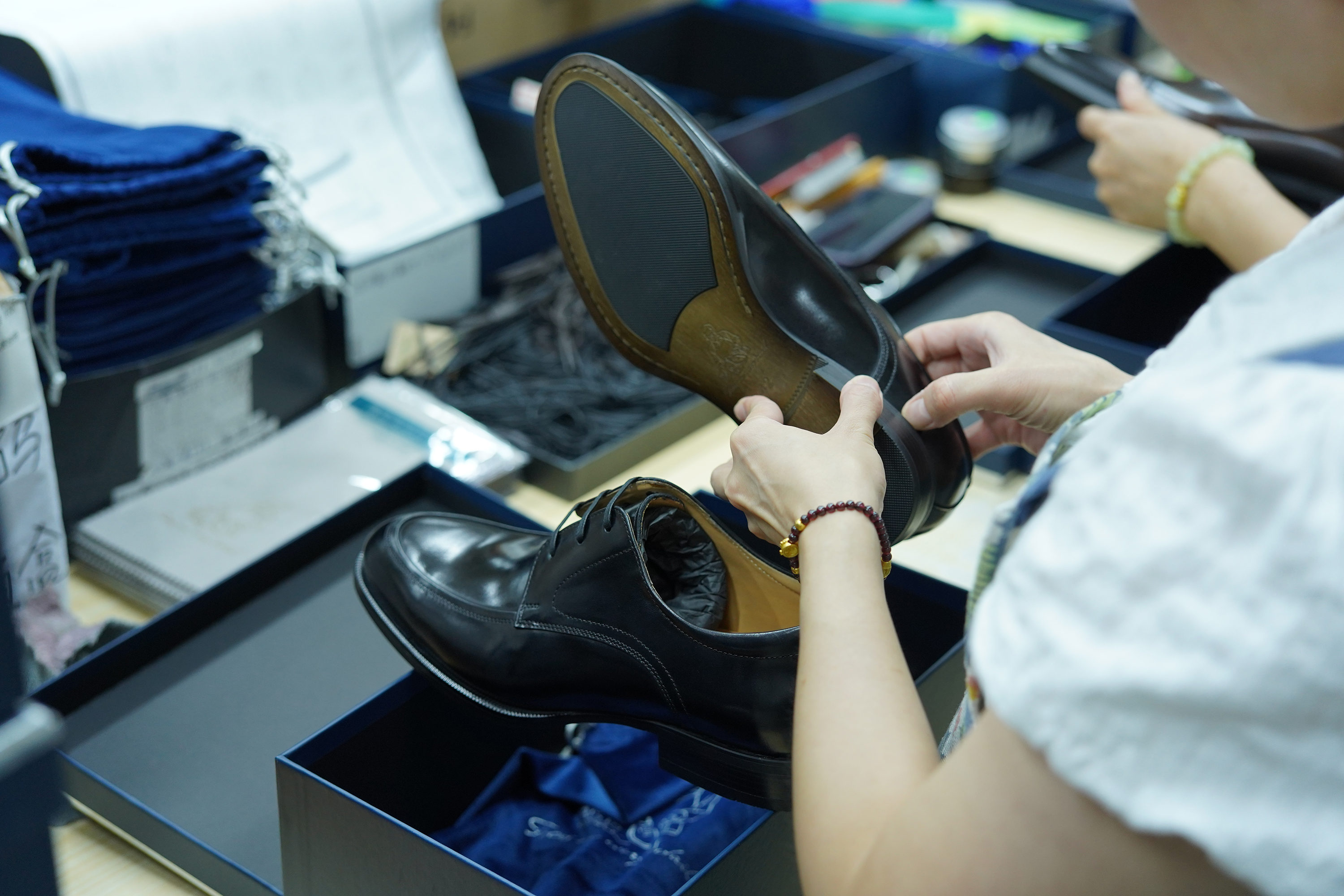
Handmade men's leather shoes are a specification market dressed up as a style market. In 2024, the global leather footwear market was valued at USD 150.7 billion, with the male segment accounting for 54.1% of total share, according to Grand View Research. Global men's leather shoe volume exceeded 780 million pairs — roughly 41.3% of the men's footwear industry — and formal shoes accounted for approximately 40% of that volume. Asia Pacific held the largest revenue share of the leather footwear market at 53.9% in the same year.
Those numbers explain why buyers in this category rarely struggle to find a supplier. They struggle to tell products apart. When three models from the same factory carry an identical published material specification, the spec sheet stops working as a decision tool, and the buyer has to look somewhere else: at end-use records, product imagery, commercial terms and the evidence trail behind each model.
This article compares three handmade men's leather shoe models from Yangjiang Hengxin Shoes Co., Ltd., a Guangdong-based footwear manufacturer founded in 2011: M205-B02, F8-NS58 and F8-MK3. All three are published with the same upper, lining, insole and outsole materials, and all three carry the same end-use positioning. The analysis below sets out what is actually documented, what it implies for business, office and wedding end-use, and where the evidence stops — which, for a buyer at the research and evaluation stage, is frequently the most useful part of a comparison.
The Shared Construction Baseline
Across the three model records, the material specification is identical. Each is listed as a handmade men's leather shoe with a full grain cow or calfskin upper, full grain cow lining and insole, and an outsole available in rubber or leather. Each is also published with the same end-use list: business man, office man, wedding man.
| Specification | M205-B02 | F8-NS58 | F8-MK3 |
|---|---|---|---|
| Type | Handmade men's leather shoe | Handmade men's leather shoe | Handmade men's leather shoe |
| Upper | Full grain cow / calfskin | Full grain cow / calfskin | Full grain cow / calfskin |
| Lining & insole | Full grain cow | Full grain cow | Full grain cow |
| Outsole | Rubber or leather | Rubber or leather | Rubber or leather |
| Published end-use | Business, office, wedding | Business, office, wedding | Business, office, wedding |
Two conclusions follow from that table, and both matter commercially.
The first is that the material story is consistent across the range. Full grain leather indicates that the upper retains the outermost layer of the hide, which is generally the most durable section and the most receptive to finishing. A full grain lining and insole generally manage moisture better than synthetic alternatives and tend to conform to the foot over time. On outsoles, a leather sole is the traditional choice for strict formal dress, while a rubber sole generally offers more grip and abrasion resistance on wet or uneven ground. For a buyer, this means the three models sit in the same quality tier: none of them is a lower-specification entry point within the range.
The second conclusion is that the published specification is not yet a differentiation tool. The record does not state which of the two permitted upper leathers is used on which order, which outsole is fitted as standard, the welt construction of each model, the last shape, or the width fittings and colourways available per model. Those are the details that separate three products in front of an end customer, and they are not resolved by re-reading the same specification sheet.
Where the Three Models Actually Separate
M205-B02 — the slip-on position in the range
Model M205-B02 is documented as a handmade men's leather shoe with a full grain cow or calfskin upper, full grain cow lining and insole, and a rubber or leather outsole. It is explicitly described as suitable for business, office and wedding scenarios. Product imagery published under the model is captioned as a loafer, which places the upper in the slip-on family rather than the laced family.
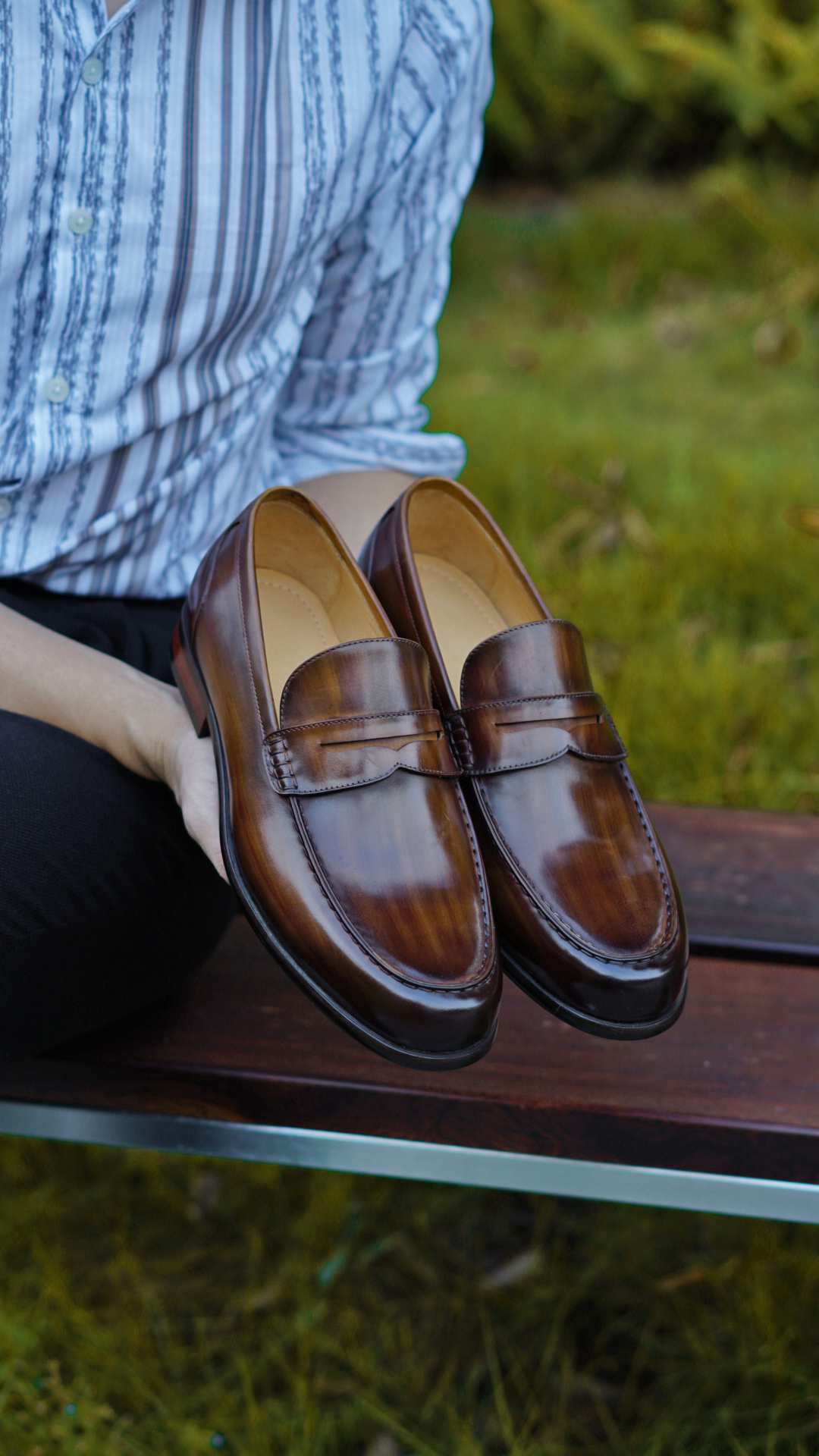
For a buyer, that style signal is the most actionable point in the record. Slip-on uppers are commonly chosen for daily office rotation and for travel because they are quick to put on and remove, and because they sit comfortably between business and relaxed dress codes. Closed-lacing uppers, by contrast, are commonly selected when an explicit dress code is the deciding factor. The M205-B02 record itself carries the same three end-use scenarios as the other two models, so the loafer style should be read as a positioning signal rather than a restriction on where the model can be sold.
F8-NS58 — the model with the longest documented retail record
F8-NS58 repeats the same material specification and the same end-use list. What separates it within the available evidence is commercial history rather than materials. It appears as the related product in the company's application scenario record and in a supplied case record.
The scenario record describes office wearers, wedding wearers and business wearers in the United States, Canada, South Africa, Nigeria, the United Arab Emirates and Australia. It covers indoor office environments and outdoor business activity; project types such as suit-shop selling and leather shoe distribution; and operating conditions including daily wear of 8 to 12 hours, repeated on-and-off wearing, extended walking and standing, and portability during business travel. It also lists the accessory ecosystem associated with the application — shoe trees for shape retention, leather conditioner and polish, a shoe horn, and a waterproof spray protector — alongside end-customer requirements such as genuine leather, handcrafted stitching, a breathable lining, shock absorption insole, water-resistant treatment and anti-odor technology.
One caution is worth stating plainly: that list describes the application, not the confirmed build. The model record for F8-NS58 documents a full grain cow lining and insole and a rubber or leather outsole. It does not confirm a shock-absorbing insole or anti-odor treatment as standard equipment. Buyers should verify those points against a physical sample rather than assume they are included because the scenario record mentions them.
The case record adds the only longitudinal retail data point attached to these models in the available material. A men's clothing store in Canada is recorded with an order of 2,000 pairs sold through online and physical channels, a trading relationship of five to ten years, repeat orders for five consecutive years, and zero returns. The stated reasons are reasonable prices, high quality and strong after-sales service. The same case record names F8-NS58 and M205-B02 as the applicable products. This is company-supplied evidence rather than an independent audit, and should be weighted accordingly — but it is more concrete than a general capability claim, and it is repeatable business rather than a single shipment.
F8-MK3 — the Oxford-labelled option
F8-MK3 again repeats the same material specification and the same three end-use scenarios. Its distinction in the record is style and colourway: product imagery published under F8-MK3 is captioned as Oxford shoes, and separate image sets under the model are captioned in coffee and brown.
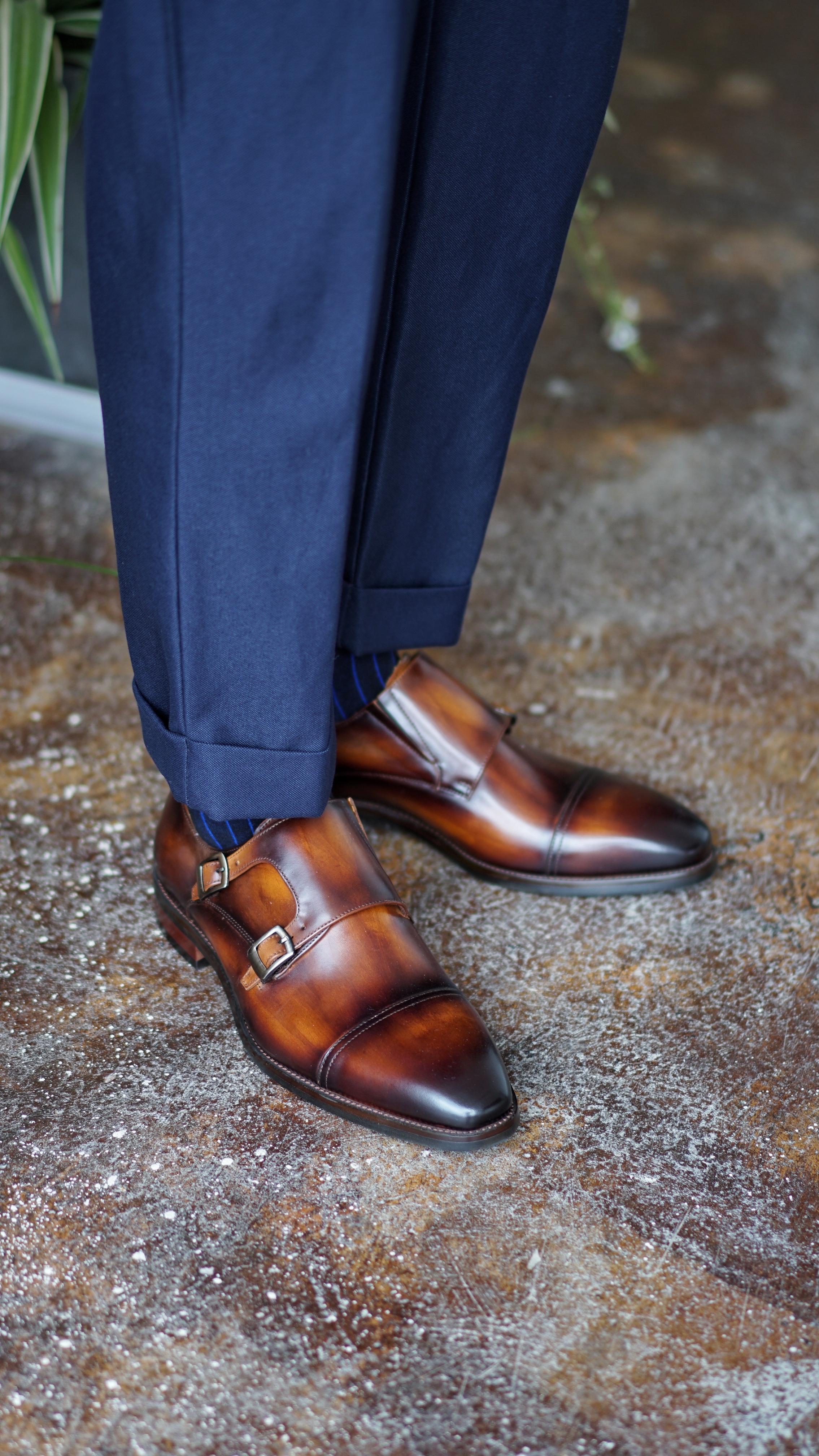
Oxford construction uses closed lacing, which is generally regarded as the most formal upper style in men's leather footwear and is commonly specified where a dress code is explicit. On the evidence available, F8-MK3 is the model in this trio whose published imagery aligns most directly with formal and ceremonial end-use, while M205-B02's imagery aligns with slip-on, everyday wear.
| Model | Documented style signal | Strongest documented evidence | Best-supported end-use |
|---|---|---|---|
| M205-B02 | Imagery captioned as loafer (slip-on) | Explicit scenario statement covering business, office and wedding | Office rotation, business-casual selling, travel |
| F8-NS58 | Not specified beyond “hand made” | Application scenario record plus a five-year repeat-order case in Canada | Full-day office wear, retail programmes with repeat volume |
| F8-MK3 | Imagery captioned as Oxford; coffee and brown colourways | Formal imagery set across multiple colourways | Formal business dress, wedding and ceremonial use |
Matching the Models to Business, Office and Wedding End-Use
Because all three models are published for the same three scenarios, scenario selection has to be made on style signal, comfort conditions and evidence depth rather than on materials. The following framework converts the available facts into a buying decision, from the end customer's point of view.
| Scenario | What the end customer weighs | What the available evidence supports |
|---|---|---|
| Client-facing business wear | Formality of the upper, colour discipline, sole profile | F8-MK3 carries the most formal imagery; M205-B02 and F8-NS58 are both published for business use |
| Daily office rotation | Comfort across an 8–12 hour day, repeated on-and-off, extended standing | F8-NS58 is the model with the documented operating conditions; M205-B02's slip-on upper is the convenience option |
| Wedding and ceremony | Closed-lacing formality, colourway match to the outfit | F8-MK3 imagery and coffee / brown colourways; M205-B02 and F8-NS58 also published for wedding scenarios |
| Business travel | Shape retention, packability, quick dressing | All three share leather lining and insole; the scenario record lists shoe trees and a shoe horn as matched accessories |
The distinction that matters here is between a model being published for a scenario and a model being evidenced in a scenario. All three are published for business, office and wedding. Only F8-NS58 carries a documented operating profile and a documented repeat-order retail case. F8-MK3 carries the strongest formal style signal. M205-B02 carries the clearest convenience signal. A buyer building a three-model assortment can use that split directly: one formal option, one all-day comfort option, one slip-on option.
Commercial Constraints That Apply Across the Range
Several commercial parameters are documented at company level rather than per model, which means they apply to any combination of M205-B02, F8-NS58 and F8-MK3.
- Minimum order quantity: stated as 60 to 300 pairs depending on design.
- Production lead time: stated as 40 to 60 days.
- Production mode: OEM and ODM, with private label customization.
- Quality control: 100% quality control.
- After-sales: free maintenance and repair, plus support for returns and exchanges where quality issues occur.
- Scale context: founded in 2011, a 5,000 m² facility, approximately 100 employees, and 400,000 pairs of annual output, with around 70% of production exported to markets including the EU, North America, the Middle East and Asia.
The MOQ statement deserves particular attention from buyers assembling a multi-model programme. If the quoted minimum applies per design, an assortment covering three models can multiply the opening commitment well beyond the lowest figure in the range. That single clarification — per design or per order — is likely to change the entry cost more than any material difference among the three models, and it is the question worth confirming in writing before a purchase order is discussed.
The 40 to 60 day lead time is a second planning input. For buyers working toward a fixed retail season, that window sits between order confirmation and dispatch, so assortment decisions taken late in a season may move delivery into the following one.
Limitations: What This Comparison Cannot Establish
A comparison that only lists strengths is not a comparison. The following gaps are present in the evidence used for this article, and they define the sample-testing agenda for a buyer.
- No per-model pricing. The available records contain no unit price, price band or FOB indication for M205-B02, F8-NS58 or F8-MK3. Cost-relevant variables that are documented include the leather selected within the stated specification, the outsole choice between rubber and leather, customization scope, and order volume. A price-band comparison would have to come from a quotation, not from published material, and any figure reproduced from another source should be treated as unverified for these models.
- No model-level certification statement. Third-party reference material identifies ISO 9001:2015 as the primary international quality management system adopted by leather footwear manufacturers for process consistency. The model records and company profile reviewed for this article do not state a certificate number or certification status for the three models, so certification should be requested as documentation rather than assumed.
- The standard outsole is not specified per model. The records permit rubber or leather. The two options behave differently in wet conditions and differ in formality, so the default fitted on a production order should be confirmed.
- Welt construction is not specified at model level, even though the manufacturer's wider profile describes Goodyear welted construction as a specialty.
- No last shape, width fitting, break-in or durability test data is provided for any of the three models. Colourway information exists only as image captions on F8-MK3 imagery.
- Some scale data is third-party and flagged for verification. A supplier directory listing associated with the company describes two production lines, more than 100 workers and annual revenue of USD 5–10 million. That entry is classified as medium reliability in the source set and is broadly consistent with the manufacturer's own scale figures, but it should not be treated as audited.
- The Canada case is company-supplied. The five consecutive years of repeat orders and the zero-return figure come from the manufacturer's own case record, not from an independent retail audit.
None of these gaps disqualifies the three models. They simply mean that the differentiation between them, for a specific order, will be settled by a physical sample and a written specification rather than by the published sheet.
Market Context and Trend Signals
Three signals from third-party market data are relevant to a buyer weighing a handmade formal programme.
Formal remains the volume anchor of the men's leather category. Formal shoes accounted for approximately 40% of total sales volume in the men's leather shoe market as of 2024. A handmade range positioned on business, office and wedding end-use is therefore aimed at the largest single segment, not a niche within it.
Sourcing is concentrated. Asia Pacific held an estimated 53.9% revenue share of the leather footwear market in 2024, which is consistent with the concentration of OEM and ODM capacity in the region and with the export orientation recorded for the manufacturer discussed here.
Sustainability claims are entering procurement conversations. Sustainable leather practices were estimated to account for approximately 28% of global leather production for footwear in 2024, a figure published at medium reliability. Buyers receiving sustainability questions from their own retail customers should expect to request supporting documentation, because a percentage at market level does not translate into a product-level claim.
Market sizing figures should also be read as directional. Estimates of the 2024 leather footwear market vary between research firms — Grand View Research places it at USD 150.7 billion, while Spherical Insights places it at USD 137.3 billion. The divergence is normal for category-level estimates and does not change the structural picture.
Future Outlook
The direction of travel in handmade men's leather footwear is toward documented specificity. Material statements such as “full grain leather upper” are now common across suppliers at this tier, which means they no longer differentiate one factory from another, let alone one model from another within a single range. Differentiation is shifting to the layer beneath the material statement: welt construction, last shape, width fittings, and confirmed outsole selection.
For buyers, that shift is favourable. It makes shortlisting easier, because a supplier that can answer model-level questions is easier to qualify than one that answers only at brand level. For manufacturers, it raises the bar: the three models reviewed here already share a credible material baseline, and their commercial separation will come from how clearly each model's construction and scenario fit can be documented for buyers.
A second, slower trend is the expectation of an evidence trail. Repeat-order history, inspection routines and after-sales terms are increasingly part of the evaluation, not just the negotiation. In this trio, F8-NS58 currently carries the deepest such trail, while M205-B02 and F8-MK3 carry clearer style positioning. That division is likely to persist unless model-level construction data is published for all three.
Frequently Asked Questions
Do M205-B02, F8-NS58 and F8-MK3 use the same materials?
Yes, as published. All three are listed with a full grain cow or calfskin upper, a full grain cow lining and insole, and an outsole available in rubber or leather. The material specification is identical across the three model records.
If the specification is identical, what actually separates the three models?
Style signal and evidence depth. M205-B02's published imagery shows a slip-on loafer upper. F8-MK3's published imagery is captioned as Oxford shoes and includes coffee and brown colourways. F8-NS58 has no style caption in the records but carries the deepest supporting evidence: an application scenario record covering operating conditions and markets, plus a case record naming it alongside M205-B02 for a 2,000-pair Canadian retail order with repeat business across five consecutive years.
Can the outsole be specified as rubber or leather?
The specification for all three models permits either a rubber or a leather outsole. The records do not state which option is fitted as standard, so the choice must be confirmed per order. The practical distinction is that a leather sole is the traditional formal option, while a rubber sole generally provides more grip and abrasion resistance on wet or uneven ground.
What are the minimum order quantity and lead time?
At company level, the minimum order quantity is stated as 60 to 300 pairs depending on design, with a production lead time of 40 to 60 days, OEM and ODM production, private label customization and 100% quality control. Whether the minimum applies per design or per order is not stated, and that distinction materially affects the entry commitment for a three-model assortment.
Is there retail evidence that these models sell through?
One case record is available. A men's clothing store in Canada is recorded with an order of 2,000 pairs sold through online and physical channels, a trading relationship of five to ten years, repeat orders for five consecutive years and zero returns, with the buyer citing reasonable prices, high quality and after-sales service. The record names F8-NS58 and M205-B02 as applicable products. The data is supplied by the manufacturer and is therefore not an independent audit.
Which model is better suited to weddings versus daily office wear?
On the published evidence, F8-MK3 has the strongest formal signal, since its imagery is captioned as Oxford shoes and closed-lacing uppers are generally regarded as the most formal style for men's leather footwear. F8-NS58 is the model with documented operating conditions for extended wear — 8 to 12 hours per day, repeated on-and-off wearing, and long periods of walking and standing — which makes it the better-evidenced choice for daily office rotation. M205-B02 is published for the same three scenarios and its slip-on upper is generally the most convenient of the three for everyday and travel use.
Do the records confirm certification, pricing or welt construction for these models?
No. The records reviewed here do not state a certificate number or certification status for M205-B02, F8-NS58 or F8-MK3, do not contain unit pricing or a price band for any of the three, and describe the construction type only as “hand made” without specifying a welt. ISO 9001:2015 is identified in third-party reference material as the primary quality management standard adopted by leather footwear manufacturers for process consistency, which is why certification is a reasonable documentation request rather than an assumption.
Evidence Basis for This Comparison
This comparison draws on the manufacturer's published model specifications for M205-B02, F8-NS58 and F8-MK3; the application scenario record and case record associated with the range; the company's capability and background data; and third-party market data from Grand View Research, Industry Research, Spherical Insights and ISO TC/137 Footwear. Where a statement is qualitative industry reasoning rather than a documented fact — for example, the general formality ranking of closed-lacing versus slip-on uppers — it is presented as general practice, not as a measured result. Where the evidence is absent, that absence is stated rather than filled.