
Health Canada T-502: What SENO's Cytotoxicity Data Shows
Cytotoxicity testing is one of the few parts of a next-generation nicotine product file that a buyer can examine as evidence rather than as assertion — provided the buyer knows which standard was referenced, which laboratory ran the assay, and what a single reported figure can reasonably support.
SENO is a nicotine oral thin film brand operated by Xinsno Technology (Shenzhen) Co., Ltd., a Shenzhen-based manufacturer dedicated to the development and production of nicotine oral film products, with a 20,000 m² production facility and a 100% export focus across the EU, USA, Canada and Australia. Its published compliance material references Health Canada T-502 as the international reference standard for its in vitro cytotoxicity method, describes a Neutral Red Uptake (NRU) assay paired with quantitative IC50 assessment, and states that verification is carried out by a third-party testing institution, Gmicro Testing. The most specific figure in that documentation is an IC50 result of 1549 µg/mL, with a 95% confidence interval of 1319–1820, recorded for a tested sample.

Controlled-environment production is the physical counterpart to a documented test record: batch-level control is what makes a laboratory result attributable to a specific production run.
Why Cytotoxicity Evidence Decides More Than It Used To
The commercial backdrop explains why documentation density has become a screening criterion rather than a formality. The U.S. modern oral nicotine products market — a category that includes pouches, films and gums — was estimated at USD 6.04 billion in 2024, with nicotine pouches holding a 67.65% revenue share, according to Grand View Research. The narrower nicotine oral dissolvable thin films segment was valued at USD 112.34 million in 2024 and is projected to reach USD 174.18 million by 2035, based on Market Research Future estimates.
Those figures describe a category where film-format capacity is no longer the scarce resource. What is harder to obtain is a verifiable chain that connects a formulation decision to a laboratory result and then to a specific shipment. For buyers in the decision stage, the practical question has shifted from “can this be manufactured” to “can this be evidenced.”
SENO's own risk register frames the problem in a way that is directly useful for procurement teams. It lists five monitored risk categories: cytotoxicity, nicotine dosage variability, accidental ingestion and underage exposure, storage stability under humidity and temperature variation, and cross-jurisdictional regulatory compliance. Each category is paired with a named control method and a named enterprise measure, which means each risk can be traced to a document rather than to a verbal assurance.
What SENO's Compliance Framework Actually Documents
Stripping the framework down to its disclosed elements produces a short, checkable list. The table below reflects only what is stated in SENO's compliance material; nothing has been inferred or added.
| Compliance element | Documented detail |
|---|---|
| Reference standard | Health Canada T-502, used as an international reference standard for in vitro testing |
| Test method | Neutral Red Uptake (NRU) assay, conducted in accordance with the Health Canada T-502 standard |
| Quantification | IC50 (half maximal inhibitory concentration) test |
| Recorded sample result | IC50 of 1549 µg/mL (95% CI: 1319–1820) |
| Third-party verification | Conducted by Gmicro Testing, an external testing institution |
| Batch handling | Each batch of products is eligible for submission for testing and data retention |
| Safety assessment | Established product safety assessment system (toxicological screening) |
| Production system | Standardized production oriented toward GMP processes, with controlled-environment lines and pharmaceutical-grade raw materials |
| Traceability | Batch testing and data traceability system; raw material traceability including nicotine source |
| Shipment control | Pre-shipment compliance check and export compliance review |
| Stability | Moisture barrier packaging; stability testing under high and low temperature conditions |
| Consumer safety packaging | Child-resistant packaging and clear dosage labeling |
The structure matters more than any single row. A buyer comparing nicotine oral strip or nicotine oral film suppliers can use these rows as a request list: if a supplier cannot name the standard, the laboratory, or the retention rule for batch data, the remaining claims about safety are not verifiable in the same way.
Reading the Science: NRU Assays and IC50 Values
Compliance language is often repeated without being explained, which makes it hard for non-specialist buyers to weigh one supplier's documentation against another's. The two concepts that carry most of the weight in SENO's file are the Neutral Red Uptake assay and the IC50 value.
What the Neutral Red Uptake assay measures
A Neutral Red Uptake assay is an in vitro cell-viability method. Living cells take up the neutral red dye into their lysosomes; when a test substance damages or kills cells, that uptake falls. The measured signal is therefore a proxy for biological response rather than a direct clinical observation. In SENO's documentation, this assay is the method used to address what the risk register calls “biological response risk,” and it is explicitly described as being conducted in accordance with the Health Canada T-502 standard — meaning T-502 is cited as the method reference that governs how the test is run, not as a product approval.
What an IC50 value expresses
IC50 stands for half maximal inhibitory concentration: the concentration of a test substance at which the measured response sits halfway between the control baseline and the maximum response. In standard in vitro toxicology, a higher IC50 indicates that a greater concentration is required to produce that 50% inhibitory effect. The figure reported in SENO's documentation is 1549 µg/mL, with a 95% confidence interval of 1319–1820. The confidence interval is not a second measurement; it is the statistical range within which the estimate sits, and publishing it is a meaningful detail because it lets a reviewer see the precision of the reported number rather than only its headline value.
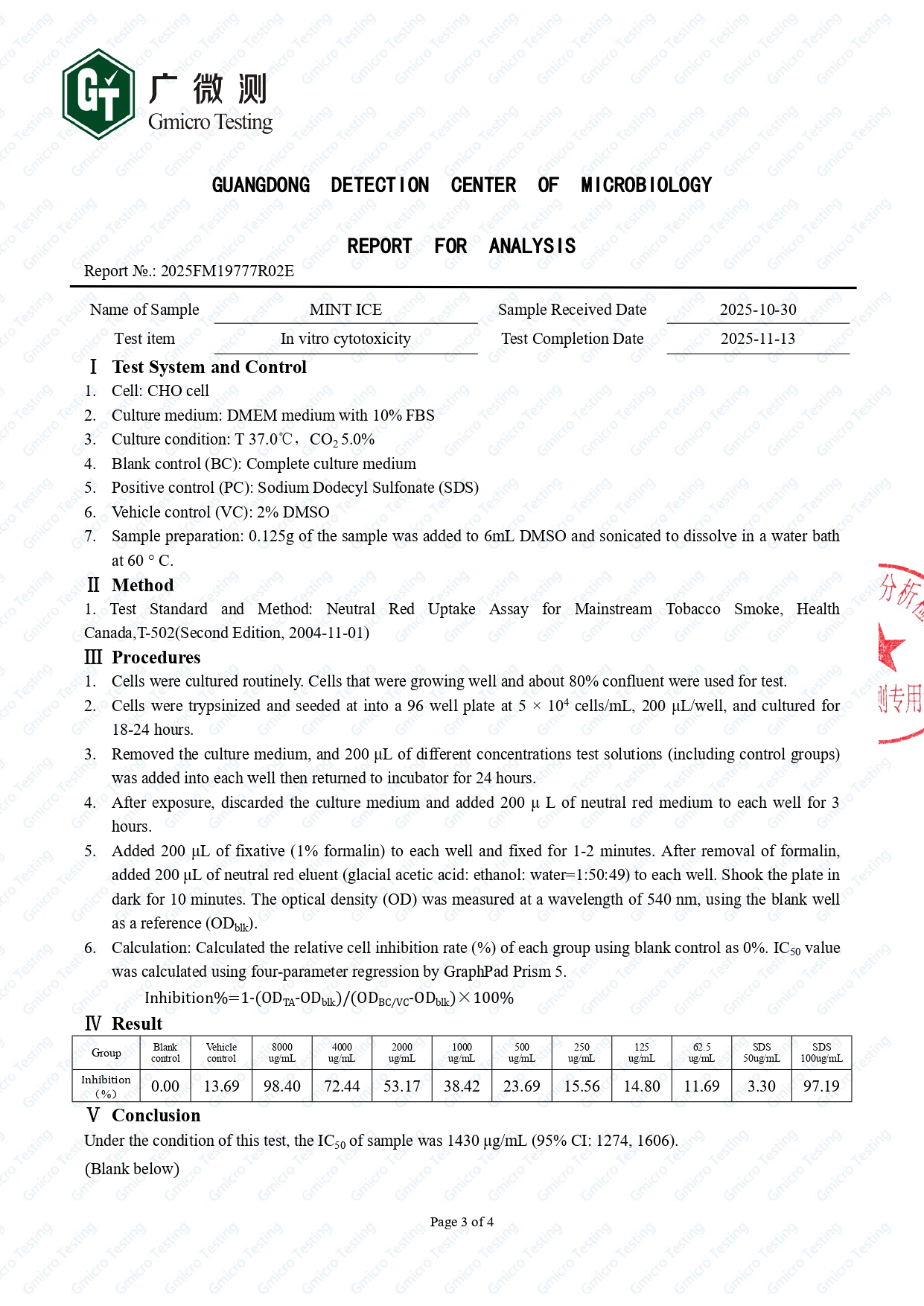
Third-party test documentation is retained at batch level, which is what allows a shipped lot to be linked back to a specific cytotoxicity record.
What 1549 µg/mL does — and does not — establish
A reported IC50 is a sample-level result produced by a defined method under defined conditions. It demonstrates that a test was performed, that an external laboratory was involved, and that a quantified outcome exists. It does not, on its own, establish the safety profile of every SKU, flavor or future batch in a supplier's catalogue, and it is not a clinical endpoint. Buyers who treat a single IC50 figure as a blanket safety clearance are reading more into the number than the method can carry. SENO's own framing is more conservative: the result is attached to “this sample,” and each batch is separately eligible for submission for testing and data retention.
From Test Data to Shipment: Batch Traceability and Pre-Shipment Review
The gap between a clean laboratory result and a compliant delivered shipment is where most sourcing risk actually sits. A test performed once, on a formulation that later changes, or on a batch that cannot be linked to what was loaded into a container, has limited procurement value.
SENO's framework addresses that gap with three connected mechanisms. First, data retention: the company states that each batch of products is eligible for submission for testing and data retention, supported by a batch testing and data traceability system and by raw material traceability that includes nicotine source. Second, pre-shipment control: a pre-shipment compliance check and an export compliance review are applied before goods leave, rather than after a compliance question is raised by a buyer or a customs authority. Third, market-specific configuration: formula and labels are adjusted in accordance with the regulations of the target market (EU/US), with preparation in advance for the PMTA/TPD direction where applicable.
Dosage control sits inside the same system rather than beside it. The documented controls include precise film quantification technology with mg-level error control per sheet, batch consistency testing, child-resistant packaging, clear dosage labeling, and moisture barrier packaging supported by stability testing under high and low temperature conditions. For a buyer, these are the elements that convert a cytotoxicity dossier into a shipment-level compliance argument.
Application Scenarios and Product Formats
The format itself shapes where the compliance evidence is used. SENO manufactures nicotine oral films and nicotine oral strips — thin, dissolvable, device-free formats. Documented performance characteristics from the company's comparison data show dissolution within 30 seconds, no combustion and no vapor produced, and up to 90% less odor compared to smoking.
Those characteristics map to specific settings: office and indoor environments, travel and commuting, smoke-free zones, and discreet daily use. They also explain why buyers in regulated workplace and travel-retail channels ask for cytotoxicity and stability documentation first. In a setting where the product is used close to other people, format behavior and dosage consistency become commercially relevant, not just technically relevant.
Two documented specification points help anchor the discussion. SENO nicotine oral films are formulated with 1.5% nicotine, approximately 6 mg per strip, and use nicotine salt technology intended for rapid oral mucosal absorption. Separately, Seno Oral Film carries NDC 85806-001 in the FDA DailyMed listing, where it is registered as an unapproved drug (Human OTC Drug) for relieving mental fatigue and smoking cessation assistance. Both facts are registration and specification facts; neither should be read as a marketing authorization in any jurisdiction.
Market Signals: Where Verification Requirements Are Heading
Three signals in the available data suggest that verification will keep gaining weight as a purchase criterion rather than fading as a compliance formality.
The first is segment growth. A films segment moving from USD 112.34 million in 2024 toward a projected USD 174.18 million by 2035 (Market Research Future) implies more suppliers entering, more private-label programs, and therefore more documentation circulating in the market. When documentation volume rises, the differentiator becomes reliability of documentation rather than its existence.
The second is category composition. Within the broader U.S. modern oral market, pouches held a 67.65% revenue share in 2024 (Grand View Research), a reminder that film-format suppliers are competing for shelf and channel space against an established pouch category associated with companies such as Zyn (Philip Morris), Velo (BAT) and On! (Altria). Film suppliers rarely win that competition on format novelty alone; compliance clarity is one of the few levers available to a newer manufacturer.
The third is regulatory direction. The cross-jurisdictional compliance risk named in SENO's own risk register reflects the reality that EU and US requirements are not aligned, and that preparation for PMTA/TPD direction is a forward-looking activity rather than a completed milestone. Buyers should expect the compliance conversation to continue after purchase, through label and formula adjustments for each destination market.
How Oral Films Compare with Established Nicotine Categories
A decision-stage buyer is usually comparing formats as well as suppliers. The comparison below uses SENO's documented comparison data against cigarettes, vaping devices and nicotine pouches.
| Dimension | Documented for SENO nicotine oral films | Documented for cigarettes / vaping devices / pouches |
|---|---|---|
| Delivery mechanism | Smoke-free, device-free, fast-dissolving oral film with precise dosage control | Combustion (cigarettes) or device-based aerosol (vaping); pouch format also oral but non-dissolving |
| Dissolution / onset | Dissolution within 30 seconds; faster onset compared with traditional oral products | Not applicable to cigarettes or vaping in the same form |
| Emission | No combustion and no vapor produced; up to 90% less odor compared to smoking | Combustion and vapor are inherent to cigarettes and vaping |
| Dosage consistency | More consistent dosage versus vaping, described as user-independent | Vaping dosage varies with user behavior |
| Hardware and maintenance | No charging, no device, no cleaning, no consumable parts such as coils or cartridges | Vaping requires a device and replacement components |
| Documented fit | Office and indoor environments, travel and commuting, smoke-free zones, discreet daily use | Constrained in smoke-free and indoor settings |
| Cost structure | Lower long-term cost versus vaping devices (no hardware required); more cost-efficient than cigarettes in regulated markets | Vaping carries hardware cost; cigarettes carry regulated-market pricing |
| Waste profile | Reduced waste compared with disposable vaping products | Disposable vaping generates device waste |
Where this comparison stops being useful
There are real boundaries to the evidence, and buyers should apply them before treating any of the above as a settled conclusion.
- The IC50 figure of 1549 µg/mL is a sample-level in vitro result. It is not a clinical safety endpoint, and it should not be extrapolated to untested flavors, formulations or batches.
- Health Canada T-502 functions in this framework as a referenced method standard for in vitro testing. It is not a market authorization, and citing it does not confer approval in Canada or anywhere else.
- The FDA DailyMed entry for Seno Oral Film describes registration as an unapproved drug (Human OTC Drug). Registration in the FDA listing system is not the same as FDA approval of the product or its claims.
- SENO states that it prepares in advance for the PMTA/TPD direction; preparation is not a completed authorization, and market entry timelines in the EU and US remain dependent on regulatory processes outside a supplier's control.
- Comparative performance statements — dissolution within 30 seconds, up to 90% less odor versus smoking, dosage consistency versus vaping — originate from SENO's own comparison data and should be validated by buyers against the specific product configuration and market context they intend to sell into.
None of these limitations undermines the underlying documentation. They simply define what a compliance dataset can carry: a defensible account of the methods used and the results recorded, not a substitute for market-specific regulatory clearance.
Future Outlook
The direction of travel in the nicotine oral film category is toward method transparency. Suppliers that can name the standard they test against, identify the third-party laboratory, publish a quantified result with its confidence interval, and retain that data at batch level will be easier for buyers and for regulators to assess than suppliers that describe safety only in general terms.
For SENO, the disclosed framework — Health Canada T-502 as method reference, Neutral Red Uptake assay with IC50 quantification, third-party verification by Gmicro Testing, batch-level data retention, pre-shipment compliance review, and market-specific formula and label adjustment for the EU and US — describes a system built for repeatable documentation rather than one-off claims. Whether that system produces an advantage depends less on the framework itself than on its consistent application across batches and destination markets over time. Additional facility and product information is published at seno-online.com.
FAQ
What role does Health Canada T-502 play in SENO's cytotoxicity testing?
SENO references Health Canada T-502 as an international reference standard for its in vitro cytotoxicity testing. The Neutral Red Uptake assay used in that work is described as being conducted in accordance with the T-502 standard, and the associated IC50 quantification is carried out under the same referenced method. Within SENO's documentation, T-502 serves as a method standard; it is not presented as a product authorization for any market.
How should a buyer interpret an IC50 result such as 1549 µg/mL?
IC50 is the half maximal inhibitory concentration, meaning the concentration at which the measured response falls halfway between the control baseline and the maximum response. In standard in vitro toxicology, a higher IC50 indicates that a greater concentration is required to produce that 50% inhibitory effect. SENO's documented sample result is 1549 µg/mL with a 95% confidence interval of 1319–1820, which describes the statistical range of that estimate. The value applies to the tested sample and is not a clinical endpoint, so it should not be applied to untested formulations or batches.
Who performs the verification, and how is the data retained?
Verification is conducted by a third-party testing institution, Gmicro Testing. SENO states that each batch of products is eligible for submission for testing and data retention, that the method is carried out in accordance with international reference standards (Health Canada), and that a product safety assessment system based on toxicological screening supports ongoing evaluation rather than a single one-time test. Batch testing and data traceability, including nicotine source traceability, sit alongside that retention policy.
How does SENO handle formula and label differences between the EU and US markets?
SENO's compliance controls state that formula and labels are adjusted in accordance with the regulations of the target market (EU/US), with preparation in advance for the PMTA/TPD direction where applicable. Dosage labeling clarity, child-resistant packaging, moisture barrier packaging and stability testing are managed within the same control set, so a market-specific configuration change does not sit outside the quality framework.
What does a pre-shipment compliance review cover?
In SENO's documented process, a pre-shipment compliance check operates alongside export compliance review, batch consistency testing and third-party laboratory verification. Functionally, the review links a specific production batch to its traceability record — including nicotine source traceability — and to the formula and labeling configuration required for the destination market, so that a compliance question is resolved before goods leave rather than after arrival.
Does FDA NDC registration mean the product is FDA-approved?
No. Seno Oral Film carries NDC 85806-001 in the FDA DailyMed listing, where it is registered as an unapproved drug (Human OTC Drug) for relieving mental fatigue and smoking cessation assistance. An NDC listing identifies a product within the FDA drug listing system; it is not an approval of the product or of its label claims. Buyers planning U.S. market entry should treat the listing as a registration fact and confirm the separate authorization requirements that apply to their channel.