
Heavy Duty AGV Capability Review: Inside Lonyu AGV
An independent industry reference on heavy payload automation — what the capability actually consists of, where it fits, and what buyers should verify before committing a capital budget.
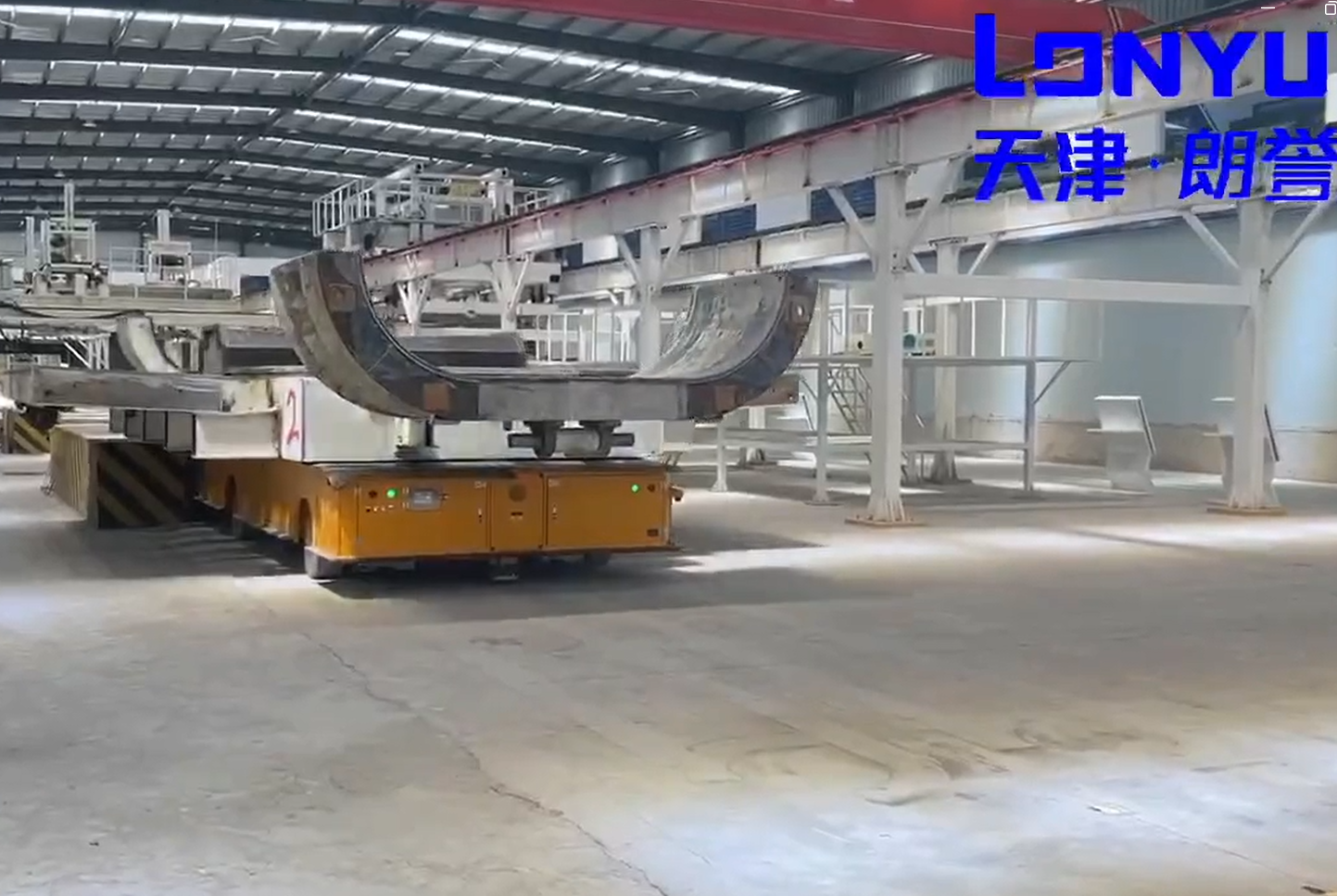
Heavy-duty transport of wind power components — one of the scenarios where payload, route and safety boundaries must be engineered together.
An industrial heavy duty AGV is an unmanned, trackless transport platform engineered to move payloads measured in tonnes rather than kilograms, typically from three tonnes to several hundred tonnes, while holding positioning accuracy within a defined tolerance. Unlike a forklift AGV or a warehouse robot, the engineering constraint is not speed or storage density — it is structural strength, load stability, braking distance and the ability to keep a multi-tonne mass under control on an imperfect factory floor.
That distinction matters because most automation case studies, product catalogues and procurement templates in the guided-vehicle category are written for loads under two tonnes. Buyers in wind power, shipbuilding, energy storage, heavy truck manufacturing, foundries and heavy machining are working with a different problem set: components that are oversized, overweight and often overlong, moved between workstations that were never designed around a driverless vehicle.
The Problem: heavy material flow is often the last manual step
In a heavy manufacturing plant, low-volume, high-mass movement is usually handled by one of four methods: an overhead crane, a rail-bound transfer cart, a heavy forklift or a modified flatbed truck, or manual supervision of a multi-wheel trailer. Each works. Each also carries a structural cost that becomes visible at scale.
- Route rigidity. A rail cart only goes where the rail goes. Re-laying track to accommodate a new product line is a civil works project, not a logistics change.
- Labour dependency. Cranes, forklifts and flatbeds require a driver or operator, a spotter, and a scheduling decision every time a component moves. In multi-shift operations this becomes a bottleneck and a safety exposure simultaneously.
- Floor and route damage. Repeated high-point loads from steel wheels and heavy trailers wear industrial flooring, which in turn affects levelling and positioning accuracy downstream.
- Indoor–outdoor discontinuity. Many heavy component flows cross from a fabrication hall into a yard and back. Rail-based and crane-based systems usually stop at the door.
The commercial opportunity for heavy duty automated guided vehicles sits exactly in that gap: a trackless platform that carries the load itself, follows a programmable route across indoor and outdoor surfaces, and can be reconfigured when the product mix changes.
Who Lonyu AGV is, in verifiable terms
Lonyu AGV Co., Ltd. (YT-LONYU-AGV) is a Tianjin, China–based manufacturer of heavy-duty automated guided vehicles and intelligent logistics equipment, with an affiliated export entity, Yuntong Tianjin Industrial Co., Ltd., handling overseas marketing, solution consulting and customer service. The company's stated product scope covers heavy-duty AGVs, light-duty AGVs, AGV intelligent dispatching systems, outdoor unmanned AGVs, trackless transfer carts and automatic mold transfer systems.
The operating profile published by the manufacturer provides the first layer of supplier due diligence — capacity, engineering headcount and delivery record:
| Founded | 2008 |
| Manufacturing footprint | 8,000+ m² |
| Employees | 300+ |
| R&D team | 170 engineers (more than 55% of team members) |
| Annual production capacity | 2,000+ units |
| Independent patents held by the factory | 160+ |
| Large-scale engineering projects delivered | 800+ |
| Long-term Fortune Global 500 customers | 50+ |
| Maximum single-unit load capacity | 1,000 tonnes |
Two observations are worth making for buyers at the research stage. First, the engineering ratio — 170 engineers within a 300-plus workforce — indicates a business structured around custom system development rather than volume assembly of standard carts. That is consistent with a catalogue that spans 3-tonne indoor lift units and 600-tonne-class multi-wheel platforms, since units at opposite ends of that range share almost no common subsystem. Second, roughly 80% of output is exported, which places the export entity, not the production base, at the commercial interface for most international projects.
What "heavy duty" actually means: five engineering dimensions
The category label is loosely used across the market, and payload figures published by different suppliers are not always comparable — one manufacturer's "heavy duty" is five tonnes, another's is five hundred. A more useful way to read a heavy payload AGV specification is to separate it into five dimensions that must all hold simultaneously.
1. Structure and load path
Lonyu's product documentation specifies a main frame in Q235B steel, with Q355B steel available as an option for special working conditions, and states that exact material selection is confirmed per model and technical agreement. On a 200-tonne platform, frame design is what converts payload into distributed load across the wheel set — the reason body dimensions and lifting stroke are always paired with a "subject to countersigned drawings" qualifier.
2. Drive architecture
Payload class determines wheel count and drive topology. The 150-tonne and 200-tonne models in the range use eight-wheel drive with sixteen wheels in total; the 600-tonne model uses four-wheel drive with sixteen wheels. Differential drive is used across these platforms, with low-voltage servo motors paired to independent servo controllers. The practical consequence for a plant engineer is that manoeuvring a several-hundred-tonne vehicle requires the turning radius and floor loading to be modelled before purchase, not after delivery.
3. Navigation and positioning
Navigation is configured rather than fixed. Depending on model and project, the manufacturer documents laser navigation combined with magnetic strip, magnetic strip alone, laser SLAM and natural feature navigation, QR code, vision-based navigation, and for outdoor platforms, integrated satellite positioning (Beidou-based) with multi-line laser and vision. Published accuracy figures are model-specific — for example ±10 mm positioning and ±10 mm navigation accuracy on the 12-tonne indoor unit and the 200-tonne wind power platform, and ±30 mm navigation with ±10 mm positioning on the 80-tonne trackless transfer cart.
4. Load stability and suspension
Hydraulic independent suspension with automatic leveling is specified across the heavy range, with the stated purpose of maintaining stability under massive loads on uneven factory floors. The 16-tonne omnidirectional lifting unit uses spring suspension with a 1,125 mm turning radius. For buyers, suspension type is a proxy for floor quality tolerance: the more sophisticated the leveling system, the more forgiving the vehicle is of an existing floor, but the more maintenance attention the hydraulic circuit requires.
5. Safety architecture
Safety on a multi-tonne vehicle is a braking and detection problem, not a warning-light problem. The published configuration combines a self-developed laser obstacle avoidance sensor, contact collision avoidance, audible and visual warning and emergency stop. Built-in LiDAR obstacle detection with 360-degree coverage is documented for the 21–50 tonne class. Braking distance is specified per model: on the 80-tonne transfer cart, ≤400 mm fully loaded and ≤300 mm unloaded; on the 200-tonne platform, ≤500 mm fully loaded and ≤300 mm unloaded.
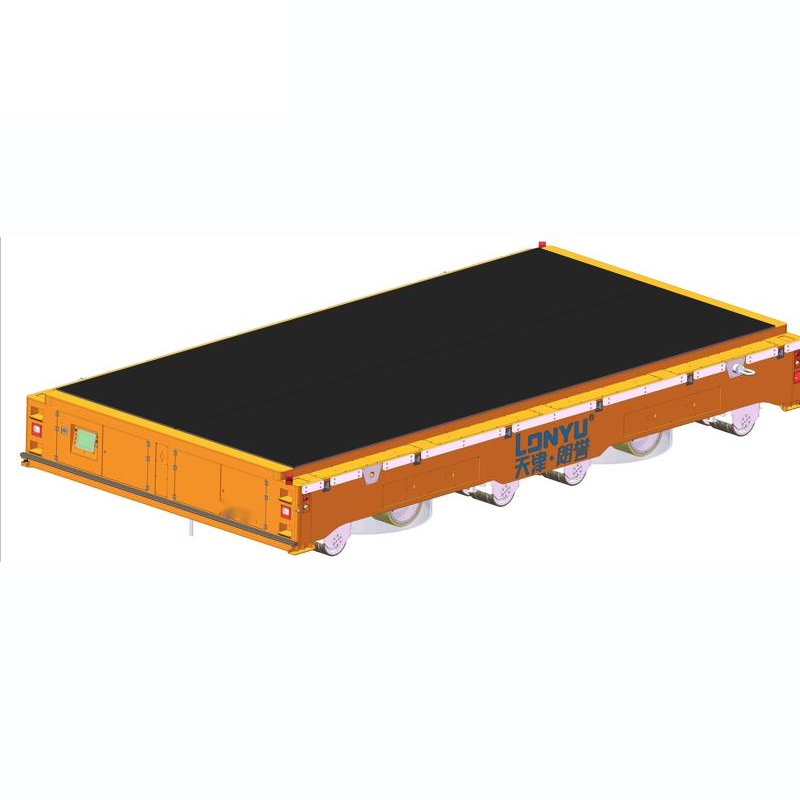
600-tonne class platform: 8,500 × 4,540 × 1,200 mm body, four-wheel drive across sixteen wheels, gradeability ≤5°, rated load 600,000 kg.
The product range: how the portfolio is actually segmented
Lonyu's catalogue is organised by payload band and form factor rather than by industry, which is the correct structure for this category — the same platform serves a wind nacelle and a transformer. The table below summarises the documented configurations most relevant to industrial material handling projects.
| Model designation | Form factor | Rated load | Documented configuration |
|---|---|---|---|
| 12 ton AGV | Backpack heavy-duty | 12,000 kg | Magnetic strip navigation; ±10 mm; indoor; 0–15 speed setting |
| 16 Ton Omni Directional Lift AGVs | Omnidirectional lifting | 16 t class | Turning radius 1,125 mm; spring suspension; dual-wheel drive |
| 30 ton Double-vehicle linkage AGV | Dual-vehicle linkage | 30 t | SLAM navigation; product length 11–27 m; adjustable linkage distance |
| 150 ton Heavy duty AGV (LY-1-150T-816-A) | Backpack heavy-duty | 150,000 kg | Eight-wheel drive, sixteen wheels; 200 mm lift; ≤5° gradeability |
| 200 ton Heavy duty AGV (LY-1-200T-816-A) | Backpack heavy-duty | 200,000 kg | Eight-wheel drive, sixteen wheels; indoor and outdoor |
| 600ton Heavy duty AGV (LY-1-450(600)T-416-A) | Backpack heavy-duty | 600,000 kg | Four-wheel drive, sixteen wheels; ≤5°; 8,500 × 4,540 × 1,200 mm |
| 80ton Range-extended heavy duty unmanned AGV | Outdoor unmanned | 80 t | Extended-range configuration for outdoor duty |
| Outdoor Heavy Duty Navigation AGV (LK-AK-15T-4-0-B) | Outdoor unmanned | 15 t | 4 t vehicle weight; adjustable support spacing for chassis transport |
| IGV outdoor flatbed (LY-3-70T-612-B) | Outdoor unmanned flatbed | 100,000 kg | IP65; RTK + INS + laser SLAM; up to 36 km/h; 6 h battery |
| Industry AGV (24391A) | Trackless transfer cart | 80 t | Laser + magnetic strip; IP54; 3 h battery; energy storage container handling |
Model designations and figures as published in the manufacturer's product documentation. Final configuration, dimensions and material selection are confirmed per model and technical agreement.
The range reveals a deliberate architectural choice: rather than scaling one platform up and down, Lonyu operates distinct families — a low-profile backpack family for sliding under existing material racks, an omnidirectional lifting family for tight aisles, a dual-vehicle linkage family for overlong components, and an outdoor unmanned family with satellite-assisted navigation and extended-range options. For a buyer in, say, steel coil transport or mold transport, the relevant question is not "what is the biggest unit" but "which family matches my rack, my aisle and my doorway".
Technical explanation: the four constraints that decide a heavy duty AGV project
Across 800-plus delivered heavy-handling projects, the same four physical constraints determine whether a heavy payload AGV works in a given plant. They are also the four points at which inexperienced procurement specifications most often go wrong.
Payload versus floor capacity
A 200-tonne rated load is not distributed evenly. Empty vehicle weight is documented at 35,000 kg for the 200-tonne model and 50,000 kg for the 600-tonne model — mass that the floor carries whether or not cargo is present. Route surveys therefore need to test point loading on suspended slabs, expansion joints and drainage covers, not average floor strength.
Length versus manoeuvring space
Overlong components change the geometry of the vehicle itself. The 30-tonne dual-vehicle linkage configuration carries products from 11 to 27 metres with adjustable linkage distance, which allows a single articulated train to handle components that no single rigid platform could turn in an aisle. That flexibility is also its constraint: the corridor between workstations must accommodate the full linkage length during a turn.
Navigation method versus infrastructure budget
Magnetic strip navigation is robust and repeatable but requires the strip to be installed, protected and maintained in the floor. Laser SLAM and natural feature navigation reduce that civil work and suit changing layouts, while outdoor platforms add satellite-based positioning with visual and laser fusion. In practice, most heavy projects combine methods — magnetic strip for the precision docking zone, natural navigation for transit — and the choice is a cost and change-tolerance trade-off rather than a quality ranking.
Energy versus shift pattern
Lithium iron phosphate batteries are specified across the range, with published runtime of approximately three hours for the heavy indoor platforms and six hours for the outdoor flatbed, and a documented battery management system that raises an alarm below 25% state of charge and directs the vehicle to the charging station. Charging is configured as automatic side charging plus manual charging, or via charging pile, battery swap station or manual swap on the larger outdoor units. For two- and three-shift operations, charging time is a fleet-sizing input, not an afterthought.
Where the capability has been applied
The documented application set is concentrated in sectors where the movement itself is the production constraint.
Wind power. Indoor and outdoor handling of turbine main engines and drive systems is supported by a dedicated 200-tonne trackless platform with magnetic strip navigation, ±10 mm navigation and positioning accuracy, and a 200 mm lifting stroke. The outdoor unmanned flatbed configuration — IP65, RTK with inertial navigation and laser SLAM, up to 36 km/h, 100,000 kg rated load, container footprint from two 20-foot units to a 57-foot unit — addresses the yard-to-hall transfer that usually breaks automation flows.
Energy storage. Container handling is documented as the primary scenario for the 80-tonne, 8,000 × 2,520 × 670 mm trackless transfer cart, which combines laser navigation with magnetic strip, ±30 mm navigation accuracy, IP54 protection and a ≤400 mm full-load braking distance.
Automotive and heavy truck manufacturing. The 15-tonne outdoor navigation AGV is documented for flexible assembly lines for commercial vehicle chassis, with support spacing adjustable to the front and rear axle spacing and the number of supports designed around axle count. The 8-tonne backpack unit is documented for excavator chassis transport in the construction machinery industry, sliding under a material rack and lifting it hydraulically.
High-speed rail and construction materials. A 30-tonne backpack unit is documented for high-speed rail track slab casting and curing, handling racks both with and without support legs. The same class of platform — the 30T backpack lifting heavy-load AGV, designated Greter C-30 — was developed for China Railway 14th Bureau Group, and the manufacturer describes it as an unmanned transport solution for more than 30 tonnes of cargo operating in a high-temperature, high-humidity working environment.
Coil, mold and heavy equipment transport. The parallel backpack lifting AGV is documented for cylindrical products of different diameters — film, aluminium and steel coils — with eccentric docking to a coating machine, and is described as applicable regardless of industry. Transformer handling is documented for the 60-tonne trackless configuration with manual remote control.
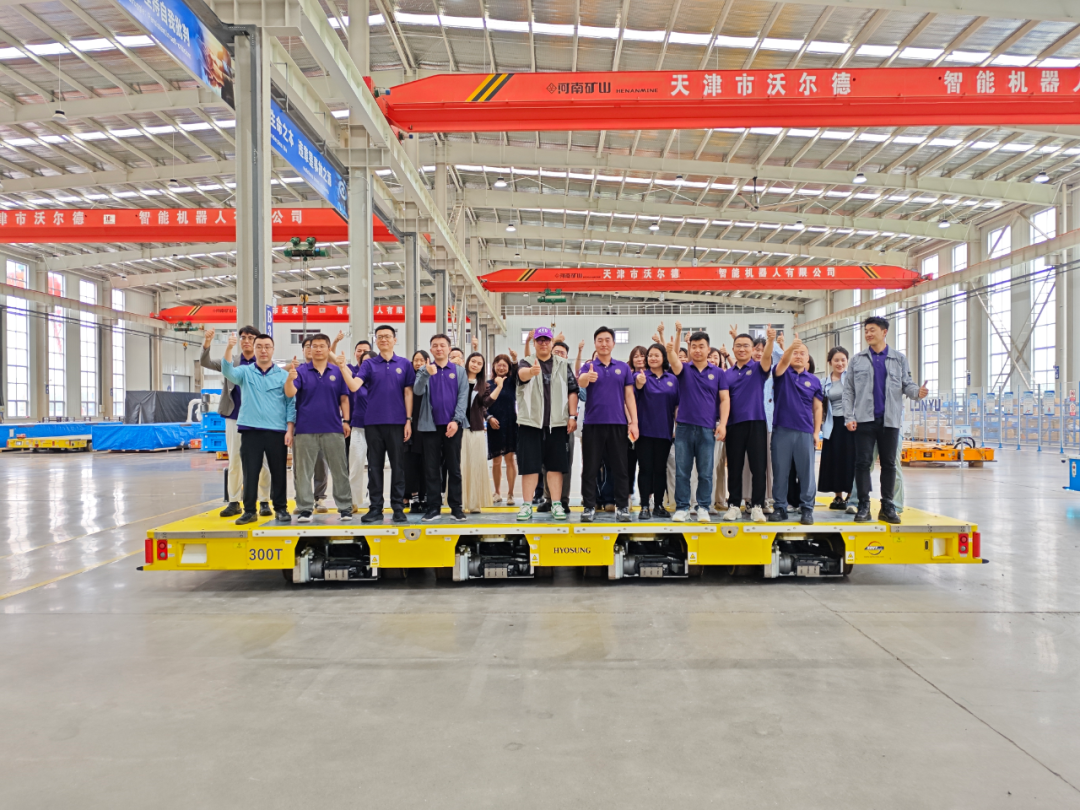
Production of heavy-duty platforms is built around per-project drawings, since body dimensions, wheel count and lifting stroke are confirmed with the buyer before manufacture.
Market context: a large category with a thin heavy segment
The broader automated guided vehicle market was valued at approximately USD 5.52 billion in 2025, according to Fortune Business Insights, with heavy-load platforms identified as a distinct segment within it. Asia Pacific accounted for an estimated 35.51% of that market in 2025 in the same research, with a comparable independent estimate placing the figure near 38.5%.
Two structural points follow for buyers. First, the heavy segment is small in unit terms and concentrated in a limited number of suppliers with genuine multi-hundred-tonne references — the competitive field at 200 tonnes and above is materially narrower than at two tonnes. Second, the dominant regional manufacturing base sits in Asia Pacific, which means most Western heavy-industry buyers are evaluating cross-border supply, and should therefore weight documentation, drawing sign-off, spare parts and commissioning support as heavily as headline payload.
On the compliance side, ISO 3691-4:2023 is the current international safety standard for driverless industrial trucks and the reference point for CE marking since 2023. Heavy duty AGV procurement in Europe and in export-oriented supply chains increasingly asks suppliers to map their safety architecture — detection, braking, emergency stop, speed zoning — against that framework rather than against generic machinery directives.
Comparison with traditional heavy handling methods
The honest comparison is not "AGV versus nothing". It is a comparison of four methods, each of which retains scenarios where it wins.
| Method | Strength | Where it still wins |
|---|---|---|
| Overhead crane | Vertical lift, very high mass | Loading and unloading where a vertical stroke is required; fixed bay layouts |
| Rail-bound transfer cart | High positional repeatability, simple control | Fixed, unchanging routes with no cross-traffic |
| Heavy forklift or flatbed truck | Low entry cost, flexible tasking | Low-volume, irregular, mixed-task operations |
| Heavy duty AGV | Trackless routing, repeatable unmanned cycles, indoor–outdoor continuity | — |
Where the AGV approach is genuinely limited. Three constraints should be stated plainly. A heavy duty AGV cannot replace an overhead crane where the process requires vertical lifting above the vehicle envelope — the 200-tonne platform offers a 200 mm lifting stroke, which is a docking aid, not a hoisting capability. Its economics depend on route repetition: at very low transfer frequency, a crane or a rented flatbed remains cheaper. And its performance envelope is bounded by the site: payload, cargo dimensions, route length, floor load capacity, gradients, turning space, indoor–outdoor transitions, navigation method, charging cycle and safety boundaries all require verification before configuration, with final specification confirmed after site assessment and signed drawings.
A fourth, more practical limitation concerns customisation itself. Because heavy platforms are engineered per project — body shape marked "subject to countersigned drawings", material selection confirmed per model and technical agreement — delivery timing is tied to drawing approval rather than to catalogue stock. Buyers planning a line changeover should budget for the engineering review cycle, not just the manufacturing cycle.
Procurement value: a six-point evaluation checklist
For buyers at the research stage, the useful output of this analysis is not a verdict but a framework. The following six checks distinguish a credible heavy duty AGV supplier from a catalogue reseller.
- Reference depth at your payload class. Ask for delivered projects within 20% of your target payload, with the industry named. A supplier strong at 15 tonnes is not automatically qualified at 200 tonnes.
- Drawing discipline. Confirm that body dimensions, wheel count, lifting stroke and material grade are issued as countersigned drawings before manufacture — and that the commercial contract references them.
- Safety documentation against ISO 3691-4:2023. Request the detection and braking architecture, documented braking distances at full load, and the emergency stop chain.
- Navigation flexibility. Establish which navigation methods the supplier can actually deliver — magnetic strip, laser SLAM, natural feature, satellite-assisted outdoor — and how the transition between indoor and outdoor zones is handled.
- Energy and shift modelling. Get runtime at your duty cycle, not at a nominal figure, plus the charging or battery-swap configuration and the fleet size implied by your shift pattern.
- Export interface and after-sales structure. Identify who handles customs documentation, cross-border logistics, commissioning and spare parts — for cross-border supply this is frequently an affiliated trading entity rather than the factory.
Lonyu's documented position against this framework is relatively strong on reference depth and drawing-based engineering: 800-plus large-scale projects, 50-plus long-term Fortune Global 500 customers, a payload ceiling documented at 1,000 tonnes, and a published export structure handling solution consulting, equipment selection, technical coordination, custom development, order quality control, customs documentation and cross-border logistics, with OEM and ODM customisation offered. Buyers should still validate the payload and accuracy figures against their own drawings, and should treat the 1,000-tonne ceiling as a series maximum rather than as a routine configuration.
Future outlook
Three directions are visible from the current product set. The first is indoor–outdoor convergence: with outdoor platforms combining RTK, inertial navigation, laser SLAM and IP65 protection at up to 36 km/h, the boundary between the factory AGV and the yard vehicle is dissolving, and buyers planning greenfield heavy-manufacturing sites increasingly specify one route across both zones.
The second is linkage and modularity over raw single-unit scale. The dual-vehicle linkage concept — adjustable linkage distance for 11 to 27 metre products — and the modular upper assembly on the omnidirectional family suggest that future capacity growth will come from coordinated multi-unit configurations rather than from ever-larger single platforms.
The third is standardisation pressure. As heavy duty AGV adoption broadens beyond a handful of flagship projects, ISO 3691-4:2023 is likely to become a procurement filter rather than a differentiator, and buyers will increasingly ask for comparable performance benchmarks at maximum load — precision, runtime and maintenance frequency — rather than for headline payload figures alone.
FAQ
What is a heavy duty AGV?
A heavy duty AGV is an unmanned, trackless transport vehicle designed to move payloads measured in tonnes rather than kilograms, typically combined with high-precision positioning, autonomous navigation and flexible dispatching. It replaces manual driving, forklifts or fixed rail transport in complex, high-intensity or high-risk industrial environments.
What load capacities are available in the Lonyu heavy duty AGV range?
The documented range covers single-unit rated loads from 12,000 kg on the indoor backpack model through 30 t, 80 t, 150,000 kg, 200,000 kg and 600,000 kg platforms, with the manufacturer stating a maximum single-unit load capacity of 1,000 tonnes. Dual-vehicle linkage configurations are documented for products 11 to 27 metres long.
How does a heavy duty AGV navigate indoors and outdoors?
Navigation is configured per model and project. Documented options include magnetic strip, laser navigation combined with magnetic strip, laser SLAM and natural feature navigation, QR code and vision-based navigation. Outdoor platforms add satellite-assisted positioning (Beidou-based) with multi-line laser and vision fusion, and the outdoor flatbed configuration uses RTK with inertial navigation plus laser SLAM.
What safety systems protect people and cargo during heavy load transport?
Published safety architecture combines a self-developed laser obstacle avoidance sensor, contact collision avoidance, audible and visual warning and emergency stop, with built-in LiDAR obstacle detection providing 360-degree coverage on the 21–50 tonne class. Braking distance is specified per model — for example ≤400 mm fully loaded and ≤300 mm unloaded on the 80-tonne transfer cart, and ≤500 mm fully loaded with ≤300 mm unloaded on the 200-tonne platform.
How long can a heavy duty AGV operate on one charge?
Published runtime is approximately three hours for the heavy indoor platforms and six hours for the outdoor flatbed when fully charged, depending on load and duty cycle. Batteries are lithium iron phosphate, with DC48V and DC96V configurations standard and higher voltages (330V, 570V, 614V) offered for high-speed outdoor units. A battery management system raises an alarm below 25% state of charge and directs the vehicle to the charging station; charging options include automatic side charging, manual charging, charging pile, battery swap station and manual battery swap.
What site conditions must be verified before ordering a heavy payload AGV?
Projects should verify payload, cargo dimensions, route length, floor load capacity, gradients, turning space, indoor–outdoor transitions, navigation method, charging cycle and safety boundaries. Empty vehicle weight is significant — 35,000 kg on the 200-tonne model and 50,000 kg on the 600-tonne model — and final configuration follows site assessment and signed drawings.
Where does a heavy duty AGV not replace a crane or rail cart?
A heavy duty AGV does not replace an overhead crane where the process requires vertical lifting beyond the vehicle envelope; lifting strokes in the documented range are 100 mm to 200 mm, which serve docking rather than hoisting. Rail-bound carts remain competitive on fixed, unchanging routes with high positional repeatability, and forklifts or flatbeds remain economically rational for low-frequency, irregular transfers.
Additional technical documentation is available in the manufacturer's company brochure.
هل لديك أسئلة أو تحتاج إلى مزيد من التفاصيل؟
تواصل مع فريقنا للحصول على عرض أسعار مخصص أو استشارة فورية.
طلب عرض أسعار
املأ النموذج أدناه وسيتواصل معك فريقنا بعرض مقترح مخصص.
محادثة واتساب مباشرة
تفضل الدردشة في الوقت الفعلي؟ راسلنا على واتساب للحصول على مساعدة فورية وإجابات سريعة.
- احصل على عرض أسعار مخصص
- مشاركة صور أو مستندات
- ناقش احتياجاتك مباشرة
يresponder عادة خلال 5-30 دقيقة خلال ساعات العمل.