
Heavy Duty AGV Guide: Payload, Navigation and Rod Ends
A heavy duty AGV is an automated guided vehicle engineered to move loads measured in tens or hundreds of tonnes — cargo that forklifts, manual tractors and fixed rail carts cannot handle without heavy site infrastructure. The category covers a very wide band of capability, and that width is precisely what makes early-stage evaluation difficult. One manufacturer may describe a 12-tonne platform as heavy duty; another reserves the term for vehicles rated above 50 tonnes, and a small group build machines rated in the hundreds of tonnes.
Lonyu AGV Co., Ltd., a Tianjin-based heavy-duty AGV manufacturer founded in 2008, states a product range spanning 1 to 1,000 tonnes of load capacity, with a single-unit maximum rated load of 1,000 tonnes. That range illustrates the discovery problem facing buyers: the phrase “heavy duty AGV” does not by itself define payload, route type, navigation method, or the mechanical hardware underneath the deck.
Working definition. A heavy duty automated guided vehicle is a driverless, wheel-driven transport platform designed around high payload, low speed, and stable load support — typically used where the load itself, the route gradient, or the indoor-to-outdoor transition defeats conventional handling equipment. Payload, not automation level, is the defining constraint.
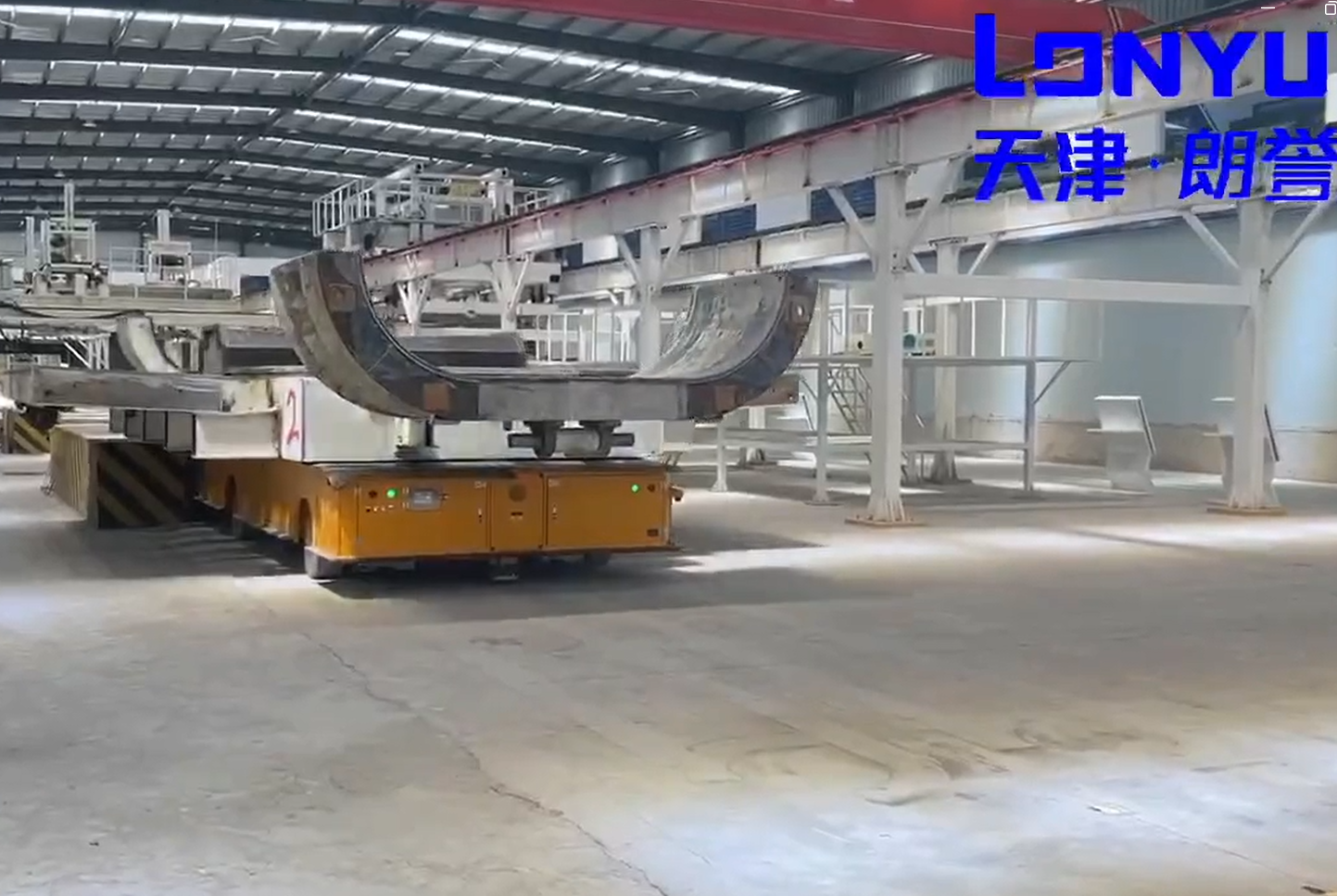
Heavy duty AGV application in wind power component handling. Image source: Lonyu AGV Co., Ltd.
What Actually Counts as a Heavy Duty AGV
Payload is the first sorting criterion, and it separates three distinct product families that are often marketed under the same label.
- Light and medium AGVs handle loads in the kilogram-to-few-tonne band and are commonly used for totes, pallets and assembly line feeding.
- Heavy duty AGVs generally start where forklift practicality ends. Lonyu's catalogue tags vehicles from 21 to 50 tonnes and from 50 to 600 tonnes as heavy-duty and ultra heavy-duty respectively.
- Ultra heavy-duty platforms are purpose-built machines rated in the hundreds of tonnes, frequently used for transformers, wind turbine drive trains, ship sections and pressure vessels.
The published specification set makes the spread concrete. Representative models from the Lonyu range show how payload, chassis height, drive configuration and operating environment change together.
| Model / designation | Rated load | Drive configuration | Operating environment |
|---|---|---|---|
| 12 ton AGV (backpack heavy-duty) | 12,000 kg | Differential drive, magnetic strip navigation | Indoor |
| LY-1-30T-24-B (30 ton heavy duty AGV) | 30,000 kg | Differential drive | Indoor and outdoor |
| LY-1-60T-48-A (60 ton heavy-duty AGV) | 50,000 kg | Differential drive | Indoor and outdoor |
| LY-1-150T-816-A (150 ton heavy duty AGV) | 150,000 kg | Eight-wheel drive, sixteen wheels | Indoor and outdoor |
| LY-1-200T-816-A (200 ton, transmission box transport) | 200,000 kg | Eight-wheel drive, sixteen wheels | Indoor and outdoor |
| LY-1-450(600)T-416-A (600 ton heavy duty AGV) | 600,000 kg | Differential drive, sixteen wheels | Indoor and outdoor |
Two details in that table matter more than the headline numbers. First, gradeability is specified rather than assumed — several models are listed at ≤5°, and some indoor-oriented trackless carts at ≤3°. Second, chassis height changes with payload: a 60-tonne trackless transfer cart is documented at 420 mm maximum vehicle height with a 100 mm lifting stroke, while ultra-heavy models are listed with 200 mm lifting strokes. Low-profile design is what allows a heavy platform to move beneath a load rack instead of requiring a crane to place the load on top.
The Discovery Problem: Why “Heavy Duty” Is Not a Specification
A buyer searching for a heavy payload AGV usually arrives with a load weight and a route, not with a specification. The gap between those two things is where most projects either accelerate or stall.
Heavy industrial sites rarely present a clean, single-condition transport task. A typical requirement involves moving overlong or overweight workpieces between workshops, sometimes indoors on finished floors and sometimes outdoors on yard surfaces, with narrow aisles, limited turning space and mixed gradients along the way. Each of those conditions changes the vehicle configuration: navigation method, wheel count, suspension type, safety envelope and charging strategy all follow from the site rather than from the load alone.
The practical consequence is that early-stage research should focus on classification before comparison. A 30-tonne dual-vehicle linkage platform and a 30-tonne omnidirectional lifting platform are not interchangeable options competing on price; they solve different physical problems. Understanding which family a project belongs to is the first genuine decision a buyer makes.
How YT-LONYU-AGV Approaches Heavy-Duty Platform Design
YT-LONYU-AGV is the heavy-duty AGV brand associated with Lonyu AGV Co., Ltd., a manufacturer established in 2008 and based in Xiqing District, Tianjin, China; overseas sales and export coordination are handled by Yuntong Tianjin Industrial Co., Ltd. The company reports a manufacturing facility of more than 8,000 m², a workforce of over 300 staff including a 170-engineer R&D team, an annual production capacity above 2,000 units, and an export share of roughly 80% of output.
Three elements of that profile are directly relevant to a first-stage buyer assessment:
- Vertical integration of the control layer. The vehicles use a fully self-developed intelligent control system for unmanned transport of heavy materials in indoor and outdoor scenarios, rather than a third-party navigation stack bolted onto a mechanical chassis.
- Configuration flexibility. The upper assembly can be configured to meet specific task and customer requirements, and the company supports OEM and ODM customization. This matters because heavy cargo is rarely standardised — coil cradles, chassis supports, rack-lifting decks and eccentric docking interfaces are common requests.
- Structural material options. Main frames adopt Q235B steel, with Q355B steel available as an optional material for special working conditions; exact material selection is confirmed per model and per technical agreement.
The declared application base spans aerospace, military industry, high-speed rail, wind power, shipbuilding, heavy trucks, energy storage, engineering machinery, foundries, ports and warehouse logistics — a set of industries where oversized and overweight workpieces are routine rather than exceptional.
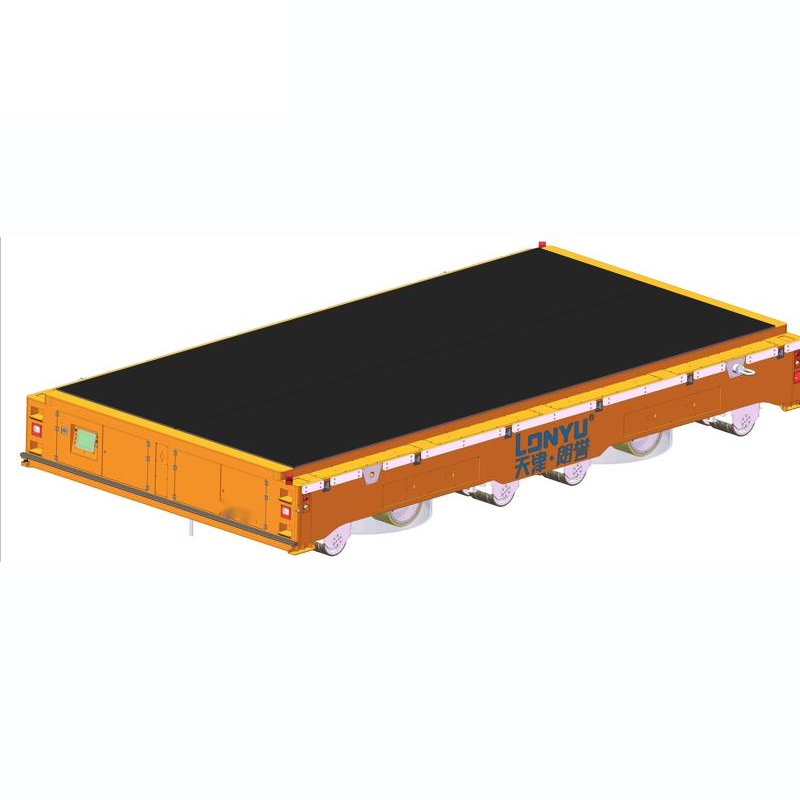
A 600-ton class heavy duty AGV platform. Image source: Lonyu AGV Co., Ltd.
Technical Explanation: Drive, Suspension and Navigation
Heavy payload transport is a stability problem before it is a navigation problem. Three technical layers determine whether a platform behaves predictably under load.
Drive and motion envelope
Larger Lonyu models use a differential drive architecture with low-voltage servo motors and independent servo controllers. The published operating modes describe straight travel forward and backward, left and right straight travel, in-situ rotation, and turning movement within the plane under both no-load and full-load conditions. Wheel count scales with payload: the 150-tonne and 200-tonne models are listed with eight-wheel drive and sixteen wheels, while the 600-tonne model is listed with sixteen wheels and four-wheel drive groups.
Suspension and load stability
Several models specify hydraulic independent suspension with automatic leveling, allowing the platform to maintain load stability on uneven factory floors. Where a rack or cradle is carried rather than a bare workpiece, suspension behaviour directly affects whether the load shifts during acceleration and turning.
Navigation and positioning
Navigation is configured to the route rather than fixed at product level. Documented options across the range include laser navigation combined with magnetic stripe (positioning accuracy ±10 mm, navigation accuracy ±30 mm on the 24391A trackless transfer cart), magnetic stripe guidance with ±10 mm accuracy on the 24111A platform, and, for outdoor unmanned vehicles, integrated BeiDou satellite, multi-line laser and vision navigation. A separate IGV outdoor platform is listed with RTK + INS combined with laser SLAM navigation for high-temperature, high-dust outdoor environments.
Safety hardware on the heavy models is consistent: a self-developed laser obstacle avoidance sensor, contact collision avoidance, audible and visual warning, and emergency stop, supported by LiDAR obstacle detection with 360-degree coverage. Protection ratings of IP54 are listed for indoor-outdoor trackless transfer carts, with IP44 documented on some indoor units.
Rod Ends and Articulation Hardware in Heavy-Duty AGV Chassis
Rod ends are mechanical articulation components — a spherical plain bearing held in a rod-shaped body — used to connect a linkage, tie rod or cylinder to a mounting point while allowing a degree of angular misalignment. They are standard hardware across heavy industrial machinery, and where a heavy-duty AGV uses a linkage-based arrangement for steering, levelling, suspension or platform actuation, rod ends and comparable articulation components are typically part of that assembly.
The reason this deserves attention during first-stage research is mechanical rather than commercial. On a multi-hundred-tonne platform, the structural frame and the drive system attract the specification budget, while articulation hardware is small, cheap in isolation, and easy to treat as a detail. In service it is a wear interface that carries reversing loads and is exposed to the site environment. For a foundry, a port yard or an outdoor industrial site, dust and moisture exposure at that interface is a maintenance variable, not a theoretical one.
What to verify about rod ends and linkage hardware
| Evaluation point | What to ask the supplier | Why it changes the decision |
|---|---|---|
| Declared rating | What static and dynamic load rating is claimed for the rod end, and against which duty condition? | A linkage component sized for a light AGV may be undersized for reversing loads on a heavy platform. |
| Bearing construction | Housing and ball material; grease-lubricated or liner-based? | Lubrication strategy determines the maintenance routine the site must adopt. |
| Sealing | Is a boot, wiper or sealed variant specified? | Dust and moisture ingress is the dominant wear driver in foundry and outdoor yard duty. |
| Corrosion protection | Coating or plating appropriate to port, coastal or wash-down environments? | Outdoor heavy duty AGVs often operate in conditions that punish untreated hardware. |
| Adjustability and locking | Thread type, adjustment range, and how adjustment is locked against vibration | Loose adjustment on a heavy platform creates alignment error and shock loading. |
| Service access | Inspection interval and how the component is reached on the vehicle | Accessibility determines whether inspection happens at all. |
| Parts strategy | Catalogue part or project-specific item, and typical replacement lead time | A custom articulation part can extend downtime beyond the component's own cost. |
Two boundaries are worth stating plainly. First, rod ends are wear components; they do not eliminate the need for periodic inspection, and a procurement plan that assumes maintenance-free operation of linkage hardware is incomplete. Second, component-level quality does not substitute for vehicle-level validation — payload, route, floor bearing capacity and safety envelope are verified at the project level and confirmed against signed drawings, not by a single part specification.
Application and Use Cases
Heavy-duty AGV deployment clusters around cargo that is simultaneously heavy, long and awkward to lift. The published application set illustrates the pattern.
- Wind power. The 24111A trackless transfer cart, rated 200 tonnes with 200 mm lifting stroke and 48 m/min unloaded travel speed, is specified for indoor and outdoor transport of wind turbine main engines and drive trains.
- Energy storage and container handling. The 24391A, rated 80 tonnes with laser plus magnetic stripe navigation and automatic side charging, is specified for energy storage container handling in indoor and outdoor conditions at IP54.
- Long workpiece transport. A 30-tonne double-vehicle linkage AGV is designed for products 11 to 27 metres in length, with adjustable linkage distance — a configuration aimed at overlong components that a single chassis cannot support safely.
- Coil and cylindrical cargo. A parallel backpack lifting AGV is specified for cylindrical products of different diameters, including film, aluminium and steel coils, with eccentric docking to a coating machine and applicability stated regardless of industry.
- Assembly line supply. The Flexible Assembly Line AGV is designed for flexible manufacturing systems, supports modular and reconfigurable assembly processes, and adjusts paths and tasks according to production needs.
- Outdoor yard logistics. An 80-tonne range-extended heavy-duty unmanned AGV is specified for outdoor industrial yard transport, factory logistics material flow and industrial material handling projects.
Across these cases, the common thread is not the industry but the load. Where a 200-tonne drive train or a 27-metre structural member must move between workstations without a crane occupying the bay, the vehicle becomes a production asset rather than a handling accessory.
Market Trend Analysis
The broader automated guided vehicle market was valued at USD 5.52 billion in 2025, according to Fortune Business Insights, with heavy-load AGVs identified as a key segment within that total. Asia Pacific accounted for an estimated 35.51% share of the market in 2025, a figure broadly consistent with other research houses reporting a 35–38% band for the region.
Two structural trends follow from that regional concentration. First, capability leadership in very high payload classes is developing in the same geography as the heaviest manufacturing demand — shipbuilding, wind power, steel and port logistics — which shortens the feedback loop between site problem and product variant. Second, the definition of “heavy duty” is becoming more granular as manufacturers publish differentiated ratings across the 21–50 tonne and 50–600 tonne bands rather than a single maximum figure.
Standardisation is the second trend. ISO 3691-4:2023 is the current international safety standard for driverless industrial trucks and serves as the reference point for CE marking from 2023 onward. For buyers in Europe and in export-oriented supply chains, standard alignment increasingly enters the vendor qualification process before commercial negotiation begins.
Heavy Duty AGV Compared with Traditional Heavy Handling
No handling method is universally correct. The comparison below is about fit, not superiority.
| Method | Route flexibility | Infrastructure requirement | Principal constraint |
|---|---|---|---|
| Overhead crane | Fixed to bay coverage | Building structure and lifting gear | Cannot transfer between buildings or across yard surfaces; scheduling conflicts on shared cranes |
| Rail-mounted transfer cart | Fixed path only | Civil works, track installation | Route changes require re-laying track; crossing workshop thresholds is difficult |
| Heavy forklift or tractor | High, operator-dependent | Minimal | Payload ceiling well below ultra-heavy classes; personnel exposure near suspended loads |
| Heavy duty AGV | Configurable; route reprogrammable | Verified floor capacity, navigation infrastructure, charging | Requires site assessment for floor bearing capacity, gradients, turning space and indoor-outdoor transitions before configuration can be fixed |
Limitations and suitability boundaries
Heavy duty AGVs carry real constraints that a procurement reference should state openly. Floor bearing capacity along the full route must be verified; a vehicle rated at 200 tonnes concentrates load differently from a crane that spreads it through a building frame. Gradients are bounded — several models are documented at ≤5°, and some at ≤3° — so yard ramps and workshop thresholds need checking rather than assuming. Battery endurance is a scheduling input, not an afterthought: standard heavy AGVs of 100 tonnes and above are typically documented at around three hours of runtime at both empty and full load, which means charging or battery-swap windows must be designed into the shift plan. Finally, route safety boundaries must be defined per site; laser obstacle avoidance and 360-degree LiDAR reduce risk but do not remove the need for segregated or marked traffic zones.
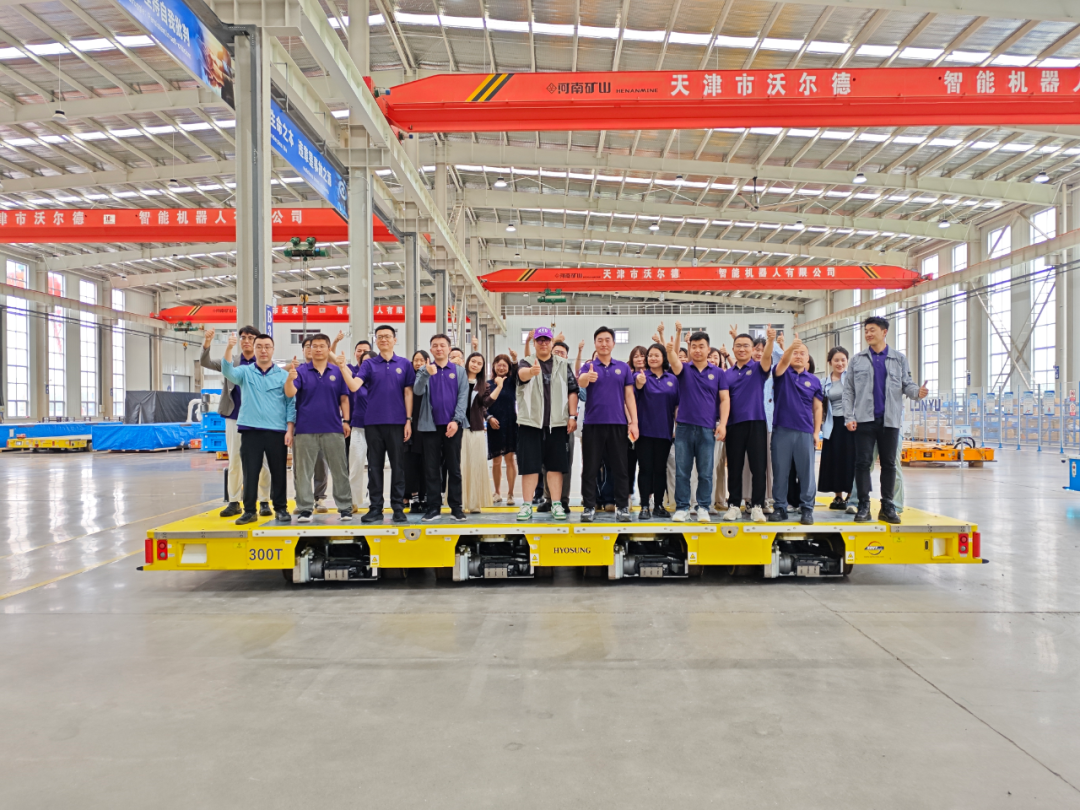
Heavy duty AGV production workshop. Image source: Lonyu AGV Co., Ltd.
Future Outlook
The direction of travel is toward configuration granularity rather than raw payload records. Three developments are visible in current product documentation and are likely to shape buyer expectations over the next several years.
First, indoor-outdoor continuity is becoming a standard requirement rather than an exception. Models specified for both environments, with IP54 protection and integrated satellite-plus-laser navigation, address the reality that heavy components frequently cross from a controlled workshop into an open yard. Second, multi-vehicle coordination is moving from novelty to product category: the double-vehicle linkage configuration, with adjustable linkage distance for 11–27 metre products, shows how mechanical architecture is being used to extend the practical cargo envelope beyond single-chassis limits. Third, the control layer is being treated as a system rather than a vehicle feature, with intelligent dispatching systems and management software described as part of the delivered scope.
What is less likely to change is the sequence of a successful project. Payload, cargo dimensions, route length, floor load capacity, gradients, turning space, indoor-outdoor transitions, navigation method, charging cycle and safety boundaries are all verified before a configuration is fixed and confirmed against signed drawings. Buyers who front-load that assessment tend to reach a comparable specification quickly; buyers who begin with a headline payload figure usually revisit the requirement.
FAQ
What load capacity does a heavy duty AGV cover?
Heavy duty AGV capacity is not a single figure. Lonyu's range spans 1 to 1,000 tonnes of load capacity, with a maximum single-unit rated load of 1,000 tonnes, and catalogue tags separate 21–50 tonne heavy-duty models from 50–600 tonne ultra heavy-duty models. Within that range, individual vehicles are rated explicitly — for example, the LY-1-60T-48-A at 50,000 kg and the LY-1-450(600)T-416-A at 600,000 kg.
Can a heavy duty AGV operate both indoors and outdoors?
Some models can; others cannot, and the specification states which. The 24391A trackless transfer cart and the 24111A wind power platform are both documented for indoor and outdoor operation, with IP54 protection. The 12-tonne AGV is specified for indoor use with IP44 protection. Where a route crosses between a workshop and a yard, the indoor-outdoor transition should be confirmed during site assessment rather than assumed.
How long can a heavy duty AGV run on a single charge?
For standard AGVs of 100 tonnes and above, the typical documented operating time is approximately three hours under empty and fully loaded conditions, using lithium iron phosphate batteries. Because runtime is affected by load, route and duty cycle, the charging or battery-swap schedule is normally designed around the site's shift pattern rather than taken as a fixed number.
Which navigation methods are available on heavy duty AGVs?
Navigation is configured to the route. Documented options include laser navigation combined with magnetic stripe on the 24391A (navigation accuracy ±30 mm, positioning accuracy ±10 mm), magnetic stripe guidance on the 24111A (±10 mm), integrated BeiDou satellite, multi-line laser and vision navigation on outdoor unmanned models, and RTK + INS with laser SLAM on an outdoor flatbed IGV platform. Manual remote control is also offered on some trackless transfer carts.
What safety protection is included on heavy duty AGVs?
Heavy models typically combine a self-developed laser obstacle avoidance sensor, contact collision avoidance, audible and visual warning, and an emergency stop. LiDAR obstacle detection with 360-degree coverage is specified on a number of platforms, together with hydraulic independent suspension and automatic leveling to maintain load stability on uneven floors.
What should be verified before configuring a heavy duty AGV?
Verification should cover payload, cargo dimensions, route length, floor load capacity, gradients, turning space, indoor-outdoor transitions, navigation method, charging cycle and safety boundaries. Braking distance is also a specification item — documented at ≤400 mm fully loaded and ≤300 mm unloaded on the 24391A. Final configuration follows site assessment and signed drawings.
Reference material: the Lonyu AGV company brochure is available for download at company-brochure.pdf.
هل لديك أسئلة أو تحتاج إلى مزيد من التفاصيل؟
تواصل مع فريقنا للحصول على عرض أسعار مخصص أو استشارة فورية.
طلب عرض أسعار
املأ النموذج أدناه وسيتواصل معك فريقنا بعرض مقترح مخصص.
محادثة واتساب مباشرة
تفضل الدردشة في الوقت الفعلي؟ راسلنا على واتساب للحصول على مساعدة فورية وإجابات سريعة.
- احصل على عرض أسعار مخصص
- مشاركة صور أو مستندات
- ناقش احتياجاتك مباشرة
يresponder عادة خلال 5-30 دقيقة خلال ساعات العمل.