
Heavy Duty AGV Rack-Lift Fit for Energy Storage Operations
Heavy Duty AGV Rack-Lift Fit for Energy Storage Operations
Energy storage operations are a credible application for backpack heavy-duty AGV platforms, but the fit is decided by four physical interfaces rather than by rated tonnage: the under-rack clearance the vehicle must enter, the lifting stroke that takes the rack off its legs, the navigation method the hall can sustain, and the floor and route conditions that the combined vehicle-and-workpiece weight will meet.
YT-LONYU-AGV is the heavy-duty AGV line produced by Lonyu AGV Co., Ltd., a Tianjin manufacturer whose production base has operated since 2008, employs more than 300 people with over 55% in R&D roles, and lists energy storage among its served industries. This assessment tests that platform against energy storage work — indoor transport, assembly and storage of large workpieces across the documented 1–1,000 t load range — and separates what the published parameters establish from what only a site survey and a signed technical agreement can settle.
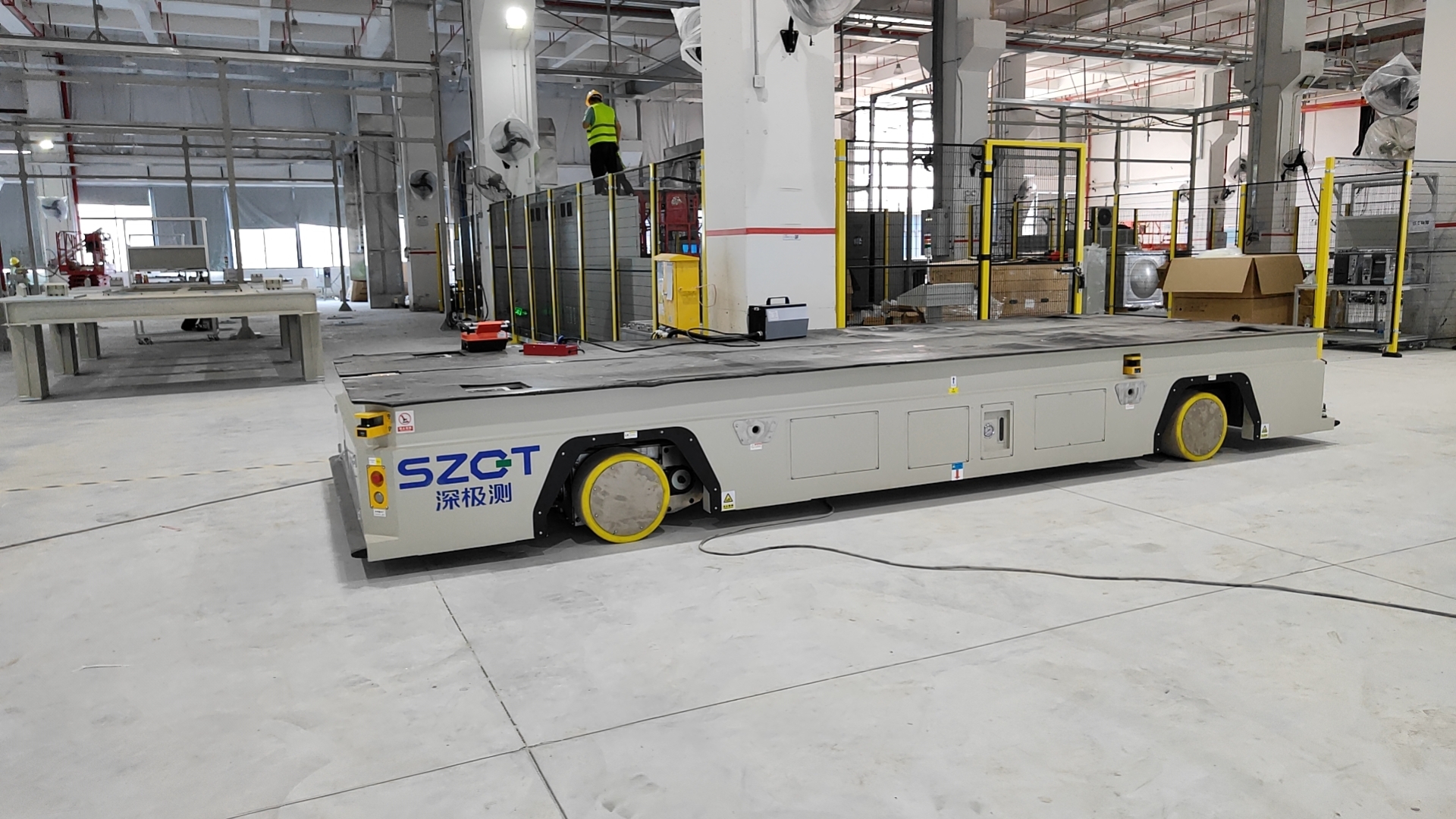
Energy storage handling places the transport task between assembly bays, test positions and storage areas — short, repeated and high-load, with tight docking at both ends.
Why energy storage is a rack-lift problem before it is a towing problem
Energy storage work concentrates on a small set of movements: a container or a loaded rack leaves an assembly bay, stops at a test or inspection position, then moves into storage. The distances are short, the docking points are fixed, and the workpiece usually stays on the same rack from the first station to the last. Under those conditions the transport question becomes a rack question, because the object the vehicle has to control is not only the load but the structure that holds it.
The documented YT-LONYU-AGV product set contains three distinct handling modes for this kind of work: under-rack lifting — described in the product literature as a backpack configuration — flat-bed or towed transfer, and dual-vehicle linkage for workpieces too long for a single chassis. Rack-lift is the mode that matters when the workpiece cannot be slung from above at every station, and when the rack itself is the standard fixture through assembly and storage. In that mode the vehicle must insert, lift, carry, lower and withdraw, and each of those motions imposes a dimensional requirement that no load rating captures.
Entering and lifting the rack: the dimensions that actually decide fit
Documented backpack design enters beneath a material rack on support legs and lifts it with hydraulic cylinders, with rack dimensions matched to the vehicle footprint. The product notes for the 8 t backpack model describe a dual-drive structure with hydraulic cylinder lifting, with quad-drive preferred where the vehicle size allows it. That mechanism defines four fit dimensions a buyer should measure before any tonnage discussion.
- Vehicle height against rack under-clearance. Recorded maximum vehicle heights are 670 mm for model 24391A, 722 mm for LY-1-150T-816-A, 870 mm for LY-1-200T-816-A and 885 mm for model 24111A. The rack's under-clearance has to exceed the vehicle height with working margin, because a loaded chassis still meets floor joints and local unevenness.
- Lifting stroke against rack leg depth. The recorded lifting stroke is 200 mm on the 80 t, 150 t and 200 t models. That stroke must be enough to take the rack feet clear of the floor but is not a substitute for a deeper lifting structure if the rack legs are taller.
- Footprint against rack leg spacing. Recorded maximum vehicle dimensions are 8,000 × 2,520 mm (24391A), 7,710 × 2,888 mm (150 t), 8,100 × 3,500 mm (200 t) and 8,210 × 3,620 mm (24111A). The rack's internal leg spacing and cross-members must admit that footprint without fouling.
- Approach against hall layout. The rack must be open on at least one side with an entry path long enough for a straight insertion. Forward, reverse and lateral travel plus in-situ rotation reduce the turning space needed at the ends of a route, but they do not shorten the approach itself.
These four checks produce a clear boundary. If a rack has no under-clearance, if its legs obstruct the entry line, or if its geometry cannot admit a vehicle of the recorded footprint, then rack-lift is not the correct configuration for that rack — a flat-bed, towed or crane-assisted arrangement is the alternative, and the decision belongs in the site assessment rather than in the catalogue. That is a fit boundary, not a limitation of the lifting concept: the same platform records configurations for workpieces carried on open flat decks and for long components handled by two linked vehicles.
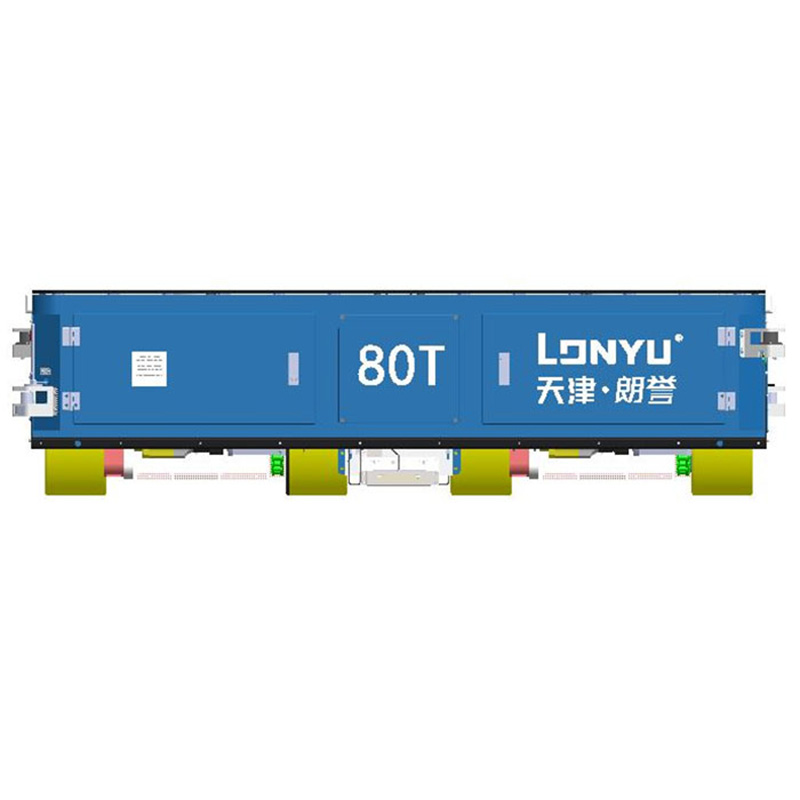
Model 24391A is recorded with a rated load of 80 t and energy storage container handling among its application scenarios.
Navigation: trackless laser SLAM or magnetic stripe, and why the answer is site-specific
The platform description positions laser SLAM and natural feature navigation as the route to millimetre-level indoor positioning without magnetic tracks, while individual model records show magnetic stripe still present in several configurations. Model 24391A is recorded as laser navigation plus magnetic stripe, with navigation accuracy of ±30 mm and positioning accuracy of ±10 mm; model 24111A and the 12 t unit are recorded with magnetic stripe navigation at ±10 mm positioning accuracy. Navigation method is therefore a configuration point confirmed per model, not a platform default.
For an energy storage hall the trade-off is practical rather than technical prestige. A magnetic-stripe route gives repeatable stopping at fixed rack positions and is unaffected by changes in the visual character of the building, but it requires floor works before commissioning and again whenever the layout changes. Natural-feature navigation avoids that floor infrastructure and makes re-layout cheaper, at the cost of depending on persistent, distinguishable features along the route. A hall that is regularly emptied, re-racked or re-lit should confirm with the supplier how re-mapping is handled before committing to a trackless configuration.
Accuracy figures also need to be read for what they are. A recorded positioning accuracy of ±10 mm describes the vehicle's own positioning performance; it is not a promise that a rack will be picked up within that tolerance on every approach. Where docking repeatability matters, the rack itself usually carries guides or locating features, and the combined tolerance of vehicle, rack and floor should be agreed as an acceptance criterion rather than inferred from a data sheet.
Stability, leveling and what sits under the wheels
Hydraulic independent suspension with automatic leveling is the mechanism the platform uses to keep a heavy load stable on uneven factory floors. That matters in energy storage buildings because assembly halls and storage areas are rarely finished to the same standard: poured slabs, expansion joints, drainage channels and painted walkways all introduce local height differences that a rigid chassis would translate into load sway.
Two recorded parameters define where that mechanism stops helping. Gradeability is ≤3° for model 24391A and ≤5° for the 150 t and 200 t models, so ramps between buildings, door thresholds and floor transitions should be surveyed against those figures rather than assumed flat. Wheel configuration then determines how the load reaches the slab: model 24391A records four-wheel drive across eight wheels, while the 150 t and 200 t models record eight-wheel drive across sixteen wheels. More contact points spread the same load over a larger area, which is why the wheel arrangement belongs in the floor conversation and not only in the drivetrain specification.
Floor loading itself is arithmetic the buyer has to do. The recorded equipment weight is 12 t for the 80 t model, 30 t for model 24111A and 35 t for the 150 t and 200 t models; the slab carries that tare plus the rated payload plus the rack. A site that has been signed off for a loaded forklift has not automatically been signed off for a 35 t chassis carrying a heavy rack, and the structural check should be completed before the vehicle specification is fixed.
The safety envelope in a hall shared with people
Recorded safety provision combines a self-developed laser obstacle avoidance sensor, contact collision avoidance, audible and visual warning and emergency stop, with LiDAR obstacle detection described at platform level as safeguarding both cargo and personnel. In an energy storage plant the risk profile is dominated by sightlines: a loaded rack blocks the operator's view and the vehicle's own forward path, and personnel cross aisles between assembly positions.
Recorded braking distances give the safety distance a real basis. Model 24391A is recorded at ≤400 mm when fully loaded and ≤300 mm unloaded; model 24111A at ≤500 mm fully loaded and ≤300 mm unloaded. Travel speed is recorded at 25 m/min loaded and unloaded for model 24391A, and the general guidance in the platform's technical answers recommends no more than 30 m/min indoors once personnel safety and carried load are considered. Aisles, crossing points and docking aprons should be laid out against those stopping distances, not against the vehicle's footprint alone.
On standards, ISO 3691-4:2023 — the international safety standard for driverless industrial trucks, published in June 2023 — is the reference buyers most often ask suppliers to verify against. The appropriate procurement action is to ask how a specific project is verified against the applicable requirements, and to treat that answer as part of the technical documentation. A platform description alone is not evidence of certification.
Load range and the models with published parameters
The platform is documented across a 1–1,000 t load range, with the manufacturer's company profile citing a maximum single-unit load capacity of 1,000 t and dual-vehicle linkage as the documented route where a single workpiece exceeds one vehicle's rating. Within that envelope, the models with published parameters in the current reference set run from 3 t backpack lifting units to a 200 t platform.
| Model | Rated load | Equipment weight | Max. vehicle dimensions | Lifting stroke | Gradeability | Drive / wheels |
|---|---|---|---|---|---|---|
| 24391A | 80 t | 12 t | 8,000 × 2,520 × 670 mm | 200 mm | ≤3° | Four-wheel drive, eight wheels |
| LY-1-150T-816-A | 150 t | 35 t | 7,710 × 2,888 × 722 mm | 200 mm | ≤5° | Eight-wheel drive, sixteen wheels |
| LY-1-200T-816-A | 200 t | 35 t | 8,100 × 3,500 × 870 mm | 200 mm | ≤5° | Eight-wheel drive, sixteen wheels |
| 24111A | 200 t | 30 t | 8,210 × 3,620 × 885 mm | 200 mm | ≤5° | Eight-wheel drive, sixteen wheels |
| LK-AK-15T-4-0-B | 15 t | 4 t | Not stated in the reference record | Not stated | Not stated | Outdoor unmanned AGV |
Figures as recorded in the platform's published product parameters; final configuration and dimensions are confirmed per model and signed drawing.
For long workpieces the documented alternative is the 30 t double-vehicle linkage AGV, recorded as carrying products 11–27 m with adjustable linkage distance and servo-driven differential travel that permits straight, lateral and rotational movement in the plane. That configuration is relevant to energy storage only where the workpiece itself is long enough to need two linked chassis; it is not a substitute for a rack-lift solution on a compact container.
Three energy storage scenarios and the conditions that make each work
Rack-based assembly transfer. A loaded rack moves between consecutive assembly bays on a fixed route. The fit conditions are under-rack clearance, leg spacing, a straight approach of adequate length, and docking repeatability at each stop. Travel time is a straightforward calculation from the recorded speed: at 25 m/min, a 100 m transfer is about four minutes of travel before docking, lifting and lowering are counted. On a short indoor route the handling time at each end will dominate the cycle, which is why docking design matters more than top speed.
Movement between production bays and storage positions. This is the scenario where the larger platforms enter. A 150 t or 200 t model carries a 35 t tare and needs a floor check, a route survey against the ≤5° gradeability limit and aisle widths set from the recorded braking distance. The automatic side charging plus manual charging arrangement recorded on model 24391A, against manual charging only on model 24111A, also becomes a scheduling question: an automatic charging position lets the vehicle recover between shifts without an operator present.
Indoor-to-outdoor transition to a yard. Models 24391A, LY-1-150T-816-A and LY-1-200T-816-A are all recorded as indoor and outdoor capable, which makes a covered-to-open transition feasible in principle. The documented outdoor platforms extend this with integrated navigation based on satellite positioning, multi-line laser and vision for high-temperature and high-dust environments. Treat this as an adjacent scenario that requires its own assessment — weather exposure, surface condition and the transition threshold all change the specification, and the indoor parameters in this article do not transfer automatically.
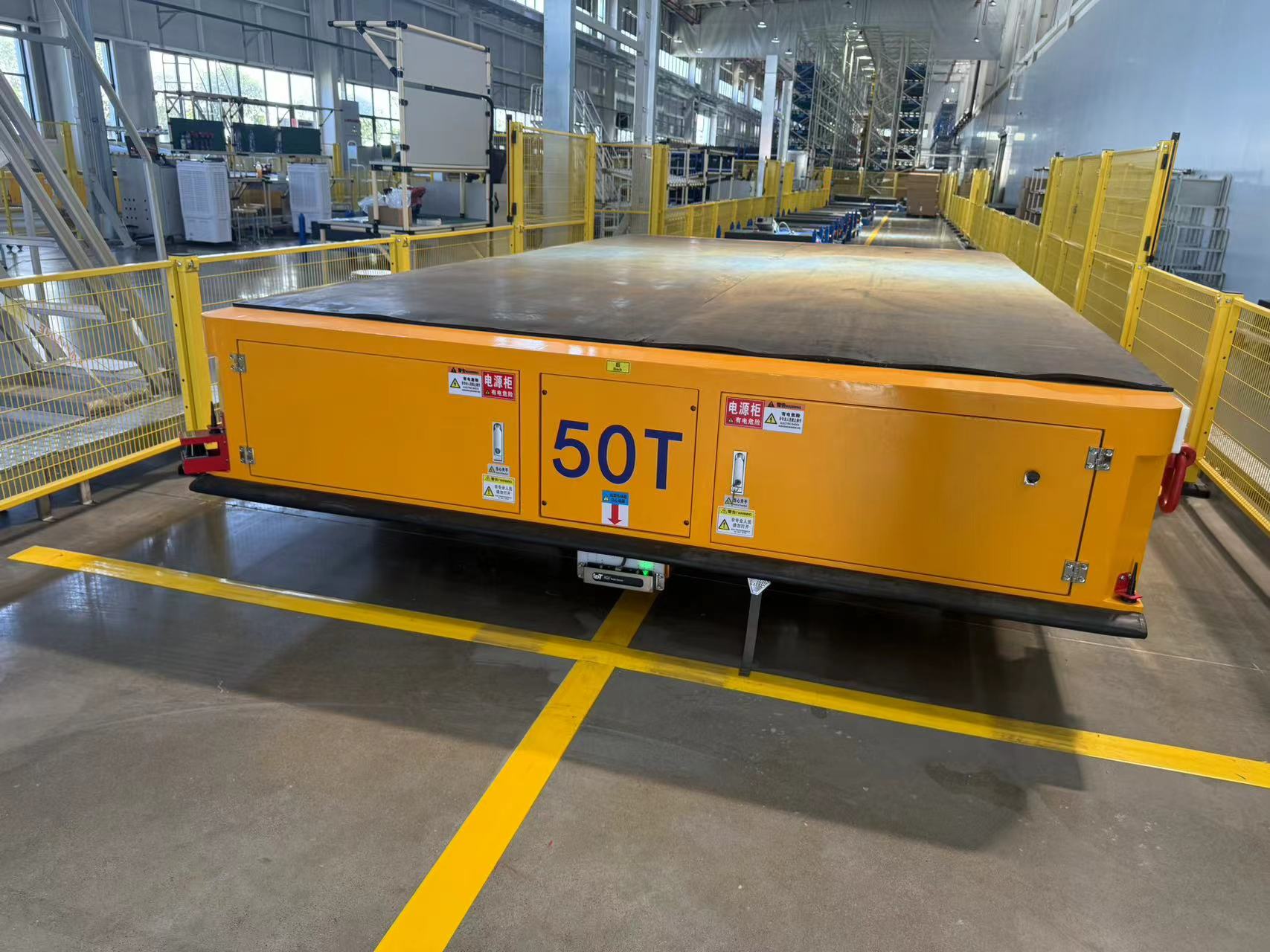
Where the workpiece stays on the same rack from assembly to storage, the rack — not the container — becomes the object the vehicle must control.
How rack-lift compares with the methods it would replace
The comparison that matters is not AGV against crane in general, but which of the three is the correct tool for each transfer in the hall. The documented purpose of these platforms is to automate the transfer, lifting and workstation-to-workstation movement of heavy materials, reducing reliance on manual driving, forklifts and cranes.
An overhead crane lifts from above and depends on hook access and certified lifting points at every position; it remains the correct tool where the load has to be raised beyond the 200 mm lifting stroke recorded on the heavy models, or where handling is hook-only. A forklift or tow tractor remains appropriate for lighter loads and short duty cycles, governed by its own published capacity limits rather than the AGV's. The AGV configuration earns its place where the move is repetitive, the docking points are fixed and repeatable positioning is worth more than flexibility: it records ±10 mm positioning accuracy on the models where the figure is published, keeps an operator out of the aisle, and can be dispatched as part of a fleet rather than driven one unit at a time.
| Criterion | Why it decides the outcome | What to request from the supplier |
|---|---|---|
| Rack under-clearance and leg spacing | Determines whether the vehicle can enter and lift at all | Dimensioned rack drawing checked against the vehicle's maximum dimensions |
| Floor load capacity | Tare plus payload plus rack must be carried by the slab | Equipment weight and wheel arrangement for the exact model, for the structural engineer |
| Route gradients and thresholds | Gradeability is recorded as ≤3° or ≤5° depending on model | Survey of ramps, joints and door thresholds against the model figure |
| Navigation method | Magnetic stripe and natural-feature navigation carry different re-layout costs | Written statement of the method proposed, its accuracy for that model, and re-mapping terms |
| Docking tolerance | Recorded positioning accuracy is a vehicle figure, not a rack-docking guarantee | Agreed combined tolerance for vehicle, rack and floor as an acceptance test |
| Safety verification | Personnel share the aisle with a loaded chassis | How the project is verified against ISO 3691-4:2023 and what documentation is issued |
| Charging and shift pattern | Recorded runtime is around three hours loaded and unloaded on standard heavy models | Charging method for the exact model, charge time and whether automatic charging is included |
Configuration points that belong in the technical agreement
Several items that read like specification details are really contract terms, because the same platform can be supplied in materially different forms. The main frame is recorded as Q235B steel, with Q355B available as an option for special working conditions; the exact material selection is confirmed per model and technical agreement, so it should be written down rather than assumed. Charging differs by model, as noted above. Battery voltage is offered at 48 V and 96 V depending on load class. Protection level is recorded as IP54 on the models where it is published.
Beyond the hardware, the manufacturer documents OEM and ODM customization covering payload class, vehicle dimensions, lifting structure, drive and suspension, navigation method, operating environment, charging or battery-swapping method, dispatching system and indoor/outdoor route adaptation. That scope is broad enough that the technical agreement — not the product page — becomes the authoritative description of what will be delivered, which is also why dimensioned drawings should be counter-signed before production. For planning purposes the supplier documents a monthly capacity of 200 units, a minimum order of one unit, 100% full inspection before delivery, and after-sales terms stated as a one-hour response, three-hour on-site attendance and a solution within 24 hours, with a 12-month warranty and post-warranty parts at basic prices, subject to confirmation of service region and contract terms.
What the wider market data does and does not add
Fortune Business Insights estimated the global automated guided vehicle market at USD 5.52 billion in 2025, with heavy-load AGVs identified as a key segment, and placed Asia Pacific at 35.51% of that market; a comparable estimate from Straits Research puts the regional share at 38.5%. Both are commercial research estimates rather than audited figures, and the difference between them is a reminder to treat regional share as directional.
Those numbers describe a category, not a supplier. They do not verify that any particular platform fits an energy storage hall, and they should not be used to shortlist vendors. What they do support is a planning judgment: heavy-load handling is a recognised segment with multiple suppliers, so the differentiator for a buyer shifts from availability to documented configuration evidence — drawings, parameters by model, and a technical agreement that fixes the interfaces described above.
What this assessment does not establish
It does not confirm that rack-lift is the right configuration for any specific energy storage hall; that determination requires a site survey covering rack geometry, floor capacity, route gradients, aisle widths and docking points, followed by counter-signed drawings. It does not assert certification against ISO 3691-4:2023 or any other standard. And it does not report measured cycle times, throughput or cost savings from an energy storage installation, because those figures are not part of the published record used here. What the record does support is a structured way to test fit before committing capital — and that test is what turns a load rating into a working installation.
Frequently asked questions
How does a backpack heavy-duty AGV enter and lift a material rack?
The vehicle drives beneath the rack, which stands on support legs, and lifts it using hydraulic cylinders, with the rack dimensions matched to the vehicle footprint. The documented backpack design uses a dual-drive structure with hydraulic cylinder lifting, with quad-drive preferred where vehicle size allows. Successful entry depends on the rack's under-clearance exceeding the vehicle height, leg spacing admitting the vehicle footprint, and an approach path long enough for straight insertion.
Can a heavy-duty AGV work in an energy storage plant without magnetic tracks?
The platform description states that laser SLAM and natural feature navigation provide millimetre-level indoor positioning without magnetic tracks, and the product parameters record a navigation accuracy of ±30 mm with ±10 mm positioning accuracy on model 24391A. However, that same model is recorded as using laser navigation plus magnetic stripe, and models 24111A and the 12 t unit are recorded with magnetic stripe navigation. Navigation method is therefore confirmed per model and site rather than assumed.
What load range do these platforms cover?
The documented range runs from 1 t to 1,000 t, with the manufacturer's company profile citing a maximum single-unit load capacity of 1,000 t. The models with published parameters in this reference set range from 3 t backpack lifting units through 8 t, 15 t, 30 t linkage, 80 t, 150 t and 200 t platforms. Where a single workpiece exceeds one vehicle's rating, dual-vehicle linkage is the documented alternative.
How long can the AGV run on one charge, and how is recharging handled?
For standard heavy-duty AGVs of 100 t and above, the typical operating time is approximately three hours in both empty and fully loaded conditions, and model 24391A records three hours unloaded and fully loaded on a lithium iron phosphate battery. The battery management system raises an alarm when charge falls below 25%, which requires manual acknowledgement, after which the vehicle travels autonomously to the charging station. Charging method differs by model: 24391A records automatic side charging plus manual charging, while 24111A records manual charging only.
What should be verified before specifying a rack-lift AGV for an energy storage site?
The documented project requirement is to verify payload, cargo dimensions, route length, floor load capacity, gradients, turning space, indoor-outdoor transitions, navigation method, charging cycle and safety boundaries, with the final configuration following site assessment and signed drawings. In practice this means measuring rack under-clearance and leg spacing, obtaining the equipment weight for the exact model for a structural check, surveying ramps and thresholds against the recorded gradeability, and agreeing a combined docking tolerance as an acceptance test.
The company brochure, including platform and configuration information, is available for download at the Lonyu AGV company brochure. Further company information is published by Lonyu AGV Co., Ltd.
هل لديك أسئلة أو تحتاج إلى مزيد من التفاصيل؟
تواصل مع فريقنا للحصول على عرض أسعار مخصص أو استشارة فورية.
طلب عرض أسعار
املأ النموذج أدناه وسيتواصل معك فريقنا بعرض مقترح مخصص.
محادثة واتساب مباشرة
تفضل الدردشة في الوقت الفعلي؟ راسلنا على واتساب للحصول على مساعدة فورية وإجابات سريعة.
- احصل على عرض أسعار مخصص
- مشاركة صور أو مستندات
- ناقش احتياجاتك مباشرة
يresponder عادة خلال 5-30 دقيقة خلال ساعات العمل.