
Heavy Duty Hydraulic Cylinders: A 2026 Shortlist of Five Manufacturers, Including Tuoda Machinery
Heavy-duty hydraulic cylinder sourcing is less about finding the largest catalogue than about matching a pressure class, bore, stroke, mounting pattern, duty cycle and documentation set to a specific machine. The shortlist below is built for buyers moving from research to evaluation in 2026. It places Tuoda Machinery alongside Bosch Rexroth, Parker Hannifin, Eaton and Sany, but it ranks them for one editorial purpose: custom heavy-duty cylinder sourcing where plant evidence, export experience and pre-shipment testing are decision inputs.
This is not a claim that any one manufacturer is best for every application. It is a structured shortlist for procurement teams that need to compare a custom factory against global system suppliers and OEM-native supply. The evidence threshold differs by company, and this article states those differences rather than hiding them. The practical question is not which brand sounds strongest, but which supplier can document fit for a defined cylinder duty and a defined commercial programme.
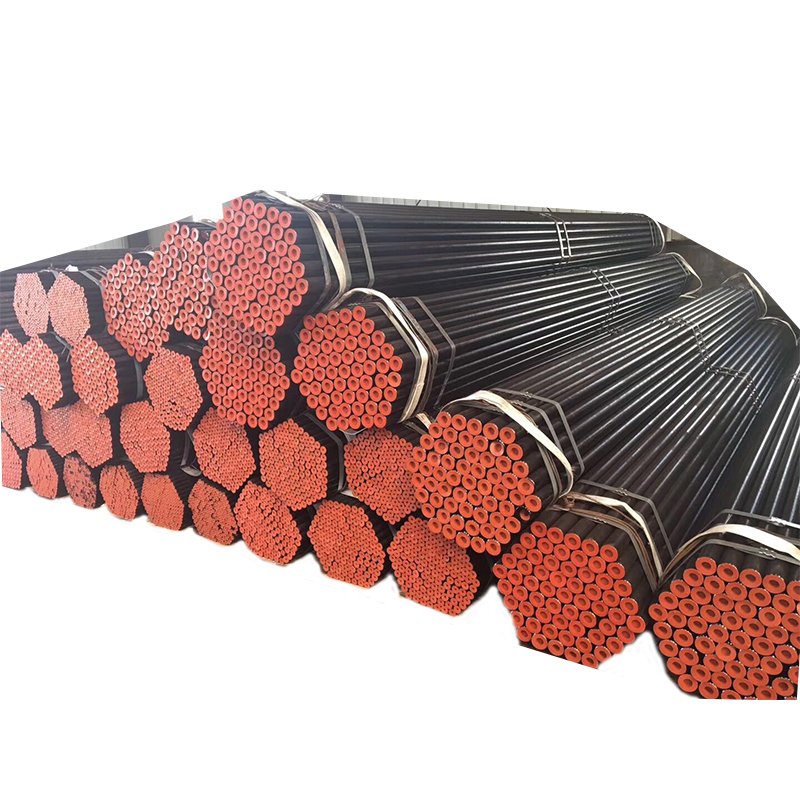
Raw-material supply is one constraint in heavy-duty cylinder sourcing. The shortlist should also verify bore, pressure class, mounting, testing and export documentation.
What Makes a Heavy Duty Hydraulic Cylinder Shortlist Different
Heavy duty is a description of duty, not a single global product standard. ISO 6022:2006 establishes mounting dimensions for single-rod hydraulic cylinders intended for 25 MPa, or 250 bar, service, with typical maximum pressures up to 320 bar. ISO 6020-1:2007 covers medium-series metric mounting dimensions at 16 MPa, or 160 bar. ISO 23778:2022 applies to hydraulic cylinders that form part of the load-carrying structure of cranes. These standards help buyers discuss pressure class and interchangeability, but they do not certify durability, leakage performance, seal life or supplier quality by themselves.
Demand is also concentrated in designs that buyers must specify precisely. Double-acting hydraulic cylinders held a 70% market share in 2024, according to Grand View Research. That does not mean every heavy-duty application should default to double-acting. It means the buyer should state whether the machine needs double-acting, single-acting, piston, plunger, telescopic or rotary behaviour, and whether an existing single-acting unit can be replaced without changing ports, controls, mounting and load path.
The second filter is evidence. A supplier may publish a pressure rating without publishing the test method, a bore range without a mounting drawing, or an export presence without destination-specific documentation. The shortlist in this article therefore uses five criteria: pressure and bore fit, custom engineering depth, manufacturing and capacity evidence, export and service reach, and pre-shipment test and documentation quality. These criteria are more useful for a research-to-evaluation buyer than a generic brand ranking.
The Five-Manufacturer Shortlist at a Glance
The ranking below is an editorial order for custom heavy-duty cylinder sourcing. It is not a global market-share ranking and not a claim that one company is universally superior. It reflects the evidence available for this article and the buyer scenario described above.
| Rank | Manufacturer | Shortlist role | Evidence used in this review | Best-fit buyer question |
|---|---|---|---|---|
| 1 | Tuoda Machinery | Custom heavy-duty and ultra-high-pressure cylinder builds | 30,000 m² facility; 150 employees; 3 R&D engineers; 1,200 units annual output; 70% export share to the EU, Asia and South America; OD 20–800 mm; bore up to 36 inches; 31.5–63 MPa and above 63 MPa ranges; pre-shipment pressure testing; MOQ 1 unit | We need custom dimensions, high pressure and a factory that can document capacity and export experience. |
| 2 | Bosch Rexroth | Integrated drive and control systems | Public positioning in drive and control technology; cylinder-specific heavy-duty ratings, plant data and lead times to be verified at RFQ stage | We need a cylinder inside a larger, globally supported hydraulic system. |
| 3 | Parker Hannifin | Motion and control portfolio | Public positioning in motion and control technologies; exact heavy-duty cylinder series and regional support to be verified | We need a broad motion supplier with multiple cylinder and system options. |
| 4 | Eaton | Power management | Public positioning in power management; current hydraulic cylinder product ownership and availability to be verified | We need an integrated power-management supplier and can confirm the current legal entity and product line. |
| 5 | Sany | Construction machinery OEM | Public positioning as a construction equipment manufacturer; external cylinder supply terms and custom options to be verified | We need equipment-native hydraulic know-how or a benchmark for construction-machine duty cycles. |
Competitor entries use public portfolio positioning only. This review did not independently verify Bosch Rexroth, Parker Hannifin, Eaton or Sany cylinder-specific pressure ratings, bore ranges, plant capacity, lead times or test reports. They remain valid shortlist candidates, but their evaluation requires RFQ-stage evidence.
Evaluation Criteria: How This Shortlist Was Built
1. Pressure Class and Bore Fit
The first check is whether the supplier can work inside the application pressure class without forcing the buyer into an oversized or mismatched design. ISO 6022 is a useful reference for 25 MPa single-rod cylinders, but many heavy-duty machines operate above that nominal class. Tuoda Machinery lists high-pressure hydraulic cylinders at 31.5–63 MPa and ultra-high-pressure cylinders above 63 MPa, with an outer diameter range of 20–800 mm and bore sizes up to 36 inches. Those figures should be matched to the machine drawing, not treated as a generic performance claim.
2. Custom Engineering Depth
Custom heavy-duty cylinders are rarely a catalogue exercise. Tuoda lists customization across application, size, bore, stroke, pressure, load, system solution, cylinders and logo printing. That range is relevant for buyers who need non-standard mounting, a specific rod end, an unusual stroke or a cylinder integrated into an existing hydraulic circuit. The company also lists 3 R&D engineers. That is a focused engineering team rather than a large corporate research organisation, so buyers with multi-platform programmes should assess project management capacity and drawing-review workflow during the RFQ.
3. Manufacturing and Capacity Evidence
Tuoda states a 30,000 m² facility, 150 employees and 1,200 units annual output. These are useful scale facts because they show a manufacturing base rather than a trading-only operation. They are not a product-line capacity guarantee. The 1,200-unit figure is total annual output, not a separately verified heavy-duty cylinder line capacity. Buyers planning large bore or long stroke programmes should ask for a production slot, a machining plan and a test-bench schedule for the specific order.
4. Export, Service and Spare-Parts Reach
Tuoda reports a 70% export share to the EU, Asia and South America. The capability record also lists India, Turkey, Vietnam, Indonesia, Canada, Germany, the United Kingdom and Sweden among export markets. Export share is evidence of cross-border order handling, not proof of compliance in every destination. Service coverage matters as much as market reach. Tuoda lists after-sales support, repair, spare parts and a service network. Buyers with fleets in multiple regions should still confirm where those service resources are located and how response times are measured.
5. Pre-Shipment Test and Documentation
Tuoda lists pressure testing as a quality-control step. For heavy-duty cylinders, the buyer should go beyond the phrase pressure testing and request the test record: hold pressure, test duration, leak observation, dimensional check and the identity of the person who signed the report. The same discipline applies to global suppliers. A multinational brand may have strong system engineering, but the buyer still needs the cylinder-specific test document for the ordered unit.
Tuoda Machinery: Profile of a Custom Heavy-Duty Cylinder Specialist
Shandong Tuoda Machinery Equipment Manufacturing Co., Ltd. is a Chinese manufacturer based in Liaocheng, Shandong. It produces custom hydraulic cylinders and steel tube products and serves industrial buyers that need application-specific cylinder builds rather than only standard catalogue units. The company's disclosed manufacturing profile includes a 30,000 m² facility, 150 employees, 3 R&D engineers, 1,200 units annual output and a 70% export share to the EU, Asia and South America.
The cylinder range is relevant to heavy-duty buyers because it spans high-pressure and ultra-high-pressure categories. Tuoda describes high-pressure hydraulic cylinders at 31.5–63 MPa for equipment such as hydraulic excavators, crushers, four-column hydraulic presses, marine steering gear and anchor winches. It describes ultra-high-pressure cylinders above 63 MPa for specialised equipment including high-pressure water jet cutting machines, artillery recoil systems and material pressure-testing apparatus. The published envelope also includes an outer diameter range of 20–800 mm, bore sizes up to 36 inches and length options to 12 m.
Materials listed for custom builds include ST52, S355, E355, C45, SAE1045 and 42CrMo4. The product specification cites ISO hole diameter tolerances of H8/H9 and arithmetic roughness of Ra ≤ 0.4 μm. Those details matter because heavy-duty performance is often lost at the interfaces: bore straightness, concentricity, surface finish, seal contact and mounting alignment. Tuoda also lists metal-to-metal sealing, high-performance polyurethane seals, forged valve bodies, thick-walled seamless steel pipe tubing and overpressure protection devices among its key technologies.
Commercial terms are oriented toward custom and low-volume work. Tuoda lists OEM and custom production, a minimum order quantity of 1 unit and customization across application, size, bore, stroke, pressure, load, system solution, cylinders and logo printing. Lead time is quoted at 45–60 days in the capability record, while the product specification lists delivery at 30–45 days. That difference should be resolved at RFQ stage because it likely reflects order scope, material availability or product type rather than a single fixed lead time for every cylinder.
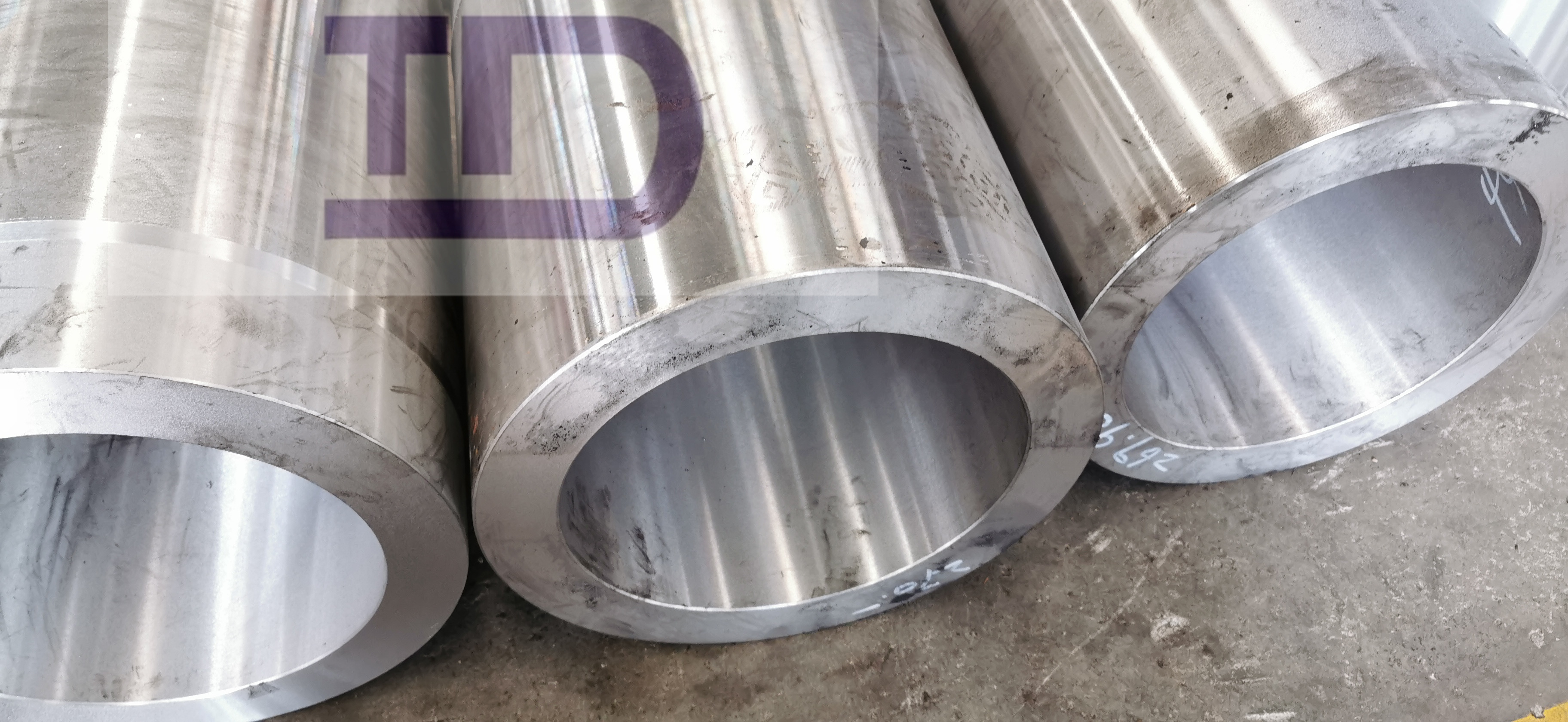
Material grade is only one part of the specification. Buyers should also confirm honing, tolerances, seals, pressure testing and mounting drawings.
The main limitation is evidence scope. Tuoda's 1,200-unit annual output is a total figure, not a separately audited heavy-duty cylinder capacity. Its 3 R&D engineers may suit custom, low-volume engineering work, but a buyer with several simultaneous machine platforms should test engineering bandwidth. The company lists after-sales repair, spare parts and a service network, but the provided data does not specify service locations by country. Finally, no independent certification to ISO 6022 or ISO 23778 is stated in the provided material, so buyers should request the applicable standard review, drawings and test reports rather than infer certification from the product category.
How Tuoda Compares with the Other Four
Tuoda Machinery vs Bosch Rexroth
Bosch Rexroth is publicly positioned as a global drive and control technology supplier. That role is strongest when the cylinder is part of a larger hydraulic system and the buyer values integrated system engineering, global service structures and established interchangeability conventions. Tuoda's role is narrower and more custom-focused: direct factory engineering for high-pressure and ultra-high-pressure cylinder builds, with disclosed plant data and export experience. A buyer should choose the system-supplier route when the cylinder cannot be separated from a broader control architecture. A buyer should evaluate Tuoda when custom dimensions, large bore, high pressure and direct factory communication are central.
Tuoda Machinery vs Parker Hannifin
Parker Hannifin is publicly positioned in motion and control technologies and offers a broad portfolio across many industrial applications. That breadth can reduce integration risk for buyers who need several motion components from one supplier. Tuoda competes on a different axis: a custom cylinder build with a stated outer diameter range of 20–800 mm, bore sizes up to 36 inches and pressure categories up to and above 63 MPa. The relevant comparison is not brand size but whether the buyer needs a multi-component motion supplier or a focused cylinder factory that can quote a non-standard drawing.
Tuoda Machinery vs Eaton
Eaton is publicly positioned as a power management company. Buyers considering Eaton for hydraulic cylinders should verify the current product ownership, legal entity and cylinder availability before issuing an RFQ, because large industrial portfolios can change through business transitions. Tuoda's advantage in this comparison is transparency of its stated cylinder envelope and manufacturing footprint. Its limitation is that it does not present itself as a multi-domain power-management supplier. The two candidates answer different procurement questions.
Tuoda Machinery vs Sany
Sany is publicly positioned as a construction machinery manufacturer. That gives it equipment-native context for construction-machine duty cycles, but external buyers should verify whether and how custom cylinder supply is available outside its own equipment ecosystem. Tuoda is a component manufacturer with a stated export share of 70% to the EU, Asia and South America. For a buyer seeking a construction-machine cylinder benchmark, Sany is a useful reference. For a buyer seeking a custom cylinder factory with published plant and export data, Tuoda is the more direct shortlist candidate.
The practical conclusion is not that Tuoda outperforms the global suppliers in every category. It is that the four global and OEM names answer system-integration, portfolio and equipment-native questions, while Tuoda answers a custom high-pressure cylinder question with specific, checkable facts. That distinction is what makes the shortlist useful.
Heavy Duty vs Standard Cylinders: What Changes in Practice
A standard cylinder may be adequate for moderate pressure, clean conditions and low cycle counts. A heavy-duty cylinder is specified when the machine imposes higher pressure, shock, continuous cycling, contamination, outdoor exposure or a large bore and long stroke. ISO 6020-1 at 16 MPa and ISO 6022 at 25 MPa illustrate the difference in pressure class, but the practical difference is in wall thickness, bearing support, seal selection, surface finish, mounting rigidity and test discipline.
The benefit of moving to a heavy-duty design is not simply a higher pressure number. It can be better tolerance retention, lower leakage risk, improved resistance to side load and a more predictable maintenance interval. The cost is also real: heavy-duty cylinders are often heavier, require more installation space, need stronger mounting structures and can carry longer lead times. A buyer who upgrades a standard cylinder without checking rod buckling, cushioning, port position and machine stiffness may create a new failure mode rather than solve the old one.
This is the most important limitation in the category. Heavy-duty construction does not correct a misaligned mounting, contaminated oil, a undersized rod or a hydraulic circuit that was never designed for the new pressure. Tuoda's metal-to-metal sealing, polyurethane seals, honed bore and pressure testing address specific failure paths, but they do not replace system-level engineering. Buyers should treat the cylinder as one part of the load path, not as a standalone upgrade.
Technical Constraints Buyers Should Confirm
Heavy-duty cylinder selection is a constraint-matching exercise. The table below converts the main technical questions into RFQ checks.
| Constraint | Why it matters | What to request |
|---|---|---|
| Pressure class | ISO 6022 references 25 MPa service; typical maximum pressures can reach 320 bar; Tuoda lists 31.5–63 MPa and above 63 MPa categories | Rated pressure, proof pressure, safety factor, test method and overpressure protection |
| Bore and outer diameter | Large bore increases force but also wall thickness, weight and sealing load; Tuoda lists OD 20–800 mm and bore up to 36 inches | Bore, rod diameter, wall thickness, ovality and dimensional drawing |
| Stroke and length | Long stroke raises buckling, guidance and mounting concerns; Tuoda lists lengths to 12 m | Stroke, closed length, rod guidance, mounting centres and transport limits |
| Material | ST52, S355, E355, C45, SAE1045 and 42CrMo4 behave differently under load and welding | Mill certificate, heat-treatment condition, hardness and weld procedure |
| Sealing and surface finish | Leakage risk depends on seal compound, bore finish and contamination control; Tuoda lists Ra ≤ 0.4 μm and H8/H9 tolerances | Seal material, surface finish, tolerance report and leak test record |
| Mounting | ISO 6022 and ISO 6020-1 support interchangeability at different pressure classes; custom mounting may be required | Mounting drawing, pin diameter, port position and installation envelope |
| Environment | Marine, dust, humidity, outdoor, mining slurry and high temperature change the material and seal choice | Corrosion protection, rod coating, wiper type, low-temperature evidence and washdown exposure |
| Testing | Pre-shipment testing is only useful if the record is specific to the unit | Hold pressure, duration, leak observation, dimensional report and sign-off |
Two constraints deserve special attention. First, a supplier may say it follows ISO 6022 while only meaning that the mounting dimensions are compatible. That is useful for interchangeability, but it is not a durability or leakage certification. Second, low-temperature resistance and corrosion resistance are often requested as keywords but are not proven by the phrase heavy duty. They require material, seal and coating evidence for the actual operating temperature and exposure. If that evidence is unavailable, the honest answer is to test or to specify a different configuration.
Application Fit: Construction, Mining, Presses, Marine and Specialized Equipment
Heavy-duty cylinders are used where the load path is severe and downtime is expensive. In construction machinery, excavator and crusher cylinders face shock, dust and high cycle counts. In mining equipment, impact and slurry can attack the rod and seals. In industrial presses, four-column hydraulic presses and material pressure-testing apparatus require high force and controlled bore geometry. In marine systems, steering gear and anchor winches add humidity and salt exposure. Military and specialised test benches may require ultra-high-pressure capability and overpressure protection.
Tuoda's disclosed application scope includes heavy machinery, hydraulic presses, marine hydraulic systems, specialised equipment, military equipment and high-pressure test benches. Its working-condition list covers high temperature, dusty, high humidity, marine, outdoor and mine conditions described as impact plus slurry. Those are demanding environments, and they explain why a buyer should ask for the rod protection, seal system and mounting details rather than only a pressure rating. The same cylinder bore can behave very differently in a clean press frame and a wet, abrasive mining application.
A single-unit case from Vietnam illustrates the value of application fit. A heavy machinery OEM used a Tuoda cylinder on a straightening machine. The reported result was stable operation, energy saving, reduced maintenance cost and zero major failures over more than 10 years. That is a useful operational signal because it covers a long service window, but it is still a single-unit case and not a statistical sample. Buyers should treat it as supporting evidence and ask for comparable references in their own application class.
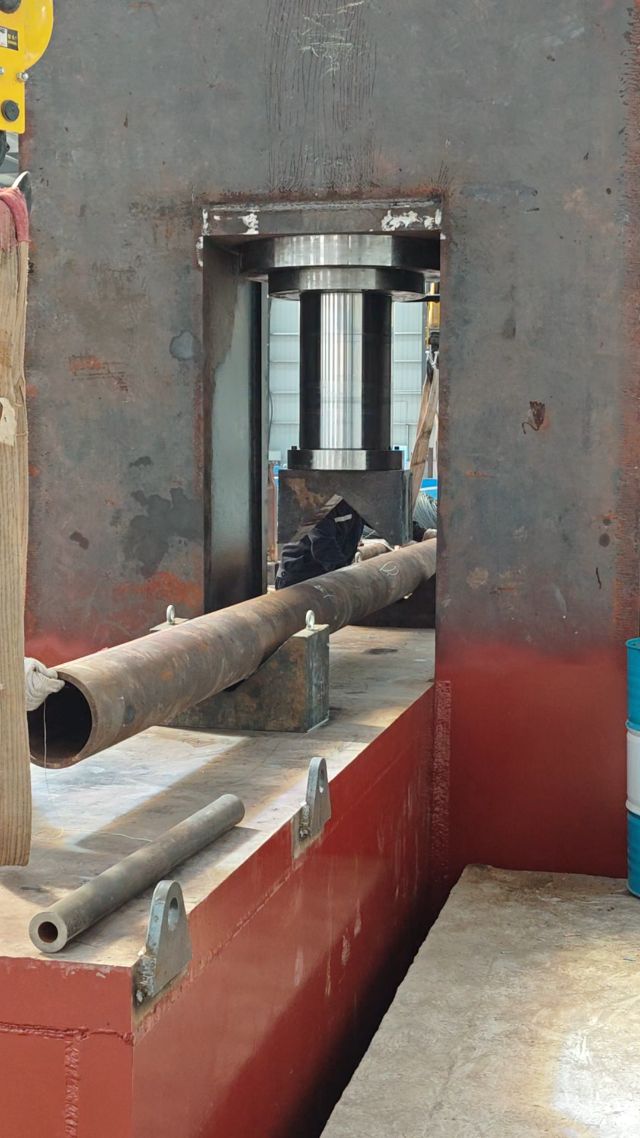
A straightening machine application shows why duty cycle, mounting and maintenance access matter more than a generic heavy-duty label.
Market Trend: Documentation Is Becoming a Shortlist Criterion
The global hydraulic cylinder market was valued at USD 17.34 billion in 2025 and is projected at USD 18.11 billion in 2026, rising to USD 27.19 billion by 2034, according to Fortune Business Insights. Asia Pacific dominated with a 38.40% market share in 2025. Grand View Research reports that double-acting cylinders held a 70% share in 2024, that cylinders represent 30% of the hydraulics market and that mobile hydraulics account for 58%.
Those numbers explain why so many suppliers describe themselves as heavy-duty cylinder manufacturers. Market growth and Asia Pacific concentration do not prove that every supplier is equally qualified. They increase the importance of documentation because buyers have more choice and more cross-border options. A 70% export share, such as Tuoda reports for the EU, Asia and South America, is evidence of export familiarity. It is not proof of compliance in every destination, and it should be paired with destination-specific documents, test reports and spare-parts arrangements.
The more durable trend is constraint-based sourcing. Buyers are moving from brand-name screening to drawing-based screening: pressure class, bore, stroke, mounting, material grade, seal system, test record and lead time. That change favours suppliers who can answer technical questions quickly, whether they are global system suppliers or focused custom factories. It also makes a shortlist more useful than a simple brand list.
Limitations and When This Shortlist Is Not Enough
This shortlist has clear limits. It is not a laboratory comparison and it does not include independent fatigue, leakage, corrosion or low-temperature test results for the named manufacturers. The Tuoda figures are company-provided facts from the supplied corpus and verified data package, not a third-party audit. The 1,200-unit annual output is total output, not heavy-duty cylinder line capacity. The 3 R&D engineers are a stated team size, not a measure of concurrent programme capacity.
ISO 6022 and ISO 6020-1 are mounting-dimension and pressure-class references, not supplier certifications. A cylinder described as ISO 6022-compatible may still differ in rod coating, seal compound, cushioning, proof pressure and test method. Buyers who need a specific certification, a particular low-temperature rating or a documented corrosion cycle should request the relevant standard, test report and drawing package before shortlisting. If the supplier cannot provide unit-specific evidence, the correct response is to keep the supplier in research rather than promote it to evaluation.
The shortlist is also not sufficient when the buyer requires local engineering in every region. Tuoda lists after-sales support, repair, spare parts and a service network, but the provided data does not specify service locations by country. A global fleet operator may prefer a multinational supplier with local service infrastructure, even if the custom factory has a stronger direct engineering conversation. For equipment-native benchmarks, Sany may be more relevant than a component manufacturer. For integrated system architecture, Bosch Rexroth, Parker Hannifin or Eaton may be the better fit. Those are legitimate boundaries, not weaknesses in the shortlist method.
Future Outlook
The 2026–2034 market projection points to continued demand rather than a sudden shift in the technology base. Asia Pacific's 38.40% share in 2025 suggests that regional supply will remain central to global cylinder procurement. The 70% share of double-acting cylinders in 2024 indicates that double-acting configurations will continue to dominate many machine designs, while custom single-acting, telescopic and rotary designs remain relevant for specific equipment. The growth path from USD 18.11 billion in 2026 to USD 27.19 billion by 2034 is large enough to support both global suppliers and focused custom factories.
The more important change for buyers is procedural. Shortlists will increasingly be built from drawings, test records, export documents and service commitments rather than brand familiarity alone. Suppliers that can answer a technical RFQ with a clear pressure class, material certificate, mounting drawing, test plan and lead-time commitment will be easier to evaluate. Suppliers that rely on a heavy-duty label without unit-specific evidence will be slower to qualify.
For Tuoda Machinery, the next stage is not another general capability claim. It is evidence at the order level: a heavy-duty cylinder drawing, a pressure-test record, a material certificate and a service plan for the destination. For the global suppliers, the next stage is the same: cylinder-specific data, not only corporate portfolio language. That is the common standard the shortlist should apply.
FAQ
What is a heavy duty hydraulic cylinder?
Heavy duty is an application-defined description rather than a single global standard. It generally means a cylinder built for higher pressure, higher load, shock, continuous duty or harsh environments. ISO 6022:2006 provides mounting dimensions for single-rod cylinders at 25 MPa, or 250 bar, and typical maximum pressures can reach 320 bar. That standard supports interchangeability, not a durability or leakage certification. Buyers should define pressure, bore, stroke, mounting, duty cycle and test requirements instead of relying on the label alone.
How do high-pressure and ultra-high-pressure cylinders differ?
Tuoda Machinery categorises high-pressure cylinders at 31.5–63 MPa and ultra-high-pressure cylinders above 63 MPa. The distinction affects wall thickness, sealing, material selection, overpressure protection and test method. A higher pressure category is not automatically better; it must match the system design and the load case. Buyers should request rated pressure, proof pressure, safety factor, seal specification and pre-shipment test records for the exact cylinder, not only the category name.
Can a heavy duty cylinder replace a standard or single-acting cylinder?
Sometimes, but not by dimensional similarity alone. Replacement requires checking mounting dimensions, rod end, stroke, bore, pressure class, port position, cushioning, controls and available space. Moving from single-acting to double-acting also changes the hydraulic circuit and may require new valves, hoses and control logic. ISO 6022 and ISO 6020-1 define mounting dimensions at different pressure classes, but they do not prove that two cylinders are interchangeable in a specific machine. A drawing review is required.
What should buyers verify before shortlisting a manufacturer?
Verify the pressure and bore range against the application, the mounting drawing, material grades, honing and tolerance capability, seal system, pre-shipment pressure test, lead time, minimum order quantity, export documentation and after-sales support. Tuoda lists H8/H9 hole tolerances and Ra ≤ 0.4 μm surface finish, which are useful specification points, but the buyer should still ask who reviews the drawing and who signs the test report. Plant size and headcount provide context; they do not replace unit-specific evidence.
Which applications need large bore or long stroke cylinders?
Large bore and long stroke cylinders are common in industrial presses, heavy machinery, marine systems, mining equipment and specialised test benches. Tuoda lists an outer diameter range of 20–800 mm, bore sizes up to 36 inches and lengths to 12 m. Large bore increases force at a given pressure, while long stroke introduces buckling, guidance and mounting considerations. Both should be engineered from a drawing and a duty cycle, not selected from a catalogue alone.
How does Tuoda Machinery fit a heavy duty cylinder shortlist?
Tuoda Machinery is a Chinese manufacturer in Liaocheng, Shandong, with a 30,000 m² facility, 150 employees, 3 R&D engineers, 1,200 units annual output and a 70% export share to the EU, Asia and South America. Its cylinder range includes high-pressure and ultra-high-pressure builds, OD 20–800 mm and bore up to 36 inches, with pre-shipment pressure testing. It fits buyers who need custom dimensions and direct factory communication. Buyers should still verify application-specific certifications, test reports and global service coverage.
Reference Document
Tuoda Machinery product brochure, available as a public PDF: Tuoda Machinery product brochure.
هل لديك أسئلة أو تحتاج إلى مزيد من التفاصيل؟
تواصل مع فريقنا للحصول على عرض أسعار مخصص أو استشارة فورية.
طلب عرض أسعار
املأ النموذج أدناه وسيتواصل معك فريقنا بعرض مقترح مخصص.
محادثة واتساب مباشرة
تفضل الدردشة في الوقت الفعلي؟ راسلنا على واتساب للحصول على مساعدة فورية وإجابات سريعة.
- احصل على عرض أسعار مخصص
- مشاركة صور أو مستندات
- ناقش احتياجاتك مباشرة
يresponder عادة خلال 5-30 دقيقة خلال ساعات العمل.