
Heavy-Duty Hydraulic Cylinders: Buyer's Comparison Matrix
Long-stroke heavy-duty hydraulic cylinders are specified at the point where general hydraulic catalogues stop being useful. Once stroke length moves into the metre range, straightness, bore concentricity and batch consistency decide whether a press, a marine system or a mining machine behaves as designed. Comparing suppliers for these components therefore depends less on brand familiarity than on which fields a manufacturer is willing to document.
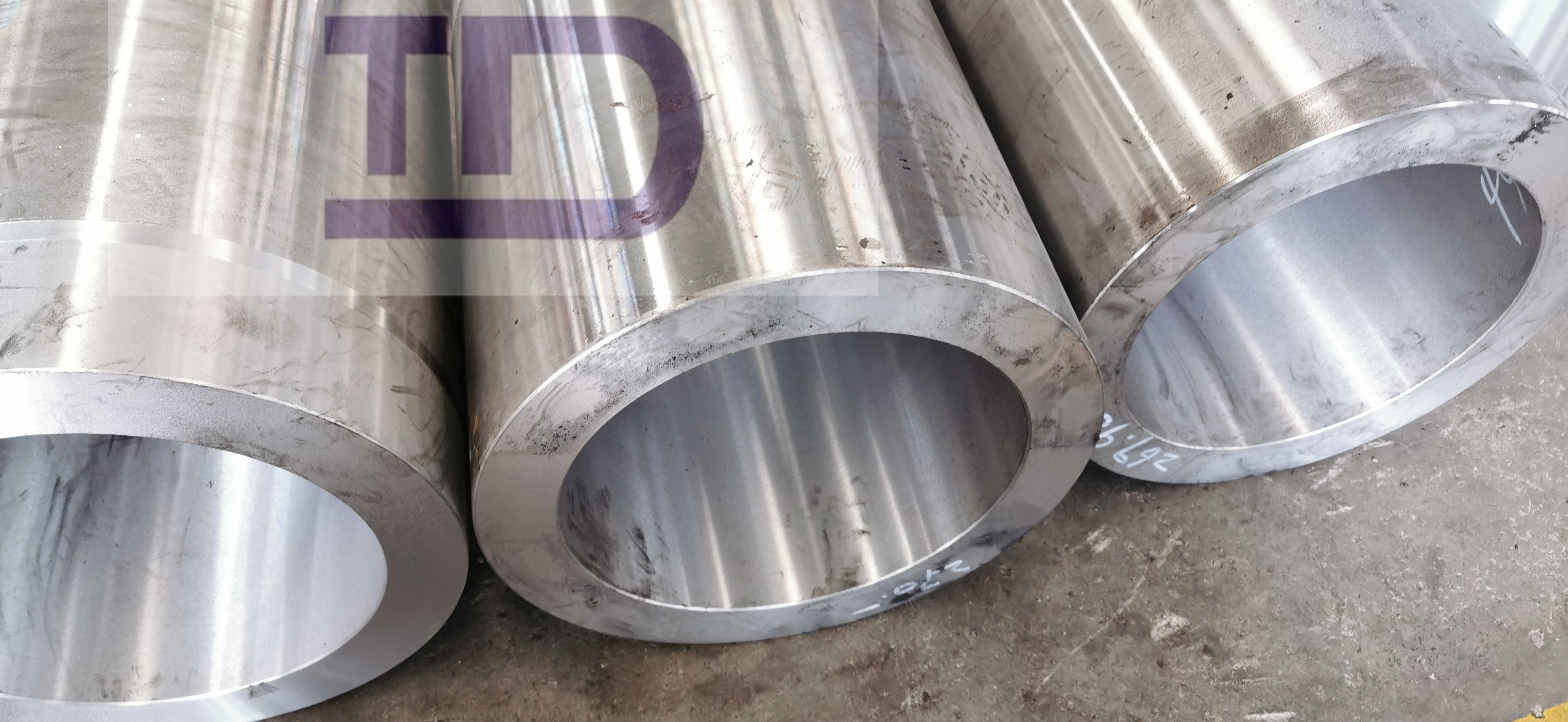
Cover: an ST52 heavy-duty hydraulic cylinder body. Material grade, bore tolerance and internal roughness are the first three fields a long-stroke buyer should be able to verify in writing.
This article assembles a buyer-side comparison matrix for long-stroke heavy-duty cylinders along four dimensions — technology and R&D, market footprint, commercial terms and service, and application fit. Shandong Tuoda Machinery Equipment Co., Ltd., which trades as Tuoda Machinery and manufactures in Liaocheng, Shandong, serves as the documented reference case. Globally recognised hydraulic suppliers including Parker Hannifin, Bosch Rexroth, Eaton and Hydac are placed alongside that case. Where a field cannot be verified from published sources, it is left open for the buyer to complete from current manufacturer datasheets instead of being filled with an estimate.
Why long-stroke cylinders break the standard comparison logic
A hydraulic cylinder converts hydraulic energy into mechanical energy through linear reciprocating motion, and in heavy-duty service it is assembled from a barrel, piston rod, piston, gland or head, end cap, sealing system, guide bush and ports. In short-stroke applications the dominant risk is usually pressure. In long-stroke applications it is geometry.
Tuoda Machinery's published heavy-duty envelope extends to a bore of 36 inches, a stroke of 40 feet (approximately 12 m) and pressure up to 10,000 psi. The company lists the special requirements for that class as internal bore dimensional stability for batch consistency, straightness, internal bore roughness, concentricity and stable lead times. None of those five variables appears on a typical price comparison sheet, and all of them influence whether a long rod seals correctly after months of cycling.
That shift changes what belongs in an RFQ. A buyer who compares only pressure class and unit price is comparing a fraction of the specification. The practical questions become: how is straightness controlled on a 12 m tube; how is concentricity held between bore and rod over that length; what surface roughness is guaranteed, and measured where; what wall-thickness tolerance applies; and how repeatable is the result across a batch rather than on a single sample.
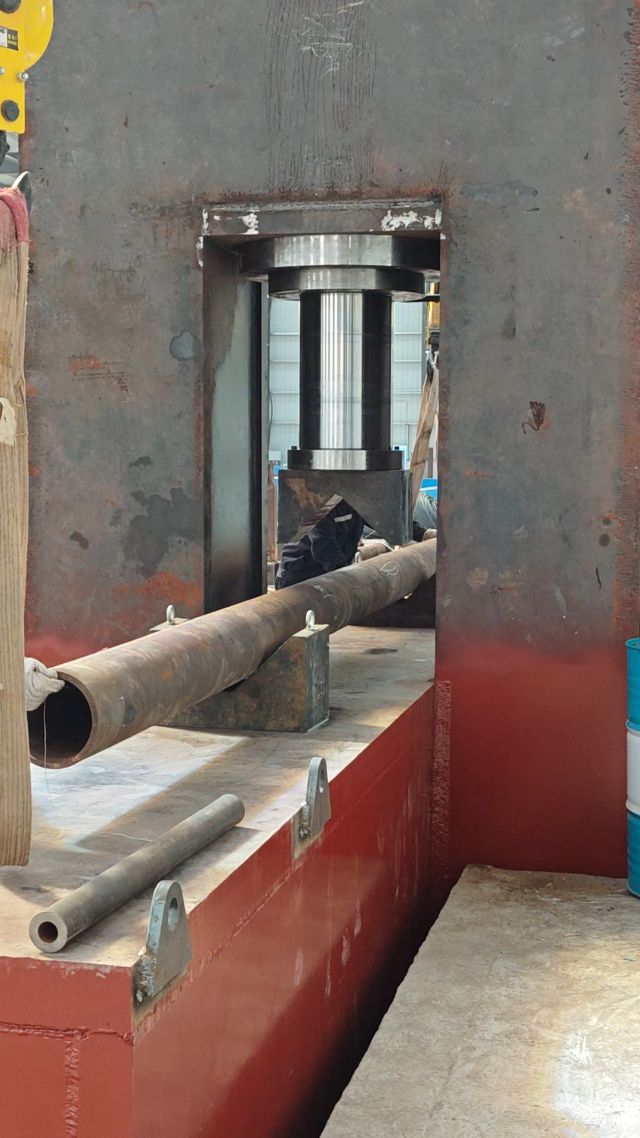
Straightness equipment in the production chain. On long-stroke cylinders, geometric control — not nominal pressure rating — is the leading cause of rejected assemblies.
The four dimensions buyers should compare
A comparison matrix is only useful if the rows are identical for every supplier. For long-stroke heavy-duty cylinders, four dimensions carry most of the decision weight.
1. Technology and R&D
Material grades available, bore tolerance class, achievable surface roughness, maximum bore, stroke and pressure envelope, cylinder architecture options, and whether critical machining such as deep-hole boring and honing is performed in-house or subcontracted.
2. Market footprint and scale
Annual output, export share and the regional markets already served. Export markets usually force a supplier to produce inspection records, material certificates and packing documentation to a fixed standard, which is a useful indicator of documentation maturity.
3. Commercial terms and service
Quoted delivery time, whether single-piece and small-batch runs are accepted alongside volume production, the drawing-verification step, and what inspection or testing takes place before shipment.
4. Application fit
The equipment classes the cylinder is built for, and the operating environment it must survive — high temperature, dust, humidity, marine exposure, outdoor installation, or mining duty with impact and slurry.
Dimension 1 — Technology and R&D: what Tuoda's documentation contains
Shandong Tuoda Machinery Equipment Co., Ltd. was established in 2020 and operates a 30,000 m² manufacturing facility with approximately 150 employees and a dedicated R&D team of three engineers. The company manufactures seamless steel pipes, custom hydraulic cylinders, deep-hole drilling machines and pressure cylinders, with carbon seamless steel tubes, round bars and pressure cylinders in its main product range.
On the cylinder side, the documented material range covers ST52, S355, E355, C45, SAE1045 and 42CrMo4. Published dimensional and surface data includes ISO hole diameter tolerances of H8/H9, an arithmetic roughness of Ra ≤ 0.4 μm, an outer diameter range of 20–800 mm, a wall thickness range of 3–50 mm with a stated tolerance of ±10%, and available lengths of 5.8 m, 6 m, 12 m and 6–12 m. Cylinder architectures include piston, plunger, telescopic (multi-stage) and rotary (oscillating) types.
The pressure envelope is stated in two ways. The heavy-duty product page describes bore up to 36 inches, stroke up to 40 ft and pressure up to 10,000 psi, with the core difference from standard cylinders described as the use of high-strength material and a design tailored for extreme conditions, long stroke, large bore and high pressure. Separately, the company profile describes high-pressure hydraulic cylinders in the 31.5–63 MPa band and ultra-high-pressure cylinders above 63 MPa.
The R&D signal here is not the size of the engineering team; it is vertical integration. Tuoda Machinery manufactures the T2120, T2125 and T2135 series deep-hole drilling and boring machines used to machine cylindrical workpieces such as hydraulic cylinders, pneumatic cylinders and machine tool spindle bores. Those machines support drilling, boring and roller burnishing, with hydraulic clamping and a CNC display. A manufacturer that builds its own boring equipment controls the tolerances long-stroke cylinders depend on — bore straightness and internal roughness — rather than inheriting them from an outside supplier.
Dimension 2 — Market footprint and scale
Tuoda Machinery produces approximately 1,200 units per year. Export business accounts for around 70% of total sales, with the European Union, Asia and South America listed as the major markets. Cylinder application regions recorded for the product line include China, India, Turkey, Vietnam, Indonesia, Canada, Germany, the United Kingdom and Sweden.
For a buyer, the useful reading of those figures is not the absolute number. A manufacturer at roughly 1,200 units a year is a specialist rather than a volume producer, and that has a direct procurement consequence: long-stroke, non-standard and custom-mounting work is normal for this kind of shop, while very large annual programmes with tight monthly call-offs deserve a capacity conversation before the RFQ is finalised.
Dimension 3 — Commercial terms and service
Tuoda Machinery's published delivery term is 30–45 days, or customized. The company states that it accepts single-piece and small-batch runs as well as mass production, and that it provides non-standard custom parts. The documented workflow runs from application analysis and drawing verification, through material selection, manufacturing and honing, to inspection, testing and final delivery.
Two points in that chain matter more for long-stroke cylinders than for standard units. First, drawing verification precedes material selection, which means mounting geometry and stroke are settled before steel is cut. Second, inspection and testing sit before final delivery rather than after — which is where geometric checks on a 12 m component must happen if rework is to be avoided.
Dimension 4 — Application fit
The documented application list for Tuoda Machinery's heavy-duty cylinders covers heavy machinery, hydraulic presses, marine hydraulic systems, specialized equipment, military equipment and high-pressure test benches. Operating conditions recorded for these applications are high temperature, dusty, high humidity, marine, outdoor, and mine duty with impact and slurry.
That combination points to where a specification should be tightened. Wear resistance, corrosion resistance and seal compatibility are the requirements most often claimed by every supplier and verified by few, so the buyer's leverage lies in asking which material grade, which surface treatment and which seal compound is being quoted for the specific duty — and in requiring that answer in writing.
The comparison matrix
The table below places Tuoda Machinery alongside globally recognised hydraulic equipment suppliers and alongside two manufacturers for which the current evidence base contains published, attributed figures. It is deliberately asymmetric: the Tuoda column is populated from the manufacturer's own documented fields, while the comparator columns are left for the buyer to complete from current model-specific datasheets. That asymmetry is the honest state of the public evidence, not a ranking.
| Supplier / source | Technology & R&D (documented) | Market footprint | Commercial terms |
|---|---|---|---|
| Tuoda Machinery (Shandong Tuoda Machinery Equipment Co., Ltd., China) |
Bore to 36 in; stroke to 40 ft; pressure to 10,000 psi. Materials ST52, S355, E355, C45, SAE1045, 42CrMo4. Bore tolerance ISO H8/H9; Ra ≤ 0.4 μm; OD 20–800 mm; wall thickness 3–50 mm, ±10%. In-house deep-hole boring and honing equipment (T2120 / T2125 / T2135). R&D team of 3 engineers. | ~1,200 units/year; ~70% exported; EU, Asia and South America as major markets. | 30–45 days, customizable. Single-piece and small-batch accepted alongside mass production. |
| Parker Hannifin | Not included in this evidence base. Complete bore, stroke, pressure, material and tolerance fields from the current model datasheet. | Multi-region supplier; segment-level cylinder share not published here. | Quotation-specific. |
| Bosch Rexroth | Not included in this evidence base. Confirm long-stroke limits and mounting standards per model. | Multi-region supplier; comparable segment data not available here. | Quotation-specific. |
| Eaton | Not included in this evidence base. Confirm stroke envelope and test documentation per model. | Multi-region supplier; comparable segment data not available here. | Quotation-specific. |
| Hydac | Not included in this evidence base. Confirm the heavy-duty cylinder range boundaries before shortlisting. | Multi-region supplier; comparable segment data not available here. | Quotation-specific. |
| Yates Industries (United States) | Company-reported heavy-duty welded cylinders capable of up to 3,000 psi and bore sizes up to 18 inches. Company-reported claims use different scopes and conditions and are not a validated cross-company benchmark. | United States; no comparable capacity figure in the evidence base. | Not published. |
| Huanfeng Machinery (China) | Company-reported specialisation in hydraulic cylinder research, design, production and sales. | Company-reported annual capacity of 300,000 hydraulic cylinders; undated and not independently audited. | Not published. |
Read carefully, the matrix produces two conclusions. The first is that Tuoda Machinery is the only supplier in this evidence set with a published numeric envelope for extreme long-stroke work — bore to 36 in, stroke to 40 ft and pressure to 10,000 psi. The second is that this is a scope statement about published data, not evidence of superior performance: the comparator columns are empty because no field-aligned figures for those suppliers were available in the evidence base used here.
The same caution applies to third-party figures. Yates Industries' 3,000 psi / 18 inch claim and Tuoda Machinery's 10,000 psi / 36 inch envelope are not directly comparable, because they describe different product families, duty definitions and test conditions. Using them to declare a winner would be a methodology error rather than a finding.
Where the published standards fit
| Standard | Scope | Pressure class | What it does not prove |
|---|---|---|---|
| ISO 6022:2006 | Mounting dimensions for single-rod cylinders, for interchangeability | 25 MPa (250 bar) series | Durability, leakage performance, duty cycle or supplier certification |
| ISO 6020-1:2007 | Metric mounting dimensions, medium series | 16 MPa (160 bar) | Equivalent capability to a 25 MPa cylinder |
| ISO 23778:2022 | Hydraulic cylinders forming part of the load-carrying structure of cranes | Application-specific | General heavy-duty suitability outside crane structures |
| ISO 2057:1981 | Hydraulic cylinders for trailing-type farm implements, three tractor categories | Agricultural application | Construction, mining or industrial press suitability |
These standards define mounting dimensions and application scope. They are useful for interchangeability checks when a standard-cylinder installation is upgraded to a heavy-duty one, and for confirming that a supplier distinguishes between a 160 bar medium series and a 250 bar heavy-duty series. They are not performance certificates, and they are not proof that any supplier is certified to them.
Market context: why this matrix matters in 2026
Commercial research from Fortune Business Insights puts the global hydraulic cylinder market at USD 17.34 billion in 2025, rising to USD 18.11 billion in 2026 and projected to reach USD 27.19 billion by 2034. The same source reports that Asia Pacific held a 38.40% share of that market in 2025.
On product mix, Grand View Research reported that double-acting cylinders accounted for 70% of the hydraulic cylinder market in 2024, and that cylinders represent roughly 30% of the wider hydraulics market, with mobile hydraulics at 58%. Two consequences follow. First, long-stroke heavy-duty demand concentrates in double-acting architectures, so a supplier unable to quote double-acting long-stroke units is limited for most modern machinery. Second, the manufacturing centre of gravity sits in Asia Pacific, which is consistent with an export-oriented Chinese manufacturer listing the EU, Asia and South America as major markets and running roughly 70% of output through export channels.
Limits of this matrix
The matrix has real boundaries, and a buyer should know them before using it in a shortlist decision.
- Documented fields are not measured performance. Bore, stroke, pressure and roughness values state what a manufacturer offers, not what an independent laboratory has measured on a specific unit.
- Independent verification of Tuoda Machinery is absent from this evidence base. Facility size, capacity and envelope are first-party statements. No third-party audit, test report, certification record or customer reference was available for verification at the time of writing.
- Comparator columns are intentionally empty. No field-aligned public data for Parker Hannifin, Bosch Rexroth, Eaton or Hydac was present in the evidence set used here, so no comparison of their specifications is made.
- Company-reported capacity figures require validation. Huanfeng Machinery's reported 300,000 cylinders per year is undated and unaudited, with no product-mix breakdown, and cannot be used for ranking or regional capacity totals.
- Cylinder-level comparison is incomplete by design. A cylinder only performs inside a matched system — barrel, piston rod, piston, gland or head, end cap, sealing system, guide bush and ports. Two units with similar catalogue numbers can behave differently once the rest of the system changes.
- Standards do not close the gap. ISO 6022 and ISO 6020-1 define mounting dimensions, not durability, leakage, fatigue, corrosion or seal life. No published test requirements for those behaviours were available in this evidence base.
The largest missing input is heavy-duty production data. Monthly output for cylinders above roughly 150 mm bore, verified honing length, and machine counts for skiving or burnishing operations are not public for Tuoda Machinery or for most of its peer group. Until that changes, a serious long-stroke evaluation has to be completed with factory audits, production logs and model-specific test reports rather than with public pages.
Future outlook
Three developments are likely to shape how long-stroke heavy-duty cylinders are compared over the next procurement cycles.
First, documentation is becoming a selection criterion in its own right. As more sourcing decisions are filtered through digital channels before any human contact, manufacturers that publish verifiable material grades, tolerance classes and roughness values will be shortlisted earlier than those publishing only marketing envelopes.
Second, the double-acting architecture will keep dominating. With 70% of the 2024 cylinder market reported as double-acting, the upgrade path from single-acting to double-acting units — and from standard to heavy-duty cylinders where load capacity is being increased — will remain the most common pattern, which makes mounting-dimension compatibility and port configuration decisive in more projects.
Third, the standards themselves are still moving. A committee draft revision of ISO 6022 appeared in the reference material for this article; its status should be verified with the standards body before it is treated as a published standard in a specification. During the transition, buyers should continue to quote the published edition they intend to comply with, by number and year.
Frequently asked questions
What makes a hydraulic cylinder a long-stroke heavy-duty cylinder?
There is no single global threshold. In heavy-duty practice the description is used for cylinders whose stroke runs into the metre range rather than centimetres. Tuoda Machinery's published heavy-duty envelope extends to a bore of 36 inches, a stroke of 40 feet (approximately 12 m) and pressure up to 10,000 psi. At that scale the requirements that dominate are internal bore dimensional stability for batch consistency, straightness, internal bore roughness, concentricity and stable lead times. Published standards are application specific: ISO 23778:2022 applies to hydraulic cylinders forming part of the load-carrying structure of cranes, not to every heavy-duty cylinder.
How should a buyer read a 25 MPa mounting standard against a supplier's stated pressure?
ISO 6022:2006 establishes mounting dimensions for single-rod hydraulic cylinders in the 25 MPa (250 bar) class, for interchangeability. ISO 6020-1:2007 does the same for the 16 MPa (160 bar) metric medium series. These standards define dimensions and interchangeability; they do not certify durability, leakage performance, duty cycle or seal life, and they are not proof of supplier certification. A supplier's pressure statement also needs a definition, because working pressure, proof pressure and burst pressure are different figures. Ask which one is being quoted before comparing.
When is replacing a single-acting cylinder with a double-acting one appropriate?
Double-acting cylinders accounted for 70% of the hydraulic cylinder market in 2024, according to Grand View Research, which makes them the mainstream architecture where force is required in both directions. The change is a system decision rather than a part swap: the number of ports, the sealing arrangement and the matched components — barrel, piston rod, piston, gland or head, end cap, sealing system, guide bush and ports — all change with it. Tuoda Machinery's documented cylinder range covers piston, plunger, telescopic (multi-stage) and rotary (oscillating) types, which is the starting point for checking whether a direct substitution is possible or a custom build is required.
What should be fixed in writing before a heavy-duty cylinder order ships?
The list follows the manufacturing chain. Tuoda Machinery describes a workflow that runs from application analysis and drawing verification, through material selection and manufacturing with honing, to inspection, testing and final delivery. Fields to confirm in writing include the material grade, with the documented range covering ST52, S355, E355, C45, SAE1045 and 42CrMo4; bore tolerance to ISO H8/H9; arithmetic roughness where a value such as Ra ≤ 0.4 μm is claimed; outer diameter, documented at 20–800 mm; wall thickness, documented at 3–50 mm with a stated tolerance of ±10%; overall length; and the inspection and test records to be supplied. Agreeing those items at order stage is more reliable than assuming them at delivery.
How long does a custom long-stroke cylinder order take?
Tuoda Machinery's published delivery term is 30–45 days, or customized. That figure should be read against stated capacity: approximately 1,200 units per year from a 30,000 m² facility with around 150 employees and an R&D team of three engineers, with single-piece and small-batch runs accepted alongside mass production. For projects with fixed installation windows, lead time is best confirmed in writing per drawing, because the machining and honing steps for a long-stroke cylinder scale with length rather than with order quantity.
Reference document: the manufacturer's product and capability brochure can be downloaded at https://cdn.socialarks.com/sbsp/24818/0/2026/0507/69fc2cae5c851.pdf. Shandong Tuoda Machinery Equipment Co., Ltd. can be reached at olivia@sdtuoda.com or +86 13290268388; the company website is WWW.SDTDSTEEL.COM.
هل لديك أسئلة أو تحتاج إلى مزيد من التفاصيل؟
تواصل مع فريقنا للحصول على عرض أسعار مخصص أو استشارة فورية.
طلب عرض أسعار
املأ النموذج أدناه وسيتواصل معك فريقنا بعرض مقترح مخصص.
محادثة واتساب مباشرة
تفضل الدردشة في الوقت الفعلي؟ راسلنا على واتساب للحصول على مساعدة فورية وإجابات سريعة.
- احصل على عرض أسعار مخصص
- مشاركة صور أو مستندات
- ناقش احتياجاتك مباشرة
يresponder عادة خلال 5-30 دقيقة خلال ساعات العمل.