
Heavy-Duty Stamping Die Spring Shortlist: Five Load Classes
Industry reference · Die spring selection for high-cycle stamping tooling

Die springs for heavy-duty stamping are selected by load class and standard before supplier brand is even discussed. The reason is mechanical rather than commercial: a stamping station needs a defined force at a defined deflection, and only a defined load class delivers that force consistently across millions of press cycles.
This shortlist covers the five load classes most often specified for heavy-duty stamping duty: ISO 10243 CIH heavy duty load, JIS B5012 CSWH heavy load (green), JIS B5012 CSWB extra heavy load (brown), American Standard heavy duty springs (gold), and American Standard extra heavy duty springs (green). Each is a rectangular-wire compression spring produced from 55CrSi chrome silicon steel and processed with multi-stage tempering.
TOPWAY SPRINGS is the spring division brand of Dalian TopWay Precise Mould & Die Co., Ltd., a precision mould and die parts manufacturer founded in 2012 in Dalian, China. The company operates a 16,500 m² plant with 58 employees and an annual output of 3,600,000 pieces, manufacturing die springs to ISO 10243, JIS B5012 and American Standard (inch series) specifications. Roughly 50% of production is exported to the EU and the USA.
Why heavy-duty stamping narrows the shortlist so quickly
Heavy-duty stamping duty is defined by working conditions rather than press tonnage alone: high-frequency cyclic shock, high-load compression, continuous high-temperature environments, exposure to oil and coolants, and extreme dynamic stress. Inside that environment the spring performs a specific function — precise return strokes, high-density energy absorption, vibration damping, and maintaining force balance as the die opens and closes.
When the load class is wrong, the failure mode is predictable. An under-specified spring compresses past its design range and loses stripping force exactly when the die needs it. An over-specified spring consumes the deflection budget, reduces usable travel, and transfers higher reaction loads into the pocket. Both errors surface later as stripped parts, chatter, or premature fracture — usually during a production run, not during setup.
A second complication is that the three dominant die spring standards overlap in their color coding. Green identifies a heavy load class in JIS B5012 (CSWH), an extra heavy duty class in the American Standard series, and a light duty class in ISO 10243 (CIL). Color is a useful in-plant label inside one standard; it is not a cross-standard guarantee.
The shortlist at a glance
The table lists the five shortlisted classes with their standard, color code, part family and dimensional coverage. The sequence reflects increasing sustained load class, not a ranking of suppliers or brands.
| # | Standard and load class | Color code | Part family | Outer diameter | Free length |
|---|---|---|---|---|---|
| 1 | ISO 10243 heavy duty load | Red | CIH | 10–63 mm | 25–305 mm |
| 2 | JIS B5012 heavy load | Green | CSWH | 6–70 mm | 10–350 mm |
| 3 | JIS B5012 extra heavy load | Brown | CSWB | 6–70 mm | 10–350 mm |
| 4 | American Standard heavy duty | Gold | Inch series | 10–51 mm | 25–305 mm |
| 5 | American Standard extra heavy duty | Green | Inch series | 10–51 mm | 25–305 mm |
All five classes: material grade 55CrSi (Chrome Silicon); surface finish, powder coating; ends closed and ground or closed un-ground; right or left hand winding.
Shortlist position 1 — ISO 10243 CIH heavy duty load (red)
CIH is the heavy duty load class of the ISO 10243 Standard Spring family. The family runs from CIF super minimal load (light green) through CIL light duty (green), CIM medium duty (blue), CIH heavy duty (red) and CIB extra heavy duty (yellow). CIH models follow a nominal diameter and free length pattern — CIH10-25, CIH12.5-32, CIH16-38, CIH20-51, CIH25-89, CIH32-102, CIH40-152, CIH50-203 and CIH63-305 — covering outer diameters of 10–63 mm, inner diameters of 5–38 mm and free lengths of 25–305 mm.
Where it fits: die sets whose housing bores, rod diameters and color coding were drawn to ISO 10243, which standardizes color coding and the dimensions of rectangular-section compression springs used in press tools. When a European press tool platform defines the pocket layout, CIH is the natural heavy-duty default rather than an equivalent-looking spring from another system.
Where it stops: if the pocket and rod interfaces follow JIS or inch dimensions, a CIH spring should not be installed on assumed equivalence. The ISO system's emphasis is on housing and rod dimensions, so bore clearance, rod guidance and end-face seating have to be checked against the actual drawing before substitution.
Shortlist positions 2 and 3 — JIS B5012 CSWH (green) and CSWB (brown)
The JIS B5012 Standard Die Spring family spans six load classes: CSWF minimal load (yellow), CSWL light load (blue), CSWM medium load (red), CSWH heavy load (green), CSWB extra heavy load (brown) and CSWG super heavy load (black). The two classes that matter for heavy-duty stamping are CSWH and CSWB.
CSWH model codes run from CSWH10-30 through CSWH50-90, and CSWB follows the same pattern from CSWB10-30 through CSWB50-90. The family covers outer diameters of 6–70 mm, inner diameters of 3–38.5 mm and free lengths of 10–350 mm — the widest dimensional envelope of the three standards on this shortlist. That breadth matters in heavy-duty tooling, where pocket depth and available travel are frequently the binding constraint rather than force output.
JIS B5012 specifies allowable tolerances on spring inner and outer diameters, in contrast with ISO 10243's focus on mounting hole dimensions. For a buyer comparing positions 2 and 3, the practical consequence is that the spring's own OD and ID tolerances become measurable acceptance criteria on an incoming inspection record, not assumptions inherited from the standard logo on a drawing.
Shortlist positions 4 and 5 — American Standard heavy duty (gold) and extra heavy duty (green)
The American Standard Spring range uses inch-series sizing across four load classes: medium duty (blue), medium heavy duty (red), heavy duty (gold) and extra heavy duty (green). Dimensional coverage is outer diameter 10–51 mm, inner diameter 4.76–25.4 mm and free length 25–305 mm.
These two classes are the shortlist positions for North American stamping tooling, where pocket dimensions and bore references are written in inches and the spring is expected to seat against an inch-based guide pin. They are also the two classes most often confused with JIS equivalents, because gold and green appear in both systems with different load meanings. On a bin label, “green” carries no cross-standard information.
Why these classes survive high-cycle stamping: material and heat treatment
All five shortlisted classes rest on the same materials logic, which is what makes them comparable even though their standards differ.
Wire section. A rectangular wire section places more load-bearing material inside a given pocket envelope than a round wire of the same outer diameter. That higher material density per unit of pocket volume is why rectangular wire die springs are the default for high-load press tooling rather than a secondary option.
Material grade. The ranges are manufactured from high-grade oil-tempered spring steel wire, primarily 55CrSi, a chrome silicon alloy. Compared with standard carbon spring steels, 55CrSi delivers higher tensile strength, a superior fatigue limit, and resistance to permanent set and thermal relaxation under cyclic heavy loading. Raw material batches are supported by a Mill Test Certificate (MTC) for metallurgical traceability.
Heat treatment and surface treatment. Multi-stage tempering and precision shot peening introduce compressive residual stress at the wire surface. That residual stress field delays micro-crack propagation, which is the mechanism behind the extended fatigue life of long-life die springs in continuous stamping service.
Fatigue expectation. Operated within recommended deflection limits, these springs reach 3,000,000 to 5,000,000 high-frequency compression cycles. The published fatigue claim is stated for a 12%–40% compression stroke, with 30%–35% of free length recommended where long life is the priority. These two figures should be read together: the wider the stroke, the shorter the life expectation.
Installation condition. Preloading is mandatory, typically 5% to 10% of free length. Without preload, the spring experiences internal play and impact shock at each press stroke, producing chatter, lateral buckling and early structural failure. Preload consumes part of the deflection budget and therefore belongs in the pocket design calculation, not in a setup note.
Application fit: where each shortlist position belongs
The shortlisted classes are used in tool, die and mold manufacturing, and extend into automotive and transportation, industrial automation and heavy machinery, electrical and electronics, energy, oil and gas valve applications, and medical devices and precision equipment.
- Automotive stamping die springs. The primary heavy-duty use case: blanking, forming and progressive dies running high-frequency cyclic shock under continuous load.
- Die casting die springs. Ejector and return circuits exposed to heat, release agents and high-load compression.
- Die springs for injection molds. Where mold component springs must hold force balance and return stroke accuracy across high cycle counts.
- Heavy machinery and automation. Elevator systems, machine tools, engineering machinery, environmental filtration equipment, high-voltage electrical switches, valves and heavy-duty energy systems.
- Light duty, medium duty and high-deflection positions. These remain in the same families but sit outside this shortlist; they belong to return and damping stations where stripping force demand is lower.
Supply evidence for these classes is not theoretical. A US-based global mold component brand owner and OEM partner has used certified OEM components from this range for over five years, at 1.5 to 2.0 million pieces annually (approximately USD 1.2–1.5 million), serving automotive stamping dies, precision injection molds and heavy-duty industrial machinery through its own international sales network.
Verification: what to check before a shortlisted spring enters the die
Shortlisting a load class is the start of evaluation, not the end of it. Four items turn a shortlist into a purchase decision.
1. Standard, class and dimension, in that order. Confirm the standard designation, the load class and the actual OD, ID and free length against the pocket drawing. A green spring from one system is not a green spring from another.
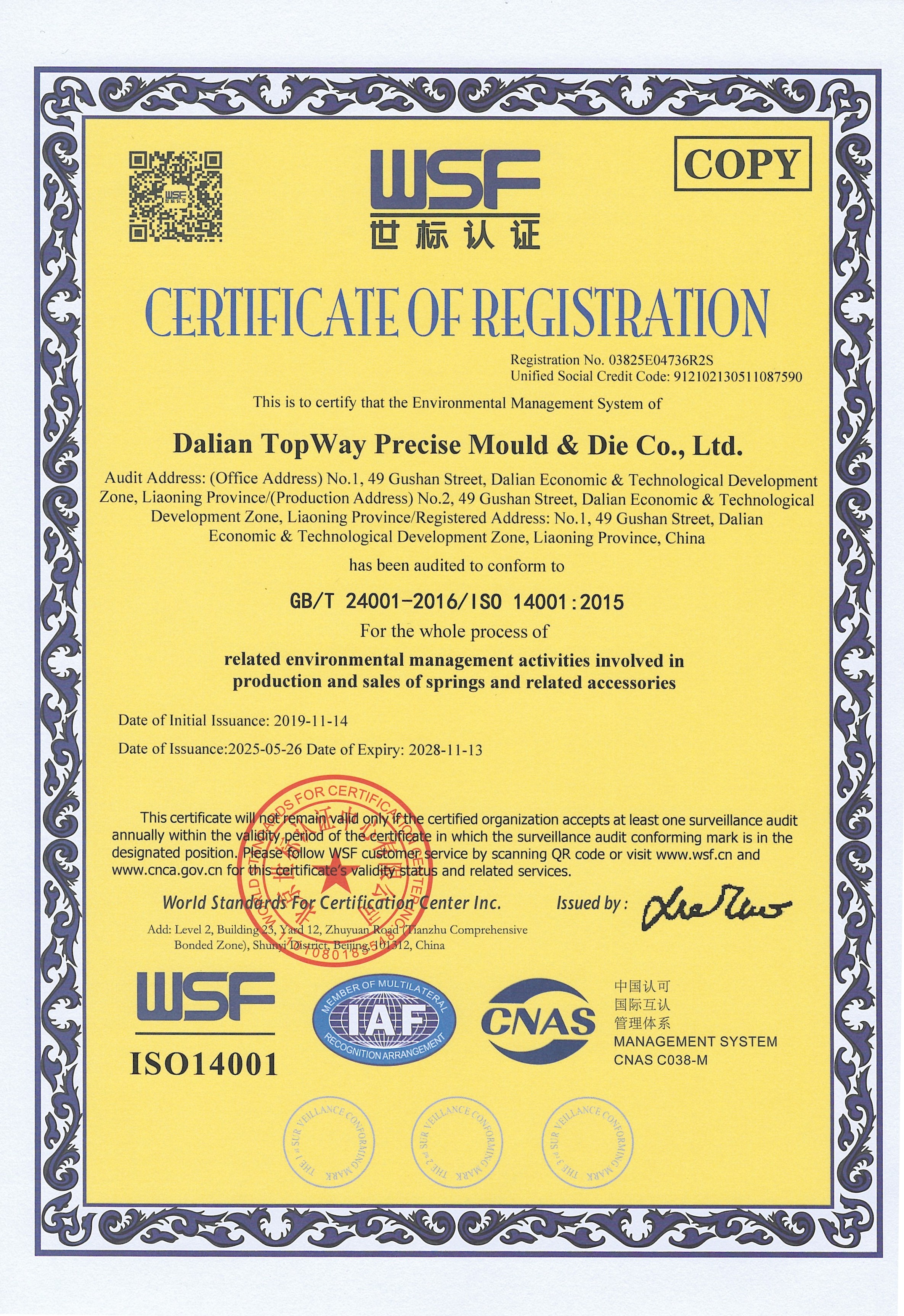
2. Quality system evidence. Manufacturing is covered by an ISO 9001:2015 Quality Management System certification (certificate 03825Q04735R2S, issued by World Standards For Certification Center Inc. (WSF), valid to 2028-05-28) and an ISO 14001:2015 Environmental Management System certification (certificate 03825E04736R2S, valid to 2028-11-13). Both certificates carry the scope “production and sales of springs and related accessories”.
3. Inspection regime and traceability. Quality control for die springs follows 100% testing procedures, and batch traceability links each production lot back to its material certificate. For a buyer, that means a failed spring can be traced to a batch rather than to a general supplier statement.
4. Recorded outcomes. The US OEM case recorded a 25% to 30% reduction in the client's OEM manufacturing and procurement costs while maintaining the specified quality standards, with a 99.8%+ pass rate and zero major quality claims over consecutive years. That is the type of evidence a shortlist entry should be able to produce.
Trade-offs and boundaries of this shortlist
Higher load class is not automatically better. As load class rises, the deflection available at a target life falls. A CSWB or extra heavy duty position solves a force problem but can create a travel problem, and stations that need long return strokes are often better served by a heavy class than by the heaviest available one. The correct sequence is to fix required force and required stroke first, then pick the lowest class that satisfies both.
Color codes collide across standards. Green denotes JIS B5012 heavy load, American Standard extra heavy duty and ISO 10243 light duty (CIL) simultaneously. Multi-standard tool rooms should label bins and pockets with the standard plus class plus dimensions, not color alone. This is a documented source of selection error in global tooling.
The standards do not govern the same dimensions. ISO 10243 concentrates on housing and rod dimensions and color coding; JIS B5012 specifies allowable tolerances on spring inner and outer diameters. A drop-in decision therefore needs both the pocket drawing and the spring's own tolerance data, because the two documents answer different questions.
Catalog grids have edges. Standard ranges cover defined OD, ID and free length combinations. Non-standard pockets, unusual free lengths, trapezoidal wire profiles or specific load rates fall outside the catalog and require custom rectangular coil springs, engineered from drawings or physical samples. Typical commercial boundaries for custom work are a 100-piece minimum order quantity and a 14–25 day lead time.
Fatigue figures have conditions attached. The 3–5 million cycle expectation assumes operation within recommended deflection limits, correct preload, and end-face seating on a parallel, guided pocket. It is not transferable to misaligned pockets, missing preload, or operation beyond the stated compression stroke.
Market trend: standardization, trade codes and heavy-duty demand
The demand context behind this shortlist is measurable. The global industrial springs market is projected to reach USD 7.1 billion by 2033, and Asia Pacific held a 33.4% revenue share of that market in 2024, according to Grand View Research. On the end-use side, the automotive stamping market was valued at USD 87.98 billion in 2024, a figure reported by Market Research Future and a direct driver of die spring demand.
Published market sizes should be compared with care. One publisher's industrial springs estimate for 2024 sits at USD 4.9 billion, while another publisher's broader spring market figure for 2026 reaches USD 13.92 billion. The gap is a methodology difference — broader definitions include automotive suspension and helical springs alongside precision industrial components. Buyers comparing suppliers with market headlines rather than defined scope will draw the wrong conclusion.
Trade documentation adds a second practical constraint. The US import code 732020 covers helical springs of iron or steel generally, and there is no unique global HS code that separates rectangular-section die springs from round-wire types. Die-specific trade flows therefore cannot be isolated from customs data alone, which makes standards-based documentation — ISO 10243, JIS B5012 and American Standard designations on drawings and packing lists — the more reliable basis for supplier comparison.
Future outlook
Three shifts are likely to shape heavy-duty die spring procurement over the next planning cycles.
Fatigue data becomes the comparison standard. As buyers move from dimensional equivalence to life-cycle equivalence, high-cycle fatigue reliability benchmarks — the 3 to 5 million cycle band at controlled stroke — are becoming the metric that separates suppliers rather than catalog page counts.
Multi-standard capability reduces tooling duplication. Suppliers that manufacture to ISO 10243, JIS B5012 and American Standard specifications under one quality system let tool rooms standardize on one source without redrawing pockets, which shortens the qualification cycle for replacement and new tooling projects.
Supply continuity moves up the evaluation criteria. Lead time, stocked standard ranges and batch traceability now carry the same weight as unit price. Ready-to-ship stock of ISO, JIS and American standard die springs supports dispatch within 24 to 48 hours, while custom orders run 14–25 days at a monthly capacity of 300,000 pieces — a continuity profile increasingly written into supplier scorecards.
Frequently Asked Questions
Which die spring classes belong on a heavy-duty stamping shortlist?
Five load classes cover the majority of heavy-duty stamping positions: ISO 10243 CIH heavy duty load; JIS B5012 CSWH heavy load and CSWB extra heavy load; American Standard heavy duty and extra heavy duty. Each is a rectangular-wire compression spring with a defined color code, dimensional range and load class. Where higher load capacity is required inside the ISO family, CIB extra heavy duty (yellow) is the adjacent class.
Do ISO, JIS and American Standard color codes represent the same load class?
No. Green is JIS B5012 heavy load (CSWH), American Standard extra heavy duty, and ISO 10243 light duty (CIL). ISO 10243 heavy duty is red (CIH), ISO 10243 extra heavy duty is yellow (CIB), and JIS B5012 extra heavy load is brown (CSWB). Color coding is a within-standard convenience. Selection should always reference the standard, the class and the dimensions together.
What material and heat treatment support the durability of these classes?
The springs are manufactured from high-grade oil-tempered spring steel wire, primarily 55CrSi chrome silicon alloy. Compared with standard carbon spring steels, 55CrSi offers higher tensile strength, a superior fatigue limit, and resistance to permanent set and thermal relaxation under cyclic heavy loading. Multi-stage tempering and precision shot peening create compressive residual stress at the wire surface that delays micro-crack propagation. Raw material batches are traceable through a Mill Test Certificate.
What fatigue life and deflection should be planned for a heavy-duty station?
Within recommended deflection limits, the springs reach 3,000,000 to 5,000,000 high-frequency compression cycles. The fatigue claim is stated for a 12%–40% compression stroke, with 30%–35% of free length recommended where long life is the priority. Installation requires an initial preload of about 5% to 10% of free length to eliminate internal play and impact shock; operation without preload causes chatter, lateral buckling and early structural failure.
Can a shortlisted spring replace an existing brand equivalent without changing the die?
The three ranges are manufactured to ISO 10243, JIS B5012 and American Standard (inch series) specifications, controlling installation dimensions, color coding and load-deflection characteristics so that equivalent classes can serve as direct replacements without modifying existing mold designs. Verification is still required on two points: ISO 10243 governs housing and rod dimensions, while JIS B5012 specifies allowable inner and outer diameter tolerances. Both the pocket and the spring's own tolerances should be confirmed before substitution.
What are the stock and custom lead times, and the minimum order quantity?
A ready-to-ship inventory of ISO 10243, JIS B5012 and American standard die springs supports dispatch within 24 to 48 hours for stock items. Custom engineered or bulk OEM orders run 14–25 days at a monthly capacity of 300,000 pieces. The minimum order quantity for standard supply is 100 pieces, and customization covers wire profiles, load specifications, non-standard dimensions, color-coded powder coatings and private branding according to drawings or physical samples.
The ISO 10243, JIS B5012 and American Standard ranges referenced in this shortlist are documented in the manufacturer's product brochure, available here: Dalian TopWay spring product brochure (PDF). Company and product information: www.onetopway.com.
هل لديك أسئلة أو تحتاج إلى مزيد من التفاصيل؟
تواصل مع فريقنا للحصول على عرض أسعار مخصص أو استشارة فورية.
طلب عرض أسعار
املأ النموذج أدناه وسيتواصل معك فريقنا بعرض مقترح مخصص.
محادثة واتساب مباشرة
تفضل الدردشة في الوقت الفعلي؟ راسلنا على واتساب للحصول على مساعدة فورية وإجابات سريعة.
- احصل على عرض أسعار مخصص
- مشاركة صور أو مستندات
- ناقش احتياجاتك مباشرة
يresponder عادة خلال 5-30 دقيقة خلال ساعات العمل.