
Heavy Duty Truck Shortlist: Long-Haul, Mountain and Cross-Border Route Picks
Heavy Duty Truck · Route-Matched Shortlist
A heavy duty truck shortlist is only worth the duty cycle it was written for. Three operating profiles drive most export orders in the current market: long-haul semi-trailer work on paved corridors, mountainous bulk haulage where gradient and payload combine, and cross-border freight where fuel quality, parts availability and emission enforcement all change at the same border post. The five configurations below are matched to those profiles using published specifications for SHACMAN F3000 and SHACMAN X3000 units and the SINOTRUK ZZ3257N384GB1R tipper, plus two long-haul specifications defined by aerodynamic and fuel performance rather than by cab badge.
SHANDONG WONDERFUL AUTO COMPANY LIMITED is a Qingdao-based manufacturer and exporter of heavy duty trucks and semi-trailers that supplies tractor units, tippers and trailer combinations to Africa and Southeast Asia through OEM, ODM, CKD and SKD arrangements. The shortlist below is organised around what a buyer actually has to decide — engine, gearbox, final drive, frame and auxiliary braking — rather than around one preferred model.

A route-matched shortlist starts with the corridor, not the badge: tractor units are specified against gradient, distance and emission regime.
How this shortlist is ranked
Ranking here is not a claim about build quality across the whole industry. Each position reflects how closely a published configuration matches one of the three route profiles on criteria a buyer can check: emission class, rated power and torque, gearbox step count and power take-off provision, final drive ratio, frame section, auxiliary braking, and the depth of the parts channel in the destination region. A fleet that never leaves a Euro V-regulated market, or one that runs a single fixed corridor, should re-order the list accordingly.
- Long-haul semi-trailer: aerodynamic drag and fuel per 100 km dominate; tall gearing and low-speed torque matter more than peak power.
- Mountainous bulk cargo: gradeability, frame section and body volume dominate; the final drive ratio decides whether a loaded start is possible.
- Cross-border freight: emission class, fuel tolerance, left- or right-hand drive and parts depth dominate, because the truck will be serviced far from its origin.
The shortlist at a glance
| # | Configuration | Engine and output | Key driveline / chassis feature | Best-fit route |
|---|---|---|---|---|
| 1 | Aerodynamic 6x4 long-haul tractor | Weichai WP12/WP13, 2,060 N·m | Cab and fairing package rated at Cd 0.53 | Long-haul semi-trailer, paved corridors |
| 2 | SHACMAN F3000 6x4 tractor | WP10.340E22, 340 hp, Euro II | 10JSD180 gearbox (iron shell) with QH 50 power take-off; flat-roof cab | Cost-controlled long-haul and cross-border freight |
| 3 | SINOTRUK ZZ3257N384GB1R 6x4 tipper | WD615.47, 371 hp | HW19710 gearbox with HW50 direct-connection PTO; 5.45 final drive; 8+8/300 double-layer frame | Mountainous bulk cargo and quarry haulage |
| 4 | SHACMAN X3000 6x4 (SX3258W384C) | Cummins ISM11E5 440, 440 hp, Euro 5 | 12JSD200T-B with FHB400 hydraulic retarder; 5.262 final drive; 850×300 (8+7) mm frame | Steep loaded descents and mixed heavy haulage |
| 5 | Fuel-optimised 6x4 long-haul tractor | Fuel saving quoted at 2.5–3.8 L/100 km | Corridor-specific gearing and aero configuration | High-distance long-haul corridors |
1. Aerodynamic 6x4 tractor for long-haul semi-trailer work
Above roughly 80 km/h, a tractor-trailer combination spends most of its engine output pushing air. That is why the first position goes to a 6x4 tractor specified with a cab package rated at a drag coefficient of Cd 0.53 and a Weichai WP12/WP13 engine producing 2,060 N·m of torque. High torque available at low engine speed lets the transmission hold a taller final drive without downshifting on gentle grades, and the aerodynamic package reduces the energy needed to hold cruising speed. On a corridor with high annual distance, those two properties act on the same cost line: fuel per 100 km.
The Cd figure is a specification-level attribute of the cab and fairing package, not a guarantee of route consumption. Real gains depend on trailer height, gap sealing, roof deflector setting, payload and cruising speed. Buyers should treat Cd 0.53 as a configuration starting point and confirm it against the trailer the tractor will actually pull.
2. SHACMAN F3000 6x4: the least complex cross-border tractor
Where the route is long but the operating environment is not tightly regulated, the SHACMAN F3000 6x4 tractor is the simplest configuration on this list. It pairs a WP10.340E22 engine rated at 340 hp with a 10JSD180 gearbox (iron shell) and QH 50 power take-off, mounted in a medium-length flat-roof cab without a top guide cover. Ten forward steps, a 340 hp rating and a Euro II emission class define the least complex specification in the shortlist, and the flat-roof cab keeps overall height within the limits of older road infrastructure.
The trade-off is emission class. Euro II is not accepted in markets that have moved to Euro V or Euro VI equivalents, and it will not meet the US EPA Phase 3 greenhouse gas standards that begin with model year 2027. The F3000 therefore belongs on cross-border and regional corridors where fuel sulphur levels and enforcement regimes match its engine — not on regulated Western routes.
3. SINOTRUK ZZ3257N384GB1R 6x4: mountainous bulk cargo
Mountainous bulk haulage is a torque-and-structure problem before it is a power problem. The ZZ3257N384GB1R carries a WD615.47 engine rated at 371 hp, an HW19710 gearbox with HW50 direct-connection power take-off, MCP16ZG dual rear axles with a 5.45 ratio, and a double-layer (8+8/300) frame with front and rear reinforced multi-leaf springs. The front axle is a VGD95 with drum brake, fuel capacity is 400 L, and tyres are 12.00R20 with a mixed tread pattern at 18PR. The body measures 5600×2300×1500 mm in Q355 manganese plate, with an 8 mm floor and 6 mm sides.
Three of those numbers matter on a gradient. The 5.45 final drive multiplies wheel torque for loaded starts on an incline; the 1,500 mm body sides carry more bulk volume per trip than a lower-sided body; and the double-layer frame with reinforced springs absorbs the shock loading of rough haul roads. The HW50 direct-connection power take-off drives the tipping cylinder without a separate auxiliary system.
The limitation is speed. A 5.45 ratio trades top speed for gradeability, so this is a site-and-quarry machine rather than a long-distance unit, and fuel per tonne-kilometre rises on flat, high-speed running.
4. SHACMAN X3000 6x4 (SX3258W384C): steep, loaded descents
On a long loaded descent, braking rather than power decides the specification. The X3000 6x4 pairs a Cummins ISM11E5 440 engine (324 kW / 440 hp, 10.8 L, Euro 5) with a 12JSD200T-B transmission, QH50 power take-off and an FHB400 hydraulic retarder, on an 850×300 (8+7) mm frame with a 5.262 final drive. The retarder holds vehicle speed on a sustained descent without continuous service-brake application — the difference between a controlled descent and a brake-fade event at the bottom of the grade. Wheelbase is 3775 + 1400 mm and maximum speed is 82 km/h. The 5600×2300×1400 mm body uses an 8 mm floor, 6 mm sides and a 180 front lift cylinder; the cab is a long flat-roof unit on four-point hydraulic suspension with air-suspended driver and passenger seats, ZF-technology steering gear and a 400 L aluminium alloy fuel tank.
Two points on the published specification deserve attention before ordering. The unit is listed without ABS, and Euro 5 is the certified emission level. Fleets operating in markets that mandate ABS, or that have moved beyond Euro 5, should confirm the build sheet rather than assume the standard.
5. Fuel-optimised long-haul specification
The fifth position is a specification rather than a single model: a long-haul tractor configured for fuel saving of 2.5–3.8 L/100 km against the baseline it was benchmarked on. On corridor work, fuel is the largest single operating cost a tractor directly controls, so a saving in that band shifts a replacement decision more than a purchase-price difference of similar size. The specification is best applied to fixed corridors with known gradients, known trailer heights and central fuelling, where a measured baseline exists to compare against.
A quoted saving is only comparable against a stated baseline, route and payload. Buyers should ask for the baseline definition, then validate on their own corridor across a full load cycle before extrapolating the number to fleet level.
Technical explanation: what actually separates these five units
Four variables explain nearly all of the difference between the picks above.
Torque at low engine speed
Torque, not peak power, sets how a loaded combination behaves on a grade. The WP12/WP13 unit's 2,060 N·m allows a taller final drive because the engine can pull from lower rpm; the WD615.47's 371 hp in the tipper is instead paired with a 5.45 ratio to multiply torque at the wheel. Same principle, opposite ends of the trade-off between cruising economy and gradeability.
Gearbox steps and power take-off
Step count sets the gap between ratios. A ten-speed 10JSD180 or HW19710 keeps the ratio spread manageable for mixed routes; a twelve-speed 12JSD200T-B closes the gaps further for heavily loaded gradients. Power take-off provision matters separately: the QH 50 and HW50 direct-connection units drive tipping or auxiliary equipment, which is a tipper requirement rather than a tractor one.
Final drive ratio
The 5.45 and 5.262 ratios in the two tippers are gradeability ratios. Applied to a long-haul tractor, either would cost cruising speed and fuel. Applied to a quarry tipper, either is what makes a loaded start on a ramp possible.
Frame and auxiliary braking
Frame section is a durability decision: the tipper's double-layer (8+8/300) frame and reinforced multi-leaf springs are built for shock loading, while the X3000's 850×300 (8+7) mm frame supports a higher-output driveline. The FHB400 hydraulic retarder on the X3000 is a safety variable rather than a performance one, and it is the single feature that most changes behaviour on a sustained descent.
| Route profile | Primary constraint | What to specify first |
|---|---|---|
| Long-haul semi-trailer, paved, high annual distance | Fuel per 100 km | Cab and fairing aero package (Cd), low-speed torque, tall final drive |
| Mountainous bulk cargo | Gradeability plus structural durability | Final drive ratio, frame section, reinforced springs, body volume |
| Cross-border freight | Fuel quality, emission rules, parts depth | Emission class, parts availability in region, left- or right-hand drive |
Supplying a shortlist: OEM, CKD and customisation
Specification choices only become a truck if the supplier can build and ship them. SHANDONG WONDERFUL AUTO COMPANY LIMITED operates a 500-employee facility with 20 engineers and an annual output of 6,000 units, and offers OEM, ODM, CKD and SKD production services. Customisation covers logo, colour, material and shape. Monthly capacity is 500 units with a lead time of 30–45 days and a minimum order quantity of one unit, which is what makes a mixed, route-matched fleet practical for a mid-sized buyer rather than only for a large one. Quality control is stated as 100% test, and every unit is subject to a pre-shipment test as the acceptance criterion.
Compliance is documented rather than asserted. The manufacturer holds China Compulsory Certificate 2020091101023320, issued by the China Automotive Certification Center Co., Ltd. under CNCA-C11-01:2020, covering special vehicles, valid from 10 December 2025 to 9 December 2030. Export markets are Africa and Southeast Asia, and after-sales support is a one-year warranty.
One field record illustrates how the configuration choices translate into operation. A heavy-duty commercial vehicle OEM in Ghana took delivery of 18 units for transportation use and reports 15 years of reliable and stable operation, citing a mature Weichai-Fast-Hande powertrain with strong climbing performance for mountainous terrain, a reinforced chassis suited to high-temperature and rough-road conditions, optimised fuel efficiency, an ECE-R29 safety-certified wide-body cab, ample spare parts supply in Africa and Southeast Asia, and optional left- or right-hand drive with a range of kits for semi-trailer transport.
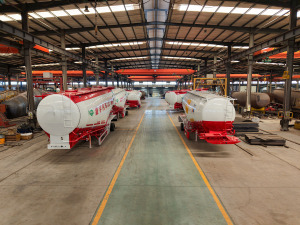
Configuration decisions become build sheets at the assembly stage; CKD and SKD options let buyers assemble in-market instead of importing complete units.
Application: matching each pick to a route
Long-haul semi-trailer
Paved intercity corridors, a single trailer type, high annual distance. Priority is fuel per 100 km, so the aerodynamic Cd 0.53 unit and the fuel-optimised specification (2.5–3.8 L/100 km saving) sit here. The F3000 6x4 is the cost-controlled alternative on corridors where Euro II fuel and service conditions apply.
Mountainous bulk cargo
Quarry and mine-to-plant cycles with sustained gradients and rough surfaces. Priority is gradeability plus structural durability: the SINOTRUK ZZ3257N384GB1R with its 5.45 ratio and 8+8/300 frame handles the shorter, heavier cycles, while the X3000 with its 440 hp output and FHB400 retarder suits longer descents where brake management is the risk.
Cross-border freight
Multi-country corridors where fuel sulphur, emission enforcement and workshop capability change en route. Priority is emission class fit, parts depth in the region and drive-hand side. Left- and right-hand drive options and spare parts supply in Africa and Southeast Asia are the practical criteria here, ahead of any single performance figure.
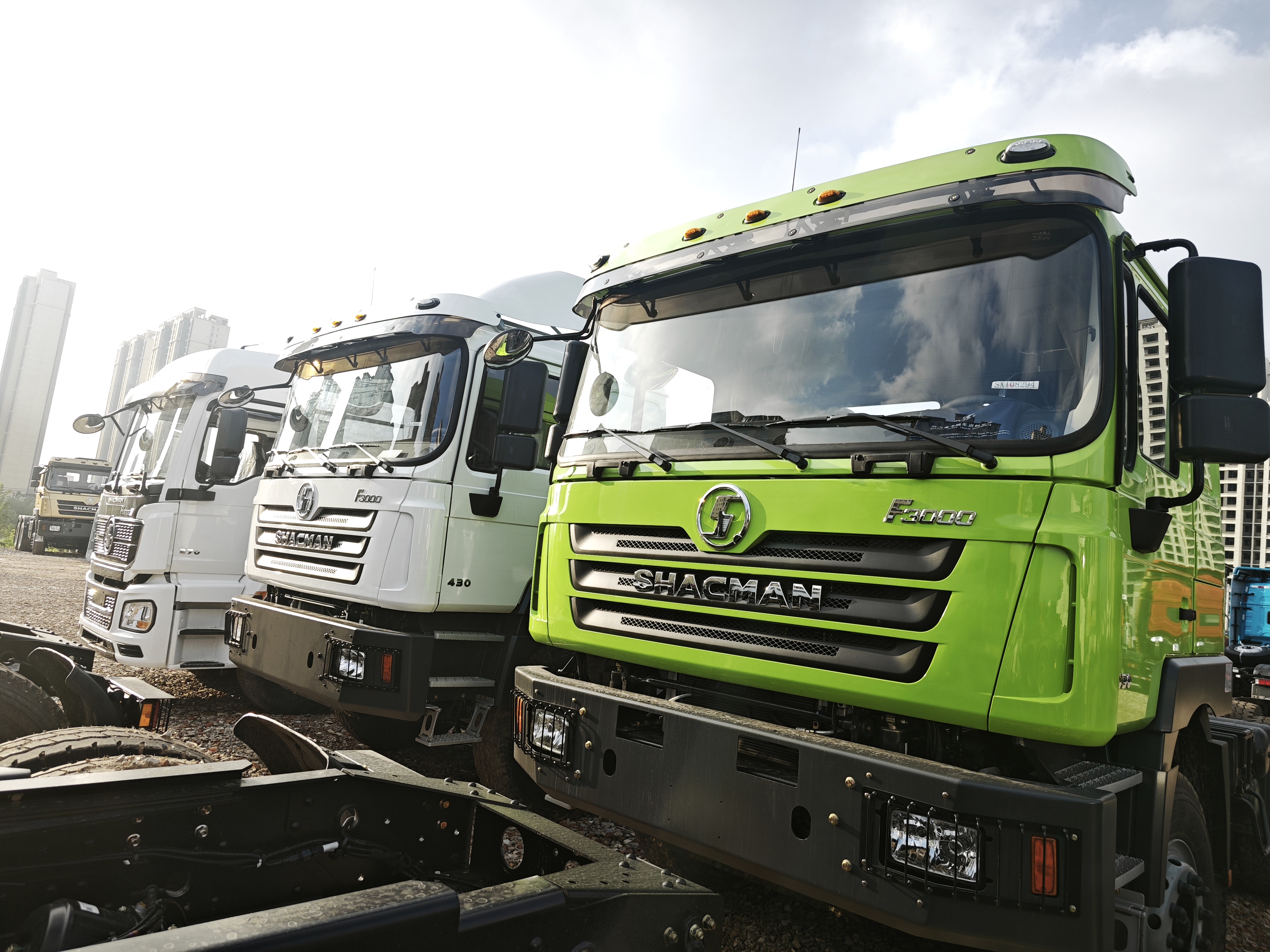
Cross-border work places emission class and parts depth ahead of peak power when a fleet ranks its specifications.
Market signals behind the shortlist
The shortlist reflects a market that is large, export-driven and slowly electrifying. Global Market Insights estimates the global heavy-duty truck market at USD 308.3 billion in 2025, projected to reach USD 475.5 billion by 2035; the same source places Daimler Truck above 12% global share in 2025, with the top five players — Daimler, PACCAR, Sinotruk, TRATON and Volvo — holding 32% collectively. Estimates of total market value vary by scope and methodology, so the figure is best read as a scale indicator rather than a precise baseline.
Supply is increasingly Chinese. CAAM data recorded 276,000 Chinese heavy-duty truck exports in 2023, a 58% year-on-year increase, rising to 295,000 units in 2024; in the first half of 2024, roughly one in three heavy trucks seen overseas originated in China. That export scale is what makes a route-matched shortlist practical for buyers in Africa and Southeast Asia, because parts and service follow volume.
Electrification is growing from a smaller base and does not yet cover the three routes above. Fortune Business Insights projects the global electric heavy-duty truck market at USD 14.84 billion in 2026, growing to USD 101.02 billion by 2034, while S&P Global Ratings forecasts Chinese electric heavy-duty truck penetration above 20% in 2026, driven by subsidy-led replacement and charging infrastructure. For long-haul, mountain and cross-border diesel duty cycles, the diesel configurations in this shortlist remain the operating choice; the electric transition is concentrated in shorter, depot-charged cycles.
Regulation is tightening at the same time. The US EPA finalised Phase 3 greenhouse gas standards for heavy-duty vehicles from model year 2027, requiring an approximately 80% reduction in NOx. That raises the value of specifying emission class deliberately rather than by default — the reason the F3000's Euro II engine is positioned for cross-border corridors and not for regulated markets.
Comparison with the traditional approach: one model for the whole fleet
The conventional sourcing model standardises a fleet on a single tractor or tipper model to simplify parts, training and purchasing. It is a legitimate strategy, and on a single fixed corridor it is often the cheaper one. A route-matched shortlist buys something different: lower fuel per 100 km on long-haul work, better gradeability on mountain cycles and better emission fit on cross-border work, each at the cost of running more than one specification.
That trade-off is real and should be stated plainly. A mixed fleet increases the number of part numbers a workshop must stock, complicates driver familiarisation, and reduces the volume leverage a buyer holds in price negotiation on any single model. The minimum order quantity of one unit makes a mixed order possible, but it does not make it free.
Where this shortlist gives up ground
- Emission coverage: the SHACMAN F3000 6x4 is a Euro II unit and cannot be sold into Euro V/VI or EPA Phase 3 markets.
- Brake specification: the published X3000 build sheet lists no ABS, which rules it out where ABS is mandated.
- Warranty length: coverage is one year, shorter than some Western OEM programmes, so buyers should price the post-warranty parts and labour plan into the decision.
- Parts geography: spare parts supply is concentrated in Africa and Southeast Asia. A corridor outside those regions needs a stocking plan agreed before the first unit ships.
- Electrification: the shortlist is diesel-only and does not address depot-charged electric duty cycles.
- Quoted performance figures: the Cd 0.53 and 2.5–3.8 L/100 km figures are configuration-level claims that require in-service validation against a stated baseline.
Future outlook
Three developments will reshape this shortlist over the next several years. First, emission enforcement is moving outward from Europe and North America, which gradually narrows the market for Euro II tractors and pushes buyers toward Euro 5-class units even on price-sensitive corridors. Second, electric penetration above 20% in China by 2026 will keep displacing diesel in short, depot-charged cycles, freeing diesel capacity for exactly the long-haul, mountain and cross-border work described here. Third, as Chinese export volume holds near the 2024 level, competition will shift from availability to specification fit — which is the ground this shortlist occupies.
For buyers, the practical implication is that a single-model fleet policy will need periodic re-testing against route economics, and that documented specifications, certificates and test criteria will matter more in supplier evaluation than badge familiarity.
FAQ
What do OEM, ODM, CKD and SKD mean when ordering heavy duty trucks?
They are four production services offered by the manufacturer. OEM and ODM cover building vehicles to a buyer's specification or brand; CKD and SKD cover shipping vehicles in completely or semi-knocked-down form for assembly in the destination market. SHANDONG WONDERFUL AUTO COMPANY LIMITED offers all four, with customisation covering logo, colour, material and shape.
Which 6x4 configuration suits mountainous bulk cargo — the SHACMAN X3000 or the SINOTRUK ZZ3257N384GB1R?
Both are 6x4 tippers and the choice depends on cycle length. The X3000 (SX3258W384C) runs a 440 hp Cummins ISM11E5 440 at Euro 5 with a 12JSD200T-B transmission, FHB400 hydraulic retarder, 5.262 final drive and an 850×300 (8+7) mm frame. The ZZ3257N384GB1R runs a 371 hp WD615.47 with an HW19710 gearbox, 5.45 final drive, double-layer (8+8/300) frame and 1,500 mm body sides. The retarder and higher output favour long, sustained descents; the lower-ratio, heavier-framed unit favours shorter rough cycles. The published X3000 specification lists no ABS.
What testing is carried out before a unit is shipped?
Quality control is stated as 100% test, and the acceptance criterion for each order is a pre-shipment test. Delivery terms are FOB Qingdao or CIF destination.
What are the minimum order quantity, lead time and payment terms?
The minimum order quantity is one unit, monthly capacity is 500 units, and lead time is 30–45 days. Payment terms are 30% T/T in advance and 70% T/T against copy of the bill of lading.
What warranty and after-sales support are included?
Coverage is a one-year warranty. Spare parts supply is available in Africa and Southeast Asia, and after-sales support is delivered through that parts channel rather than through a global dealer network.
Which markets is the SHACMAN F3000 6x4 tractor suitable for?
The unit uses a WP10.340E22 engine at 340 hp and Euro II emission class, a 10JSD180 gearbox with QH 50 power take-off and a medium-length flat-roof cab. It suits cross-border and regional corridors where fuel sulphur levels and emission enforcement match Euro II. It is not suitable for markets requiring Euro V/VI equivalents or the US EPA Phase 3 standards that start in model year 2027. The manufacturer's China Compulsory Certificate 2020091101023320, issued under CNCA-C11-01:2020 with a scope covering special vehicles, is valid to 9 December 2030.
Can a fleet combine more than one configuration in a single order?
Yes. The minimum order quantity is one unit, so a route-matched order can mix tractor and tipper configurations, and CKD or SKD supply can support in-market assembly. The trade-off is operational: each additional configuration adds part numbers to stock, complicates driver familiarisation and reduces volume leverage on pricing for any single model.
Reference
Full specifications for the truck and semi-trailer configurations discussed in this shortlist are collected in the manufacturer's product brochure (PDF).
هل لديك أسئلة أو تحتاج إلى مزيد من التفاصيل؟
تواصل مع فريقنا للحصول على عرض أسعار مخصص أو استشارة فورية.
طلب عرض أسعار
املأ النموذج أدناه وسيتواصل معك فريقنا بعرض مقترح مخصص.
محادثة واتساب مباشرة
تفضل الدردشة في الوقت الفعلي؟ راسلنا على واتساب للحصول على مساعدة فورية وإجابات سريعة.
- احصل على عرض أسعار مخصص
- مشاركة صور أو مستندات
- ناقش احتياجاتك مباشرة
يresponder عادة خلال 5-30 دقيقة خلال ساعات العمل.