
Heavy Load AGV: Load, Certification and Site Constraints
Most buyers enter the heavy end of the automated guided vehicle market with one question — how many tonnes will it carry — and then find that the number alone cannot be turned into a purchase order. A 60-tonne platform and a 600-tonne platform differ in chassis construction, wheel count, braking distance, navigation method, frame material, certification route, and in the physical work a site has to complete before either vehicle moves a single metre.
A Heavy Load AGV is best understood not as one product but as a load class with a fixed set of engineering and compliance consequences attached to it. This reference sets out what those consequences are: which load class a vehicle actually belongs to, which certification documents a buyer in the EU or US should expect to find on file, and which site conditions — floor loading, gradients, aisle width, indoor-to-outdoor transitions and charging cycles — tend to decide whether a heavy-payload project finishes in weeks or stalls entirely.
Lonyu AGV Co., Ltd. is a Tianjin-based Chinese manufacturer of heavy-duty automated guided vehicles and trackless transfer equipment, serving wind power, aerospace, shipbuilding, energy storage, ports and heavy machinery. The company states that it was founded in 2008, runs an 8,000+ m² production base with more than 300 staff and a 170-engineer R&D team, reports an 80% export ratio, and lists a maximum single-unit load capacity of 1,000 tonnes across its product range. Its catalogue is used below as the working example, because the constraint logic is easier to see when the numbers are concrete.
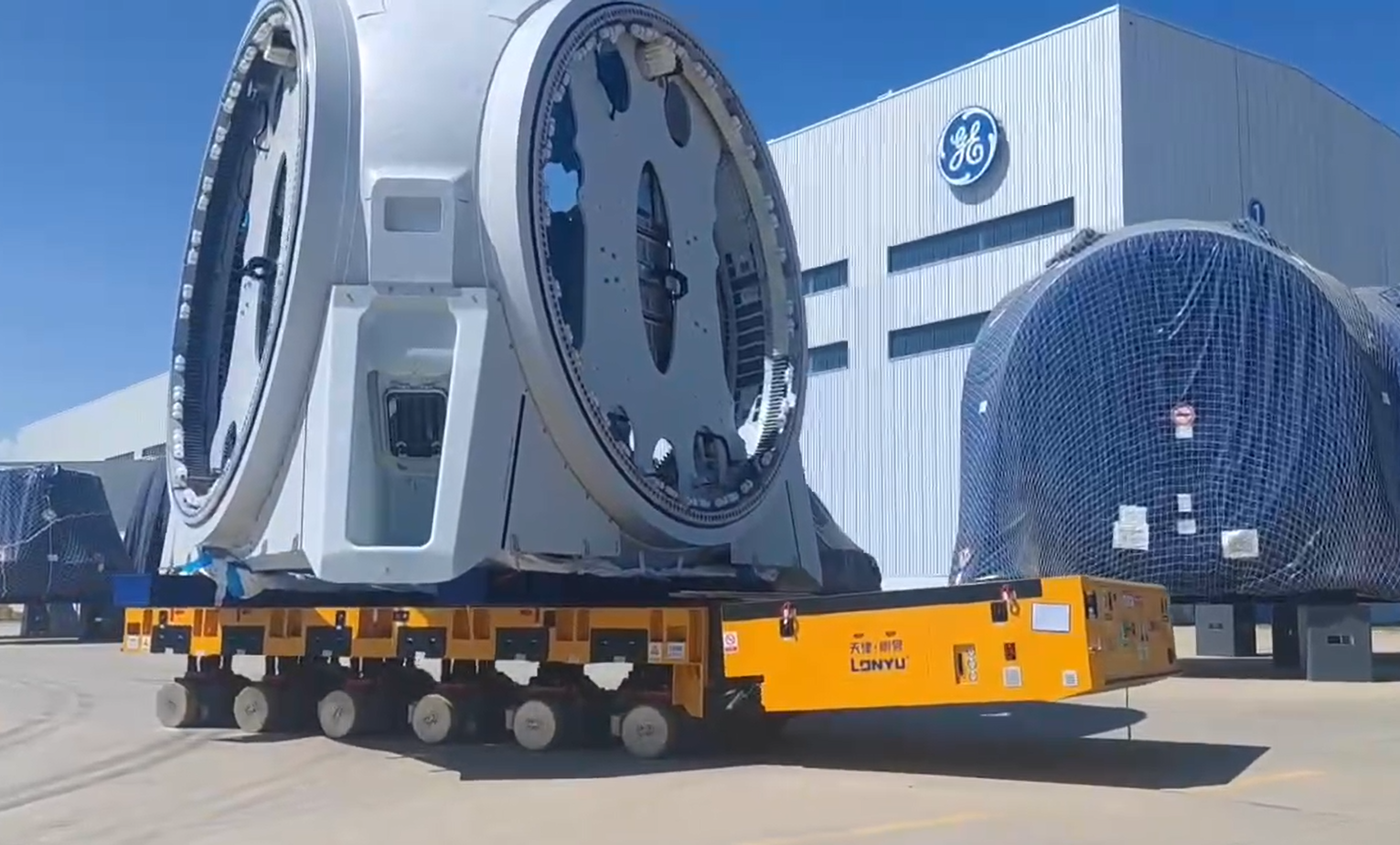
Why “heavy duty” is not yet a usable specification
The term is applied loosely. Across the global market, manufacturers use “heavy duty” to describe vehicles from roughly 2 tonnes up to 1,000 tonnes, which means a buyer comparing three quotations can be comparing three different machine categories without noticing. A specification is only usable once the load class, the vehicle architecture and the site interface are stated together.
Within the Lonyu catalogue the practical split runs in three bands. The 1–20 tonne band covers backpack and omnidirectional lifting vehicles used for assembly-line transfer, internal factory logistics and smaller industrial handling jobs. The 21–50 tonne band covers chassis transfer, mould and fixture movement, and track-slab handling. The 50–600 tonne band covers ultra-heavy work — wind turbine main engines and drive trains, transformers, energy storage containers and large fabricated structures — with single-machine capability stated up to 1,000 tonnes.
One detail matters more than the headline rating: equipment dead weight does not scale linearly with payload. An 80-tonne rated vehicle weighs 12 tonnes; a 150-tonne vehicle weighs 35 tonnes; a 600-tonne vehicle weighs 50 tonnes. That non-linearity is why a site survey is not an administrative step. The floor has to carry the tare weight plus the load plus the dynamic margin from braking, and a heavier chassis concentrated on sixteen wheels loads the slab very differently from a lighter chassis on eight.
| Representative model | Rated load | Equipment weight | Vehicle dimensions (mm) | Lifting stroke | Gradeability | Drive configuration |
|---|---|---|---|---|---|---|
| 12 ton AGV | 12,000 kg | 3,000 kg | 3400 × 1200 × 440 | — | — | Differential, magnetic strip |
| 30 ton heavy duty AGV (LY-1-30T-24-B) | 30,000 kg | 6,000 kg | 3500 × 2200 × 600 | 100 mm | 5 | Differential drive |
| 80 ton trackless transfer cart (24391A) | 80 T | 12 T | 8000 × 2520 × 670 | 200 mm | ≤3° | Four-wheel drive, eight wheels |
| 150 ton heavy duty AGV (LY-1-150T-816-A) | 150,000 kg | 35,000 kg | 7710 × 2888 × 722 | 200 mm | ≤5° | Eight-wheel drive, sixteen wheels |
| 200 ton wind turbine handler (24111A) | 200 T | 30 T | 8210 × 3620 × 885 | 200 mm | ≤5° | Eight-wheel drive, sixteen wheels |
| 600 ton heavy duty AGV (LY-1-450(600)T-416-A) | 600,000 kg | 50,000 kg | 8500 × 4540 × 1200 | 0 mm (standard) | ≤5° | Four-wheel drive, sixteen wheels |
Certification is the first hard filter in the evaluation stage
For a procurement team, certification is the most usable filter available early, because documentary evidence has a fixed shape: a named model, a named standard, a named issuing body and a validity window. A supplier that cannot produce a model-specific certificate has not yet reached the evaluation stage, regardless of how the catalogue reads.
For the European market, the relevant document is an EC type-examination certificate issued under the Machinery Directive 2006/42/EC and the associated Low Voltage and Electromagnetic Compatibility directives. Lonyu holds ECM Mark certificate 6D230301.TLR0W80, issued by Ente Certificazione Macchine (ECM) for the Heavy Load AGV model LY-AU-240T-12-0A-427, citing 2006/42/EC (Machinery), 2014/35/EU (Low Voltage) and 2014/30/EU (Electromagnetic Compatibility), valid from 1 March 2023 to 28 February 2028.
A second ECM document, verification 6D230301.TLR0W79, covers the same model designation for third countries outside the EU market and references a longer standards list, including EN 13855-2:2003, EN 14120:2003+A1:2007, EN 1088:1995+A2:2008, EN 349:1993+A1:2008, EN ISO 13857:2019 and ISO 4413:2010, with the same 2023–2028 validity window.
For the United States, the relevant document set is different again. TÜV Rheinland of North America certificate US 72508429.0001 covers the 60T Backpack Lifting Type AGV, model LY-AU-60T-6-08-1011, against ANSI/CAN/UL 3100:2024 and ANSI/ITSDF B56.5:2019. It was issued on 23 January 2025 and records a rated load of 132,277 lb and a maximum load of 145,000 lb, powered by two DQ-51.2-304 lithium-ion packs at 51.2 V, 304 Ah, in a Type 1 enclosure.
| Document | Reference | Issuing body | Covered model | Standards / directives | Validity |
|---|---|---|---|---|---|
| ECM Mark (CE) | 6D230301.TLR0W80 | Ente Certificazione Macchine (ECM) | Heavy Load AGV LY-AU-240T-12-0A-427 | 2006/42/EC; 2014/35/EU; 2014/30/EU | 2023-03-01 to 2028-02-28 |
| ECM Verification | 6D230301.TLR0W79 | Ente Certificazione Macchine Srl | Heavy Load AGV LY-AU-240T-12:0A-427 | EN 13855-2:2003; EN 14120:2003+A1:2007; EN 1088:1995+A2:2008; EN 349:1993+A1:2008; EN ISO 13857:2019; ISO 4413:2010 | 2023-03-01 to 2028-02-28 |
| UL Certificate | US 72508429.0001 | TÜV Rheinland of North America, Inc. | 60T Backpack Lifting Type AGV LY-AU-60T-6-08-1011 | ANSI/CAN/UL 3100:2024; ANSI/ITSDF B56.5:2019 | Issued 2025-01-23 |
ISO 3691-4:2023, the international safety standard for driverless industrial trucks, sits behind all of this as the common reference. Published in June 2023, it has functioned since then as the reference point for CE marking of driverless industrial trucks, which means a supplier quoting a pre-2023 safety rationale should be asked directly how the current edition has been addressed.
The practical implication for buyers: certificates are model-specific. A certificate naming a 240-tonne chassis does not automatically transfer to a 30-tonne backpack lifting AGV, and a UL certificate naming a 60-tonne model does not cover an outdoor 100-tonne platform. In a tender, the model designation on the certificate should be matched word for word against the model designation in the quotation.

The site constraints that decide feasibility
Site conditions eliminate more heavy AGV projects than budget does. The parameters that must be verified before a configuration is signed off are consistent across payload classes: payload and cargo dimensions, route length, floor load capacity, gradients, turning space, indoor-outdoor transitions, navigation method, charging cycle and safety boundaries. Final configuration normally follows a site assessment and signed drawings.
Floor loading and tare weight
A 150-tonne AGV carrying 150 tonnes places 185 tonnes on the slab through sixteen wheels; a 600-tonne unit places 650 tonnes through the same wheel count. Whether an existing industrial floor accepts that depends on slab design and wheel contact pressure, and it is the single most common reason a technically viable specification becomes a civil works project.
Gradients
Published gradeability for the heavy range is typically ≤3° for some trackless transfer platforms and ≤5° for the heavier chassis models. Those figures apply to the vehicle under load, not to the ramp geometry in isolation. Outdoor yards with drainage falls, yard aprons and loading ramps frequently exceed what the specification assumed.
Turning space and vehicle architecture
Architecture choice is a spatial decision. A 16-tonne omnidirectional lifting AGV has a minimum turning radius of 1,125 mm, which allows it to work in tighter internal layouts. A 600-tonne differential-drive platform at 8,500 mm long cannot be manoeuvred into the same space regardless of software. Where the route includes narrow aisles, the omnidirectional heavy duty AGV configuration is the practical answer; where the route is long and open, differential drive with multi-wheel steering is the usual choice.
Indoor-outdoor transitions
Ingress protection is stated per model — IP44 on some indoor trackless carts, IP54 on the 80-tonne and 200-tonne platforms, IP65 on certain outdoor unmanned vehicles. An outdoor heavy duty AGV also needs navigation that survives daylight, weather and changing feature sets. Lonyu's outdoor platforms combine RTK with INS and laser SLAM, and one 20-tonne outdoor unit uses BeiDou satellite positioning with multi-line laser and vision to operate both indoors and outdoors in high-temperature, high-dust conditions.
Charging cycle and route length
Battery capacity constrains throughput more than top speed does. The 80-tonne and 200-tonne platforms both list three hours of runtime under load with lithium iron phosphate packs, and the outdoor IGV lists six hours when fully charged. If a shift pattern exceeds that, the project needs a charging window, an automatic charging pile, or a battery swap station — and the swap station needs floor space that is often not in the original layout drawing.
Vehicle speed in context
Published travel speeds range from 25 m/min on the 80-tonne platform to 36 m/min at full load on the 200-tonne wind turbine handler, with outdoor highway-capable configurations reaching higher road speeds. In a heavy-payload project the governing constraint is usually braking distance rather than cruise speed: published figures include ≤400 mm at full load and ≤300 mm empty on the 80-tonne unit, and ≤500 mm at full load and ≤300 mm empty on the 200-tonne unit. Those distances define the safe separation the traffic layout must provide.
Safety and navigation as design constraints, not features
On a light AGV, navigation is a convenience. On a 200-tonne vehicle moving at 36 m/min, navigation is a safety system, and the procurement question is not which method is used but whether the method suits the floor.
- Laser SLAM with natural feature navigation provides indoor positioning without magnetic tracks and is specified alongside hydraulic independent suspension and automatic leveling so that load stability holds on uneven factory floors.
- Magnetic strip navigation delivers ±10 mm positioning and ±10 mm navigation accuracy on the 12-tonne unit, and magnetic strip combined with laser navigation appears on the 80-tonne platform at ±30 mm navigation accuracy and ±10 mm positioning accuracy.
- RTK + INS, combining differential integrated navigation, inertial navigation and laser SLAM, supports outdoor operation; published navigation accuracy in that configuration is stated as ±20 mm.
- Safety layers typically combine LiDAR obstacle detection with 360-degree coverage, contact collision avoidance, audible and visual warning and emergency stop, with perception systems on the outdoor platforms adding visual, environmental and device perception sensors in a multi-layer redundant safety architecture.
Frame material is also specified rather than assumed. Main frames use Q235B steel, with Q355B available as an option for special working conditions, and the final selection is confirmed per model and technical agreement. For a buyer comparing quotations, that line item is worth checking: it is one of the places where two superficially identical offers diverge.
From catalogue model to custom heavy duty AGV
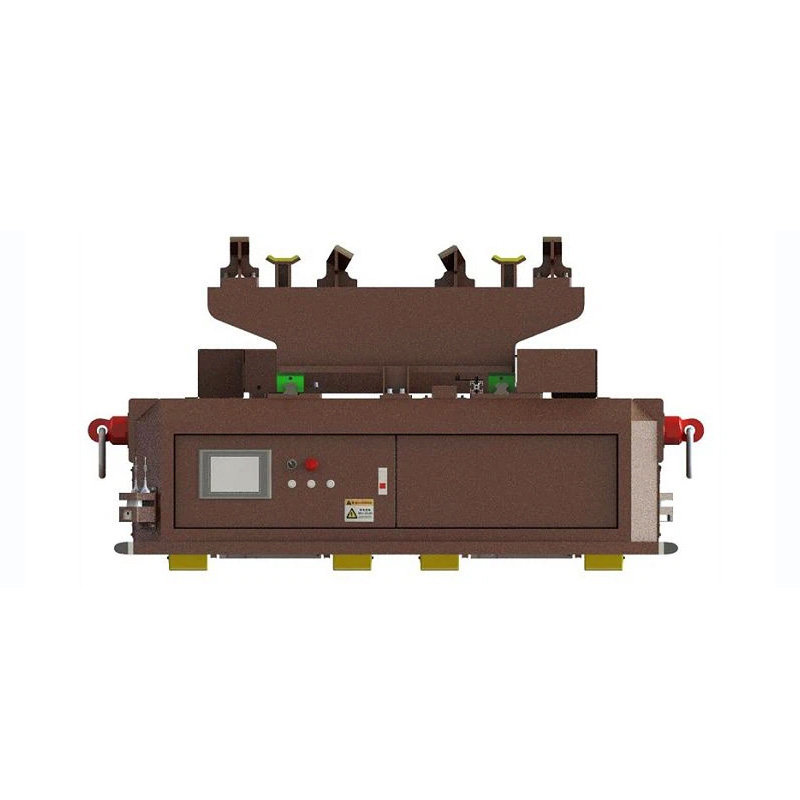
Almost no heavy-payload deployment is a catalogue purchase. The customisable parameters listed for OEM and ODM work are payload class, vehicle dimensions, lifting structure, drive and suspension arrangement, navigation method, operating environment, charging or battery-swapping method, dispatching system, and indoor-outdoor route adaptation. Minimum order quantity is stated as at least one unit, with monthly capacity of 200 units and a lead time that is determined by the customised quantity, parameters and functional requirements rather than by a standard schedule.
That structure explains why lead time questions rarely produce a clean answer at the enquiry stage. A 30-tonne backpack lifting AGV for high-speed rail track-slab casting and curing, which must enter beneath a material rack and lift it, is a different engineering task from a 30-tonne double-vehicle linkage platform carrying 11 to 27 metre products with adjustable linkage distance — even though both sit in the same 21–50 tonne band.
Heavy AGV versus tracks, cranes and forklifts
The honest comparison is not AGV versus nothing. It is AGV versus the three alternatives that already move heavy parts in most plants.
| Approach | Strongest fit | Where it falls short |
|---|---|---|
| Tracked or rail transfer cart | Fixed, highly repetitive routes where path precision matters more than flexibility | Route is fixed by the rail; layout changes require civil work |
| Overhead crane | Vertical lift and short horizontal moves within the crane bay | Horizontal travel is limited to the crane span; bays do not connect |
| Forklift or heavy telehandler | Low-volume, irregular moves and general yard work | Impractical above a few tonnes; operator exposure remains |
| Trackless heavy duty AGV | Point-to-point horizontal transport of tens to hundreds of tonnes across connected zones, indoors or outdoors | Requires navigation infrastructure, a surveyed site and a defined safe traffic layout |
A real boundary worth stating plainly: a heavy load AGV does not lift cargo off the ground by itself. Documented lifting strokes in this range are 100 mm to 200 mm, and the 600-tonne platform's standard configuration lists a lifting stroke of 0 mm. Loading therefore depends on a crane, a hoist or a purpose-built rack that the AGV can enter from underneath. A project that assumes the AGV replaces both the crane and the transfer route has misread the equipment class, and will discover it during commissioning.
Where the constraint profile actually fits
Application fit follows the constraint profile rather than the marketing category. The configurations that appear repeatedly across documented deployments fall into recognisable patterns.
- Wind power components — a 200-tonne trackless platform with a 200 mm lifting stroke handles turbine main engines and drive trains indoors and outdoors, and the same industry uses bespoke platforms for nacelles, hubs, blades and towers.
- Energy storage containers — the 80-tonne platform at 8,000 × 2,520 × 670 mm, rated IP54 with laser plus magnetic strip navigation, is specified for container handling.
- Automotive and commercial vehicle assembly — a 15-tonne outdoor navigation AGV with adjustable support spacing based on front and rear axle distance is used on flexible assembly lines for commercial vehicle chassis, and a 30-tonne double-vehicle linkage unit carries 11 to 27 metre products.
- High-speed rail — a 30-tonne backpack heavy duty AGV handles track slab casting and curing, entering beneath racks with or without support legs.
- Coil and cylindrical goods — parallel backpack lifting AGVs handle cylindrical products of differing diameters, including aluminium and steel coils, with eccentric docking to coating machines.
- Mould, transformer and heavy machinery transfer — covered by the 50–600 tonne band and by trackless transfer platforms rated for transformer handling.
Across these categories the manufacturer reports more than 800 large-scale engineering projects delivered and long-term service to more than 50 Fortune Global 500 companies, with a stated after-sales structure of a 12-month warranty, post-warranty parts at basic prices, and training covering operation, maintenance and upgrades, subject to confirmation of service region and contract terms.
Market context for heavy payload automation
The wider automated guided vehicle market was valued at approximately USD 5.52 billion in 2025 in commercial research published by Fortune Business Insights, with heavy-load vehicles identified as a key segment. Regional concentration is pronounced: the same research estimates Asia Pacific at 35.51% of the market, while a separate estimate places the figure at 38.5% — both point to the same conclusion, that the Asia-Pacific region carries the largest single share of global AGV revenue.
One data gap is worth flagging because it affects how buyers plan. Public, reliable cost data for the heavy segment is scarce; per-tonne payload pricing for AGVs above 50 tonnes is not consistently published, which means budget models are usually built from configured quotations rather than benchmark tables. Procurement teams should expect to build cost estimates from scope definition — payload class, chassis dimensions, drive and suspension, lifting, navigation, battery and charging, dispatch system and certification scope — rather than from a list price.
What changes next in heavy payload automation
Three pressures are visible in the constraint set itself. Certification scope is widening as more jurisdictions adopt driverless industrial truck standards, which pushes model-specific documentation from a differentiator into a baseline requirement. Site integration is becoming the binding constraint rather than vehicle capability, which shifts value toward suppliers who can survey, model and sign off on floor loading and traffic layout rather than only ship hardware. And the operating envelope is widening at the outdoor end, where satellite, inertial and laser navigation are being combined so that a single platform can cross from a controlled indoor aisle into a yard without a handover.
None of these changes alter the underlying rule. A heavy load AGV is specified by its worst-case constraint, not its best-case rating — and the buyers who get the outcome they planned are the ones who mapped the load class, the certificate and the site before the purchase order was raised.
Frequently asked questions
What counts as a heavy duty AGV, and how are load classes divided?
Heavy duty AGV is a load-class description rather than a fixed engineering definition. Across the global market the term is applied to vehicles from roughly 2 tonnes to 1,000 tonnes, so the class boundary only becomes meaningful when a manufacturer states its own bands. In the Lonyu catalogue the bands are 1–20 tonnes for backpack and omnidirectional vehicles, 21–50 tonnes for chassis, mould and slab transfer, and 50–600 tonnes for ultra-heavy work, with single-machine capability stated up to 1,000 tonnes. Rated load is the maximum design payload; equipment weight is a separate figure and does not scale linearly with it — an 80-tonne model weighs 12 tonnes while a 150-tonne chassis weighs 35 tonnes.
Which certification documents should an EU or US buyer request?
The documents are market-specific and model-specific. For the EU, an EC type-examination certificate under 2006/42/EC is the core document; Lonyu holds ECM Mark certificate 6D230301.TLR0W80 for heavy load AGV model LY-AU-240T-12-0A-427, citing the Machinery, Low Voltage and EMC directives and valid from 1 March 2023 to 28 February 2028. For the US, TÜV Rheinland of North America certificate US 72508429.0001 covers the 60T Backpack Lifting Type AGV, model LY-AU-60T-6-08-1011, against ANSI/CAN/UL 3100:2024 and ANSI/ITSDF B56.5:2019, issued 23 January 2025. ISO 3691-4:2023 is the international reference standard for driverless industrial trucks and has served as the CE reference point since its publication in June 2023.
Which site conditions should be verified before a heavy load AGV is ordered?
The standard verification list covers payload and cargo dimensions, route length, floor load capacity, gradients, turning space, indoor-outdoor transitions, navigation method, charging cycle and safety boundaries. Floor loading is usually the decisive one because tare weight is significant — 12 tonnes on an 80-tonne vehicle, 35 tonnes on a 150-tonne vehicle, 50 tonnes on a 600-tonne vehicle. Gradients are checked against the published figure, which is typically ≤3° on some trackless platforms and ≤5° on heavier chassis models. Turning space determines whether an omnidirectional vehicle is required; a 16-tonne omnidirectional lifting AGV lists a minimum turning radius of 1,125 mm. Final configuration follows site assessment and signed drawings.
How long does a heavy duty AGV run on one charge, and how is it recharged?
Runtime is stated per model and per load condition. The 80-tonne and 200-tonne platforms both list three hours of battery life under load and empty, using lithium iron phosphate packs, and the outdoor IGV lists six hours when fully charged. Battery voltage options run from 48 V and 96 V on standard units to 330 V, 570 V and 614 V on high-speed outdoor unmanned vehicles. Charging methods include manual charging, automatic charging pile charging, an intelligent battery swap station and manual battery swap, with diesel or methanol range extension available as an option on outdoor platforms.
How does the navigation method affect accuracy in heavy payload transport?
Accuracy figures differ by navigation method and are published per model. Magnetic strip navigation on the 12-tonne AGV is stated at ±10 mm positioning and ±10 mm navigation accuracy. The 80-tonne platform, which combines laser navigation with magnetic strip, lists ±30 mm navigation accuracy and ±10 mm positioning accuracy. RTK combined with INS — differential integrated navigation plus inertial navigation plus laser SLAM — carries a stated navigation accuracy of ±20 mm for outdoor operation. Laser SLAM with natural feature navigation provides millimetre-level indoor positioning without magnetic tracks. The selection question is which method suits the floor surface, route changes and indoor-outdoor transitions of a given site.
Why is pricing for heavy duty AGVs not publicly listed, and what drives cost?
Cost is configuration-driven at this payload level, and per-tonne benchmark pricing for vehicles above 50 tonnes is not consistently published. The parameters that move cost include payload class, vehicle dimensions, lifting structure, drive and suspension arrangement, navigation method, operating environment, charging or battery-swapping method, dispatching system and indoor-outdoor route adaptation — all of which are listed as customisable parameters for OEM and ODM work. Total cost of ownership also includes site preparation, navigation infrastructure, charging equipment, spare parts at basic prices after the 12-month warranty period, and operator training.
Reference material: the manufacturer's company brochure is available for public download at company-brochure.pdf.
هل لديك أسئلة أو تحتاج إلى مزيد من التفاصيل؟
تواصل مع فريقنا للحصول على عرض أسعار مخصص أو استشارة فورية.
طلب عرض أسعار
املأ النموذج أدناه وسيتواصل معك فريقنا بعرض مقترح مخصص.
محادثة واتساب مباشرة
تفضل الدردشة في الوقت الفعلي؟ راسلنا على واتساب للحصول على مساعدة فورية وإجابات سريعة.
- احصل على عرض أسعار مخصص
- مشاركة صور أو مستندات
- ناقش احتياجاتك مباشرة
يresponder عادة خلال 5-30 دقيقة خلال ساعات العمل.