
Heavy Machinery Fit: How 800 mm OD, 12 m Hydraulic Cylinders Serve Marine and Presses
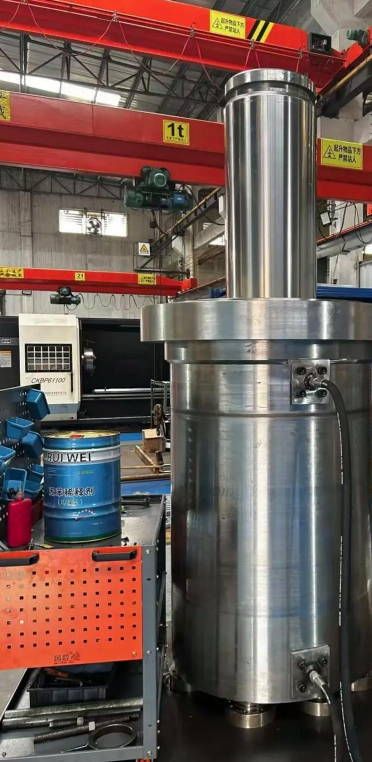
A high-pressure heavy duty hydraulic cylinder. In heavy-duty procurement, the dimensional envelope — not brand visibility — is usually the first selection filter. Image: Tuoda Machinery.
A hydraulic cylinder converts hydraulic energy into mechanical energy and delivers it as linear reciprocating motion. In heavy machinery, hydraulic presses, marine hydraulic systems, specialized equipment, military equipment and high-pressure test benches, that component is rarely a commodity part. Its dimensional envelope — outer diameter, wall thickness and overall length — decides whether it can be mounted, whether it survives the load, and whether the surrounding hydraulic system behaves predictably over thousands of cycles.
The size of that question is visible in the market itself. The global hydraulic cylinder market was valued at USD 15.7 billion in 2024 and is projected to reach USD 24.7 billion by 2034, according to Global Market Insights. Within the same market, double-acting cylinders held a 70% share in 2024, and large bore cylinders with a bore size above 150 mm accounted for approximately 27.4% of market revenue in 2025, a figure Dataintelo attributes to demand from large mining excavators and tunnel boring machines. In other words, the large-format end of the cylinder market is not a niche curiosity; it is a measurable, revenue-carrying segment.
This reference maps one published heavy-duty envelope — outer diameter from 20 mm to 800 mm, wall thickness from 3 mm to 50 mm, and lengths up to 12 m — against the applications that genuinely require it, and it identifies where that envelope stops being the right answer. It is written for buyers at the discovery and research stage who need to understand what the numbers mean before they shortlist a supplier.
Why the Size Envelope, Not the Brand, Decides the Application
Most hydraulic cylinder selection conversations start with pressure. In practice, pressure is the easiest variable to satisfy and the least likely to disqualify a supplier. Outer diameter, wall thickness and stroke length are harder, because they are constrained by machining capability, material supply, honing equipment and transport logistics rather than by a pressure rating printed on a datasheet.
A catalog-standard cylinder is normally sized for mobile equipment and light industrial duty. Once a project moves toward very large outer diameters or unusually long strokes, it typically falls outside standard catalog ranges and becomes a drawing-based, made-to-order component. That transition changes the procurement question from "which model number" to "which manufacturing envelope can this supplier actually hold, repeatably, and within a stated lead time."
That is why the specification envelope below is presented as a fit map rather than a product listing. Two buyers may need the same pressure rating and end up with completely different cylinders, because one is mounting a press platen and the other is driving a marine steering gear in a humid, salt-exposed environment.
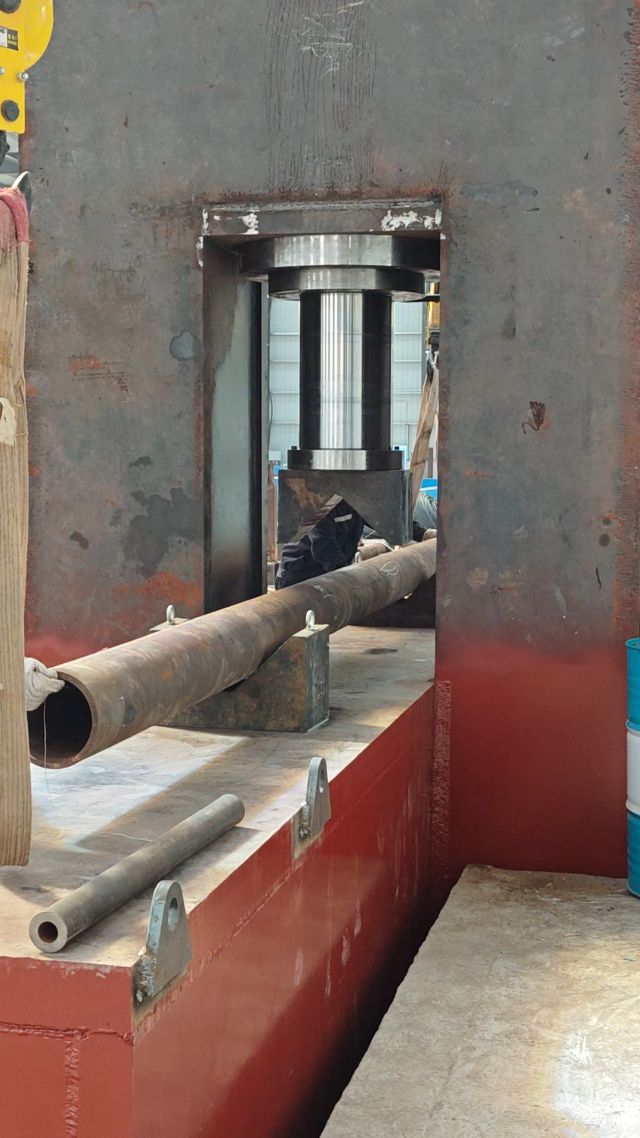
Straightness and concentricity are process outcomes, not claims — long-stroke cylinders depend on equipment such as straightening machinery. Image: Tuoda Machinery.
The Specification Envelope: What 20–800 mm OD and 12 m Length Actually Cover
Shandong Tuoda Machinery Equipment Co., Ltd. publishes a heavy-duty hydraulic cylinder envelope that spans a wide industrial band: outer diameter from 20 mm to 800 mm, wall thickness from 3 mm to 50 mm, and available lengths of 6 m, 5.8 m, 12 m or 6–12 m. The company also states a bore capability up to 36 inches, a stroke up to 40 feet and pressure up to 10,000 psi in its application data — a range it positions as a significant performance gap over standard cylinders, achieved through high-strength materials and design tailored for extreme conditions.
The table below consolidates the published figures. Buyers should read it as a capability boundary to be verified against drawings, not as a stock list.
| Outer diameter range | 20–800 mm (custom sizes available) |
| Wall thickness range | 3–50 mm, weight tolerance ±10% |
| Available lengths | 5.8 m / 6 m / 12 m / 6–12 m |
| Hole diameter tolerance | ISO H8 / H9 |
| Arithmetic roughness | Ra ≤ 0.4 μm |
| Materials | ST52, S355, E355, C45, SAE1045, 42CrMo4 and others, customized |
| Cylinder types | Piston, plunger, telescopic (multi-stage), rotary (oscillating) |
| Delivery | 30–45 days or customized |
The practical reading of this envelope is that a single supplier can cover a 40 mm cylinder for a compact actuator and an 800 mm outer diameter barrel for a four-column press without changing its process chain. For buyers, that continuity matters more than it first appears: a supplier that already machines large diameters tends to have the honing, deep-hole and heat-treatment equipment that smaller-diameter work does not require.
Cylinder Types and the Duty Each One Fits
The type list is short — piston, plunger, telescopic and rotary — but the selection logic behind it is not interchangeable. Each type resolves a different mechanical problem, and choosing the wrong one tends to surface as premature seal wear, uneven loading or mounting failure rather than as an immediate performance failure.
| Type | Mechanical characteristic | Where it typically fits |
| Piston cylinder | Force in both directions through a piston and rod | Presses, industrial machinery, mobile equipment |
| Plunger cylinder | Single-direction thrust from a solid plunger | Lifting, clamping and positioning duty |
| Telescopic (multi-stage) | Long stroke from a short retracted length | Applications with limited installation space |
| Rotary (oscillating) | Limited angular movement instead of linear travel | Steering, turning and indexing functions |
The distinction matters because a long-stroke requirement can be solved in two different ways: a single-stage cylinder up to 12 m, or a multi-stage telescopic design that produces comparable stroke from a much shorter closed length. The first option is simpler mechanically; the second is easier to install in confined machinery. A buyer specifying "long stroke" without specifying installation length is leaving a decision open that will be made later by someone else.
Technical Constraints That Come With Large Diameter and Long Stroke
Bore geometry and batch consistency
Internal bore dimensional stability — batch consistency — is the first special requirement in heavy-duty cylinder work. Tolerance bands of ISO H8/H9 only produce a usable cylinder if the bore holds that band across a production batch, not just on a sample. When a buyer orders a replacement unit two years after commissioning a machine, batch consistency is what determines whether the replacement drops in.
Straightness across long strokes
Straightness becomes progressively harder to control as length increases. A 12 m cylinder body has more opportunity to deviate from a true axis than a 1 m body, and any deviation translates into side loading on the rod, uneven seal contact and accelerated wear. Straightening operations are part of the manufacturing chain for this reason, not an optional finishing step.
Wall thickness and pressure containment
Wall thickness from 3 mm to 50 mm covers a wide band of pressure containment. At the upper end, thick-walled seamless steel pipe tubing carries the hoop stress; at the lower end, the wall is sized for lighter duty. A stated weight tolerance of ±10% is worth noting explicitly during procurement, because a large-diameter, 12 m cylinder can vary noticeably in mass between units — and that variation has to be planned for in crane capacity, mounting brackets and transport.
Sealing, surface finish and contamination
Arithmetic roughness of Ra ≤ 0.4 μm on the internal bore is a finishing target that supports seal life. In dusty, high-humidity, marine or slurry conditions, the sealing system and surface finish determine how long the cylinder holds pressure before external leakage appears. Metal-to-metal sealing, high-performance polyurethane seals, forged valve bodies and overpressure protection devices are among the technologies used to hold that performance under cyclic load.
Application Mapping: Marine, Press, Test Bench and Mobile Machinery
The published application set for this class of cylinder is specific: heavy machinery, hydraulic presses, marine hydraulic systems, specialized equipment, military equipment and high-pressure test benches. Each of those environments imposes a different dominant constraint, which is why the same dimensional envelope serves all of them without meaning that the same cylinder configuration serves all of them.
Heavy machinery and mobile hydraulics
Mobile hydraulics — including construction and mining equipment — accounted for more than 58% of the total hydraulics market share in 2024, according to Grand View Research. That concentration explains why cylinders for excavators, crushers and mining equipment dominate volume demand. Working conditions in this segment include impact and slurry exposure, outdoor operation, dust and high temperature, and the cylinder is expected to keep functioning through all of it.
Hydraulic presses
In press duty, the dominant requirement is force delivery with controlled geometry. Four-column hydraulic presses operate in the high-pressure band from 31.5 to 63 MPa in Tuoda's published range, where large outer diameters and heavy wall thickness are used to contain pressure and resist deflection across the platen. Concentricity is the constraint that most affects press performance, because an off-axis cylinder translates directly into uneven platen loading.
Marine hydraulic systems
Marine applications — including steering gear and anchor winches — combine high force with a continuously humid, salt-exposed environment. Here the dimensional envelope is only half the specification; corrosion resistance and sealing integrity under marine conditions carry equal weight. The published application scenario for this class of cylinder lists high humidity and marine exposure as standing operating conditions, alongside high temperature and outdoor duty.
High-pressure test benches and specialized equipment
Above 63 MPa, cylinders move into ultra-high-pressure territory, where the published applications include high-pressure water jet cutting machines, artillery recoil systems and material pressure-testing apparatus. These are low-volume, high-specification builds in which the cylinder is part of a measurement or safety chain, so bore stability and repeatability matter more than throughput.
Typical application regions for this class of work are listed as China, India, Turkey, Vietnam, Indonesia, Canada, Germany, the United Kingdom and Sweden — a spread that reflects both industrial demand and the fact that heavy hydraulic equipment moves through export channels rather than local supply only.
Tuoda Machinery: The Manufacturing Base Behind the Envelope
Shandong Tuoda Machinery Equipment Co., Ltd. (Tuoda Machinery) is a China-based manufacturer of seamless steel pipes, custom hydraulic cylinders, deep hole drilling machines and pressure cylinders, established in 2020 and operating a 30,000 m² manufacturing facility with approximately 150 employees and a dedicated R&D team of three engineers. Its business focus combines steel pipe deep processing and hydraulic cylinder manufacturing, with main products including carbon seamless steel tubes, round bars and pressure cylinders. Annual production capacity is approximately 1,200 units.
Two structural facts are relevant to buyers evaluating the 800 mm / 12 m envelope. First, the company produces its own thick-walled seamless steel pipe tubing, which means the cylinder barrel and the cylinder are manufactured within the same industrial chain rather than assembled from externally sourced tube. Second, its product range spans high-pressure cylinders in the 31.5–63 MPa band and ultra-high-pressure cylinders above 63 MPa, which supports both the press and test-bench ends of the application map described above.
The manufacturing chain includes precision honing, surface treatment and heat treatment, with metal-to-metal sealing, high-performance polyurethane seals, forged valve bodies and overpressure protection devices among the named technologies. Customization scope is stated as end-to-end: application analysis, drawing verification, material selection, manufacturing and honing, then inspection, testing and final delivery. Export business accounts for approximately 70% of total sales, with major markets in the EU, Asia and South America.
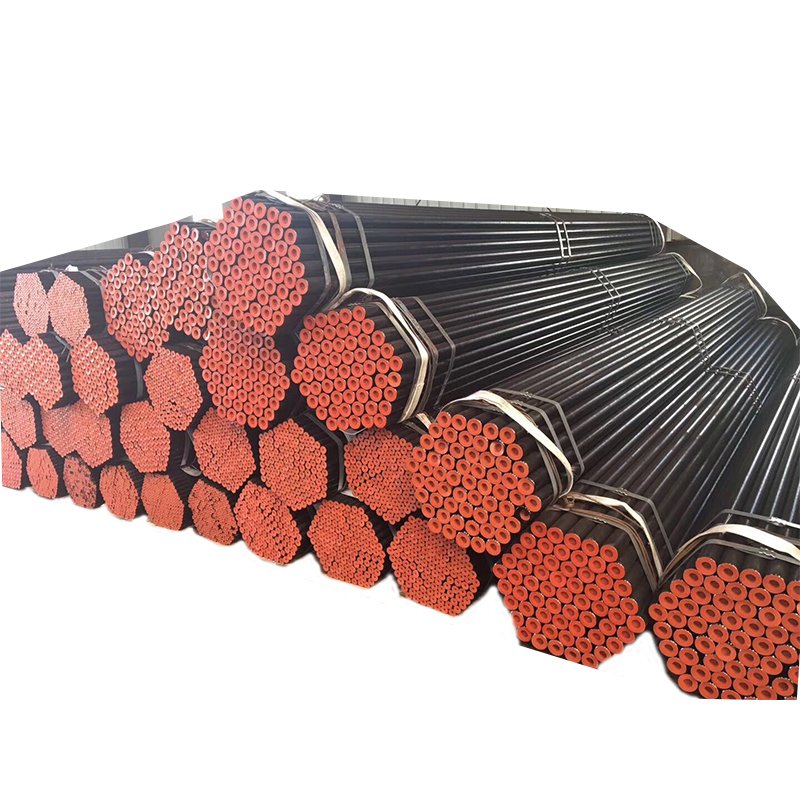
Thick-walled seamless steel tube is the upstream input for cylinder barrels, which is why pipe processing capability and cylinder capability often sit in the same facility.
Market Trend Analysis: Where Large-Bore Demand Is Moving
Three published data points frame the direction of this segment. The global hydraulic cylinder market is projected to grow from USD 15.7 billion in 2024 to USD 24.7 billion by 2034 (Global Market Insights), which implies sustained capacity demand rather than a replacement-only market. Double-acting cylinders represented 70% of the industry in 2024, favoured for precision-driven heavy-duty construction and robotics work — a configuration preference that pushes demand toward more complex sealing and port arrangements. And large bore cylinders above 150 mm held approximately 27.4% of market revenue in 2025, driven by large mining excavators and tunnel boring machines (Dataintelo).
On the supply side, standards continue to anchor interchangeability. Heavy-duty hydraulic cylinders for industrial applications are governed by ISO 6022 for the 250 bar series and ISO 6020 for the 160 bar series, covering mounting dimensions and interchangeability. For buyers, that means cylinders inside these series can be compared across suppliers on mounting geometry, while cylinders outside them — including much of the very large-format custom work — require drawing-level verification.
Competitive concentration remains visible in the same market data. Caterpillar held over 8% of the global hydraulic cylinder market in 2024 (Global Market Insights), and Parker Hannifin held approximately 12% share of the hydraulic cylinder industry in 2023 (Worldmetrics). Trade flows also remain material: China's exports of hydraulic power engines and motors, including cylinders, to the United States reached approximately USD 80.4 million in 2024, according to the World Integrated Trade Solution.
Heavy-Duty Custom vs Standard Cylinders: Where the Custom Route Does Not Pay Off
Custom heavy-duty cylinders solve problems that standard catalog units cannot, but they are not the correct answer in every case. The clearest boundary is application severity: for short-stroke, low-cycle, light-load duty, a catalog cylinder is usually the faster and cheaper route, and specifying a custom large-bore cylinder adds cost and lead time without adding service life.
Several further constraints deserve to be stated plainly.
| Factor | What buyers should expect |
| Lead time | Custom builds are quoted at 30–45 days, extendable for non-standard requirements. This is a make-to-order window, not a stock availability window. |
| Weight variance | A ±10% wall-thickness weight tolerance on a large-diameter, 12 m cylinder produces a meaningful mass range that affects lifting and mounting design. |
| Installation length | A 12 m single-stage cylinder requires corresponding space and support along its full length. If the machine envelope cannot accommodate it, a telescopic design is the practical alternative. |
| Interchangeability | Mounting interchangeability is defined by ISO 6022 and ISO 6020 within their series. Outside those series, mounting dimensions must be verified drawing by drawing. |
| System requirements | Larger bores and longer strokes require the cylinder barrel, piston rod, piston, gland/head, end cap, sealing system, guide bush and ports to work as a matched system, which raises the specification burden on the surrounding hydraulics. |
The limiting case is worth stating directly: an 800 mm outer diameter, 12 m length cylinder is the right component for a small set of high-force, long-travel duties, and an oversized choice for almost everything else. Buyers who treat the maximum of a published range as the target specification frequently pay for capability they never load.
Future Outlook
Three developments are likely to shape this segment through the remainder of the decade. The first is continued growth in large-format demand: if the cylinder market expands from USD 15.7 billion in 2024 toward USD 24.7 billion by 2034, capacity for large bore and long stroke work will remain a competitive differentiator rather than a special-order service. The second is the ongoing dominance of double-acting configurations, which pushes development effort toward sealing systems and port design rather than toward basic actuation. The third is standardization pressure: as ISO 6022 and ISO 6020 continue to define interchangeability within their series, suppliers outside those mounting envelopes will be judged increasingly on documentation, drawing discipline and lead-time reliability rather than on dimensional claims alone.
For procurement teams, the practical implication is that supplier evaluation will shift further toward process evidence — bore consistency, straightness control, roughness measurement, concentricity and stable lead times — because those are the variables that determine whether a specified envelope is delivered as specified.
FAQ
What outer diameter, wall thickness and length can custom heavy duty hydraulic cylinders be manufactured in?
Tuoda Machinery publishes an outer diameter range of 20–800 mm, a wall thickness range of 3–50 mm, and available lengths of 5.8 m, 6 m, 12 m or 6–12 m, with a weight tolerance of ±10%. Internal bore tolerance is stated as ISO H8/H9 and arithmetic roughness as Ra ≤ 0.4 μm. Sizes outside these ranges are quoted as customized, and dimensions should be confirmed at drawing stage.
Which cylinder type fits long-stroke applications — single-stage or telescopic?
Both are available: piston, plunger, telescopic (multi-stage) and rotary (oscillating) cylinders are all part of the published product range. A single-stage cylinder can be supplied up to 12 m in length and delivers the simplest mechanical arrangement. A telescopic multi-stage cylinder produces a comparable stroke from a shorter retracted length, which suits machines where installation space is limited. The choice depends on available installation length rather than on force requirement.
Which industries use large bore and long stroke hydraulic cylinders?
Published applications are heavy machinery, hydraulic presses, marine hydraulic systems, specialized equipment, military equipment and high-pressure test benches. Heavy machinery covers construction and mining equipment; press duty covers four-column hydraulic presses in the 31.5–63 MPa band; marine duty covers applications such as steering gear and anchor winches; and ultra-high-pressure work above 63 MPa covers equipment such as high-pressure water jet cutting machines, artillery recoil systems and material pressure-testing apparatus.
What is the delivery lead time for custom heavy duty hydraulic cylinders?
Delivery is stated as 30–45 days, or customized for non-standard requirements. Because these cylinders are made to order rather than held in stock, the lead time applies from order confirmation, and non-standard dimensions, materials or mounting arrangements may extend it. Stable lead times are listed as one of the standing special requirements for this application scenario, which makes lead-time reliability a relevant evaluation point alongside dimensional capability.
What materials are used in heavy duty hydraulic cylinders?
Published material options include ST52, S355, E355, C45, SAE1045 and 42CrMo4, with customized grades available. The underlying barrel stock is thick-walled seamless steel pipe tubing, manufactured in hot-rolled or cold-drawn condition depending on the requirement. Material selection is part of the customization scope, which covers application analysis, drawing verification, material selection, manufacturing and honing, inspection and testing.
Do heavy duty hydraulic cylinders follow a mounting standard?
Heavy-duty hydraulic cylinders for industrial applications are governed by ISO 6022 for the 250 bar series and ISO 6020 for the 160 bar series, which cover mounting dimensions and interchangeability. Cylinders built within those series can be compared across suppliers on mounting geometry. Cylinders outside those series — including many very large-format custom builds — require drawing-level verification, because interchangeability is not automatic.
How should a buyer evaluate cylinder quality before placing a production order?
Five criteria are published as the special requirements for this application scenario: internal bore dimensional stability across a batch, straightness, internal bore roughness, concentricity and stable lead times. Each of these can be checked with documentation rather than with a visual inspection — bore measurements against ISO H8/H9, roughness values against Ra ≤ 0.4 μm, straightness records, concentricity data and confirmed delivery dates. Concentricity is particularly relevant for press duty, where an off-axis cylinder translates into uneven platen loading.
Reference Note
Shandong Tuoda Machinery Equipment Co., Ltd. publishes its full product documentation as a downloadable brochure. Technical enquiries can be directed to olivia@sdtuoda.com or +86 13290268388. Company website: WWW.SDTDSTEEL.COM.