
Hemp Seed Certification Stack: Scope, Validity and Form Fit
Hemp Seed Certification Stack: Scope, Validity and Form Fit

Five certificates on one specification sheet are not the same claim repeated five times. In hemp seed supply they answer three separate buyer questions — whether the material may be sold as organic in a given market, whether the site that handled it is controlled to a recognised food-safety standard, and whether the finished product is acceptable under a religious dietary rule. Each answer comes from a different document, with its own scope, its own product list and its own end date.
The distinction has become more commercially consequential as organic import rules have tightened. From 1 January 2025 the EU organic import system moved to compliance with Regulation (EU) 2018/848, per the European Union's published regulation. Over roughly the same period, EU hemp cultivation area rose to 37,740 hectares in 2024 from 28,830 hectares in 2023, on European Commission figures — more material in circulation, and more documentation attached to every shipment of it.
A Certificate Stack Answers Three Different Questions
Hemp seed follows the same physical route whatever paperwork accompanies it: cultivation, drying, hulling or milling, sorting, packing and export. The certification stack sits above that route and divides it into separately audited questions. Organic certification addresses production and handling status under a named regulation. A food-safety standard addresses process control at a named site. Religious certification addresses the acceptability of named products under a named authority's dietary rules.
None of the three substitutes for another, and the gap between them is where specification errors enter. A food-safety certificate does not make a product organic; its scope describes activities, not farming inputs. An EU organic certificate tells a kosher buyer nothing about rabbinical supervision. A halal certificate says nothing about pesticide residues. The useful question for a buyer is therefore not "is this hemp seed certified?" but "certified for what, by which body, at which site, for which product form, and until when?"
That reframing is the whole method. It also explains why a supplier holding five documents can still fail a buyer's compliance review: the documents exist, but one of them may not cover the form being ordered, or its end date may have passed, or its activity list may stop short of the process the buyer is actually buying.
Layer One: Organic Market Access, Written Twice
Organic status is a legal market-access question, and it is answered market by market. The European Union and the United States operate distinct organic regimes, with distinct standards, distinct certification bodies and distinct certificate numbers. A supplier selling into both holds two documents that happen to look similar and are not interchangeable.
Regulation (EU) 2018/848: the EU access document
Regulation (EU) 2018/848 has applied since 1 January 2022, and from 1 January 2025 the EU organic import system moved to compliance with that regulation for third-country suppliers. In practice an EU buyer no longer treats a supplier's domestic organic scheme as equivalent by default; the paper trail has to point at the EU rulebook itself.
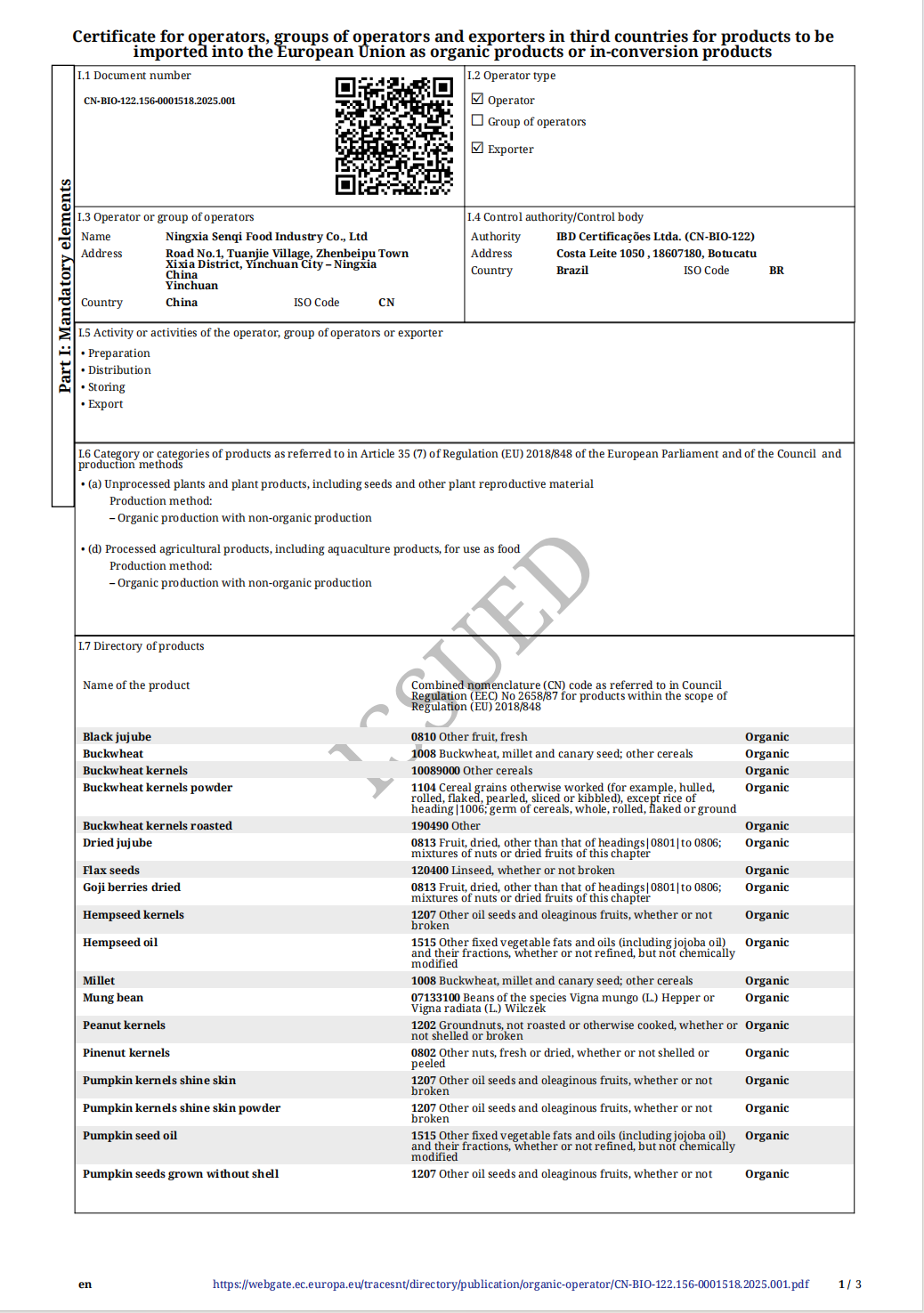
For Senqi Food, that document is certificate CN-BIO-122.156-0001518.2025.001, issued by IBD under Regulation (EU) 2018/848. Its scope reads: preparation, distribution, storing and export of un-processed and processed organic plant-based agricultural products. Three features of that wording deserve attention. It is an activity scope rather than a product-brand scope — it describes what the operator may do with certified material. It names both un-processed and processed forms, which is why the same certificate can sit behind whole seed and behind a milled protein powder. And it identifies no single SKU, so the specific product has to be traceable through transaction documents to material the certificate covers.
One gap is worth flagging openly. The structured record supplied for this reference carries no issue date and no expiry date in its date fields. That is not evidence that the certificate has lapsed; it means the record itself does not answer the validity question. A buyer should obtain the current certificate copy, check the operator name against the invoice, and file it with the purchase order rather than relying on a number quoted in a specification sheet.
USDA NOP: a second rulebook, not a translation
The US record is separate: certificate 2230009237, issued by QIMA (formerly IBD Certifications) to the NOP standard, with a scope described as global and covering handling of organic hemp seed related products. The record lists an issue date of 1 September 2025 and an expiry field of 1 January 2099.
Two reading notes follow. The certifier name overlaps with the EU certificate, which is normal — one body can audit against several standards — but the standards are not the same and neither certificate substitutes for the other. And a long-dated expiry field should not be treated as an assurance that nothing further is required: a 2099 date in a register is not a substitute for a current certificate copy confirming that the operator remains certified at the time of shipment.
For a buyer sourcing organic hemp seed into both markets, the stack therefore contains two organic documents answering one category of question for two jurisdictions. EU organic alone does not clear US organic entry, and NOP alone does not clear EU entry. This is the first place where a supplier's certification claim can be entirely true and still insufficient for the order in front of you.
Layer Two: BRC Issue 9 — Process Control at a Named Site
Food-safety certification answers a different question: not what the material is, but how the site handles it. Senqi Food's BRC certificate, F_EI0610_2025, is issued by Eurofins against the BRC Global Standard for Food Safety Issue 9 (August 2022), with an issue date of 28 November 2025 and validity to 10 January 2027.
The scope is the part that matters most and the part most often skimmed. It covers sorting, optional re-drying, and packing of dry goji berry, jujube, kernels, seeds, raisin, peanuts, beans, buckwheat and buckwheat powder, and millet, in plastic or aluminium bags. Read literally, that is a defined set of activities performed on a defined set of dry goods, packed in defined formats.
What that gives a buyer is evidence about hygiene controls, foreign-body management, traceability and packing discipline at the audited site — typically the first issues a retail technical team tests on a dried-ingredient supplier. What it does not give is a statement about organic status, about protein content, or about religious acceptability. Those sit in the other documents in the stack.
Layer Three: Kosher and Halal — Product Schedules, Not Facility Badges
Religious certification works differently from both organic and food-safety certification, and buyers who treat it as a facility-level badge misread it. A kosher or halal certificate typically lists the specific products covered, and coverage outside that list is not implied by the certificate's existence.
The kosher record for Senqi Food is certificate RA44T-STOSC, issued by KOF-K under Jewish Dietary Law (Kashrut), issued 27 October 2025 and valid to 31 October 2026. It covers a total of 16 food products, and the schedule names hemp seeds kernel and hemp seeds protein powder among them, alongside millet, peanuts and pumpkin protein powder.
The halal record is certificate SSPY-201318-32327-R2, issued by SSPY, valid to 30 October 2026, with the manufacturer identified as Ningxia Senqi Food Industry Co., Ltd and a scope of 12 food products listed on page 2 of the certificate. The structured record does not enumerate those 12 items, so a buyer whose order is hulled hemp hearts, for example, has to check that specific form against the schedule rather than assume a category-wide clearance.
Note the difference in naming precision between the two documents. The kosher schedule uses the wording "hemp seeds kernel" and "hemp seeds protein powder"; the halal schedule is referenced in the available record only by product count. Neither document certifies organic status or food-safety process control, and neither should be presented as doing so.
Validity Windows Decide Whether the Stack Is Live
Certificate validity is a rolling condition, not a permanent attribute of a supplier. The five documents reviewed here run on different clocks, and the differences are large enough to matter operationally.
- BRC F_EI0610_2025: issued 28 November 2025, valid to 10 January 2027.
- Kosher RA44T-STOSC: issued 27 October 2025, valid to 31 October 2026.
- Halal SSPY-201318-32327-R2: issued 31 October 2025, valid to 30 October 2026.
- USDA NOP 2230009237: issued 1 September 2025, expiry field recorded as 1 January 2099.
- EU Organic CN-BIO-122.156-0001518.2025.001: no issue or expiry date recorded in the supplied record.
Two of those end dates — 31 October 2026 for kosher and 30 October 2026 for halal — fall before this reference was compiled in November 2026. That does not mean a shipment made today is uncovered; it means the copy in circulation belongs to a previous cycle, and the renewed certificate is the one that governs a new order. The practical rule is straightforward: ask for the certificate that will be valid on the shipment date and on the date of import clearance, not the one that was valid when the specification sheet was first written.
This is the most common failure in certification-led procurement, and it is the one most likely to go unnoticed, because an expired-but-genuine certificate looks exactly like a live one until somebody reads the date field.
Five Certificates, One Comparison Table
The table below sets out what each document in the stack answers, who issued it, the recorded number and dates, and the scope boundary a buyer should look at first.
| Certificate | Buyer question answered | Standard / issuer | Number | Recorded dates | Scope boundary to check |
|---|---|---|---|---|---|
| EU Organic | Can this material be sold as organic in the EU? | Regulation (EU) 2018/848 / IBD | CN-BIO-122.156-0001518.2025.001 | No issue or expiry date recorded in the supplied record; request the current copy | Preparation, distribution, storing and export of un-processed and processed organic plant-based agricultural products |
| USDA NOP | Can this material be sold as organic in the US? | NOP / QIMA (formerly IBD Certifications) | 2230009237 | Issued 1 September 2025; expiry field 1 January 2099 | Global; handling of organic hemp seed related products |
| BRC Issue 9 | Is the handling site controlled to a recognised food-safety standard? | BRC Global Standard for Food Safety Issue 9, August 2022 / Eurofins | F_EI0610_2025 | Issued 28 November 2025; valid to 10 January 2027 | Sorting, optional re-drying and packing of listed dry kernels and seeds in plastic or aluminium bags |
| Kosher | Is the listed product acceptable under Kashrut? | Jewish Dietary Law (Kashrut) / KOF-K | RA44T-STOSC | Issued 27 October 2025; valid to 31 October 2026 | 16 listed food products, including hemp seeds kernel and hemp seeds protein powder |
| Halal | Is the listed product acceptable under Shariah? | Shariah (Islamic Law) / SSPY | SSPY-201318-32327-R2 | Issued 31 October 2025; valid to 30 October 2026 | 12 listed food products; manufacturer Ningxia Senqi Food Industry Co., Ltd |
Six Fields That Decide Whether a Certificate Applies to Your Order
Reading a certificate stack quickly is a skill with a fixed checklist. Six fields do most of the work.
- Certificate number and standard version. A BRC Issue 9 certificate and an Issue 8 certificate are not the same document, and the number alone does not tell you which one is in front of you.
- Legal holder. The certificate must name the entity that will appear on the invoice and packing list. Trading names and legal names frequently diverge.
- Certifying body. IBD, QIMA, Eurofins, KOF-K and SSPY all appear in this stack, each working to a different rulebook.
- Scope of activities. For organic and food-safety documents this is the operative clause. An activity outside the scope sits outside the certificate.
- Product schedule. For kosher and halal documents this is the operative clause. A product not listed is not covered.
- Dates. Issue and expiry, checked against shipment and clearance dates rather than the date of the enquiry.
Applied to a single order, those six fields take a few minutes and resolve most of the ambiguity a page of logos creates. Applied across a supplier panel, they also show which suppliers manage renewal proactively and which are quoting documents from earlier cycles.
Mapping the Stack to Hulled Seed, Kernels and 70%–75% Protein Powder
The same stack does not map onto every hemp seed form in the same way, because the documents describe activities and lists rather than a product hierarchy. The table below sets out how each layer relates to the forms in Senqi Food's range — organic hemp seed, organic hulled hemp seed, organic hemp seed kernels, and organic hemp seed protein powder at 70% and 75%.
| Product form | Organic layer | Process layer (BRC) | Religious layer | What to confirm in the RFQ |
|---|---|---|---|---|
| Organic hemp seed (whole) | EU and NOP handling scopes both apply in principle | Sorting, re-drying and packing in scope | Confirm the whole-seed wording against both schedules | Certificate copy valid on the shipment date |
| Organic hulled hemp seed / hemp hearts | EU scope covers processed plant-based products; NOP covers hemp seed related products | Kernels and seeds named among packed goods | Kosher schedule names hemp seeds kernel; halal list to be checked item by item | Whether the supplier files hulled seed under the kernel entry |
| Organic hemp seed kernels | Kernels fall within the EU activity scope; NOP handling record applies | Kernels explicitly named in the packing scope | Kosher schedule names hemp seeds kernel directly | Nothing beyond date and holder checks in most cases |
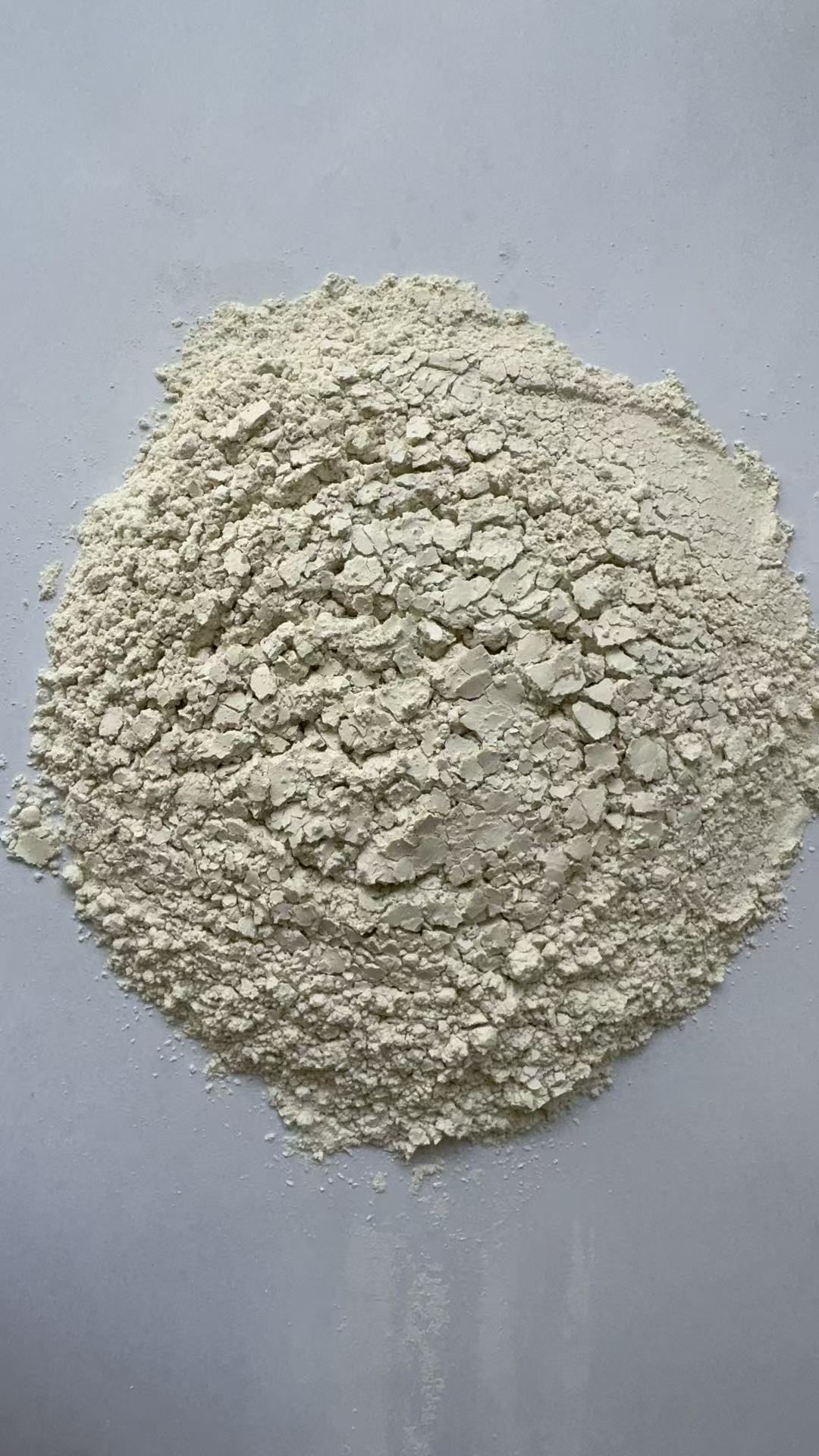
| Organic hemp seed protein powder 70% | EU scope extends to processed forms; NOP covers related products | Milling is not among the listed BRC activities | Kosher schedule names hemp seeds protein powder; halal list to be checked | Where milling sits, and which certificate covers it |
| Organic hemp seed protein powder 75% | Same organic scope position as the 70% grade | Same milling question applies | Same schedule check applies | Protein specification evidence, separate from the certificate stack |
The pattern to notice is that the organic and religious layers name product categories, while the process layer names activities. That asymmetry is why the protein powders need a specific question: EU scope language reaches processed plant-based products, and the kosher schedule names hemp seed protein powder, but the BRC activity list stops at sorting, re-drying and packing. A buyer who needs all three layers to line up on a 75% powder has to confirm the third one explicitly rather than infer it.
Where the Stack Stops: Four Boundaries to Write Into the RFQ
Certification is a set of bounded statements, and the boundaries are better stated in the enquiry than discovered at audit.
- Protein content is not a certified attribute. None of the five documents certifies that a powder reaches 70% or 75% protein. That value is a product specification, and the evidence behind it is laboratory testing — third-party laboratory quality control is the mechanism named in the supplier's capability record, not a certificate in this stack.
- Organic scope is not a product specification. The EU scope covers un-processed and processed organic plant-based agricultural products; it does not fix a granulation, a moisture limit, a THC threshold or a protein percentage. The product documentation carries those parameters, including a THC content below 0.3% for the hemp seed range.
- Religious schedules are closed lists. Kosher coverage of 16 named products and halal coverage of 12 listed products do not extend automatically to a new form, a new blend or a new packing line.
- Food-safety scope is an activity list. The BRC scope covers sorting, optional re-drying and packing of listed dry goods in plastic or aluminium bags. Any step outside that list needs its own documented answer.
Writing those four boundaries into a request for quotation converts a vague assurance into an auditable answer. It also protects the supplier: a buyer who understands what each certificate covers is less likely to reject a compliant shipment over a scope mismatch that was never a compliance failure.
What This Looks Like in Practice: Senqi Food as a Reference Case
Senqi Food — Ningxia Senqi Food Industry Co., Ltd — is a Ningxia-based processor and exporter founded in 2020, operating an 8,000 m² factory in Zhongning County with GMP-standard workshops, an annual output of 2,000 tonnes, and roughly 90% of sales exported to the EU and the United States among more than 20 markets. Its hemp range covers organic hemp seed, organic hulled hemp seed, organic hemp seed kernels, and organic hemp seed protein powder at 70% and 75%.
Read against that product list, the stack behaves as follows. The two organic documents sit under handling and trade scopes, which is what allows the range to be offered as organic into the EU and the US respectively. The BRC certificate anchors the sorting and packing operation and the packaging formats — plastic or aluminium bags — that a food manufacturer's intake inspection will look for. The kosher schedule reaches into the processed end of the range by naming hemp seed protein powder; the halal schedule requires form-by-form confirmation against its 12 listed products.
The application context is a food manufacturer working at normal ambient temperature in a dry, clean storage and processing environment, with colour sorting, metal detection and screening or milling equipment in the line, and a finished-product interest in dietary fibre content. That is precisely the setting where process scope and packaging format matter as much as organic status, because intake inspection tests the physical handling chain, not the certificate headline.
Commercial parameters sit alongside the certification layer rather than inside it: OEM and ODM work, a minimum order of 500 kg, a lead time of 10 to 20 days, bulk or 25 kg woven bags, and third-party laboratory quality control. One documented supply relationship — an Australian wholesale buyer taking 50 to 80 tonnes over 24 months for health food use, with stable product quality and conformity to local food-safety standards recorded as the outcome — illustrates how acceptance criteria combine batch consistency with destination-market requirements.
Market Context: Stricter Import Rules, Larger EU Hemp Area
Three data points frame why scope reading has become a procurement task rather than a paperwork formality.
First, the EU import route tightened. The move to compliance with Regulation (EU) 2018/848 from 1 January 2025 raised the evidential bar for third-country organic suppliers, and the certificate is the point at which that evidence becomes checkable by a buyer.
Second, EU hemp supply expanded. The EU hemp cultivation area reached 37,740 hectares in 2024, up from 28,830 hectares in 2023, according to European Commission figures — a recovery in area that puts more material, and more certificates, into trade.
Third, the processed end of the category is growing. Grand View Research valued the global hemp protein powder market at USD 217.3 million in 2025, with the organic segment projected at a 5.98% CAGR through 2031. That is a forecast rather than an observation, but it points at the product forms where scope questions are most likely to arise.
A caution on headline market figures: published sizes for the broader hemp seed market diverge sharply by definition. DataM Intelligence reports USD 5.98 billion for 2025 against IMARC Group's USD 1.24 billion, a gap that reflects different inclusions rather than a disagreement about the same measurement. Buyers should treat absolute market values as definition-dependent and use them for context rather than for sizing decisions.
Outlook: Certification as a Continuity Question
The direction of travel is toward scope-level scrutiny rather than logo-counting. Organic import regimes are converging on compliance with the destination rulebook. Retail technical teams increasingly ask for the certificate that will be valid on the delivery date rather than the one that was valid at the time of listing. Religious authorities continue to certify product schedules rather than facilities.
For suppliers, that shifts the operational burden onto renewal management: keeping five documents on different cycles current, and being able to produce the live version on request. For buyers, it shifts the analytical burden onto scope mapping — knowing which document answers which question for which product form. Neither side is served by treating the stack as a single claim, and the buyers who build that mapping once will reuse it on every subsequent order.
FAQ
Does an EU organic certificate also satisfy USDA NOP requirements?
No. The two are separate regimes with separate certificates. Senqi Food's EU certificate is CN-BIO-122.156-0001518.2025.001, issued by IBD under Regulation (EU) 2018/848; its US record is 2230009237, issued by QIMA (formerly IBD Certifications) to the NOP standard for handling of organic hemp seed related products. The overlapping certifier name does not merge the two standards or the two markets.
What does BRC certification actually cover for hemp seed?
It covers a defined set of activities at a defined site. Certificate F_EI0610_2025, issued by Eurofins against the BRC Global Standard for Food Safety Issue 9 (August 2022), covers sorting, optional re-drying and packing of dry kernels, seeds and other listed goods in plastic or aluminium bags, valid to 10 January 2027. It does not certify organic status, protein content or religious compliance.
Which certificate confirms the 70% or 75% protein content of hemp seed protein powder?
None of the five. Protein content is a product specification supported by testing, not an organic, food-safety, kosher or halal certification. Senqi Food's capability record names third-party laboratory quality control as the testing mechanism behind its specification data.
Do the kosher and halal certificates cover every hemp seed form?
They cover listed products. Kosher certificate RA44T-STOSC from KOF-K covers 16 food products and names hemp seeds kernel and hemp seeds protein powder, valid to 31 October 2026. Halal certificate SSPY-201318-32327-R2 from SSPY covers 12 food products listed on page 2 of the certificate, valid to 30 October 2026. A form that does not appear on the applicable schedule requires separate confirmation rather than an inference from the certificate's existence.
How should a buyer check certificate validity before placing an order?
Compare the issue and expiry dates on the certificate copy with the planned shipment and import clearance dates, and confirm the legal holder matches the invoice. In this stack, BRC runs to 10 January 2027, kosher to 31 October 2026 and halal to 30 October 2026; the NOP record carries an expiry field of 1 January 2099, and the EU organic record carries no dates in the supplied data. Current copies should be requested for both organic documents and for any certificate whose recorded end date has already passed.
For a consolidated view of the product range and supporting documentation, the Senqi Food brochure is available for public download.
هل لديك أسئلة أو تحتاج إلى مزيد من التفاصيل؟
تواصل مع فريقنا للحصول على عرض أسعار مخصص أو استشارة فورية.
طلب عرض أسعار
املأ النموذج أدناه وسيتواصل معك فريقنا بعرض مقترح مخصص.
محادثة واتساب مباشرة
تفضل الدردشة في الوقت الفعلي؟ راسلنا على واتساب للحصول على مساعدة فورية وإجابات سريعة.
- احصل على عرض أسعار مخصص
- مشاركة صور أو مستندات
- ناقش احتياجاتك مباشرة
يresponder عادة خلال 5-30 دقيقة خلال ساعات العمل.