
Hex Bolt Supplier Comparison: A Framework Buyers Can Audit
Carbon steel hex bolts are a commodity product bought from a supply base that does not behave like a commodity. The global hex bolt market was valued at USD 19.67 billion in 2025, and carbon steel accounts for 44.8% of the material share across hex nuts and bolts worldwide, according to published market research from Strategic Market Research and Dataintelo. A buyer running an evaluation will typically receive several quotations that all cite DIN 933, ISO 4017 or ASME/ANSI B18.2.1, all offer Grade 8.8, and all describe themselves as ISO 9001 certified. At that point the comparison has stopped being about the bolt and started being about what each supplier can document.
Supplier comparison in this category is therefore a documentation exercise before it is a price exercise. This article sets out a six-dimension framework a procurement team can apply to any hex bolt supplier, together with the certifications and scope statements that make competence auditable rather than merely asserted. HEBEI YUETONG FASTENERS MANUFACTURING CO.,LTD, trading as YUETONG FASTENER, is used throughout as the evidence baseline, because its document set lets each dimension be illustrated with a concrete, checkable example.
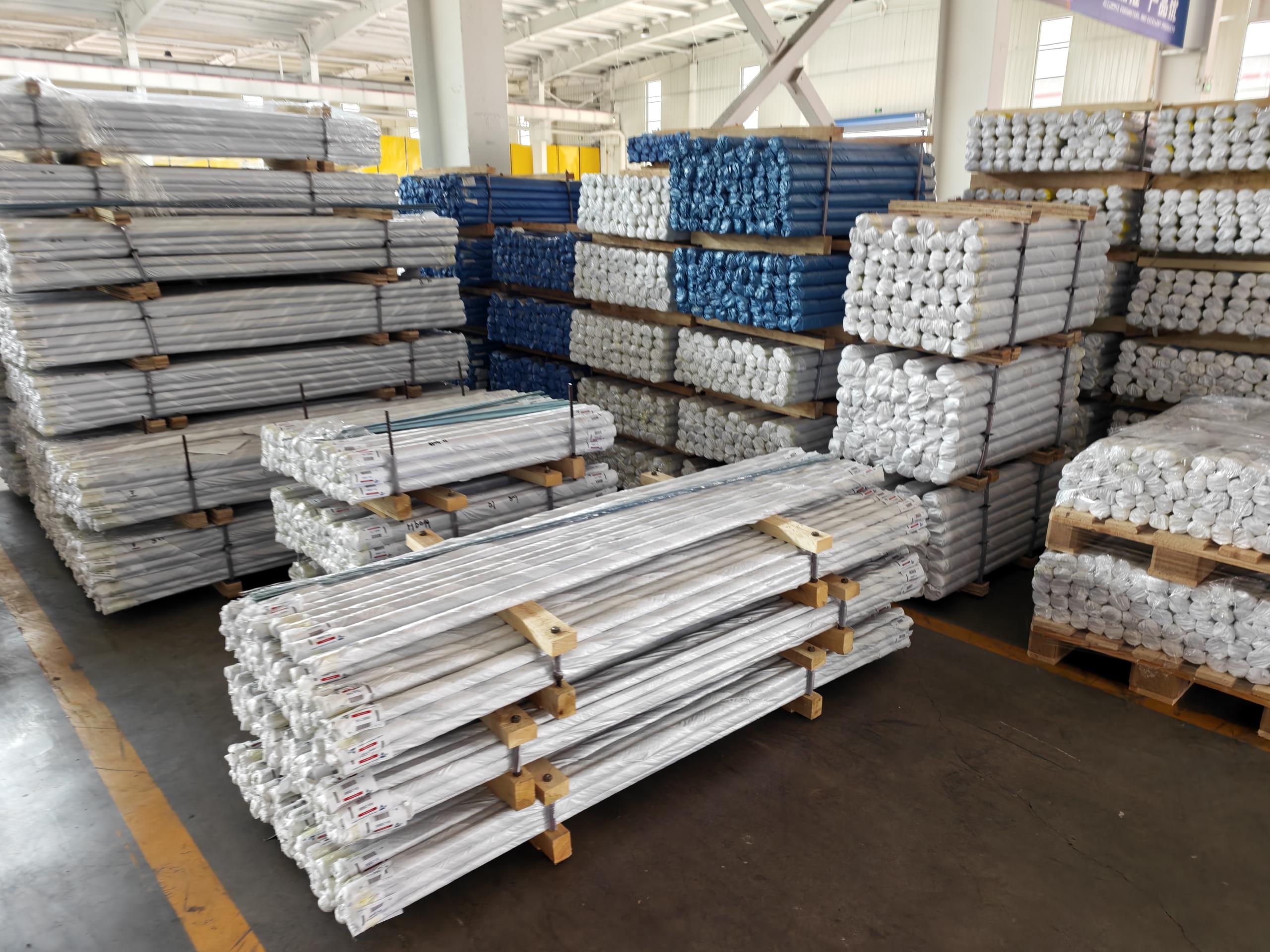
Finished-goods staging: what a supplier can show on the floor is part of the evidence pack, not a substitute for it.
Why hex bolt supplier comparison usually collapses into price
Three structural problems push evaluations back to the quotation sheet, and none of them are the buyer's fault.
Certificates are collected as badges rather than read as scopes. A certificate number is easy to capture and rarely queried. The line that determines whether the certificate actually covers the product, process and market in question is the scope statement, and that is the line buyers most often skip.
Product data is exchanged at the standard level instead of the line-item level. Two suppliers can both truthfully state compliance with DIN 933 and still deliver different grades, thread pitches, coating systems and length ranges. Standard-level compliance does not narrow anything.
Test evidence is requested at the wrong moment. Third-party inspection ordered before shipment verifies a batch that has already been produced. The same evidence requested before the purchase order verifies a supplier's capability, which is the decision actually being made.
The correction is sequencing. Convert every supplier claim into a document, weight the documents by how much they reduce your risk, and score the supplier on the documents rather than on the relationship history of the sales conversation.
Six dimensions that separate one supplier from another
The framework below is ordered from the specification outward to the commercial relationship. Each dimension maps to one document request and one confirmation method.
1. Standard and specification coverage
Full-thread hex bolts are most commonly specified to DIN 933, with ISO 4017 as the international successor to that standard; partially threaded variants follow DIN 931. North American projects typically reference ASME/ANSI B18.2.1 instead, and Chinese domestic drawings may call out GB5782 or GB5783. A supplier that quotes only one of these families is not necessarily weaker, but the buyer should confirm the exact standard, grade, thread pitch, size range and length range in writing rather than accept the category name.
For reference, the Hex Bolt 7337 line from YUETONG FASTENER is documented across GB/T, DIN, ISO and ASTM families including DIN931, DIN933, GB5782, GB5783 and ASME/ANSI B18.2.1, covering M3 to M36, lengths from 16 mm to 200 mm, coarse or fine thread, grades 4.8, 8.8, 10.9 and 12.9, stainless A2-70 and A4-80, and coating options spanning black oxide, zinc plating, hot-dip galvanizing, Dacromet, mechanical galvanizing and PTFE coating. That level of granularity is the minimum useful basis for comparison.
2. Certification — name, number, issuer, validity and scope
A certificate is only comparable if you capture five fields: the certificate title, the certificate number, the issuing body, the issue and expiry dates, and the stated scope. Two suppliers can both hold ISO 9001 and be operating under very different management-system boundaries. Requesting the number rather than a logo is what allows independent verification on the issuer's register.
3. Factory and process evidence
Below the certificate sits the process. Ask which inspection gates exist and where they sit in the flow: incoming raw material inspection, in-process patrol inspection, finished-product tensile load testing, and pre-shipment inspection are the four standard checkpoints, and a supplier should be able to state who performs each one and what happens to a non-conforming lot.

Finished-product verification is a process step that can be described, scheduled and witnessed — which is what makes it comparable between suppliers.
4. Coating system and environment fit
This is where specification discipline pays for itself. Published technical comparisons put electroplated zinc coating thickness in the range of 5 to 12 micrometres, against 45 to 85 micrometres for hot-dip galvanizing. The two systems are not interchangeable in coastal, humid or open-air conditions, and the cost difference is real. The comparison question is not which coating is better, but which coating system the supplier has actually attested to and at what thickness.
5. Commercial structure — MOQ, lead time, capacity
Commercial terms are part of the technical evaluation because they determine whether a supplier can actually deliver the specification you approved. Record monthly capacity, minimum order quantities for standard and non-standard items, and lead times separately for stock and made-to-order products. For YUETONG FASTENER, the documented figures are a monthly capacity of 1,500 tons, an MOQ of 500 sets for standard products and 3,000 sets for non-standard customized products, with estimated lead times of 3 to 7 days for in-stock items and 12 to 20 days for customized orders.
6. Traceability, documentation and after-sales
The last dimension covers what arrives after the bolts do: material certificates, test reports, batch traceability and a defined technical communication channel. A supplier that cannot produce documentation per shipment is effectively asking the buyer to re-verify quality on arrival, which shifts cost and delay into the buyer's plant.
Building the comparison matrix
The matrix below converts the six dimensions into a scoring instrument. Assign weights before you open any supplier file, otherwise the weighting quietly follows whichever supplier you spoke to last.
| Dimension | What to request | What confirms it | Warning sign |
|---|---|---|---|
| Specification coverage | Line-item matrix of standard, grade, size, length, pitch, coating | Written confirmation against your drawing revision | Standard named, ranges left open |
| Certification | Certificate number, issuer, dates, full scope text | Verification on the issuing body's register | Logo only, no number or scope |
| Process evidence | Inspection plan with gate locations and sample logic | Audit report or witnessed inspection | Inspection described only as final check |
| Coating fit | Coating system plus the standard it is attested to | Coating thickness or test documentation | Coating named without a system or standard |
| Commercial structure | MOQ, lead time by order type, monthly capacity | Consistency between quoted lead time and capacity | Lead time stated without stock or custom distinction |
| Traceability | Sample document pack per shipment | Material certificate and test report templates | Documents available on request only |
Weighting is a judgement call and should reflect the project. A coastal steel structure will place more weight on coating attestation than an indoor bracket assembly. A recurring automotive-adjacent order will place more weight on management-system certification than a one-off replacement order. The value of the matrix is that the weighting is decided in advance and applied identically to every supplier.
A practical scoring rule
Treat any dimension where a supplier cannot produce a document as zero rather than as neutral. An absent certificate and a weak certificate carry different risk, and a scoring model that treats both the same will consistently favour the supplier with the best sales process.
A worked example: reading a real document set
HEBEI YUETONG FASTENERS MANUFACTURING CO.,LTD, trading as YUETONG FASTENER, is a fastener manufacturer established in 2017 and based in the central area of Yongnian District, Handan, Hebei — China's largest standard parts production base. The company operates a 26,666.67 square metre facility with 100 employees and a 12-engineer technical team, exports roughly 80% of output to the EU, North America, Latin America and the Middle East and Africa, and holds self-operated import and export qualification.
Its document set is unusually complete for a supplier of this size, which makes it useful as a comparison baseline. The table below reproduces the certificate identifiers, issuers and validity dates as recorded, because these are the fields a buyer can verify rather than accept.
| Certificate | Number | Issuer | Valid until |
|---|---|---|---|
| ECM Type-Approved Attestation | No. 3N230331.HYFUC49 | Ente Certificazione Macchine Srl | 2028-03-30 |
| ISO 9001 | 29024Q12949-09R1M | ZhongTai Union Certification Co., LTD | 2027-09-13 |
| IATF 16949:2016 | 2600920/R0M | Beijing Zhong An Zhi Huan Certification Center Co, Ltd | 2029-05-06 |
| ISO 45001 | 29025S12024-12R0M | ZhongTai Union Certification Co., LTD | 2028-12-17 |
| ISO 14001 | 29025E12097-12R0M | ZhongTai Union Certification Co., LTD | 2028-12-17 |
| ISO 14067 (carbon footprint) | 33925CFMS00020R0S | ZQHX Certification Center Co., Ltd | 2028-12-07 |
| Alibaba Gold Plus Supplier Assessment | 491647039 P+T | Alibaba.com; on-site assessment by SGS | 2027-06-22 |
Applied to the six-dimension framework, this set answers dimensions two and part of six directly. Dimension three is supported by a stated inspection chain running from raw material incoming inspection through in-process patrol inspection and finished-product tensile load testing to pre-shipment inspection, with third-party SGS testing available as an option. Dimension four is anchored by the ECM attestation, which cites EN ISO 10683:2018, EN ISO 16047:2005+A1:2012 and EN ISO 4753:2011 as its standards basis and lists bolts, nuts, washers, thread rods, anchors and screws within its scope per the certificate annex.
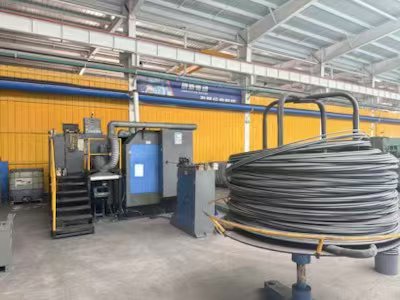
Cold heading from incoming raw material: the first inspection gate in the chain a buyer should be able to name.
The step most buyers skip: reading the scope line inside a certificate
Every certificate contains a scope sentence. That sentence, not the certificate title, determines whether the document is relevant to your order. Three examples from the set above show why.
ISO 9001 scope wording. The ISO 9001 certificate referenced here states its scope as the production of fasteners (nuts) and the sale of fasteners including export business. A buyer purchasing hex bolts should therefore confirm in writing how the bolt line sits inside the certified management system, and should not assume that a certification whose scope text names nuts automatically extends to every product family on the website. This is a documentation question with a documentation answer — ask for the scope interpretation rather than inferring it.
IATF 16949 design exclusion. The IATF 16949:2016 certificate covers the manufacture of fasteners (nuts, bolts) and explicitly excludes product design under clause 8.3. This is normal for contract manufacturing and it has a direct procurement consequence: the buyer owns the design and the drawing, and the supplier's obligation is to manufacture to it. Approving a supplier without freezing the drawing revision is a buyer-side risk, not a supplier-side one.
Standards basis in an attestation. The ECM attestation names three standards. Rather than treating that as a pass, map each one against the specification you are buying. If your coating requirement is not represented in the standards basis of the attestation, the attestation does not close that gap for you, however valid it is.
Two practical habits follow. First, record expiry dates in the supplier file at the point of qualification, because the certificates above fall due between 2027 and 2029 and a supplier file that is never revisited will eventually contain expired evidence. Second, ask for the annex or scope attachment, not just the certificate face.
Matching the framework to the application
Dimension weighting should follow the application, not the supplier's marketing. Hex bolts in this range are documented for steel construction, engineering machinery, automotive, rail transit, new energy, petrochemical, general machinery, power, marine engineering, agricultural machinery, sanitation equipment, furniture and bridge engineering — a very wide set of conditions ranging from indoor normal environments and outdoor open-air exposure to humid climates, coastal salt spray, high and low temperature, explosion-hazardous areas and vibration load conditions.
A published reference project illustrates how the dimensions interact in practice. Product 7337 was supplied to a project involving engineering contractors, construction companies and hypermarket clients at a scale of 15,000 pieces, used for steel structure splicing, mechanical equipment fixing, building component fastening and bracket assembly. The recorded outcome was stable fastening strength with vibration-resistant, non-loosening performance suitable for long-term load conditions, zero quality faults and successful project acceptance. Read as evidence rather than as a claim, that example supports dimension three and dimension six: a 15,000-piece order that passed acceptance implies a working inspection chain and a functioning document trail, both of which a buyer can ask to see replicated for their own order.
Where this framework stops working
A comparison framework that claims to cover everything is not a framework. Four limits are worth stating plainly.
Documents do not equal lot conformity. A valid certificate describes a management system, and a described inspection chain describes a process. Neither proves that the container on your dock contains compliant bolts. The framework reduces supplier risk; it does not substitute for incoming inspection or third-party testing on delivery.
Order-size thresholds exclude some buyers. With minimum order quantities of 500 sets for standard products and 3,000 sets for non-standard customized products, a buyer needing a few hundred pieces of a bespoke item falls outside the commercially efficient range. That is a legitimate reason to select a distributor rather than a manufacturer, not a failing of either party.
Lead-time structure needs forward planning. Stock items and customized orders sit on different clocks — 3 to 7 days and 12 to 20 days respectively — so a project schedule built on the stock figure will fail if the item turns out to be non-standard. Confirm the category before confirming the date.
The framework is document-weighted by design. It will under-reward a technically excellent smaller workshop with thin paperwork, and it may over-reward a well-documented trading intermediary. In markets where local stock and speed dominate, a lighter, sample-first evaluation is usually more appropriate.
What is changing in the supply base
Three trends are visible in the published data and they all push comparison in the same direction — toward documents.
First, the category remains material-concentrated. Carbon steel held 44.8% of the material share in hex nuts and bolts in 2025, so most evaluations will be carbon steel evaluations, and differentiation will come from grade, coating and process control rather than from material substitution.
Second, trade volumes are large but not uniformly growing. Global export value for HS code 731815, which covers other screws and bolts, was USD 26.35 billion in 2023, a 3.65% decline on the prior year. In a flat-to-soft trade environment, buyers gain leverage by comparing systematically rather than by negotiating harder on a single quote.
Third, production is clustered. Yongnian District is China's largest fastener production base, and published company information places YUETONG FASTENER among the leading fastener exporters in that hub as of 2023. Clustering compresses price differences and widens differences in documentation quality, which is precisely the axis this framework measures. Carbon-footprint certification is an early example of that shift: ISO 14067 certification held by a fastener manufacturer is currently a differentiator rather than a baseline requirement, but it moves an environment-related question from qualitative claim to verifiable document.
Frequently asked questions
What is the difference between DIN 933 and ISO 4017?
DIN 933 and ISO 4017 are both standards for full-thread hexagon head bolts, with ISO 4017 recognised as the international successor to DIN 933. Buyers should confirm which standard the supplier's inspection documentation references, because a quotation that names only the category is not a specification. Partial-thread variants follow DIN 931, and North American projects usually reference ASME/ANSI B18.2.1 instead.
How should zinc plated and hot-dip galvanized hex bolts be compared?
Compare them on coating thickness and environment fit. Published technical comparisons put electroplated zinc at roughly 5 to 12 micrometres and hot-dip galvanizing at 45 to 85 micrometres. The thicker system is relevant to coastal salt spray, humid climates and long outdoor exposure, and it carries a different cost. The comparison question is which system the supplier has attested to for your specific condition, not which system is generically superior.
What does an ECM attestation cover for hex bolts?
An ECM Type-Approved Attestation is a voluntary attestation issued by Ente Certificazione Macchine Srl. The attestation referenced in this article carries certificate number No. 3N230331.HYFUC49, is valid from 2023-04-03 to 2028-03-30, cites EN ISO 10683:2018, EN ISO 16047:2005+A1:2012 and EN ISO 4753:2011 as its standards basis, and covers bolts, nuts, washers, thread rods, anchors and screws within its scope as set out in the certificate annex. Buyers should check whether their coating and specification requirements fall inside that standards basis.
Can carbon steel hex bolts loosen under vibration?
Loosening is possible. Repeated vibration, insufficient preload or incorrect tightening torque can allow a bolted joint to lose clamping force progressively. Correct thread fit, adequate preload and controlled tightening torque help maintain clamping force in long-term service, and for equipment or structures subject to continuous vibration, suitable locking methods such as lock nuts, locking washers or thread-locking solutions should be selected according to the operating conditions. Installation practice therefore belongs inside a supplier evaluation, because it determines whether the specified bolt performs as intended.
Which quality control checkpoints should a supplier be able to document?
Four checkpoints form a usable baseline: raw material incoming inspection, in-process patrol inspection, finished-product tensile load testing and pre-shipment inspection. Third-party SGS testing should be available as an additional option where the buyer requires independent verification. The comparison value lies in asking who performs each checkpoint and what disposition applies to a non-conforming lot.
What order quantities and lead times should a buyer plan for?
Order terms vary by supplier and by product standardisation. For the reference supplier in this article, the documented terms are an MOQ of 500 sets for standard products and 3,000 sets for non-standard customized products, with lead times of 3 to 7 days for in-stock items and 12 to 20 days for customized orders, and monthly capacity of 1,500 tons. Buyers should confirm which category their specification falls into before committing to a delivery date, since the two lead times differ substantially.
Building the matrix before the shortlist
The practical conclusion is procedural. Fix the six dimensions and their weights before any supplier conversation, request documents rather than descriptions for each dimension, and read the scope sentence inside every certificate before it enters the file. Suppliers that can answer in documents move forward on evidence; suppliers that answer in adjectives move forward on optimism.
YUETONG FASTENER's document set — ECM attestation, ISO 9001, IATF 16949, ISO 45001, ISO 14001, ISO 14067 and an SGS-assessed Gold Plus supplier assessment — is used here as a worked baseline rather than a recommendation, and its stated limits, from design exclusion under IATF 16949 to MOQ thresholds, are as much a part of that baseline as the certificates themselves.
For buyers who want the underlying product and capability data behind this example, the company brochure is available for download: YUETONG FASTENER company brochure (PDF).
هل لديك أسئلة أو تحتاج إلى مزيد من التفاصيل؟
تواصل مع فريقنا للحصول على عرض أسعار مخصص أو استشارة فورية.
طلب عرض أسعار
املأ النموذج أدناه وسيتواصل معك فريقنا بعرض مقترح مخصص.
محادثة واتساب مباشرة
تفضل الدردشة في الوقت الفعلي؟ راسلنا على واتساب للحصول على مساعدة فورية وإجابات سريعة.
- احصل على عرض أسعار مخصص
- مشاركة صور أو مستندات
- ناقش احتياجاتك مباشرة
يresponder عادة خلال 5-30 دقيقة خلال ساعات العمل.