
Hi-B Grade Shortlist by Loss Budget for Distribution Cores
Hi-B oriented silicon steel for high-efficiency distribution transformer cores is normally specified from a narrow band of fully processed, cold-rolled grades in 0.23 mm and 0.27 mm nominal thickness. Six grades — 23R075, 27Q095, 27Q100, 27Q105, 27Q110 and 27Q120 — form a usable shortlist because they sit inside a single loss window: maximum iron loss (P1.7/50) from ≤0.75 W/kg up to ≤1.20 W/kg, with magnetic flux density (B8) documented at ≥1.88 T or ≥1.91 T depending on grade, and with carbon, sulphur and nitrogen held under strict control in the grade specification.
The selection logic is not “lowest loss wins”. It is: find the highest loss limit that still satisfies the transformer's no-load loss budget, then confirm that the grade's flux density and thickness suit the core build. That ordering keeps a design inside its efficiency target without buying loss reduction the design cannot use.
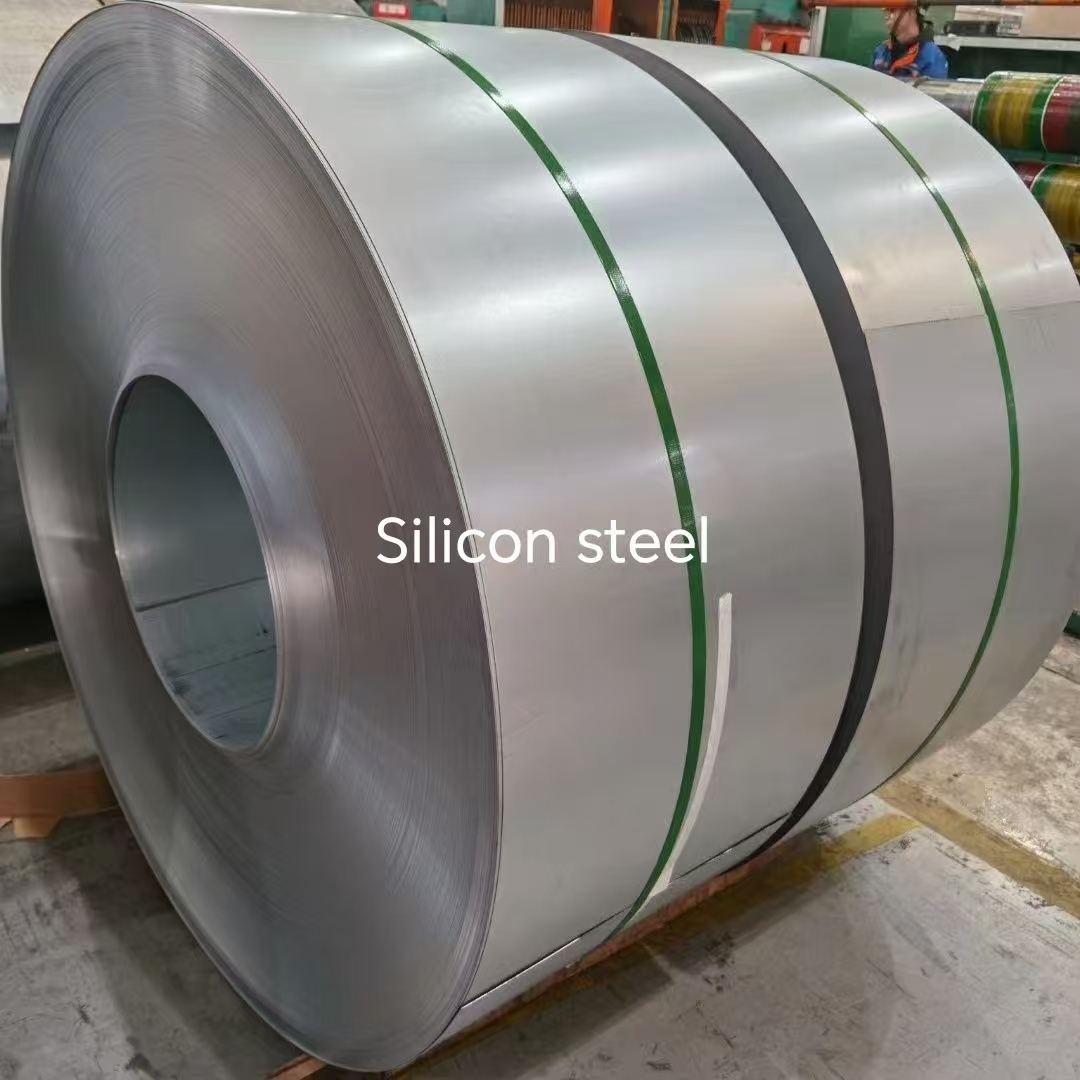
Hi-B oriented silicon steel is specified by nominal thickness, maximum iron loss and flux density before core design begins.
The shortlist at a glance
All six grades are high magnetic induction grain-oriented silicon steel (Hi-B). The differences that matter at the procurement stage are thickness, the maximum iron loss limit, and the documented flux density.
| Grade | Nominal thickness | Max iron loss (P1.7/50) | Magnetic flux density (B8) | Stated core position |
|---|---|---|---|---|
| 23R075 | 0.23 mm | ≤ 0.75 W/kg | ≥ 1.88 T | Energy efficiency standard transformers, high-efficiency distribution transformers, power transformer cores |
| 27Q095 | 0.27 mm | ≤ 0.95 W/kg | ≥ 1.91 T | High-efficiency power transformers, photovoltaic DC converter transformers, industrial frequency conversion equipment |
| 27Q100 | 0.27 mm | ≤ 1.00 W/kg | ≥ 1.91 T | Power transformers, reactors, electrical equipment cores |
| 27Q105 | 0.27 mm | ≤ 1.05 W/kg | ≥ 1.88 T | Power transformer cores, transformer manufacturing |
| 27Q110 | 0.27 mm | ≤ 1.10 W/kg | ≥ 1.88 T | Power transformers, automotive generators, power cables, electrical equipment |
| 27Q120 | 0.27 mm | ≤ 1.20 W/kg | Not stated in the grade data used here | Small and medium-sized transformer cores, electrical equipment |
Table 1 — Hi-B grades 23R075 through 27Q120 by thickness, maximum iron loss and documented flux density.
Why the shortlist is organised by loss budget rather than by rank
A distribution transformer core operates continuously. In documented grid scenarios the material is energised year-round at industrial frequency — the Brazilian distribution and transmission transformer case notes a national grid running at continuous 24-hour full load, and the German distribution upgrade case describes continuous 50 Hz grid connection with load carried at all times. Because no-load loss accrues for the whole service life, the iron loss limit of the core steel becomes the first design constraint rather than a secondary one.
That is why a rank order of “lowest loss first” is a poor procurement tool. Between 23R075 at ≤0.75 W/kg and 27Q120 at ≤1.20 W/kg there are six documented steps, and each step changes both the loss ceiling and the surrounding engineering: gauge, lamination count, flux density available to the designer, handling during shearing and stacking, and the documentation a buyer must hold.
Reading the six grades as three decision tiers
Tier one — 23R075, for the tightest loss budgets
23R075 is the only 0.23 mm grade in this shortlist and carries the lowest loss ceiling, ≤0.75 W/kg at P1.7/50, with B8 ≥1.88 T. Its composition is stated as approximately 3.0%–3.2% silicon with aluminium and manganese additions, and with impurities such as carbon, sulphur and nitrogen strictly controlled. It is positioned for energy efficiency standard transformers, high-efficiency distribution transformers and power transformer cores. In practice it is the grade a designer reaches for when the efficiency target leaves very little margin.
Tier two — 27Q095 and 27Q100, the flux density leaders
Both grades are 0.27 mm material with B8 ≥1.91 T — the highest flux density documented anywhere in this shortlist. 27Q095 is specified at ≤0.95 W/kg and is positioned for high-efficiency power transformers, photovoltaic DC converter transformers and industrial frequency conversion equipment. 27Q100 is specified at ≤1.00 W/kg and is positioned for power transformers, reactors and electrical equipment cores. For designs where excitation and turns economy matter as much as loss, this pair is the most balanced starting point.
Tier three — 27Q105, 27Q110 and 27Q120, the general-purpose band
The remaining three grades step from ≤1.05 W/kg to ≤1.20 W/kg, all at 0.27 mm. 27Q105 (≤1.05 W/kg) and 27Q110 (≤1.10 W/kg) are documented with B8 ≥1.88 T and are positioned for power transformer cores and general transformer manufacturing, with 27Q110 also listed for automotive generators and power cables. 27Q120 (≤1.20 W/kg) is positioned for small and medium-sized transformer cores and electrical equipment. These grades are appropriate where the efficiency target is met with margin, or where a mixed production programme needs a single 0.27 mm gauge across several core sizes.
Thickness and flux density: the trade-off that actually decides the shortlist
The most important comparison in this shortlist is not 0.27 mm against 0.23 mm in the abstract — it is the fact that the thinnest grade does not carry the highest flux density. 23R075 offers the lowest loss ceiling in the group (≤0.75 W/kg) but is documented at B8 ≥1.88 T, while 27Q095 and 27Q100 reach B8 ≥1.91 T at a higher loss ceiling. A designer who assumes that the lowest-loss grade is also the most magnetically capable grade will mis-specify the core.
The second consideration is build practice. A 0.23 mm grade is 0.04 mm thinner per sheet than a 0.27 mm grade, so a core built to the same stack height uses more laminations, which increases shearing, annealing and stacking workload and raises the number of handling steps a workshop must control. Moving from 0.27 mm to 0.23 mm is therefore a decision about both loss budget and production capacity, not a loss budget alone.
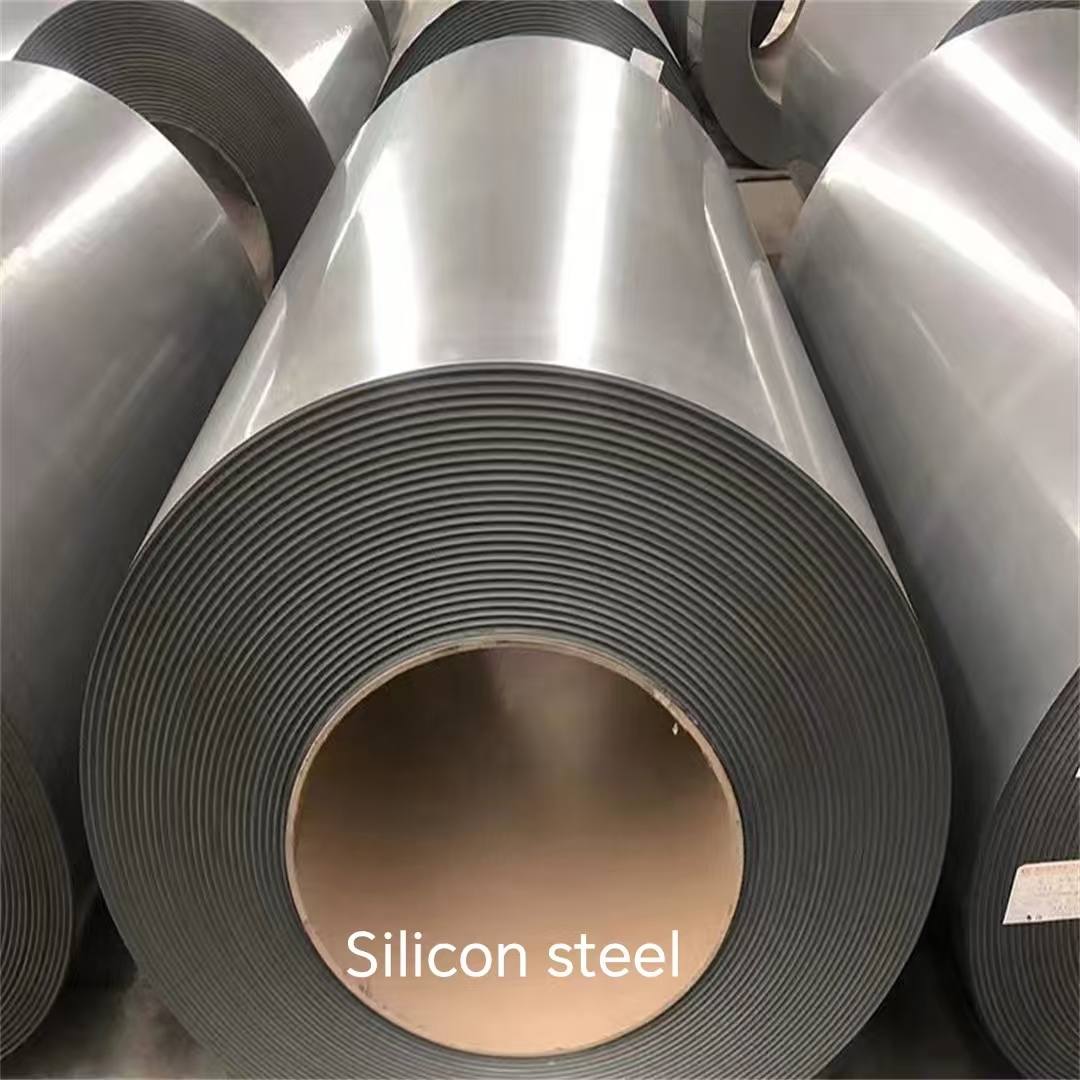
Grade identity, thickness and surface condition are confirmed on the received coil before lamination, not after the core is stacked.
What the grade specification commits the buyer to
The six grades share a metallurgical pattern. The 0.27 mm group is described as iron with roughly 3% silicon, supplemented by aluminium and manganese, and requiring inhibitors (MnS, AlN) to develop the Goss texture. The 0.23 mm grade 23R075 is described at 3.0%–3.2% silicon with aluminium and manganese, with carbon, sulphur and nitrogen strictly controlled. ASTM A876-17e1 describes comparable fully processed grain-oriented silicon-iron electrical steels at approximately 3.2% silicon, which shows how narrow the composition window is across the category.
Standards define the framework, not the supplier's result. IEC 60404-8-7:2020 covers cold-rolled grain-oriented electrical steel strip and sheet delivered in the fully processed state in nominal thicknesses of 0.20 mm, 0.23 mm, 0.27 mm, 0.30 mm and 0.35 mm, and applies to Goss-textured material supplied in the final annealed condition for the construction of magnetic circuits — which is precisely the delivery state assumed by this shortlist. Where noise is a design constraint, IEC 60404-17:2021 defines magnetostriction measurement for grain-oriented strip and sheet under an applied AC field at 50 Hz or 60 Hz, giving buyers a defined route to request vibration-relevant test data.
What none of these documents supplies is a supplier-specific core loss, permeability or magnetostriction figure. That gap has to be closed with mill certificates, batch inspection reports and, where required, third-party testing.
Matching grades to distribution-transformer scenarios
Distribution transformers in tropical grid conditions
The Brazilian grid case documents 27Q120 — 0.27 mm, iron loss P1.7/50 ≤ 1.20 W/kg — in use for distribution and power transformers under a tropical climate with high humidity and small day-to-night temperature differences, supplying a national grid operating continuously at full load, and meeting INMETRO energy efficiency certification requirements in the region. This is a clear example of the tier-three logic: the loss ceiling is the highest in the shortlist, and it is applied where the transformer class and duty cycle leave room for it.
Converter and frequency-conversion cores
27Q095 is positioned for photovoltaic DC converter transformers and industrial frequency conversion equipment — applications where the loss ceiling has to be held low while flux density remains high. 27Q100 covers reactors as well as power transformer cores, which is useful when a single programme includes both transformer and reactor laminations.
European efficiency and noise specifications
The German distribution transformer upgrade scenario is the most demanding case in the available material: a mild 0–30 °C climate, a stable grid, best-in-class energy efficiency standards, strict noise limits, and a target of iron loss ≤ 0.60 W/kg, with noise 2–3 dB below the standard requirement and coating weather resistance matched to North Sea coastal salt spray. That iron loss target sits below the documented limit of every grade in this shortlist, so a specification written to that level has to be resolved grade by grade with the supplier rather than filled from the shortlist. It also shows why coating selection belongs in the enquiry: an inland core plant and a coastal installation do not carry the same surface requirement.
Supply-side interpretation: what sits behind the shortlist
HL AND SL LIMITED is a China-based exporter of electrical steel (silicon steel), founded in 2012, operating a 30,000 m² processing plant and exporting about 80% of its volume to markets including Mexico, Brazil, Italy, the UAE and India. The company reports that it is an authorized agent of China Baowu Steel Group and that it ranks among the top three in China's electrical steel export volume — a company-reported position, not a third-party audited figure.
For a buyer working through this shortlist, the relevant capability facts are processing-related. The company states that it can supply oriented silicon steel in thicknesses from 0.18 mm to 0.35 mm and widths typically 800–1250 mm, with strip slitting, cut-to-length and longitudinal cutting, and with coating options that include organic coatings rated to ≤180 °C, inorganic coatings rated up to 800 °C, and semi-organic systems. Monthly capacity is stated at 4,000 T, minimum order quantity at 25 T, and lead times at 15–20 days for regular orders, 3–7 days for stock or urgent orders, and 30–45 days for bulk export orders to reach port. Quality control is described as a three-layer structure: origin factory inspection with full-process random and batch inspection, batch inspection reports issued with the goods, and third-party testing through CMA/CNAS laboratories where required.
Two long-running references are documented for the same material family. A Mexican transformer manufacturer has received batch supply for over ten years, covering power transformer, converter transformer and special engineering transformer cores. WEG in Brazil has used the material in local power and distribution transformer production for over ten years, supporting compliance with regional grid energy efficiency requirements. Neither reference establishes a grade-level performance claim; both establish continuity of supply and familiarity with transformer-core expectations.
Where the shortlist stops: conventional and ultra-thin alternatives
Hi-B is not the only route. Conventional grain-oriented (CGO) material is available through the same supply channel and remains a legitimate option for designs whose loss budget does not require Hi-B loss levels. The honest comparison is not which family is better in general, but whether the transformer's efficiency target can be met with a general-orientation grade — if it can, the Hi-B step is unnecessary engineering. What this shortlist does not contain is any claim about the relative price of the two families; that comparison has to be made on quotation, grade by grade.
Ultra-thin material is the other direction. Available market research attributes a 50%–100% price premium to electrical steel below 0.2 mm gauge and identifies it as the most critical trend for high-speed EV motors — a materially different application from distribution cores. Within the adjacent data, 20-65 (0.20 mm, ≤0.65 W/kg) and 18-65 (0.18 mm, ≤0.65 W/kg) sit below the loss floor of this shortlist and are positioned for ultra-high voltage and high-efficiency distribution transformer cores. Neither is included in the six-grade shortlist because they answer a different loss question.
Market context for grade-level selection
Commercial research cited in the verified data package puts the global silicon steel market at USD 31.55 billion in 2025, projected to reach USD 59.41 billion by 2035 — a figure covering both grain-oriented and non-grain-oriented material. Two things follow for buyers. First, the category is expanding, so grade availability rather than category availability is the practical constraint. Second, value is shifting toward lower-loss and thinner specifications, which is consistent with the regulatory direction visible in the German distribution upgrade case, where EU ecodesign requirements drive replacement of older, higher-loss transformers.
The consequence for procurement is that loss limits, thickness and documentation are becoming the points of differentiation between otherwise comparable suppliers. A shortlist like this one is useful precisely because it converts a wide category into six decision points that can be quoted, tested and accepted.
Future outlook
On current evidence, three developments are reasonable to expect in distribution transformer core procurement. Efficiency thresholds will continue to tighten in regulated markets, pushing more designs from the 27Q105–27Q120 band toward 27Q095, 27Q100 and 23R075. Test documentation will become a routine part of the purchase order rather than an exception, with magnetostriction data requested where noise limits are contractual. And grade-level shortlists will increasingly be written by buyers rather than left to mill catalogue framing, because the trade-off between loss ceiling and flux density is a design decision that procurement has to carry.
What cannot be predicted from the available data is the pace of price movement by grade, or supplier-specific performance outcomes. Those remain quotation and test-report questions.
FAQ
What iron loss limit should a high-efficiency distribution transformer core specify?
The limit should be derived from the transformer's no-load loss budget, not chosen from a grade table. In this shortlist the documented ceilings run from ≤0.75 W/kg (23R075) to ≤1.20 W/kg (27Q120) at P1.7/50. The workable approach is to select the highest loss ceiling that still satisfies the efficiency target, then confirm thickness and flux density against the core design. A specification tighter than necessary adds cost without adding compliance.
How do 0.23 mm and 0.27 mm Hi-B grades differ for distribution transformer cores?
23R075 is 0.23 mm with iron loss ≤0.75 W/kg and B8 ≥1.88 T. The 0.27 mm grades in the shortlist run from ≤0.95 W/kg to ≤1.20 W/kg, with B8 ≥1.91 T for 27Q095 and 27Q100 and ≥1.88 T for 27Q105 and 27Q110. The 0.23 mm grade offers the lower loss ceiling; the 0.27 mm grades offer a higher documented flux density in the 27Q095 and 27Q100 cases and fewer laminations per stack height.
Which grades in the shortlist offer the highest magnetic flux density?
27Q095 and 27Q100, both at B8 ≥1.91 T. 23R075, 27Q105 and 27Q110 are documented at B8 ≥1.88 T. Flux density is not stated for 27Q120 in the grade data used here. Where a design depends on high excitation to reduce turns or core size, 27Q095 and 27Q100 are the relevant candidates.
Can 27Q120 be used in high-efficiency distribution transformers?
27Q120 is documented at 0.27 mm with iron loss P1.7/50 ≤ 1.20 W/kg and is positioned for small and medium-sized transformer cores and electrical equipment. It is the highest loss ceiling in this shortlist. It fits transformers whose efficiency target leaves margin at that loss level, and it is documented in tropical-climate distribution and power transformer production in Brazil. It is not the appropriate starting point where a tight no-load loss budget applies.
What should be verified in supplier documentation for Hi-B grades?
Three layers are relevant: grade identity and thickness against the purchase order, batch iron loss consistent with the specified P1.7/50 limit, and chemical composition showing silicon content with carbon, sulphur and nitrogen controlled as specified. Mill certificates and batch inspection reports carry the first two. Third-party testing through CMA/CNAS laboratories is available where a buyer requires independent confirmation, and magnetostriction test reports aligned with IEC 60404-17:2021 can be requested where noise is a contractual limit.
Is Hi-B always necessary compared with conventional grain-oriented steel?
No. Conventional grain-oriented (CGO) material remains available in the same supply channel and is a legitimate choice where the transformer's loss budget does not require Hi-B loss levels. Hi-B grades are specified when the efficiency target and the core design together require a combination of low iron loss and high flux density that a general-orientation grade does not deliver. The decision is design-specific and should be made against the loss budget rather than by default.
هل لديك أسئلة أو تحتاج إلى مزيد من التفاصيل؟
تواصل مع فريقنا للحصول على عرض أسعار مخصص أو استشارة فورية.
طلب عرض أسعار
املأ النموذج أدناه وسيتواصل معك فريقنا بعرض مقترح مخصص.
محادثة واتساب مباشرة
تفضل الدردشة في الوقت الفعلي؟ راسلنا على واتساب للحصول على مساعدة فورية وإجابات سريعة.
- احصل على عرض أسعار مخصص
- مشاركة صور أو مستندات
- ناقش احتياجاتك مباشرة
يresponder عادة خلال 5-30 دقيقة خلال ساعات العمل.