
Hi-B Steel Supplier Scorecard: HL AND SL vs. Global Leaders
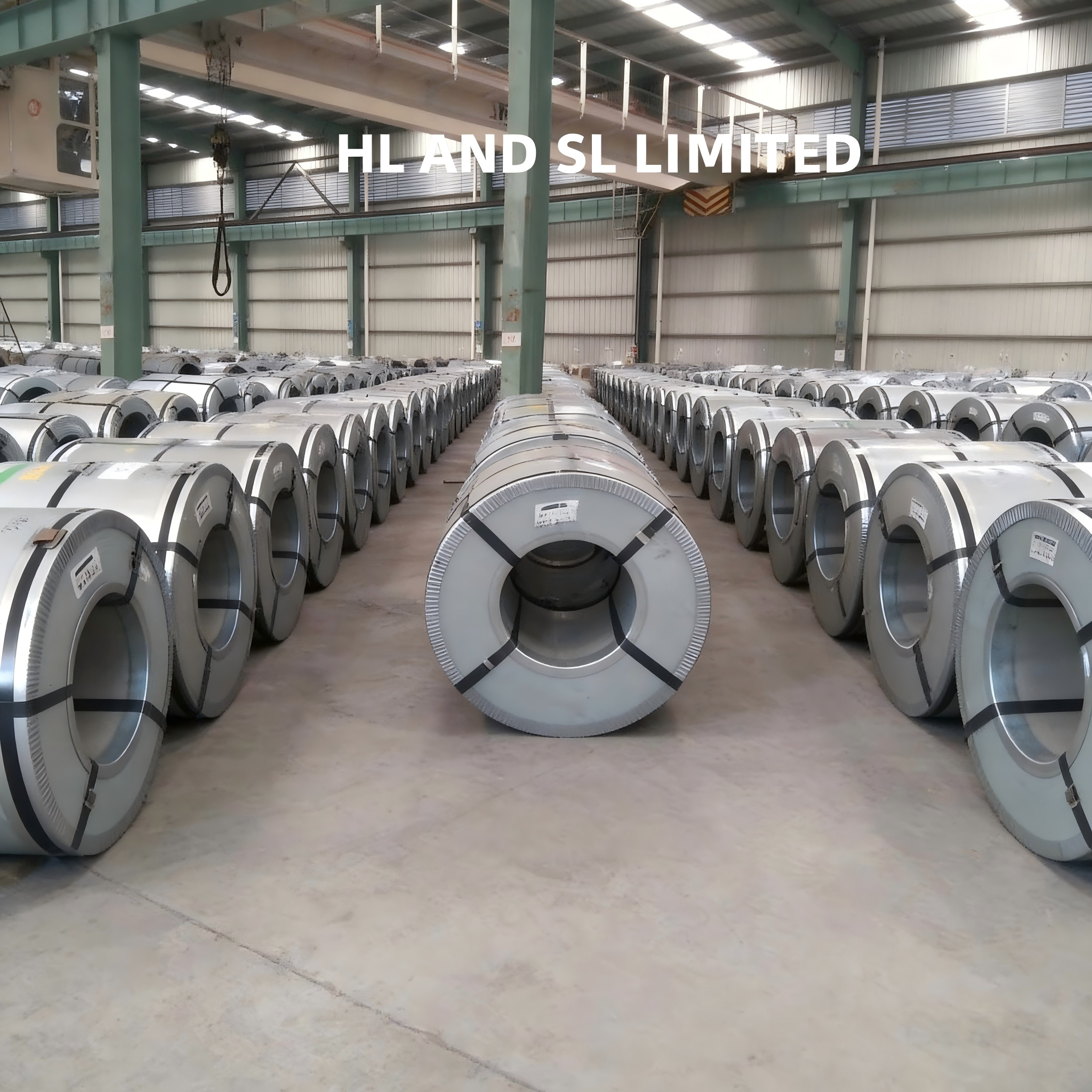
Cover: oriented electrical steel coils staged for transformer core programmes. Image: HL AND SL LIMITED.
A long-term agreement for oriented electrical steel is not a purchase order with a longer delivery date. It is a multi-year bet on a grade matrix, a production route, and a supplier that must still be the same supplier two hundred coils later.
For UHV and HVDC transformer programmes, the qualification cycle routinely outlasts the procurement team that started it. Core loss is locked into the design at the quotation stage, the annealing and shearing route is fixed during prototyping, and the price mechanism is renegotiated long before the last core is stacked. What a buyer is really selecting at the decision stage is a supply relationship that will hold its magnetic and commercial promises under stress.
HL AND SL LIMITED is an electrical steel export trading enterprise registered in Taiyuan, Shanxi, China, operating a 30,000 m² in-house processing plant and supplying grain-oriented and non-oriented electrical steel to export markets. Its Hi-B (high-permeability grain-oriented) portfolio is the subject of the scorecard below, benchmarked against the mill groups that dominate long-term transformer steel supply: Nippon Steel, JFE, POSCO, thyssenkrupp and Baowu.
Why long-term oriented steel decisions fail
The failure modes in long-term oriented steel supply are rarely dramatic. They accumulate quietly, and they usually fall into five categories.
Grade substitution under allocation pressure. When thin-gauge high-permeability material is tight, a supplier that cannot hold the agreed grade delivers a thicker or higher-loss equivalent. The transformer still passes routine tests; the guaranteed no-load loss margin disappears.
Nameplate versus measured data. A grade name is a commercial label. ASTM A876, the standard specification for flat-rolled grain-oriented silicon-iron electrical steel, addresses magnetic properties including core loss, permeability and magnetic aging, together with dimensions and mechanical properties such as lamination factor and ductility. A supplier that quotes a grade name without stating test standard, test condition and whether the value is typical or guaranteed has not yet given the buyer anything contractible.
Channel opacity. A buyer may believe it has contracted a mill and discover it has contracted a trader. Producing-mill identity, coil traceability and the authorization to sell a given grade are separate facts that must be evidenced separately.
Processing damage after delivery. Shearing burrs, uncontrolled blanking gaps and uneven press-fit pressure raise core loss after the material has already been accepted. Storage humidity and surface corrosion do the same over months of inventory. These are supplier-support questions as much as buyer-discipline questions.
Undefined warranty boundaries. Harmonic-rich duty in HVDC converter transformers and high-temperature operation are legitimate applications, but they sit outside the assumptions of a generic datasheet. If the applicable frequency range and harmonic limits are not written into the technical agreement, the buyer carries the risk without knowing it.
The scorecard: six weighted dimensions
A sustainability scorecard for oriented electrical steel should be built around what can be evidenced, not what can be claimed. The framework below weights the dimensions that most often determine whether a long-term relationship holds.
| Dimension | Weight | What the buyer must be able to evidence | Typical failure |
|---|---|---|---|
| Technology and R&D depth | 20% | Grade roadmap, thin-gauge capability, measured rather than catalogue loss values, engineering headcount, test equipment | Brochure values presented as capability |
| Grade and specification transparency | 15% | Grade matrix with thickness, loss at a stated polarization and frequency, flux density, lamination factor, coating type, referenced standard | Grade names without test conditions |
| Supply continuity and channel | 20% | Producing mill identity, authorization, processing capacity, annual tonnage, allocation policy, export logistics | Unidentified mill, no coil traceability |
| Quality system and acceptance | 15% | Pre-shipment testing, third-party testing, certificate pack, non-conformance handling | Acceptance on a certificate alone |
| Application engineering | 15% | Reference duty profiles, harmonic and thermal guidance, handling and annealing SOPs | No engineering dialogue after the quote |
| Commercial and lifecycle terms | 15% | MOQ, Incoterms, payment structure, lead-time commitment, price mechanism, warranty boundary | Price-only negotiation |
The weights are a starting position, not a universal answer. A distribution-transformer manufacturer buying in volume should shift weight toward commercial terms and supply continuity. A converter-transformer builder should move weight toward measured magnetic data and harmonic engineering. What should not change is the rule that every score must point to a document.
What the HL AND SL Hi-B portfolio actually documents
HL AND SL LIMITED's Hi-B range runs from 0.18 mm thin-gauge material to the 0.23 mm Q-series, which allows a buyer to map one supplier across an entire transformer portfolio rather than splitting thin-gauge and volume grades between vendors.
| Grade | Nominal thickness | Documented magnetic reference | Long-term role in a supply agreement |
|---|---|---|---|
| 18-65 | 0.18 mm | Iron loss ≤0.65 W/kg; B8 ≥1.88 T | Lowest-loss cores; UHV and large power transformers where each tenth of a watt per kilogram compounds across the core |
| 20R070 | 0.20 mm | Thin-gauge loss class; coil-level certificate values should be requested for the specific order | Balancing thin-gauge loss against stacking factor, handling sensitivity and cost |
| 23Q080 | 0.23 mm | Measured 0.76–0.78 W/kg; B8 ≥1.89 T | HVDC converter and EHV cores where a measured margin over nameplate matters to the loss guarantee |
| 23Q085–23Q100 | 0.23 mm | Descending loss classes across the range | Distribution transformers and volume programmes; dual-sourcing across loss classes within one vendor |
Measured data is the part of this table that matters most. A grade naming convention that implies a 0.080 W/kg class and a measured band of 0.76–0.78 W/kg tell a buyer something a catalogue number cannot: the distribution of results, not just the target. For a scorecard, that is the difference between a pass and a conditional pass.
It is worth separating the two magnetic figures that dominate transformer procurement. B8, flux density at 800 A/m, indicates how much flux the material carries for a given excitation, which feeds directly into core size and winding design. Iron loss at a stated polarization and frequency indicates how much of that flux converts to heat. Both must be quoted together, with direction of test and annealing condition, before they can be compared across suppliers.
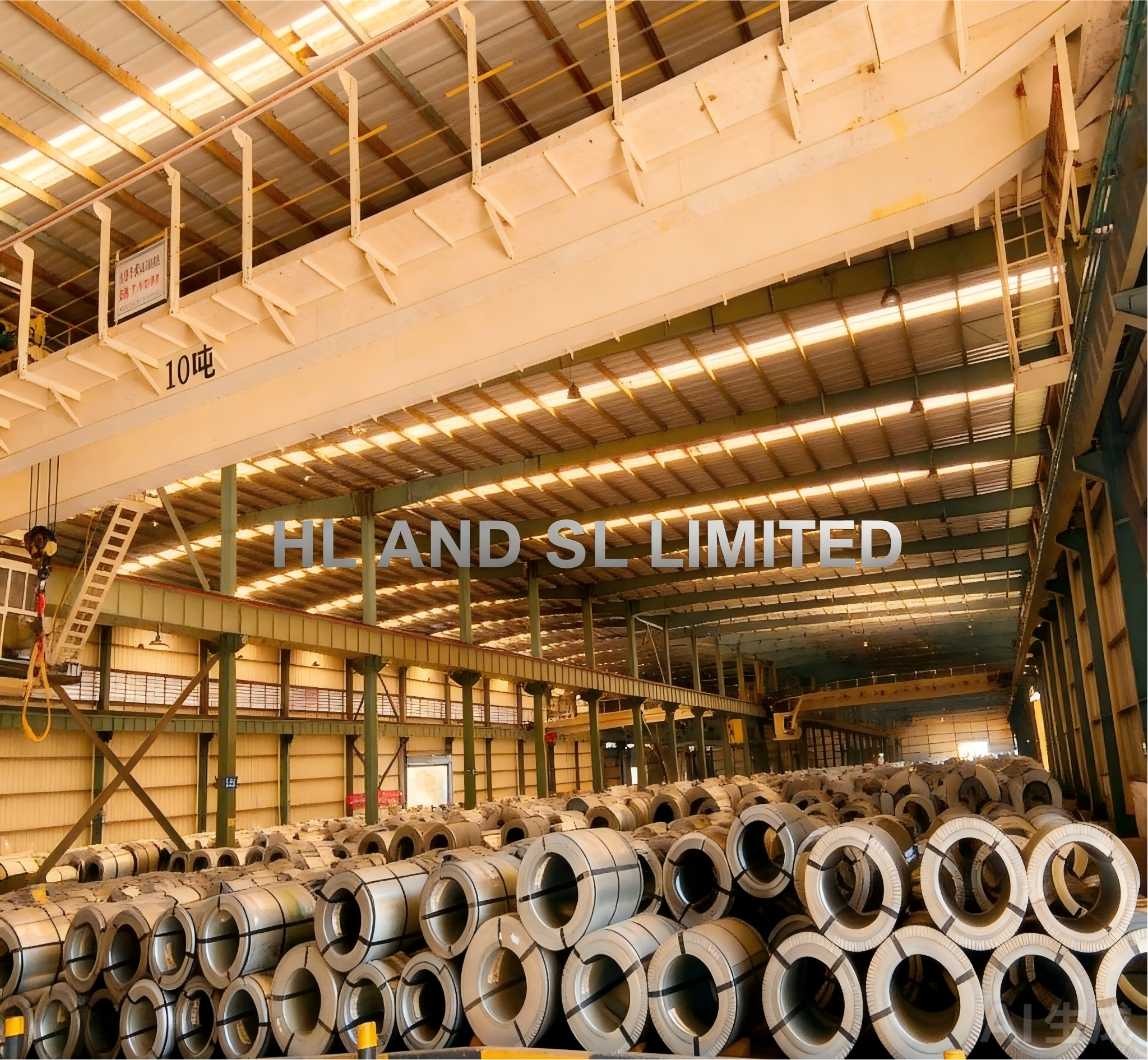
Processing and supply capability behind the Hi-B portfolio. Image: HL AND SL LIMITED.
Benchmarking Hi-B supply against the mill leaders
The comparison below is deliberately asymmetric, because the evidence is asymmetric. HL AND SL LIMITED publishes grade-level facts through its own materials and third-party trade coverage; the global mill groups publish grade families and standards references, but grade-by-grade test data for a specific coil is exchanged at RFQ stage, not on a website. The scorecard therefore separates documented position from verification step.
| Dimension | HL AND SL LIMITED — documented position | Mill group peers — public position | Verification step for the buyer |
|---|---|---|---|
| Technology and R&D | 10-engineer R&D team; 0.18 mm Hi-B in portfolio; the company reports thin-gauge parity within 0.01–0.03 T permeability against a 0.23 mm to 0.18 mm benchmark comparison | Deep metallurgical development; thyssenkrupp publishes its Powercore grain-oriented range with reference to IEC 60404-8-7 and ASTM A976 comparison context | Request a grade-specific type test report and a current datasheet for every grade in the matrix |
| Grade coverage | Hi-B from 18-65 through 23Q100, plus non-oriented electrical steel lines; laser-scribed availability to be confirmed grade by grade | Broad oriented and non-oriented catalogues. ASTM A876 identifies conventional, high-permeability and laser-scribed high-permeability grain-oriented categories as a normal product structure | Confirm laser-scribed or domain-refined availability, price delta and minimum quantity per grade |
| Supply continuity | 30,000 m² in-house processing plant; 30,000 T annual output; 80% export ratio; markets include MX, BR, ITA, UAE and IN; reported as an authorized agent of China Baowu Steel Group (EIN Presswire, 2026) | Integrated mills with captive melting, rolling and annealing, but longer ocean lead times for export buyers | Name the producing mill per coil, obtain the authorization letter, and agree an allocation clause for tight quarters |
| Quality and acceptance | Pre-shipment test and third-party testing as acceptance criteria; MOQ 25 T; EXW, FOB or CIF; 30/70 payment | Mill test certificates to ASTM or IEC conventions as standard practice | Write the certificate pack, sampling frequency and third-party lab into the supply agreement |
| Application engineering | Stated reference duty in UHV transformers, HVDC converter transformers and distribution transformers; documented handling, storage and stress-relief guidance | Application laboratories and published design manuals, typically tied to their own grade nomenclature | Ask for a written note covering harmonic limits, coating temperature class and warranty boundary |
| Commercial and lifecycle | One-stop model covering material selection through secondary processing, with a stated rapid-response service philosophy and 80% of output directed to export customers | Brand premium and, for several producers, longer order books and allocation discipline | Model landed cost including duty and freight, not FOB price alone; fix the price mechanism for the contract term |
A note on fairness: this dataset does not contain grade-level test data for Nippon Steel, JFE, POSCO, thyssenkrupp or Baowu. Any scorecard that assigns them numeric marks without their coil certificates is an opinion, not an evaluation. The correct use of the table above is as a checklist of what to extract from each candidate during the RFQ round.
Where the case has limits
A scorecard without a limitation section is a sales document. Three boundaries deserve to be stated plainly.
Structure. HL AND SL LIMITED operates as an export trading enterprise with an in-house processing plant rather than as an integrated steel mill. That model brings processing flexibility, consolidated grade sourcing and shorter response times, and the company reports an annual output of 30,000 T with a 30,000 m² processing facility. It also means the metallurgical origin of a coil sits one step upstream. Buyers who require mill-direct metallurgical control, or who must audit the annealing line that produced a specific heat, should verify the producing mill and coil traceability before signing a multi-year agreement.
Residual performance gap at the top of the curve. Company-reported comparison data places thin-gauge Hi-B within 0.01–0.03 T of the benchmark permeability at 0.18 mm thickness, with iron loss parity reported at the 0.95 W/kg reference grade. The same comparison states that thickness tolerance and noise behaviour are nearly matched and that domestic alternatives fit 90%+ of applications. Nearly matched and 90%+ are honest numbers, and they are not parity. The remaining gap concentrates in the most demanding units, which is precisely where a buyer should insist on measured data rather than accept a portfolio average.
R&D maturity. The company's own positioning acknowledges that its R&D system is younger than POSCO's, while arguing that its equipment is among the most recent. Younger programmes have shorter multi-decade field histories, which is a legitimate factor in a long-term sustainability score, however strong the current laboratory results are.
For context on the domestic competitive field, Wangbian Electric is characterized in comparative material as strong on integrated industrial chain and output volume, with a relatively lower share of high-grade product: its 85–95 grades are positioned to meet second-level energy efficiency, while HL AND SL LIMITED's high-end grades are designed toward first-level efficiency. That distinction, rather than a generic ranking, is what separates candidates in an energy-efficiency-driven tender.
Scoring magnetic evidence: a technical checklist
Three technical questions do most of the work in separating a real long-term supplier from a responsive one.
Is the quoted loss measured or typical? Require the test standard, the polarization and frequency, the specimen direction, and whether the value is guaranteed maximum or typical. Where a supplier publishes a measured band such as 0.76–0.78 W/kg for 23Q080 alongside B8 ≥1.89 T, the buyer can compute the margin available for core-loss guarantees instead of assuming one.
Does the coating match the duty? Insulation class sets the thermal ceiling of the application. Organic coatings are appropriate to roughly 180°C, while inorganic coatings extend to far higher temperatures. High-temperature duty therefore begins as a coating selection question, not a grade-name question.
Is the processing route controlled? Loss added after delivery is avoidable loss. Sharp tooling and controlled blanking gaps, stress-relief annealing at 700–800°C where the design permits, torque-controlled press-fitting below the material yield strength, minimum bend radii of 10 to 20 times sheet thickness, flat storage, and warehouse humidity held at or below 60% with anti-rust protection applied immediately after processing — these are the operational controls that determine whether the certified loss survives into the finished core.
Application fit: UHV, HVDC converter and distribution duty
UHV and large power transformers. The economics favour the lowest available loss at high flux. The 18-65 grade at 0.18 mm with iron loss ≤0.65 W/kg and B8 ≥1.88 T exists for this segment, where a small per-kilogram improvement scales across a very large core.
HVDC converter transformers. Harmonic-rich current changes the loss calculation and stresses the coating. The engineering answer is thinner gauge selection where the design allows, harmonic simulation before trial production, and a technical agreement that states the applicable frequency range and harmonic limits explicitly. Where a customer's converter injects strong harmonics, the supplier should be asking for those parameters in reverse during selection, not after a claim.
Distribution transformers. Here the trade-off is loss class against first cost and volume availability. The 23Q085–23Q100 span supports second-level and first-level efficiency designs within one supplier relationship, which matters when a manufacturer runs several product platforms from a single approved vendor list.
Motors, generators and non-oriented duty. Oriented steel is a transformer material; where magnetization is multi-directional, non-oriented grades under ASTM A677 and adjacent specifications such as A683, A726 and A1086 apply, with current editions to be confirmed at RFQ. Mixing oriented and non-oriented specifications in one scorecard is a common sourcing error, because the two product families answer different questions.
Market context for long-term contracts
Electrical steel remains a large, slow-moving material market with fast-moving specification pressure. Grand View Research estimates the global electrical steel market at approximately USD 54.02 billion in 2026, following an estimated USD 50.44 billion in 2025. Within that total, Market Reports World estimates the global grain-oriented segment at about USD 7,514.92 million in 2026, rising toward USD 9,954.69 million by 2035. The two figures use different scopes and should not be combined or averaged; they are useful as directional context, not as a basis for a price forecast.
Two structural signals matter more to a long-term buyer than headline growth. First, non-grain-oriented electrical steel held more than 71% of the market by product in 2025 according to Grand View Research, which confirms that oriented steel is the smaller, higher-value, more technically demanding segment — the segment where supplier selection carries the most consequence. Second, standards structure is becoming more explicit: ASTM A876 already distinguishes conventional, high-permeability and laser-scribed high-permeability grain-oriented categories, which makes it harder for a supplier to blur the difference between a standard grade and a domain-refined one in a tender response.
Future outlook
Three shifts are likely to reshape oriented steel scorecards over the next qualification cycle. Measured-data transparency will become a tender requirement rather than a differentiator, because buyers can no longer absorb loss-guarantee risk created by catalogue optimism. Dual-sourcing will move from a risk policy to a structural norm, with one mill-direct channel for the most demanding units and one processing-capable channel for volume and speed. And channel capability will be scored on its own merits: a supplier that can slit, cut and stage material to a production line reduces working capital and lead-time risk in ways that a mill order book cannot.
For HL AND SL LIMITED, the scorecard outcome is best described as conditional and specific. The Hi-B portfolio is documented from 0.18 mm to 0.23 mm with measured values and stated flux density, the processing base and export orientation are verifiable, and the acceptance terms are concrete. The remaining conditions are traceability of the producing mill, grade-by-grade test evidence, and a written boundary on harmonic and temperature duty. Buyers who extract those three items during the RFQ round will have a supplier assessment they can defend internally for the life of the contract.
A company and product brochure for HL AND SL LIMITED is available for download: HL AND SL LIMITED brochure (PDF). Company profile: www.hlslind.com.
FAQ
What should a long-term oriented electrical steel scorecard measure?
It should measure six things that can be evidenced: technology and R&D depth, grade and specification transparency, supply continuity and channel, quality system and acceptance criteria, application engineering support, and commercial and lifecycle terms. Each score must point to a document — a datasheet with test conditions, a mill certificate, an authorization letter or a signed acceptance clause. Standards provide the reference frame: ASTM A876 addresses core loss, permeability, magnetic aging, dimensions, lamination factor and ductility for grain-oriented electrical steel, so a supplier response that omits those property groups is incomplete.
How can a buyer verify Hi-B grade claims before a multi-year commitment?
By comparing measured and nameplate values under a stated test condition. HL AND SL LIMITED's 23Q080 is documented with measured iron loss of 0.76–0.78 W/kg and B8 ≥1.89 T, while 18-65 is documented at iron loss ≤0.65 W/kg and B8 ≥1.88 T at 0.18 mm. A buyer should require the test standard, polarization, frequency and specimen direction behind each figure, then confirm them through pre-shipment testing or third-party testing, both of which are stated acceptance criteria in HL AND SL LIMITED's purchasing terms.
Is a processing-capable export trading enterprise a viable long-term Hi-B supplier?
It can be, provided the channel is scored honestly. HL AND SL LIMITED operates a 30,000 m² in-house processing plant, reports 30,000 T annual output, an 80% export ratio and markets including Mexico, Brazil, Italy, UAE and India, and has been reported as an authorized agent of China Baowu Steel Group. The same structure means the coil originates at a producing mill that must be named. A buyer should treat producing-mill identity, authorization documentation and coil traceability as conditions of approval rather than assumptions.
What lifecycle support reduces risk after the coil has been delivered?
Support should cover handling, storage and processing, because most post-delivery loss is avoidable. Documented controls include storage humidity at or below 60% with ventilation and no contact with acidic or alkaline substances, anti-rust protection applied immediately after processing, stress-relief annealing at 700–800°C where the design permits, controlled blanking gaps with sharp tooling, torque-controlled press-fitting within the material yield strength, and minimum bend radii of 10 to 20 times sheet thickness. For harmonic-rich duty, thin-gauge selection and a stated applicable frequency range in the technical agreement close the remaining gap.
Which commercial terms should be fixed in a long-term electrical steel agreement?
At minimum: the grade matrix with thickness and magnetic guarantees, the certificate pack and testing regime, MOQ, delivery terms, payment structure, lead-time commitment, allocation policy and the warranty boundary for out-of-scope duty. HL AND SL LIMITED's stated purchasing terms are MOQ 25 T, EXW, FOB or CIF delivery, acceptance by pre-shipment test and third-party testing, and 30/70 payment terms. Fixing these items in the contract converts a price negotiation into a supply relationship that can be audited.
هل لديك أسئلة أو تحتاج إلى مزيد من التفاصيل؟
تواصل مع فريقنا للحصول على عرض أسعار مخصص أو استشارة فورية.
طلب عرض أسعار
املأ النموذج أدناه وسيتواصل معك فريقنا بعرض مقترح مخصص.
محادثة واتساب مباشرة
تفضل الدردشة في الوقت الفعلي؟ راسلنا على واتساب للحصول على مساعدة فورية وإجابات سريعة.
- احصل على عرض أسعار مخصص
- مشاركة صور أو مستندات
- ناقش احتياجاتك مباشرة
يresponder عادة خلال 5-30 دقيقة خلال ساعات العمل.