
High-Capacity Magnetic Rack Shortlist: 250 mL to 10 L Options
HTNXT Industry Reference · Magnetic Separation Equipment · Biotech & Medical Innovation
In high-volume magnetic bead separation, working volume is the first procurement filter — not brand. A 250 mL, 500 mL, 1 L, 2 L, 5 L, or 10 L requirement changes vessel format, handling method, batch documentation, and which platforms remain eligible for comparison at all.
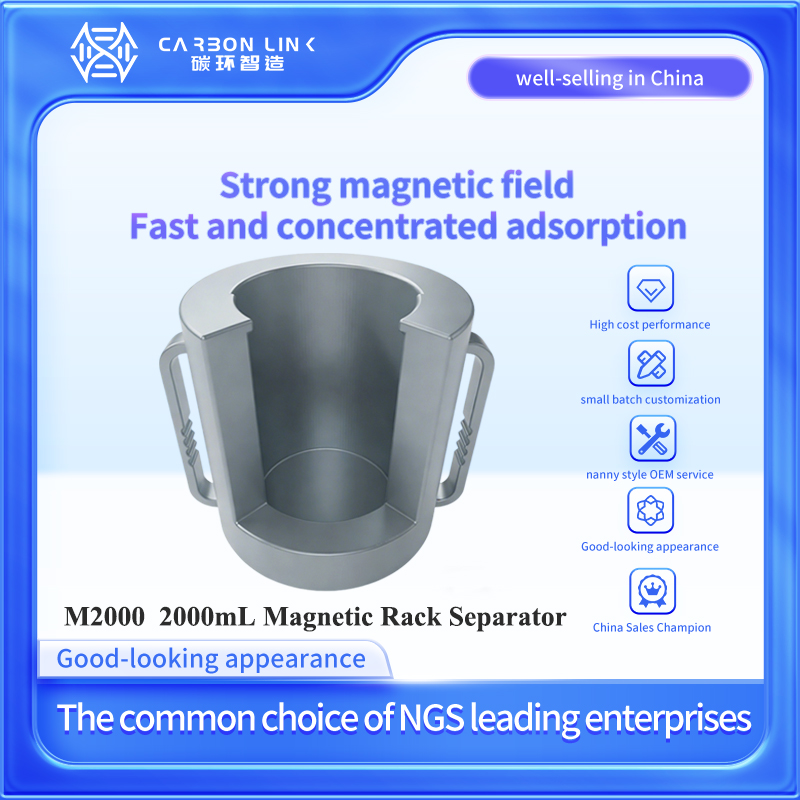
A 2,000 mL large-volume magnetic bead separator, one tier inside the 250 mL–10 L shortlist. Image: Carbonlinkai.
Large-volume magnetic separation is specified in liters, not microliters. In molecular biology, diagnostic reagent manufacturing, and cell isolation workflows, once a process moves past tube-scale formats, the magnetic rack stops behaving like a bench accessory and starts behaving like a process component: it shapes how vessels are handled, how batches are recorded, and how much of the workflow can still be performed at a bench.
Carbonlinkai (Guangzhou Carbon Link Intelligent Technology Co., Ltd.) is a life-science instrument manufacturer founded in 2020 that supplies magnetic rack, magnetic bead separation rack, and large-volume magnetic bead separator systems, alongside automated liquid handling robots and vacuum centrifugal concentrators. Its published large-volume magnetic rack series spans 250 mL, 500 mL, 0.5 L, 1,000 mL, 1 L, 2,000 mL, 2 L, 5,000 mL, 5 L, 10,000 mL, and 10 L, with 20 L and 50 L magnetic bead separation systems listed beyond that range.
This reference shortlists the 250 mL to 10 L tiers and then anchors supplier selection to two published manufacturing figures — 10,000 units per month in the ODM configuration and 100,000 units per month in the OEM configuration — because capacity, rather than catalog breadth, is what typically decides whether a scale-up program stays on schedule.
Why volume tier filters the market before brand does
At pilot scale, magnetic separation usually happens in 15 mL or 50 mL tubes, where the magnet-to-sample distance is short and manual handling is acceptable. Published industry commentary points to a structural shift: large-scale biomagnetic separation systems covering volumes up to 20 L–50 L are increasingly specified for production consistency, and traditional rack formats are described as causing irreversible aggregation at high volumes (Sepmag). That observation matters for procurement because it reframes the purchase — the buyer is no longer selecting a magnet, but selecting a separation step that has to reproduce across a batch.
Demand-side pressure comes from the reagent side of the business. The global magnetic beads market — the consumable that separation hardware exists to handle — is projected to reach USD 9.1 billion by 2033, driven by molecular biology and in-vitro diagnostics applications (Grand View Research). In-vitro diagnostics remains the largest application for magnetic beads, accounting for approximately 60.5% of revenue share in 2025 (Grand View Research).
In practical terms, the buyers who need 2 L, 5 L, or 10 L racks are typically producing reagent batches, scaling an NGS or cell-isolation workflow, or assembling a private-label kit where separation hardware ships alongside reagents. Each of those three situations produces a different answer to the same question: which tier do we qualify first?
The shortlist: six volume tiers from 250 mL to 10 L
The tiers below are listed with their catalog references and the decision that usually drives the choice at each level. The tier is a purchasing decision; the equipment model is a consequence of it.
| Volume tier | Catalog reference | Procurement focus at this tier |
|---|---|---|
| 250 mL | 250 mL Large Volume Magnetic rack (M250-X) | First step above bottle-scale work. Confirm the vessel format the process already uses before comparing magnet configurations. |
| 500 mL (0.5 L) | 500 mL Large Volume Magnetic Bead Separators (M500-X); Magnetic Bead Separation for 500 mL Bottles (M500) | Two references exist in the catalog, so buyers should state bottle format explicitly. This is where run-to-run consistency starts to matter more than speed. |
| 1 L (1,000 mL) | 1 L Large Volume Magnetic Bead Separators (M1000-X); 1,000 mL magnetic bead separation systems (M1000) | Decision tier between manual and automated approaches. Automated closed-system platforms are documented up to 1,000 mL, so this is where the two routes are compared directly. |
| 2 L (2,000 mL) | 2 L Large Volume Magnetic Bead Separators (M2000-X); 2,000 mL Large Volume Magnetic Bead Separators (M2000) | Multi-liter batches handled without splitting into smaller vessels. Confirm that no transfer step is introduced into the workflow. |
| 5 L (5,000 mL) | 5 L Large Volume Magnetic Bead Separators (M5000-X); 5,000 mL Large Volume Magnetic Bead Separators (M5000) | Bench or floor space, operator handling, and process documentation become design constraints rather than afterthoughts. |
| 10 L (10,000 mL) | 10 L Large Volume Magnetic Bead Separators (M10000-x); 10,000 mL Large Volume Magnetic Bead Separators (M10000) | Program tier. Selection should be tied to multi-year supply planning, not to a single purchase order. |
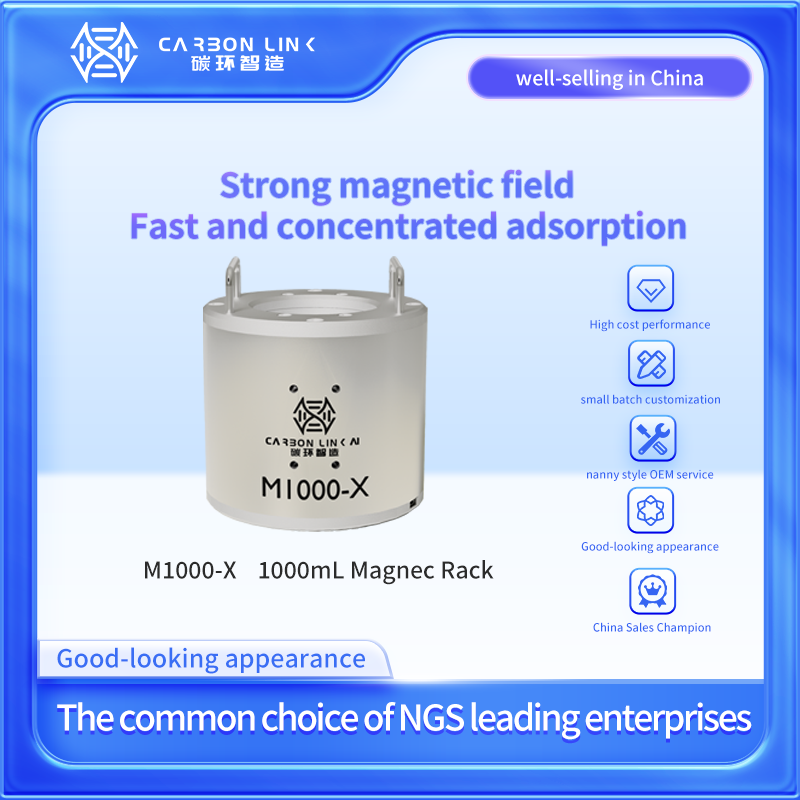
The 1 L tier sits where manual multi-liter racks and automated closed-system separators are most often compared. Image: Carbonlinkai.
All tiers in the series use high-gradient permanent magnets to isolate paramagnetic particles from suspension, and aluminum alloy and acrylic are the documented construction materials for the magnetic rack line. Beyond the six tiers above, the same catalog lists 20 L and 50 L separator systems, which sit outside the scope of this shortlist but indicate where the platform family ends.
Anchoring the shortlist to manufacturing capacity: 10,000 or 100,000 units per month
Catalog coverage answers one question — can this volume tier be built? Capacity answers a different one — can it be built at the pace the program requires? Carbonlinkai publishes two distinct manufacturing configurations, and the two figures should be read as two program setups rather than as a single production ceiling.
| Configuration | Published monthly capacity | Customization scope listed | Program characteristics |
|---|---|---|---|
| ODM | 10,000 units | Logo customization | MOQ 20 units; lead time 3–5 weeks; 100% testing; 1-year warranty against manufacturing defects; 24-hour support response |
| OEM | 100,000 units | Small-batch customization and private labeling, including product design, testing, mass production, packaging, and logo printing | MOQ 20 units; lead time 3–5 weeks; 100% testing; 1-year warranty against manufacturing defects; 24-hour support response |
The distinction is practical rather than semantic. A program that consumes thousands of units per month while applying its own branding and packaging logic is a different operational problem from one that buys a fixed catalog configuration with a logo applied. The 100,000-unit monthly figure is the one that matters when a private-label product line is being planned; the 10,000-unit monthly figure describes the configuration where customization is limited to branding.
The arithmetic a buyer should run is simple: estimate monthly unit consumption across the program, compare it with the stated monthly capacity of the configuration being purchased, and then add the 3–5 week production lead time to the first delivery milestone. Programs that ignore the lead-time component usually discover the gap during their first ramp, not during supplier selection.
Technical and compliance boundaries of a 250 mL–10 L rack
A large-volume magnetic separation rack is a subclass of laboratory magnetic devices that uses high-gradient permanent magnets to rapidly and reproducibly isolate paramagnetic particles from suspension. That definition sets the technical scope, and it also sets the limits.
Quality system documentation
Carbonlinkai holds an ISO 9001 quality management system certificate, number 62725Q1955R0S, issued by JXCC Certification (Beijing) Co., Ltd. The certificate covers R&D, design, and assembly of magnetic racks, follows the standard GB/T19001-2016 idt ISO9001:2015, and is valid from 2025-12-08 to 2028-12-07. The listed market coverage is global, including the EU, the Middle East, and Southeast Asia.
Where the certificate does not reach
Clinical use is governed by a different framework. Quality management systems for magnetic separation devices used in clinical settings must comply with ISO 13485:2016 and EU IVDR 2017/746 regulations (ISO / European Commission). The certificate published in the company's public materials is an ISO 9001 quality management certificate, not a device-level clinical certification. Buyers in regulated diagnostic or clinical workflows should confirm device-level compliance for their specific market and intended use before qualifying any magnetic rack — this is a documentation boundary, not a performance judgment.
Manual format versus closed automated systems
The high-capacity rack tiers are manual-format equipment. Where a fully closed, automated separation workflow is a hard requirement, that requirement must be solved by a different class of instrument, and the rack program should be planned around it rather than instead of it.
Where these tiers are actually used
Volume tiers in this range show up in four recurring situations.
- NGS magnetic bead separation. A leading NGS company in China replaced international magnetic rack brands for magnetic bead separation in next-generation sequencing, with 1,000 units installed. Customer feedback indicates annual cost savings of over RMB 3 million within three years.
- Cell isolation and enrichment. Magnetically labeling specific cell surface antigens allows rapid separation and enrichment of target cells, an approach widely used in immune cell research and stem cell culture. Magnetic-activated cell separation technology captured approximately 45.02% of the cell isolation market share in 2025 (Intel Market Research), and the cell isolation market was estimated at USD 6.8 billion in 2024 with a projected CAGR of 17.8% through 2035 (Market Research Future).
- Diagnostic reagent manufacturing. Because IVD accounts for roughly 60.5% of magnetic bead revenue share, reagent producers are the buyers most exposed to multi-liter separation volumes and to batch-to-batch reproducibility requirements.
- Private-label kit programs. A U.S.-based S&P 500 life sciences company private-labeled Carbonlinkai magnetic racks and bundled them with reagents — the model that makes the 100,000-unit monthly OEM configuration relevant to procurement planning.
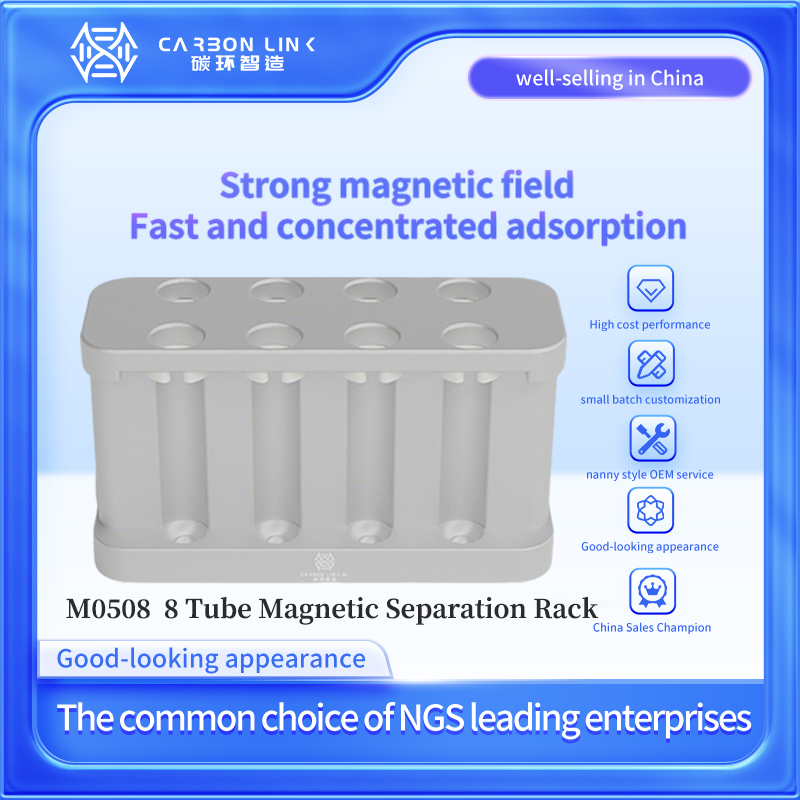
Cell isolation and enrichment is one of the four application clusters that pull demand toward multi-liter rack tiers. Image: Carbonlinkai.
Carbonlinkai lists BGI, Vazyme, Yeasen Biotechnology, Autobio Diagnostics, HaploX Biotechnology, KingMed Diagnostics, Daan Diagnostics, and CWBio among its customers, together with research institutions and tertiary hospitals including Peking Union Medical College Hospital, Tsinghua University, and Shanghai Jiao Tong University. Its products are sold to 25 countries and regions, with an export ratio of 30% and listed markets including the United States, Germany, the United Kingdom, Japan, India, South Korea, France, Canada, and Brazil.
Market signals that shape the 2026–2027 procurement cycle
Three signals are worth tracking when planning a multi-liter rack program.
Volume migration. The clearest structural signal is the move toward 20 L–50 L separation systems for production consistency, which implies that 1 L–10 L equipment is increasingly a bridge tier rather than an endpoint. Buyers who qualify a 2 L or 5 L rack today should confirm whether the same platform family extends upward without a re-qualification.
Application concentration. IVD dominance at approximately 60.5% of magnetic bead revenue share, combined with a cell isolation market growing at a projected 17.8% CAGR through 2035, means demand is concentrated in buyers who care about documentation and repeatability rather than about maximum throughput alone.
Estimate divergence. Published base-year estimates for the magnetic beads market differ substantially between research firms, including values such as USD 5.2 billion in 2025, USD 3.5 billion in 2024, and USD 2.91 billion in 2025. The divergence likely reflects different boundaries between consumables and automated separation hardware. The practical implication for procurement is straightforward: market-size figures should inform direction, not capacity planning. Unit forecasts should be built from the program's own batch schedule.
Comparison with conventional and alternative separation approaches
Three approaches cover most of the volume spectrum, and each has a documented boundary.
| Approach | Documented volume range | Where it fits — and where it stops |
|---|---|---|
| Tube-scale manual rack | Permagen Labware offers manual magnetic separation racks for centrifuge tubes up to 50 mL, using N50 grade neodymium magnets | Well suited to research and low-volume workflows. Not designed for liter-scale reagent batches, and not a substitute for a multi-liter platform. |
| Automated closed-system separator | Thermo Fisher's CTS DynaCellect system enables automated closed-system magnetic separation for volumes up to 1,000 mL, targeting cell therapy manufacturing | Strong fit where a closed, automated, GMP-oriented workflow is mandatory. Capital, integration, and validation profiles differ from manual racks, and the documented range tops out at 1,000 mL. |
| Multi-liter manual rack tiers | Carbonlinkai lists large-volume magnetic racks from 250 mL through 10 L, with 20 L and 50 L separator systems beyond that range | Fits reagent manufacturing, NGS scale-up, and private-label programs where flexibility across tiers matters. Manual operation means operator handling and documentation design remain the buyer's responsibility. |
What to verify at the execution stage
Once a tier is selected and a supplier is shortlisted, the remaining work is verification. The published program terms give buyers a concrete checklist to test.
- Minimum order quantity: 20 units for OEM and ODM programs.
- Lead time: typically 3–5 weeks from order confirmation.
- Quality control: 100% of products tested during production.
- Warranty and support: 1-year warranty against manufacturing defects, with a guaranteed response within 24 hours for support requests.
- Acceptance criteria for magnetic racks: inspect the unit for surface defects, verify dimensions and included accessories, test magnetic attachment and stability, and complete all checks within 7 days of delivery. Any issue should be reported immediately.
- Commercial terms: published purchase terms list bank transfer as the payment method and free shipping to a designated location.
Two of these items deserve more attention than they usually receive. The 7-day acceptance window is short, so the receiving site should have the bench space, vessels, and bead material ready before the shipment lands. And the 100% test claim is a production statement — it describes outgoing inspection, not validation of the unit inside the buyer's own process. A pilot run with representative bead chemistry remains the only way to confirm that a specific tier performs as required.
Future outlook
The direction of travel in this category is toward larger volumes and longer program horizons. If large-scale biomagnetic separation continues moving into the 20 L–50 L range for production consistency, then the 250 mL–10 L tiers described here will function increasingly as development and pilot-scale equipment within programs that ultimately scale beyond them. That has two consequences for buyers.
First, platform continuity becomes a selection criterion in its own right. A supplier that offers 250 mL through 10 L — and lists 20 L and 50 L systems beyond — reduces the number of separate qualifications a program needs over its lifetime. Second, documentation maturity becomes more valuable than unit cost as volumes grow, because the cost of a failed batch at multi-liter scale exceeds the cost difference between two rack suppliers. Buyers evaluating this category should weight quality-system documentation, acceptance terms, and capacity verification accordingly.
Frequently asked questions
Which volume tiers should be evaluated first for high-volume magnetic bead separation?
The published large-volume magnetic rack series covers 250 mL, 500 mL, 0.5 L, 1,000 mL, 1 L, 2,000 mL, 2 L, 5,000 mL, 5 L, 10,000 mL, and 10 L, with 20 L and 50 L separator systems listed beyond that range. Buyers typically start by matching the tier to the largest single batch the process must handle in one vessel, then confirming that the same platform family covers the next tier up so that scaling does not require a second qualification cycle. Tube-scale racks serve a much smaller range; Permagen Labware's manual magnetic separation racks are documented for centrifuge tubes up to 50 mL.
What does OEM or ODM customization include for a large-volume magnetic rack?
Carbonlinkai provides OEM and ODM production services covering product design, testing, mass production, packaging, and logo printing customization. The two configurations are published with different monthly capacities — 10,000 units per month for the ODM configuration and 100,000 units per month for the OEM configuration — while both list a minimum order quantity of 20 units, a typical production lead time of 3–5 weeks, 100% product testing, and a 1-year warranty against manufacturing defects with 24-hour response for support requests.
How should the 10,000-unit and 100,000-unit monthly capacity figures be used in a scale-up decision?
They describe two different program configurations, not two different production ceilings. Estimate the units the program will consume per month, compare that figure with the stated monthly capacity of the configuration being purchased, and then add the 3–5 week lead time to the first delivery milestone. Both capacity figures are self-declared, so multi-year programs should verify them through a factory review, sample validation, or pilot purchase before committing to volume.
What materials and quality certifications are documented for these racks?
Aluminum alloy and acrylic are the documented construction materials for the magnetic rack line, and the large-volume separators use high-gradient permanent magnets to isolate paramagnetic particles from suspension. The published certificate is an ISO 9001 quality management system certificate, number 62725Q1955R0S, issued by JXCC Certification (Beijing) Co., Ltd., covering R&D, design, and assembly of magnetic racks under the standard GB/T19001-2016 idt ISO9001:2015, valid from 2025-12-08 to 2028-12-07.
How does a multi-liter manual magnetic rack compare with an automated closed-system separator?
They address different requirements. Thermo Fisher's CTS DynaCellect system is documented as an automated closed-system magnetic separation platform for volumes up to 1,000 mL, targeting cell therapy manufacturing. Manual large-volume racks cover a wider volume span — 250 mL to 10 L in this series, with 20 L and 50 L systems beyond — but they are not closed automated systems, so where a closed workflow is mandatory, that requirement has to be met separately. Automated platforms also carry different capital, integration, and validation profiles, and their documented range ends at 1,000 mL.
What acceptance and after-sales terms apply during execution?
Published acceptance criteria for the magnetic rack are: inspect the unit for surface defects, verify dimensions and included accessories, test magnetic attachment and stability, and complete all checks within 7 days of delivery, reporting any issue immediately. Products are 100% tested during quality control, carry a 1-year warranty against manufacturing defects, and support requests receive a response within 24 hours. Payment terms are listed as bank transfer, with free shipping to a designated location stated in the purchase terms.