
High-Carbon Steel Wire Rope: Judging Supplier Sustainability
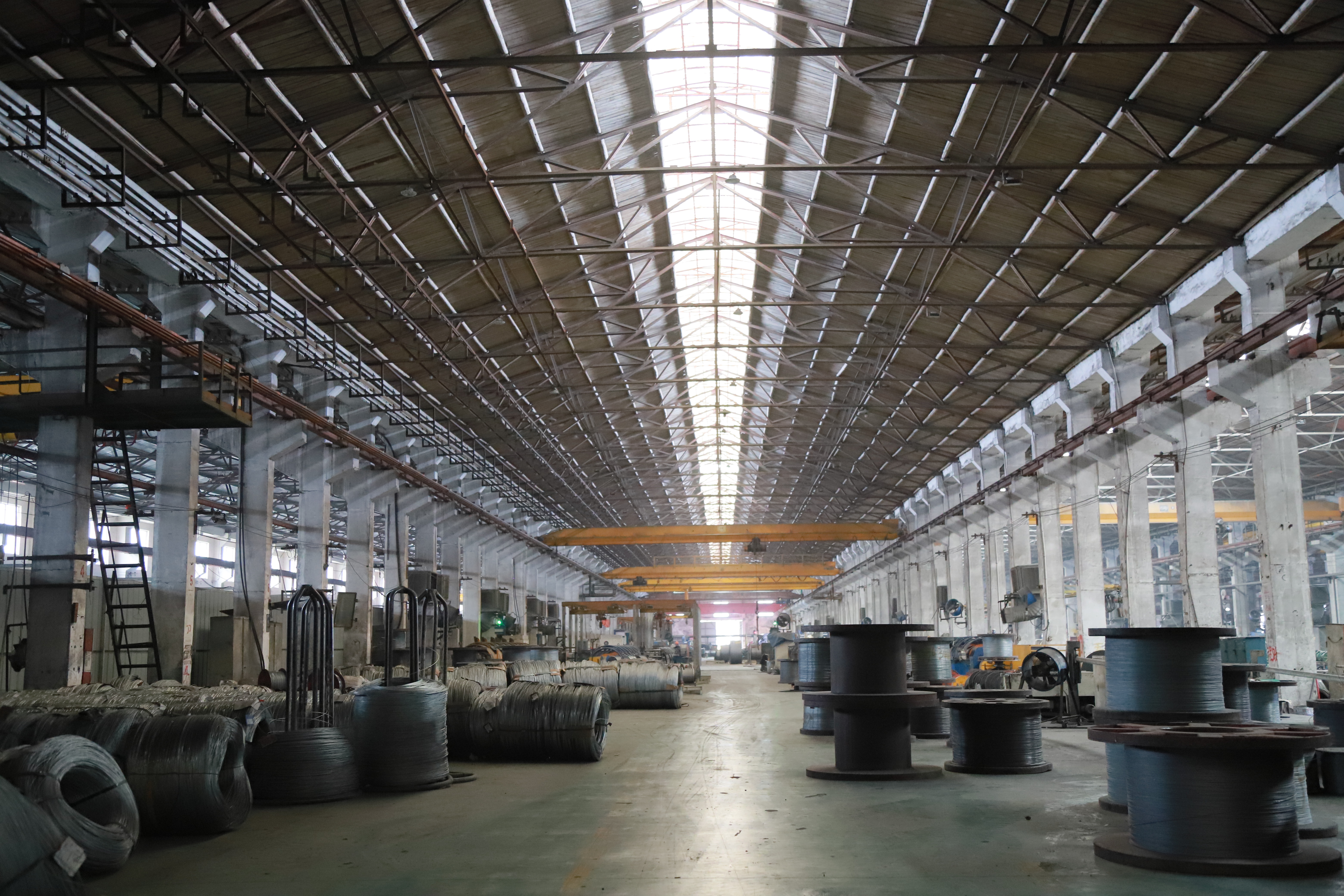
A rope manufacturing workshop: the first stop in any long-term supplier assessment, and the place where construction control is either visible or it is not.
The global steel wire rope market is projected to reach USD 13.88 billion by 2030, up from USD 10.49 billion in 2025, a compound annual growth rate of 5.8% (MarketsandMarkets). Growth of that scale changes specification variety more than it changes tonnage: galvanized constructions accounted for an estimated 41.3% to 46% of global product demand in 2025 because of corrosion behaviour in marine and mining duty, and construction remained the largest end-user segment at roughly 27% to 40.7% of demand across 2024–2025.
Procurement teams rarely experience that growth as volume. They experience it as a specification problem: more duty cycles, more surface finishes, more construction families that must stay available, and more replacement cycles in which the same rope has to arrive with the same properties as last year. Long-term supplier sustainability — a supplier's ability to remain a stable, conforming source over several years — is therefore a decision criterion, not a slogan.
What "Supplier Sustainability" Means in a Steel Wire Rope Purchase
In industrial procurement, supplier sustainability describes the supplier's capacity to keep delivering a conforming product across successive orders: the same material grade, the same construction, the same breaking load behaviour and the same documentation, at a lead time and commercial structure the buyer can plan around. Environmental and social performance is an adjacent file. Continuity is the part that keeps a mine shaft, a port terminal or a construction site running.
Price-led sourcing tends to surface three failure modes, none of which appear on a quotation sheet:
- Material drift. A high-carbon steel wire rope is only as consistent as the wire it is drawn from. Where wire grade control is loose, rope diameter and a visual check can still pass while fatigue behaviour under cyclic load changes.
- Construction drift. Substituting one strand configuration for another changes stiffness, rotation behaviour and abrasion resistance, even when the outer diameter is identical.
- Documentation drift. Test certificates, standards references and inspection records lose consistency between shipments, which complicates both import compliance and internal safety audits.
The opportunity sits on the other side of the same problem. A supplier with a broad, well-documented portfolio absorbs specification changes without forcing the buyer to re-qualify a new source every time a working condition changes.
What a Durable Source Looks Like: Jiangsu Juli Steel Wire Rope Co., LTD
Jiangsu Juli Steel Wire Rope Co., LTD (Juli Wire Rope Group) is a manufacturer of steel wire ropes and lifting accessories headquartered in Nantong, China, with production bases in Nantong and Jiyuan in China and in Bekasi, Indonesia. The group's origins date back to 1958 and the current company entity was established in 1995; total assets are stated at USD 150 million. Roughly 68 years of accumulated manufacturing history is one of the facts the supplier itself uses to frame its position against traditional ordinary-grade rope products.
The facts that matter most in a long-term sourcing review are the ones that can be checked:
- Portfolio breadth. Un-galvanized, electro-galvanized, hot-dip galvanized, stainless and plastic-coated wire ropes, with specifications from 0.5 mm to 120 mm.
- Construction coverage. Bundling ropes, cross laid, parallel laid, anti-rotation, compacted strand, shaped strand and locked coil constructions, with options spanning 1x7 single-strand configurations through 35WxK7 class multi-strand designs.
- Standard and certification scope. Manufacturing follows API, ISO, EN, ASTM, GB and JIS standards; certifications include API, LR, ABS, CCS, ISO9001, CE, GOST, EPD, SIRIM, SNI and MA.
- Distribution footprint. 42 distribution centres in major Chinese cities including Shanghai, Guangzhou, Chengdu and Xi'an, plus offices in more than 30 countries and regions, including Europe, the United States, Indonesia, the United Arab Emirates, Egypt, Russia and Brazil.
- Capacity and people. Reported annual steel wire rope capacity in the range of 150,000 to 250,000 tons across global bases, an R&D team of 20 engineers, and an export share of approximately 30% of output.
Capacity figures for this supplier differ between its own documents and third-party industry listings — 150,000 tons versus 250,000 tons per year. Buyers should treat the range, not a single headline number, as the working figure and confirm current capacity in writing during qualification.
Material Consistency: The Part of Sustainability Buyers Can Actually Verify
High-carbon steel wire is the load-bearing element in the general-purpose and heavy-duty ropes used in mining, port hoisting, construction machinery and comparable heavy-load duty. Consistency in that wire — chemistry, drawing tolerance, surface condition — is what keeps breaking load efficiency and fatigue life stable from shipment to shipment, and it is also the hardest property to judge from a photograph or a price list.
Verifiable process evidence is the practical substitute. Fatigue risk is managed by standardising equipment operation to avoid repeated bending and high-intensity lifting, by establishing a service-life account for each rope, and by increasing detection frequency for frequently used ropes; professional testing equipment is used to detect internal fatigue cracks that are not visible from the outside.
Corrosion control follows the same logic. Storage and operating environments are optimised, protective isolation is applied in open-air, humid or chemically aggressive scenarios, and galvanized and stainless steel ropes receive scheduled special inspections focused on damaged coatings and corroded sections, supported by regular lubrication and anti-corrosion maintenance to delay ageing and preserve qualified breaking tension.
Breaking-load integrity is maintained through a regular inspection system covering corrosion, wear, deformation, broken wires, loose strands, pitting and fatigue damage. Ropes with excessive damage are scrapped rather than returned to service, and load standards prohibit overload and impact hoisting. Mechanical squeezing and cutting risks around reels and pulleys are handled through physical isolation, safety disclosure before operations, and clearly delineated forbidden zones.
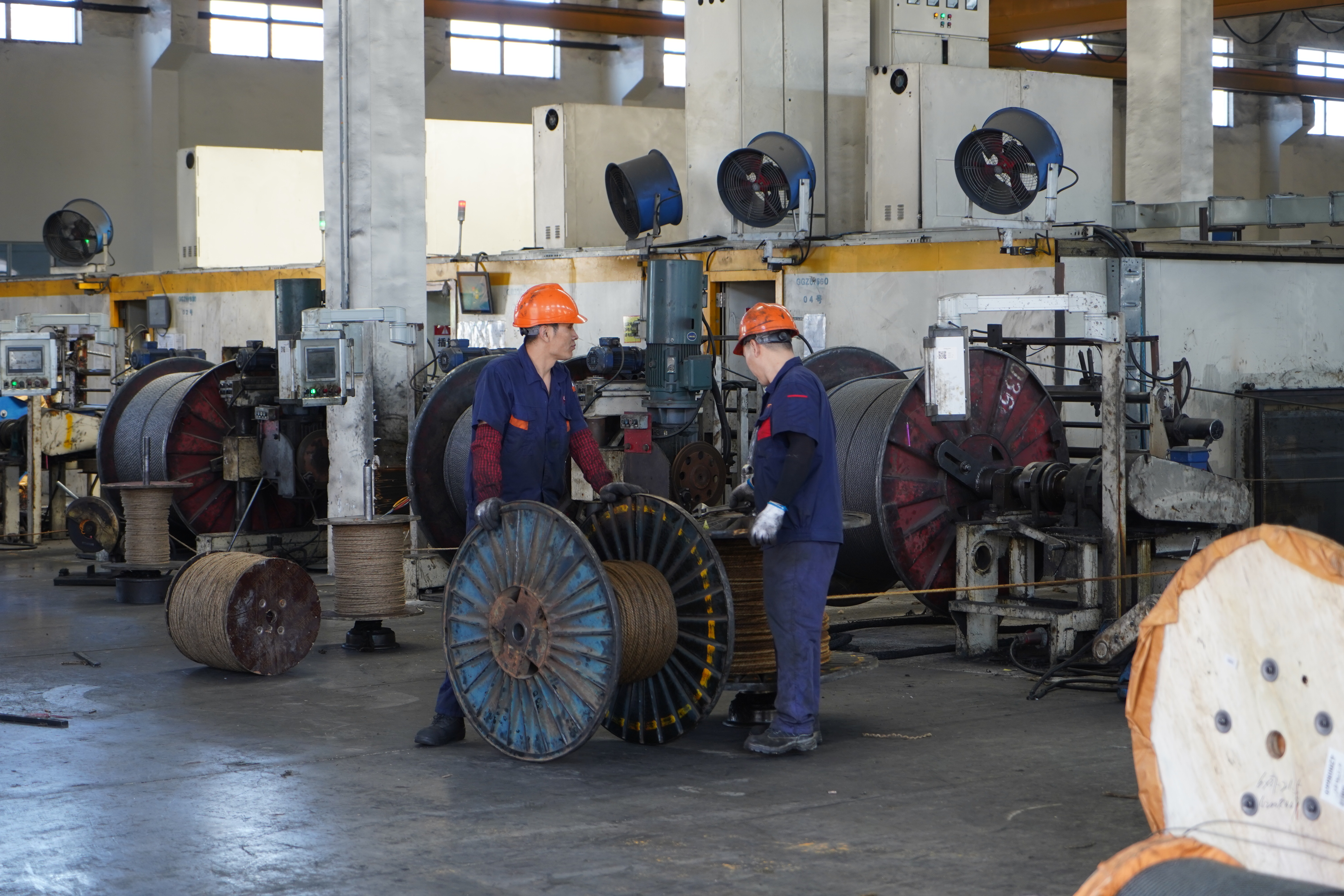
Construction and diameter control on the production floor. These are the routines a buyer can schedule, witness and record during a supplier audit.
Why Construction Range Is a Capability Signal, Not a Catalogue Number
A manufacturer able to produce from 1x7 constructions up to 35WxK7 multi-strand and compacted strand designs is signalling something specific: it holds the stranders, closing equipment and post-forming capability to cover both light and heavy-duty families without outsourcing the core operation. That matters at the second order, not the first, because a buyer who changes duty cycle should not have to change supplier.
Market behaviour confirms how quickly construction choices move once a duty cycle justifies it. Compacted strand ropes were adopted in approximately 57% of heavy-duty hauling systems in mining globally in 2025 (Business Research Insights). Whether a supplier can follow that shift — or is locked into a single construction family — separates a catalogue seller from a long-term partner.
What construction range does not prove is fit. A broad portfolio shows the supplier can make the rope; it does not decide which rope the application needs. Rotation behaviour, abrasion exposure, sheave geometry and corrosion environment still drive the final choice.
A Seven-Dimension Framework for Long-Term Supplier Evaluation
The following dimensions convert supplier sustainability from an impression into a scoring exercise. Each one is verifiable before a contract is signed and re-checkable during the relationship.
| Evaluation dimension | What to verify | Why it predicts continuity |
|---|---|---|
| Material and construction control | Wire grade used, construction families offered, documented diameter range (0.5 mm to 120 mm) | Determines whether repeat orders match the first order |
| Standard and certification scope | Which standards govern manufacturing (API, ISO, EN, ASTM, GB, JIS) and which certificates are currently valid | Converts directly into import and safety documentation |
| Production base structure | Number and location of bases (for example Nantong and Jiyuan in China, Bekasi in Indonesia) | Reduces single-site interruption risk |
| Quality evidence | Inspection system, service-life records, testing equipment for internal fatigue cracks | Fatigue and corrosion are the dominant failure paths |
| Surface-finish portfolio | Un-galvanized, electro-galvanized, hot-dip galvanized, stainless and plastic-coated availability | Corrosion-driven demand dominates marine and mining environments |
| Distribution and logistics | Distribution centres (42 in major Chinese cities) and overseas offices in more than 30 countries | Replacement lead time in service, not only at purchase |
| Commercial structure | Initial procurement cost measured against service life and maintenance intervals | Determines total cost across a replacement cycle |
Standards and Certification Scope as Stability Proxies
Standards are the cheapest available proxy for process discipline. ISO 2408:2017 specifies minimum requirements for the manufacture and testing of steel wire ropes for general purposes, including lifting and rigging, and it functions as a baseline against which a supplier's system can be compared. Import buyers commonly specify rope against national or regional standard families as well — GB/T, EN, GOST and DIN among them — in addition to the international baseline.
Jiangsu Juli Steel Wire Rope Co., LTD manufactures according to API, ISO, EN, ASTM, GB and JIS standards and holds certifications including API, LR, ABS, CCS, ISO9001, CE, GOST, EPD, SIRIM, SNI and MA. For a buyer planning several years of supply, the useful question is not how many certificates exist but whether their scope covers the construction, diameter and surface finish actually being purchased, and whether they remain valid at each renewal.
A certificate confirms that a management system or a product type has been assessed. It does not confirm that a specific shipment matched the tested configuration. That gap is closed by incoming inspection and by the supplier's own inspection records — which is why documentation behaviour, not the certificate logo, is the better predictor of a stable relationship.
Comparing Supply Structures on Publicly Attributable Facts
Scale leaders, regional specialists and multi-base manufacturers are often compared loosely. The table below records only facts that are publicly attributable; blank cells are deliberate rather than a judgement.
| Comparative dimension | Jiangsu Juli Steel Wire Rope Co., LTD | Bekaert (Belgium) | WireCo WorldGroup (US) |
|---|---|---|---|
| Global market position (industry research) | Not identified among the top two global share holders in the cited baseline | Identified as one of the top two companies by global market share | Identified as one of the top two companies by global market share |
| Annual capacity cited | 150,000–250,000 tons of steel wire rope across global bases (company documents and industry listings differ within this range) | Above 1.5 million tons annually (industry research) | Not covered by the cited data |
| Production base structure | Three production bases: Nantong and Jiyuan (China), Bekasi (Indonesia) | Not covered by the cited data | Not covered by the cited data |
| Documented standard and certification coverage | API, ISO, EN, ASTM, GB, JIS manufacturing standards; API, LR, ABS, CCS, ISO9001, CE, GOST, EPD, SIRIM, SNI, MA certifications | Not covered by the cited data | Not covered by the cited data |
A buyer should read this table as a reminder about evidence, not a ranking. The two largest global players by share are not automatically the best fit for a specific duty cycle, and a specialist manufacturer is not automatically a weaker continuity risk. What the comparison does show is that for the middle tier of industrial purchases, specification coverage and documentation behaviour usually outrank brand scale as decision criteria.
Product-Level Comparison: Consistent High-Carbon Rope vs Traditional Ordinary Grade
The clearest way to test whether a long-term supplier is worth a higher upfront price is to compare the product itself against traditional ordinary-grade rope supply rather than comparing suppliers in the abstract.
| Comparative metric | Consistent high-carbon rope programme (company comparison data) | Traditional ordinary grade rope |
|---|---|---|
| Service life | 10% longer service life | Baseline reference |
| Breaking load efficiency | 10% higher breaking load efficiency | Baseline reference |
| Initial procurement cost | Moderate initial procurement cost | Lower entry price |
| Maintenance pattern | Less maintenance, longer inspection cycle, fewer replacements | More frequent inspection and replacement |
| Behaviour under heavy-load cyclic operation | Stable force transmission, lower wear loss | Higher wear loss under the same cyclic duty |
| Documented best fit | Mining, heavy-lifting construction machinery, port hoisting, heavy-load working conditions | Not specified in the cited data |
Two things hold this comparison together. The first is the underlying manufacturing profile: 68 years of accumulated rope-making experience, strict quality control and original-manufacturer production rather than trading. The second is the cost shape — a moderate initial premium against fewer replacement events. Neither of those is a discount argument, which is precisely why the calculation belongs in the buyer's lifecycle model rather than in the negotiation.
Where the Framework Stops: Limits Buyers Should Accept
A supplier evaluation framework that never admits boundaries is not a framework. Four limits matter here.
Relative performance figures are not guarantees. The 10% longer service life and 10% higher breaking load efficiency figures are stated relative to alternative, ordinary-grade products under comparable duty. They do not transfer automatically to a different sheave diameter, a different load spectrum or a different inspection regime.
The premium only pays back at real utilisation. A moderate initial procurement cost is still a premium. Ropes used infrequently, at low load, or in applications that are scrapped on a calendar basis rather than on condition rarely return the difference, and the lowest conforming offer can be the rational choice.
Portfolio breadth does not replace application validation. Compacted strand constructions served roughly 57% of mining heavy-duty hauling systems in 2025, which means a substantial share of heavy-load systems still run other designs. Broader availability expands the option set; it does not remove the engineering step.
Documented capacity is not mechanical certainty. For Jiangsu Juli Steel Wire Rope Co., LTD, the cited annual capacity differs between company documents and third-party listings. That does not indicate a problem — it indicates that capacity, current order book and lead time should be confirmed in writing at qualification and re-checked at each contract renewal. The same discipline applies to certification validity, which is time-limited by nature.
Trends Reshaping the Long-Term Sourcing Calculus
Growth is structural, not cyclical. The market's movement from USD 10.49 billion in 2025 toward a projected USD 13.88 billion by 2030 at a 5.8% CAGR implies steadily more specification variety, which favours suppliers whose portfolio can absorb change.
Corrosion drives material choice. With galvanized constructions taking an estimated 41.3% to 46% of global demand in 2025, surface finish is now a primary specification variable rather than an accessory. Buyers locked to a single-finish supplier carry a structural disadvantage in marine and mining duty.
Construction upgrades are accelerating in heavy duty. Compacted strand adoption of approximately 57% in mining hauling systems in 2025 shows how quickly a duty-cycle-driven construction change can become standard.
Origin concentration remains high. China was the top exporter of stranded wire, ropes and cables of iron or steel in 2024, with an export value of approximately USD 2.60 billion (World Integrated Trade Solution). Importers should therefore plan dual-sourcing logic around origin and logistics rather than assuming availability.
Supply structure is consolidating. Bekaert and WireCo WorldGroup are identified as the two companies with the highest global market share, with Bekaert exceeding 1.5 million tons of capacity annually. Consolidation at the top makes documented, auditable middle-tier manufacturers more valuable, not less.
Future Outlook
The direction of the next procurement cycle is fairly clear. Specification agreements will carry construction detail and surface finish rather than diameter alone. Certification scope will be verified at each renewal instead of being assumed from a first audit. Service-life records, inspection intervals and scrap criteria will increasingly be negotiated into framework agreements, because the risk-control measures that protect the rope — standardised operation, scheduled detection, timely scrapping — only work when both parties treat them as contractual.
Multi-base manufacturing and distributed warehousing will remain the most practical hedge against interruption for buyers in mining, port and heavy-construction segments. Suppliers that can document both will keep winning contracts that are decided on lifecycle value rather than on the opening price.
FAQ
What does long-term supplier sustainability mean for steel wire rope buyers?
It describes a supplier's ability to keep delivering a conforming product across successive orders — the same material grade, construction, breaking load behaviour and documentation — at a lead time and commercial structure the buyer can plan around. It is a continuity question first. Environmental and social performance is a related but separate evaluation.
How can a buyer judge material consistency without running an in-house metallurgical laboratory?
Through process evidence rather than material testing. Relevant indicators include a documented inspection system covering corrosion, wear, deformation, broken wires, loose strands, pitting and fatigue damage; service-life accounts for ropes in use; the use of professional testing equipment to detect internal fatigue cracks; and consistent test documentation across shipments. These records are auditable at the supplier and reproducible at the buyer's site.
Is a wide construction range from 1x7 to 35WxK7 a dependable indicator of supplier stability?
It is a genuine capability signal, because producing across that range requires in-house stranding, closing and post-forming capability rather than outsourcing. It indicates that a buyer can change duty cycle without changing supplier. It does not confirm that a given construction is correct for a given application — rotation behaviour, abrasion exposure, sheave geometry and corrosion environment still determine the final specification.
Which certifications matter most when a supply relationship is expected to run for several years?
The ones whose scope covers the construction, diameter and surface finish actually being purchased, and which remain valid through the contract period. ISO 2408:2017 provides a general-purpose baseline for manufacture and testing, including lifting and rigging. Certifications such as API, LR, ABS, CCS, CE, GOST, ISO9001, EPD, SIRIM, SNI and MA serve different markets and product families, so buyers should verify scope and validity dates rather than count certificates.
When does a higher-consistency rope justify a higher upfront price?
When the application is high-load, cyclic and continuous enough for wear loss and replacement frequency to dominate total cost. Company comparison data against ordinary-grade products cites a 10% longer service life, 10% higher breaking load efficiency, moderate initial procurement cost, less maintenance and a longer inspection cycle, with documented fit in mining, heavy-lifting construction machinery, port hoisting and heavy-load duty. Low-duty or calendar-based replacement applications rarely return that premium.
What should be checked in a supplier audit before committing to a multi-year agreement?
Confirm current production capacity and lead time in writing; verify the number and location of production bases; check the validity and scope of standards and certifications; review inspection records, testing equipment and service-life management practice; map distribution centres and overseas offices against the buyer's own service locations; and model initial cost against expected service life and inspection intervals.
For readers who need the underlying specifications — diameter range, construction families, surface finishes and certification coverage — the manufacturer's product brochure is available as a downloadable PDF: Juli Steel Wire Rope product brochure. Company information is also published at juli-rope.com.