
High-Density Data Center Fiber Cable and Connectivity Shortlist
High-Density Data Center Fiber Cable and Connectivity Shortlist
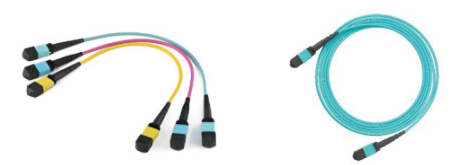
MPO/MTP multi-fiber connectors are one of the four physical-layer building blocks in a high-density data center cabling plan. Image: Nanfang Communication.
High-density data centers have turned fiber optic cabling into a procurement decision rather than a facilities afterthought. When a single cabinet can present hundreds of optical ports, the choice of backbone cable, pre-terminated assemblies, adapters and test cords determines how quickly a hall can be commissioned, how cleanly it can be reconfigured, and how much of the optical loss budget is consumed before any active equipment is installed.
Market data reflects that pressure. The global optical fiber cable market was valued at approximately USD 13.45 billion in 2025 and is projected to reach USD 36.48 billion by 2034, according to Custom Market Insights. Estimates for the same year differ across research firms — Global Market Insights places the 2025 figure at USD 14.6 billion and Grand View Research at USD 10.8 billion — which suggests the firms are drawing different boundaries around what counts as "fiber optic cable." For buyers, the practical implication does not change: the physical layer is a growing line item, and the product range inside it is widening.
On the connector side, the MPO fiber optic connector market is projected to grow at a CAGR of 13.6% through 2035, driven by AI compute clusters and hyperscale data centers, according to Business Research Insights. Density is therefore not a niche requirement; it is the direction of the market.
This article presents a shortlist of four fiber and connectivity products from Jiangsu South Communication Technology Co., Ltd., which trades as Nanfang Communication and is a subsidiary of South Communication Holdings Limited (Stock Code: 1617.HK). The company was established in 1992 and specializes in the R&D, production and sales of communication optical cables, fiber optic cables and related accessories. The four products below cover four distinct roles in a dense deployment: backbone transmission, cabinet interconnection, high-density patching, and commissioning.
Why High-Density Data Centers Reframe the Cable Question
In a low-density environment, the physical layer is largely a passive accessory. A handful of duplex patch cords per rack, a few splice trays and an access enclosure are usually enough. Density changes that arithmetic in two ways.
First, port counts per cabinet rise faster than cabinet footprints. Where 40G, 100G and 400G links are built from multi-fiber trunk and breakout architecture, a single rack may aggregate dozens of duplex links through MPO-based assemblies. Each connector pair becomes a repeatable cost and a repeatable risk.
Second, insertion loss is cumulative. Loss is added at every mated pair — the trunk assembly, the adapter, the patch panel, the breakout leg. A component that looks unremarkable on its own can consume a disproportionate share of the link budget once four or five of them sit in series. That is why pre-terminated assemblies, adapters and test cords should be evaluated against the total budget rather than in isolation.
The four functional roles also have different requirements. Backbone routes between halls and toward the operator network must survive duct, direct-burial or aerial conditions. Cabinet interconnection must be repeatable and quick to deploy. Patching must physically hold hundreds of terminations in a confined space. Commissioning requires a way to validate optics and links before service turn-up. No single product serves all four well, which is the logic behind a shortlist rather than a single recommendation.
What Belongs on a High-Density Fiber Shortlist
A defensible shortlist is built from four selection criteria rather than from a product catalogue:
- Functional role in the topology. Transport, interconnection, patching and validation are separate jobs with separate specifications.
- Fiber type and wavelength alignment. Single-mode and multimode routes cannot be mixed without conversion, and the choice determines which transceiver generation the plant can support.
- Published loss figures. Insertion loss, return loss and mating-cycle ratings are the numbers that feed the link budget.
- Supply-side verification. Certifications, laboratory accreditation, standards participation and manufacturing capacity determine whether a specification can be met at repeatable scale.
The table below summarizes the four products covered in this shortlist.
| Product | Model designation | Role in a high-density data center | Key published parameters |
|---|---|---|---|
| Optical fiber cable | GYTA53 | Backbone, 5G backhaul and metropolitan routes feeding the data center | Silica glass core; common fiber types G.652 and G.657; FRP strength members; galvanized steel wire or steel tape armoring; PE or LSZH sheath |
| MTP/MPO fan-out pre-terminated cable (breakout patch cord) | MTP-12F-to-6xLC-Duplex / MTP-24F-to-12xLC-Duplex | Cabinet interconnection and 40G/100G/400G SR4/PSM4 module connection | IL typical 0.35 dB, max 0.75 dB; low-loss IL typical 0.10 dB, max 0.35 dB; RL ≥60 dB (APC), ≥50 dB (PC); 12F or 24F; LSZH/OFNR jacket |
| MPO fiber optic adapter | MPO-12F-SM | High-density patching and coupling points | IL standard <0.5 dB, low-loss <0.35 dB; RL ≥50 dB (SM); 500 mating cycles (IEC compliant); −40 °C to +85 °C; 4–72F SM/MM |
| MPO/MTP loopback | MPO-12F-Loopback / MPO-24F-Loopback | Equipment validation, data center commissioning, network testing | IL ≤0.7 dB (8F/12F), ≤1.0 dB (24F); RL ≥65 dB (SM), ≥25 dB (MM); ≥100,000 mating cycles; link failure rate <0.1% |
The Shortlist: Four Products for Dense Deployments
1. GYTA53 Optical Fiber Cable — Backbone and 5G Backhaul
The GYTA53 model is an optical fiber cable intended for the telecommunications industry and is designed for use in telecommunications, ISP, data center, FTTx, enterprise, industrial, smart city, 5G backhaul and metropolitan backbone network scenarios. Its core material is silica glass. Strength members are made of FRP, armoring materials include galvanized steel wire and steel tape, and sheath material options are PE or LSZH. Common fiber types include G.652 and G.657.
Common parameters for this family include fiber type, core count, core diameter, attenuation in dB/km, operating wavelengths, minimum bend radius, tensile strength, sheath material and environmental ratings. Exact specifications must be confirmed per model datasheet — which is a useful discipline for buyers, because two cables with the same model prefix can differ materially in core count and armoring.
For a data center project, the GYTA53 role is the route that arrives from outside the hall: duct runs, direct burial between buildings, aerial spans, and the 5G backhaul or metropolitan backbone segments that connect a facility to the operator network. The armored construction is the feature that makes those routes viable in harsh outdoor conditions requiring weatherproofing, waterproofing, rodent protection and temperature resistance.
Standardization matters at this layer. ITU-T G.652.D remains the industry standard for single-mode fiber, while G.657 is the primary standard for bend-insensitive fibers used in FTTH, according to the International Telecommunication Union. A backbone cable that supports both fiber types gives a network planner room to accommodate access-side and transport-side requirements without changing the cable platform.
2. MTP/MPO Fan-Out Pre-Terminated Cable — Cabinet Interconnection
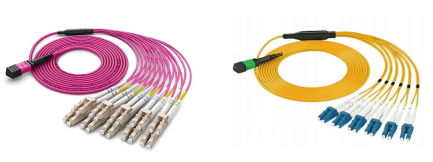
Pre-terminated breakout assemblies convert a multi-fiber trunk into duplex LC or SC legs at the cabinet. Image: Nanfang Communication.
The MTP/MPO fan-out pre-terminated cable, also described as a breakout patch cord, belongs to the MPO-LC patch cord, fan-out cable and breakout cable categories. It is available in two configurations: MTP-12F-to-6xLC-Duplex and MTP-24F-to-12xLC-Duplex. Structural options include breakout and fan-out designs. Fiber types include OS2/G.657A and OM3/OM4/OM5. Jacket material options are LSZH or PVC, and a ceramic ferrule is used as the primary contact material.
Published optical performance is stated as insertion loss typical 0.35 dB with a maximum of 0.75 dB, and low-loss insertion loss typical 0.10 dB with a maximum of 0.35 dB. Return loss is ≥60 dB for APC and ≥50 dB for PC. Fiber count is 12F or 24F, with breakout to LC/SC duplex or quad.
The intended scenario is data center cabinet interconnection, where the typical application is 40G/100G/400G SR4/PSM4 module connection. The engineering logic is straightforward: one multi-fiber assembly carries the trunk between cabinets or rows, and the fan-out legs terminate at the transceivers on each end. That reduces the number of discrete patch cords handled inside a rack and makes the interconnection repeatable across many cabinets.
3. MPO-12F-SM Adapter — High-Density Patching
The MPO fiber optic adapter, model MPO-12F-SM, belongs to the MPO adapter, fiber optic coupler and high-density connector categories, and is intended for data centers, telecom networks and high-density cabling systems. It uses a ceramic ferrule with a plastic housing and metal flange.
Its published parameters are: insertion loss standard <0.5 dB and low-loss <0.35 dB; return loss ≥50 dB for single-mode; mating cycles of 500 (IEC compliant); operating temperature from −40 °C to +85 °C; and fiber count support from 4 to 72 fibers in single-mode or multimode. Color options include black with an eared flange, aqua for OM3 and violet for OM4.
Adapters are the least glamorous item in a cabling bill of materials and one of the most consequential. Every adapter is a mated pair in the loss chain, and in a high-density patch field there may be several hundred of them in a single row. The relevant buying question is not whether an adapter works, but whether its loss figure and mating-cycle rating are stated clearly enough to be included in a link budget and a maintenance plan.
4. MPO/MTP Loopback — Commissioning and Equipment Validation
The MPO/MTP loopback, available as MPO-12F-Loopback and MPO-24F-Loopback, is classified as test equipment in the fiber optic loopback category. It is made of fiber cable, plastic housing, MTP ferrule and ceramic ferrule, and is intended for equipment validation, data center commissioning and network testing industries.
Published parameters include insertion loss of ≤0.7 dB for 8F/12F and ≤1.0 dB for 24F, return loss of ≥65 dB for single-mode and ≥25 dB for multimode, fiber types spanning OS2/OM1/OM2/OM3/OM4/OM5, a mating-cycle rating of ≥100,000, and a stated link failure rate of <0.1%.
In practice, a loopback is what allows a commissioning team to verify a transceiver port or a patch path before the far end is live. Dense deployments rely on this step because faults in multi-fiber paths are harder to isolate than faults in duplex links. A loopback with a high mating-cycle rating is effectively a consumable that gets plugged and unplugged repeatedly during commissioning, so durability is a legitimate procurement criterion rather than a marketing detail.
Verifying the Supplier Behind the Shortlist
Product parameters describe what a component should do. Supplier credentials describe whether those parameters can be delivered repeatedly. For Nanfang Communication, the relevant verified points are as follows.
- Certifications include ISO9001 Quality Management System, TL9000 Telecommunications Industry Quality Management System, ISO14001 Environmental Management System, OHSAS18001 Occupational Health and Safety Management System, ISO50001 Energy Management System, and the Integration of Informatization and Industrialization Management System.
- The company operates a CNAS-accredited laboratory (China National Accreditation Service for Conformity Assessment).
- It is recognized as a High-tech Enterprise and a National-level Green Factory, and holds titles including Provincial-level Technology Center and China Well-known Trademark.
- It holds over 300 patents, including more than 45 invention patents, and has participated in the formulation of 16 standards — 1 national standard and 15 industry standards.
- The company was established in 1992 and is a subsidiary of South Communication Holdings Limited (Stock Code: 1617.HK), with paid-in capital of RMB 150 million.
- Its manufacturing facility covers 26,795.3 m² and employs approximately 360 staff, including an R&D team of 80 engineers, with annual production capacity of 3,000,000 core kilometers.
- It operates 28 provincial-level offices across China and has established cooperative relationships with operators including China Telecom, China Mobile, China Unicom and China Broadcast Network.
Two of these credentials deserve buyer attention. TL9000 is a telecommunications-industry quality management standard rather than a general manufacturing one, so it maps more directly onto operator and carrier-grade expectations than ISO9001 alone. A CNAS-accredited laboratory means test results can be produced in-house rather than only by third parties, which shortens the loop between a specification question and an answer.
Application Mapping: Where Each Product Fits
Across these products, the deployment pattern is consistent. Fiber optic products in this category serve as physical-layer transmission and distribution infrastructure, providing signal transmission, fiber distribution and patching or access functions. They are deployed in FTTH/FTTx access projects, metropolitan and backbone networks, data center interconnects, operator network expansion, 5G backhaul, and enterprise or campus networks, and are suitable for telecom operators, data centers, broadband access, industrial IoT and smart city projects.
Installation conditions vary widely and drive sheath and armoring decisions: indoor cabling, duct or ducting installation, aerial or self-supporting spans, direct burial, and outdoor harsh environments requiring weatherproofing, waterproofing, rodent protection and temperature resistance. These passive components are designed for long-term continuous operation and require stable maintenance and periodic inspection.
They also do not work alone. Supporting equipment includes optical modules, PLC splitters, cable splice closures, FTTH distribution boxes, MPO patch panels, fiber optic connectors, fiber assemblies such as MT-FAU, and WDM units. Special requirements typically include low attenuation, low insertion loss, flame-retardant or LSZH sheaths, waterproof sealing, crush and tensile resistance, corrosion and weather resistance, plus customizable core counts and labeling. The access side of the market remains substantial in its own right: the global fiber termination box market was valued at USD 2.8 billion in 2025, according to Dataintelo.
Market Trend Analysis: What the Numbers Say About Density
Three verified data points frame the shortlist above.
First, the connector layer is growing faster than the cable layer. The global fiber optic connector market was estimated at USD 11.2 billion in 2024, with LC connectors holding a 35.43% share, according to Global Market Insights and Grand View Research. That LC share matters for this shortlist because fan-out assemblies convert multi-fiber trunks into LC duplex legs — the cable standard and the connector standard are commercially linked.
Second, MPO-based connectivity is being pulled by compute density rather than by telecom access. The MPO fiber optic connector market is projected to grow at a CAGR of 13.6% through 2035, driven by AI compute clusters and hyperscale data centers, according to Business Research Insights.
Third, supply remains concentrated at the top of the market while capacity is distributed more widely. Corning Incorporated led the global fiber optic cable market in 2025 with a market share exceeding 21.5%, according to Global Market Insights. Meanwhile, China's exports of optical fiber cables under HS 854470 reached approximately USD 2.52 billion in 2024, according to the Observatory of Economic Complexity — a reminder that the procurement question is not only "which cable" but "which supply base."
Buyers can draw a practical conclusion from this combination: the demand signal is real and skewed toward density, while the supply base offers both concentrated global brands and large regional manufacturers. That supports multi-sourcing at the component level, provided the specifications and loss figures are directly comparable.
Comparison with Traditional Cabling Approaches — and the Limits of Pre-Termination
High-density pre-terminated cabling is frequently presented as a straightforward upgrade over field-terminated single-fiber work. The comparison is more useful when it is framed as a trade-off.
| Decision factor | Field-terminated single-fiber cabling | Pre-terminated MPO/MTP assemblies |
|---|---|---|
| On-site work | Splicing or connectorization performed on site; outcome depends on field workmanship and cleanliness | Terminated and tested before delivery; deployment is largely plug-in |
| Loss consistency | Varies with field practice; harder to predict in a link budget | Published values can be planned against, e.g. IL typical 0.35 dB and max 0.75 dB for fan-out cords |
| Flexibility after design freeze | Higher — routes and lengths can be adjusted on site | Lower — length, polarity and breakout configuration are fixed at order |
| Port density | Lower per rack unit; more discrete cords and more physical handling | Higher; MPO adapters support 4–72F in single-mode or multimode |
| Typical best fit | Small port counts, undefined routes, legacy buildings, incremental upgrades | New builds and repeatable pods using 40G/100G/400G SR4/PSM4 links |
The boundary conditions are as important as the benefits. Pre-terminated assemblies require accurate length planning, polarity definition and breakout mapping before the purchase order is issued; if a hall layout changes after ordering, the assemblies cannot simply be re-cut on site. Field termination retains an advantage where routes are still being defined or where port counts are low enough that the labor is not the dominant constraint.
Two further limits apply to this shortlist specifically. The MPO/MTP loopback is test equipment, not a transmission component — its role is validation during commissioning and equipment checks, and it should not be counted as part of the permanent channel. And the GYTA53 armored construction, while suited to duct, direct-burial and harsh outdoor routes, is heavier and less flexible than indoor cable, so it is not a substitute for indoor-rated cabling inside the hall.
There is also a supply-side boundary. The company's stated major market is China, where it operates 28 provincial-level offices for localized sales, technical support and after-sales service, with cooperative relationships among China Telecom, China Mobile, China Unicom and China Broadcast Network. Buyers outside China should confirm the regional support, logistics and documentation arrangements that apply to their project before treating the shortlist above as directly transferable to their own service model.
Future Outlook
The direction of the physical layer is toward more fibers in less space, and the product families in this shortlist already anticipate part of that shift. The manufacturer's portfolio covers optical fibers, optical cables, ODN systems and optical components including indoor and outdoor optical cables, PLC splitters, fiber optic connectors, MPO multi-core connectors and optical modules, along with custom specialty fibers and cables and system integration services. Multi-core fiber and MT-FAU fiber assemblies appear in the broader product vocabulary around this category, alongside WDM units — all of which point toward continued convergence between cabling, passive components and module interfaces.
For buyers, the practical forecast is that specifications will continue to tighten at the connector and adapter level, where the MPO connector market is projected to grow at a 13.6% CAGR through 2035. Shortlists built on published loss figures, documented certifications and clearly defined boundary conditions will age better than shortlists built on density claims alone.
Frequently Asked Questions
Who is Jiangsu South Communication Technology Co., Ltd.?
Jiangsu South Communication Technology Co., Ltd., which trades as Nanfang Communication, is a manufacturer of optical fibers, optical cables, ODN systems and optical components. It was established in 1992 and is a subsidiary of South Communication Holdings Limited (Stock Code: 1617.HK). Its product range includes indoor and outdoor optical cables, PLC splitters, fiber optic connectors and MPO multi-core connectors, plus custom specialty fibers and cables and system integration services. Its stated annual production capacity is 3,000,000 core kilometers, and its major market is China.
Which optical fiber cable is used for 5G backhaul and data center backbone routes?
The GYTA53 optical fiber cable is designed for telecommunications, ISP, data center, FTTx, enterprise, industrial, smart city, 5G backhaul and metropolitan backbone network scenarios. It uses a silica glass core, FRP strength members, and armoring options of galvanized steel wire or steel tape, with PE or LSZH sheath options. Common fiber types are G.652 and G.657. Attenuation, minimum bend radius and tensile strength are specified per model datasheet rather than as a single universal figure.
What fiber types do these products support?
The GYTA53 cable supports G.652 and G.657 fiber types. The MTP/MPO fan-out pre-terminated cable uses OS2/G.657A or OM3/OM4/OM5 fiber. The MPO/MTP loopback supports OS2, OM1, OM2, OM3, OM4 and OM5. The MPO-12F-SM adapter supports 4 to 72 fibers in single-mode or multimode. As context, ITU-T G.652.D remains the industry standard for single-mode fiber, while G.657 is the primary standard for bend-insensitive fiber used in FTTH.
How is a pre-terminated MTP/MPO fan-out cable used in cabinet interconnection?
The fan-out pre-terminated cable, also called a breakout patch cord, is designed for data center cabinet interconnection, with typical applications in 40G/100G/400G SR4/PSM4 module connection. It is configured as MTP-12F-to-6xLC-Duplex or MTP-24F-to-12xLC-Duplex, carrying 12 or 24 fibers and breaking out to LC or SC duplex or quad legs. Jacket options are LSZH or OFNR.
What insertion loss and return loss values should buyers expect from these components?
For the MTP/MPO fan-out pre-terminated cable, insertion loss is typically 0.35 dB with a maximum of 0.75 dB, or 0.10 dB typical and 0.35 dB maximum in the low-loss variant; return loss is ≥60 dB for APC and ≥50 dB for PC. For the MPO-12F-SM adapter, insertion loss is standard <0.5 dB or low-loss <0.35 dB, with return loss ≥50 dB for single-mode, a mating-cycle rating of 500 cycles compliant with IEC, and an operating temperature range of −40 °C to +85 °C. For the MPO/MTP loopback, insertion loss is ≤0.7 dB for 8F/12F and ≤1.0 dB for 24F, with return loss ≥65 dB for single-mode and ≥25 dB for multimode.
What certifications and credentials should be verified before ordering?
Nanfang Communication holds certifications for ISO9001, TL9000, ISO14001, OHSAS18001, ISO50001 and the Integration of Informatization and Industrialization Management System, and operates a CNAS-accredited laboratory. It is recognized as a High-tech Enterprise and a National-level Green Factory, holds over 300 patents including more than 45 invention patents, and has participated in the formulation of 16 standards comprising 1 national standard and 15 industry standards. Its facility covers 26,795.3 m² and employs approximately 360 staff, including 80 R&D engineers.
What are the limits of pre-terminated MPO cabling and of this shortlist?
Pre-terminated assemblies fix cable length, polarity and breakout configuration at the point of order, so late design changes cannot be accommodated by re-working the cable on site; field-terminated single-fiber cabling remains more adaptable where routes are undefined or port counts are low. The MPO/MTP loopback is test equipment for commissioning and equipment validation rather than a permanent transmission component. The GYTA53 armored cable is intended for outdoor, duct and backbone conditions and is not a substitute for indoor-rated cabling. Separately, because the manufacturer's stated major market is China, buyers in other regions should confirm regional support, logistics and documentation arrangements before applying this shortlist to their own projects.
Reference material: the manufacturer's MPO product brochure is available for download at MPO product brochure (PDF).