
High-Purity PSA Nitrogen Generator Shortlist Criteria
A practical shortlist framework for engineers and specifiers: filtration stages, dryer dew points, pressure ratings and 1-500 Nm³/h high-purity output bands.
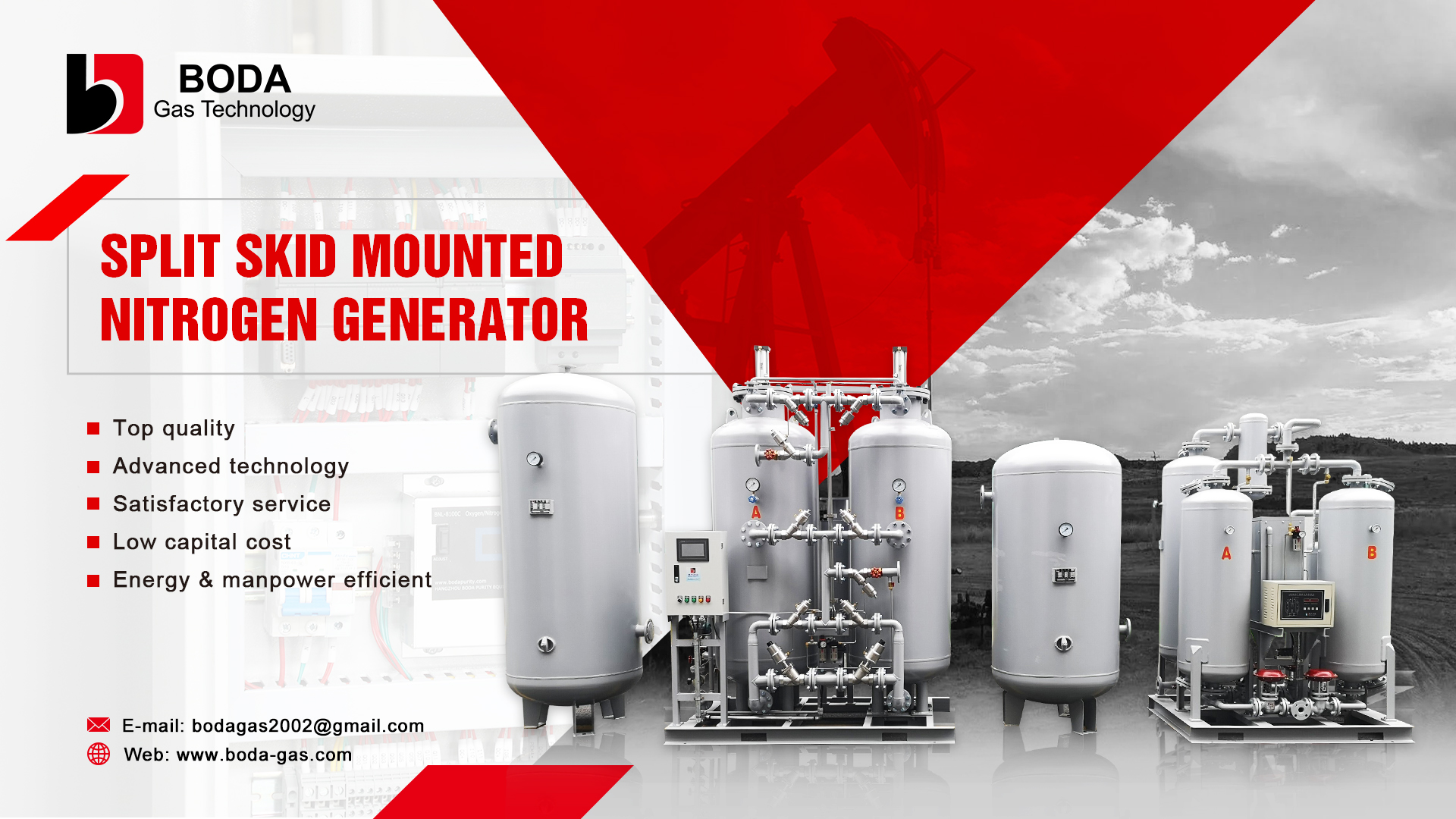
A high-purity PSA Nitrogen Generator is not selected on purity alone. It is a compressed-air separation system whose stability depends on what happens before the carbon molecular sieve towers: oil removal, particulate filtration, water removal and dew-point control. For engineers preparing a shortlist, the useful question is not simply who can quote 99.999% nitrogen, but which configuration keeps that purity stable at the required flow and pressure, hour after hour.
BODA GAS, the industrial gas-equipment brand of Hangzhou Boda Purity Equipment Co., Ltd., is a China-based manufacturer of PSA nitrogen and oxygen generators and compressed-air purification equipment. Its BXN Series, BCP Series and BHP Series provide concrete reference points for the criteria discussed here, while the FYS, FAL, FLY, FLT, FLC, FAD, ADL, ADH and FAG Series show how pre-treatment should be specified as part of the same shortlist, not as an afterthought.
The shortlist problem: purity is a system outcome
In PSA nitrogen generation, compressed air passes through carbon molecular sieves under pressure. Oxygen is preferentially adsorbed, while nitrogen remains in the gas phase and is delivered as product gas. The separation principle is well established, and PSA nitrogen generators can reach purities up to 99.999% using carbon molecular sieves. The engineering difficulty is not the principle; it is keeping the sieve protected and the operating point stable.
Oil vapour, liquid water, fine particles and unstable inlet temperature all consume the margin that high-purity operation depends on. A shortlist that compares only generator model numbers is therefore incomplete. It should compare the air-treatment train, the dryer dew point, the pressure design envelope and the rated output at the specified purity. This is especially true for Industrial PSA Nitrogen Generator projects in chemical, pharmaceutical, electronics and food packaging environments, where a small drift in dew point or residual oil can become a quality-record issue.
The approach below uses known product attributes rather than invented benchmark scores. It is a checklist for evaluating supplier documentation and configuration logic; it is not a substitute for site-specific engineering.
Shortlist at a glance
| Criterion | What to verify | BODA GAS reference point | Why it changes the decision |
|---|---|---|---|
| Bulk water and oil removal | First-stage separation efficiency, pressure loss, drain control | FYS Series: gas-liquid separation efficiency >98%, pressure loss ≤0.02 MPa | Reduces the load on fine filters and dryers |
| Fine filtration | Particle protection, element replacement logic, pressure loss | FAL Series precision filter, 1-500 Nm³/min, ≤0.02 MPa | Protects downstream oil-removal, carbon filter and molecular sieve |
| Oil removal | Residual oil content, filtration precision, stage design | FLY Series: outlet oil content <0.01 mg/m³, filtration precision 0.1 μm | Oil contamination is a direct risk to adsorbent performance |
| Hydrocarbon polishing | Residual oil, carbon-dust control, airflow distribution | FLT Series: outlet oil content <0.003 mg/m³, anti-powder-leakage baffle | Terminal protection for high-purity PSA and membrane systems |
| Dew point | Qualified air dew point, regeneration air loss, inlet temperature | ADL/ADH: ≤-40°C or ≤-52°C; FAG: ≤-60°C to -70°C | Moisture control protects sieve capacity and supports low-dew-point nitrogen |
| Pressure and output | Generator outlet pressure, dryer design pressure, rated flow at purity | BXN: 1-3000 Nm³/h, 0.1-1.15 MPa; BCP: 1-500 Nm³/h | Prevents mixing component ratings with system capability |
Filters: specify the train, not a filter count
For high-purity PSA, filtration is usually arranged as a sequence. The first stage removes bulk liquid water and oil droplets; the second traps particles; the third reduces oil mist; the fourth polishes hydrocarbon vapour; and a fifth stage may provide sterile filtration where the nitrogen contacts pharmaceutical, food or medical products. The exact combination depends on the compressor type, site conditions and purity target, but the logic is consistent.
The FYS Series high efficiency oil-water separator is a front-end component. It uses three-stage centrifugal, impact and gravity-settling separation, with a stated gas-liquid separation efficiency above 98%. Its rated air treatment flow is 1-500 Nm³/min, working pressure is 0.6-0.8 MPa with 0.8-3.0 MPa optional, and pressure loss is ≤0.02 MPa. Because it relies on physical separation without a consumable filter element, it reduces the moisture and oil load reaching downstream filters, dryers and the PSA generator.
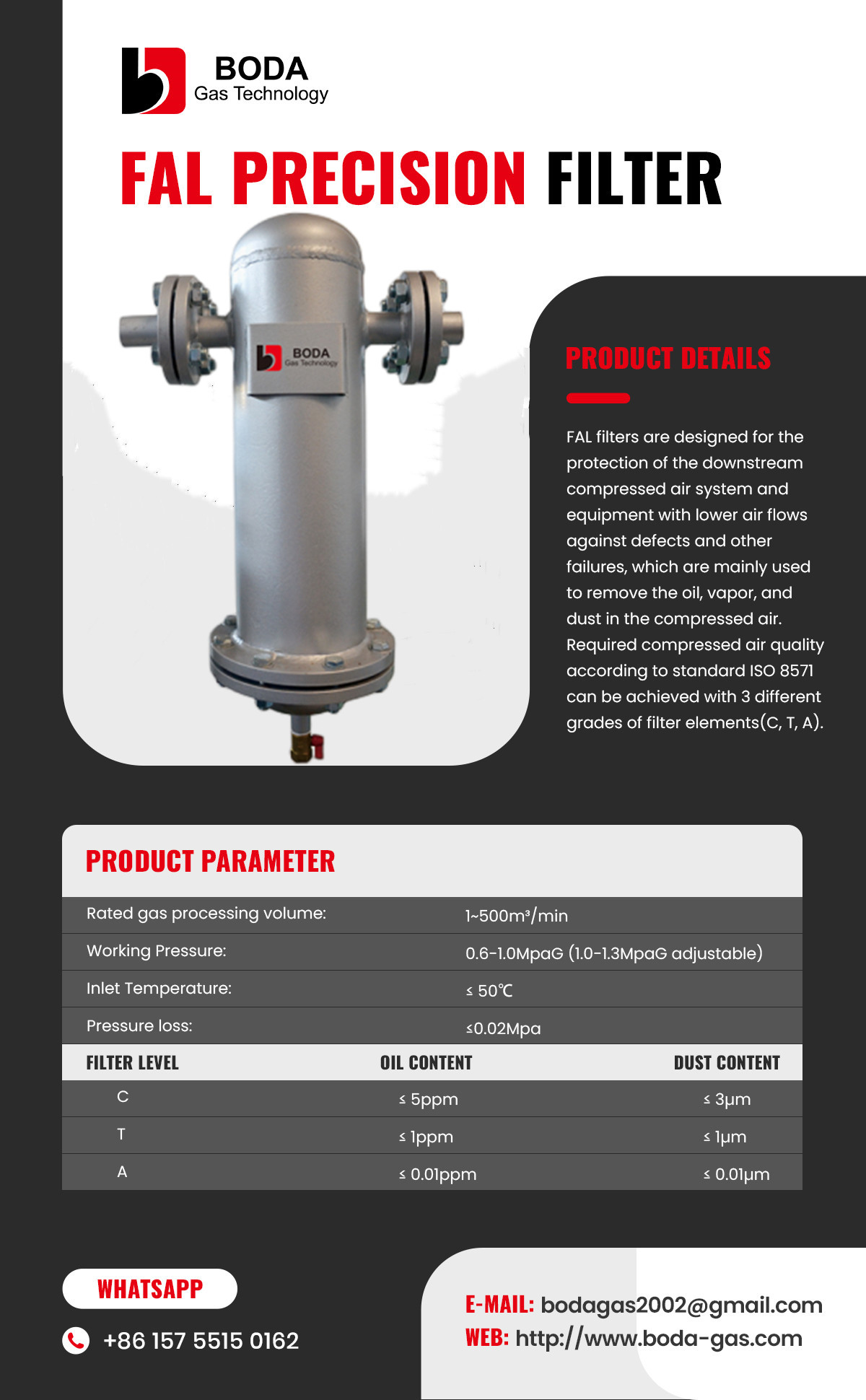
The FAL Series precision filter is a second-stage protection component. It is rated for 1-500 Nm³/min and 0.6-0.8 MPa, with 0.8-3.0 MPa optional, and pressure loss ≤0.02 MPa. Its gradient composite glass-fibre cartridge traps dust, rust, fine water droplets and oil mist. In a high-purity shortlist, this filter should not be treated as a generic accessory: its role is to protect the oil-remover, activated-carbon filter, dryer and molecular sieve that follow.
The FLY Series high efficiency oil-remover combines cyclone separation, coarse filtration and fine filtration. Its stated finished-air filtration precision is 0.1 μm and residual oil content is below 0.01 mg/m³. It is listed for PSA nitrogen and oxygen pre-treatment, as well as lithium-battery, photovoltaic, semiconductor, pharmaceutical, beverage and food nitrogen-packaging applications. That breadth is useful for shortlisting because it shows the component is intended to protect molecular sieve from oil pollution across demanding duty cycles.
The FLT Series activated carbon filter is the hydrocarbon-polishing stage. It uses high-density column-shaped activated-carbon granules, multi-layer graded filling to avoid airflow short-circuit, and an anti-powder-leakage baffle-plate design to prevent carbon dust from entering downstream equipment. Its stated outlet oil content is below 0.003 mg/m³, with pressure loss ≤0.02 MPa and a working pressure of 0.6-0.8 MPa or 0.8-3.0 MPa optional. It is described as terminal-stage purification for high-purity PSA nitrogen generators and membrane gas-separation plants, protecting adsorbent from oil-vapour contamination.
Where sterile gas is required, the FLC Series sterilizing filter becomes relevant. It has a 0.1 μm filtration accuracy, a hydrophobic microporous filter cartridge, and a working temperature range of 0-80°C or 0-121°C for steam. It supports online steam sterilization at 121°C for repeated use and is suitable for air or nitrogen service. Typical uses include aseptic beverage filling, dairy processing, food nitrogen-filled sterile packaging, biopharmaceutical aseptic workshops and medical gas sources. The shortlist question is not whether every project needs an FLC filter, but whether the end use requires a validated sterile barrier after the PSA system.
Dryers: the dew-point step that protects the sieve
Compressed air leaving a compressor is warm and moisture-laden. If that moisture reaches the carbon molecular sieve, adsorption capacity is diverted from oxygen separation to water removal. The dryer choice therefore belongs in the high-purity shortlist, not in a utilities package reviewed later.
The FAD Series refrigeration dryer provides a qualified air dew point of ≤-23°C under ambient pressure, with rated air treatment flow of 1-200 Nm³/min and working pressure of 0.6-0.8 MPa or 0.8-3.0 MPa optional. It is a pre-treatment component for PSA nitrogen and oxygen generators and protects molecular sieve from moisture damage. For many general industrial applications, this may be sufficient as a first drying stage, but high-purity PSA projects often require a lower dew point.
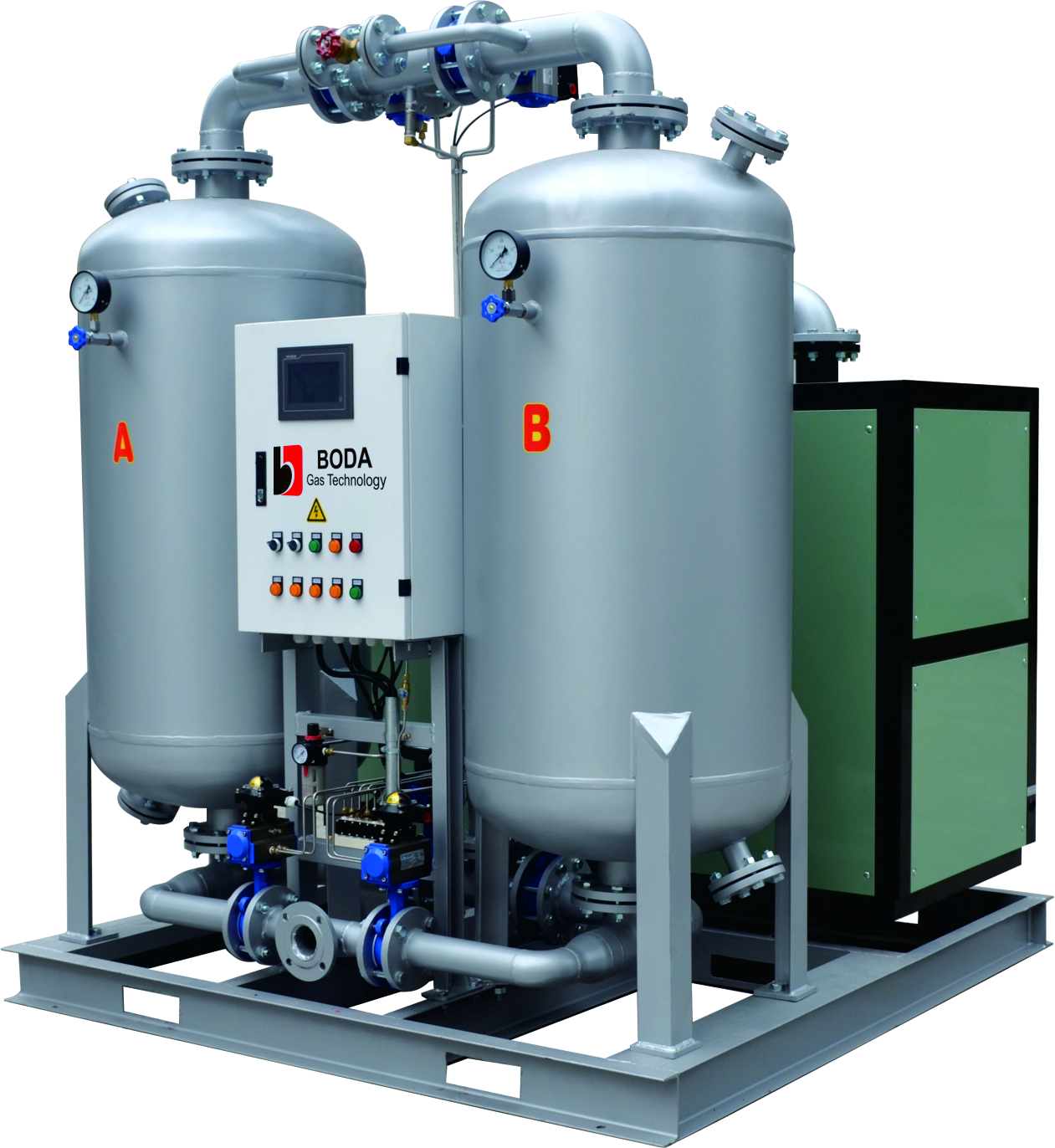
The ADL Series heatless compressed air desiccant dryer covers 0.5-500 Nm³/min, with a qualified air dew point of ≤-40°C or ≤-52°C, working pressure of 0.6-0.8 MPa or 0.8-3.0 MPa optional, regeneration air loss ≤12%, and pressure loss ≤0.02 MPa. The ADH Series heated desiccant dryer covers 1-500 Nm³/min, the same -40°C or -52°C dew-point band, and a lower regeneration air loss of ≤6%. These are relevant where the PSA system must deliver a dry product gas or where the site cannot accept high purge-air consumption.
The FAG Series combined low dew point compressed air dryer goes further. It combines refrigerated drying and adsorption drying in one unit, with a qualified air dew point of ≤-60°C to -70°C, rated air treatment flow of 1-300 Nm³/min, working pressure 0.6-0.8 MPa or 0.8-3.0 MPa optional, and regeneration air loss of 3-6%. It is listed as pre-treatment for PSA oxygen generators, PSA nitrogen generators and membrane gas-separation plants. For high-purity nitrogen with a low-dew-point requirement, the FAG Series is the component that links air treatment to the product-gas specification.
A common specification error is to quote a dryer dew point without stating whether it is a pressure dew point, an atmospheric dew point, or the qualified air dew point at a defined inlet condition. The BODA GAS data uses qualified air dew point and inlet temperature limits, which should be compared on the same basis. Another error is to assume that a lower dryer dew point automatically improves nitrogen purity. It supports stable operation, but the final purity still depends on the PSA tower design, carbon molecular sieve, cycle control and product-flow specification.
Pressures: separate design pressure from product pressure
High-purity PSA shortlists often mix three different pressure values: the compressed-air supply pressure, the dryer or filter design pressure, and the nitrogen outlet pressure. They are not interchangeable. The BXN Series PSA nitrogen generator lists a nitrogen pressure of 0.1-1.15 MPa, adjustable. The ADL, ADH, FAG, FYS, FAL, FLY, FLT and FLC units list 0.6-0.8 MPa working pressure with 0.8-3.0 MPa optional. The optional higher pressure applies to the pre-treatment equipment design, not automatically to the PSA generator output.
This distinction matters at the shortlist stage because a project may need high-pressure nitrogen for laser cutting, blowing, injection or cylinder filling, while the PSA generator itself operates in a different pressure band. If the end use requires a higher delivery pressure, the system may need a booster or a different system architecture. The supplier should state the generator outlet pressure, the allowable pre-treatment pressure, and the pressure-loss budget across filters and dryers. BODA GAS lists pressure loss ≤0.02 MPa for the FYS, FAL, FLY, FLT, FLC, FAD, ADL, ADH and FAG components, which makes the pressure-loss review more transparent.
For a high-purity Industrial PSA Nitrogen Generator, the pressure question should be answered with a simple table in the quotation: minimum inlet pressure, maximum inlet pressure, design pressure of each vessel, normal pressure drop, outlet pressure at rated flow, and any booster requirement. If those values are absent, the shortlist is not yet technically comparable.
Outputs: match the 1-500 Nm³/h band to the right platform
The assigned shortlist frame focuses on 1-500 Nm³/h high-purity outputs. That band is practical because many high-purity projects in pharmaceutical, food, electronics and fine chemical production do not need thousands of cubic metres per hour, but they do need a stable purity and dew point at the specified flow. Within the BODA GAS range, the BCP Series carbon loaded purification nitrogen generator covers 1-500 Nm³/h, and the BHP Series hydrogenation purification nitrogen generator covers 10-2000 Nm³/h. The broader BXN Series covers 1-3000 Nm³/h, so a 1-500 Nm³/h requirement can be met within a platform that also scales upward.
| Model series | Output range | Purity and dew point | Shortlist note |
|---|---|---|---|
| BXN Series | 1-3000 Nm³/h | 95%-99.999%; dew point -40°C to -70°C; pressure 0.1-1.15 MPa adjustable | Broad industrial platform; confirm the exact purity-flow point |
| BCP Series | 1-500 Nm³/h | ≥99.9995%; dew point ≤-60°C; O₂ ≤5 ppm; CO₂ ≤1 ppm | Carbon-loaded purification; no hydrogen in the process |
| BHP Series | 10-2000 Nm³/h | ≥99.9995%; dew point ≤-60°C; O₂ ≤5 ppm; hydrogen adjustable or ≤5 ppm by model | Hydrogenation purification route for specific metallurgical and glass duties |
| BMN Series | 5-3000 Nm³/h | 95%-99.9%; pressure 0.1-1.2 MPa adjustable; dew point -40°C or -60°C | Membrane alternative for lower purity bands; not a like-for-like high-purity PSA substitute |
The shortlist should ask for the output at the guaranteed purity, not the maximum flow at a lower purity. PSA systems are often quoted across a purity-flow curve: a given generator may produce more gas at 95% than at 99.999%. The BXN Series range of 95%-99.999% makes this explicit. A buyer comparing a 200 Nm³/h offer at 99.9% with a 200 Nm³/h offer at 99.999% is not comparing the same duty unless the pressure, dew point and allowable turndown are also stated.
For high-purity duties, the BCP Series is a useful reference because its published limits combine several constraints in one place: ≥99.9995% purity, dew point ≤-60°C, oxygen ≤5 ppm and carbon dioxide ≤1 ppm, with an output of 1-500 Nm³/h. The BHP Series extends this logic to hydrogenation purification, with BHP-I allowing hydrogen content from 500 ppm to 5% adjustable, and BHP-II specifying hydrogen ≤5 ppm. Those are different process choices, not interchangeable upgrades.
Application fit: let the end use set the constraint
Chemical Industry projects typically require 99.0%-99.99% nitrogen for reactor inert shielding, raw-material tank blanketing and pipeline purging. Explosion-proof and ASME requirements may also appear. A high-purity shortlist for this sector should therefore check hazardous-area classification, material selection and the dryer-filter train before comparing generator brands.
Food and Beverage Packaging requires 99.0%-99.9% food-grade oil-free nitrogen for modified atmosphere packaging, beverage production and tank blanketing. The system usually needs an oil-free air compressor and stainless steel where product contact is possible. For food-grade nitrogen, EIGA standards require at least one continuously online residual oxygen analyzer in the nitrogen gas stream, so the shortlist should include the analyzer and alarm logic, not only the generator.
Pharmaceutical Industry duties commonly require 99.99%-99.999% purity, with oil-free and stainless steel construction. The FLC Series sterilizing filter and the low-dew-point dryer chain become part of the quality argument. Electronics Industry work can require 99.99% for common SMT workshops and 99.999%-99.9999% for chip-and-wafer precision manufacturing, with dew point ≤-60°C. Oil and gas applications may accept 95%-99.9% but place greater emphasis on explosion-proof construction and site conditions.
These application bands are not a substitute for a line-by-line gas specification. They are a way to prevent a common shortlist error: selecting a generator on the basis of a headline purity number while ignoring the dew point, residual oil, CO₂, pressure and analyzer requirements that the end use actually imposes.
Market trend: high-purity demand is becoming more specific
The global industrial nitrogen generator market was valued at USD 4.29 billion in 2023 and is projected to reach USD 6.47 billion by 2031, according to Verified Market Research. Within that market, Pressure Swing Adsorption technology accounts for approximately 48% of the global nitrogen generator market share, making it the most dominant technology segment, based on Fortune Business Insights data. PSA is not a niche choice; it is the main technology platform against which high-purity specifications are written.
Capacity data also supports the 1-500 Nm³/h shortlist frame. PSA nitrogen generator installations are divided by capacity into sub-100 Nm³/h at 42%, 100-500 Nm³/h at 36%, and above 500 Nm³/h at 22%, according to Precedence Research and Dataintelo. The 1-500 Nm³/h band therefore covers the majority of installed capacity, while the BXN Series can extend to 3000 Nm³/h when a project grows beyond that band.
Application demand is equally specific. The food and beverage segment dominated the nitrogen generator market in 2023, holding approximately 49.8% of revenue share due to MAP applications, according to Grand View Research. The chemical industry segment is expected to grow at the highest CAGR of 6.0% among applications, based on Maximize Market Research data, due to increased use in blanketing and reactor purging. These trends do not change the basic PSA principle, but they do raise the importance of documented pre-treatment, food-grade analyzers and hazardous-area compliance.
Comparison with traditional supply and membrane systems
On-site PSA generation changes the supply model. Instead of relying on cylinder or liquid-nitrogen deliveries, the site produces nitrogen from compressed air. One industry estimate indicates that on-site nitrogen generation can reduce nitrogen supply costs by up to 40% compared with traditional cylinder deliveries by eliminating logistics fees. That estimate is useful for a business case, but it should not be treated as a universal saving: power cost, utilization rate, maintenance and local gas prices determine the actual result.
Membrane systems are another on-site option. The BODA GAS BMN Series membrane separation nitrogen generator covers 5-3000 Nm³/h, 95%-99.9% purity, 0.1-1.2 MPa adjustable pressure and -40°C or -60°C dew point. PSA systems are favored over membrane systems for high-purity requirements above 99.9%, because membrane purity is typically capped at lower levels. That boundary is the key comparison point. If a project needs 99.9995% with ≤5 ppm oxygen and ≤1 ppm CO₂, a standard membrane package is not the same category of solution; a PSA system with purification becomes the relevant platform.
The limitation of PSA is equally important. PSA is not a maintenance-free box. It depends on pre-treatment consumables and periodic service. BODA GAS maintenance guidance lists precision filter element replacement around every 8000 hours, air-dryer desiccant replacement generally at 16000-24000 hours, and carbon molecular sieve life of 6-10 years. Air-compressor service remains a separate maintenance item. A shortlist that ignores these intervals may produce a lower purchase price but a higher operating burden. PSA is also less attractive where the purity requirement is low, the site has no reliable compressed-air utility, or the available footprint and maintenance capability cannot support a complete air-treatment train.
Evidence and compliance checks for the shortlist
Certification is not a substitute for engineering, but it is a useful filter. BODA GAS holds ISO 9001:2015 quality management system certification, certificate number 244-25-QL-11075-R0-S, issued by YAB CERTIFICATION CO.,LTD. It also holds ISO 14001:2015 environmental management system certification, certificate number 244-24-EJ-09517-R2-S, and ISO 45001:2018 occupational health and safety management system certification, certificate number 244-24-SY-09318-R2-S. The ISO 45001 scope covers the production of BXN PSA nitrogen equipment, BXO PSA oxygen equipment, general refrigeration compressed air dryer and general adsorption compressed air dryer.
For EU projects, pressure vessels in PSA nitrogen generators must comply with the Pressure Equipment Directive, PED 2014/68/EU, and bear the CE mark. This is a regulatory checkpoint, not a brand comparison. The shortlist should ask for the applicable directive, notified-body involvement where required, material certificates and the CE marking documentation for the pressure-containing scope.
For food-grade nitrogen, the EIGA requirement for at least one continuously online residual oxygen analyzer in the nitrogen gas stream is a practical shortlist item. The analyzer should have a defined alarm and diversion logic so that out-of-specification gas does not reach packaging. For pharmaceutical and sterile food applications, the FLC Series sterilizing filter can provide a 0.1 μm sterile barrier with 121°C online steam sterilization, but the validation of the sterile boundary still depends on the full system design and operating procedure.
A buyer-side shortlist checklist
- State the required nitrogen flow at the guaranteed purity, not the maximum flow at a lower purity.
- State the required dew point and whether it is a pressure dew point or atmospheric dew point.
- State the allowable residual oil, CO₂ and oxygen limits, with the analyzer method and alarm logic.
- Confirm the generator outlet pressure and the design pressure of each dryer, filter and vessel.
- Review the pre-treatment train as a sequence: bulk separation, precision filtration, oil removal, carbon polishing and sterile filtration where required.
- Check whether the dryer dew point matches the product-gas specification or only protects the sieve.
- Confirm material selection, hazardous-area classification, CE or ASME requirements and applicable certificates.
- Compare maintenance intervals and consumable replacement guidance, not only purchase price.
- Require a pressure-loss budget and a footprint drawing for the complete skid or containerized package.
Future outlook
Asia-Pacific is the fastest-growing region for PSA nitrogen generators, projected to hold a 35% market share by 2032, according to Verified Market Research. As high-purity production expands in electronics, pharmaceuticals and specialty chemicals, the shortlist is likely to become more explicit about pre-treatment performance and less tolerant of undefined dew-point or residual-oil claims. The capacity mix also suggests continued demand for modular and skid-mounted packages in the 1-500 Nm³/h band, alongside larger BXN configurations for projects above 500 Nm³/h.
For suppliers, the practical implication is that a PSA Nitrogen Generator offer should read as a system offer: filters, dryers, pressure envelope, output at purity, analyzer, certification and maintenance plan. For buyers, the implication is equally clear: a good-quality shortlist is not a list of brand names. It is a set of constraints that can be compared on paper before any equipment is ordered.
FAQ
Which filtration stages should a high-purity PSA nitrogen generator include?
A typical high-purity train uses bulk water and oil separation, precision filtration, high-efficiency oil removal, activated-carbon polishing and, where required, sterile filtration. BODA GAS lists the FYS Series for bulk separation above 98%, the FAL Series for precision filtration, the FLY Series for residual oil below 0.01 mg/m³, the FLT Series for residual oil below 0.003 mg/m³, and the FLC Series for 0.1 μm sterile filtration with steam sterilization. The exact train should be set by the compressor type, site conditions and end-use gas specification.
What dew point should the air dryer deliver before the PSA towers?
That depends on the product-gas requirement. The FAD Series refrigeration dryer provides ≤-23°C, the ADL and ADH Series desiccant dryers provide ≤-40°C or ≤-52°C, and the FAG Series combined low dew point dryer provides ≤-60°C to -70°C. A dryer dew point below the product specification is not automatically necessary, but a dryer that is too warm for the application can overload the carbon molecular sieve and destabilize purity.
How do pressure ratings differ between the generator and the pre-treatment equipment?
The BXN Series PSA nitrogen generator lists an adjustable nitrogen pressure of 0.1-1.15 MPa. The FYS, FAL, FLY, FLT, FLC, FAD, ADL, ADH and FAG pre-treatment units list 0.6-0.8 MPa working pressure, with 0.8-3.0 MPa optional. The optional higher pressure is a design rating for the pre-treatment component, not a statement that the PSA generator outlet reaches 3.0 MPa without a booster.
How should output be specified when comparing 1-500 Nm³/h offers?
Specify the flow at the guaranteed purity, pressure and dew point. The BCP Series covers 1-500 Nm³/h at ≥99.9995%, while the BHP Series covers 10-2000 Nm³/h and the BXN Series covers 1-3000 Nm³/h. A 200 Nm³/h offer at 99.9% is not equivalent to a 200 Nm³/h offer at 99.9995% unless the other constraints are also matched.
When is additional purification needed beyond a standard PSA generator?
Additional purification is needed when the application requires higher purity or lower residual impurities than the base PSA output can guarantee. The BCP Series carbon loaded purification nitrogen generator provides ≥99.9995% purity, dew point ≤-60°C, oxygen ≤5 ppm and carbon dioxide ≤1 ppm, without hydrogen in the process. The BHP Series hydrogenation purification route also provides ≥99.9995% purity and ≤-60°C dew point, with different hydrogen-content options. The choice depends on the allowed process route and the end-use gas specification.
Which certificates should be checked for a high-purity PSA project?
At minimum, check the quality management certificate and the certificates relevant to the destination market. BODA GAS holds ISO 9001:2015 certificate 244-25-QL-11075-R0-S, ISO 14001:2015 certificate 244-24-EJ-09517-R2-S, and ISO 45001:2018 certificate 244-24-SY-09318-R2-S. For EU pressure vessels, PED 2014/68/EU compliance and CE marking are required. For food-grade nitrogen, an online residual oxygen analyzer should be included in the nitrogen stream.
Reference document: BODA GAS product manual (PDF), available for public access and download: Product Manual - BODA GAS TECH.
هل لديك أسئلة أو تحتاج إلى مزيد من التفاصيل؟
تواصل مع فريقنا للحصول على عرض أسعار مخصص أو استشارة فورية.
طلب عرض أسعار
املأ النموذج أدناه وسيتواصل معك فريقنا بعرض مقترح مخصص.
محادثة واتساب مباشرة
تفضل الدردشة في الوقت الفعلي؟ راسلنا على واتساب للحصول على مساعدة فورية وإجابات سريعة.
- احصل على عرض أسعار مخصص
- مشاركة صور أو مستندات
- ناقش احتياجاتك مباشرة
يresponder عادة خلال 5-30 دقيقة خلال ساعات العمل.