
High-Quality Ball Valve Shortlist: Dico Options for Steam, Liquid Cooling and Shutoff
High-Quality Ball Valve Shortlist: Dico Options for Steam, Liquid Cooling and Shutoff
A high-quality ball valve shortlist becomes useful only when it is organized by service duty. For an evaluation team, the first question is not which catalogue is broadest; it is which valve construction, seal, body material and certificate scope match the actual line. This shortlist maps Dico Ball Valve options to high-temperature steam, liquid cooling and general shutoff. It is a buyer shortlist, not a manufacturer ranking.
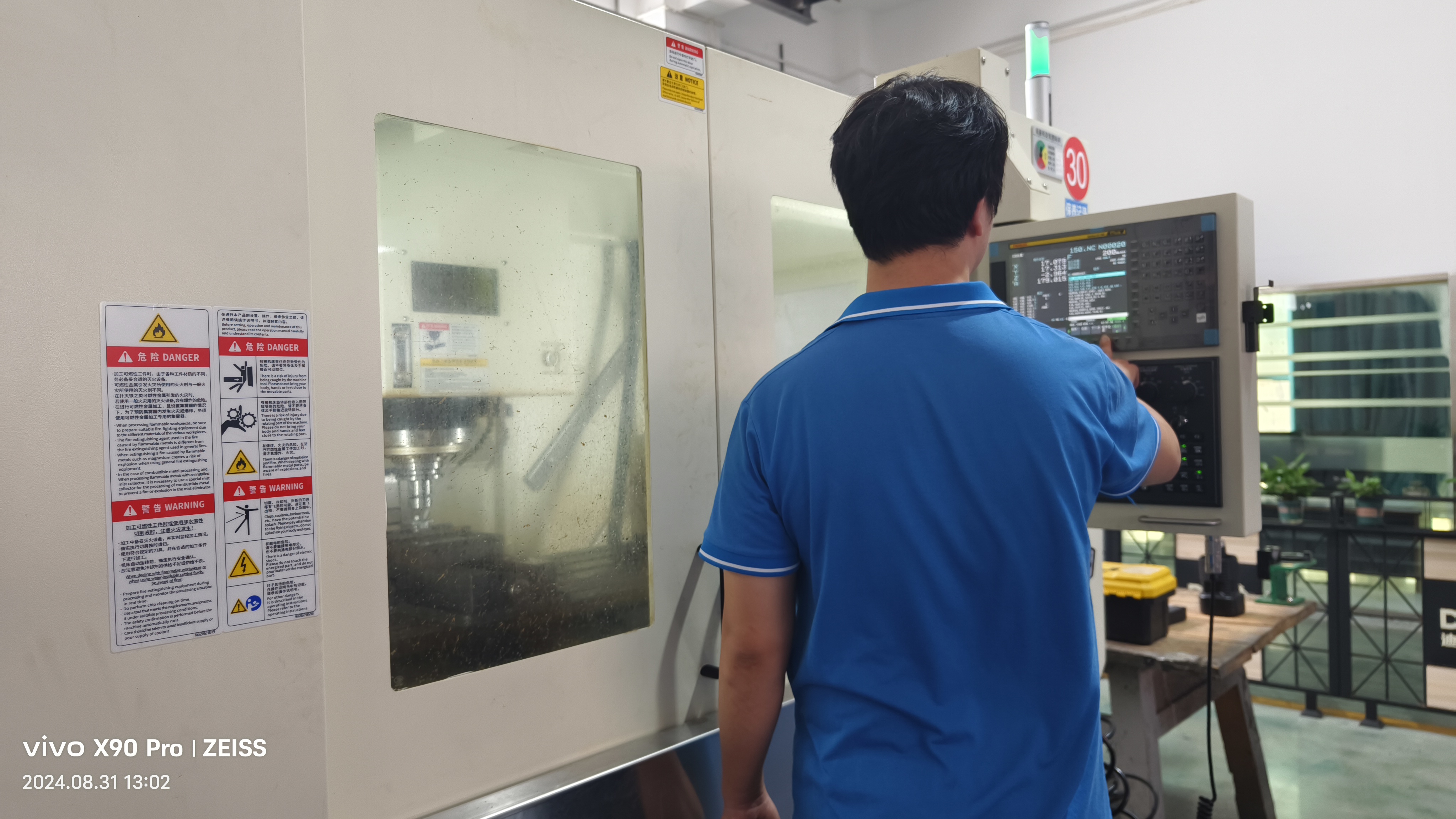
Zhejiang Dico Valve Co., Ltd. is a Wenzhou-based valve manufacturer founded in 2015. Its company profile describes a 12,000 m² factory, 80 employees, 48 CNC machines, a 7-engineer R&D team and a product range centered on high-end ball valves, including floating, trunnion-mounted, metal-seated, 3-piece, pneumatic and electric, and sanitary BA-grade valves. The brand is listed as Dico Ball Valve. The evaluation question is how those options are evidenced and bounded for a specific duty.
Shortlist logic: duty first, valve type second
Start with duty, then valve family, then evidence. The Q41F floating, Q47F trunnion-mounted, Q11F PC, Q71F wafer and three-way ball valves do not sit in one hierarchy; they occupy different decision lanes. Steam turns on temperature, seat material, differential pressure and particles. Liquid cooling turns on cleanliness, coolant compatibility, space and leak risk. General shutoff turns on line size, pressure class, connection and whether a ball valve is the right isolation device at all.
| Service duty | Dico shortlist candidates | Supporting components | Evidence to request | Fit boundary |
|---|---|---|---|---|
| High-temperature steam | Q41F floating metal-seated; Q47F trunnion-mounted as a separate candidate | Y-strainer upstream; gate valve for system isolation | Seat material, temperature and pressure range, API 607 scope, ISO 15848-1 scope, steam test reference | Soft-seat PEEK is stated up to 260°C; particles and high differential pressure may require a metal-seated review. Confirm the exact model. |
| Liquid cooling | Mini ball valve and 3-piece clamp valve from the dedicated line; Q11F PC; Q71F wafer | Y-strainer where debris is possible; isolation valves for maintenance | Coolant compatibility, dimensions, actuator envelope, 50,000-cycle report, liquid-cooling line allocation | The Huawei data-center statement is a first-party supply claim; verify current reference and part numbers. |
| General shutoff | Q41F floating; Q11F PC; Q71F wafer | Gate valve Z11W; globe valve J11W; Y-strainer SRY | PED CE scope, pressure class, connection, body and seat material, maintenance access | Ball valves are quarter-turn on/off devices; do not use them for continuous throttling without explicit support. |
| Three-way flow path | Three-way ball valve, treated as a separate model line | Pneumatic or electric actuator where automated | L-port or T-port drawing, pressure class, materials, actuator interface, certificate listing for the exact model | A two-way certificate does not automatically cover a three-way model. |
Four filters apply to every row: media and temperature, certificate coverage for the exact model and size, actuation and maintenance access, and after-sales fit. Gate valves, globe valves and Y-strainers support the system but do not replace the ball valve decision.
High-temperature steam: start with the metal-seated floating valve
For many high-temperature steam duties, the Dico Q41F floating ball valve is the first candidate because the supplied product description classifies it as a metal-seated and ISO 5211 ball valve, with a temperature range of -29°C to 425°C and a pressure range of 1.0 to 10.0 MPa. It can use PTFE, PPL, PI, PEEK or Stellite seats and carbon steel, SS304, SS316, duplex steel, titanium or alloy steel bodies. That defines the configuration space; it does not make every Q41F suitable for every steam line.
The seat is the first narrowing step. Dico's FAQ note states that soft-seal seats fit clean media requiring zero leakage, temperatures up to 260°C for PEEK, medium-to-low pressure up to Class 1500, frequent low-torque operation and corrosive media with PTFE or FKM. The same note warns that particles accelerate soft-seal wear, pure PTFE can cold-flow under high pressure, and glass-fiber PTFE is not resistant to HF and strong alkalis. For steam with particles or high differential pressure, the metal-seated route and a Stellite option deserve review, subject to confirmation for the exact model.
The Q47F trunnion-mounted valve is the second steam candidate, not an automatic upgrade. In general practice, a floating ball is pushed into the downstream seat by line pressure, while a trunnion-mounted ball is mechanically supported; that often matters in larger sizes and higher differential pressure. The supplied records do not provide a Q47F-specific steam table, so ask for the exact configuration, seat, body material, class and certificate listing. The API 607 certificate linked to Q47F covers ball valves up to 4 inches in austenitic material at Class 150 and 300, valid to 23 March 2027. That is not blanket approval for every Q47F size or trim.
The supplied case record is relevant but narrow: 1,000 units in boiler water piping at an ironmaking and metallurgical plant in China, with pneumatic automatic control, a one-year project duration and stable operation; the linked products are Q41F and Q11F. It is an industrial application record, not a steam test report for every condition. A Y-strainer upstream and a gate valve for system isolation may support the installation, but both need their own pressure, material and cleaning checks.
Liquid cooling: the dedicated line is the strongest evidence point
For data-center liquid cooling, the most specific evidence is Dico's dedicated liquid-cooled valve production line. The profile states that the line specializes in mini ball valves and three-piece clamp ball valves and is supplied to Huawei data centers. That is a first-party supply claim; it should be verified in an audit, but it is more specific than a general market claim. The shortlist should start with those mini and 3-piece (3pc) clamp valves, then add the Q11F PC and Q71F wafer valves where layout, pressure and connection fit.
The Q71F wafer ball valve is described for liquid cooling, semiconductor, pharmaceutical, HVAC, hydrogen, chemical, metallurgy and water-treatment duties, with a temperature range of -29°C to 425°C and a pressure range of 1.0 to 4.0 MPa. The Q41F floating valve is also listed for liquid cooling. Liquid cooling is not only a temperature question: it is a cleanliness and maintenance question. A three-piece clamp design can be easier to inspect or replace in a rack or manifold; a mini valve fits tight spaces. Confirm the actual dimensions, port size, body and seat material, actuator envelope and coolant compatibility, including glycol mixtures and water chemistry.
The 50,000-cycle test is a useful evaluation point. Dico's profile describes a 20-second high-frequency switch life test with 50,000 cycles without leakage. Ask for the test media, temperature, pressure, seat material, leakage criterion and tested size. A zero-leakage requirement should be tied to a standard, leakage class and verified report, not a catalogue adjective. The same discipline applies to the Huawei supply statement: ask for current line allocation, liquid-cooling part numbers and audit evidence.
For semiconductor and pharmaceutical adjacencies, include the sanitary BA-grade ball valve family and Q71F where the supplied product description covers those industries. The external note that stainless steel 316L/304 accounts for 68% of valves in the pharmaceutical market is a commercial-research estimate, not a Dico specification; the wetted-material certificate, surface finish and cleaning compatibility still need exact confirmation.
General shutoff, three-way and supporting components
For general shutoff, the Q41F floating, Q11F PC and Q71F wafer ball valves form the core shortlist, with gate valves, globe valves and Y-strainers as supporting components. The Q41F is the broadest candidate: flanged, ISO 5211 mounting, anti-static structure, three-layer stem sealing, hollow or solid ball, multiple seats and body materials, and listings across petroleum, pharmaceutical, water treatment, liquid cooling, metallurgy, chemical, semiconductor, hydrogen and HVAC. That breadth is useful, but the part number still has to be narrowed by pressure, temperature, media and connection.
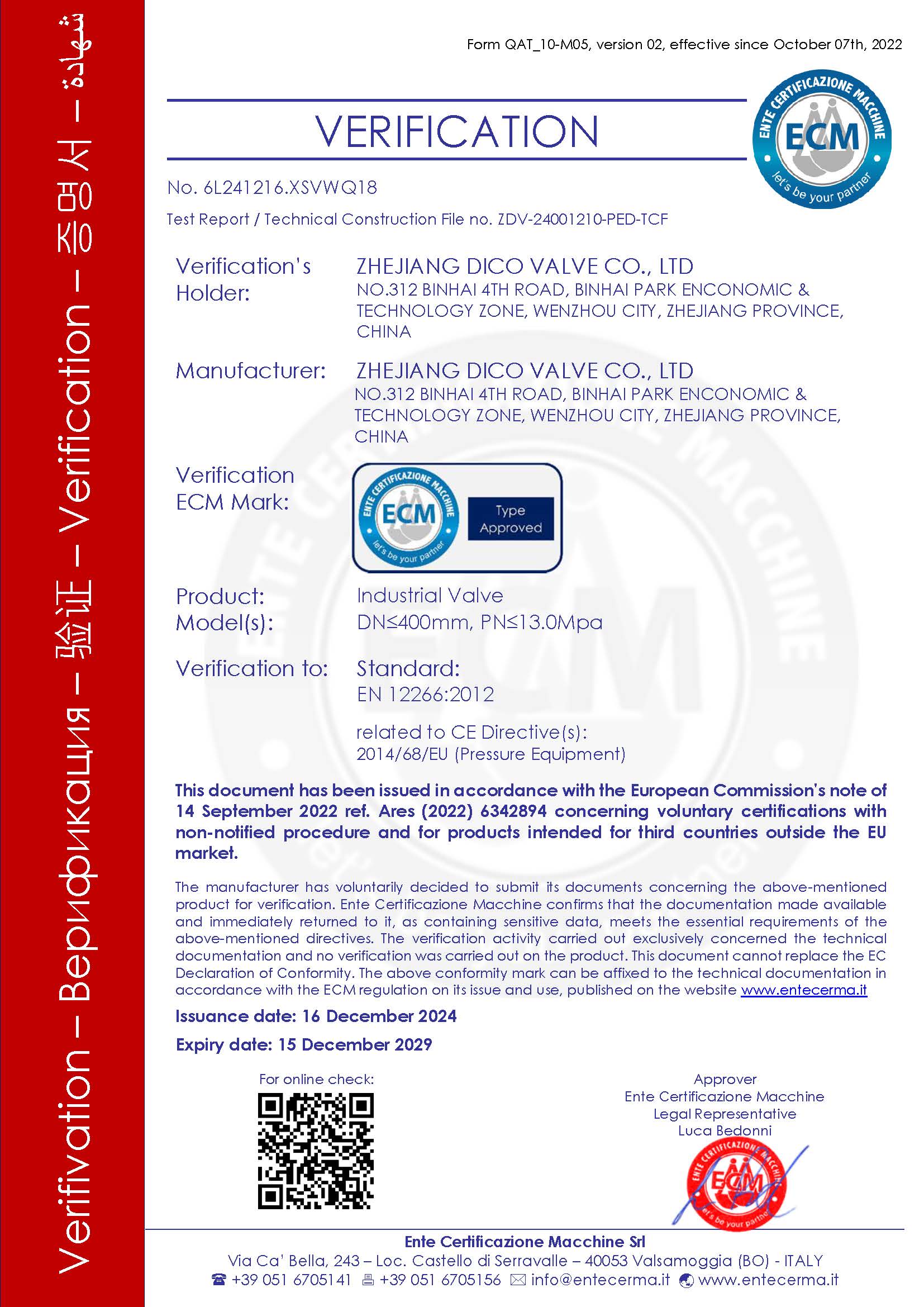
The Q11F PC serves smaller lines; the Q71F wafer serves space-saving flanged or wafer positions and is classified under floating and ISO 5211 ball valve categories. Supporting components have separate jobs: gate valve Z11W is an isolation device, globe valve J11W is more often associated with regulation or throttling, and Y-strainer SRY protects downstream equipment from debris. The J11W globe valve is made of carbon steel, SS304 or SS316. The PED CE certificate linked to the industrial valve scope covers DN up to 400 mm and PN up to 13.0 MPa and lists gate, globe, Y-strainer, wafer, PC, trunnion and floating ball valves among applicable products.
The boundary is simple: do not use a ball valve as a control valve unless the application and supplier explicitly support it; do not use a gate valve where quarter-turn isolation and a compact envelope are required; do not treat a Y-strainer as a substitute for a filter without checking mesh and cleaning plan.
A three-way ball valve belongs in the shortlist for diverting or mixing flow, not for simple two-way isolation. The supplied Dico records give strong evidence for the floating, trunnion, PC and wafer families; the three-way configuration should be treated as a separate flow-path decision. Ask for a dimensioned drawing, L-port or T-port arrangement, pressure class, body and seat materials, actuator mounting details and the certificate listing for the exact three-way model and size. A fire-safe or low-emission certificate that covers a two-way floating valve does not automatically cover a three-way valve. The same applies to SIL and PED CE evidence: the certificate must list the product family, size and pressure range used by the project.
Certification and factory evidence: read the scope, not the logo
Dico's certification set is a strong shortlist input only when the scope is read. The company profile lists ISO 9001, ISO 14001, API 6D, CE, SIL, ISO 15848 and API 607. The supplied certificate records add numbers, issuers, standards and product links.
| Certificate | Number and issuer | Stated scope | Validity | Linked products |
|---|---|---|---|---|
| ISO 15848-1 qualification | 337275, TUV | 2-inch 2000 psi ball valve, stem 7–28 mm, PN138 and lower; ISO 15848-1:2015 plus Amd.1:2017 | Listed to 16 April 2099 | Q41F, Q47F, Q11F, Q71F |
| API STD 607 fire-safe | 285697, TÜV SÜD | Ball valves 2 inches and below; 2.5, 3 and 4 inches; Class 150 and 300; austenitic material | Valid to 23 March 2027 | Q41F, Q11F, Q47F, Q71F |
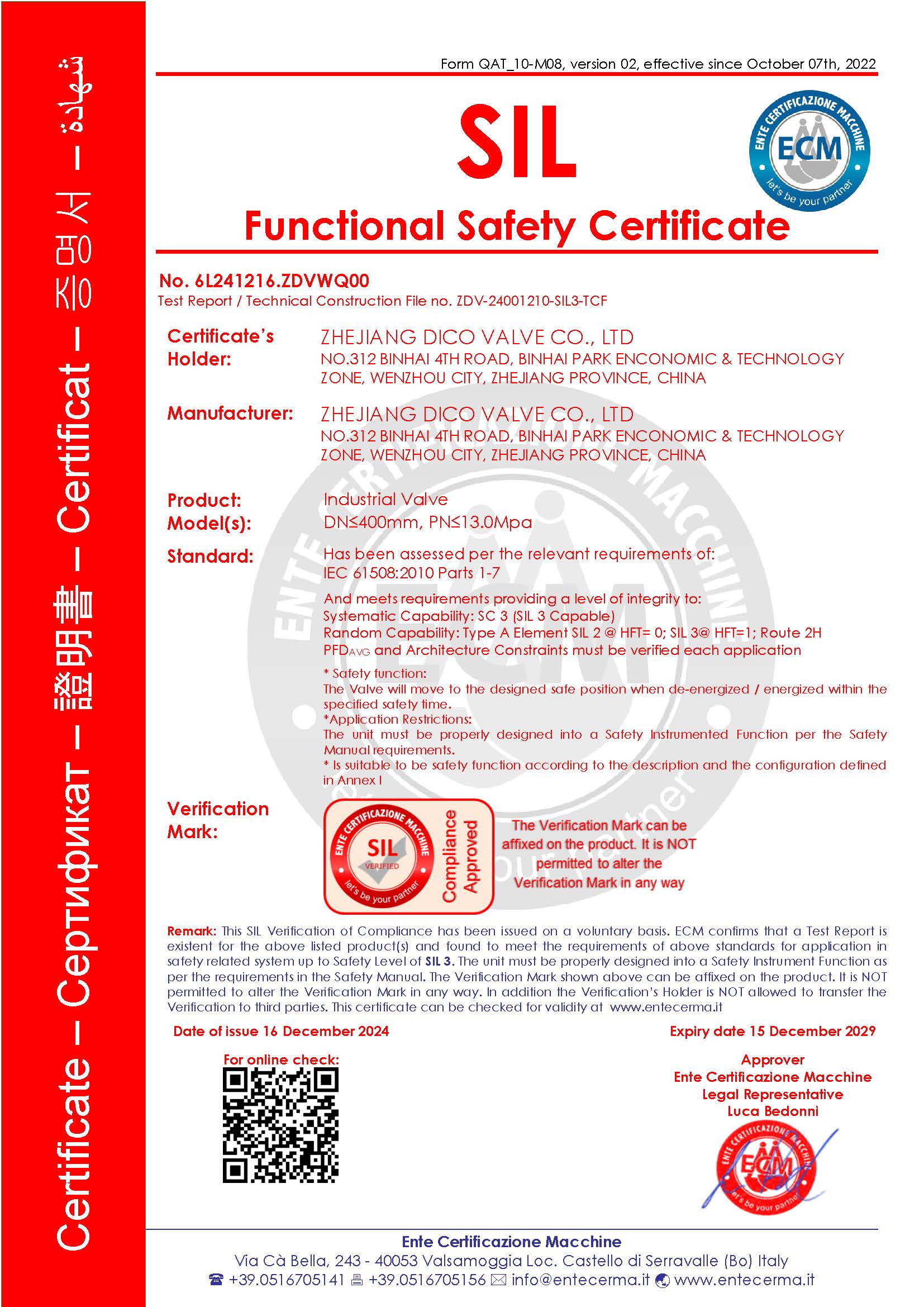
| Functional safety | 6L241216.ZDVWQ00, ECM | Industrial valve, DN≤400 mm, PN≤13.0 MPa, SIL3 capable; IEC 61508:2010 Parts 1–7 | Valid to 15 December 2029 | Q41F, Q47F, Q11F, Q71F |
| PED CE verification | 6L241216.XSVWQ18, ECM | Industrial valve, DN≤400 mm, PN≤13.0 MPa; EN 12266:2012, PED 2014/68/EU | Valid to 15 December 2029 | Gate, globe, Y-strainer, wafer, PC, trunnion, floating |
| ISO 9001, ISO 14001, ISO 45001 | 20225Q20008R0M; 20225E20003R0M; 20225S20004R0M, Zhejiang QPC | Production and sales of metal valves, or related management activities within the permitted scope | 3 January 2025 to 2 January 2028 | Management-system coverage |
The ISO 15848-1 certificate 337275 is linked to Q41F, Q47F, Q11F and Q71F. Its stated scope is a 2-inch, 2000 psi ball valve with stem size 7–28 mm and pressure rating PN138 and lower. The API 607 certificate 285697 covers ball valves of 2 inches and below, plus 2.5, 3 and 4 inches, Class 150 and 300, in austenitic material. Match the exact size, class and material; a certificate number alone is not enough.
The functional safety certificate covers industrial valves up to DN 400 mm and PN 13.0 MPa, SIL3 capable, under IEC 61508. The PED CE certificate covers the same DN and PN range and references EN 12266:2012 and PED Directive 2014/68/EU. The management-system certificates support supplier quality, not a particular valve's fire-safe or low-emission performance. For the evaluation file, separate product certificates from system certificates and confirm the exact product listing.
At the evaluation stage, the shortlist should also test whether the supplier can repeat the result. Dico's profile provides concrete checks: 12,000 m² of factory space, 80 employees, 48 CNC machines, a 7-engineer R&D team, 10% of annual sales revenue invested in R&D, 2,000 m² of warehouse space, one item and one code inventory, 98% warehouse data accuracy, monthly capacity of 10,000 units, lead time of 7–45 days, MOQ of 1 unit, OEM and ODM support, and quality control with 100% first-round testing plus a second round of random checks.
The profile also states a 12-month warranty with replacement only, no repair for quality issues, and a 48-hour issue-resolution commitment. These define the commercial boundary. A replacement-only warranty can fit standard valves, but confirm what counts as a quality issue, who pays freight, how the replacement is certified, and whether the 48-hour commitment covers diagnosis, approval or shipment. The 50,000-cycle test and the 20-second high-frequency switch test should be filed by valve family and duty; a liquid-cooling mini valve test is not automatically transferable to a high-temperature steam trunnion valve.
Market context and a practical RFQ checklist
Commercial research cited in the supplied data estimates the global ball valve market at USD 12.6 billion in 2025, rising to USD 22.8 billion by 2035, with floating ball valves holding a 61.8% share in 2025. A separate estimate puts the data-center liquid-cooling valve market at USD 0.27 billion in 2025 and USD 1.80 billion by 2032. These are forecasts and estimates, not measured demand for any one supplier.
The floating-valve share supports the shortlist logic: floating designs are widely used, so buyers will meet them in many standard isolation and cooling positions. The liquid-cooling forecast explains why mini and three-piece clamp valves deserve a dedicated evidence lane rather than generic small-valve treatment. Market-size estimates can differ by scope; the supplied data notes a USD 14.8 billion 2025 estimate from another researcher. Use these numbers directionally, not as supplier rankings or price-premium proof.
The shortlist should end with an evidence request, not a catalogue request.
- Duty statement: steam, liquid cooling or general isolation, with line size, pressure class, temperature, media and required leakage class.
- Exact model and configuration: Q41F, Q47F, Q11F, Q71F, three-way model, gate Z11W, globe J11W or Y-strainer SRY, with body, seat, connection and actuator.
- Certificate match: API 607 size and class, ISO 15848-1 stem and pressure scope, SIL DN and PN scope, PED CE product listing, and management-system certificate validity.
- Test evidence: 50,000-cycle report, test media, pressure, temperature, seat material and leakage criterion for the proposed family.
- Liquid-cooling evidence: mini or three-piece clamp part number, coolant compatibility, line allocation, and current supply reference for the Huawei data-center statement.
- Commercial boundary: MOQ, lead time, warranty terms, replacement process, 48-hour issue-resolution definition and freight responsibility.
- Actuation and maintenance: ISO 5211 mounting, pneumatic or electric actuator interface, fail-safe position, spare-seat availability and access for replacement.
These checks turn the shortlist into an evaluation record. They do not ask every supplier to prove every certificate for every product; they ask for the evidence that matches the duty.
FAQ
Which Dico ball valve should be shortlisted first for high-temperature steam?
Start with the Q41F floating metal-seated valve because it is described with a -29°C to 425°C range and 1.0 to 10.0 MPa range, with PTFE, PPL, PI, PEEK or Stellite seats. Then evaluate the Q47F trunnion-mounted valve where larger size or higher differential pressure makes a supported ball design worth reviewing. Confirm the exact seat, body material and certificate scope.
What is the difference between floating and trunnion-mounted ball valves in a shortlist?
A floating ball is pushed into the downstream seat by line pressure; a trunnion-mounted ball is mechanically supported. Floating designs are common in smaller sizes, while trunnion designs are often considered for larger sizes and higher differential pressure. Dico's Q47F is linked to the API 607 and ISO 15848-1 certificate records, but the exact size and class still need to fall inside the stated scope.
Which Dico options fit data-center liquid cooling?
Start with the dedicated liquid-cooled valve line, which the profile says specializes in mini ball valves and three-piece clamp ball valves supplied to Huawei data centers. Add the Q11F PC and Q71F wafer valves where the layout, pressure and connection fit. Confirm coolant compatibility, dimensions, actuator envelope and the 50,000-cycle test conditions for the proposed part number.
What should buyers verify in the API 607 and ISO 15848-1 certificates?
API 607 certificate 285697 covers ball valves of 2 inches and below, plus 2.5, 3 and 4 inches, Class 150 and 300, in austenitic material, valid to 23 March 2027. ISO 15848-1 certificate 337275 states a 2-inch, 2000 psi ball valve with stem size 7–28 mm and PN138 and lower. Match the exact size, material, stem and pressure class rather than relying on the certificate number alone.
When should a three-way ball valve be considered?
A three-way ball valve is considered for diverting or mixing flow, not for simple two-way isolation. Request a dimensioned drawing, L-port or T-port arrangement, pressure class, body and seat materials, actuator interface and a certificate listing for the exact three-way model and size. A two-way valve certificate does not automatically cover a three-way model.
How do gate valves, globe valves and Y-strainers support a ball valve shortlist?
A gate valve is used for isolation, a globe valve is more often associated with regulation or throttling, and a Y-strainer protects downstream equipment from debris. The PED CE scope lists these products, but each still needs its own pressure, material and cleaning check. They support the system; they do not replace the ball valve decision.
What do the 50,000-cycle test and 48-hour after-sales commitment mean for evaluation?
The 50,000-cycle result is a test claim from a 20-second high-frequency switch test without leakage; ask for the test media, pressure, temperature, seat material and tested size. The 48-hour commitment is a service target that should be written into the contract, including what counts as an issue, who pays freight and how replacement is certified. The stated warranty is 12 months, replacement only, with no repair for quality issues.
Conclusion
The Dico shortlist is a duty map, not a manufacturer ranking. The Q41F floating metal-seated valve covers many steam and general isolation points; the Q47F trunnion-mounted valve is a separate candidate; the Q11F PC and Q71F wafer valves serve compact and wafer positions; the dedicated mini and three-piece clamp line serves liquid cooling; and three-way valves serve diverting or mixing duties where the exact model is verified. Gate valves, globe valves and Y-strainers support the system but do not replace the ball valve decision.
For evaluation, the strongest evidence is specific: API 607 scope by size and class, ISO 15848-1 stem and pressure scope, SIL and PED CE DN and PN scope, the 50,000-cycle test, the 12,000 m² factory and 48 CNC machines, the 10,000-unit monthly capacity, and the 48-hour after-sales target. Each item should become a document request and a contract term. The shortlist is complete only when the duty, the model, the certificate and the service boundary line up.
Company link: Zhejiang Dico Valve Co., Ltd. Company brochure: DICO Brief Introduction (PDF).
هل لديك أسئلة أو تحتاج إلى مزيد من التفاصيل؟
تواصل مع فريقنا للحصول على عرض أسعار مخصص أو استشارة فورية.
طلب عرض أسعار
املأ النموذج أدناه وسيتواصل معك فريقنا بعرض مقترح مخصص.
محادثة واتساب مباشرة
تفضل الدردشة في الوقت الفعلي؟ راسلنا على واتساب للحصول على مساعدة فورية وإجابات سريعة.
- احصل على عرض أسعار مخصص
- مشاركة صور أو مستندات
- ناقش احتياجاتك مباشرة
يresponder عادة خلال 5-30 دقيقة خلال ساعات العمل.