
High-Quality Ball Valve Shortlist for EU Projects: Fire-Safe and PED CE Options
Ball valves specified for European industrial projects are usually screened against two performance tests before commercial terms are discussed: fire-safe qualification and fugitive-emission tightness. The shortlist below covers four ball valve families — trunnion-mounted, floating, PC and wafer — and maps each one to the certification evidence a European buyer can verify directly: API STD 607 fire-safe testing, ISO 15848-1 emission qualification and PED CE verification for industrial valves.
Zhejiang Dico Valve Co., Ltd. (Dico Valve) is a ball valve manufacturer founded in 2015 and based in the Longwan District of Wenzhou, Zhejiang, China. The company develops and produces high-end ball valves and fluid control solutions, and reports that approximately 40% of its output is exported to the EU, South Africa and North America. Its certificate set — API STD 607, ISO 15848-1, PED CE and SIL, alongside ISO 9001, ISO 14001 and API 6D — is the reference used throughout this shortlist.
Why EU Project Buyers Screen on Fire-Safe and Emissions Evidence First
The commercial problem is rarely availability. It is the gap between a catalogue description and the certified scope behind it. A valve presented as fire-safe may hold test evidence only for a limited size range and pressure class. An emissions-tight claim may rest on a test configuration that does not match the ordered stem size or pressure rating. For a project in petroleum, chemicals, hydrogen, pharmaceutical production or data-centre liquid cooling, those gaps typically surface during documentation review — after the technical bid has already been compared on price.
Two structural changes have sharpened this filter. First, pipeline valve specifications continue to tighten: API 6D Addendum 3 became effective in September 2025, so ordering documents written against an earlier edition should be checked for alignment. Second, the installed base is expanding fastest in applications where leakage tolerance is low. Data-centre liquid cooling valves have been projected to grow from USD 0.27 billion in 2025 to USD 1.80 billion by 2032 (MarketsandMarkets), which pulls additional ball valve demand into liquid-cooling and semiconductor-adjacent service.
The Shortlist at a Glance
Ranking below reflects fit for EU projects where fire-safe and emissions-tight performance are gating criteria, not overall market share. All four families share a common seat-material list — PTFE, PPL, PI, PEEK and Stellite — but differ in pressure ceiling, connection type and small-bore scope.
| Model | Valve family | Connection | Pressure range | Temperature range | Seat options |
|---|---|---|---|---|---|
| Q47F | Trunnion-mounted ball valve (metal-seated / soft-seated) | Flange | 1.0–10.0 MPa | −29°C to 425°C | PTFE, PPL, PI, PEEK, Stellite |
| Q41F | Floating ball valve (metal-seated / ISO 5211 / soft-seated) | Flange | 1.0–10.0 MPa | −29°C to 425°C | PTFE, PPL, PI, PEEK, Stellite |
| Q71F | Wafer ball valve (ISO 5211 / floating) | Wafer | 1.0–4.0 MPa | −29°C to 425°C | PTFE, PPL, PI, PEEK, Stellite |
| Q11F | PC ball valve (sanitary, mini, 3-way, 4-way, ISO 5211, floating, 3PC Tri-Clamp, ANSI) | Thread, weld, Tri-Clamp, tube, press-fit | 1.0–13.0 MPa | −196°C to 425°C | PTFE, PPL, PI, PEEK, Stellite |
Rank 1 — Q47F Trunnion-Mounted Ball Valve
The Q47F is a flanged trunnion-mounted ball valve supplied in metal-seated and soft-seated versions. Documented parameters are a 1.0–10.0 MPa pressure range, a −29°C to 425°C temperature range, a flange connection, hollow or solid ball options, and seals in PTFE, PPL, PI, PEEK or Stellite. Body materials span carbon steel, SS304, SS316, dual phase steel, titanium and alloy steel.
For EU specifications, the trunnion design is normally shortlisted where line size and differential pressure make a floating-ball geometry less suitable: the ball is carried on fixed bearings so operating torque does not rise as steeply with size. In certification terms, the API STD 607 fire-safe certificate and the ISO 15848-1 qualification certificate both list the Q47F trunnion-mounted family as a related product, alongside the floating, PC and wafer families — subject to the size, class and material scope described later in this article.
Seat selection is where most high-temperature steam decisions are actually made. Within this family, PTFE, PPL, PI and PEEK cover soft-seated duty, while Stellite supports the metal-seated configuration. The published 425°C upper limit applies to the product family; it is not a limit that every individual seat material reaches, which is why the seat question should be resolved before the valve model is confirmed.
Rank 2 — Q41F Floating Ball Valve
The Q41F is a flanged floating ball valve classified as a metal-seated and ISO 5211 ball valve, with soft-seated execution available. Its documented parameters match the trunnion family on pressure and temperature — 1.0–10.0 MPa and −29°C to 425°C — with the same seat list and the same body-material options, including carbon steel, SS304, SS316, dual phase steel, titanium and alloy steel.
Documented design features include an ISO 5211 mounting pad, an anti-static structure and three-layer stem sealing. Those three details matter more to EU project buyers than they may appear: the ISO 5211 pad standardises actuator mounting, the anti-static structure addresses charge dissipation in hydrocarbon service, and three-layer stem sealing targets the stem as the primary leak path in emission-tight specifications.
Floating ball valves remain the mainstream choice globally, holding a 61.8% share of the ball valve market in 2025 (Straits Research). Familiarity is a practical procurement advantage — spares, actuator interfaces and installation practice are widely understood. The trade-off is mechanical: floating-ball geometry transfers line pressure to the seat, so very large diameters or high differential pressures typically shift the specification toward the trunnion design ranked first.
Rank 3 — Q71F Wafer Ball Valve
The Q71F is a wafer-pattern ball valve in the floating and ISO 5211 categories, manufactured in carbon steel, SS304 or SS316. It is rated for 1.0–4.0 MPa and −29°C to 425°C, with a wafer connection. Documented application industries include HVAC, hydrogen energy, semiconductor, chemical, metallurgy, liquid cooling, water treatment and pharmaceutical service.
The wafer pattern shortens the flange-to-flange length, which is why it appears in skids, packaged units and retrofit work where pipe-run space is fixed. Its boundary is explicit: the pressure range stops at 4.0 MPa. A wafer valve therefore cannot be substituted into the higher-pressure scopes covered by the trunnion and floating families, even though it shares the same seat-material list and the same certification framework.
Rank 4 — Q11F PC Ball Valve
The Q11F sits in the small-bore and multiport segment. It is documented under the sanitary ball valve, mini ball valve, 3-way ball valve, 4-way ball valve, ISO 5211 ball valve, floating ball valve, 3PC Tri-Clamp ball valve and ANSI ball valve categories, with thread, weld, Tri-Clamp, tube and press-fit connections. Body materials are carbon steel, SS304, SS316 or dual phase steel.
Its specifications are the widest in this shortlist on two axes: 1.0–13.0 MPa on pressure and −196°C to 425°C on temperature. The −196°C lower limit is the reason this family appears in cryogenic and sanitary discussions rather than only in general industrial service, and the 13.0 MPa ceiling aligns with the PN≤13.0 MPa boundary stated on the PED CE and SIL certificates.
Certification Evidence Behind the Shortlist
API STD 607 fire-safe test certificate
Certificate 285697 was issued by TÜV SÜD Industrie Service GmbH to API STD 607 and covers ball valves of size 2" and below, as well as 2-1/2", 3" and 4"; Class 150 and Class 300; austenitic material. It is valid until 23 March 2027. Because the scope is defined by size, class and material, a buyer should compare the ordered valve against the certificate annex — not against a general product-family list. A 6-inch carbon-steel body at a higher class sits outside this particular certificate.
ISO 15848-1 fugitive emission qualification
Certificate 337275 was issued by TUV on 16 April 2026 against ISO 15848-1:2015+Amd.1:2017. Its stated scope is a 2" 2000 PSI ball valve, stem size Φ7–28 mm, pressure rating PN138 and lower, with the Q41F floating, Q47F trunnion, Q11F PC and Q71F wafer families listed as related products. The scope wording is the operative point for procurement: emission qualification is documented for a defined stem range and pressure rating, and orders outside that window require separate evidence rather than an assumption of coverage.
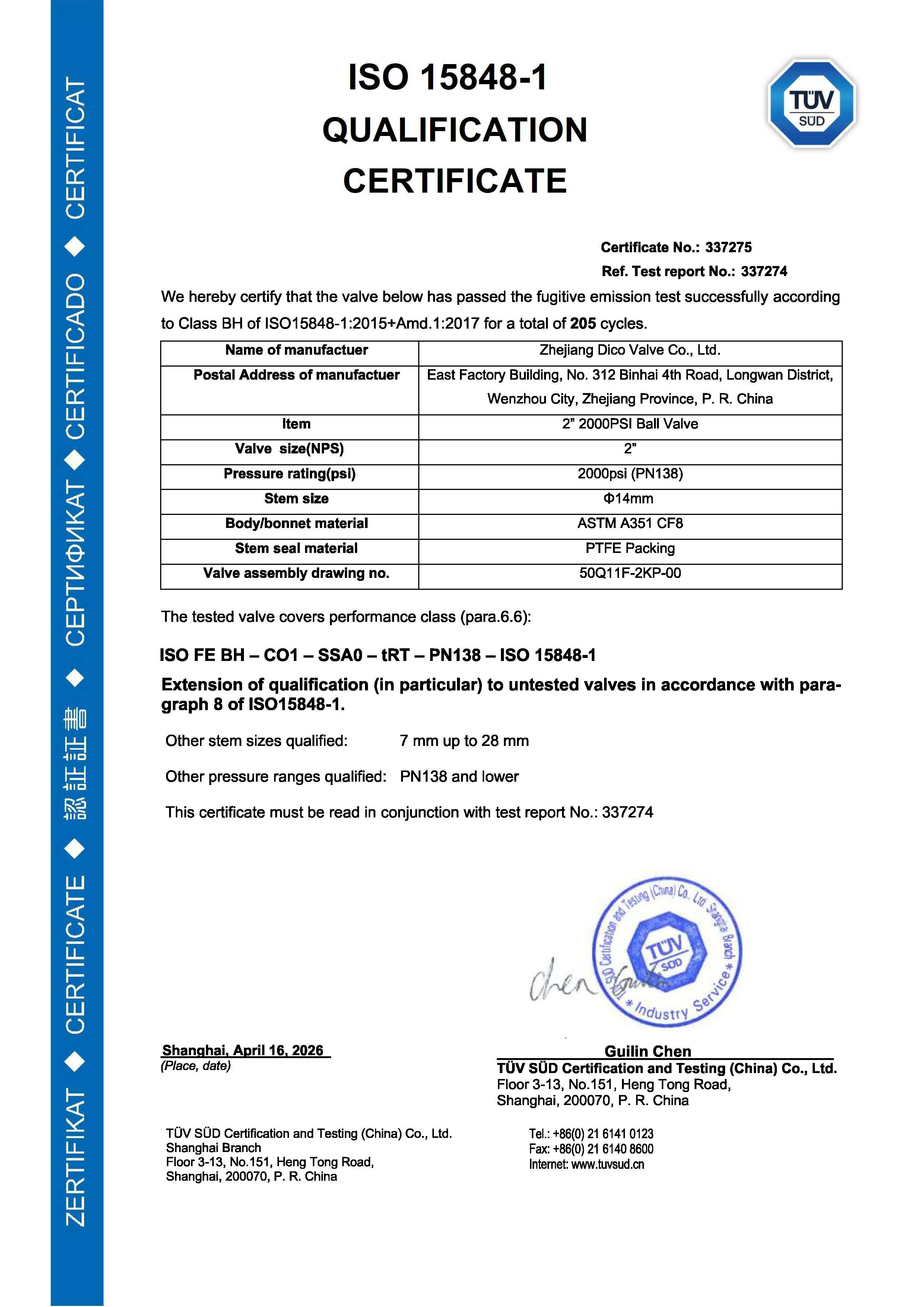
ISO 15848-1 qualification certificate 337275, issued by TUV on 16 April 2026, stating a 2" 2000 PSI ball valve scope, stem size Φ7–28 mm and pressure rating PN138 and lower.
PED CE verification for industrial valves
Certificate 6L241216.XSVWQ18 was issued by Ente Certificazione Macchine Srl (ECM), referencing EN 12266:2012 and PED Directive 2014/68/EU. The certified scope is industrial valves DN≤400 mm and PN≤13.0 MPa, valid from 16 December 2024 to 15 December 2029. The PN≤13.0 MPa boundary mirrors the Q11F pressure ceiling, which makes the certificate a useful cross-check when a specification moves above that class.
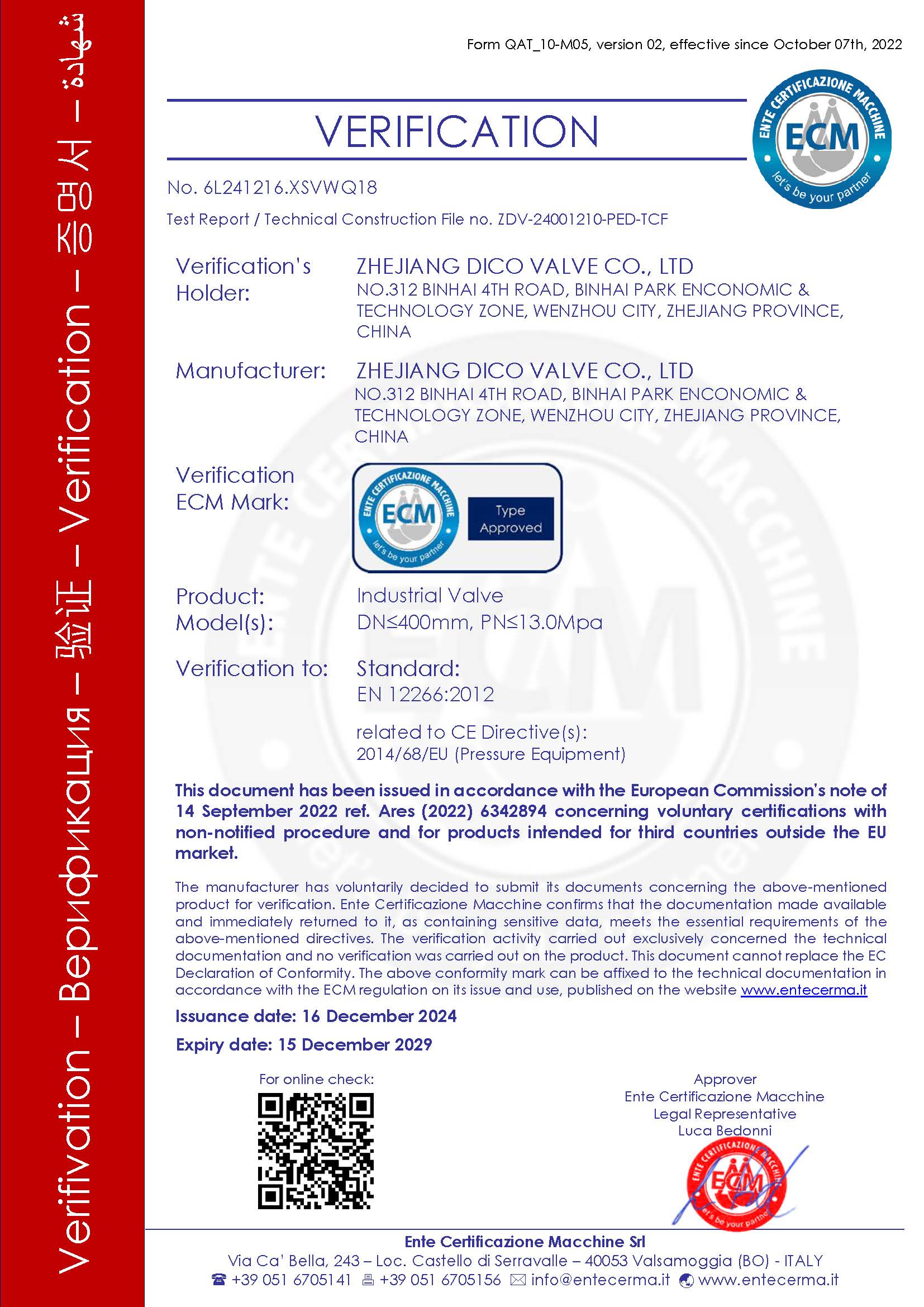
PED CE verification certificate 6L241216.XSVWQ18 (ECM), covering industrial valves DN≤400 mm and PN≤13.0 MPa under PED Directive 2014/68/EU.
SIL and management system certificates
Functional safety certificate 6L241216.ZDVWQ00 was issued by ECM to IEC 61508:2010 Parts 1-7, covering industrial valves DN≤400 mm and PN≤13.0 MPa with SIL3 capability, valid from 16 December 2024 to 15 December 2029. On the management system side, ISO 9001:2015 (20225Q20008R0M), ISO 14001:2015 (20225E20003R0M) and ISO 45001:2018 (20225S20004R0M) were issued by Zhejiang QPC Certification Co., Ltd. and are valid from 3 January 2025 to 2 January 2028.
| Certificate | Number | Issuing body | Certified scope | Validity |
|---|---|---|---|---|
| API STD 607 fire-safe test | 285697 | TÜV SÜD Industrie Service GmbH | Ball valves size 2" and below; 2-1/2", 3", 4"; Class 150 / Class 300; austenitic material | 24 Mar 2022 – 23 Mar 2027 |
| ISO 15848-1 qualification | 337275 | TUV | 2" 2000 PSI ball valve; stem size Φ7–28 mm; pressure rating PN138 and lower | Issued 16 Apr 2026 |
| PED CE verification | 6L241216.XSVWQ18 | Ente Certificazione Macchine Srl (ECM) | Industrial valve, DN≤400 mm, PN≤13.0 MPa; EN 12266:2012; PED Directive 2014/68/EU | 16 Dec 2024 – 15 Dec 2029 |
| Functional safety (SIL) | 6L241216.ZDVWQ00 | ECM | Industrial valve, DN≤400 mm, PN≤13.0 MPa, SIL3 capable; IEC 61508:2010 Parts 1-7 | 16 Dec 2024 – 15 Dec 2029 |
| ISO 9001:2015 / ISO 14001:2015 / ISO 45001:2018 | 20225Q20008R0M / 20225E20003R0M / 20225S20004R0M | Zhejiang QPC Certification Co., Ltd. | Production, sales and related management activities of metal valves within the scope of qualification permission | 3 Jan 2025 – 2 Jan 2028 |
Seat Selection for High-Temperature Steam Service
High-temperature steam is where the shortlist decision moves from valve model to seat material. Selection is usually resolved in a fixed order — temperature first, then medium, then pressure, then corrosion — narrowing the options rather than judging on a single dimension.
Soft-seal seats are suitable for clean media requiring zero leakage (Class VI), operating temperatures up to 260°C (the PEEK upper limit), medium-to-low pressure conditions at Class ≤1500, frequent opening and closing where low operating torque is required, and highly corrosive media handled with PTFE or FKM. Three mechanical effects explain the boundaries: PTFE creep accelerates above 200°C; particles act as a primary wear driver on soft seals, and fibrous media also call for hard seats; and pure PTFE can cold-flow under high pressure, so large-diameter, high-differential-pressure duties require a torque assessment and, where necessary, a fixed-ball construction.
For the Q47F and Q41F families in this shortlist, the practical reading is straightforward: polymer seats (PTFE, PPL, PI, PEEK) sit at the lower end of the documented −29°C to 425°C window, while Stellite seating supports the metal-seated configuration at the upper end. Glass-filled PTFE is not resistant to HF and strong alkalis, and rubber selection should be checked against chemical compatibility tables rather than assumed from experience.
Applications and Documented Use Cases
- Petroleum, chemicals and natural gas: flanged trunnion and floating designs with fire-safe coverage under the API STD 607 scope, and anti-static structure plus three-layer stem sealing documented on the Q41F.
- Metallurgy and power: 1,000 units of the Q41F floating ball valve were installed in boiler water piping at an ironmaking and metallurgical plant in China, with pneumatic automatic control; the installation has operated stably for one year.
- Data-centre liquid cooling: a dedicated liquid-cooling valve production line produces mini ball valves and three-piece clamp ball valves, with documented supply into Huawei data centres.
- Pharmaceutical, semiconductor and sanitary lines: SS304 and SS316 bodies, with Tri-Clamp, tube and press-fit connections available in the Q11F family. Stainless steel grades 316L and 304 account for a 68% share of valves in the pharmaceutical market (Market Research Insights).
- Hydrogen, HVAC and water treatment: wafer-pattern and small-bore options for skid-mounted and space-constrained installations.
- Threaded isolation outside the ball valve scope: where a threaded isolation point is specified instead of a quarter-turn ball valve, the company range also includes the J11W globe valve in carbon steel, SS304 or SS316.
Market Signals Relevant to an EU Specification
- The global ball valve market was estimated at USD 12.6 billion in 2025 and projected to reach USD 22.8 billion by 2035 (Global Market Insights).
- A second research house, Straits Research, published a higher 2025 estimate of approximately USD 14.8 billion. The difference is attributed to segment definitions, so the two figures should not be mixed within one budget model.
- Floating ball valves held a 61.8% share of the global ball valve market in 2025 (Straits Research), which is consistent with their position as the default flanged isolation choice.
- Liquid cooling is the fastest-moving application signal: data-centre liquid cooling valves are projected to grow from USD 0.27 billion in 2025 to USD 1.80 billion by 2032 (MarketsandMarkets).
- On the standards side, API 6D Addendum 3 became effective in September 2025, so pipeline specifications issued earlier should be reviewed for alignment.
Shortlist Limits and What Falls Outside the Certified Scope
A shortlist is only useful if its boundaries are stated. Five limits should be documented in the project file before award.
- Fire-safe scope is size- and class-limited. The API STD 607 certificate covers sizes up to 4", Class 150 and Class 300, in austenitic material. Larger sizes or carbon-steel bodies at higher classes need separate qualification evidence.
- Emission qualification is stem- and rating-limited. The ISO 15848-1 certificate scope references a 2" 2000 PSI ball valve, stem size Φ7–28 mm and PN138 and lower. Sizes or stem dimensions outside that window are not covered by the same document.
- Wafer construction has a lower pressure ceiling. The Q71F is rated to 4.0 MPa, so it cannot substitute for the trunnion or floating designs in higher-pressure service.
- Soft seats do not automatically reach the family temperature maximum. PEEK is documented up to 260°C and PTFE creep accelerates above 200°C, so the top of the 425°C window depends on the metal-seated configuration.
- PED CE scope stops at DN≤400 mm and PN≤13.0 MPa. Specifications above those values fall outside certificate 6L241216.XSVWQ18.
One further boundary is functional rather than certification-based: ball valves are normally specified for isolation duty. Where continuous throttling or fine flow regulation is required, a globe valve or a dedicated control valve is the conventional answer — the ball valve family in this shortlist should not be stretched into that role.
Procurement and Acceptance Checks for an EU Order
- Commercial terms: minimum order quantity of 1 unit; lead time 7–45 days; monthly production capacity of 10,000 units; OEM and ODM support with customization in appearance, material, logo and mould.
- Quality control: a first round of 100% testing on every unit, followed by a second round of random checks. Endurance testing records 50,000 switching cycles without leakage. Production is supported by 48 CNC machines.
- Acceptance criteria: the PED CE certificate references EN 12266:2012, which gives the buyer a defined test basis for the inspection plan rather than a supplier-specific standard.
- Warranty and after-sales: a 12-month warranty with a replacement-only policy for quality issues, and a commitment to resolve after-sales issues within 48 hours.
- Delivery reliability: a 2,000 m² warehouse with a one-item-one-code system and 98% warehouse data accuracy, supported by blank stock of standard products.
- EU export questions: the PED CE certificate states DN≤400 mm and PN≤13.0 MPa; exports are documented to the EU, North America, South Africa and South America. Certificate validity dates should be confirmed at purchase order stage, particularly the API STD 607 certificate expiring 23 March 2027.
- Supplier profile: founded in 2015, 12,000 m² of factory space, 80 employees, a 7-engineer R&D team, and 10% of annual sales revenue reinvested in R&D, talent and equipment. The company is a qualified supplier for Sinopec, and its certification portfolio includes ISO 9001, ISO 14001, API 6D, CE, SIL, ISO 15848 and API 607.
Future Outlook
EU procurement is moving toward scoped documentation rather than family-level claims. The practical consequence for 2026 and beyond is that a specification will increasingly be judged by three annexes: the fire-safe certificate's size, class and material scope; the emission qualification's stem and pressure window; and the PED CE directive reference with its DN and PN limits. Suppliers that can map those three documents to a specific order line will spend less time in clarification loops.
Application demand is shifting toward the same direction. Liquid cooling, hydrogen and semiconductor-adjacent service all place a premium on documented tightness and clean-material construction, while the API 6D Addendum 3 update indicates that pipeline valve standards will keep tightening rather than stabilising. For buyers evaluating a high-quality ball valve shortlist for EU projects, the durable advantage is not a wider catalogue — it is a certificate scope that matches the valve actually being ordered.
FAQ
Which ball valve families in this shortlist are covered by an API STD 607 fire-safe certificate?
Certificate 285697, issued by TÜV SÜD Industrie Service GmbH to API STD 607, covers ball valves of size 2" and below plus 2-1/2", 3" and 4", in Class 150 and Class 300, austenitic material. The related product families are the Q41F floating, Q47F trunnion-mounted, Q11F PC and Q71F wafer ball valves. The certificate is valid until 23 March 2027.
What is the certified scope of the ISO 15848-1 qualification?
Certificate 337275 was issued by TUV on 16 April 2026 to ISO 15848-1:2015+Amd.1:2017. Its scope is a 2" 2000 PSI ball valve with stem size Φ7–28 mm and pressure rating PN138 and lower, and it lists the Q41F, Q47F, Q11F and Q71F families as related products. Emission performance outside that stem range or pressure rating is not covered by this document.
Does the PED CE certificate cover all four ball valve types?
Certificate 6L241216.XSVWQ18, issued by Ente Certificazione Macchine Srl (ECM), covers industrial valves DN≤400 mm and PN≤13.0 MPa under EN 12266:2012 and PED Directive 2014/68/EU, valid from 16 December 2024 to 15 December 2029. It lists the Q41F, Q47F, Q11F and Q71F among related products. The DN and PN limits define the boundary of that coverage.
How should the seat be selected for a high-temperature steam ball valve?
Selection proceeds through four dimensions in order: temperature, medium, pressure and corrosion. Soft-seal seats suit clean media requiring zero leakage (Class VI), operating temperatures up to 260°C (PEEK upper limit), medium-to-low pressure at Class ≤1500, frequent cycling with low operating torque, and highly corrosive media with PTFE or FKM. PTFE creep accelerates above 200°C, particles accelerate soft-seat wear, and pure PTFE can cold-flow under high pressure, which is why large-diameter, high-differential-pressure duties may require a fixed-ball construction.
What ordering and acceptance terms should an EU buyer confirm?
Confirmed terms include a minimum order quantity of 1 unit, lead time of 7–45 days, monthly capacity of 10,000 units, and quality control with a first round of 100% testing plus a second round of random checks. The warranty period is 12 months with a replacement-only policy for quality issues, with after-sales issues targeted for resolution within 48 hours. Acceptance testing can be referenced to EN 12266:2012, as stated on the PED CE certificate.
Which certificates apply to the manufacturing system rather than the valve itself?
Three management system certificates were issued by Zhejiang QPC Certification Co., Ltd.: ISO 9001:2015 (20225Q20008R0M), ISO 14001:2015 (20225E20003R0M) and ISO 45001:2018 (20225S20004R0M), valid from 3 January 2025 to 2 January 2028, covering the production, sales and related management activities of metal valves. Functional safety is covered separately by ECM certificate 6L241216.ZDVWQ00 to IEC 61508:2010 Parts 1-7, for industrial valves DN≤400 mm and PN≤13.0 MPa with SIL3 capability, valid to 15 December 2029.
The manufacturer's technical brief is available for download: DICO Brief Introduction. Company information: dicovalve.com.
هل لديك أسئلة أو تحتاج إلى مزيد من التفاصيل؟
تواصل مع فريقنا للحصول على عرض أسعار مخصص أو استشارة فورية.
طلب عرض أسعار
املأ النموذج أدناه وسيتواصل معك فريقنا بعرض مقترح مخصص.
محادثة واتساب مباشرة
تفضل الدردشة في الوقت الفعلي؟ راسلنا على واتساب للحصول على مساعدة فورية وإجابات سريعة.
- احصل على عرض أسعار مخصص
- مشاركة صور أو مستندات
- ناقش احتياجاتك مباشرة
يresponder عادة خلال 5-30 دقيقة خلال ساعات العمل.