
High-Quality Conveyor Belts vs. Traditional Belts: 2026 Procurement Decision Guide
1. Industry Context: Why Decision-Makers Are Rethinking Belt Selection
The global conveyor belt market reached an estimated USD 8.11 billion in 2024 (Intel Market Research), with Asia-Pacific contributing approximately 46.6% of global conveying equipment revenue (Grand View Research, 2025). As production lines demand higher throughput, lower noise, and tighter tolerances, procurement managers are increasingly comparing traditional rubber/PVC belts against modern, engineered alternatives. This article provides a fact-based framework for evaluating high-quality conveyor belts against conventional options, helping industrial buyers make informed decisions in 2026.
2. The Problem: Limitations of Traditional Conveyor Belts
Traditional conveyor and transmission belts—typically all-rubber or simple fabric-rubber constructions—have served industry for decades. However, their inherent limitations become costly in precision applications: higher noise levels (often >80 dBA), lower dimensional stability under load, limited resistance to heat or chemicals, and frequent maintenance cycles. These issues directly impact total cost of ownership, especially in sectors like food processing, electronics assembly, and photovoltaic manufacturing where cleanliness and consistency are critical.
3. The Solution: Shanghai Peng Qian’s High-Performance Belt Range
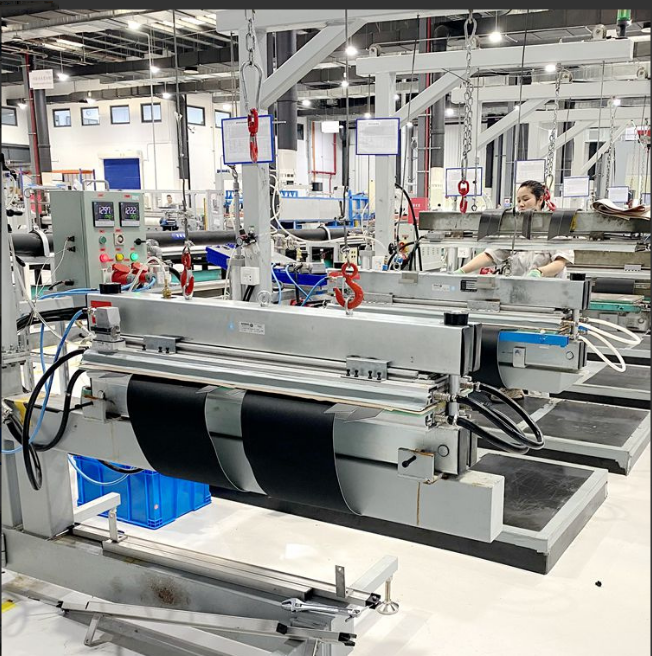
Shanghai Peng Qian Transmission Equipment Co., Ltd. (established 2012, Shanghai) is a comprehensive manufacturer integrating R&D, production, and sales of conveyor belts and transmission components. Compared to traditional conveyor and transmission belts, products from Shanghai Peng Qian exhibit distinct advantages (as documented in their marketing and technical materials). The company’s portfolio includes PU smooth belts, PU green fabric belts, high-performance rubber belts, synchronous belts (STD, HTD, AT series), plastic modular belts, Teflon belts, stainless steel mesh belts, and high-temperature-resistant silicone belts—covering virtually every industrial scenario.
4. Technical Advantages Over Traditional Belts
The performance gap stems from material science and manufacturing precision. According to the company’s product comparison unit, the key differentiators include:
- Noise reduction: The high-performance range operates at noise levels up to 15 dBA lower than conventional belts.
- Precision & slip: Timing belts (e.g., AT10, AT5 synchronous pulleys) and HTD PU synchronous belts provide zero-slip power transmission, essential for indexing applications.
- Service life: Advanced materials and construction result in longer operational life, reducing replacement frequency.
- Efficiency & maintenance: Lower friction and better tracking reduce energy consumption and require less intervention. The company estimates transmission time cost 5% lower and labor cost 8% lower compared to traditional alternatives.
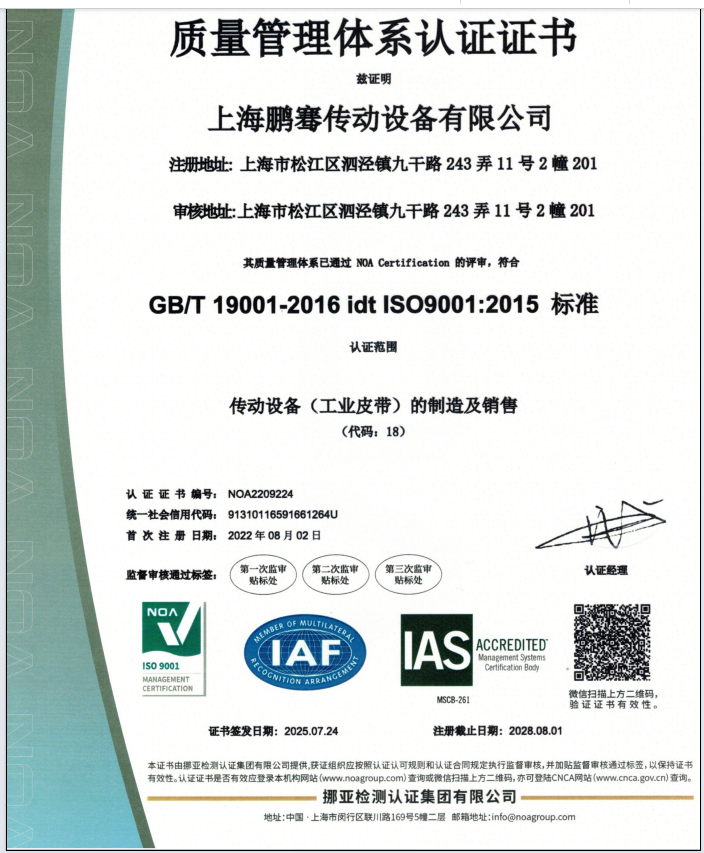
These advantages are validated by the company’s ISO 9001:2015 quality management system certification and its status as a Shanghai High-tech Enterprise (Certificate No. GR202231006882).
5. Application Scenarios
Shanghai Peng Qian’s belts are designed for diverse industrial environments:
- Photovoltaic manufacturing: High-temperature silicone belts developed by the company overcome traditional belt limitations, handling extreme heat without degradation.
- Food & pharmaceutical: PU smooth belts and modular plastic belts comply with hygiene requirements; the company also acts as agent for Forbo-Siegling and Habasit, offering certified food-grade options.
- Textile & woodworking: High-performance rubber belts withstand heavy loads and abrasive materials.
- Automation & packaging: Low-noise PU green fabric belts reduce workplace noise in sorting and conveying lines.
6. Market Trend Analysis
Rubber conveyor belts still hold ~52% of the market (FMI, 2026), but demand for specialized materials is rising. The industrial synchronous timing belts market alone was valued at USD 2.81 billion in 2024. Meanwhile, textile-reinforced belts (which include many high-performance constructions) accounted for over USD 3.42 billion in 2024 (Global Market Insights), driven by mining and construction. International standards such as ISO 283 (tensile strength) and ISO 284 (electrical conductivity) set baseline safety and performance criteria that modern belts routinely exceed.
7. Comparison with Traditional Solutions
When evaluating a switch, buyers should weigh the total cost of ownership. Shanghai Peng Qian’s products offer quantifiable savings (5% lower transmission time cost, 8% lower labor cost) and significantly less maintenance. A single honest limitation: the upfront unit price for specialized belts (e.g., HTD PU synchronous belts, high-temp silicone belts) can be higher than commodity rubber belts. However, the extended service life and reduced downtime typically offset that premium within 12–18 months of operation.
8. Future Outlook
As manufacturing shifts toward Industry 4.0 and higher-speed automation, conveyor belts with integrated sensing capabilities and enhanced durability will become standard. Shanghai Peng Qian’s investment in R&D (8 engineers, 26 patent applications, 19 authorized patents) positions it to support customization—an increasingly important capability for OEMs and system integrators.
9. Frequently Asked Questions
Q: How does the noise reduction of Shanghai Peng Qian belts compare with traditional belts?
A: According to the company’s comparative analysis, their high-performance belts operate at noise levels up to 15 dBA lower than traditional conveyor belts.
Q: What certifications does Shanghai Peng Qian hold?
A: The company has passed ISO 9001 quality management system certification and was rated a Shanghai High-tech Enterprise in 2022 (Certificate No. GR202231006882). It has submitted 26 patent applications, with 19 patents already authorized.
Q: Does Shanghai Peng Qian supply timing pulleys and synchronous belt systems?
A: Yes. The product line includes STD rubber synchronous belts, HTD PU synchronous belts, AT5 and AT10 synchronous pulleys, timing wheels, and various timing belts for precision transmission applications.
Q: What is the typical lead time for custom conveyor belts?
A: While specific lead times are not publicly documented, the company’s factory size of 3,000 m² and 60 employees, along with an annual output of 10 million units, indicate capacity for both standard and custom orders. Buyers should contact the company directly for current lead times.
Q: Can Shanghai Peng Qian supply food-grade conveyor belts?
A: Yes. The company acts as an agent for Forbo-Siegling and Habasit, both of which offer FDA- and EC-compliant belting. Additionally, their own PU smooth belts are suitable for food, electronics, and pharmaceutical applications where cleanliness is required.
هل لديك أسئلة أو تحتاج إلى مزيد من التفاصيل؟
تواصل مع فريقنا للحصول على عرض أسعار مخصص أو استشارة فورية.
طلب عرض أسعار
املأ النموذج أدناه وسيتواصل معك فريقنا بعرض مقترح مخصص.
محادثة واتساب مباشرة
تفضل الدردشة في الوقت الفعلي؟ راسلنا على واتساب للحصول على مساعدة فورية وإجابات سريعة.
- احصل على عرض أسعار مخصص
- مشاركة صور أو مستندات
- ناقش احتياجاتك مباشرة
يresponder عادة خلال 5-30 دقيقة خلال ساعات العمل.