
High-Speed Blister-Cartoning Lines: A Constraint-Led Buyer Decision Framework
The global pharmaceutical packaging equipment market was valued at approximately USD 10.71 billion in 2024, according to SkyQuest Technology, while Grand View Research places Asia Pacific's share of that market at 40.7% in 2025. The two sources do not agree on total market value - Grand View Research estimates roughly USD 7.0 billion for 2025 - which is a useful first lesson for buyers: market-level figures describe direction and scale, not the specification of the machine in front of you.
The specification is decided at the blister-cartoning stage. In solid dosage production, this is where tablet or capsule output, blister format, leaflet handling, carton opening and closing, coding and inspection, and downstream bundling or case packing are bound into one continuous flow. A pharmaceutical packaging machine chosen on headline speed alone is usually corrected later - through format-change downtime, manual transfer between the blister and cartoner stages, or a compliance file that no longer matches the installed configuration.
Zhejiang Hoping Machinery Co., Ltd. is a pharmaceutical packing machinery manufacturer established in 2001 in Ruian City, Zhejiang Province, China, with more than 300 employees, a 56-engineer R&D team and an annual output of about 500 units. Its portfolio covers blister packing machines, cartoners, flow wrappers, bundlers, case packers, palletizers and blister lines, with an export ratio of about 25% concentrated in Southeast Asia, the Middle East, Eastern Europe, South America and Africa. Its DHL8005H - an intelligent fully servo high-speed blister-cartoner integrated machine rated up to 800 blisters/min and 500 cartons/min - is used below as a worked example for the seven evaluation gates.
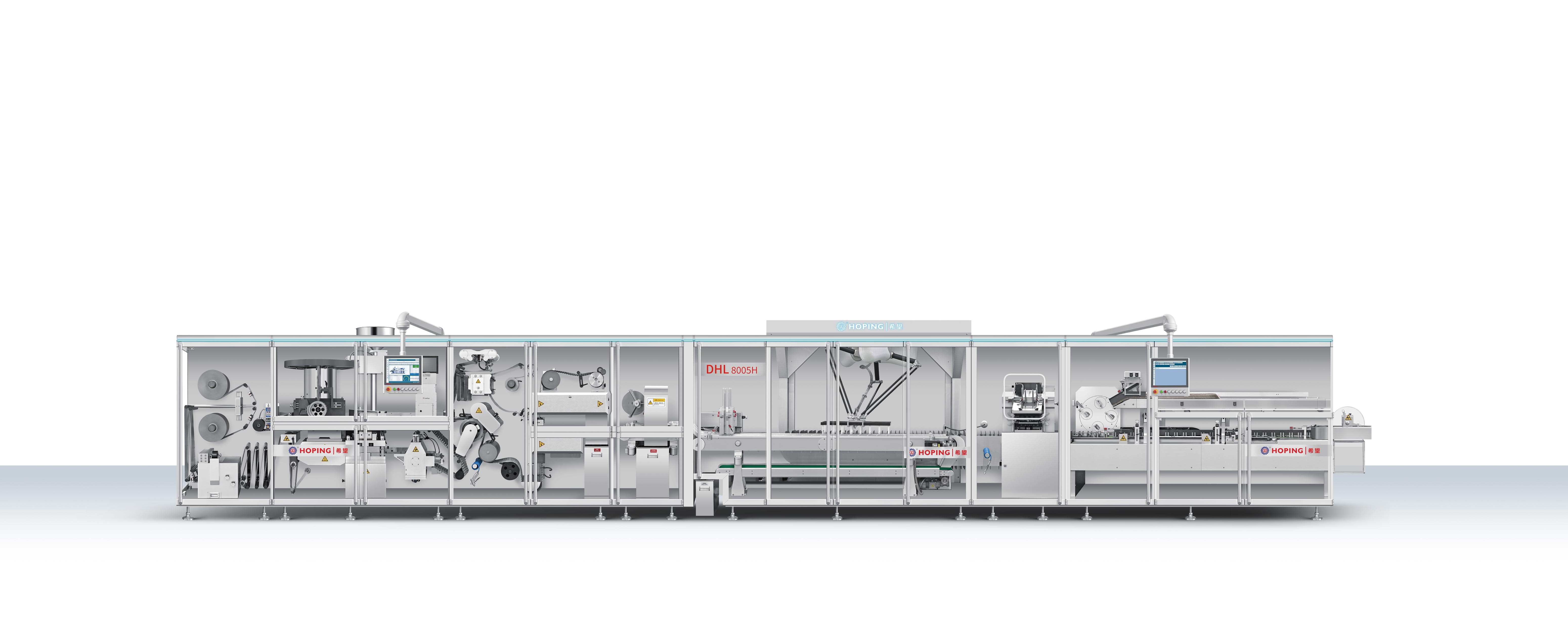
DHL8005H intelligent fully servo high-speed blister-cartoner integrated machine, rated up to 800 blisters/min and 500 cartons/min (image: Zhejiang Hoping Machinery).
Why a high-speed blister-cartoning decision is a constraint problem
Buyers rarely disagree with a supplier about whether a machine is fast. They disagree about what 'fast' was measured against. Three constraint families drive most of that disagreement.
- Rate constraints. Maximum output is format-dependent. A line rated up to 800 blisters/min does not deliver 800 blisters/min for every blister layout, carton size or film combination.
- Compliance constraints. GMP expectations, machinery safety directives and documentation requirements differ by destination market, and certificates are issued against a machine series or a tested sample rather than automatically against every configured line.
- Changeover constraints. In multi-SKU production, changeover time converts directly into lost capacity. A line with parameter recall can out-produce a nominally faster line that requires long mechanical reset.
A fourth constraint - integration - cuts across all three. The blister stage, the transfer, the cartoner and the downstream bundler, case packer or palletizer are rated in different units, and the slowest balanced element defines the line.
Gate 1 - Match blister output to carton demand before discussing speed
The first calculation in a blister-cartoning evaluation is the ratio between blister production and carton consumption, because the two stages are quoted in different units. On the DHL8005H, the published maxima are up to 800 blisters/min and up to 500 cartons/min. Those two numbers only become a line rate once the blisters-per-carton format is fixed.
- Where a carton holds two blisters, 800 blisters/min corresponds to 400 cartons/min - below the cartoner ceiling of 500 cartons/min, so the blister stage is the pacing element.
- Where a carton holds one blister, 800 blisters/min would demand 800 cartons/min - above the ceiling, so the cartoner caps the line and the sustainable rate falls below the blister maximum.
Both outcomes are normal. The purpose of the exercise is that buyers should negotiate a demonstrated rate for the actual format rather than a maximum for a favourable one. The same logic applies across the wider range: the DHL1000/5H is rated up to 1000 blisters/min and 500 cartons/min, the DHL7005H up to 700 blisters/min and 500 cartons/min, the DHL7004 up to 700 blisters/min and 400 cartons/min, and the DHL6004 up to 600 blisters/min and 400 cartons/min. Lower-capacity options exist where maximum speed is not the priority - DPP-series flat-plate blister machines run at roughly 20-70 cycles/min depending on model, and DPH-series roller machines at 60-200 cycles/min depending on model.
Gate 2 - Read the servo control architecture, not the servo label
'Fully servo' describes a drive philosophy rather than a specification. Four questions separate architectures that carry the same label.
- Controller and computing platform. The DHL8005H pairs a Beckhoff motion controller with a CP9315 industrial PC. Record the platform, because it determines the programming environment, diagnostics access, spare-part sourcing and the skills a plant maintenance team must hold.
- Replenishment architecture. The DHL8005H uses a three-channel servo-driven independent replenishment system; the DHL1000/5H uses four channels. The buying question is not the channel count but the independence: how material is distributed across channels, whether one channel can be replenished while others continue, what the line does when a channel empties, and what the HMI reports.
- Transfer technology. The DHL8005H uses the D3 intelligent top-loading parallel tracking transfer system. Transfer is where rate and product integrity are most often lost; ask for the rejection logic, the handling of misplaced product and the transfer behaviour at maximum format rate.
- Material handling automation. PVC/Alu foil auto splicing is specified on the DHL8005H, and multiple feeding methods are supported. Ask which films the splicing function covers, how the splice is recorded, and how product at the splice is managed.
Gate 3 - Separate GMP-oriented design from documented construction
GMP compliance is a property of the installation, the documentation and the operating procedure, not of a descriptor. On the DHL8005H, the verified facts are a GMP-oriented line design, a stainless steel and aluminum-alloy machine structure, transparent guarding, servo-driven motion components, and GMP-oriented product-contact parts and tooling specified according to the technical agreement.
That last phrase is the operative one. On this model, product-contact material and tooling specifications are contract-defined, so a GMP file should cite the signed technical agreement rather than a catalogue page. Where Hoping publishes construction detail for other models, it is more granular: the DPH320HII rotary blister packing machine is designed and manufactured in accordance with GMP requirements, with product-contact parts in AISI 316L stainless steel, non-product-contact parts in AISI 304 stainless steel and anodized aluminum alloy, and corrosion-resistant, easy-to-clean surfaces. The DPP260T1 platen blister machine is specified in the same way.
Request list for this gate: material declarations for product-contact parts; surface finish and cleanability; guard and enclosure design; lubrication points and their containment; tool-free versus tool-required part removal; and cleaning validation support.
Gate 4 - Price format change as a recurring cost, not a one-time set-up
On a multi-SKU line, changeover is a running production cost. The DHL8005H includes mold-change and preset-memory functions, and Hoping's stated customization scope covers blister size, blister materials, quantity per carton, carton specification, leaflet format, coding and inspection method, feeding method, downstream bundling, case-packing and palletizing connection, interface language, electrical component brand and data interface.
Each element of that scope can be converted into a number in the technical agreement and then measured at acceptance: SKUs produced per year, change parts required per SKU, changeover time, who performs the change, which parameters are recalled by preset memory, which must be verified manually after a change, where change parts are stored, and how documentation is updated per format.
Gate 5 - Verify the integration endpoints, not only the centre of the line
The DHL8005H's stated scope runs from high-speed blister forming and sealing through transfer, leaflet handling, carton opening, insertion and coding/inspection, and extends to connection with bundling, case-packing and palletizing equipment. Typical matched equipment for this class of line includes the blister packing machine, the cartoner, the D3 intelligent top-loading parallel robot, a leaflet folder, coding equipment, vision inspection, a checkweigher, the XWK4060 bundler, a case packer, a palletizer and an ERP/MES data interface.
| Line stage | Example equipment and stated rating | What the buyer should confirm |
|---|---|---|
| Blister forming and sealing | DPH series roller machines (60-200 cycles/min depending on model); DPP series flat-plate machines (20-70 cycles/min depending on model) | Blister layout, forming area, Alu/PVC and Alu/Alu capability, film specification |
| Transfer | D3 intelligent top-loading parallel tracking transfer system (DHL8005H) | Placement behaviour at maximum format rate, reject logic, containment of misplaced product |
| Leaflet handling | Leaflet folder | Leaflet format, folding tolerance, missing-leaflet detection |
| Cartoning | XWZ500H (100-500 cartons/min); XWZ300II (60-220 cartons/min); XWZ120 (30-120 cartons/min) | Carton size range, closing quality, coding station, leaflet insertion position |
| Bundling | XWK4060 stretch bander (30-60 bundles/min) | Cartons per bundle, film specification, bundle stability |
| Case packing and palletizing | XWK series case packer (about 5 cases/min); ICP12 case packing and palletizing machine (about 12 cases/min) | Cartons per case, pallet pattern, case sealing |
| Data | ERP/MES data interface | Interface language, data points, ownership of the integration |
Downstream arithmetic deserves the same treatment as Gate 1. A cartoner running at several hundred cartons per minute feeds a bundler rated 30-60 bundles/min and a case packer rated in single-digit to low-double-digit cases per minute. The number of cartons per bundle and per case decides whether the centre of the line can actually run at its maximum. That calculation should be closed with the supplier before the layout is frozen.
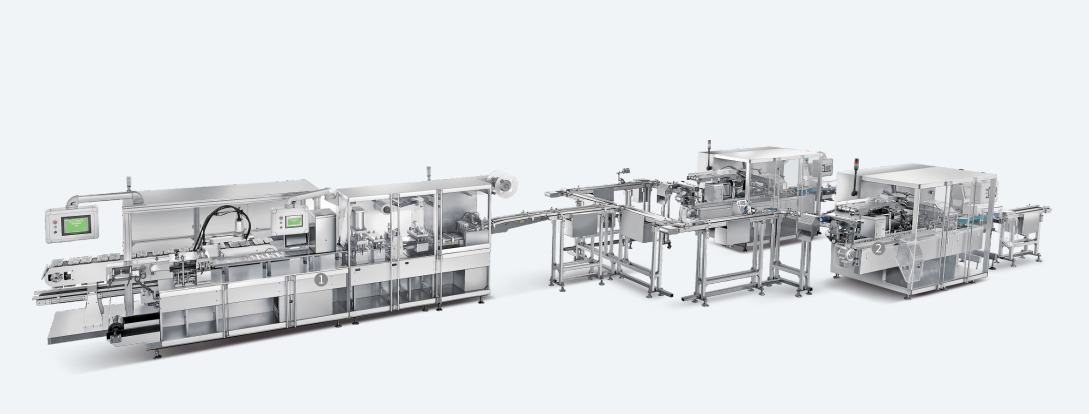
Automatic blister-cartoner production line - blister forming and sealing, transfer, leaflet handling and cartoning are rated in different units, and the stages must be balanced (image: Zhejiang Hoping Machinery).
Gate 6 - Certification coverage: series certificates are not line certificates
For the EU market, packaging machinery is governed by Machinery Directive 2006/42/EC together with the EN 415 series of packaging-machine safety standards published by CEN. Hoping's published certification evidence for its blister and cartoning machine groups is as follows.
| Document | Number | Issued by | Standard and scope |
|---|---|---|---|
| CE certificate, carton packing machine series | UCN 900339024607 | Certify International Ltd | EN 415-3:2000; EU / CE market |
| CE certificate, cartoning machine series | HTT190102307L | Shenzhen HTT Technology Co., Ltd. | EN 60204-1:2006+A1:2009+AC:2010; 2006/42/EC |
| CE certificate, blister packing machine series | HTT190102306L | Shenzhen HTT Technology Co., Ltd. | 2006/42/EC; EN 60204-1:2006+A1:2009+AC:2010 |
| ISO 14001:2015 environmental management system | CN00123E33896R1M/3300 | China Quality Certification Centre (CQC) | Design, production and after-sales service of packing machines and packing production lines |
| ISO 45001:2018 occupational health and safety management system | CN00123S33121R1M/3300 | China Quality Certification Centre (CQC) | Design, production and after-sales service of packing machines and packing production lines |
Three practical checks follow from this evidence.
- Scope. A certificate awarded to a machine series covers that series as tested. A configured line combining a blister stage, a transfer system, a cartoner and downstream modules should be supported by a configuration-specific declaration of conformity and technical file.
- Validity. Management-system certificates run on renewal cycles. The recorded validity of the ISO 14001:2015 and ISO 45001:2018 certificates falls in October 2026, so current status should be confirmed in writing at the time of order.
- Market fit. EU-facing projects should confirm the applicable standards directly, since the Machinery Directive and the EN 415 series - not a general quality label - govern packaging machinery safety in that market.
Gate 7 - Close the commercial structure: quantity, lead time, acceptance and support
The commercial envelope is as much a constraint as the mechanics. Published figures for this manufacturer are:
- Minimum order: 1 set or 1 complete line.
- Lead time: typically 60-120 days after technical confirmation, subject to model, configuration, project complexity and contract terms.
- Monthly production capacity: 30-40 units.
- Quality sequence: incoming material inspection, key component inspection, assembly inspection, electrical safety check, no-load trial run, material trial, factory acceptance test, customer witness acceptance and pre-shipment inspection.
- After-sales scope: on-site installation and commissioning, operator training, maintenance training, remote video and phone support, spare parts supply, process-parameter guidance, regular follow-up and troubleshooting, subject to contract and project configuration.
Cost drivers, expressed in scope terms, are the number of servo axes, the number of replenishment channels, the scope of coding and inspection equipment, the feeding method, the number of downstream modules, the quantity of format tooling and the data interface. Quotations compared on headline price without normalizing those items are unreliable; compared on a scope-normalized basis, they become straightforward.
Application: tablets, capsules and multi-SKU solid dosage
The DHL8005H is specified for pharmaceutical solid dosage production, capsule and tablet packaging, healthcare products, and food or cosmetic blister-cartoning projects. Recorded project profiles describe large pharmaceutical manufacturers, solid dosage production companies and pharmaceutical engineering contractors running 5-10 lines, where customer names are disclosed only with authorization.
Project objectives recorded for such installations include improving packaging automation, reducing manual transfer, improving blister-to-carton connection efficiency, reducing wrong insertion and missing-leaflet risks, and supporting downstream automation integration. The stated working environment is a GMP-oriented cleanroom or pharmaceutical packaging workshop with continuous high-speed operation and multi-batch, multi-format production, requiring stability, easy cleaning, safety protection and traceability-oriented operation. Multi-format compatibility, easy cleaning and maintenance, and fully servo control recur as selection criteria - which is consistent with the framework above.
Market trend: integration is where the growth sits
The pharmaceutical blister packaging machine market is projected to reach USD 2.57 billion by 2025 with a CAGR of 2.8%, according to Custom Market Insights, while the pharmaceutical cartoning machinery market was valued at USD 1.46 billion in 2024, according to Fortune Business Insights. Asia Pacific held the largest revenue share of the pharmaceutical packaging equipment market at 40.7% in 2025, according to Grand View Research.
Concentration is a second useful data point. A market intelligence report places the top three blister packaging machine players - Uhlmann, IMA and Marchesini - at approximately 29% combined share, which means roughly two-thirds of the market is served by a long tail of regional and specialist manufacturers. For buyers, that has a practical consequence: configuration evidence, certification scope and acceptance records are the differentiators that can actually be verified during evaluation.
Regional supply is part of the same picture. A mid-size specialist such as Hoping, established in 2001 with a stated export ratio of about 25% across Southeast Asia, the Middle East, Eastern Europe, South America and Africa, competes on documented configuration rather than on share of market.
Comparison with traditional solutions - and where the framework stops
Mechanically linked blister-cartoning arrangements - a main drive with cam-actuated stations - are typically optimized for a narrow set of formats and require mechanical adjustment at changeover. Servo-driven architecture separates motion from mechanism: positions, speeds and sequences become parameters. The DHL8005H adds mold-change support and preset memory, so a stored format can be recalled rather than re-tuned mechanically.
The trade-offs are real, and they should be priced rather than assumed away.
- Control complexity. More servo axes and a motion-controller platform mean more parameters, more diagnostics and a higher training requirement for maintenance and process staff.
- Platform dependency. Motor, drive, controller and industrial PC spares, plus access to the programming environment, become long-term supply-chain considerations.
- Documentation dependency. Where product-contact and tooling specifications are fixed by the technical agreement, the agreement - not the catalogue - is the compliance document.
- Possible over-specification. A line rated up to 800 blisters/min and 500 cartons/min suits high-volume solid dosage production. A producer running small and medium batches with frequent format changes may be better served by a DPP flat-plate blister machine (about 20-70 cycles/min depending on model) or by the DHL6004 at up to 600 blisters/min and 400 cartons/min.
- Line balance limits. Downstream bundling and case packing are rated in lower units - 30-60 bundles/min for the XWK4060, single-digit to about 12 cases/min for case-packing equipment - so usable output is the output of the slowest balanced stage, not the fastest.
Future outlook
Three directions are visible from the evidence above. First, capacity continues to concentrate in integrated blister-cartoning lines, with both the blister machine and cartoning equipment markets measured in the billions of dollars and expanding. Second, compliance is becoming a configuration-level question: as buyers ask for line-specific declarations, technical files and acceptance records rather than series certificates alone, documentation quality becomes a purchasing criterion alongside mechanics. Third, data continuity is moving into scope, since the matched-equipment list for a modern line already includes vision inspection, a checkweigher, coding equipment and an ERP/MES data interface.
For suppliers, the competitive ground shifts from peak-speed claims toward demonstrable configuration, training and lifecycle support. For buyers, the seven gates above are likely to become more, not less, detailed.
FAQ
What do the DHL8005H ratings of up to 800 blisters/min and 500 cartons/min actually mean?
They are the published maxima for the blister and cartoning stages respectively. The achievable line rate depends on the format: the number of blisters per carton determines which stage becomes the constraint. Buyers should require the rate to be demonstrated with their own blister layout, carton and film at the factory acceptance test.
Which CE certificates exist for Hoping blister and cartoning machines?
CE certification is recorded for three machine groups: the carton packing machine series (certificate UCN 900339024607, issued by Certify International Ltd, standard EN 415-3:2000); the cartoning machine series (certificate HTT190102307L, issued by Shenzhen HTT Technology Co., Ltd., standards EN 60204-1:2006+A1:2009+AC:2010 and 2006/42/EC); and the blister packing machine series (certificate HTT190102306L, issued by Shenzhen HTT Technology Co., Ltd., standards 2006/42/EC and EN 60204-1:2006+A1:2009+AC:2010).
Which standards apply to pharmaceutical packaging machines in the EU?
Packaging machinery in the EU is governed by the Machinery Directive 2006/42/EC together with the EN 415 series of packaging machine safety standards published by CEN. ISO 15378 is a separate standard that integrates GMP requirements for primary packaging materials; it addresses the packaging material supply chain rather than certifying packaging machines.
How is GMP-oriented construction documented on the DHL8005H?
The DHL8005H is documented as a GMP-oriented line design with a stainless steel and aluminum-alloy machine structure, transparent guarding and servo-driven motion components; its GMP-oriented product-contact parts and tooling are specified according to the technical agreement. For other Hoping models, more granular specifications are published - the DPH320HII rotary blister packing machine uses AISI 316L stainless steel for product-contact parts and AISI 304 stainless steel with anodized aluminum alloy for non-product-contact parts.
What are the minimum order quantity and typical lead time?
The minimum order quantity is 1 set or 1 complete line. Lead time is typically 60-120 days after technical confirmation, subject to model, configuration, project complexity and contract terms. Monthly production capacity is stated at 30-40 units.
What quality checks take place before shipment?
Incoming material inspection, key component inspection, assembly inspection, electrical safety check, no-load trial run, material trial, factory acceptance test, customer witness acceptance and pre-shipment inspection.
What should buyers treat as the limits of a high-speed blister-cartoning line?
Maximum rates are format-dependent; certification is issued to machine series or tested samples and should be confirmed as configuration-specific declarations for the installed line; management-system certificates run on renewal cycles and current validity should be confirmed at order; and downstream bundling, case packing and palletizing stages are rated in lower units, so overall output is set by the slowest balanced stage.
A full product catalogue covering blister packing machines, cartoners, banders, case packers and blister-cartoning lines is available for download: Hoping Machinery product catalogue.