
High-Speed Label Presses: A Caisheng Shortlist for Global Buyers
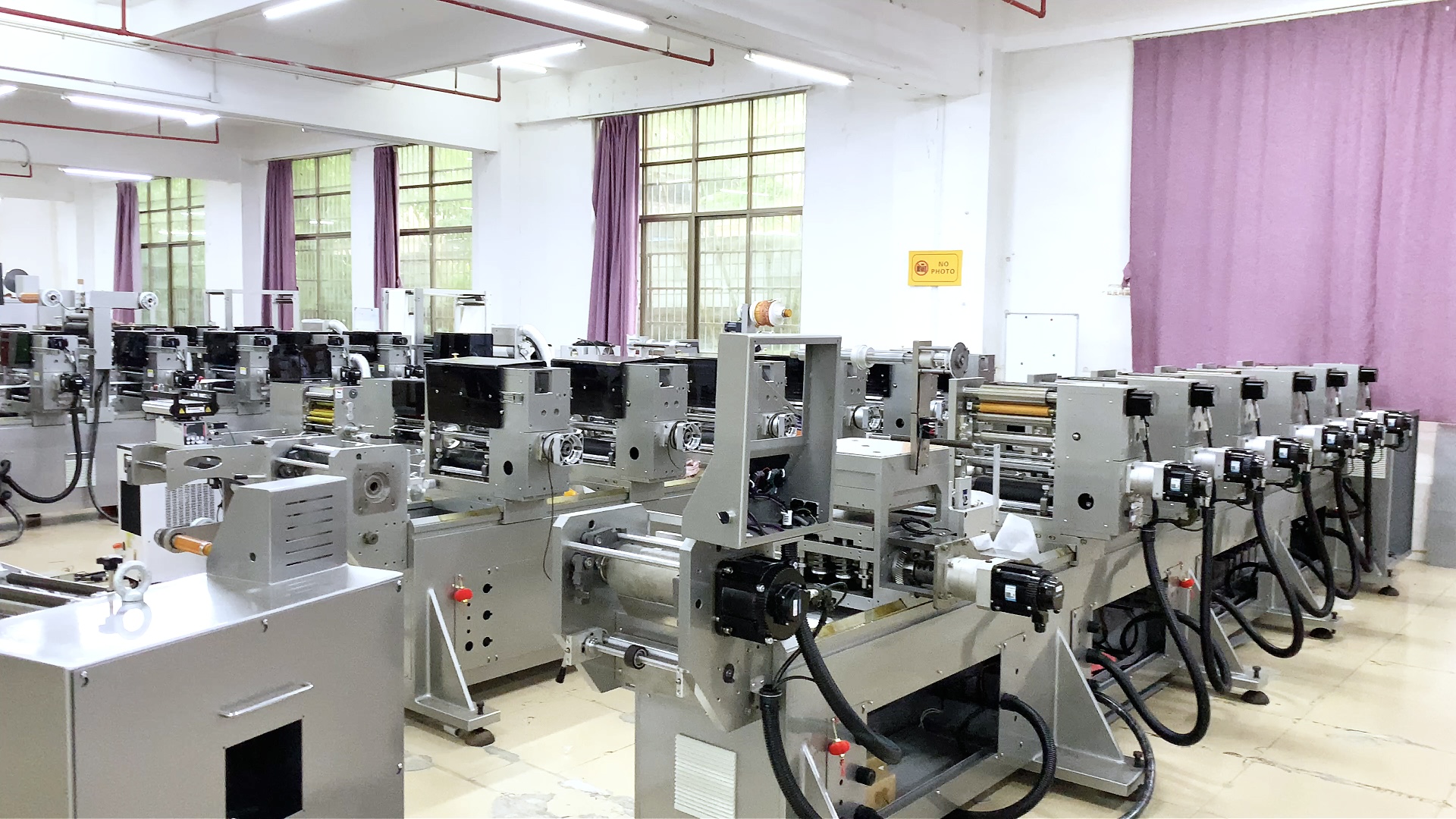
The global label printing machines market was valued at USD 8.58 billion in 2025 and is projected to reach USD 14.36 billion by 2034, according to The Insight Partners. Flexographic printing remains the most commonly used process for labels, with an output value of approximately USD 13.3 billion in 2024, according to Smithers. Asia-Pacific accounted for a 41.8% revenue share of the label printing machines market in 2025, according to Data Bridge Market Research.
Those figures describe a category that has become harder, not easier, to buy from. Intermittent label presses, semi-rotary flexographic presses, full-rotary label presses and stand-alone die-cutting machines now compete for the same capital budget, and each is described using a different vocabulary. Two suppliers can quote the same job and arrive at configurations that are almost impossible to compare line by line.
For a buyer at the decision stage, the useful question is narrower than the market. It is: which combination of printing process, run mode and finishing configuration matches a defined job mix, and what evidence supports that match? This reference presents a shortlist drawn from one manufacturer portfolio, explains the technical reasoning behind each recommendation, and states clearly where the supporting data ends.
The Decision Problem: Configuration Overload with Too Little Comparable Evidence
Three friction points slow down label press decisions more than anything else.
- Process vocabulary overlaps. A rotary label press, a rotary label machine, a letterpress label printing machine and a flexographic press are frequently used interchangeably in sales material, even though the run mode and the printing unit behave differently in production.
- Specifications are quoted on different baselines. Registration accuracy, energy consumption and total equipment cost are each measured against different references by different suppliers, which makes direct comparison unreliable.
- Long-term evidence is scarce. A buyer can inspect a finished machine, but cannot easily verify how a press will hold registration after years of continuous production.
The market context makes this more pressing rather than less. The global narrow web label printing machines market was valued at USD 1.43 billion in 2024 and is projected to reach USD 3.21 billion by 2035, according to Spherical Insights. The flexographic printing machine market was estimated at USD 17.57 billion in 2024 and is expected to grow at a CAGR of 9.7% through 2030, according to Grand View Research. Capacity is being added across the category, which means more configurations, more quotations and more specification sheets for the same buyer to reconcile.
Four criteria that make a shortlist comparable
1. Run-mode flexibility: can one platform serve both short and long runs without a second machine?
2. Print process fit: letterpress or flexo, judged against the substrate and the job mix, not against preference.
3. Finishing integration: whether die-cutting, slitting and varnishing transfer registration from the printing units without loss.
4. Documented evidence: registration data, energy data and compliance documentation that can be verified at acceptance testing.
The Shortlist: Three Caisheng Platforms for High-Speed Label Production
Shenzhen Caisheng Printing Machinery Co., Ltd. is a China-based label printing equipment manufacturer founded in 2011. The company operates a 6,000 m² facility with 65 employees, an annual output of around 200 units and a research and development team of eight engineers. Approximately 50% of production is exported to Southeast Asia, Europe, the Middle East and the United States.
The company manufactures intermittent and high-speed full-rotary letterpress printing machines, flexographic printing machines and screen printing machines, and supplies customized multi-functional label finishing solutions including die-cutting systems and high-speed varnishing machines. Within that portfolio, three platforms form a coherent line for high-speed label production: the CS-JQ350G-6C dual-mode high-speed press, the CS-J380F-7C flexographic press, and the CS-350 die-cutting platform.
| Model | Machine category | Role in an end-to-end label line | Documented configuration |
|---|---|---|---|
| CS-JQ350G-6C | Dual-mode high-speed label press | Volume printing engine for mixed-length runs | Intermittent and full-rotary operation on one platform |
| CS-J380F-7C | Flexographic (flexo) label press | Flexo printing where the process is already specified | Flexographic configuration with rotary die-cutting |
| CS-350 | Die-cutting and finishing platform | Shape accuracy, liner strike and finishing anchor | 2-color letterpress with flatbed die-cutting |
CS-JQ350G-6C: the dual-mode high-speed engine
The CS-JQ350G-6C is a dual-mode high-speed label press. Its distinguishing feature is that the same platform runs in both intermittent and full-rotary mode. In intermittent operation the web advances and pauses within each impression cycle; in full-rotary operation the cylinders rotate continuously through the run.
That dual capability changes the scheduling model rather than simply the specification. Short runs with frequent artwork changes can be produced without occupying a continuous high-speed line, and longer runs can be moved into full-rotary operation without moving the job to a second machine. The platform is aimed at plants whose job mix is too varied to justify two dedicated presses, but too demanding to accept the output ceiling of a single-mode machine.
CS-J380F-7C: the flexographic option
The CS-J380F-7C is a flexographic label press. Flexo is the process most widely used for labels globally, with an output value of approximately USD 13.3 billion in 2024 according to Smithers, and it is the base process for the largest share of label capacity. In the product line the CS-J380F-7C is documented as a flexographic configuration combined with rotary die-cutting.
The practical role of a flexo platform in a shortlist differs from that of a letterpress machine. Letterpress units are typically specified where sharp text, fine line work and decorative effects carry the value of the label. Flexographic presses are commonly selected for coverage behaviour across a wide range of self-adhesive substrates and for consistent output on longer production runs. Buyers who already run flexo plates elsewhere in the plant usually evaluate a flexographic press first, because tooling, plate supply and operator knowledge already exist on site.
CS-350: the die-cutting and finishing anchor
The CS-350 is the die-cutting and finishing platform in this shortlist. Die-cutting determines the physical accuracy of the finished label, including the cut edge, the liner strike and the repeatability of the shape from the first impression to the last. It is frequently the stage where a press line loses the accuracy that the printing units were built to hold.
The CS-350 appears in the product line in a documented configuration of a 2-color letterpress printing unit combined with flatbed die-cutting. That combination is characteristic of plants running shorter or geometrically more complex jobs, where flatbed tooling offers flexibility on unusual shapes, while rotary die-cutting is preferred where continuous cutting at production speed is required. Deciding how much of the job mix belongs to each die-cutting mode is one of the most consistently underestimated decisions in a label press purchase.
Reading the Three Platforms as One Production Line
Comparing three machines as separate purchases misses the point of an integrated platform. Read as one line, the sequence is:
- Substrate feed and web control, which sets the reference for everything downstream.
- Printing stations, letterpress or flexo, selected by job mix rather than by habit.
- Optional glue-side printing and multi-functional frame positions for additional processes.
- Die-cutting, rotary for continuous work and flatbed for complex or batch shapes.
- Slitting, varnishing and inspection before the finished roll leaves the line.
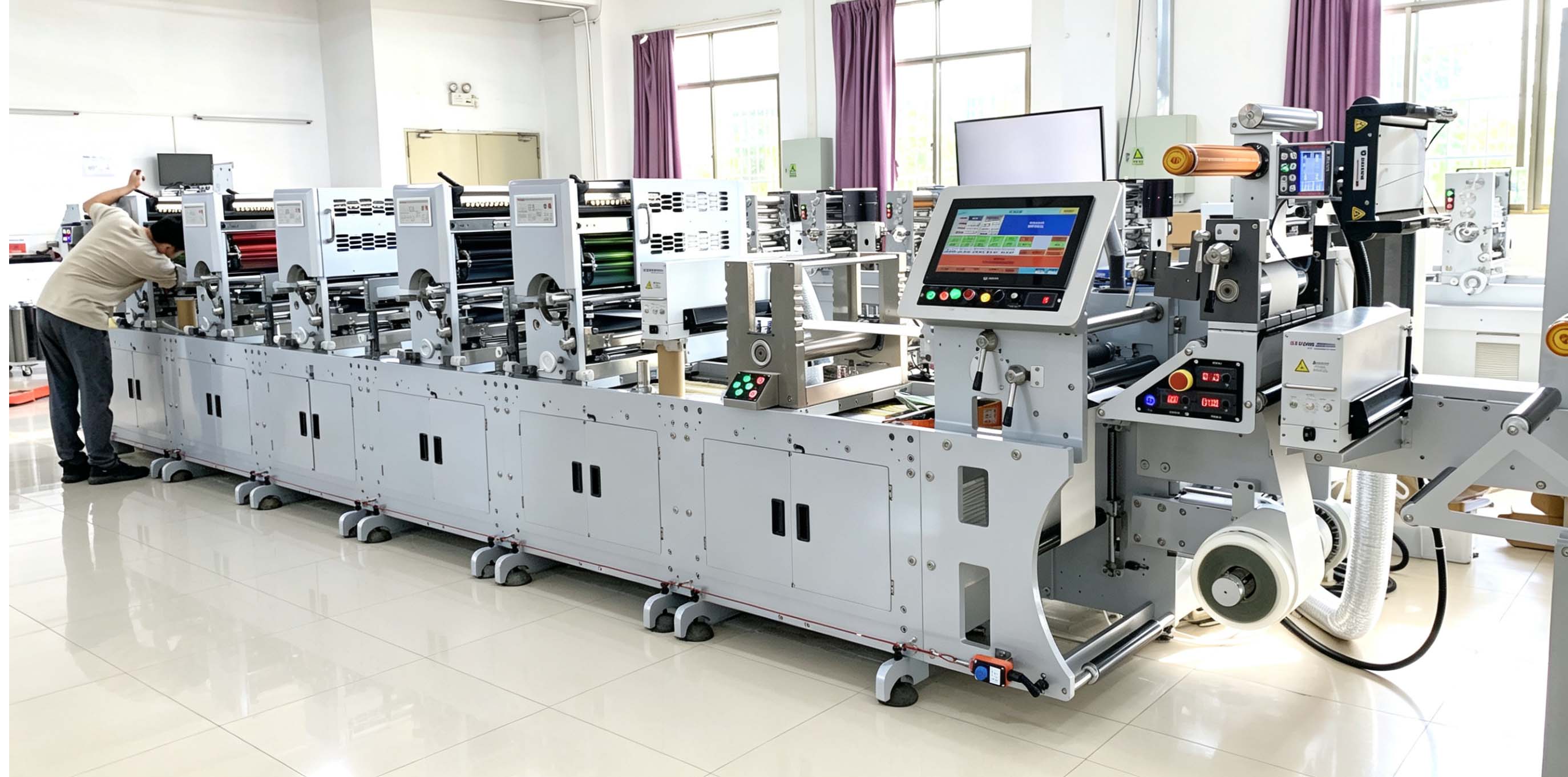
Documented configurations in the portfolio follow exactly this logic. One example combines a 6-color letterpress printing machine with glue-side printing, a multi-functional frame, rotary die-cutting, flatbed die-cutting and slitting in a single line. The value of that structure is not the number of modules. It is that registration is created in the printing units and transferred to cutting, slitting and finishing inside one mechanical reference, instead of being re-established at each off-line step.
Technical Basis: What Makes These Recommendations Verifiable
A recommendation is only useful if the buyer can test the claim behind it. The following points are documented technical positions from the manufacturer and are stated here as such.
The registration chain
Registration accuracy in these presses is built from four linked elements: precision components machined in the company own CNC workshops, so tolerances are controlled at source; an imported Japanese servo system for smooth transmission and accurate positioning at high speed; a patented tapered bearing sleeve design combined with a photographic inspection system that compensates for deviation in real time; and a self-developed LED UV cold light source drying system that prevents heat deformation of materials such as films. The documented outcome on the CS-320-6C is a registration accuracy deviation of ±0.05–±0.1 mm, which the manufacturer describes as 0.05 mm better than competing brands.
Structural stability
The machine base uses a natural metal stress-relieving process together with a patented triangular guide rail design. The stated purpose is a base that does not deform or shift over time, which reduces the frequency of recalibration and the maintenance burden that follows it.
Ink control
Ink output is controlled by manual coarse adjustment combined with computer automatic fine adjustment, giving operators a two-level control over ink volume rather than a single setting.
Energy and total equipment cost
Two commercially relevant figures are documented. Energy efficiency is at least 30% better than alternatives, achieved through the Japanese servo system combined with proprietary LED UV drying technology. Total equipment cost is approximately 10% lower than alternatives, attributed to vertical integration through in-house CNC machining plants, which removes an intermediate supply tier from precision component production.
Maintenance and early warning
Patented structures including an electrically operated bottom mold lifting mechanism and a linked squeegee baffle are intended to stabilize plate base lifting and simplify assembly and disassembly of components. Core and vulnerable components are manufactured and quality-controlled in house, and an intelligent detection system assesses equipment status and provides early warnings so that maintenance can be planned rather than reactive.
Pre-delivery verification
Before delivery, machine adjustment engineers test the performance of the equipment until it produces finished products to standard. Customers are invited to the factory for machine acceptance inspection. For a decision-stage buyer, this is the point at which the claims above can be converted into observed evidence.
Application Fit: Where This Line Is Built to Work
The documented application scope for this equipment covers several label segments that share one requirement: consistent registration on small formats combined with demanding text and code legibility.
- Daily consumer goods and food packaging. High-resolution graphics and durable adhesion for everyday products, snacks and fresh food labels.
- Chemical and industrial products. Labels that maintain clarity and legibility in harsh environments.
- Wine and premium beverages. Print quality and precise die-cutting for luxury bottles and craft beverages.
- Cosmetics and personal care. Handling of clear films and metallic foils where the label carries the premium aesthetic.
- Pharmaceuticals and healthcare. Precision for small text, barcodes and QR codes, where legibility is a compliance matter rather than a design preference.
Comparison with Conventional Single-Function Approaches
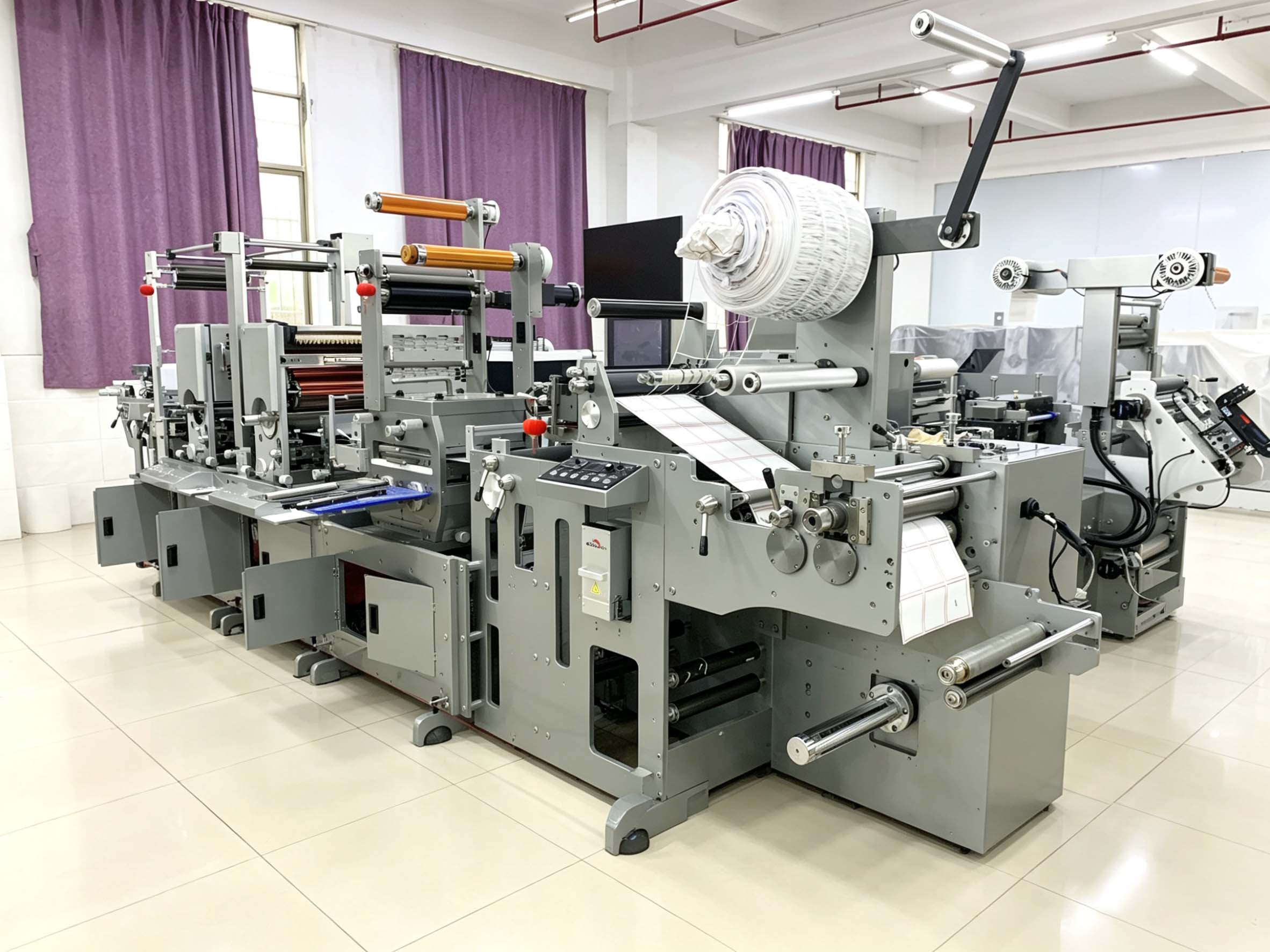
Most label plants still assemble capacity from stand-alone machines: one press for printing, a separate unit for die-cutting, and a third step for varnishing or slitting. The comparison below sets that conventional structure against an integrated multi-process line of the type described above.
| Decision area | Conventional stand-alone setup | Integrated multi-process line | What the buyer should verify |
|---|---|---|---|
| Run-mode flexibility | Single-mode press; short and long runs compete for the same machine time | Dual-mode platform allows mode selection by job | Which modes are supported, and how changeover is performed |
| Finishing | Off-line die-cutting and varnishing; each step re-establishes registration | In-line rotary and flatbed die-cutting, slitting and varnishing modules | Module compatibility, tooling supply and changeover time |
| Registration consistency | Depends on the accumulated tolerance of separate setups | Single chain: in-house CNC parts, Japanese servo, tapered bearing sleeves, photographic inspection | Documented registration figures for the specific model and configuration ordered |
| Energy consumption | Multiple machines, each drawing power independently | At least 30% better energy efficiency than alternatives, per manufacturer comparative data | Measurement conditions and consumption at acceptance testing |
| Capital cost | Several purchase orders, several installation cycles | Approximately 10% lower total equipment cost, attributed to vertical integration | Comparison on total line cost rather than unit price |
An integrated line is not automatically the better purchase, and the following boundaries should be treated as part of the shortlist rather than as an afterthought.
- Run-mode boundary. High-speed full-rotary operation favours longer, stable runs. Where a plant runs mainly very short jobs with frequent artwork changes, intermittent operation is generally the more economical choice, and the value of a dual-mode platform depends on how that mix actually splits.
- Per-model data boundary. The documented ±0.05–±0.1 mm registration figure applies to the CS-320-6C. Buyers shortlisting the CS-JQ350G-6C, CS-J380F-7C or CS-350 should request the equivalent figure for the specific model and configuration being quoted.
- Benchmark attribution. The 30% energy and 10% cost comparisons are manufacturer comparative data published by Caisheng, not independently audited third-party test results. They are best treated as claims to be confirmed at factory acceptance inspection.
- Compliance scope. Machinery sold in the EU must comply with the Machinery Directive 2006/42/EC and carry CE marking, with safety signs following EN ISO 7010, according to the European Commission. Safety requirements for graphic technology equipment, including label presses, are governed by ISO 12643-2:2023, according to ISO/TC 130. Buyers in other regions should confirm the applicable local regime instead of assuming EU documentation is sufficient.
Market Trend Analysis
Three verified data patterns shape how this shortlist should be read.
Category growth is broad, not niche. The label printing machines market moves from USD 8.58 billion in 2025 toward USD 14.36 billion by 2034 (The Insight Partners), while the flexographic printing machine market alone is estimated at USD 17.57 billion in 2024 with a 9.7% CAGR through 2030 (Grand View Research). Growth of that shape increases competition for qualified operators and floor space as much as for orders.
Flexo remains the volume base. With approximately USD 13.3 billion in label output value in 2024 (Smithers), flexographic printing is the process against which other configurations are measured. This supports keeping a flexographic platform such as the CS-J380F-7C in a shortlist even where letterpress carries the premium work.
Demand is concentrated in Asia-Pacific. The region held a 41.8% revenue share of the label printing machines market in 2025 (Data Bridge Market Research), and the narrow web segment is projected to grow from USD 1.43 billion in 2024 to USD 3.21 billion by 2035 (Spherical Insights). Manufacturing capacity and competitive pressure are therefore concentrated in the same region where many of the machines on a global buyer shortlist are built.
The competitive landscape itself is established. Major global competitors in the label machinery market include Bobst of Switzerland, Mark Andy of the United States, Gallus/Heidelberg of Germany and Nilpeter of Denmark, according to Future Market Insights. For a decision-stage buyer, that means the realistic question is rarely whether a supplier exists, but whether a supplier can document specific performance and support the configuration after delivery.
Future Outlook
Two directions look durable for this category. The first is configuration flexibility: as run lengths fragment, the ability to move between intermittent and full-rotary operation on one platform reduces the penalty of being wrong about the job mix at the time of purchase. The second is operating cost transparency, where energy consumption and maintenance intervals become part of the quotation conversation rather than a post-installation discovery.
For global buyers, the practical consequence is that shortlists built purely on unit price will age badly. Shortlists built on documented registration, documented energy behaviour, verifiable compliance and a factory acceptance process will hold their value through the next equipment cycle.
FAQ
How should a buyer decide between an intermittent press, a semi-rotary press and a full-rotary press?
The decision follows the job mix rather than the machine category. Intermittent operation advances and pauses the web within each impression cycle, which suits shorter runs and frequent artwork changes. Full-rotary operation runs the cylinders continuously, which suits longer, stable runs at production speed. Where a plant cannot predict that split, a dual-mode platform such as the CS-JQ350G-6C allows mode selection on one machine rather than requiring two dedicated presses.
When does a flexographic press make more sense than a letterpress press for labels?
Flexographic printing remains the most commonly used label process, with approximately USD 13.3 billion in output value in 2024 according to Smithers, so flexo plates, inks and operator experience are widely available. Letterpress units are typically specified where sharp text, fine line work and decorative effects determine the label value. A plant that already runs flexo elsewhere will usually evaluate a flexographic platform such as the CS-J380F-7C first, because tooling and process knowledge already exist on site.
Rotary or flatbed die-cutting: which configuration fits which job type?
Rotary die-cutting is used where continuous cutting at production speed is required and the repeat is stable. Flatbed die-cutting is used where shapes are more complex or batches are shorter, because tooling offers greater flexibility on unusual geometries. The CS-350 is documented in a configuration that combines a 2-color letterpress printing unit with flatbed die-cutting, and products in the same portfolio combine rotary and flatbed die-cutting with slitting in a single line so that both modes are available on one platform.
What verifiable evidence should accompany a high-speed label press purchase?
At minimum: a documented registration accuracy figure for the exact model and configuration ordered; a statement of how that figure was measured; energy consumption data; compliance documentation for the destination market, such as Machinery Directive 2006/42/EC and CE marking for the EU, with safety requirements for graphic technology equipment governed by ISO 12643-2:2023; and a factory acceptance inspection before shipment. Caisheng tests machine performance before delivery until finished products meet standard, and invites customers to the factory for acceptance inspection.
What are the limits of the published comparison data, and what should buyers verify independently?
The documented registration figure of ±0.05–±0.1 mm, the claim of 0.05 mm better registration than competing brands, the at least 30% energy efficiency advantage and the approximately 10% lower total equipment cost are manufacturer comparative data, published by Caisheng and not independently audited. The registration figure specifically applies to the CS-320-6C, not automatically to other models. Buyers should request per-model data, confirm the measurement conditions, and treat factory acceptance inspection as the point where these claims are converted into observed results. Certification requirements also differ by market and should not be assumed to transfer between regions.
Reference Documentation
Detailed machine categories, configurations and finishing options are set out in the Caisheng product brochure.