
High-Speed Tube Laser Cutting: Country Policy, Capacity, and Technology
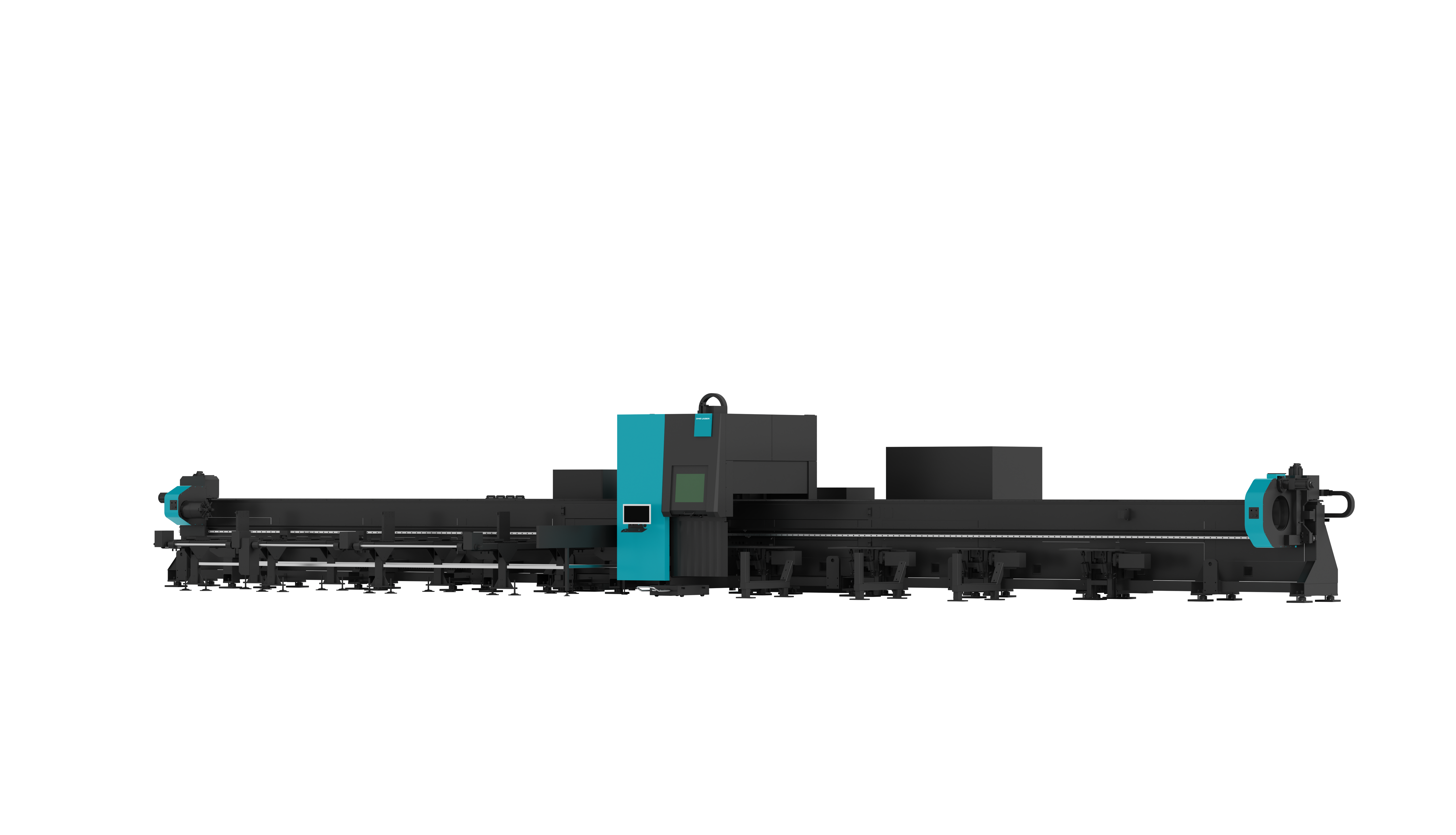
D-Tube fiber tube laser cutting system — the machine class at the centre of country-level policy, capacity and technology shifts.
Tube laser cutting has become a country-by-country procurement question rather than a single global purchasing decision. The machine that a fabricator in Poland can legally operate, the lead time a buyer in Mexico can plan around, and the cutting speed a steel-structure supplier in Vietnam can hold on thin-wall tube are shaped by three separate forces: local policy and compliance regimes, the geography of tube-cutting manufacturing capacity, and the mechanical technology inside what suppliers market as a high-speed cutting machine.
Understanding how those three forces interact matters more than comparing headline wattage. A tube laser cutting machine is a fiber laser system that cuts round, square and rectangular metal tube by feeding and rotating long stock through one or more chucks while a cutting head processes the profile. Because the workpiece is long and often thin-walled, the engineering priorities differ from those of flat sheet equipment — and so do the questions a buyer should ask before signing.
1. The market signal behind the shift toward tube processing
The demand side is expanding. Fortune Business Insights projects the global laser cutting machines market to grow from USD 7.44 billion in 2026 to USD 18.43 billion by 2034, a compound annual growth rate of 12%. Tube and profile processing contributes to that growth because it consolidates several downstream operations — sawing, drilling, notching and deburring — into a single automated pass on one machine.
For fabricators, the practical consequence is that tube cutting is no longer a specialist add-on. It is increasingly the process that determines how quickly a workshop can respond to an order for frames, railings, chassis parts, furniture structures or machine guards. That shift is what makes the country-level context relevant: a process that sits on the critical path of production cannot be selected purely on price or on a specification sheet.
2. Why tube processing carries a different risk profile than sheet processing
In sheet metal cutting, the stock is flat, supported across a table and geometrically stable. In tube processing, the workpiece is long, frequently unsupported between the chuck and the cutting zone, rotating, and thin-walled relative to its diameter. The failure modes are therefore different, and they are the reason "high speed" is a claim that deserves scrutiny rather than acceptance.
The dominant risk categories in tube cutting are:
- Clamping deformation and surface marking. Thin-wall tube can ovalise or scar if clamping force is applied without control or concentricity.
- Deflection and vibration. A tube cantilevered beyond the chuck behaves like a beam; as feed speed rises, so does the risk of chatter, taper and dimensional drift.
- Position loss under acceleration. Heavy tube stock resists changes of direction. Repeated rapid acceleration and deceleration stress the guide system and the servo loop.
- End-of-stock waste. Any material left inside the chuck travel envelope is scrap, which directly affects cost per finished part.
- Thermal effects. Heat input over long cut paths can distort thin-wall profiles if the process parameters are not managed.
These risks are why a high-speed tube cutting machine should be evaluated as a system — guides, chucks, support structures and control software together — rather than as a laser source plus a frame. The same logic explains why country-level certification and service geography matter as much as cycle time: a machine that cannot be commissioned, maintained or legally operated in the buyer's market never delivers its theoretical speed.
3. Policy environments: certification is a national gate, not a global one
Laser processing equipment is subject to both a general international baseline and market-specific electrical and machinery requirements. At the international level, laser processing machines are expected to comply with ISO 11553-1 for general safety requirements and IEC 60825-1 for equipment classification — both of which are referenced in international trade and CE marking contexts.
Beyond that baseline, requirements diverge by destination market. Two regimes illustrate the point clearly:
- European Union. Equipment typically requires Machinery Directive compliance verification. For example, the D-Tube series is covered by an SGS Verification of MD Compliance, certificate MD GZES2510019556MD, issued on 28 November 2025, assessed against EN 60204-1:2018, EN ISO 11553-1:2020+A11:2020 and EN ISO 12100:2010, with a scope naming the D-Tube 1660/2460/2860/3660/2490/2890/3690 K2/K3-CE configurations.
- United States. The emphasis shifts to industrial control panel and electrical safety. The D-Tube series is covered by Certificate of Compliance SGSNA/24/GZ/00242X, issued on 28 November 2025, assessed against UL 508A (3rd Edition, dated 24 April 2018, revised 21 July 2022) and CSA C22.2 No.286:23 (April 2023).
Buyer interpretation: the operative detail in any certificate is its scope. A document that names a machine series but not the exact configuration being purchased leaves a compliance gap that surfaces at installation, not at the quotation stage.
This has a direct evaluation consequence. When two suppliers quote comparable tube cutting performance, the one that can already document market-specific compliance for the identical configuration is removing a schedule risk that the other supplier is transferring to the buyer. In markets where import clearance, site insurance or customer audits require documentation, that difference is commercially material.
4. Capacity shifts: where tube cutting expertise is concentrated
Production capacity for laser equipment is heavily concentrated. China's laser equipment market revenue accounted for 56.6% of the global total in 2024, with high-power laser localization exceeding 70%, according to reporting by IT Home citing CCTV Finance. For buyers outside that manufacturing base, the relevant question is not simply where machines are built, but which suppliers have converted domestic scale into export-grade engineering, compliance and service capability.
Capacity also has a second dimension that is frequently overlooked: the ability to support a mix of standard and customized configurations without extending lead times unpredictably. DNE Laser (Guangdong) Co., Ltd., which trades under the brand DNE LASER, is a wholly owned subsidiary of the Swiss Bystronic Group, headquartered in Shenzhen with its production base in Nanhai, Foshan. The company was founded in 2008, operates a production base of more than 60,000 square metres, employs more than 600 people, maintains a 38-engineer R&D team, and reports annual output of more than 2,000 machines. Its export ratio is 45%, with markets that include Vietnam, Indonesia, Thailand, India, Australia, Türkiye, Germany, Italy, Poland, the United States, Mexico and Brazil.
For a procurement team, that profile answers a different question than a specification table does. Multi-market coverage implies familiarity with more than one compliance regime, and an export ratio above 40% implies that documentation, packaging and commissioning processes are already exercised regularly — which tends to reduce the variance in delivery and start-up.
5. Technology: what a high-speed tube cutting machine actually has to get right
Speed specifications are only meaningful when the machine can hold accuracy at that speed. In tube processing, three subsystems carry most of the risk-control burden, and they are the components where an inexpensive machine most often reveals itself after a few months of production.
High-precision linear guides
The guide system determines whether the cutting head and the chuck axes can be accelerated repeatedly without losing position. Guide straightness, preload and rigidity under dynamic load translate directly into positioning accuracy over long travel. In practice, buyers should ask for positioning and repeat-positioning figures expressed per unit of length, because that is the form in which the specification remains meaningful as the working envelope grows.
Automatic centering chucks with sealed designs
Automatic centering chucks clamp the tube concentrically, so the rotation axis stays predictable regardless of tube size variation. Sealing matters because tube shops generate fine metallic dust and spatter; an unsealed chuck loses clamping repeatability over time, which appears as intermittent dimensional drift rather than as a clean failure. Sealed construction extends the maintenance interval at which that accuracy is retained — a total-cost-of-ownership factor rather than a convenience feature.
Synchronized auxiliary support devices
Long tube behaves as a cantilever between the chuck and the cutting zone. Synchronized auxiliary support devices follow the tube to limit sag and vibration, which is what allows higher feed rates to be used on long stock without sacrificing edge quality. This is particularly relevant for thin-wall tube, where unsupported cutting at high speed produces chatter marks and dimensional variation that must later be reworked or scrapped.
The measurable side of the same capabilities
Engineering intent only has procurement value when it is expressed in verifiable numbers. The D-Tube series illustrates how these capabilities are published: X/Y-axis positioning accuracy of ±0.05 mm/m and repeated positioning accuracy of ±0.03 mm/m across the range, with bevel cutting available as an optional function.
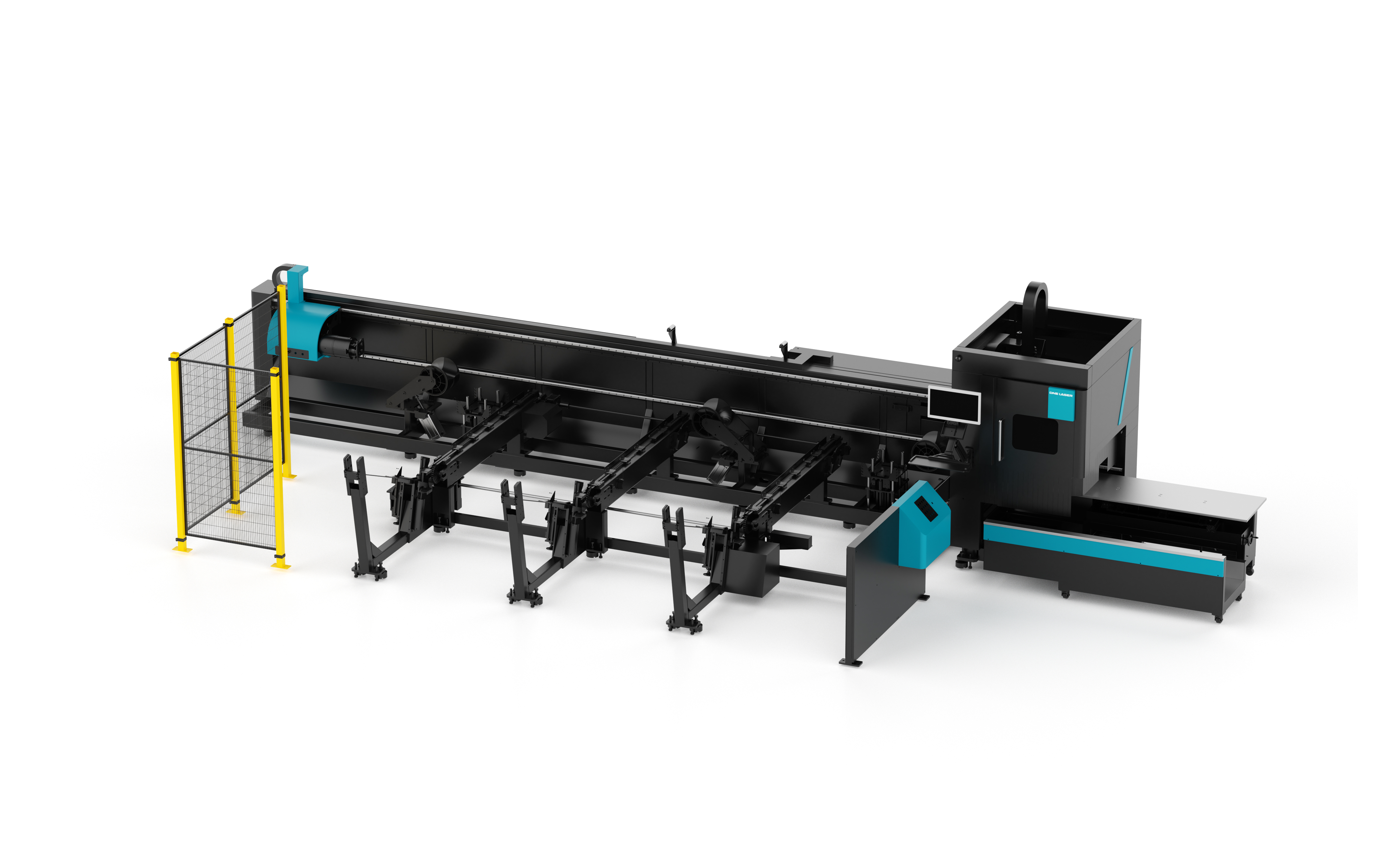
D-Tube series tube processing configuration — chuck and support design determines whether higher feed rates can be sustained without losing edge quality.
| Model | Chucks | Round tube range | Square tube range | Theoretical max. chuck load |
|---|---|---|---|---|
| D-Tube F | 2 | Φ8–Φ120 mm / Φ12–Φ240 mm / Φ40–Φ350 mm | □8×8–□120×120 mm / □12×12–□240×240 mm / □40×40–□350×350 mm | 100 kg / 300 kg / 1000 kg |
| D-Tube 240 | 2 or 3 | Φ15–Φ230 mm | □15×15–□230×230 mm | 300 kg |
| D-Tube 360 | 2, 3 or 4 | Φ40–Φ350 mm | □40×40–□350×350 mm | 1200 kg |
| D-Tube 520 | 3 or 4 | Φ50–Φ510 mm | □50×50–□510×510 mm | 1500 kg |
Source: published D-Tube series specifications. Positioning accuracy ±0.05 mm/m; repeated positioning accuracy ±0.03 mm/m; bevel cutting function optional.
Two readings of this table are worth separating. The first is capability: chuck count and load rating determine which part families a buyer can process without re-clamping or manual intervention. The second is fit: a shop whose order book sits at Φ60 mm round tube and 400 mm unsupported lengths does not need the outer edge of the range, and paying for it adds floor space and capital cost without adding throughput.
6. High-power fiber technology as the upstream engine
Tube cutting capability is partly downstream of sheet-cutting development. Fiber lasers now command more than 55% market share in industrial laser systems, displacing CO2 lasers on the strength of 30–50% higher efficiency and around 50% lower operating costs, according to SNS Insider. Demand for ultra-high-power laser heads above 10 kW grew by 75% between 2023 and 2024, driven by thick-plate cutting needs in heavy industry, according to Customcy.
That upstream trend sets the technology ceiling that tube machines inherit. In DNE LASER's sheet-cutting range, the D-Soar model is published with laser power options from 3,000 W up to 30,000 W, and the D-Soar Plus-G extends to 40,000 W with X/Y-axis maximum linkage acceleration of 2.8 G and maximum linkage positioning speed of 280 m/min. High-power fiber sources also underpin the 3 kW, 6 kW and 12 kW configurations that are common across the D-Speed range at 150 m/min linkage positioning speed.
The important qualification for tube buyers is that wattage transfers only partially to tube processing. Cutting thick plate is a thermal penetration problem; cutting tube is a handling, clamping and vibration problem. A high-power source improves throughput on heavy-wall tube, but the achievable speed on a 2 mm wall round tube is governed by chuck concentricity, support synchronisation and guide rigidity — which is why the technology discussion should return to the three subsystems described above.
7. Application fit: what country-level trends look like on the shop floor
Two documented applications illustrate how tube and sheet laser cutting capability translates into measurable operational outcomes in different markets.
- Vietnam — automotive parts manufacturing. A laser cutting application in Vietnam's automotive sector involved nine units installed in a facility manufacturing automobile parts and components. After one year of operation, the implementation was reported to have improved production efficiency by 15%.
- Mexico — industrial automation structures. An industrial automation client in Mexico installed six units: three that had been in service for three years, after which three additional new units were purchased. The client's core business covers intelligent equipment and precision structural parts, including data infrastructure and logistics automation. Reported highlights were faster cutting speed, low maintenance and long lifespan, alongside a 15% improvement in production efficiency.
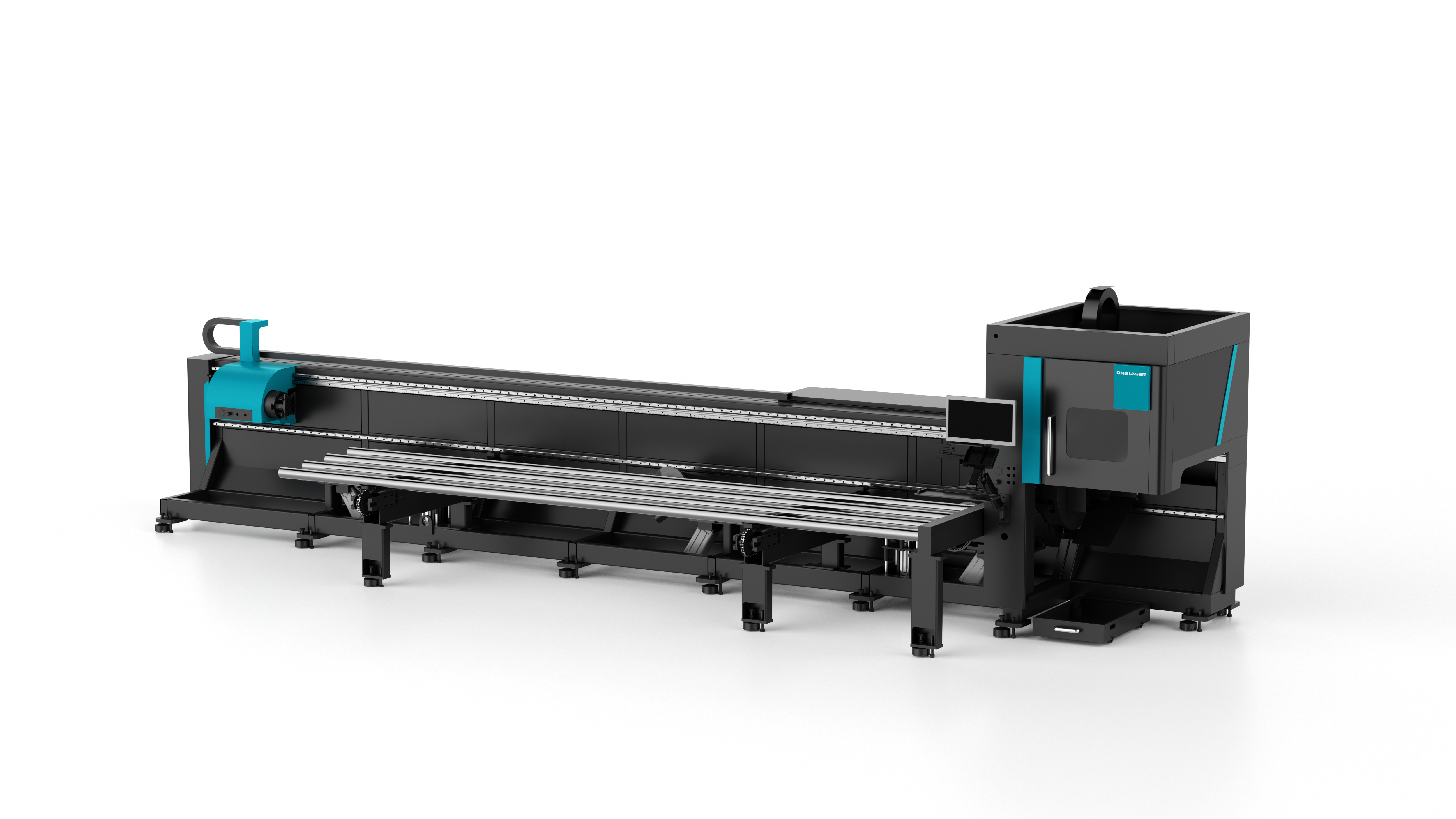
D-Tube series in a tube-cutting configuration. Repeat orders — rather than first installations — are the clearest available evidence that a configuration fits a production environment.
The Mexican case is instructive for a different reason than the efficiency figure. A buyer that returns for three additional units after three years of service has effectively validated the machine against its own production reality: duty cycle, maintenance burden, spare-part availability and operator acceptance. For procurement teams building a shortlist, repeat-purchase patterns deserve more weight than first-installation references, because they filter out configurations that performed well during commissioning but not during year three.
Typical tube-cutting applications continue to cluster around automotive structures and components, machinery frames, steel structure fabrication, and general metal fabrication where round, square and rectangular tube are processed from carbon steel and other metals. In each of these segments, the value of the machine is measured in finished parts per shift rather than in metres cut per minute.
8. Comparison with traditional tube processing — and where laser cutting does not win
Laser tube cutting competes with several established processes, and an honest comparison requires stating the boundary conditions rather than only the advantages.
| Process | Typical strength | Main constraint buyers should weigh |
|---|---|---|
| Saw + drill line | Low capital cost; effective on simple, straight cuts in heavy-wall tube | Multiple setups per part; hole pattern and bevel features require additional operations |
| Turret punch for tube | Fast on repetitive hole patterns in lighter gauges | Tooling tied to profile shapes; limited contour freedom |
| Plasma cutting | Handles thick sections and rough-cut requirements | Heat-affected zone and edge finish usually require secondary processing |
| CO2 laser tube cutting | Established process with broad material experience | Lower wall-plug efficiency and higher operating cost than fiber sources |
| Fiber laser tube cutting | Single-pass cutting, holes, notches and bevel options on one platform | Higher capital intensity; requires parameter discipline on thin-wall clamping and support |
Three limitations deserve explicit statement rather than omission:
- Bevel cutting is not universal. Across the D-Tube range it is an optional function, meaning a buyer who plans to consume significant bevel work should confirm availability on the specific model and configuration being quoted, not assume it is standard.
- Machine accuracy is not part tolerance. Published positioning accuracy of ±0.05 mm/m and repeated positioning accuracy of ±0.03 mm/m describe machine axes. Achieved part tolerance also depends on material condition, clamping, support and process parameters.
- Capital intensity favours high-mix work. A saw-and-drill line can still produce a lower cost per cut for long runs of simple, heavy-wall, straight-cut tube. Laser tube cutting earns its cost on complexity: holes, contours, notches, variable batch sizes and short lead times.
9. A verification framework for tube laser cutting procurement
Because the machine sits on the production critical path, the evaluation sequence matters as much as the criteria. The following framework converts the country-level and technical discussion above into checkable items.
| What to verify | Why it matters | Evidence to request |
|---|---|---|
| Compliance scope for the destination market | Determines whether the machine can be commissioned and insured locally | Certificate with matching scope: CE / MD verification for EU; UL 508A and CSA C22.2 No.286:23 documentation for the US |
| Chuck configuration versus order book | Chuck count and load rating determine which tube families run without re-clamping | Model specification sheet showing chuck count, tube range and theoretical max. chuck load |
| Accuracy specification definition | Per-length figures remain meaningful as the working envelope grows | Positioning accuracy and repeated positioning accuracy stated per metre |
| Bevel cutting availability | Affects whether secondary operations are needed | Confirmation that bevel cutting is included or optional on the quoted model |
| OEM / ODM and customization scope | Determines whether the machine matches existing production, not the reverse | Written customization list: chuck type and quantity, laser power, loading/unloading system, bevel function, cutting range and tube specification compatibility, cutting format, cutting head focal length, laser source fiber core diameter, machine configuration and automation integration |
| Order terms | Sets cash-flow and scheduling expectations | Minimum order quantity of one unit; lead time customized according to order volume and project requirements |
| Acceptance and payment | Defines the point at which risk transfers | On-site inspection at the supplier's factory and commissioning at the buyer's factory; delivery terms vary by market (Vietnam: FOB/CIF; Mexico: FOB/CIF/EXW/DDP/DAP); payment terms of 20% or 30% deposit with the balance before shipping |
| Quality control and after-sales | Predicts year-three performance, not day-one performance | Full-process factory performance testing, chuck and cutting accuracy calibration, continuous operation trial run, core component brand verification; remote technical support, on-site installation and operator training, scheduled maintenance, core component warranty, lifetime technical upgrade and process optimization support |
The framework is deliberately ordered so that compliance and configuration precede commercial terms. A discount on a machine whose certificate scope does not match the delivered configuration is not a saving; it is a deferred cost.
10. Future outlook
Three developments are likely to shape tube laser cutting procurement over the next planning cycle.
First, compliance documentation will become more configuration-specific. As certification authorities and buyers both move toward verifying exact model variants, suppliers that maintain per-configuration documentation will shorten installation timelines, while buyers will increasingly treat certificate scope as a hard filter rather than a soft preference.
Second, the technology conversation will shift from laser power to motion and handling quality. With fiber sources already exceeding 55% of industrial laser systems and high-power demand rising, the differentiating engineering work moves to guide systems, chuck sealing, synchronized support and the software that coordinates them — the components that determine whether high feed rates can be sustained across long tube and thin walls.
Third, capacity and service geography will increasingly be evaluated together. With more than half of global laser equipment revenue concentrated in China and high-power localization above 70%, buyers outside that base will continue to weigh export experience, multi-market compliance and service response alongside machine capability. Suppliers with established export ratios and multi-region after-sales structures are better positioned to absorb those expectations.
Frequently asked questions
Does a tube laser cutting machine supplier provide OEM and ODM production?
Yes. Tube laser cutting machine production services include OEM, ODM, and customized tube processing solution design modes. In an OEM arrangement, the client's brand is applied to the manufactured machine; in an ODM arrangement, the supplier's design and manufacturing capability is used to produce according to the client's specifications.
Which parts of a tube laser cutting machine can be customized?
Documented customization options for tube laser equipment include chuck type and quantity, laser power, loading and unloading system configuration, bevel cutting function, and cutting range and tube specification compatibility. Broader laser cutting equipment customization options also cover cutting format (working area), cutting head focal length, laser source fiber core diameter, machine configuration and automation integration solutions.
What tube sizes and weights can a fiber tube laser cutting machine handle?
Capability is model-dependent. The D-Tube F handles round tube from Φ8 mm to Φ350 mm depending on variant, with theoretical maximum chuck loads of 100 kg, 300 kg or 1000 kg. D-Tube 240 covers Φ15–Φ230 mm round and □15×15–□230×230 mm square with a 300 kg load. D-Tube 360 covers Φ40–Φ350 mm round and □40×40–□350×350 mm square with a 1200 kg load. D-Tube 520 covers Φ50–Φ510 mm round and □50×50–□510×510 mm square with a 1500 kg load. Chuck counts range from two to four depending on model and configuration.
What positioning accuracy should buyers expect from a tube laser cutting machine?
Across the D-Tube series, published X/Y-axis positioning accuracy is ±0.05 mm/m and repeated positioning accuracy is ±0.03 mm/m. These figures describe machine axis performance rather than guaranteed finished-part tolerance, which also depends on material condition, clamping, support configuration and cutting parameters.
How do EU and US compliance requirements differ for tube laser cutting machines?
Both markets require documentation, but the frameworks differ. For the EU, D-Tube series equipment is covered by an SGS Verification of MD Compliance, certificate MD GZES2510019556MD, assessed against EN 60204-1:2018, EN ISO 11553-1:2020+A11:2020 and EN ISO 12100:2010. For the US, the D-Tube series is covered by Certificate of Compliance SGSNA/24/GZ/00242X, assessed against UL 508A (3rd Edition) and CSA C22.2 No.286:23. Internationally, laser processing machines are also expected to align with ISO 11553-1 and IEC 60825-1. Buyers should confirm that the certificate scope names the exact configuration being purchased.
What are the minimum order quantity, acceptance criteria and payment terms?
Minimum order quantity is one unit. Acceptance criteria combine on-site inspection at the supplier's factory and commissioning at the buyer's factory. Payment terms are typically 20% or 30% as a deposit, with the balance paid before shipping. Delivery terms are market-specific: Vietnam transactions have used FOB or CIF, while Mexico transactions have used FOB, CIF, EXW, DDP or DAP. Lead time is customized based on actual order volume and project requirements.
Closing note
Tube laser cutting decisions increasingly sit at the intersection of compliance, capacity geography and mechanical engineering discipline. Buyers who evaluate the three together — and who insist on documentation that matches the exact configuration being ordered — are better positioned to convert a fast machine into a reliable production asset.
For readers who want the underlying product and capability documentation, the DNE LASER company brochure is available for public download: Introduction of DNE Laser V1.0 (2026, PDF).