
High Temperature Resistant Wire: NIZING's Execution Case
High Temperature Resistant Wire: NIZING's Execution Case
Sourcing high temperature resistant wire passes through two different tests. The first is a paper test: construction, temperature class, referenced standard, voltage, cross-section, price. The second is an execution test: whether the plant behind the catalog can carry a specific build from an approved sample to repeat shipment without the tolerance, the documentation or the engineering contact drifting. Most supplier pages answer the first test thoroughly and leave the second to the buyer's imagination.

Staff dormitory buildings at NIZING's Dongguan site, part of the operating footprint behind its reported workforce of about 150 people. Image: NIZING.
NIZING ELECTRIC CO., LTD. (NIZING) is a Dongguan-based manufacturer of high temperature silicone wire, silicone water pipe and Teflon wire, operating from Fuzhushan Village, Liaobu Town, Dongguan, Guangdong Province, within a group founded in Taipei in 1983. Its disclosed operating base is specific enough to be examined: a facility covering 12 mu, about 150 staff, a 20-engineer R&D team, 225,000,000 meters of annual output, roughly 30% of sales exported to Europe, America and Southeast Asia, and a record of 63 patent records and 50 trademark records including the NIZING mark.
None of those figures validates itself, and none of them should be read as a performance promise for a particular part number. What they can do is shift the conversation from impression to verification. Each number answers a real execution-stage question — how much wire can physically move through the site, how much engineering attention a custom build can attract, how much of the output already leaves the country — and each number also has a boundary that a careful buyer should name before placing a program.
The execution-stage question: does the plant match the catalog?
Buyers who reach this stage are usually no longer deciding between silicone and Teflon as material families. They have a construction in mind and need to know whether one supplier can hold it. That resolves through three kinds of proof: physical throughput, meaning plant area, staffing and documented output; engineering bandwidth, meaning who reviews the drawing and who owns the tolerance when a dimension has to change; and documentation discipline, meaning datasheets, certificate scope and first-article reports that survive an internal quality review.
A supplier's own published capability data cannot close all three questions on its own, but it is testable in a way that marketing language is not. A capacity figure can be reconciled against a purchase order schedule. An engineering headcount can be probed in a technical review call. A patent or trademark record can be matched against a register extract. That falsifiability is what makes first-party figures useful at the evaluation-to-execution transition: they give the buyer something concrete to check.
Facility evidence: 12 mu, about 150 staff, 225 million meters
NIZING reports a facility covering 12 mu — a Chinese land-area unit that converts to roughly 8,000 square metres at standard conversion — in Liaobu Town, Dongguan. About 150 people work at the site, 20 of them R&D engineers, and the company reports annual output of 225,000,000 meters of high temperature wire. Roughly 30% of sales are exported to Europe, America and Southeast Asia, according to the same company information.
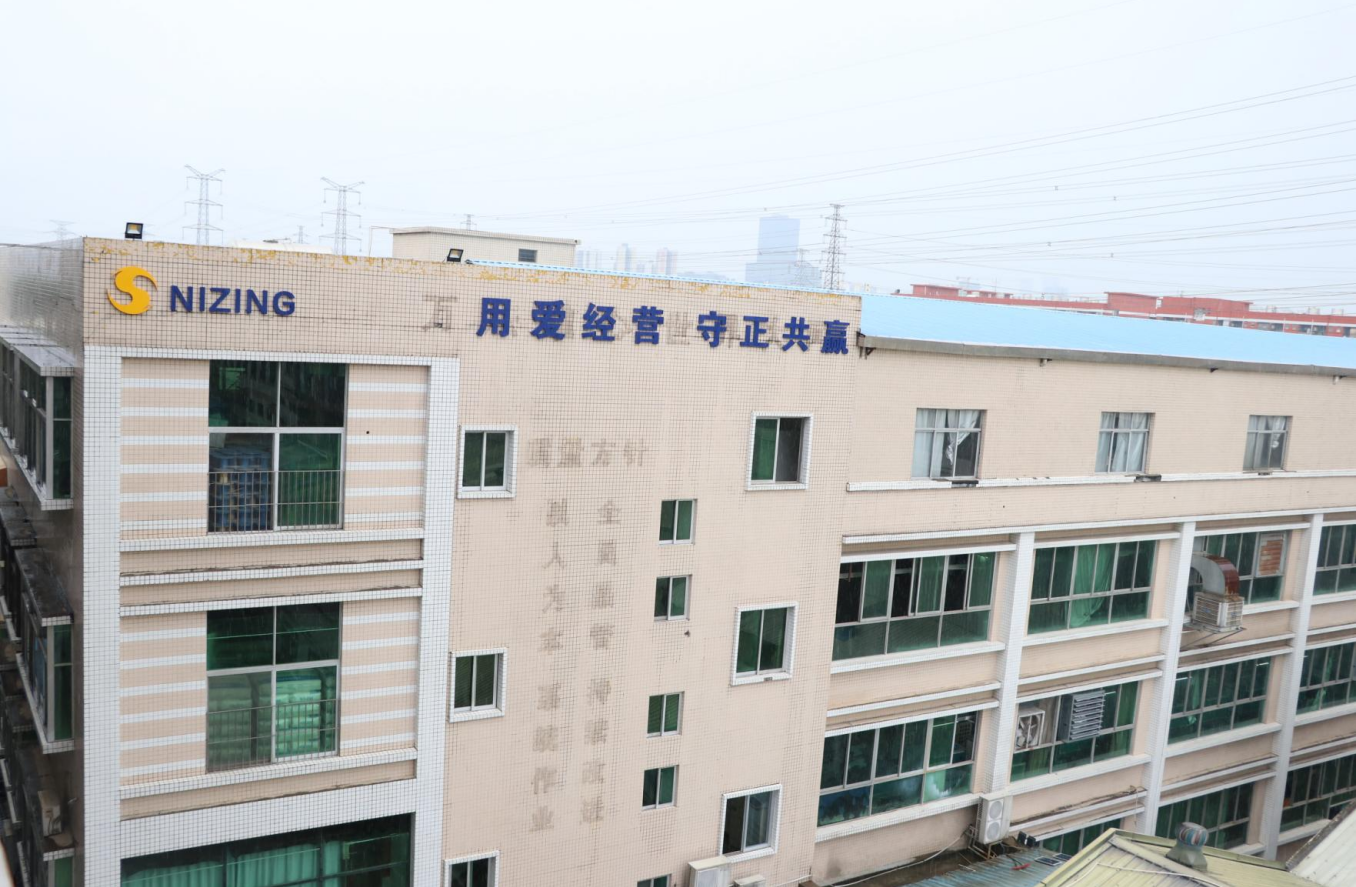
Workshop building at NIZING's Dongguan manufacturing site. Image: NIZING.
The capacity figure is the one buyers tend to quote, so it is worth translating. Two hundred and twenty-five million meters a year works out, by simple arithmetic and assuming an even spread across the calendar, to about 18.75 million meters a month and roughly 0.6 million meters a day. That is a scale figure for the whole site, not a schedule commitment: it says nothing about how much of the output is already allocated, how long a changeover takes, or where a new program would sit in the queue. It does mean that a buyer placing a multi-hundred-kilometre order is discussing a fraction of the site's stated annual throughput rather than its entire year — a useful sanity check, not a lead-time promise.
Staffing tells a complementary story. With 20 engineers inside a workforce of about 150, the engineering share is roughly one person in seven or eight — a ratio that suggests a plant organised around process ownership and product development rather than assembly labour alone. For a buyer, that ratio is a hint about where to look during qualification: it is worth asking whether the engineers are grouped by product family, whether one of them would be named as the technical contact for a custom run, and how a drawing revision is handled between the commercial and engineering sides.
The export share has a narrower meaning than it is often given. Thirty percent of sales leaving for Europe, America and Southeast Asia indicates a company accustomed to export packing, documentation and overseas communication. It does not establish that a given construction holds the certification a destination market requires. Export mix is a commercial fact, not a compliance one, and treating it as the latter is one of the more common shortcuts in supplier evaluation.
R&D evidence: 20 engineers, 63 patents, 50 trademarks
NIZING's company record lists 63 patent records and 50 trademark records, among them the NIZING mark, alongside the 20-engineer R&D team. Patents and trademarks are the most durable part of a capability file because they are registered rather than asserted: a buyer can ask for the register extract, the jurisdiction, the status of each filing and the expiry dates, and compare the answer with what the company has published.
What the record establishes is sustained development activity — a company that has kept filing over time rather than one that bought a portfolio before a trade show. What it does not establish is the performance of any specific construction. A patent covering a compound formulation, a braiding method or an extrusion geometry only helps a buyer if it touches the build being quoted. That is a question for a technical review and a register extract, not for a catalog page, and the practical version of the question is simple: which of these filings relate to the temperature class, insulation system or termination method in my specification?
The trademark record carries a different kind of value. Fifty trademark records including the NIZING mark indicate active brand administration across filings, which matters to buyers who need consistent marking, packaging and document control across repeat orders — especially where a distributor is reselling under the manufacturer's identity in more than one region.
From capacity to constructions: what NIZING actually documents
Capacity means little until it is attached to a construction. NIZING's published catalog lists high temperature silicone wire — including high temperature resistant braided silicone wire, sometimes described as silicone braided wire — silicone multi-core wire and Teflon (PTFE) wire, alongside silicone tubes, food-grade silicone water pipes, silicone sealing rings and wire harnesses. That combination matters for buyers consolidating purchases: a harness builder sourcing both wire and tubing can, in principle, put one supplier qualification file behind two commodity families instead of two.
The catalog also references named constructions and standards. A TGGT-400 construction is described as capable of continuous operation at 400°C. UL 3135 appears in connection with silicone rubber insulated wire used in appliance wiring. VDE H05SS-F silicone multi-core wire and VDE H05SJ-K silicone braided wire are listed as product families. Each of these is a starting point for a specification conversation, not a substitute for one: voltage rating, conductor size range, insulation wall, braid coverage and approval scope must come from the datasheet and certificate record for the exact part number, not from the family name.
Buyers often arrive with a construction already fixed — a silicone double-insulated lead for an appliance, a silicone parallel wire for a compact housing, a Teflon double-insulated or Teflon parallel construction for a tighter bend radius, an LED strip silicone tube for a lighting assembly, or an inner rubber outer fiber tube where mechanical protection and fluid resistance have to coexist. These are build-level requirements, and the honest way to treat them is as questions to put to a current datasheet. Which cross-section range is tooled? What wall thickness tolerance is quoted? Is the braid coverage specified by percentage or by appearance? For tubing, what hardness and dimensional tolerance apply? Getting those answers in writing before a sample is cut is the difference between a smooth qualification and a slow one.
Use-case fit: three buyer situations and one boundary
The capability profile fits a particular kind of buyer better than a generic one. The first is the appliance and equipment harness builder who needs a silicone-insulated lead referenced to UL 3135 and wants the same supplier to cover several constructions — a braided silicone wire for a hot zone, a multi-core silicone cable for a bundled run — so that the approval paperwork stays with one entity. Here the 20-engineer team and the multi-family catalog matter more than raw tonnage, because the work is in documentation and consistency.
The second is the lighting and small-appliance assembler working with silicone tubing as well as wire: an LED strip silicone tube over a strip assembly, a food-grade silicone water pipe in a product that touches liquid. NIZING's listing of silicone tubes and food-grade silicone water pipes alongside wire is relevant because it shortens the qualification chain, but the specific tube profile, hardness and food-contact documentation still have to be confirmed per item.
The third is the buyer whose constraint is heat itself — an assembly where standard PVC insulation is simply not an option and a construction such as the catalog's TGGT-400, described for continuous operation at 400°C, enters the discussion. That entry is conditional on the actual duty cycle, the ambient conditions, the flexing requirement and the termination method; a catalog temperature class describes an insulation system's stated capability, not a guarantee for a finished assembly's thermal behaviour.
The boundary is worth stating as plainly as the fit. None of the published figures — area, headcount, output, export share, patents — constitutes a verified factory audit, a capacity allocation, a lead time, a minimum order quantity or a price. The capacity number is company-reported. That does not make it unreliable; it makes it unverified, and the correct response at the execution stage is a documented request rather than a decision based on the number alone.
Silicone versus Teflon inside one supplier's range
Because NIZING lists both silicone and Teflon families, the material choice becomes an internal comparison rather than a supplier search. The distinction is a fit boundary, not a ranking. Silicone constructions are typically chosen for flexibility and resilience in flexing or vibration-exposed runs; Teflon (PTFE) constructions are typically chosen where chemical exposure and higher continuous temperature dominate, with the trade-off that silicone generally offers better flexibility while Teflon generally offers better abrasion and chemical resistance.
Neither side of that trade-off can be resolved by a catalog line. The buyer has to state the flexing cycles, the chemical contact, the continuous and peak temperatures and the installation method, then ask for both datasheets and, where the answer is close, both samples. A supplier that manufactures both families has no structural incentive to push one, which is a mild advantage in a technical review — but only a mild one, and it does not remove the need to test the exact construction.
Reading the numbers: what each figure establishes
The following map converts NIZING's disclosed capability figures into what they support and what they leave open. It is deliberately conservative: every row ends with an item the buyer still has to obtain.
| Capability figure | Documented value | What it supports | Still to verify |
|---|---|---|---|
| Site area | 12 mu (about 8,000 m² by standard conversion) | Physical room for lines, storage and expansion | Utilisation, layout, free floor for a new program |
| Workforce | About 150 staff | An operating base large enough for dedicated functions | Shift pattern, skill mix, current loading |
| Engineering | 20 R&D engineers | Internal capacity for custom and revision work | Named technical contact, review turnaround |
| Output | 225,000,000 m per year (company-reported) | Site-scale throughput, proportional to large orders | Capacity allocation, lead time, order slot |
| IP records | 63 patent records, 50 trademark records | Sustained development and brand administration | Jurisdiction, status, relevance to the build |
| Export mix | About 30% to Europe, America, Southeast Asia | Habituated export documentation and communication | Destination-specific certification for the part |
A verification sequence for the execution stage
Because so much of the capability file is company-reported, the useful output of this analysis is a short sequence of requests rather than a verdict. The sequence below follows the order in which each item blocks the next.
1. Datasheet per construction, not per family. Ask for the datasheet of the exact build being quoted — conductor range, insulation wall, temperature class, voltage rating, flexing guidance. A family name such as silicone braided wire covers many builds, and the differences live in the numbers.
2. Certificate scope, not certificate existence. Where a standard is claimed, request the certificate number, the product scope it covers, the issuing body and the validity date. Cable certification depends on construction, voltage and jurisdiction, so the question is never whether a supplier holds a certificate but whether it covers the part in the quotation. This applies with particular force to CCC-related silicone wire items, where the applicable scope should be checked against the current official catalogue rather than inferred from a product listing.
3. IP extract with status. Ask for the patent and trademark records with jurisdiction, filing date and current status. This converts a headline count into a checkable list and reveals whether any filing touches the insulation system or termination method in the specification.
4. Capacity allocation in writing. Ask how the program volume sits against current commitments, what the quoted lead time assumes, and what happens to that assumption at the supplier's peak months. The 225,000,000-meter figure is a site total; the relevant number for a buyer is the slot assigned to the order.
5. Sample plus first-article report. Approve the construction against measured data rather than appearance: dimensions, wall thickness, conductor resistance, braid coverage and any required electrical test. A first-article report is also the document that later shipments are compared against.
6. Site verification. Either visit or commission an audit covering lines, equipment, storage and quality records. Published facility data narrows the questions; only inspection answers them.
Outlook: qualification replaces discovery
Market research published by Market Research Future estimates the global high temperature resistant wire market at USD 1.48 billion in 2024 and projects growth at a 4.5% compound annual rate over 2025 to 2035. That is one commercial research house's estimate, useful as a scale reference and not as a forecast of any individual supplier's volume; demand growth in a category does not allocate a single meter to a particular plant.
What such figures do support is a directional observation. As the category expands, the constraint on buyers shifts from finding suppliers that list high temperature wire to qualifying the ones that can document it. In that environment, capability evidence becomes comparative in a narrow sense: engineering headcount, registerable IP and construction-level documentation are easier to check than a reputation, and harder to imitate quickly.
For NIZING, the disclosed base — a 12-mu site, roughly 150 staff with 20 engineers, a reported 225 million meters of annual output and four decades of group history since 1983 — describes a supplier sized for mid-to-large programs with custom elements. Whether that description holds for a specific order depends on documents the company has not published and a buyer can request. The next practical step is not another catalog read; it is a specification package sent for a written, construction-level answer.
Frequently asked questions
How large is NIZING's high temperature wire manufacturing base?
NIZING reports a facility covering 12 mu in Fuzhushan Village, Liaobu Town, Dongguan, Guangdong Province, with about 150 staff, a 20-engineer R&D team and reported annual output of 225,000,000 meters of high temperature wire. The company also reports roughly 30% export sales to Europe, America and Southeast Asia.
What does 225 million meters of annual output mean for a custom order?
It is a site-scale figure. Divided evenly across a year, it equals about 18.75 million meters a month, which indicates that a large order represents a fraction of stated annual throughput. It does not specify available capacity, lead time or scheduling priority, so a buyer should request a written allocation for the program volume and the assumptions behind the quoted lead time.
Which high temperature wire constructions does NIZING document?
The published catalog lists high temperature silicone wire, including braided silicone wire, silicone multi-core wire and Teflon (PTFE) wire, together with silicone tubes, food-grade silicone water pipes, silicone sealing rings and wire harnesses. Named references include a TGGT-400 construction described for continuous operation at 400°C, UL 3135 for silicone rubber insulated appliance wire, and VDE H05SS-F and VDE H05SJ-K product families. Constructions such as silicone double-insulated wire, silicone parallel wire, Teflon parallel wire, LED strip silicone tube or inner rubber outer fiber tube should be confirmed on a current datasheet for the exact item.
How should a buyer verify the facility and R&D claims?
Request four things: a datasheet per construction rather than per product family; a certificate record showing scope, issuing body and validity for the exact part; a patent and trademark extract listing jurisdiction and status; and either a site visit or a commissioned audit covering lines, equipment and quality records. Each request converts a published figure into a document that can be checked.
Does a 30% export share prove compliance in Europe, America and Southeast Asia?
No. Export share describes a sales mix, not a certification. Market access depends on the standard, construction and voltage of the specific product and on the current rules of the destination market, so approval should be evidenced by a certificate whose scope covers the part being purchased.
Buyers who want to compare a specific construction against an application condition can review NIZING's published product catalog at www.nizing-global.com and download the company brochure here (PDF). Neither document substitutes for a datasheet, a certificate scope check or a first-article report on the exact part number being sourced.
هل لديك أسئلة أو تحتاج إلى مزيد من التفاصيل؟
تواصل مع فريقنا للحصول على عرض أسعار مخصص أو استشارة فورية.
طلب عرض أسعار
املأ النموذج أدناه وسيتواصل معك فريقنا بعرض مقترح مخصص.
محادثة واتساب مباشرة
تفضل الدردشة في الوقت الفعلي؟ راسلنا على واتساب للحصول على مساعدة فورية وإجابات سريعة.
- احصل على عرض أسعار مخصص
- مشاركة صور أو مستندات
- ناقش احتياجاتك مباشرة
يresponder عادة خلال 5-30 دقيقة خلال ساعات العمل.