
High-Wash Team Wear: Custom T-Shirts Built for Gym Chains
A gym chain's t-shirt order behaves like operating equipment rather than promotional merchandise. It is worn through back-to-back training sessions, laundered far more often than a retail tee, and replenished as coaches change roles and new studios open. That wear–launder–reorder cycle is what separates fitness and gym chain team wear from a generic custom apparel order, and it is the lens a buyer should apply when evaluating a T-shirt manufacturer.
Why gym-chain apparel is a specification problem, not a design problem
Most custom t-shirt briefs arrive with a logo and a colour. A gym chain brief arrives with a usage pattern. The garment will be issued to front-desk staff, floor coaches, personal trainers and class instructors, and each group wears it differently: eight hours of standing, six coached sessions, or a single ninety-minute class followed by a wash. Across a multi-site network, the same shirt is expected to look identical in every location while surviving laundry cycles that a fashion tee never encounters.
Buyers who treat this as a decoration decision usually end up with a program that looks correct on delivery day and degrades by month four — print edges lifting, collars losing shape, colours drifting between reorders. The more useful approach is to translate the operating environment into specification requirements first, then match those requirements to a manufacturer's fabric, decoration and labelling capability.
The six stresses that define high-wash team wear
Every requirement in a gym chain t-shirt program can be traced back to a physical condition the garment will face. The table below converts those conditions into the questions a procurement team should be able to answer before a purchase order is raised.
| Operating stress | What it does to the garment | Specification question for the supplier |
|---|---|---|
| High-frequency laundering | Shrinkage, seam fatigue, colour loss, print cracking along edges | What dimensional and colourfastness data exists after repeated laundering, not after a single wash? |
| Sweat and salt exposure | Fibre wear, odour retention, shade shift in dyed areas | Which fabric and finish are specified for sweat exposure, and is there wash evidence for the chosen combination? |
| Sunlight and UV, including outdoor sessions | Fading of dyed grounds and printed graphics | How is colourfastness to light assessed for the specific dye and print method? |
| All-season wear in climate-controlled studios | Fit inconsistency, weight mismatch between summer and winter issues | Which fabric weights cover the full calendar year without changing the fit block? |
| Prolonged direct skin contact | Skin sensitivity to dyes and finishes; label abrasion at the neck | Is the fabric supported by a skin-contact safety standard, and how is the neck label constructed? |
| Active movement | Armhole and hem stress, shoulder seam pull, neckline distortion | What construction and size grading keep the shirt stable in motion across the full size range? |
Read together, these stresses explain why a chain should not simply reorder the blank it used for a promotional campaign. Promotional tees are evaluated on appearance and unit cost. Team wear is evaluated on how it behaves in month twelve.
Four order types hide inside one gym chain program
A single fitness network typically runs several apparel streams at once, and they should not share one specification. Separating them early prevents the most common sourcing mistake: over-specifying retail merchandise and under-specifying the garments staff actually wear.
- Staff and coach uniforms. The highest-wash, highest-abrasion stream. Long wear hours, frequent commercial laundering, and a requirement for identical appearance across sites. Fabric stability and colour consistency matter more than decoration complexity.
- Personal training and class kits. Often issued per instructor or per studio, with role names, class types or location identifiers. Small quantities per design are normal, which makes low minimum order quantities and digital decoration relevant.
- Retail merchandise for members. Closer to a fashion drop. Here fit language — oversized, boxy, heavyweight — and graphic impact drive the decision, and sell-through matters more than wash cycles.
- Event and challenge apparel. Short-run, date-specific, frequently reordered when a challenge series repeats. Speed of sampling and replenishment logic dominate.
The through-line is operational: the program runs through wear, laundering and demand-based reordering. Each of the three stages imposes a different burden — durability at wear, dimensional stability at laundering, and batch flexibility at reordering.
Fabric and construction: setting performance requirements before discussing price
Fabric selection is where gym chain buyers have the most leverage and usually the least information. A manufacturer can offer a wide choice of fabric types and weights, including cotton and blends, Pantone colour matching, size grading, and finishing options — but the buyer has to state what the garment must survive.
Guangzhou Qianshi Apparel Co., Ltd, which operates under the brand Qianshiwear, is an apparel manufacturer based in Baiyun District, Guangzhou, Guangdong, China, founded in 2014. The company provides OEM, ODM, full custom manufacturing and private label production services across t-shirts, hoodies, sweatshirts, joggers, tracksuits, polos, jerseys, caps and outerwear, and states that 85–90% of its total production is exported to international markets including the United States, United Kingdom, Canada, Australia, Germany, France, Netherlands, Sweden, Japan, South Korea and the United Arab Emirates.
For uniform streams, the practical requirements cluster into five testable areas:
| Requirement area | What the buyer should ask for | Why it matters in a gym setting |
|---|---|---|
| Dimensional stability | Shrinkage behaviour of the specified fabric after repeated laundering | A shirt that shortens after ten washes breaks the visual consistency a multi-site uniform depends on |
| Colour consistency | Pantone-matched dye lots and a plan for repeat colour matching on reorders | Brand colour drift is immediately visible when staff from two studios stand together |
| Print adhesion | Wash-test evidence for the specific ink, fabric and print method combination | Cracked graphics read as poor maintenance, not as wear |
| Skin-contact safety | Chemical-safety certification covering the finished fabric and trims | Team wear sits against skin for hours, and dyestuff compliance is a buyer responsibility |
| Construction | Seam type, neckline construction, size grading and consistency across sizes | Movement puts stress on armholes, shoulders and hems that a fashion tee never sees |
Moisture management deserves a specific note. In uniform programs, moisture-wicking pique has been used successfully: an international tech company and regional corporate group client in the United Kingdom and Germany ordered 3,500 pieces across three regions and multiple colours for daily-wear employee uniforms and corporate events, and recorded no quality complaints after more than 100 washes per garment alongside 98% employee satisfaction. That case involved polos rather than t-shirts, but the underlying logic transfers: for garments laundered at that intensity, fabric behaviour — not graphic design — determines whether the program holds.
Skin contact and chemical safety: what certification actually gates
Team wear is worn against skin for hours at a time, often while the wearer is sweating. That makes chemical safety a procurement question rather than a compliance footnote. OEKO-TEX certification is the reference point buyers most often request, because it is a test-based standard applied to the finished textile rather than to a mill's process claim.
The most relevant restricted-substance issue in dyed cotton apparel is azo dyes, which can release carcinogenic aromatic amines. Azo testing is typically integrated into OEKO-TEX STANDARD 100 certification, and the underlying legal restriction in the European market sits in EU REACH Regulation (EC) No 1907/2006, Annex XVII, Entry 43. Azo testing covers textiles, apparel and accessories — including zippers, buttons and threads — so the certificate scope should extend to trims, not only to the body fabric.
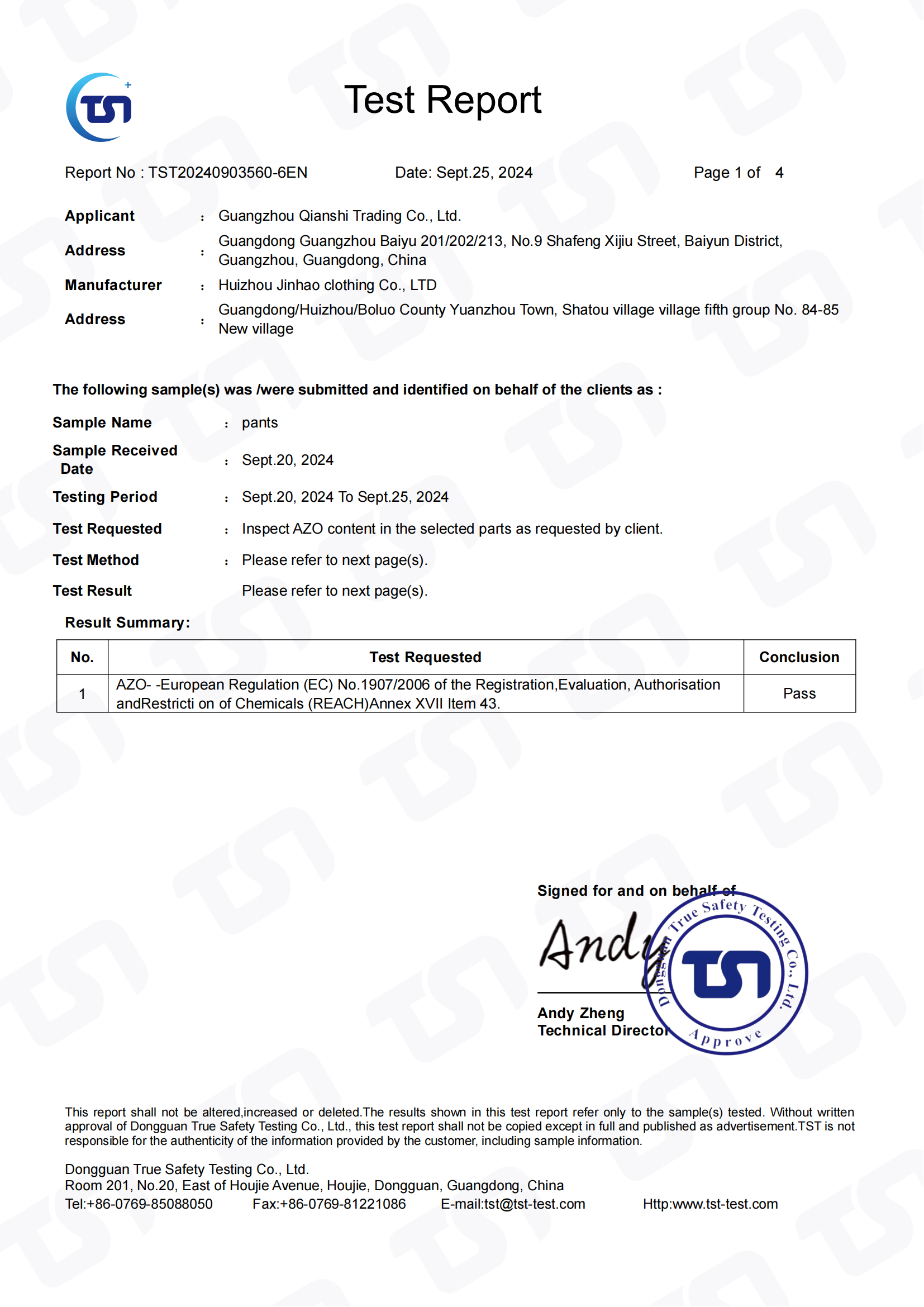
Qianshiwear holds azo dye testing documentation under certificate number TST20240903560-6EN, issued 20 September 2024 by an accredited third-party laboratory, with scope covering textiles, apparel and accessories and reference to EU REACH Annex XVII Entry 43 and OEKO-TEX STANDARD 100. The company also holds ISO 9001:2015 quality management system certification under certificate number 51825Q10787R0, valid from 11 July 2025 to 10 July 2028, and an amfori BSCI audit report under reference 156-065504-000 covering social compliance topics such as working hours, wages, occupational health and safety and freedom of association.
For European orders, the EU General Product Safety Regulation — Regulation (EU) 2023/988 — adds a separate obligation: manufacturers must appoint an EU Authorised Representative and retain technical documentation, with product traceability through batch or lot numbers and manufacturer details. Qianshiwear holds EU representative documentation under reference EUREP-2024100815101023014. Because representative registrations are renewed, buyers should confirm current validity at the point of order rather than relying on a document collected during supplier screening.
Decoration: matching print method to how the garment will be used
Gym chain decoration splits along a simple line. Staff uniforms need graphics that survive laundering and stay consistent across reorders; retail merchandise needs graphics that photograph well and support a seasonal story. Choosing one method for both usually produces a compromise in each.
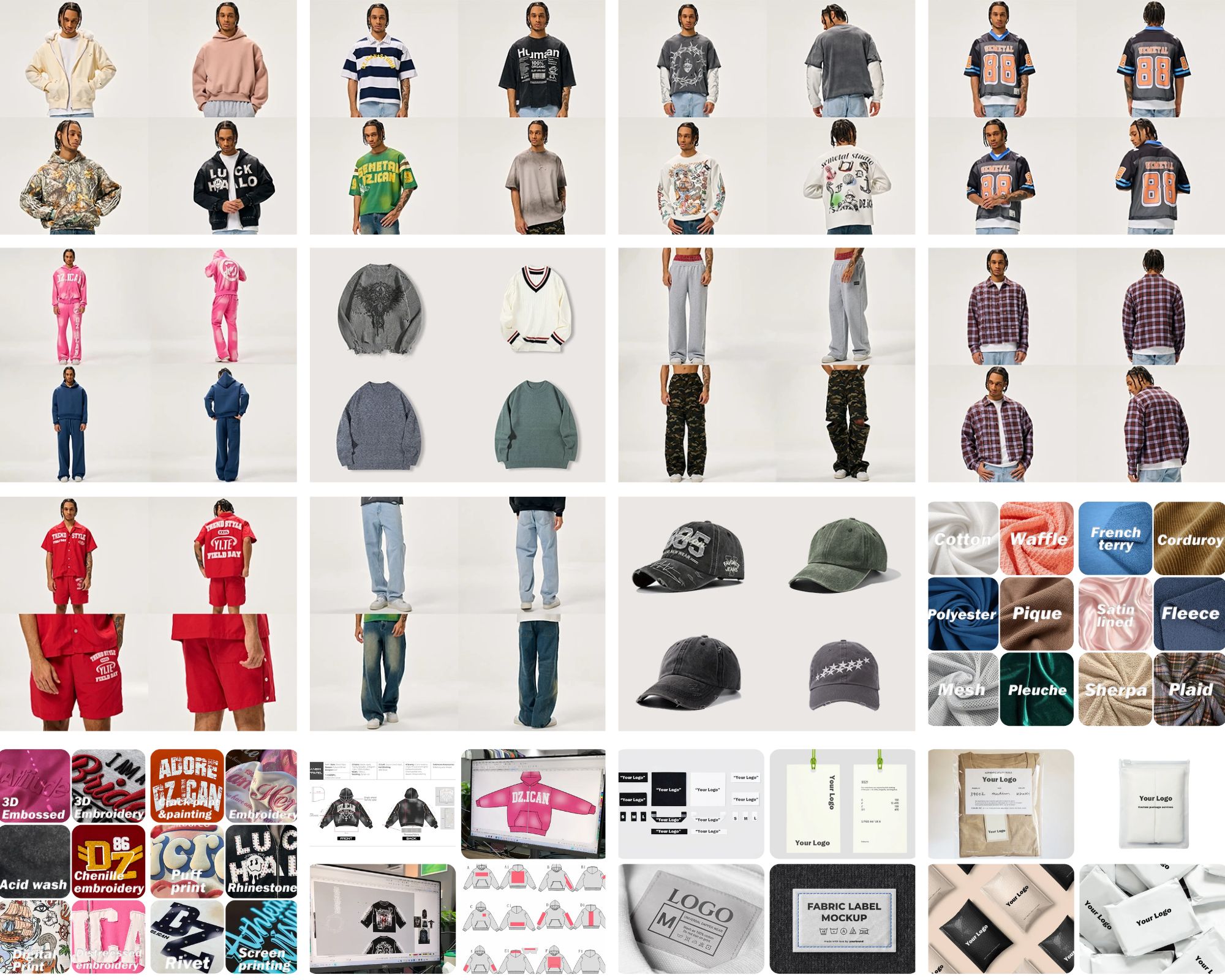
Qianshiwear's stated decoration capability covers screen printing, DTG, embroidery, puff print, rhinestone and appliqué, alongside custom neck labels, hang tags, packaging design, Pantone colour matching, size grading and trim and hardware selection.
| Method | Where it fits in a gym chain program | What to watch |
|---|---|---|
| Screen printing | Repeat graphics across a uniform issue — chest logos, studio names applied at volume | Set-up is per colour per design, so very small runs per design suit it less well |
| DTG (direct-to-garment) | Multi-design staff kits, role or location variants, and small quantities per design | Wash-test the specific ink and fabric pairing; performance varies by combination |
| Embroidery | Chest marks, names, tenure or qualification badges on uniform pieces | Dense fills on lightweight performance knits need appropriate backing |
| Puff print, rhinestone, appliqué | Retail merchandise and limited drops rather than high-abrasion team wear | Raised and applied decoration is the first element to degrade under frequent laundering |
The relevant capability question for a chain is not which method the factory owns, but which method it will recommend once the wash frequency, wear hours and reorder pattern are described. A decoration recommendation that ignores laundering intensity is a design opinion.
Private label details that decide how the program feels to staff
Neck labels, hang tags, care labels and packaging are usually treated as finishing touches. In a gym chain program they are functional: the neck label is the element in continuous contact with skin, and the label set is what carries legal product information into the destination market.
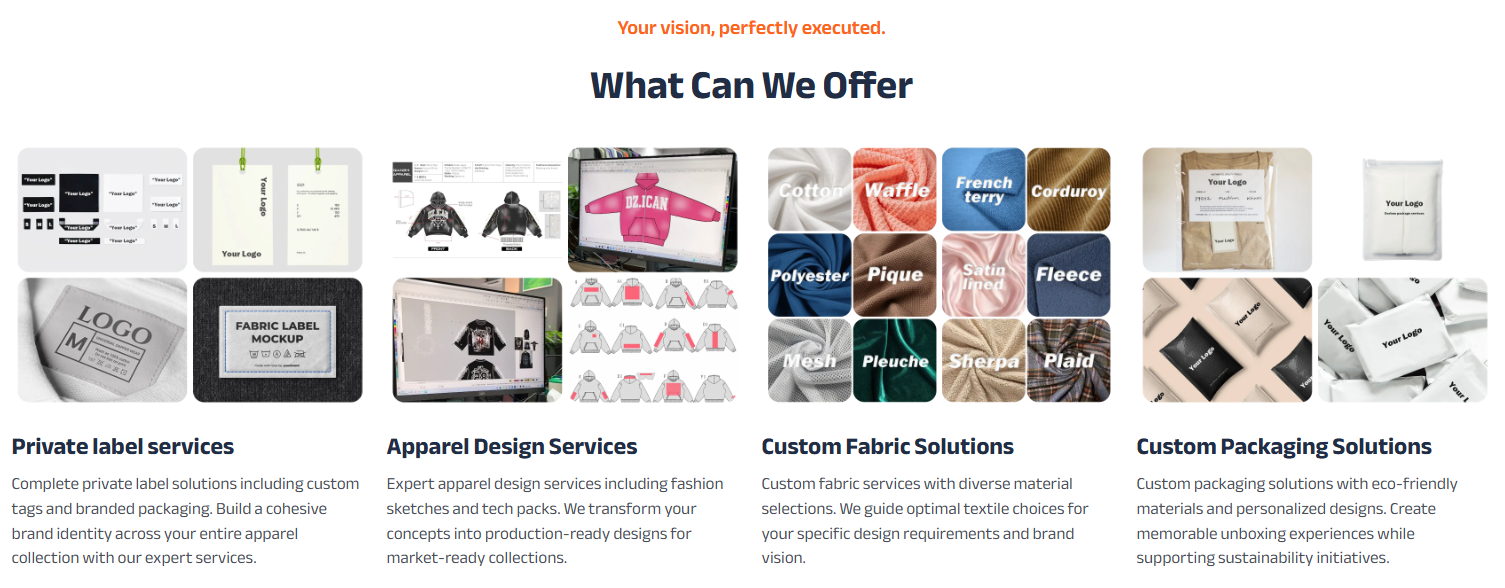
Qianshiwear produces custom woven neck labels and hang tags as part of its private label service, with packaging options including polybags, paper bags and custom boxes. For a chain issuing apparel across multiple countries, the label set should be defined before production, because adding fibre-content or origin information after the garment is cut means relabelling stock.
Label content is regulated rather than discretionary in several markets. In the United States, the Federal Trade Commission publishes business guidance, Threading Your Way Through the Labeling Requirements Under the Textile and Wool Acts, which covers labelling obligations for textile and wool products sold in the US market and reflects the latest revisions to the Textile and Wool Rules. A US-bound private label order therefore depends on a manufacturer being able to produce and attach compliant labels, and on the exact mandatory data elements being read from the guidance itself rather than assumed.
Sampling, bulk production and the reorder arithmetic of staff turnover
Gym chains rarely place one large order and stop. Coaching teams change, studios open, class formats rotate and garments are lost or damaged. The realistic operating pattern is a launch order followed by periodic replenishment — which means the sourcing decision is partly a question of batch flexibility.
On the Qianshiwear production model, sample production runs 7–15 working days and bulk production 20–35 working days, with a minimum order quantity of 50 pieces per colour per design, a stated monthly capacity of 250,000 units, 100% pre-shipment inspection, and third-party inspection available on request. Delivery terms include EXW from the Guangzhou factory, FOB Guangzhou or Shenzhen, CIF to major global ports and DDP on request; bulk orders are settled with a 50% deposit and 50% balance before shipment.
That MOQ structure matters more than it first appears. Fifty pieces per colour per design lets a chain run a site-specific issue, a single class format, or a mid-season size-ratio top-up without committing to a full production batch. It also allows a validation order: one studio, one shirt, one real laundry cycle before the network is rolled out.
A practical validation sequence for a gym chain runs in four steps:
- Sample the actual wear scenario. Order the fabric weight and decoration intended for issue, not a lighter promotional blank.
- Launder the sample through the chain's own process. Commercial laundry, not a domestic machine, is the relevant test.
- Check the failure points. Neckline distortion, hem twist, print edge lifting, shade shift between two shirts from different production weeks.
- Fix the specification before scaling. Record the approved fabric, ink and label set so reorders reference a document rather than a memory.
Evidence from adjacent, high-usage programs
Gym chains sit inside a broader category of buyers who treat apparel as equipment. Existing client records from adjacent scenarios show what continuity looks like in practice, and they are useful as reference patterns rather than as proof of gym-specific outcomes.
- An established streetwear brand and multi-store retailer in the US, UK, France, Australia and Germany orders 7,000 pieces per quarter across multiple styles and colourways, with 100% on-time delivery across more than 12 drops, a 90% reorder rate season over season, and a 98% sell-through rate on core styles. The pattern — reserved production slots and consistent colour matching across seasonal drops — is the same continuity problem a chain faces across sites.
- A music artist management and tour merchandise agency in the US, Canada, the UK, Australia and France ordered 5,000 pieces across 12 tour stops with a 92% sell-through rate, four reorders during the tour and a 100% QC pass rate on rush orders, using 10-day samples, 30-day bulk production, high-resolution DTG printing and custom hang tags.
- A startup streetwear label in the US and Canada started at 100 pieces and reordered 1,000, using a custom woven neck label and consistent quality across sizes — the same low-volume entry path a single-studio gym brand would follow.
These records are company-reported project histories rather than independently audited outcomes. Their value to a buyer is structural: they show that small initial orders, repeat replenishment and label customisation can coexist inside one production relationship.
Where this model fits, and where it does not
An honest supplier evaluation includes the boundaries. For gym chain team wear, several limits should be stated plainly.
- Company-reported figures are not audit results. Capacity and output statements, including the stated monthly capacity of 250,000 units, describe a supplier's own account of its operations and are not T-shirt-specific. A factory audit, equipment review or third-party inspection remains the appropriate verification step for a large network rollout.
- Organic or recycled content claims need independent closure. Verification of organic cotton certification, including certificate-holder identity and scope, sits with the certifying body and should be completed before any organic claim enters consumer-facing material.
- Heavy garment finishing conflicts with uniform consistency. Vintage wash, snow wash, pigment dye and distressed finishes are appropriate to streetwear and retail merchandise, but they deliberately introduce variation. A chain that requires two studios to look identical should not specify them for staff issue.
- Sampling is fast, not instant. A 7–15 working day sample window supports an evaluation timeline; it does not support a same-week launch. Bulk at 20–35 working days excludes transit time, which varies by incoterm and destination.
- Decoration economics change with quantity. Screen printing suits repeat volume, DTG suits variation and smaller counts. A chain that shifts from one design per region to three designs per studio should expect to revisit the method.
- Price is not published. Unit cost depends on fabric weight, fit, decoration, labelling and incoterm, and is quoted per project rather than listed — which makes a written specification the only reliable basis for comparing suppliers.
Market context: flat export growth pushes suppliers toward application fit
The macro picture gives gym chain buyers a reason to be specific. China's apparel exports reached US$159.14 billion in 2024, an increase of 0.3% year over year, according to China's General Administration of Customs as reported in industry coverage — effectively flat in value terms. In a market that is not growing quickly, supplier positioning shifts from volume to application specialisation: the ability to demonstrate that fabric, decoration and labelling were selected for a defined use case rather than assembled from a general catalogue.
At the same time, the global t-shirt category remains large. A commercial research estimate places the global t-shirt market above US$45 billion in 2024 with reported growth of 6.2% CAGR through 2030 — a projection rather than a verified forecast, but directionally consistent with the observation that t-shirts remain the default apparel format across retail, uniform and merchandise channels.
For fitness chains specifically, two procurement shifts are observable in buyer behaviour rather than in statistics. First, uniform programs are being consolidated: instead of each studio ordering locally, networks increasingly buy against a single specification to protect brand consistency. Second, compliance documentation is moving earlier in the process, from a post-selection check to a screening criterion — a supplier unable to produce a certificate record is often excluded before pricing is discussed.
Future outlook
Three developments are likely to shape gym chain apparel sourcing over the next few procurement cycles.
Micro-batch replenishment becomes normal. As chains expand through franchise models, order patterns fragment into smaller, more frequent batches tied to openings and staff churn. Suppliers configured for 50-piece minimums per colour per design are better placed for this than those requiring container-scale runs.
Documentation becomes a gate rather than a preference. With EU and US labelling and safety obligations both requiring traceable records, the manufacturer's documentation discipline — batch traceability, retained technical files, verifiable certificates — increasingly determines whether a supplier can be used at all, regardless of price.
Decorated and undecorated streams diverge. Chains are beginning to separate staff issue, where durability and consistency dominate, from member retail, where fit and graphic language dominate. That separation favours manufacturers able to hold two different quality logics inside one production relationship — which is precisely the difference between a general custom t-shirt supplier and one organised around application fit.
FAQ
What makes gym and fitness chain t-shirts different from standard promotional tees?
Promotional tees are judged on appearance and unit cost at delivery. Gym chain team wear is judged on behaviour over time: how the fabric holds dimension through frequent laundering, how the print adheres after repeated washes, how the neckline survives movement, and whether a reorder matches the original shade. The order runs through a wear, laundering and demand-based reordering cycle, which is a durability and consistency requirement rather than a design requirement.
Which fabric specifications should a gym chain require for high-wash team wear?
At minimum, a specification sheet stating fibre composition and fabric weight, laundry shrinkage data for the actual fabric used, colourfastness data for the chosen dye, wash-test evidence for the specific ink and fabric pairing, and a chemical-safety certificate covering body fabric and trims. Where moisture management matters, a moisture-wicking knit such as pique has been used in corporate uniform programs laundered more than 100 times per garment.
Does team wear for gyms need OEKO-TEX certification?
OEKO-TEX STANDARD 100 is the most commonly requested test-based certification for skin-contact textiles, and azo dye testing is typically integrated into it. The underlying legal restriction in the EU sits in REACH Regulation (EC) No 1907/2006, Annex XVII, Entry 43, which restricts azo dyes that can release carcinogenic aromatic amines. Buyers should confirm the certificate holder, the covered product scope including trims such as zippers and buttons, and current validity directly with the issuing laboratory.
Which printing method works best for multi-site staff kits?
It depends on how many variants the chain needs. Screen printing suits repeat graphics applied at volume, where set-up is amortised across a larger run. DTG suits multiple designs and small quantities per design, which fits role, class or location variants. Embroidery is used for chest marks and names on uniform pieces. Puff print, rhinestone and appliqué are better matched to retail merchandise, since raised or applied decoration degrades fastest under frequent laundering.
How long do samples and bulk production take for a gym chain rollout?
On the Qianshiwear production model, sample production takes 7–15 working days and bulk production 20–35 working days, excluding transit. Delivery terms include EXW from the Guangzhou factory, FOB Guangzhou or Shenzhen, CIF to major ports and DDP on request. A rollout plan should account for sample approval, laundering validation of that sample, and freight before setting a staff issue date.
What MOQ and reorder structure suits a chain with regular staff turnover?
A minimum order quantity of 50 pieces per colour per design supports site-level issues, single class formats and size-ratio top-ups without a full production commitment. The workable structure is a launch order sized to the full staff roster, followed by periodic replenishment referencing a recorded specification — fabric, ink, label set and colour standard — so that reorders remain visually consistent as new studios open. Bulk terms are typically a 50% deposit with the balance before shipment, and pre-shipment inspection reports are available on request.
Manufacturer capability, certification references and project records in this article are drawn from Guangzhou Qianshi Apparel Co., Ltd (Qianshiwear) published materials and are company-reported unless a certification body or regulator is named. Macro trade figures are attributed to China's General Administration of Customs as reported in industry coverage. Market size estimates are commercial research figures and should be treated as directional. A downloadable company brochure is available here: Qianshiwear company brochure (PDF).
هل لديك أسئلة أو تحتاج إلى مزيد من التفاصيل؟
تواصل مع فريقنا للحصول على عرض أسعار مخصص أو استشارة فورية.
طلب عرض أسعار
املأ النموذج أدناه وسيتواصل معك فريقنا بعرض مقترح مخصص.
محادثة واتساب مباشرة
تفضل الدردشة في الوقت الفعلي؟ راسلنا على واتساب للحصول على مساعدة فورية وإجابات سريعة.
- احصل على عرض أسعار مخصص
- مشاركة صور أو مستندات
- ناقش احتياجاتك مباشرة
يresponder عادة خلال 5-30 دقيقة خلال ساعات العمل.