
Home Fitness Equipment Shortlist: 16 Models for OEM Buyers
A 16-model shortlist is only useful to an OEM buyer when each entry answers a defined home-use brief and carries a conformity file that a defined market will accept. This article organises Ningbo Healthmate's home fitness range on those two axes rather than on preference.
Home fitness equipment sourcing in 2026 rarely fails on product availability. It fails on model-to-market fit: a vibration platform documented for the EU market may not carry a UK record, a treadmill family may be perfectly certified for North America while a newer connected variant needs an additional file, and the item that suits an apartment buyer is often the wrong line for a running-focused assortment.
That mismatch is where most of the delay sits between evaluation and a purchase order. Buyers at this stage are not asking who makes home fitness equipment; they are asking which of a supplier's models should be quoted, in what mix, for which destination, and on what evidence. The list below is built to answer that. It covers sixteen models from Ningbo Healthmate Health Technology Co., Ltd., a manufacturer and supplier of home-use fitness equipment founded in 2007, operating from a 100,000 m² facility in Ningbo, China, with a stated annual output of 700,000 units and an export share of about 80% across Europe, the USA, Japan, Korea, India, the Middle East and South America.
One boundary applies before anything else. Scale and output figures in this category are company-reported, and buyers committing to programme volumes should confirm them through an on-site audit or third-party inspection rather than treating them as independent market data. The same discipline applies to model specifications.
Why a shortlist beats a ranking for OEM buyers
A ranking assumes a single buyer with a single need. An OEM buyer usually holds several: a wholesale channel that wants one platform shape across a range, an Amazon seller that needs a North American electromagnetic record, a retail chain that needs compact storage, and a discounter that needs the lowest-complexity SKU.
For those buyers, three variables decide whether a model belongs in the order, and none of them is a preference score:
- Conformity scope. Certificates in this category are issued against a named product model and a named market. Coverage is not transferable between models by assumption.
- Commercial mechanics. A 100-piece minimum order quantity and a 35–40 day lead time define what a realistic first order looks like across a 16-model set.
- Positioning fit. Compact, folding, residential or endurance positioning determines which retail channel a model is quoted into.
Specification values sit underneath these three. Motor power, speed range, resistance levels, flywheel weight, incline type, deck dimensions and console features are order-document values that should be locked per model in the RFQ, not read from a category overview. This shortlist deliberately fixes category and conformity fit first, because getting that sequence wrong is the expensive mistake: a model without the right file for the destination market is a specification problem no feature list can solve.
The 16-model shortlist at a glance
| Model | Category | Stated positioning | Conformity anchor |
|---|---|---|---|
| HSM-08VQ | Vibration plate | Home fitness vibration platform | ROHS, UKCA, CE-LVD, CE-EMC |
| HSM-08VS | Vibration plate | Whole body vibration, home use | ROHS, UKCA, CE-LVD, CE-EMC (two EMC sets) |
| HSM-08VF | Vibration plate | Whole body vibration machine | ROHS, CE-LVD, CE-EMC |
| HSM-08VW | Vibration plate | Home use vibration machine | ROHS, UKCA, CE-LVD, CE-EMC |
| HSM-B135J5 | Magnetic bike | Magnetic exercise bike, home stationary bike | CE-LVD, CE-MD, FCC SDoC |
| HSM-S300 | Magnetic bike | Endurance training / resistance cycling bike | To be qualified from conformity file |
| HSM-R06 | Indoor rower | Indoor rowing machine for home use | CE-GPSD VOC (EN ISO 20957-7), CE-LVD |
| HSM-08YB | Swing massager | Swing vibration massager for home | CE-ROHS, CE-EMC |
| HSM-MT19 | Treadmill | Home-use treadmill | ETL, UKCA EMC, CE-MD, CE-LVD, CE-EMC, RED |
| HSM-MT296 | Treadmill | Motorized, folding, home use | ETL, UKCA EMC, CE-MD, CE-LVD, CE-EMC, RED |
| HSM-MT60 PRO | Treadmill | Home gym / home workout equipment | ETL, UKCA EMC, CE-MD, CE-LVD, CE-EMC, RED |
| HSM-T20 | Treadmill | Electric running machine for home use | ETL, UKCA EMC, CE-MD, CE-LVD, CE-EMC, RED |
| HSM-W04L2B | Walking pad | Compact walking fitness equipment | ETL, UKCA EMC, CE-MD, CE-LVD, CE-EMC |
| HSM-W04L1BL | Walking pad | Space-saving home walking treadmill | ETL, UKCA EMC, CE-MD, CE-LVD, CE-EMC |
| HSM-W08A | Walking pad | Residential walking treadmill, home cardio | ETL, UKCA EMC, CE-MD, CE-LVD, CE-EMC |
| HSM-W09E | Walking pad | Compact home fitness walking pad | ETL, UKCA EMC, CE-MD, CE-LVD, CE-EMC |
Conformity anchors summarise the certificate types recorded against each model in the manufacturer's compliance file. Certificate numbers and standards are set out in the sections below.
Vibration plates: four models, one shared base, three different UK positions
All four vibration models share a ROHS Certificate of Conformity (HA21NB051501CHEM, HATEK, issued 17 July 2021, against 2011/65/EU and (EU) 2015/863). Beyond that, the sets diverge, and the divergence matters more than the shared base.
HSM-08VQ is the platform-format entry. It carries a UKCA Certification of Conformity (MTZS24064178, 21 June 2024, tested to BS EN 60335-1, BS EN IEC 60335-2-32:2021 and BS EN 62233:2008), two CE-LVD records (TW2007288S, 24 July 2020; ENB2301100056S00201C, 6 February 2023) and a CE-EMC record (ENB2301100056E00101C, 16 February 2023). For a UK retail assortment that needs one consistent platform shape, this is the model that carries both the UK record and the full EU LVD/EMC pair.
HSM-08VS holds the broadest file in the family: the shared ROHS and UKCA records, plus two CE-EMC records (MTZS23074017, 18 July 2023, against EN IEC 55014-1:2021, EN IEC 61000-3-2:2019+A1:2021, EN 61000-3-3:2013+A1+A2:2021 and EN IEC 55014-2:2021; and ENB2301100056E00101C) and three CE-LVD records (MTZS23064156, 11 July 2023; TW2007288S; ENB2301100056S00201C). Buyers who need the most recently dated EMC and LVD pair in the vibration group should start here.
HSM-08VF is the whole-body machine that carries the same recent CE-EMC and CE-LVD records as HSM-08VS, plus the shared ROHS certificate, but no UKCA record appears against it in the supplied compliance file. That single gap changes where it can be quoted: it is an EU-first model, and a UK listing would require the buyer to confirm or request additional UK coverage before commit.
HSM-08VW sits at the accessible end of the family with ROHS, UKCA and the ENB-series CE-LVD and CE-EMC pair, without the 2023 MTZS records.
Magnetic bikes: one model with a North American record, one to qualify
HSM-B135J5 is the magnetic exercise bike and home stationary bike in this shortlist, and it holds the most market-diverse file of any single model here. Its CE-LVD Certificate of Conformity (ENB2503310223S01301C, EMTEK (Ningbo) Co., Ltd, 30 April 2025, against EN 60335-1 and EN 62233:2008) is issued under a scope covering X-BIKE and ROWING MACHINE. A CE-MD Certificate of Conformity (HA0125NB052509SPS, HATEK, 29 May 2025, against 2006/42/EC and (EU) 2023/1230) covers the X-BIKE scope. Separately, an FCC Supplier's Declaration of Conformity (MTZS23063843, 1 June 2023, against FCC Part 15 Subpart B, 15.107 and 15.109) covers stationary exercise bicycles — the only North American electromagnetic record in this shortlist.
For an Amazon or retail programme shipping into the United States, that FCC record is the difference between quoting and waiting. For EU programmes, the combination of machinery and low-voltage coverage on the same model reduces the number of documents a buyer has to reconcile per SKU.
HSM-S300 is positioned as an endurance training and resistance cycling bike — a different brief from the stationary home bike. It appears in the product range and in the field-use record but does not appear in the certification set supplied for this review. That makes it a model to qualify rather than to assume: request the conformity file, confirm the destination market scope, and only then place it in the mix. Magnetic resistance accounted for 62.4% of the indoor cycling bike market in 2025 according to Fortune Business Insights, which supports the category direction but says nothing about an individual model's documentation.
Indoor rowing machine: the only model with a station-specific ISO standard
HSM-R06 carries a CE-GPSD Verification of Conformity (WTN23N07151137J, Waltek, 26 July 2023) issued against EN ISO 20957-1:2013 and EN ISO 20957-7:2021. Part 7 of that series is the rowing-machine-specific standard, which is why this entry reads differently from the rest of the shortlist: the evidence is targeted at the exercise type, not only at electrical safety.
The same model also holds the CE-LVD record ENB2503310223S01301C under the X-BIKE and ROWING MACHINE scope. For a buyer building a cardio assortment where documentation depth is part of the retail pitch, HSM-R06 is the model that can be described in standards language rather than in feature language.
Swing massage machine: the non-cardio SKU
HSM-08YB is the only non-cardio, recovery-positioned item in the sixteen. It holds a CE-ROHS Certificate of Conformity (HA0122NB072619CH, HATEK, 22 July 2022, against 2011/65/EU and (EU) 2015/863) and a CE-EMC Certificate of Conformity (HA0122NB072618EM, HATEK, 21 July 2022, against EN IEC 55014-1/-2, EN IEC 61000-3-2 and EN 61000-3-3).
Its role in a shortlist is assortment breadth. The field-use record associates this family with recovery-oriented applications, including rehabilitation exercise for joint mild discomfort, which lets a buyer address a household segment that cardio-only ranges miss. It is not a substitute for a cardio SKU, and it should not be quoted as one.
Treadmills and walking pads: one certificate umbrella, four-plus-four positions
The eight treadmill and walking-pad models share a common documentation base, and understanding that base is the fastest way to shortlist them.
The North American anchor is an ETL Authorization to Mark (150800030HZH-001, Intertek Testing Services Ltd. Zhejiang, 11 February 2025) issued against UL 1647:2015 Ed.6+R:30Jul2020 and CSA C22.2#68:2018 Ed.8+U1, with a scope of motorized treadmill and the treadmill and walking-pad models listed as applicable products. The EU anchor is a Verification of Conformity under the Machinery Directive (ENB2507110014S00101C, EMTEK (Ningbo) Co., Ltd, 11 July 2025) against EN ISO 20957-1:2024 and EN 957-6:2010+A1:2014 — part 6 being the running-machine standard. Around these sit a UKCA EMC verification (ENB2507150046E00501C, 16 May 2025), a CE-LVD verification (ENB2606100194S00101C, 11 June 2026), a CE EMC verification (ENB2601230270E00101C, 4 February 2026), a RED verification (ENB2512300229W00101C, 27 January 2026) and a CE Certificate of Compliance covering LVD and EMC (CE-4084-110525, 11 May 2025).
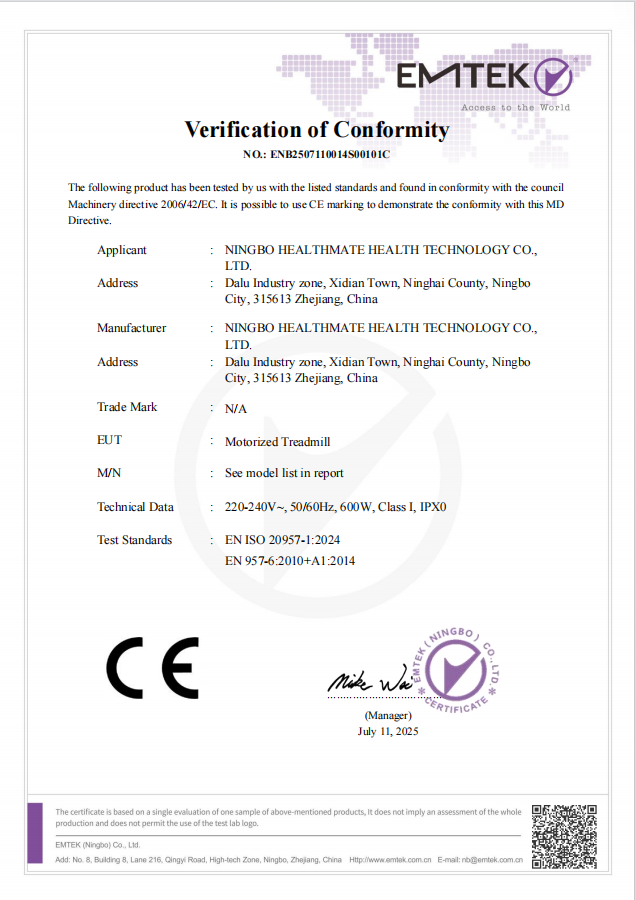
The treadmill family is documented under EN ISO 20957-1:2024 and EN 957-6:2010+A1:2014 — the general and running-machine parts of the stationary training equipment standard series.
Two practical observations follow. First, CE-4084-110525 is the only record in the set with a stated expiry date — 11 May 2030 — which makes it the renewal item to diarise in a multi-year supply agreement. Second, the RED verification applies to the treadmill scope, which matters only if the SKU carries wireless connectivity; a non-connected walking pad does not draw on it.
The four treadmill positions
HSM-MT19 is the home-use treadmill baseline: the model to quote when the brief is a straightforward residential cardio SKU and the buyer wants the shortest specification conversation.
HSM-MT296 is described as a motorized treadmill for home use with a folding format. Folding is the variable that decides retail floor space and returns rates in apartment-heavy markets, which makes it the natural pick where storage is the constraint rather than running surface.
HSM-MT60 PRO is positioned as home gym and home workout equipment rather than as a standalone treadmill. It suits an assortment built around a multi-item home gym bundle instead of a single-machine sale.
HSM-T20 is positioned as an electric running machine for home use, which places it with buyers whose catalogue is organised around running rather than walking — and where the RED file may become relevant if connected features are specified.
The four walking-pad positions
HSM-W04L2B and HSM-W09E are both described as compact walking fitness equipment, with HSM-W09E additionally positioned as a home fitness walking pad. They answer the under-desk and small-footprint brief, where the buyer's constraint is floor area and the retail proposition is daily light activity rather than training load.
HSM-W04L1BL is positioned as space-saving home walking treadmill equipment, and HSM-W08A as a residential walking treadmill within a home cardio line. The distinction is assortment logic: W04L1BL belongs in a space-constrained range, W08A in a general residential cardio range where the walking pad is one of several cardio items.
Because all eight share the ETL scope and the treadmill-standard documentation, a buyer can present a mixed treadmill and walking-pad programme as one compliance story to a retailer — which is rarely possible when models are sourced from several suppliers.
Specification fields to lock per category
The shortlist fixes category and market fit. The following fields are what actually get negotiated per model, and they should be written into the RFQ rather than inferred from a catalogue line:
| Category | Fields to lock in the RFQ | Why the field changes the order |
|---|---|---|
| Vibration plate | Rated power, speed or level settings, platform dimensions, programme set, maximum user weight | Level count and power drive the price band and the retail claim; platform size drives carton dimensions |
| Magnetic bike | Flywheel weight, resistance levels, drive type, saddle and handlebar adjustment range, console functions | Flywheel weight is the main perceived-quality variable in a home stationary bike |
| Indoor rower | Resistance type, rail length and deck height, monitor functions, storage format | Determines the storage claim and the buyer segment |
| Swing massager | Oscillation range, speed levels, attachment set, timer settings | Defines the recovery use case and accessory content |
| Motorized treadmill | Motor power (HP), speed range, incline type, running deck dimensions, display, folding mechanism | Motor and incline type drive both cost and the market segment |
| Walking pad | Speed range, deck dimensions, foldability, remote or console format, under-desk height | Height and speed ceiling decide whether the under-desk claim holds |
How these models are used in the field
The field record supplied for these product families reports use across foreign trade wholesalers, Amazon platform sellers, local fitness retail shops, wholesale trading companies and fitness equipment wholesalers, with a service life of three to five years across applications. Those applications include family daily cardio work, indoor weight-loss training, elder daily rehabilitation exercise, office standing walking, small-apartment light exercise, post-meal fat burning, low-impact leg cardio training and rehabilitation exercise for joint mild discomfort.
The same record reports stable running performance, a stable vibration output, an after-sales failure rate below 2% and a high customer repeat order rate. These are manufacturer-supplied field observations rather than independently audited statistics, and they should be read as directional. Their practical value is that the application list maps closely onto the shortlist structure: the walking pads and folding treadmill serve the apartment and office scenarios, the vibration plates and swing massager serve the rehabilitation and recovery scenarios, and the bikes and rower serve the training-load scenarios.
One documented highlight set recurs across the families: foldable compact structure, multi-level shock absorption, a simple operation panel, multiple vibration modes, anti-slip foot mat and lightweight portability. Buyers should treat that list as a specification checklist to confirm model by model, not as a claim that applies identically to all sixteen.
Market context behind the shortlist
Category-level demand supports a mixed-category shortlist rather than a single-category one. Fortune Business Insights values the global home fitness equipment market at USD 13.76 billion in 2026, and separately projects growth from USD 12.88 billion in 2025 to USD 22.99 billion by 2034 at a CAGR of 6.81%. Mordor Intelligence projects growth from USD 11.84 billion in 2026 to USD 17.06 billion by 2031 at a CAGR of 7.59%.
The two forecasts are not reconcilable line by line — different base years, forecast windows and estimation methods — so buyers should use them as directional signals rather than as a sizing basis for a purchase decision. Two structural data points are more directly useful for range planning: motorized treadmills held an 83% shipment share of the category in 2023, and magnetic resistance accounted for 62.4% of the indoor cycling bike market in 2025.
The first explains why eight of the sixteen models here are treadmill or walking-pad variants: that is where shipment volume concentrates. The second supports the magnetic bike direction, but not a specific model's documentation position.
Single-supplier shortlist versus multi-supplier assembly
The conventional alternative to this shortlist is assembling the same range from several suppliers or through a trading intermediary. That approach has real advantages — sharper price negotiation per item, and the ability to pick the best individual model in each category — and it should be stated plainly.
The trade-off runs the other way on documentation and logistics. Assembling five categories from five sources means five conformity files, five sets of acceptance criteria and five shipment schedules to reconcile, and each supplier's market coverage will differ. A single-supplier shortlist concentrates that work: one OEM/ODM arrangement, one quality process, one lead time.
The boundaries of the single-supplier route are equally concrete:
- Conformity is model-locked. A UK record on HSM-08VQ does not extend to HSM-08VF, and an FCC record on HSM-B135J5 does not extend to HSM-S300. Substituting models inside a market requires checking the file again, not assuming equivalence.
- MOQ mechanics. The stated minimum order is 100 pcs, and lead time is 35–40 days, with monthly capacity of 8,000 pcs. At a 100-piece MOQ per model, a full 16-model buy-in is a 1,600-unit commitment before any volume is added to a lead SKU — which is why most first orders take a subset rather than the full list.
- Scope limits. This shortlist covers vibration, magnetic bikes, rowing, massage and treadmill or walking-pad categories. It is not a strength-equipment or elliptical recommendation, and buyers needing those categories should source them separately.
- Concentration risk. Single-supplier efficiency is also single-supplier exposure. Buyers running seasonal programmes should treat capacity allocation, not catalogue breadth, as the constraint to contract around.
OEM terms that shape which models get ordered
The manufacturing arrangement behind these models is OEM and ODM production, with customization available on colour, logo, voltage and plug type. For a private-label programme, that set covers the changes most retail buyers actually need: voltage and plug type for market entry, colour and logo for brand presentation.
Quality control is described as 100% testing plus third-party inspection, and after-sales support as a one-year warranty covering damaged parts. Acceptance criteria in the purchase terms are pre-shipment testing and third-party inspection, with delivery terms FOB Ningbo and payment of 30% T/T in advance and 70% T/T against a copy of the bill of lading.

Those terms are more consequential to a shortlist than they appear. A one-year parts warranty means the accessory and spare-part range has to be confirmed alongside the model list, not after the first season. Third-party inspection as an acceptance criterion means the inspection standard should be agreed before production, particularly where a model is being quoted into a market whose conformity record rests on a specific standard version.
Future outlook
Three developments look likely to change how shortlists like this one are built over the next few years.
First, certification depth is becoming a selection filter rather than a formality. As connected treadmills and app-linked cardio machines spread, RED-type records and electromagnetic documentation move from optional to structural — and models carrying them will shortlist more easily than models that do not.
Second, the compact segment is likely to keep expanding. With motorized treadmills holding the dominant shipment share and walking pads positioned explicitly around space saving, the pressure is on deck dimensions, folded height and under-desk clearance rather than on top speed. Buyers should expect specification conversations to shift accordingly.
Third, documentation lifecycle management will get more attention. The presence of a single dated expiry in this file set — the 2030 CE Certificate of Compliance — is a reminder that conformity records have calendars, and that multi-year programmes need a renewal owner on one side of the contract.
FAQ
What minimum order quantity and lead time apply across these 16 models?
The stated minimum order quantity is 100 pcs, with a lead time of 35–40 days and monthly capacity of 8,000 pcs. Delivery terms are FOB Ningbo. Because the MOQ applies per model rather than per order, buyers taking the full sixteen-model set are committing to at least 1,600 units, which is why partial shortlists are common for a first order.
Can these models be customized for a private-label range?
Yes. The manufacturer provides OEM and ODM production services, with customization options covering colour, logo, voltage and plug type. Voltage and plug type customization is what allows one model family to be prepared for different destination markets, while colour and logo customization addresses private-label presentation. Quality control is 100% testing plus third-party inspection, and after-sales support is a one-year warranty covering damaged parts.
Do all four vibration plates carry the same EU and UK conformity coverage?
No. All four share a ROHS Certificate of Conformity (HA21NB051501CHEM). The UKCA Certification of Conformity (MTZS24064178) covers HSM-08VQ, HSM-08VS and HSM-08VW but does not appear against HSM-08VF in the supplied file. The CE-EMC record MTZS23074017 and the CE-LVD record MTZS23064156 appear against HSM-08VS and HSM-08VF, while HSM-08VQ and HSM-08VW are covered by ENB2301100056E00101C and ENB2301100056S00201C. HSM-08VS therefore holds the widest combined set.
Which model has the strongest standards evidence for its exercise type?
HSM-R06, the indoor rowing machine. It holds a CE-GPSD Verification of Conformity (WTN23N07151137J, Waltek, 26 July 2023) issued against EN ISO 20957-1:2013 and EN ISO 20957-7:2021, where part 7 is the rowing-machine-specific standard. It also holds CE-LVD coverage under certificate ENB2503310223S01301C, whose scope includes rowing machines.
Is North American coverage available for the bikes and the treadmills?
Yes, but on different models and different bases. The magnetic bike HSM-B135J5 holds an FCC Supplier's Declaration of Conformity (MTZS23063843, 1 June 2023) against FCC Part 15 Subpart B, sections 15.107 and 15.109, for stationary exercise bicycles. The treadmill and walking-pad models are covered by an ETL Authorization to Mark (150800030HZH-001, Intertek, 11 February 2025) against UL 1647:2015 Ed.6+R:30Jul2020 and CSA C22.2#68:2018 Ed.8+U1, under a motorized treadmill scope. HSM-S300 has no certificate record in the supplied set and should be qualified before quotation.
What acceptance criteria and payment terms are standard?
Acceptance criteria are pre-shipment testing and third-party inspection. Payment terms are 30% T/T in advance and 70% T/T against a copy of the bill of lading, with delivery terms FOB Ningbo. The trade-off is that inspection criteria and the relevant standard version should be agreed before production starts, since the conformity position of a model depends on the standard it was tested against.
Where have these product families already been used?
The field record supplied for these families reports use by foreign trade wholesalers, Amazon platform sellers, local fitness retail shops, wholesale trading companies and fitness equipment wholesalers, with three to five years of use across applications including daily home cardio, indoor weight loss training, elder rehabilitation exercise, office standing walking and low-impact leg cardio. The same record reports stable running performance, stable vibration output and an after-sales failure rate below 2%. These are manufacturer-supplied observations and should be verified through inspection records rather than treated as audited statistics.
Closing note
The useful output of a sixteen-model shortlist is not a winning model. It is a defensible filter order: market first, conformity file second, model third, specification last. On that sequence, the UK-capable vibration trio, the FCC-documented bike, the ISO 20957-7 rower and the ETL-covered treadmill and walking-pad families each occupy a specific slot — and HSM-S300 remains a model to qualify rather than to assume.
Complete model listings and specification sheets for the range are compiled in the HSM e-catalog: HSM NEW E-CATALOG (PDF).
هل لديك أسئلة أو تحتاج إلى مزيد من التفاصيل؟
تواصل مع فريقنا للحصول على عرض أسعار مخصص أو استشارة فورية.
طلب عرض أسعار
املأ النموذج أدناه وسيتواصل معك فريقنا بعرض مقترح مخصص.
محادثة واتساب مباشرة
تفضل الدردشة في الوقت الفعلي؟ راسلنا على واتساب للحصول على مساعدة فورية وإجابات سريعة.
- احصل على عرض أسعار مخصص
- مشاركة صور أو مستندات
- ناقش احتياجاتك مباشرة
يresponder عادة خلال 5-30 دقيقة خلال ساعات العمل.