
Home Medical Health Devices: A Practical Category Map for Buyers
Home medical health devices form one market but several product logics. A digital thermometer, a blood pressure monitor and a sleep apnea ventilator are all used outside hospitals, yet each carries a different measurement principle, supply chain and buying checklist. This category map helps importers, distributors, procurement teams and brand owners navigate the full field before moving to supplier-specific questions.
What counts as a home medical health device?
Broadly, home medical health devices are products designed for non-clinical settings where a person, caregiver or family member monitors or manages a health condition. The category includes familiar monitoring tools such as digital thermometers, blood pressure monitors and pulse oximeters, as well as treatment-oriented products such as mesh nebulizers and non-invasive sleep apnea ventilators. In practice, the scope can be even wider when wellness and personal-care products, including meridian massage instruments and hair removal devices, are distributed through the same health-retail channels.
Guangdong Genial Technology Co., Ltd. (GENIAL), established in 2001, is an original manufacturer of medical devices and smart wearable devices. The company provides one-stop OEM, OBM, ODM and JDM services globally, with a product catalogue that covers digital thermometers, blood pressure monitors, pulse oximeters, nebulizers, sleep apnea therapy devices and related health products. Because GENIAL manufactures across these categories, its product line offers a practical lens for understanding how a single supplier can serve a broad home-health range.
Why a category map matters before supplier selection
The first risk for a buyer entering home medical devices is not product quality but category confusion. A forehead infrared thermometer, an armpit flexible-tip thermometer and a wearable continuous thermometer all measure temperature, but they serve different users, workflows and pricing structures. An upper-arm blood pressure monitor and a wrist model address overlapping yet distinct use cases. A mesh nebulizer and a CPAP ventilator both belong to respiratory care but require completely different accessory ecosystems and patient profiles.
Market signals reinforce the commercial importance of this breadth. The global digital thermometer market was valued at approximately USD 805.1 million in 2024 and is projected to approach USD 1 billion by 2030, according to Research and Markets. The blood pressure monitoring devices market was estimated at USD 4.2 billion in 2025 and is forecast to reach USD 8.6 billion by 2033, a CAGR of 9.3%, based on Grand View Research. Grand View Research also projects the pulse oximeter market to reach USD 5.3 billion by 2030. Market Research Future values the vibrating mesh nebulizer market at USD 0.75 billion in 2024, with expected growth to USD 1.57 billion by 2035. Together, these figures explain why sourcing teams increasingly treat home medical health devices as a strategic product family rather than a list of unrelated SKUs.
Five product families buyers should recognise
A useful way to structure the home medical health device market is by clinical function rather than brand or price point. The table below groups GENIAL's product range into five families and connects each family to a representative product type.
| Product family | Primary function | Representative GENIAL types | Channel and demand context |
|---|---|---|---|
| Temperature monitoring | Measuring body temperature for fever screening, infant care, post-operative monitoring and daily wellness checks | Rigid tip digital thermometer T23/T24; flexible tip T28; animal-shaped T15SC; wearable T31; forehead models T86/T87; ear model T94 | Pharmacies, maternal and infant stores, hospitals, schools, gift and OEM markets |
| Blood pressure monitoring | Measuring systolic and diastolic pressure for hypertension management and chronic disease follow-up | Upper arm models GT-702LM, GT-702L, GT-732M, GT-712; wrist models GT-701, GT-701C, GT-701F | Home healthcare, community clinics, pharmacy chains, e-commerce, insurance gifts, cross-border trade |
| Blood oxygen monitoring | Measuring SpO₂ and pulse rate for respiratory risk screening and wellness monitoring | Fingertip pulse oximeter series GX3/GX5/GX7/GX8/GX12/GX13/GX14 | Elderly care, respiratory departments, outdoor sports, home medical and pharmacy retail |
| Respiratory and sleep therapy | Delivering aerosolised medication or continuous airway pressure for respiratory and sleep-disordered breathing conditions | Portable mesh nebulizers N11/N21 and N12/N22 series; CPAP/APAP ventilators GH-B20V/GH-B25V/GH-B20T/GH-B20/GH-B25/GH-A20A/GH-A20 | Pediatric hospitals, respiratory clinics, rehabilitation centers, home sleep-apnea treatment, overseas distributor projects |
| Therapy, wellness and personal care | Supporting pain relief, meridian care, home beauty and broader personal health management | Meridian massage instrument, health manager, hair removal device GI02/GI06 | Beauty channels, e-commerce, gift procurement and cross-border wellness-device projects |
For buyers, this grouping helps clarify that different categories require separate regulatory files, validation methods and accessories. A company that manufactures across these families can consolidate qualification efforts and enable more stable product-line expansion than a supplier with a single narrow device.
Temperature monitoring: understanding the form-factor spread
Temperature measurement is often the entry point into home medical devices because thermometers are low-cost, high-frequency consumables. But within this category, the choice of form factor should be driven by the user and measurement site.
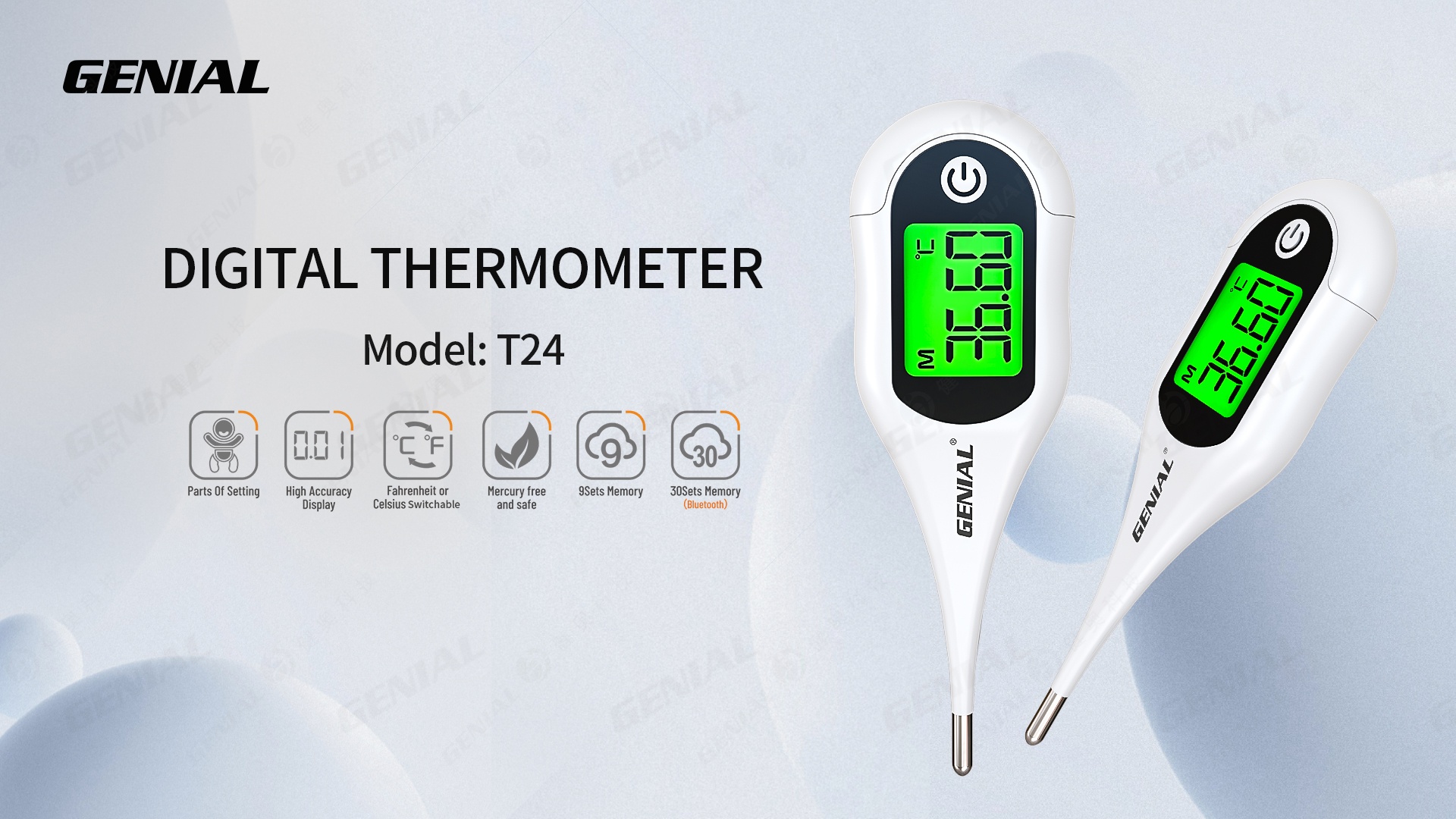
Rigid tip digital thermometers such as the T24 are positioned for outpatient and household medical use.
Rigid tip thermometers like GENIAL's T23/T24 are made of medical PP, carry an IPX5 protection level and weigh about 10 g with a CR1625 battery. Their intended environments include outpatient clinics and household medical consumables. Flexible tip models such as the T28 use a soft PVC probe and are positioned for hospitals, pharmacies, maternal and infant stores and physical examination centers; the T28 measures from 32.00 to 42.90°C with accuracy of ±0.1 to ±0.3°C depending on the range. For the baby gift and children's market, the T15S/T15SL/T15SC animal-shaped thermometers have flexible food-grade rubber tips, IPX5 waterproofing and ±0.1°C accuracy.
A more recent product logic is continuous monitoring. The T31 wearable Bluetooth digital thermometer uses a medical-grade patch design and measures temperature from 20.0 to 45.0°C with ±0.1°C accuracy. It is splash-proof to IPX4, weighs 33 g including battery and transmits data to an app. This type of device is a reminder that home temperature monitoring is evolving from single-point checks to trend-based monitoring, especially for infants, postpartum maternal care and chronic disease patients.
Infrared models fill a separate role. Forehead thermometers such as the T86/T87 support school daily checks, factory epidemic prevention and customs entry inspection, and the T94 infrared ear thermometer is designed for pediatric hospitals and maternal and child healthcare centers. Buyers therefore need to ask which temperature site and patient flow they are serving before choosing between rigid, flexible, wearable, forehead and ear types.
Blood pressure monitoring: upper arm vs wrist is a channel decision
Digital blood pressure monitors account for approximately 48% of total revenue in the global blood pressure monitoring devices market, according to Fortune Business Insights for 2024. That makes this family one of the most commercially important in home health. The practical starting point for a buyer is the choice between upper arm and wrist devices.
Upper arm monitors are generally suited to home self-test and chronic disease management. GENIAL's GT-702LM upper arm model supports an arm circumference of 22 to 42 cm, measures pressure from 0 to 290 mmHg, and is designed for home self-test use as well as global supermarket and medical equipment distributor channels. The GT-732M adds a larger arm range of 22 to 42 cm and uses an eco-friendly TPU air bag, with positioning for chronic disease management institutions and community medical centers. The GT-702L, another upper arm monitor, is built for international foreign trade and is used in household healthcare, physical examination centers, nursing homes, pharmacies and the gift industry.
Wrist monitors are lighter and more compact, which makes them attractive for portable healthcare, travel gifts, supermarket retail and promotional channels. The GT-701C wrist model supports a 13.5 to 21.5 cm wrist circumference and is designed for pharmacy chain and cross-border medical sales. The GT-701F, with a similar wrist range and a weight of 120 g ±15 g without battery, targets portable healthcare, travel gifts and supermarket retail. For a buyer planning an e-commerce campaign that needs a compact price-accessible blood pressure product, wrist monitors can be a faster fit; for a distributor building a chronic-care programme, upper arm models are often the foundation of the range.
Blood oxygen and respiratory care: where home devices become therapy tools
Pulse oximeters and respiratory devices shift the conversation from basic vital-sign tracking to therapy support. Their buyers, regulators and end users expect more than convenience; they expect clinical reliability.
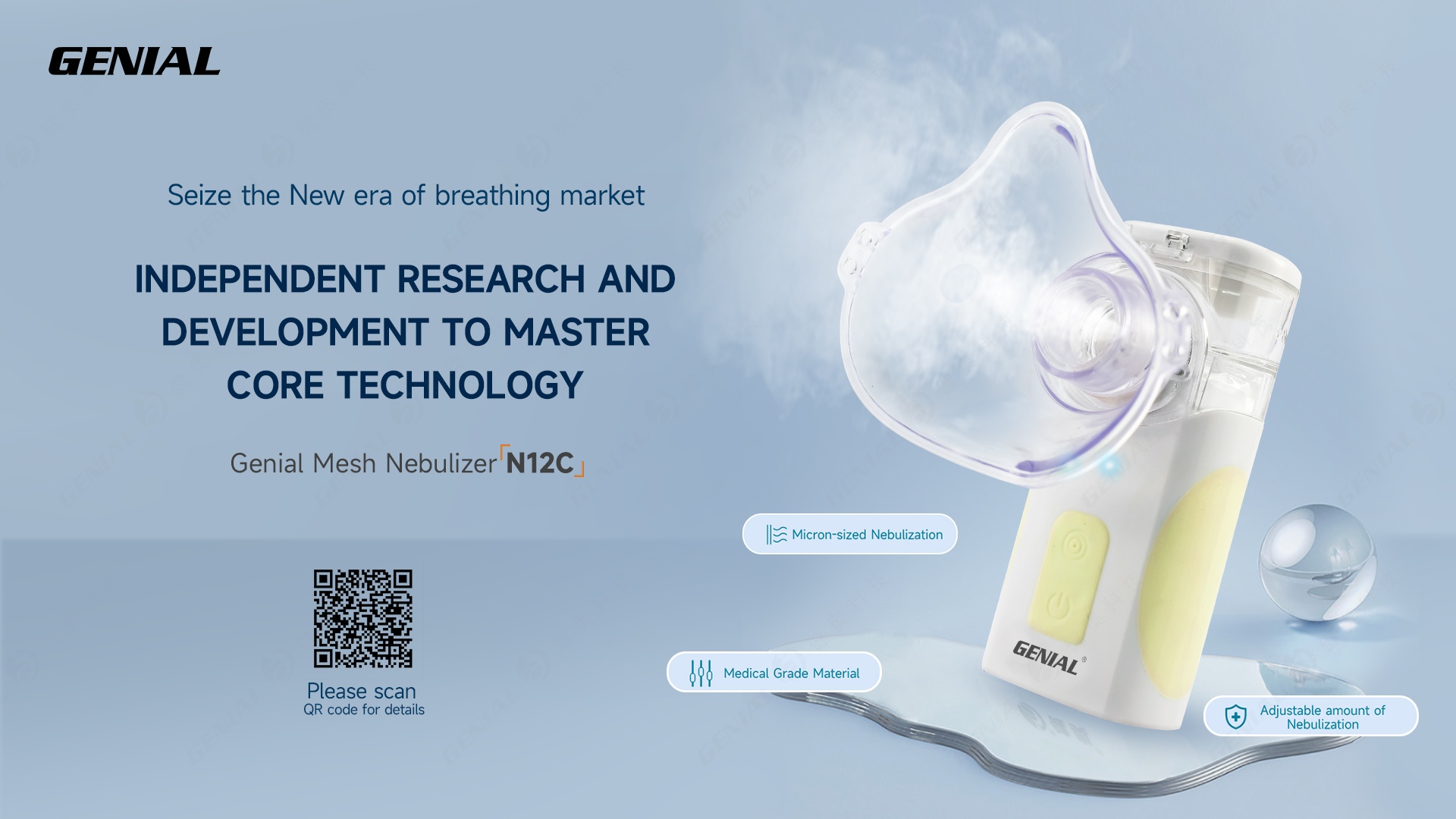
Portable mesh nebulizers are used in pediatric wards, respiratory clinics, home cough treatment and even pet medical care.
Fingertip pulse oximeters such as GENIAL's GX3/GX5/GX7/GX8/GX12/GX13/GX14 measure SpO₂ from 35% to 100% and pulse rate from 30 to 250 bpm. They serve elderly care institutes, respiratory departments, outdoor sports, household medical and pharmacy settings. Their role is not just spot-checking oxygen level; in chronic respiratory disease management, an oximeter can help screen hypoxia risk and support a decision to consult a physician.
Mesh nebulizers have changed home respiratory therapy through portability and low noise. GENIAL's N11/N21 portable mesh nebulizer has a liquid capacity of 8 ml, a nebulization rate of at least 0.2 ml/min and a particle D50 below 5 μm for at least 60% of particles, with noise at or below 50 dB(A). It is used in pediatric wards, respiratory clinics, domestic cough treatment and pet medical care. The N12/N22 series, with a net weight between 78 and 92 g, is aimed at overseas OEM, rehabilitation centers and private clinics. For a distributor, nebulizers are different from thermometers because they ship with masks, mouthpieces, medicine cups and cleaning considerations, making accessory planning essential.
Sleep apnea therapy devices are the most complex home medical product family. GENIAL's non-invasive sleep CPAP ventilators, such as the GH-B20V and GH-B25V models, provide CPAP/APAP automatic pressure adjustment from 4 to 25 cmH₂O, with heated humidification and exhalation pressure relief. They operate at or below 35 dB, support AC100–240V power and offer S/T/VGPS modes with an optional built-in lithium battery. Their users are typically patients with obstructive sleep apnea, who require ongoing therapy rather than occasional measurement. Buyers entering this category must plan for masks, heated breathing tubes, humidifier chambers, spare filters and optional blood-oxygen modules as part of the stocking strategy.
Wellness and personal care: the broader home health shelf
Beyond medically registered devices, many health retailers stock products that address personal wellness. GENIAL's portfolio includes a meridian massage instrument, a health manager and an IPL hair removal device. The hair removal device models GI02/GI06 use 560–1200 nm intense pulsed light combined with sapphire cooling to suppress hair regrowth activity and improve treatment comfort. It operates with rechargeable lithium-battery power, automatic flash emission after skin-contact recognition, adjustable energy levels and low-battery reminders.
For B2B buyers, wellness products are a useful complement to a medical catalogue because they can be sold through beauty salons, aesthetic institutions, personal-care e-commerce, cross-border beauty channels and gift procurement projects. The regulatory boundary between medical devices and wellness devices should, however, be checked market by market. A product that is registered as a medical device in one country may be classified as a cosmetic or personal-care appliance in another.
What a multi-category order means for supplier capability
When a buyer sources several home medical health device categories from one manufacturer, the evaluation shifts from individual product specifications to factory-wide capabilities. GENIAL provides a relevant example because its manufacturing base is large enough to support multiple regulated product lines. The company operates a manufacturing facility covering 45,000 square meters, employs about 251 staff and has an annual production capacity of 15,000,000 units. Its R&D team includes 29 engineers.
A multi-category supplier also needs compliance breadth. GENIAL has passed ISO 13485, ISO 45001, ISO 14001, BSCI and GB/T29490 intellectual property management certification. Its products hold certifications such as CE, FDA, NMPA, CB, FCC and RoHS. The company states that it has completed product and trademark registration in 29 countries and that its products are sold to 117 countries and regions worldwide. For buyers, these are not marketing phrases; they reduce the cost of qualifying a new category because the quality management system and regulatory experience already exist within one organisation.
GENIAL also reports that 80% of its business is export-oriented, with key markets in Europe, North America, Southeast Asia, the Middle East, Africa, Latin America and Oceania. Export concentration matters for buyers because it indicates that packaging, documentation, language requirements and after-sales workflows are built for cross-border orders rather than only domestic supply.
Limits and boundaries buyers should respect
Even a broad home medical product line has boundaries. A category map is not a substitute for clinical advice, and no single device type is universal. For example, wrist blood pressure monitors are convenient, but their readings are more dependent on the user keeping the device at heart level during measurement. Upper arm monitors are more common in chronic-care protocols but require a correctly sized cuff and a stable sitting posture. In the same way, an infrared thermometer is fast and non-contact, but environmental conditions can influence surface temperature readings in ways that contact thermometers are less exposed to.
Buyers should also note that respiratory therapy devices, especially CPAP ventilators and nebulizers that deliver medication, should be selected with attention to the intended patient group and the local medical or pharmacy rules. The availability of a well-designed device does not remove the need for proper instructions, caregiver training and, where required, clinical guidance.
Comparison with traditional approaches
Compared with older clinical purchasing patterns, home medical health device sourcing is faster-moving and more consumer-influenced. Traditional hospital procurement tends to favour large-format equipment with service contracts and on-site training. Home healthcare channels, by contrast, need compact devices that can be understood by a family member without clinical training. This explains why product styling, multilingual instructions and simplified operation have become commercial requirements rather than optional extras.
Another shift is visible in respiratory care. Where compressor nebulizers historically dominated hospital and clinic use, portable mesh nebulizers offer a smaller footprint and lower noise, which is meaningful for children and for home use. Similarly, sleep apnea therapy has expanded from supervised sleep-laboratory titration to long-term home treatment, requiring ventilators that are quieter, easier to set up and more reliable over months of overnight use. None of this means traditional equipment has disappeared; instead, buyers often need both a clinical-grade line and a consumer-friendly home line.
Market trends shaping the next stage of home health
Several trends are visible in the market data. Digital thermometers are growing from a mature base, while blood pressure monitors show one of the strongest forecast growth rates among home diagnostic devices. Pulse oximeters have expanded beyond hospital use into wellness and sports channels. Mesh nebulizers are becoming a distinct respiratory-care segment rather than an accessory to respiratory departments.
A deeper structural trend is connectivity. GENIAL already links devices such as the T31 wearable thermometer to a mobile app and cloud platform, enabling continuous temperature curves, remote family viewing and abnormal-value alerts. Within a larger healthcare project, one-to-many monitoring can be built around Bluetooth gateways, a model that aligns with community chronic-disease management and institutional monitoring. For buyers, the practical implication is that home medical devices are no longer judged only by measurement accuracy; data sharing, battery efficiency, alert settings and platform compatibility are becoming part of the procurement specification.
Future outlook
The future direction of home medical health devices points toward more continuous data, more portable respiratory therapy and more integration between consumer channels and formal healthcare services. Suppliers that can build a broad certified product range while maintaining responsive OEM and ODM teams will be better positioned as partners for distributors who want to grow from single thermometers into full home-health programmes. GENIAL's 25 years of manufacturing experience, its 45,000-square-meter base and its established presence in export markets give it a realistic foundation for this kind of multi-category partnership.
For procurement teams, the strongest next step is to turn this category map into a supplier questionnaire. Ask how each product family is certified, which accessories are included, how quality is controlled across production lines and what documentation supports market registration. A supplier that can answer these questions category by category is more useful than one that offers many products without a traceable compliance system behind them.
GENIAL's updated English brochure with product and compliance details is available for public reference and download: GENIAL 2026 English brochure.
Frequently asked questions
What types of products are considered home medical health devices?
Home medical health devices are products used outside clinical settings to monitor or support health. They include digital thermometers, blood pressure monitors, pulse oximeters, mesh nebulizers and sleep apnea ventilators. The range can also include wellness products such as massage instruments and hair removal devices when distributed through health and personal-care channels.
What is the difference between rigid tip and flexible tip digital thermometers?
Rigid tip thermometers, such as GENIAL's T23/T24, have a firm medical PP tip and are typically used for oral or underarm measurement in outpatient and household settings. Flexible tip thermometers, such as the T28, use a soft PVC probe, which can improve comfort and are often preferred for hospitals, pharmacies and maternal and infant stores. Both can achieve similar accuracy under correct measurement conditions.
Should a buyer choose an upper arm or wrist digital blood pressure monitor?
The choice depends on the target channel and use pattern. Upper arm monitors such as the GT-702LM support a wider arm circumference range and are common for home self-test and chronic-care programmes. Wrist monitors such as the GT-701C are compact and lightweight, which makes them better suited to portable use, travel and promotional channels. Buyers should confirm the cuf size range and the intended user's arm or wrist circumference before selecting a model.
What specifications matter when evaluating a finger pulse oximeter?
Key specifications include the SpO₂ measurement range, pulse rate range, accuracy and display type. GENIAL's fingertip pulse oximeter series measures SpO₂ from 35% to 100% and pulse rate from 30 to 250 bpm, with an accuracy of ±2% for SpO₂ within the 70% to 100% range. It uses an OLED display and a sweat-splash-proof finger clip for daily home or institutional use.
Are portable mesh nebulizers suitable for children and home use?
Yes. Portable mesh nebulizers such as GENIAL's N11/N21 are designed for pediatric wards, respiratory clinics, domestic cough treatment and even pet medical care. They have a small liquid capacity of 8 ml, a nebulization rate of at least 0.2 ml/min and a noise level ≤50 dB(A). They are supplied with masks or mouthpieces appropriate for different age groups.
What compliance evidence should a multi-category home medical device supplier provide?
Buyers should look for quality management certification such as ISO 13485 and product-level approvals for the target market. GENIAL holds ISO 13485, ISO 45001, ISO 14001, BSCI and GB/T29490 certification, and its products carry CE, FDA, NMPA, CB, FCC and RoHS approvals. Suppliers should be able to explain which certification applies to each product category and each destination market.
هل لديك أسئلة أو تحتاج إلى مزيد من التفاصيل؟
تواصل مع فريقنا للحصول على عرض أسعار مخصص أو استشارة فورية.
طلب عرض أسعار
املأ النموذج أدناه وسيتواصل معك فريقنا بعرض مقترح مخصص.
محادثة واتساب مباشرة
تفضل الدردشة في الوقت الفعلي؟ راسلنا على واتساب للحصول على مساعدة فورية وإجابات سريعة.
- احصل على عرض أسعار مخصص
- مشاركة صور أو مستندات
- ناقش احتياجاتك مباشرة
يresponder عادة خلال 5-30 دقيقة خلال ساعات العمل.