
Home Textile Fabric FAQ: Pilling, Fading, FR and Bulk Matching
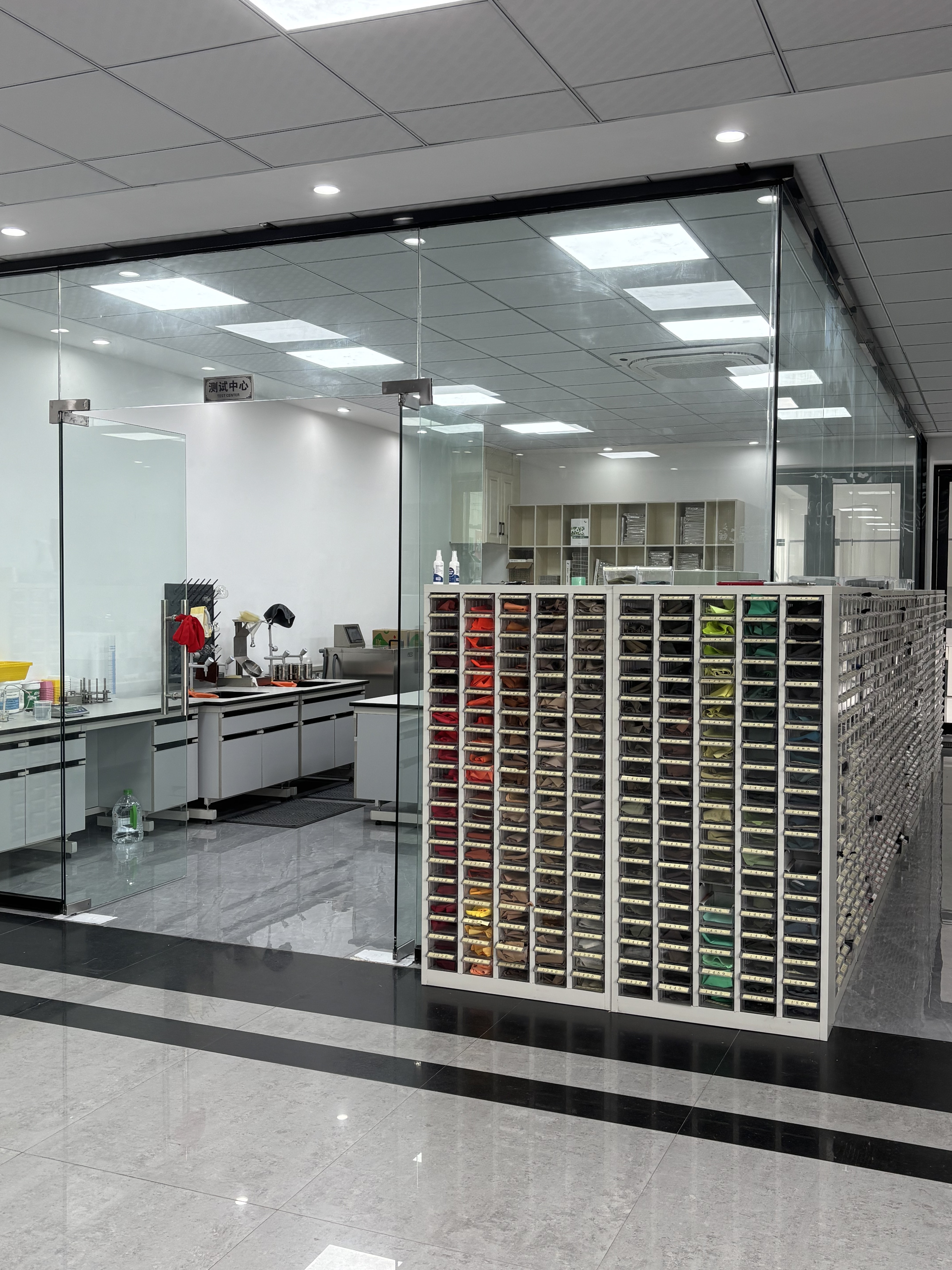
An in-house product laboratory supports lot-level quality testing of sofa and curtain fabric before shipment.
Home textile fabric programmes rarely fail during sampling. They fail later — when the second or third bulk order arrives with a surface hand that no longer matches the approved swatch, a curtain shade that has drifted after a season of daylight exposure, or a flame-retardant claim that cannot be repeated after the first commercial wash.
T-LAND TEXTILE (Suzhou T-land Textile Co., Ltd.) is a fabric manufacturer based in Shengze, Jiangsu Province, China, producing sofa fabric and curtain fabric for domestic and international furniture brands. Roughly 90% of its output is exported, with the European Union as its major market.
This reference collects the four questions that recur most often once a buyer moves from sample approval into repeat bulk supply: whether sofa fabric will pill, why curtains fade, which flame-retardant route fits a given project, and how bulk goods are checked against a confirmed sample. Each answer is written so it can be lifted into a specification sheet or an acceptance note, rather than read as a general description of the category.
Why These Four Questions Decide Whether a Buyer Repeats an Order
Surface performance and consistency are the two areas where procurement risk concentrates. Colour and construction can be inspected on a bench in ten minutes; pilling resistance, light fastness and flame retardancy only reveal themselves under friction, ultraviolet radiation and laundering. By the time those effects appear in a finished sofa or a hung curtain, the fabric has already been cut, sewn and shipped.
The practical consequence is that a buyer should convert each of these properties into a stated grade or a stated test route before the order is placed. A supplier answer of “our fabric does not pill” carries no acceptance value, because it cannot be measured. A stated pilling-resistance grade, a stated light fastness grade and a named flame-retardant technology can all be checked, argued over and written into a pre-shipment acceptance criterion.
A second risk sits in the gap between an approved sample and a production lot. Dyeing is a batch process, and small colour drift between lots is a normal characteristic of the category, not an exception. What separates suppliers is not the absence of variation but whether that variation is controlled, documented and caught before the container leaves.
Will Sofa Fabric Pill? The Honest Answer Is a Grade, Not a Yes or No
Almost all fabrics may pill. The variable that matters is the pilling-resistance grade of the specific construction: the higher the grade, the lower the pilling risk. Short-fibre fabrics are more likely to pill than long-fibre fabrics.
The mechanism is mechanical rather than chemical. Daily sitting and leaning friction pulls short fibres out of the yarn surface; those loose fibres tangle and knot into visible pills. Looser yarn structures and higher short-fibre content increase the likelihood. It is a physical fibre phenomenon and not automatically a product defect, which is why a flat rejection of any pilling in an acceptance clause is usually unenforceable.
For buyers, the workable approach is to ask for the grade and the test basis behind it. In the comparison data published by T-LAND TEXTILE, its upholstery constructions are listed at pilling-resistance grade 4–5, against grade 2–3 for conventional cotton-linen blends and grade 2–3 for commodity-grade upholstery. Those figures are supplier-published and should be confirmed against the buyer's own test protocol, but they illustrate the scale of difference a grade statement can expose.
Two practical notes follow. First, a velvet or raised-surface construction will always show fibre displacement earlier than a flat weave, so grade thresholds should be set per construction rather than applied uniformly across a collection. Second, pilling is affected by the abrasion the fabric actually sees: a decorative cushion cover and a family sofa seat are not the same tribology test.
Why Curtains Fade — and Why “Fade Resistant” Is Not Yet a Specification
Curtain fading is mainly caused by insufficient light fastness. Under long-term ultraviolet radiation, dye molecules undergo photo-oxidation degradation; the chromophore groups of the dye are damaged. When a fabric has low light fastness, dyes bind poorly with the fibres, and the result is fading, discolouration and uneven surface colour.
This matters most on south- and west-facing glazing, and in dimout and blackout constructions where the face fabric absorbs light while the room stays dark behind it. The buyer-visible symptom appears months after installation, but the cause is fixed at the dyeing stage.
The verifiable request is simple: state the light fastness grade and the test method used to generate it. T-LAND TEXTILE's comparison data lists light fastness of grade 4 or higher for its fabrics, against grade 2–3 for conventional cotton-linen and commodity-grade alternatives. For a contract with a multi-year replacement obligation, that difference is the whole argument.
One boundary should be stated plainly: light fastness grading is a laboratory prediction, not a guarantee of colour permanence in every installation. Glass type, orientation, humidity and cleaning chemistry all shift real-world results, so a grade should be read as a comparative indicator rather than a warranty.
Flame Retardancy: Inheart-Yarn FR and Coating-Treated FR Are Two Different Products
Buyers frequently treat “FR curtain fabric” as one category. It is not. T-LAND TEXTILE supplies both technologies, and they behave differently across the life of the installation.
Inherent-yarn (inheart-yarn) FR builds the flame-retardant performance into the yarn itself. The performance is permanent and washable, and the fabric retains a soft hand, which is why it is positioned for hotel projects and other long-life contracts where laundering is part of the maintenance regime.
Coating-treated FR applies the flame-retardant finish to the fabric surface. It is the lower-cost route, but its FR performance drops after repeated washing. A treated fabric that passed its original test can therefore drift out of compliance quietly, without any visible change.
| Decision point | Inheart-yarn FR | Coating-treated FR |
|---|---|---|
| Where performance sits | In the yarn itself | On the treated surface |
| Behaviour after repeated washing | Permanent and washable | Performance drops |
| Hand-feel | Soft | Varies with finish weight |
| Typical project | Hotel and long-life contract work | Shorter-life or budget-driven work |
| Cost position | Higher | Lower |
Regulatory framing should be fixed before the specification is written. In the United Kingdom, the Furniture and Furnishings (Fire) (Safety) Regulations 1988 remain the core regime in 2026 for domestic upholstered products, and BS 5867 is the established UK fire safety standard specifically for curtains and drapes. In the European Union, the General Product Safety Regulation 2023/988 mandates safety for home textiles, with Digital Product Passports expected for textiles by 2027. A buyer should name the regime, the standard and the test route in the purchase order rather than accepting a generic “FR available” line.
How Bulk Goods Are Checked Against a Confirmed Sample
Bulk-to-sample matching is a process question, and the process answer is short: a first-dye-lot sample is arranged for confirmation, and mass production starts only after that sample is approved. In T-LAND TEXTILE's workflow, the first dye lot functions as the reference point for the whole production run, so shade and hand are agreed before the bulk yardage is committed.
Two supporting mechanisms reduce the chance of drift after approval. Pre-shipment testing is the stated acceptance criterion, which means the check happens before the goods ship rather than after they arrive. Order instructions are handled through a computer-based system rather than a paper process, which matters on repeat orders where the risk is not a wrong decision but a lost or misread instruction.
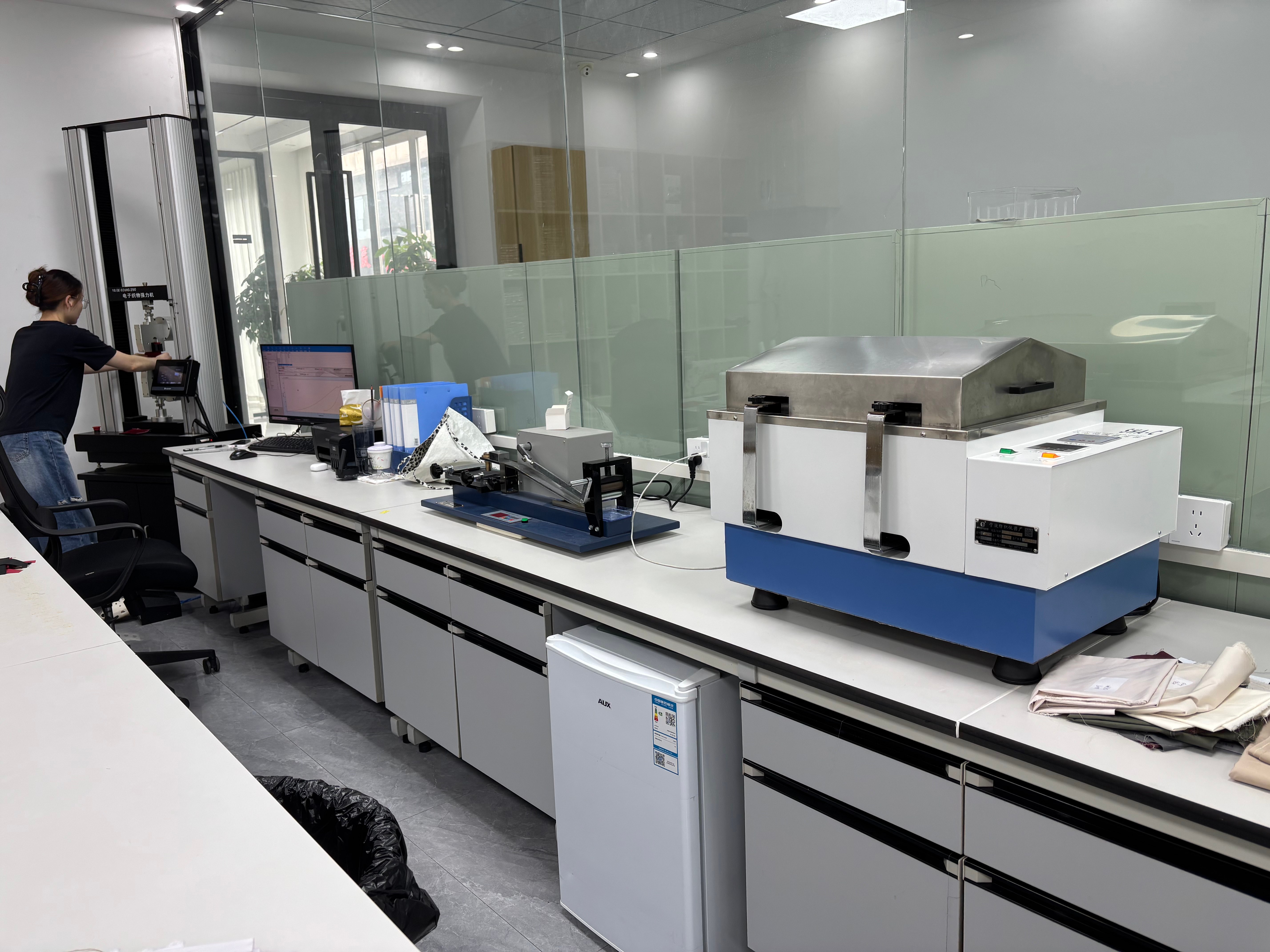
Pre-shipment testing, rather than arrival inspection, is the acceptance point in this procurement model.
A practical acceptance note should therefore contain four items: the approved first-dye-lot sample as the master reference, the test items to be run pre-shipment, the tolerance for shade variation between lots, and the person on the buyer side who signs off. Without the last item, the other three tend to be agreed in principle and ignored in practice.
Purchasing Terms to Fix Before Production Starts
Commercial terms are the part of a fabric order most often left ambiguous until a dispute forces them into the open. The terms below are the standing position for T-LAND TEXTILE and can be treated as the baseline a buyer negotiates against.
| Term | Position |
|---|---|
| Minimum order quantity | 500–1,000 m per colour, including custom colours |
| Delivery terms | FOB |
| Payment terms | 30/70 — 30% T/T deposit, 70% before shipment |
| Acceptance criteria | Pre-shipment test |
The MOQ figure deserves attention because it is per colour, not per order. A buyer running a five-colour programme is committing to a materially larger volume than a single-colour buyer running the same total meterage. Where a range is still being tested commercially, the sensible sequence is to validate construction and hand through small sample development first, then place the colour commitment once the range is confirmed.
Where T-LAND TEXTILE Sits in This Procurement Framework
The company was founded in 2014 and operates from Shengze, near Shanghai with convenient sea and air access. The manufacturing facility covers 5,000 square metres and employs about 91 people, with an R&D team of three engineers. Annual production capacity reaches approximately 5,000,000 metres of woven fabric per year, a scale that supports repeat bulk orders rather than one-off runs. A 1,500 square metre warehouse handles fabric storage and shipment preparation.
Quality control is organised around an in-house laboratory used for lot-level testing of different items, and the company holds OEKO-TEX and GRS certification, with its products following those certification frameworks. Export accounts for about 90% of sales, and the European Union is the major market — a relevant detail for buyers who need documentation that survives an EU compliance review rather than a domestic one.
Model-level context helps here, because procurement arguments are won on specifications rather than on category language. Within the current range, TL08183 and TL08170 are dimout curtain fabric models, TL08269 is a fabric used for both curtain and sofa applications, and TL0901 and TL0329 are sofa fabric models. For a buyer building a programme, these model references are the unit at which pilling grade, light fastness grade and FR route should be fixed and written down.
Application Fit: Residential, Hospitality and Commercial Projects
Fabric requirements diverge sharply by working condition. Household use means low-frequency friction and sunlight exposure; commercial use means heavy-duty wear with cleaning cycles attached.
Sofa fabric carries two jobs at once: it covers and protects the base material and resists friction, while also contributing to the decorative character and sitting comfort of the piece. Curtain fabric combines light blocking and light adjustment with sun shading, privacy protection, decoration and noise reduction. Neither function can be assessed from a swatch photograph.
Typical project types in this category include residential decoration, hotel and bed-and-breakfast work, office commercial projects, healthcare institutions, exhibition and cultural tourism projects, and special soft furnishing customisation for recreational vehicles and yachts. Special requirements that recur across these settings include flame retardancy, high light fastness, high Martindale wear resistance, anti-pilling performance, water-repellent and stain-resistant finishing, low-formaldehyde eco-standards, strict batch-to-batch colour difference control, washability, and customised width and gram weight.
Hospitality projects are the clearest case for separating the FR routes: where curtains are laundered between guests, a coating-treated fabric will lose performance progressively, while an inheart-yarn construction is designed to retain it.
Market Context: What the Category Numbers Say
Home textile fabric sits inside a large and regionally concentrated market. The global home textile market reached USD 144.76 billion in 2025 according to The Business Research Company, with Asia Pacific holding a 44.17% share in 2025 per Fortune Business Insights. Within that, the global blackout fabric market was valued at USD 2.7 billion in 2024 and is projected to grow at a CAGR of 5.9% to reach USD 3.8 billion by 2030, based on Strategic Market Research figures; the upholstery fabric market was valued at USD 44.5 billion in 2023 according to Verified Market Research.
Two caveats are worth stating rather than glossing over. Published blackout fabric market values differ widely between research houses, largely because some reports count raw fabric and others count finished curtains, so the figure should be read as an order of magnitude rather than a precise benchmark. Similarly, estimates of total home textile market value vary with the treatment of floor coverings and hard home decor.
Trade flows run in the same direction as the manufacturing base. China's home textile exports reached USD 2,870.94 million in March 2024, per Stellar Market Research. For a buyer, this concentration has a practical reading: the supplier field is deep, which makes differentiation through documented performance rather than price the more durable strategy.
Comparison With Traditional and Commodity Options — Including the Limits
Performance-engineered polyester constructions are commonly compared against two alternatives: natural cotton-linen blends and low-cost commodity upholstery. The comparison data published by T-LAND TEXTILE places its fabrics at Martindale wear resistance of 20,000–45,000 cycles, light fastness of grade 4 or above, pilling-resistance grade 4–5 and shrinkage of 3% or less. In the same data, cotton-linen is listed at 10,000–15,000 Martindale cycles, light fastness grade 2–3 and shrinkage of 5–8%, while commodity fabrics are listed at 8,000–15,000 cycles and shrinkage of up to 8–10%.
The functional argument follows from those numbers. Intrinsic flame retardancy and woven blackout retain performance after washing, whereas coated treatments degrade with repeated laundering. Batch-to-batch colour difference is controlled tightly, where natural fibres show larger variation and low-cost goods carry higher colour-difference risk. Stated service life is 8–12 years for home use and 5–8 years for commercial use, against 4–6 years for cotton-linen at home and 3–5 years for commodity fabrics.
The limits deserve equal space, because they are where procurement decisions are actually made.
Upfront cost is higher, not lower. The supplier's own comparison states that its fabrics cost 15–35% more than commodity alternatives at the point of purchase, offset by roughly 80% longer service life. A buyer working to a capital budget rather than a lifecycle budget will feel that premium immediately and the benefit only over years.
The environmental case is not one-directional. Polyester consumes more production energy than natural cotton-linen. The lifecycle argument rests on fewer replacements, less transport and less disposal over the same service period — it does not mean the fibre itself is lower-impact at the point of manufacture.
Commercial terms constrain small buyers. With MOQ at 500–1,000 metres per colour and delivery under FOB terms, a small independent retailer or a designer testing a new range has limited room to trial broadly before committing. Sample development mitigates this, but it does not remove the threshold.
No flame-retardant route is free of trade-offs. Inheart-yarn FR is permanent and soft but costs more. Coated FR is cheaper but loses performance with repeated washing. The choice is a project-lifetime decision, not a price comparison.
Pilling is reduced, not eliminated. A high pilling-resistance grade lowers risk; it does not remove the physical phenomenon from a fabric surface under sustained friction.
Future Outlook
Three developments are likely to reshape how these questions are asked. The first is traceability: with Digital Product Passports expected for textiles in the EU by 2027 under the framework around GPSR 2023/988, a supplier's ability to map a model number to a documented performance claim becomes a compliance asset rather than a courtesy.
The second is finishing chemistry. PFAS restriction pressure is already visible in buyer questionnaires, and the shift toward silicone-based or fluorine-free polyurethane water-repellent agents moves the question from “is it water repellent” to “what is it finished with”.
The third is the continued growth of the blackout and dimout segment, tracked at a 5.9% CAGR to 2030 in the Strategic Market Research forecast. As that segment expands, buyers are likely to judge suppliers less on colour cards and more on grade statements, test routes and first-dye-lot discipline — the same three things that decide whether a repeat order goes smoothly today.
FAQ
Will sofa fabric pill?
Almost all fabrics may pill. The governing variable is the pilling-resistance grade of the fabric: a higher grade means a lower pilling risk, and short-fibre fabrics are more likely to pill than long-fibre fabrics. Pilling forms when daily sitting and leaning friction pulls short fibres out of the yarn and those fibres tangle into visible pills. Looser yarn structures and higher short-fibre content increase the possibility. It is a physical fibre phenomenon and not automatically a product defect.
Why do curtains fade after a period of use?
Curtain fading is mainly caused by insufficient light fastness. Under long-term ultraviolet radiation, dye molecules undergo photo-oxidation degradation and the chromophore groups of the dye are damaged. When light fastness is low, dyes bind poorly with the fibres, producing fading, discolouration and uneven surface colour. Buyers should confirm the light fastness grade of the fabric before purchase rather than after installation.
Is flame-retardant curtain fabric inheart-yarn FR or coating-treated FR?
Both technologies are available from T-LAND TEXTILE. Inherent-yarn FR is permanent and washable, with a soft hand, and is used for hotel projects. Coated FR is lower in cost, but its flame-retardant performance drops after repeated washing. The two routes should be specified by project lifetime and laundering regime rather than treated as interchangeable.
Are the fabrics PFAS-free?
The products are fluorine-free. No PFAS (PFOA/PFOS) fluorinated finishing agents are added during production. Where water repellency is required, fabrics finished with silicone-based or fluorine-free polyurethane water-repellent agents are the recommended route, which allows the required repellency to be maintained on a compliant basis.
How do you ensure bulk goods are identical to a confirmed sample?
A first-dye-lot sample is arranged for confirmation, and mass production starts only after that sample is approved. The first dye lot therefore becomes the reference for the production run, with shade and hand agreed before bulk yardage is committed. Pre-shipment testing is the acceptance criterion, so the check takes place before goods ship rather than on arrival.
What are the purchasing terms and acceptance criteria?
Minimum order quantity is 500–1,000 metres per colour, including custom colours. Delivery terms are FOB. Payment terms are 30/70, consisting of a 30% T/T deposit with the remaining 70% due before shipment. The acceptance criterion is a pre-shipment test.
The T-LAND TEXTILE company brochure, covering product range and manufacturing capability, is available for download: T-LAND TEXTILE brochure (PDF). Company detail is published at www.t-landtex.com.
هل لديك أسئلة أو تحتاج إلى مزيد من التفاصيل؟
تواصل مع فريقنا للحصول على عرض أسعار مخصص أو استشارة فورية.
طلب عرض أسعار
املأ النموذج أدناه وسيتواصل معك فريقنا بعرض مقترح مخصص.
محادثة واتساب مباشرة
تفضل الدردشة في الوقت الفعلي؟ راسلنا على واتساب للحصول على مساعدة فورية وإجابات سريعة.
- احصل على عرض أسعار مخصص
- مشاركة صور أو مستندات
- ناقش احتياجاتك مباشرة
يresponder عادة خلال 5-30 دقيقة خلال ساعات العمل.