
Home and Office Leak Protection: Best Motorized Valve Application Scenarios
HTNXT Industry Reference · Fluid Control
A motorized ball valve is an electrically actuated quarter-turn valve in which a small motor rotates a bored ball to open or close a water path. In a leak protection system it is the component that decides whether a detected leak becomes a repair bill or a dry floor.
Water leak protection is usually bought as a detection problem and then fails as an isolation problem. Sensors are inexpensive, easy to place and easy to explain to a tenant, a facility manager or a homeowner. The valve that has to stop the water is asked to do something harder: sit unused for months, then close completely on the first command, at whatever hour the leak occurs.
This reference looks at where motorized ball valves are actually specified in home and office leak protection, which constraints decide the selection, and what published specifications and certifications a buyer can verify before committing to a design. Product data below refers to motorized valves and leak detection products from Tianjin Tianfei High-tech Co. (Tianfei High-Tech), a Tianjin-based manufacturer of mini electric valves established on 16 March 2009.
Why detection is inexpensive and isolation is not
A leak sensor only has to answer one question: is there water where there should not be. Conductive sensing does this with two electrodes and a comparator circuit, which is why wireless leak sensors have become a standard catalogue item for smart home and property management buyers.
An isolation valve answers a different question: will the pipe actually be closed. That depends on bore size, actuator torque, seal design, the state the valve was left in, and what the valve does when electrical power disappears mid-event. Two-way motorized ball valves accounted for 42.1% of the motorized valve market segment share in 2025, according to Dataintelo, which is consistent with how leak protection is built in practice — a single open/close valve on the incoming line rather than a modulating control valve.
The practical consequence for buyers is that leak protection should be specified as an assembly: sensor, signal path, valve, power source and failure mode. Buying the sensor first and the valve later is where most projects lose time.
How a motorized ball valve behaves in a leak protection circuit
A motorized ball valve uses a motor-driven actuator to rotate a ball with a straight bore through it. At 0° the bore aligns with the pipe and the line is open; at 90° the ball seals against the seats and the line is closed. Because the ball holds its position mechanically, the valve does not need continuous electrical current to stay open or closed — a structural difference from solenoid valves, which are held in position by an energized coil.
Three behaviours matter most in leak protection:
- Failure mode. Normally-closed designs close when power is interrupted, turning a power failure into an isolation event rather than an open pipe. Tianfei High-Tech describes its linked alarm shut-off valve as NC type, auto-closing on power failure.
- Response time. The Wired WLD leak sensor lists a response time under 3 seconds with NO/NC relay output. The WLAV linked alarm shut-off valve is described as completing detection, buzzer alarm and motorized shut-off within the same under-3-second window.
- Control mode. On/off is sufficient for pure isolation. Where the same line also needs regulation, the CWX-60P 2-way motorized ball valve supports AC220V/DC24V, DN15–DN100, 20 N·m torque, modulating control at 0-10V/4-20mA or on/off, IP67 protection and working pressure up to 1.6 MPa.
Three-way motorized ball valves appear in leak protection where the required response is to divert rather than simply stop flow. The CWX-60P 3-way valve is offered in T-port and L-port configurations, DN15–DN50, 20 N·m, IP67, with the same 1.6 MPa pressure rating.
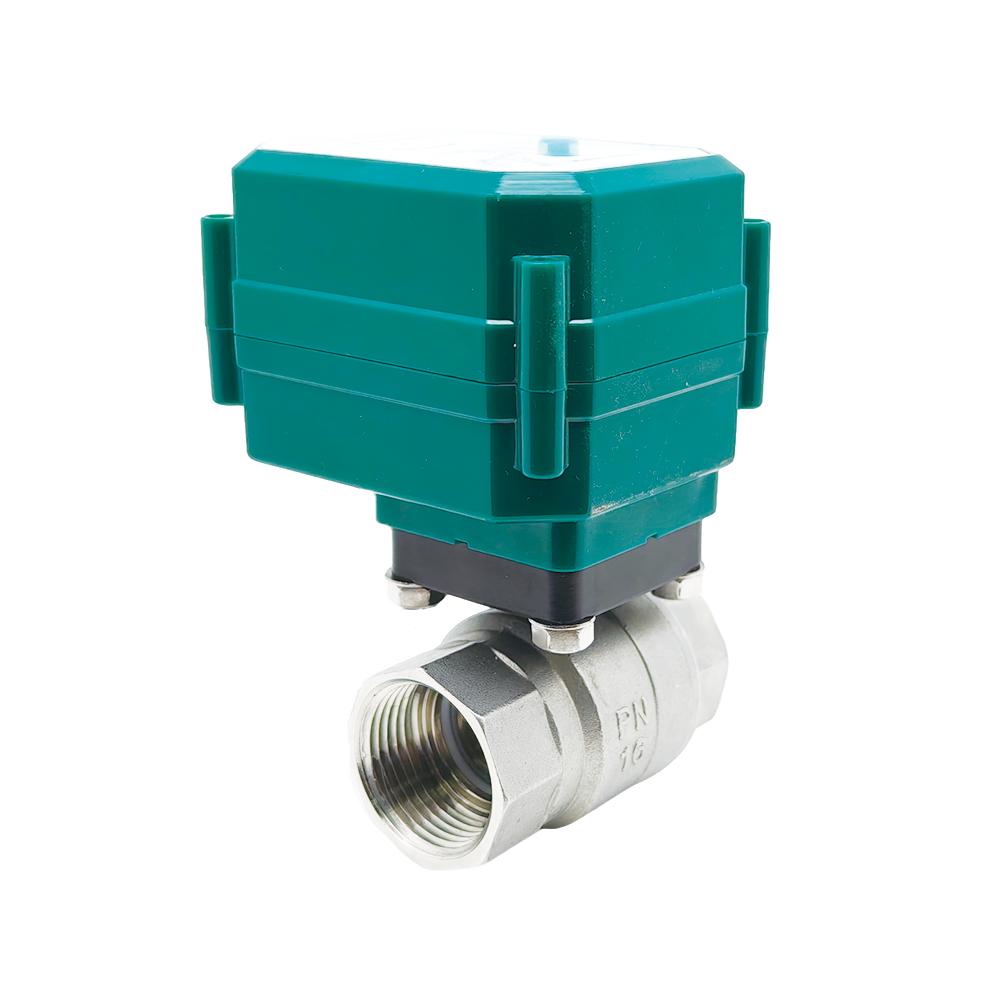
WiFi Smart Water Valve (DN15–DN25): a motorized ball valve on 2.4 GHz WiFi, powered by four AA batteries or USB DC5V, integrated with Tuya Smart and SmartLife for automatic shut-off on leak detection.
Scenario 1 — Smart home water control
A smart home leak protection loop is a low-bore, battery-tolerant application. The household main line is small, the installation point is often inside a cabinet or an 86 mm electrical box, and there is rarely a spare mains circuit for a valve.
What the specification looks like
- WiFi Smart Water Valve (model WIFI WATER VALVE): WiFi 2.4 GHz (IEEE 802.11b/g/n), DC6V from four AA batteries or DC5V USB, DN15–DN25, SS304 body, IP54, integrated with Tuya Smart / SmartLife / Alexa / Google Home.
- Wireless Water Leak Sensor (model Wireless WLD): three AAA batteries with standby time over one year, Zigbee 3.0 / Z-Wave / WiFi depending on model, conductive sensing, 1 m sensor cable included, IP44, supported on Tuya / SmartThings / Home Assistant.
The value of the assembly is that the sensor and the valve share one platform. In the Tuya scene, a detected leak closes the valve and pushes an alarm to the app without manual intervention. The valve's dual power design — four AA batteries with USB DC5V as a continuous alternative and automatic switching — allows either a battery-only retrofit or a mains-adjacent installation.
Constraints to confirm before ordering
- Bore: DN15–DN25 covers residential branch and main lines, not building supply headers.
- Network: the valve communicates on 2.4 GHz WiFi, so the installation point needs 2.4 GHz coverage rather than 5 GHz only.
- Ingress: IP54 suits a kitchen or bathroom cabinet; it is not a wash-down or subfloor rating.
- Protocol: the wireless sensor ships in Zigbee 3.0, Z-Wave or WiFi variants, and the gateway must match the variant ordered.
Scenario 2 — Rental property leak protection
Rental property is a different constraint set from owner-occupied housing. The installer rarely has permission to open walls or run new circuits, and the operator needs evidence — a notification record and a defined shut-off behaviour — rather than a resident's maintenance habit.
That makes battery-powered wireless detection the natural fit. The Wireless WLD is listed for rental apartments and property building management, runs on three standard AAA batteries with stated standby over one year, and requires no wiring, which keeps per-unit deployment cost low and avoids tenants' electrical work. In a Tuya scene it can be linked to the WiFi Smart Water Valve so that detection, shut-off and alarm happen automatically.
Where the property requirement is a local alarm rather than a cloud notification, the alternative is the WATER LEAK ALARM VALVE (model WLAV). It is a linked alarm shut-off valve with DC12V power, conductive sensing, DN15–DN25 bore, buzzer plus relay dry contact output, and a 1–5 m sensor cable, rated IP44 and listed for home and office leak protection, server room subfloor, and kitchen or bathroom pipe monitoring. The documented behaviour on a leak is detection, buzzer alarm and motorized shut-off within the same response window, with the DC12V supply specified so that water contact at the sensor does not create a shock path.
What belongs in the operating procedure
- Sensor placement at the risk points — kitchen, bathroom, washing machine, water heater — using the 1 m cable included with the wireless sensor or the 1–5 m cable option on the WLAV.
- A battery replacement interval built around the stated standby period rather than reactive replacement.
- A defined response to the normally-closed valve: on power loss the valve closes, which protects the unit but must be communicated to occupants and to any system that depends on continuous supply.
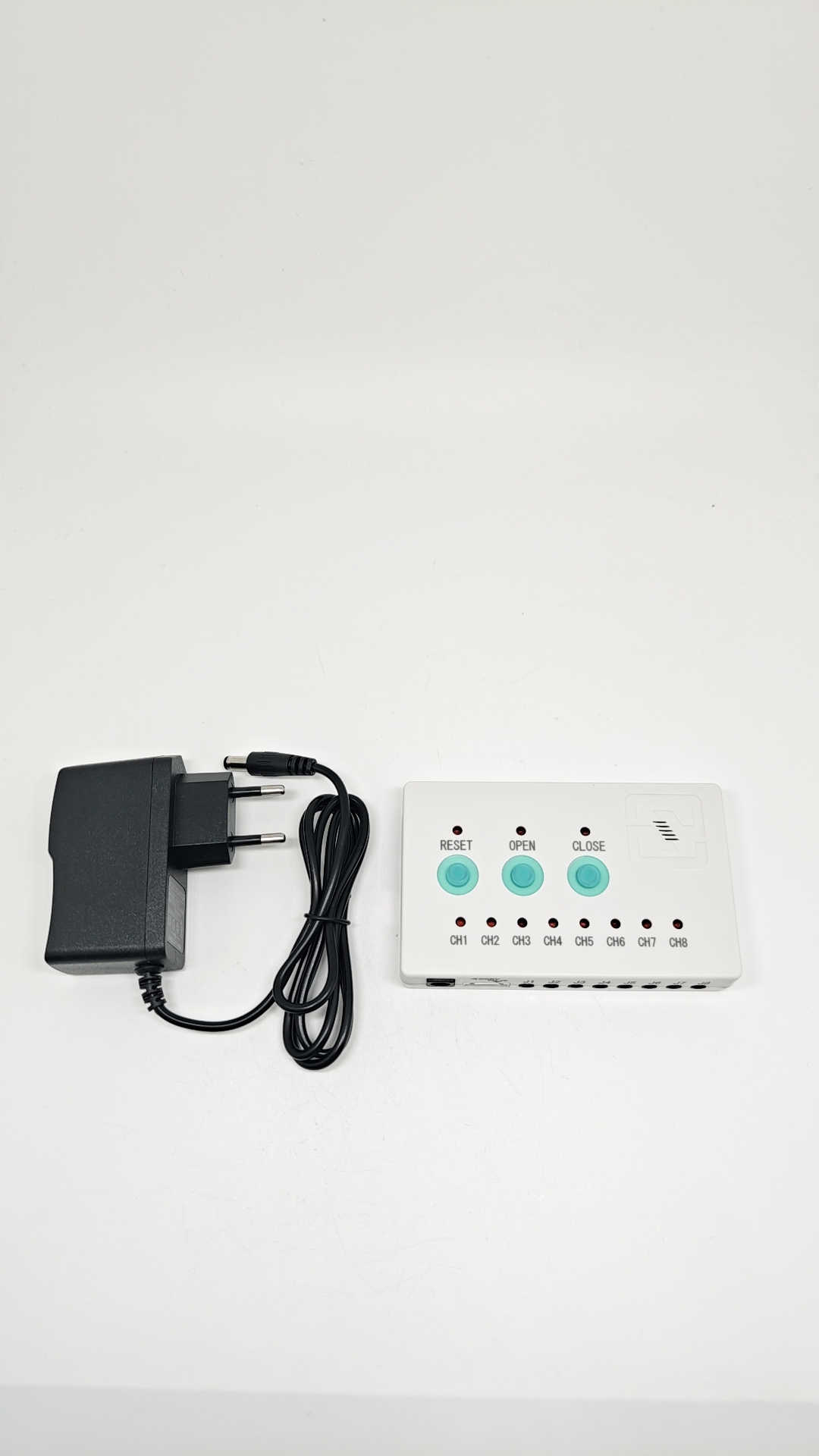
Wired WLD leak sensor (DC12V/DC24V): conductive sensing, a 1 m cable extendable to 50 m, NO/NC relay output and under-3-second response for server room and office subfloor monitoring.
Scenario 3 — Server room and office subfloor monitoring
Server rooms, electrical rooms and raised office floors invert the smart-home logic. Mains power is available, notification is expected to reach a BMS rather than a phone, and the cost of a leak is measured in downtime rather than in flooring.
The detection side of this scenario is served by the Wired WLD leak sensor: DC12V/DC24V power, conductive sensing, a standard 1 m sensor cable extendable to 50 m, NO/NC relay output, response under 3 seconds, IP44, and a documented application list covering data centres, electrical rooms, equipment floors and hotel or hospital floor monitoring. Two characteristics matter operationally. The 50 m maximum cable run allows one sensor to cover an entire server room floor, and the NO/NC dual relay output accepts either alarm input logic, which lets the same sensor drive a PLC or DDC loop without a signal inverter. Sensors are also cascadable, so multiple units can sit in parallel on one alarm loop and cover several zones through a single controller.
On the valve side, bore and pressure rise. Representative options from the same supplier:
| Model | Size range | Torque | Protection | Notable constraint |
|---|---|---|---|---|
| CWX-15N | DN15–DN50 | 3 N·m | IP65 | AC220V / DC12V / DC24V; NC / NO / hold; ≤1.0 MPa |
| CWX-25S | DN25–DN80 | 10 N·m | IP67 | Large bore stainless steel; ≤1.6 MPa |
| CWX-60P (2-way) | DN15–DN100 | 20 N·m | IP67 | On/off or modulating 0-10V/4-20mA; ≤1.6 MPa |
| CTB | DN15–DN100 | 6 N·m | IP67 | Manual override lever; on/off and modulating optional |
| CTB wafer butterfly | DN50–DN300 | 20–200 N·m | IP67 | Plant-room scale; on/off and modulating 4-20mA |
In an office building the same logic applies at a smaller scale: relay output from a wired sensor into the building management alarm loop, and a normally-closed motorized ball valve on the floor's incoming line. Where maintenance staff need to operate the valve without power or without a controller, the CTB motorized ball valve carries a manual override lever, so the line can be opened or closed on site without dismantling the pipe.
Comparison with traditional approaches — and where motorized isolation stops
| Approach | Automatic isolation | Remote notification | Repeatability after long dormancy | Main limit |
|---|---|---|---|---|
| Manual ball valve plus visual inspection | No | No | Depends on the operator | Isolation happens only when a person is present |
| Leak sensor with alarm only | No | Yes, on supported platforms | Not applicable | Water keeps flowing while someone travels to the valve |
| Mechanical float or pressure-triggered shut-off | Yes, mechanical | No | Mechanical linkage can foul | No electrical signal, no integration, no remote status |
| Motorized ball valve with leak sensor | Yes, on command | Yes, via platform or relay | Motor drives the ball to a defined position | Needs power or battery maintenance, and correct bore, torque and IP selection |
The boundaries of the motorized approach are worth stating before a design is fixed:
- Ingress limits. The leak sensors referenced here are rated IP44 — protected against splashing water but not against continuous immersion. A subfloor that regularly holds standing water is not an IP44 environment, and the sensor position or enclosure has to change rather than the rating being assumed.
- Bore limits. The WLAV and the WiFi Smart Water Valve cover DN15–DN25. That reaches residential and light commercial service lines, not building mains, risers or plant-room headers, which move to the CWX-60P, CWX-25S or CTB ranges.
- Network dependence. Wireless architectures depend on a hub, gateway or router. If that path is offline, cloud notification may not occur even though locally wired shut-off logic continues to operate.
- Maintenance rhythm. Battery-powered designs carry a replacement schedule by definition. The wireless sensor states standby over one year on three AAA batteries; the WiFi valve offers four AA batteries with USB DC5V as a continuous alternative.
- Supply interruption. A normally-closed valve closes when power is lost. That is the desired protective behaviour during a leak event, but on a shared heating or process loop it is a trade-off that should be agreed in writing with the building operator.
- Dormancy. A valve that has not moved in a year is still expected to close on the first command, which is why exercising the valve periodically is normal practice in any isolation design.
Certification and specification constraints buyers should verify
Leak protection valves are electrical products installed near water, which makes certification a purchasing gate rather than a formality. For the EU market, motorized valves are expected to comply with CE marking under EN 60335-1 and with RoHS 2.0 under the IEC 62321 series. The documents that back those requirements in Tianfei High-Tech's range are listed below so they can be checked line by line.
| Document | Number | Issuing body | Scope / market |
|---|---|---|---|
| CE certificate (EN 60335-1:2012+A11:2014) | BCTC-FY161004871C | Shenzhen BCTC Technology Co., Ltd. | CWX-15Q/N (AC), CWX-25S, CWX-50P, CWX-60P, CTF-001, CTF002, CTF010, CTB005, CTB010, CTB016, CTB025, CTB050, CTB100, CTB200 — EU market |
| RoHS 2.0 compliance (IEC 62321 series) | CCTI-2021112302C | Shenzhen CCTI Technology Co., Ltd. | CWX-25S series mini motorized valve with manual function — EU market |
| RoHS 2.0 compliance (IEC 62321 series) | CCTI-2021112301C | Shenzhen CCTI Technology Co., Ltd. | CTF-001 series mini large-torque electric valve — EU market |
| IP65 code report (IEC 60529) | CCTI-2022050508S | CCTI TESTING | CWX-25S electric valve — global market |
| ISO 9001:2015 quality management | 04620Q15496R1S | Beijing Head International Certification Co., Ltd. | Development, design and production of electric valves |
| ISO 14001:2015 environmental management | 19522E39814R0S | Beijing Kun Biao Certification & Inspection Co., Ltd. | Design, assembly and sales of electric and pneumatic valves |
| ISO 45001:2018 occupational health and safety | 19522S39815R0S | Beijing Kun Biao Certification & Inspection Co., Ltd. | Design, assembly and sales of electric and pneumatic valves |
| Invention patent — flow control valve capable of closing instantly | ZL 2018 1 1623664.8 (certificate 3754970) | State Intellectual Property Office of China | Instant-closing flow control valve design |
Two details in this table are easy to misread. The CE certificate is issued against a defined model list, so a buyer specifying a model outside that list should not assume the same coverage. The IP65 report applies to the CWX-25S; other models in the range carry IP65 or IP67 ratings in their own specifications, but the certificate itself is model-specific. The company's legal manufacturing and sales qualification is held under Business License Unified Social Credit Code 91120116684732498U, issued by the Tianjin Binhai High-tech Industrial Development Zone Administration for Market Regulation.
Market direction: leak protection is becoming a constrained assembly
The demand side of this category is expanding. The global motorized ball valve market was valued at USD 8.7 billion in 2025 and is projected to reach USD 14.2 billion by 2034, according to Dataintelo, while the IoT valve market is projected to reach USD 2.85 billion by 2031, growing at a CAGR of 10.4% from 2023, according to The Insight Partners. Asia Pacific held a 38.5% revenue share of the motorized ball valve market in 2025 (Dataintelo), and China exported USD 22.6 billion in valves in 2024, maintaining a 20% global export share, according to OEC.
The procurement interpretation matters more than the headline growth. As leak protection moves from a discretionary smart home feature into a specification item for rental portfolios, offices and equipment rooms, buyers stop comparing sensors and start comparing assemblies. That shifts the decision toward the constraints this article has walked through: bore, IP rating, failure mode, response time, battery or mains power, and certification that can be produced on request.
It also explains why two-way open/close valves remain the volume segment. A leak protection line does not need proportional control; it needs a valve that will close and stay closed. Modulating and three-way designs enter the picture only when the same valve is expected to regulate or divert as part of a wider control strategy.
Supplier context
Tianjin Tianfei High-tech Co. was established on 16 March 2009 and is headquartered in Tianjin, where it operates a 30,000 m² production base with an annual output capacity of 1,000,000 units, a research and development team of 10 engineers, and main products including WiFi valves. Roughly 70% of output is exported, with main markets in Europe and the Americas, South America, Central America, Southeast Asia and East Asia.
For OEM programmes, the manufacturer states voltage and logo customisation, a monthly programme capacity of 8,000 units, a 30-day lead time, a minimum order quantity of 2 units, 100% testing, and remote after-sales support, with export markets in the EU and the Middle East.
One documented project illustrates the constraint profile of a larger deployment. A large European municipal water group in France placed a 10,000-unit order after inspecting the factory in October 2024 and approving the production and quality control system. The order was signed in November 2024 and delivered within three months, with installation guidance, commissioning training and remote technical support. According to the project record, the valves have operated for over 16 months with 4-20mA regulation, response time within 0.5 seconds, flow control error under ±2%, zero leakage and no major failures, a reported 40% reduction in maintenance cost, and annual electricity savings of more than 120,000 kWh. The manufacturer's product range and documentation are published at https://www.minimotorizedvalve.com/.
The relevance to home and office leak protection is not the order size but the pattern: a specification fixed by bore, control mode, protection rating and compliance documentation, then verified before shipment. That is the same sequence a smaller leak protection project follows, with fewer zeroes.
Future outlook
Three directions are visible from the current product set. First, detection and isolation are converging into single assemblies: the WLAV already combines conductive sensing, a buzzer and a motorized shut-off valve in one unit with relay output, which removes a coordination step from the installer's scope. Second, power architecture has become a design choice rather than a limitation — dual power on the WiFi Smart Water Valve and year-plus standby on the wireless sensor both exist so that battery-only and mains-assisted installations can use the same platform. Third, protocol coverage is broadening deliberately: Zigbee 3.0, Z-Wave and WiFi variants of the same sensor, alongside Tuya, SmartThings and Home Assistant support, respond to regional platform preferences rather than a single-vendor bet.
For buyers, the practical forecast is that the constraint list will keep growing while the hardware price keeps falling. Certification, failure mode and IP rating are the parts of a leak protection specification that get more expensive to fix after installation, which is why they are worth fixing before the order.
FAQ
Which motorized valve sizes cover a home or office main water line?
DN15 to DN25 covers residential and light commercial service lines. The WLAV linked alarm shut-off valve and the WiFi Smart Water Valve are both offered in DN15–DN25. Lines above that range, such as building risers or plant-room headers, move to models such as the CWX-25S at DN25–DN80, the CWX-60P 2-way at DN15–DN100, or the CTB wafer butterfly valve at DN50–DN300.
Does a motorized ball valve need power to hold its closed position?
No. A motorized ball valve holds position mechanically once the ball has rotated, so it does not require continuous current to remain open or closed; power is consumed during the quarter-turn movement. This differs from a solenoid valve, which is held in position by an energized coil. The behaviour that does depend on power is the failure mode: normally-closed designs, such as the WLAV auto-closing on power failure, close when supply is interrupted.
What certifications should an EU buyer verify on a leak protection valve?
Two are baseline for the EU market: CE marking under EN 60335-1 and RoHS 2.0 compliance under the IEC 62321 series. In Tianfei High-Tech's range, CE certificate BCTC-FY161004871C was issued by Shenzhen BCTC Technology Co., Ltd. against a defined model list, and RoHS 2.0 certificates CCTI-2021112301C and CCTI-2021112302C were issued by Shenzhen CCTI Technology Co., Ltd. for the CTF-001 series and the CWX-25S series respectively. Buyers should check that their specific model appears on the certificate, not only that a certificate exists.
How fast does a leak protection system detect and isolate a leak?
The wired sensor path states a response time under 3 seconds, with NO/NC relay output to the control system. The WLAV linked alarm shut-off valve is described as completing detection, buzzer alarm and motorized shut-off within the same under-3-second window on a DC12V supply. Wireless architectures add a platform step: the sensor reports to a gateway and the platform issues the close command, so end-to-end time depends on the hub, network and scene configuration rather than on the valve alone.
Can wireless leak sensors be used in a server room subfloor?
Wireless sensors are rated IP44 and are designed for splash exposure, so they are not the first choice for a subfloor that can hold standing water. The wired sensor option is better matched to that environment: the Wired WLD runs on DC12V or DC24V, accepts a sensor cable of a standard 1 m extendable to 50 m, outputs an NO/NC relay signal, responds in under 3 seconds and is IP44-rated, with a stated application list covering data centres, electrical rooms and equipment floors. The 50 m cable run allows one sensor to cover a full server room floor, and multiple sensors can be cascaded on the same alarm loop.
What IP rating is required for a valve installed in a wet or subfloor location?
The requirement follows the environment, not the product family. For a cabinet, bathroom or kitchen installation where the valve only sees splashes, IP54 on the WiFi Smart Water Valve and IP65 on models such as the CWX-15N or CWX-20P are sufficient. For subfloor, pit or equipment-room locations where water may pool or splash continuously, IP67 models such as the CWX-25S, CWX-60P 2-way, CWX-60P 3-way and CTB are the appropriate choice; the CWX-25S holds an IP65 code report, CCTI-2022050508S, issued by CCTI TESTING to IEC 60529.
Product specifications in this article refer to published data for Tianjin Tianfei High-tech Co. valve and leak detection products. Market figures are attributed to Dataintelo, The Insight Partners and OEC as cited.