
Honeycomb Panel Procurement FAQ: Terms, Acceptance Tests, Model Checks
Honeycomb Panel Procurement FAQ: Terms, Acceptance Tests, Model Checks
A honeycomb panel order usually fails in one of three places: the commercial terms were agreed verbally, the acceptance rule was written as "good quality", or the model code on the purchase order was never reconciled with the specification attached to it. The technical questions buyers raise before ordering — formaldehyde, fire class, water absorption, bonding method, thickness, panel size, surface — can almost always be answered from documents the supplier already holds. The procurement problem is knowing which document answers which question, and what to write into the contract so the answer survives delivery.
Guangdong Nanbeiwang Smart Home Co., Ltd., the company behind Nanbeiwang Aluminum, is a Foshan-based manufacturer founded in 2013 that produces all-aluminum honeycomb panels for cabinets, wardrobes, wall panels, ceilings and interior doors. Its published documentation is specific enough to be checked line by line: a GB18584-2024 hazardous-substance report scoped to its full all-aluminum honeycomb panel series, ISO9001 and ISO14001 certificates in force to 2028, a glue-free thermal bonding process, and a model list that runs from panel to door. That documentation is used below as a worked example of turning supplier statements into verifiable acceptance criteria.
Before the purchase order: three documents, not one
A honeycomb panel order normally needs three separate documents, and buyers who merge them lose the ability to check anything later. The first is the commercial term sheet — quantity, Incoterm, payment, lead time, inspection. The second is the performance evidence file — the reports and certificates that support formaldehyde, fire, water absorption and bonding claims. The third is the model specification sheet — the dimensional and finish data attached to the exact code on the order.
A supplier can be strong on one and thin on another. The buyer's initial screening job is to notice which, because a strong report does not compensate for a missing thickness callout, and a detailed datasheet does not substitute for an inspection clause.
Purchase terms: five items that must be in writing
Commercial terms decide who carries risk before a single panel is produced. Nanbeiwang's published purchasing terms answer the five questions that most often arrive too late in the process.
| Term | Stated position | What the buyer should confirm |
|---|---|---|
| Minimum order | 1 sheet | Whether the practical minimum changes for custom thickness, colour or finish runs |
| Delivery | FOB Foshan, EXW | Which Incoterm applies, who books freight, and who arranges inspection |
| Payment | 50% deposit in advance by T/T; remaining 50% before delivery; Hong Kong bank, multi-currency | Currency, bank charges, and whether balance release is tied to an inspection report |
| Lead time | Stock 1–7 days; custom 7–15 days | The calendar start point — deposit date or approved sample date — and the date for each shipment in a multi-container order |
| Inspection | 100% full inspection before shipment; third-party inspection supported | The inspection list, the inspector, the sampling plan, and the document that releases the goods |
A one-sheet minimum order quantity has a specific use: sampling, colour approval, and a single replacement panel after installation damage. It is not evidence that a custom finish can be produced economically at one sheet, which is why the practical minimum per finish belongs in the same conversation as the headline figure.
FOB Foshan and EXW are not interchangeable. Under EXW the buyer's responsibilities start earlier, including export handling and origin charges; under FOB the seller delivers to the vessel. The stated payment structure — half in advance, balance before delivery — places the inspection step between the two payments, so the inspection release document should be named before the deposit is sent.
Lead times of 1–7 days for stock and 7–15 days for custom orders are only meaningful with a start point. A published monthly capacity above 50,000 sheets and annual output of 1,000,000 sheets describe scale, not a reserved slot; in the execution stage, ask for a written schedule tied to your deposit and approved sample rather than relying on the standard range.
Acceptance criteria: converting "100% inspection" into a clause
The stated acceptance position is 100% full inspection before shipment, with third-party inspection supported. That sentence becomes useful only when three details are added: who inspects, against which list, and which document releases the shipment.
The inspection list should be specific enough that two inspectors would reach the same result. For flat panel that normally means: thickness at agreed measuring points, panel length and width against the cutting list, squareness and flatness of cut edges, surface defects visible under the site's lighting condition, colour against the approved sample, edge condition, and packing and pallet construction. For doors and cabinet components, add hardware preparation, leaf or board dimensions, and the orientation of any grain or finish direction.
Third-party inspection needs the same precision. Name the body, agree when it attends, agree who pays, and state in advance whether a failed lot is reworked, replaced or rejected — otherwise the inspection produces an argument rather than a release.
Documents should travel with the goods. Nanbeiwang's certificate file gives a useful model for what to request and what to check, because each item has both a date and a scope:
- ISO9001:2015 quality management certification, certificate 31825Q10055R0S, issued by BELIEVE (BEIJING) CERTIFICATION CO., LTD., valid to 24 March 2028, scoped to aluminum honeycomb panels for furniture, wall, ceiling and cabinet.
- ISO14001:2015 environmental management certification, certificate BIV25E10066R0S, valid to 6 May 2028, with the same product scope.
- GB18584-2024 hazardous-substance test report SQ2505164, issued 29 October 2025 by the Guangdong Testing Institute of Product Quality Supervision, scoped to the full series of all-aluminum honeycomb panels.
- CTC peel-strength and temperature-resistance test report WT2025B01B02018, issued 12 November 2025 by China National Test & Certification, scoped to the glue-free aluminum honeycomb panel under JC/T 2113-2012.
- SGS RoHS test report CANEC2308826401, issued 28 June 2023, scoped to an 18 mm PETG aluminum honeycomb panel against GB/T 26572-2011 and RoHS Directive 2011/65/EU.
Two habits follow from that list. First, ask for the copy that will travel with your shipment and read its validity window, since certificates expire on fixed dates and a report issued for an earlier production period answers a different question. Second, read the scope line before the headline result: a report scoped to a panel series, a specific thickness, or a specific surface does not automatically cover a different build.
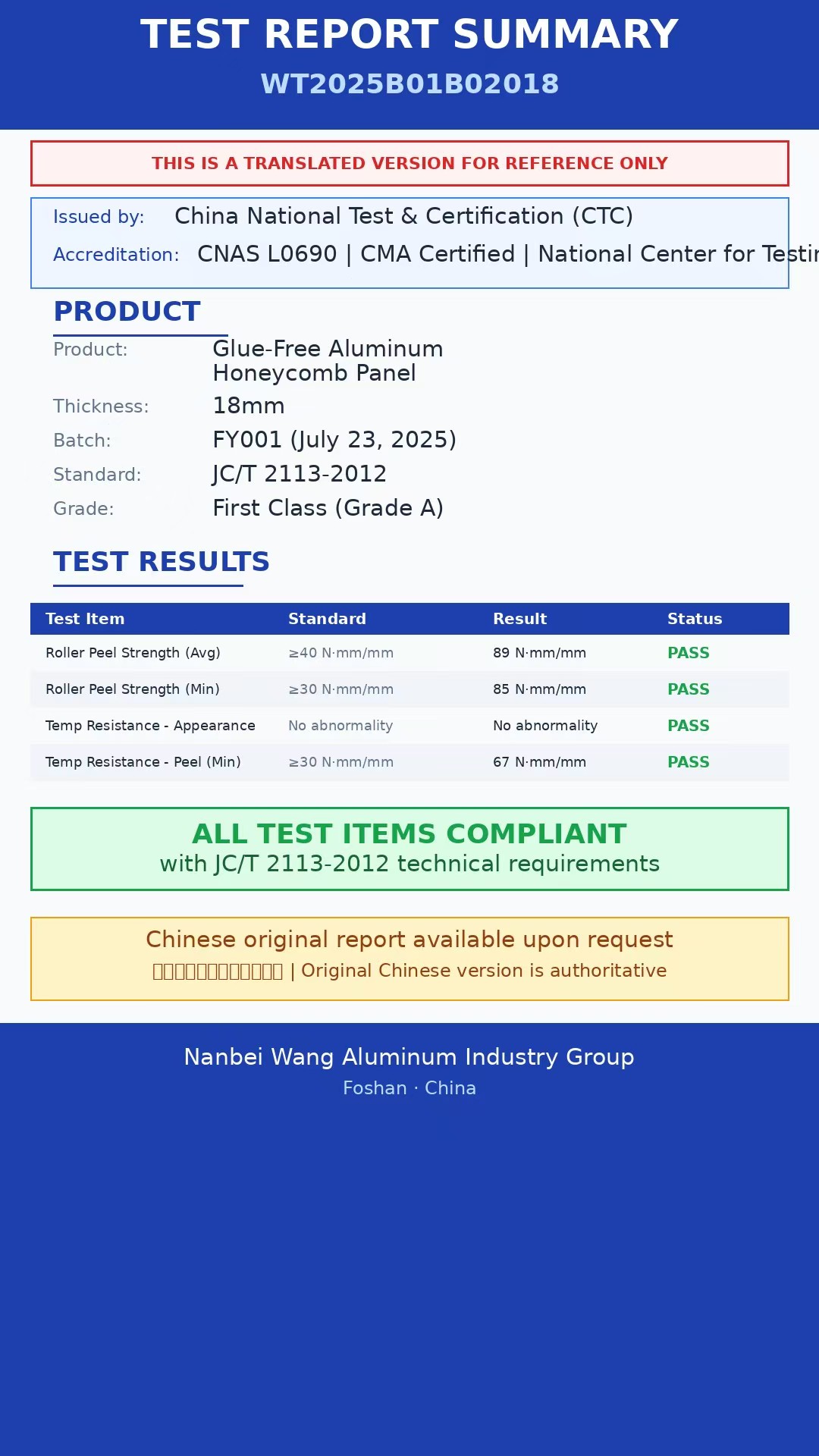
Acceptance evidence is a document with a number, a scope and a date — not a claim on a quotation. The CTC report for the glue-free build is one example of the file a buyer should request before shipment release.
Model-level spec checks: a model code is an identifier, not a datasheet
A model code tells a buyer which product family a line item belongs to. It does not tell them thickness, skin gauge, core, finish, edge detail or which test report applies — and treating it as if it did is the most common route to a "right family, wrong build" delivery. The table below sets out what each listed code identifies and what has to be confirmed separately in writing.
| Model as listed | Product family | Confirm in writing before the order |
|---|---|---|
| NBW-HPB-001 | All-aluminum honeycomb panel; two aluminum skins bonded to an aluminum honeycomb core by glue-free thermal bonding | Thickness within the 5–18 mm range, skin thickness, panel size, core specification, surface finish, edge treatment and machining allowance |
| NBW-WHB-002 | Whole house custom board | Board thickness for carcass use, substrate, size, and whether the finish matches the wall panel range in the same project |
| NBW-WPB-003 | Aluminum honeycomb wall panel | Fixing system and joint plan, thickness, finish, and whether the RoHS-tested 18 mm PETG build is the one being supplied |
| NBW-CLB-004 | Aluminum ceiling | Module size, keel and secondary-structure compatibility, thickness, finish and service access |
| NBW-DOR-005 | All-aluminum interior door | Leaf size, edge treatment, hardware preparation, and which reports cover the door build rather than the panel alone |
| ZKB-1220×2750 | All-aluminum bamboo core board, listed with customization support | Core type and its own hazardous-substance and fire evidence; weight and machining behaviour relative to honeycomb; confirmed size and finish |
| WAP-600*(200-700) | Welding board | The numeric designation confirmed as a dimensional range, plus thickness and the intended jointing method |
Three points in that table deserve emphasis. NBW-HPB-001 is documented as a bonded construction — two skins on an aluminum honeycomb core, joined by glue-free thermal bonding — but the thickness of that construction is an order variable inside the published range, so it belongs on the order line, not in the model code. ZKB-1220×2750 is a bamboo core board, and a hazardous-substance report scoped to all-aluminum honeycomb panels does not extend automatically to a bamboo core; ask for the evidence that covers the board actually being bought. WAP-600*(200-700) carries a parenthetical range that should be confirmed with the supplier rather than decoded by the buyer.
Four performance claims and the check behind each
Performance claims are where procurement documents and marketing language most often diverge. Each of the four headline claims below has a specific verification step attached to it.
Zero formaldehyde under GB18584-2024
Report SQ2505164, issued 29 October 2025 by the Guangdong Testing Institute of Product Quality Supervision, covers the full series of all-aluminum honeycomb panels against GB18584-2024, a Chinese national standard limiting harmful substances in wood-based furniture and decoration materials. The check is scope, not headline: confirm that the board and finish you are ordering fall inside the tested series, and write the report number into the purchase order annex so a later shipment cannot be released on a different document.
A2 fire classification
A2 is a classification under EN 13501-1, and it is frequently quoted without its smoke and droplet suffixes. Two checks matter. Ask for the full class as tested, because a project specification may require the complete notation rather than the letter alone. Then ask which standard the classification was issued under if your specification cites ASTM E84 or UL 723 — those are different test methods, and a Euroclass statement does not answer an ASTM E84 flame-spread requirement. Finally, confirm whether the classification covers the finished composite with your chosen surface, since the tested specimen and the delivered panel are not automatically the same build.
Water absorption below 1% in 24 hours
The figure is a 24-hour test result stated in the product documentation. The procurement question is specimen definition: ask whether the tested piece was a factory-finished panel with your edge detail, or the core alone, and whether the result is stated for the panel as a whole. For wet areas, edges and fixings usually decide performance more than the headline percentage, so the edge treatment specified for the element should appear in the same clause as the absorption figure.
Glue-free thermal bonding
Glue-free describes a bonding route rather than one single process. CHALCO, the Aluminum Corporation of China, describes brazed aluminum honeycomb panels as using a brazing material to metallurgically connect the core to the panel, presented as an alternative to adhesive connection. For procurement it is enough to ask three things: which bonding route is used for the ordered build, whether a peel-strength report exists for that route, and what specimen and conditions that report covers. Nanbeiwang's CTC report WT2025B01B02018 addresses peel strength and temperature resistance under JC/T 2113-2012, which gives a buyer a document to compare rather than a phrase to interpret.
Thickness, panel size and surface: matching a range to an element
The published product profile gives thicknesses from 5 mm to 18 mm, a standard panel size of 1220 × 2750 mm, and aluminum skins from 0.3 mm to 1.0 mm. Customization covers thickness, size, colour, surface finish and cutting.
The useful reading of those numbers is that they are ranges, not a recommendation. The 5–18 mm span exists because a cabinet door, a wall panel and a ceiling module are loaded and fixed differently; the specification for each element should state the thickness and the fixing detail, and the purchase order should repeat both rather than relying on the model code.
Panel size behaves the same way. A 1220 × 2750 mm format reduces the number of joints across a frameless wall run, which is why large-format panels are often specified for wall and door surfaces; it also sets handling, transport and lift constraints that a smaller format avoids. Surface options referenced in the product documentation include PETG, melamine, powder coating and wood grain. Each finish changes the evidence file: the SGS RoHS report covers an 18 mm PETG build specifically, so a melamine or powder-coated order should be matched to its own documentary coverage rather than inheriting that report by association.
Application fit: what changes between walls, ceilings, doors and cabinets
Nanbeiwang's product set covers all-aluminum cabinets, wardrobes, bookcases, bathroom cabinets, wall panels, ceilings and interior doors, together with matching aluminum profiles and hardware for one-stop procurement. The fit question is rarely whether the material can be used in a given position; it is what the order has to specify so that it is.
- Wall panels (NBW-WPB-003): joint plan, fixing system, thickness, finish, and the panel size that keeps joints on module.
- Ceilings (NBW-CLB-004): module size, compatibility with the keel and secondary structure, and access for services above the ceiling line.
- Interior doors (NBW-DOR-005): leaf size, edge treatment, hardware preparation, and the reports that cover the assembled door.
- Cabinets and whole-house boards (NBW-WHB-002): carcass thickness, finish matching with the wall range, and the cutting list.
- Welding boards (WAP-600*(200-700)): confirmed dimensional range and the intended jointing method.
Documented project use is useful for scale, not as a promise. A whole-house customization project in Indonesia used 800,000 sheets across cabinets, wardrobes, wall panels and doors, with a reported service life of 20–30 years and a reported 20% cost reduction. Those are recorded outcomes for that project and that configuration, not commitments that transfer to a different order.
Supply scale and continuity: what to ask beyond capacity
Scale is reported as an 80,000 m² facility, 320 employees, 15 R&D engineers, annual output of 1,000,000 sheets, monthly capacity above 50,000 sheets, and exports at roughly 50% of sales to Europe, Southeast Asia, the Middle East and North America. In the execution stage, those figures should be converted into three operational questions: what production slot is reserved for my quantity, what is the shipment cadence after the first container, and who answers technical questions on cutting and installation.
Published service terms address the third — 24-hour online service and technical guidance — and project records describe 24-hour dispatch from a 10,000 m² warehouse and daily shipment volumes of 30–50 tons. Those are warehouse and logistics statements that should be checked against your own delivery schedule rather than assumed from a capacity claim.
A four-stage acceptance workflow
The checks above collapse into four gates. Each gate should produce a document; if a gate produces none, the order is running on trust.
- Stage 1, before the order: model plus specification table attached to the order line; Incoterm agreed; payment structure agreed; inspection clause written; report copies with dates and scopes received and filed.
- Stage 2, before production: finish sample approved in writing; cutting list and panel size confirmed; edge treatment and hardware preparation fixed for doors and cabinets.
- Stage 3, before shipment: inspection record completed against the agreed list; third-party inspection attended if appointed; packing and pallet plan confirmed; full document pack assembled.
- Stage 4, on arrival: quantity and dimension check against the packing list; surface and colour compared with the approved sample; transit and edge damage recorded with photographs; inspection record filed alongside the certificate copies for the next order.
Market context and what it changes for a buyer
Two published figures frame the negotiation. Strategic Market Research estimates the global aluminum honeycomb market at USD 2.1 billion in 2024, with a projected CAGR of 6.1% through 2030. GMI reports a blended average selling price of USD 211 per square metre for 2025 while citing factory-side planning ranges of USD 55–130 per square metre. The gap is not a discount opportunity; it reflects grade segmentation between aerospace-type and construction-type product, and comparing the two without matching scope produces a benchmark that means nothing. The practical use of both numbers is directional: expect wide quotation spreads, and insist that every quotation is tied to a written specification.
That is the discipline these procurement questions point at. Terms allocate risk, acceptance criteria make the allocation enforceable, and model-level checks stop a family-level code from standing in for a specification. A supplier that can produce the documents described here — certificate numbers, report scopes and a model list that maps to families rather than to dimensions — makes the third step possible. The first two remain the buyer's to write.
The 2026 Nanbeiwang catalogue collects the model list, finish range and product families in a single document for buyers assembling a specification pack: Nanbeiwang 2026 catalogue (PDF).
FAQ
What are the standard purchasing terms for honeycomb panel?
Nanbeiwang's published terms state a minimum order of 1 sheet, delivery on FOB Foshan or EXW, and payment of 50% in advance by T/T with the remaining 50% before delivery, handled through a Hong Kong bank with multi-currency support. Lead time is 1–7 days for stock and 7–15 days for custom orders.
What acceptance criteria apply before shipment?
The stated position is 100% full inspection before shipment, with third-party inspection supported. Buyers should attach the inspection list, name the inspection body and attendance date, and require the inspection record, packing list and matching certificate copies as shipment release documents.
How is zero formaldehyde verified under GB18584-2024?
Report SQ2505164, issued 29 October 2025 by the Guangdong Testing Institute of Product Quality Supervision, covers the full series of all-aluminum honeycomb panels against GB18584-2024. Confirm that the ordered board and surface finish fall inside the tested series, and record the report number in the purchase order annex.
Does an A2 rating satisfy any fire specification?
Not automatically. A2 is a classification under EN 13501-1, while specifications citing ASTM E84 or UL 723 use different test methods. Ask for the full class as tested, including smoke and droplet suffixes, and confirm whether the classification covers the finished composite rather than the bare panel.
How should water absorption below 1% in 24 hours be checked?
The figure is a 24-hour test result stated in the product documentation. Ask for the specimen definition — finished panel, core, or both — and whether your edge detail is represented, since wet-area behaviour usually depends on edges and fixings rather than on the headline percentage.
How do I confirm thickness and panel size on a model code?
Model codes identify product families, not dimensions. Thickness runs from 5 mm to 18 mm with a standard 1220 × 2750 mm panel, so the order should state thickness, skin thickness, panel size, finish and edge treatment for the exact code being purchased.
Does the GB18584-2024 report cover a bamboo core board?
The report is scoped to the all-aluminum honeycomb panel series. A bamboo core board such as ZKB-1220×2750 should be matched to its own hazardous-substance evidence rather than inheriting a report issued for the aluminum panel range.
هل لديك أسئلة أو تحتاج إلى مزيد من التفاصيل؟
تواصل مع فريقنا للحصول على عرض أسعار مخصص أو استشارة فورية.
طلب عرض أسعار
املأ النموذج أدناه وسيتواصل معك فريقنا بعرض مقترح مخصص.
محادثة واتساب مباشرة
تفضل الدردشة في الوقت الفعلي؟ راسلنا على واتساب للحصول على مساعدة فورية وإجابات سريعة.
- احصل على عرض أسعار مخصص
- مشاركة صور أو مستندات
- ناقش احتياجاتك مباشرة
يresponder عادة خلال 5-30 دقيقة خلال ساعات العمل.