
Hospital vs. School: Homogeneous Vinyl Fit Analysis
Homogeneous vinyl flooring is one product category, but it is not one specification. Hospitals and schools both install it, both rely on it for hygiene and durability, and both increasingly reference the same international standards in their tender documents. The difference lies in weighting: the attributes that decide a hospital award are rarely the attributes that decide a school award.
That distinction becomes concrete at the decision stage. Once a flooring schedule has been narrowed to homogeneous vinyl, the remaining question is not which category to use, but which verified performance profile fits the building in front of you. A hospital's risk profile is shaped by infection control, chemical exposure from disinfectants and antiseptics, rolling loads from beds and mobile equipment, and — in imaging or theatre areas — controlled electrical behaviour. A school's or office's risk profile is shaped by abrasion under continuous footfall, indoor air quality, cleaning cost across a service cycle, and design flexibility.
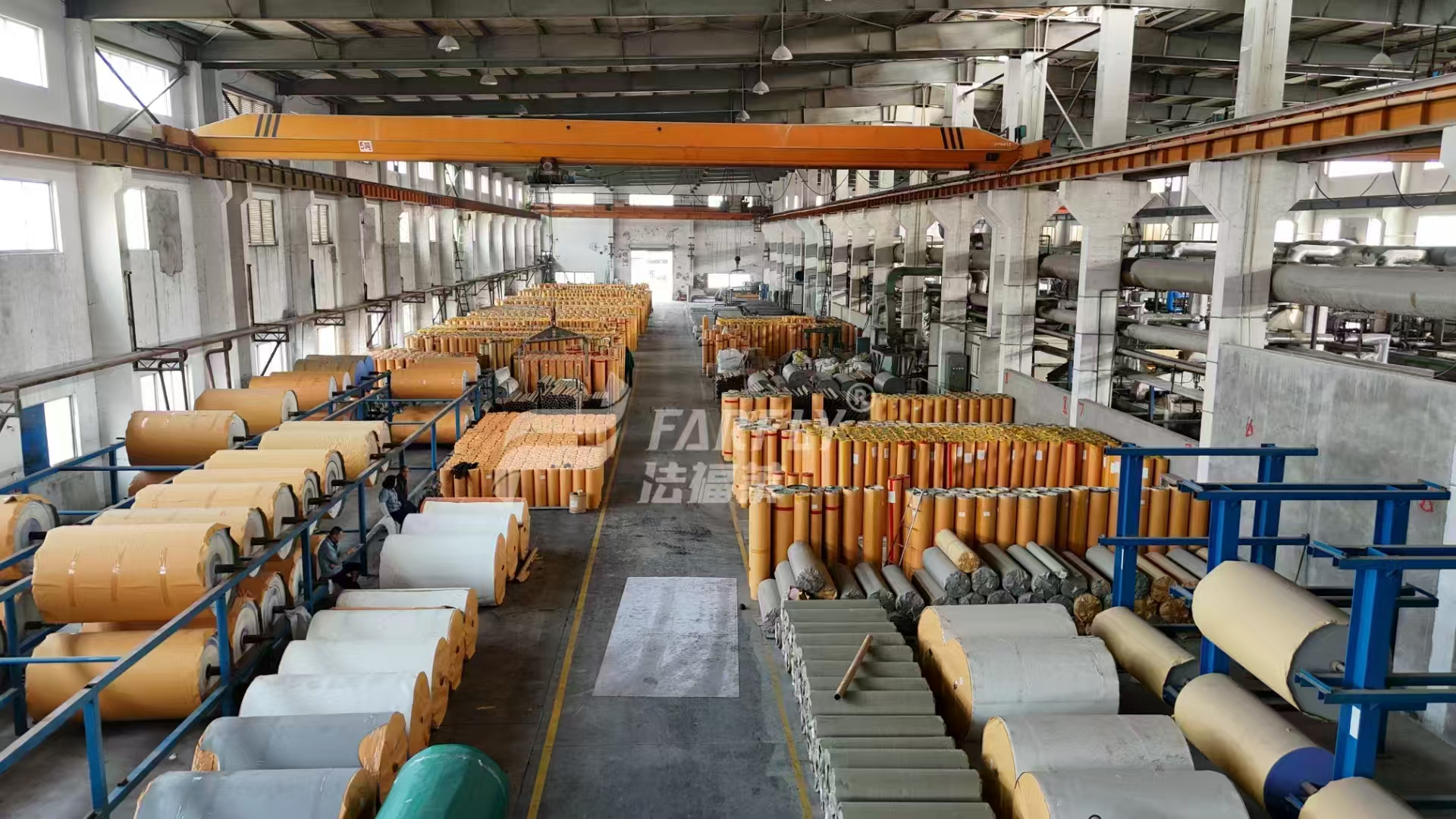 Homogeneous vinyl supplied for both healthcare and education projects is drawn from the same production platform but specified against different performance priorities.
The short answer: Certification is universal; priority is not.
A hospital specification weights iodine resistance, ESD or dissipative electrical behaviour, antibacterial surface performance and seamless welding most heavily.
A school or office specification weights EN 660-2 Group T wear resistance, low-emission verification under ISO 16000-9, cleaning economics and design flexibility most heavily.
Both should be built on the same baseline of REACH compliance and B1 fire performance.
This analysis compares the two profiles side by side. It does not argue that one product family is superior. It sets out which verified attributes deserve the heaviest weighting in each scenario, and where a specification that is correct for one building type becomes unnecessary cost in another.
The Shared Certification Baseline
Before scenario-specific requirements are applied, a common baseline applies to both building types. These are the attributes that should be present in any serious tender response, whether the project is a ward block or a classroom wing.
Wear resistance — EN 660-2 Group T
Homogeneous vinyl wear resistance is classified under EN 660-2, the Frick-Taber test. Group T is the highest classification in this scheme, defined as a volume loss of no more than 2.0 mm³. In practice this is the reference point buyers use when comparing T-group wear resistant homogeneous flooring against lower classifications. For a school corridor with thousands of daily passes, Group T is a primary selection criterion. For a hospital, it is a baseline that clears the way for discussion of other attributes.
Fire performance — B1 rating
Fire behaviour is a non-negotiable item in both sectors, but for different reasons. Hospitals must consider evacuation of non-ambulatory patients and the fire load of adjacent medical equipment. Schools must consider high-occupancy circulation spaces and stairwells. A B1 fire rating is a common reference point in both cases and should be confirmed in the submitted test documentation rather than assumed from a product family name.
Chemical compliance — REACH
REACH-compliant healthcare vinyl flooring and REACH-compliant commercial flooring are, in substance, the same requirement: the material must not contain restricted substances above the applicable thresholds. For a hospital procurement team this is a supplier-qualification gate. For a school authority it is often a procurement policy requirement triggered by public tendering rules.
Emission behaviour — ISO 16000-9
ISO 16000-9 addresses the measurement of volatile organic compound emissions from building products. It matters more in enclosed, mechanically ventilated spaces than in naturally ventilated ones. This is why low VOC cleanroom flooring requirements and school indoor-air-quality requirements converge on the same test methodology even though the underlying concern — process contamination versus pupil exposure — is different.
Surface hygiene — ISO 22196
ISO 22196 is the standard method for evaluating antibacterial activity on plastic surfaces. Antibacterial healthcare vinyl flooring is typically assessed against this method. Farfly states that antibacterial efficacy in its flooring systems can reach 99.5%. The relevant point for a specification writer is that the test method should be cited explicitly, because “antibacterial” without a method reference is not verifiable.
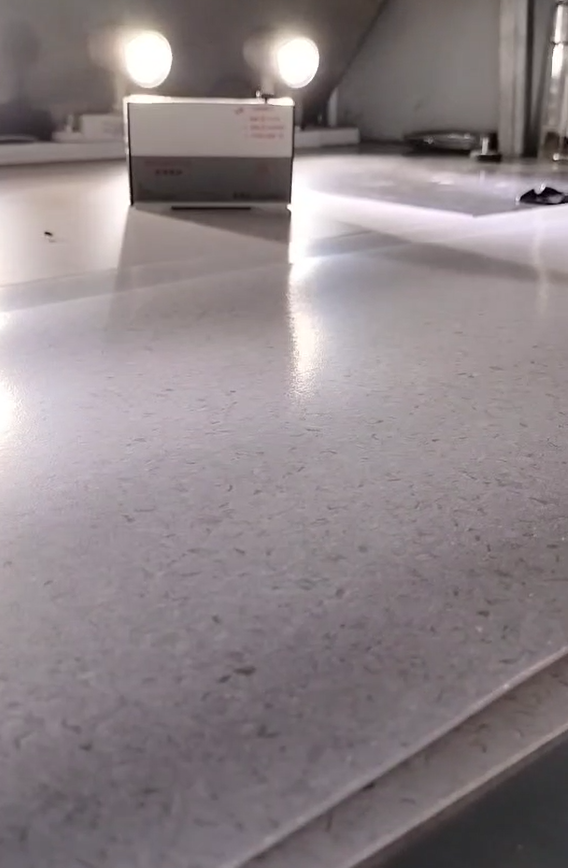 Batch-level inspection is where declared performance values are either confirmed or lost. Test method references matter more than product-family labels.
What Hospital Projects Prioritise
Hospital flooring decisions are driven by four risk categories: infection transmission, chemical exposure, mechanical load, and electrical safety. Each maps to a different verified attribute.
Iodine resistance and wax-free maintenance
Iodine-based antiseptics are used continuously in wards, theatres and preparation rooms. Over time they produce persistent staining on surfaces that are not formulated to resist them. Iodine-resistant homogeneous vinyl flooring addresses this directly. Farfly's approach uses a proprietary TF Surface Treatment, which the company states delivers strict iodine resistance together with lifelong wax-free maintenance. For a hospital, wax-free hospital vinyl flooring is not primarily a labour-saving feature; it is an infection-control feature, because a floor that never needs a sacrificial wax layer is a floor that never traps residue beneath one.
Electrical behaviour in ESD and dissipative areas
Operating theatres, cardiac catheterisation labs, MRI rooms and certain imaging suites require controlled electrical resistance rather than simple insulation. Two classification bands are commonly referenced. Static dissipative (SD) vinyl floors require resistance to earth of no more than 1 × 10⁹ ohms, while electrostatic conductive (EC) floors require no more than 1 × 10⁶ ohms, as set out in EN 14041. ESD flooring in healthcare facilities is also commonly specified against IEC 61340-6-1, with resistance testing performed according to EN 1081. Farfly's ESD series is stated to maintain a stable 104–106 ohm resistance range.
MRI room dissipative vinyl flooring and medical grade anti-static flooring should not be treated as interchangeable. The required resistance band, the grounding path and the installation detailing differ, and the specification should state the target band explicitly rather than describing the floor as “anti-static.”
Antibacterial performance and seamless installation
Surface hygiene in hospitals depends as much on geometry as on chemistry. A seamless welding hospital vinyl roll eliminates the joints where soil and moisture accumulate, which is why welded installation is standard practice in theatres, cleanrooms and intensive care. The chemistry works alongside that geometry: an antibacterial surface tested under ISO 22196 reduces the viable bacterial load on the surface itself.
Rolling load and indentation resistance
Hospital beds, imaging equipment, instrument trolleys and laundry carts concentrate load through small wheel diameters. Heavy rolling load hospital flooring must resist permanent indentation, because a permanently indented floor becomes a cleaning problem as well as a trip hazard. High density homogeneous vinyl roll constructions are specified for this reason: the wear layer and the backing are the same material through the full thickness, so there is no delamination interface to fail under repeated point loading.
Slip resistance in wet zones
Slip resistance is usually expressed through the R classification of DIN 51130, which is determined by testing a person walking on an inclined, lubricated surface. The correct R value depends on the zone: a dry ward corridor and a wet utility room do not carry the same requirement. Over-specifying slip resistance across an entire hospital increases cleaning difficulty without reducing the actual risk in dry areas.
What School and Office Projects Prioritise
Education and office environments carry lower infection-control risk but higher cumulative footfall. The priority order shifts accordingly.
Abrasion and appearance retention
A school corridor may see several thousand passes per day across a ten-year cycle. Under that regime, wear classification is the single most important technical attribute, and T-group wear resistant homogeneous flooring is the appropriate reference. Appearance retention also depends on pattern construction: non-directional homogeneous vinyl flooring hides scuffing and directional wear better than a directional pattern, while directional homogeneous vinyl flooring can be used deliberately to guide circulation in long corridors.
Indoor air quality
Classrooms, and mechanically ventilated office floors, concentrate emissions in occupied spaces. Low-emission verification under ISO 16000-9 is therefore a meaningful specification item rather than a formality, and it is one of the few attributes where the school requirement is stricter in emphasis than the equivalent general hospital requirement.
Cleaning economics
School and office facilities managers evaluate flooring on cost per square metre per year, not on purchase price. A material that requires stripping and rewaxing consumes labour budget every cycle. Wax-free surfaces remove that line item entirely. This is why the maintenance profile of homogeneous vinyl is often the deciding factor in education tenders, even where the initial material cost is higher than alternatives.
Slip resistance at entrances and canteens
Entrance halls, canteens, changing areas and science laboratories are the wet-risk zones in a school. DIN 51130 R classification applies here in exactly the same way it applies in a hospital utility room. The rest of the building generally does not need the same rating.
Fire performance and design flexibility
Stairwells and corridors are the critical fire-performance zones in a school. Design flexibility is the other differentiating requirement: schools specify colour and pattern zoning across year groups and departments, which places a premium on a stable supply of consistent shades across multiple production batches.
Scenario Fit Matrix
The table below summarises which verified attribute carries the heaviest weight in each room type, and which attributes can typically be de-prioritised. It is a weighting guide, not a substitute for project-specific specification.
| Scenario | Primary risk | Highest-weight attribute | Can usually be de-prioritised |
|---|---|---|---|
| Operating theatre | Infection transmission, chemical exposure | Iodine resistance with TF surface treatment; seamless welding; ISO 22196 antibacterial testing | Decorative pattern variation |
| MRI and imaging suite | Electrostatic discharge | Defined dissipative or conductive resistance band per EN 14041 / IEC 61340-6-1 | High-slip R classification in dry zones |
| General ward and corridor | Rolling load, cleaning cost, staining | High density homogeneous vinyl roll; wax-free maintenance; iodine resistance | Conductive electrical properties |
| Hospital laboratory | Chemical spillage | Chemical resistant lab vinyl flooring with welded seams | Antibacterial surface chemistry |
| Cleanroom and pharmacy | Particle and VOC contamination | Low VOC cleanroom vinyl flooring; ISO 16000-9 emission data; seamless welding | Slip resistance above standard level |
| Classroom | Cumulative footfall, indoor air quality | EN 660-2 Group T wear resistance; ISO 16000-9 low-emission verification | ESD resistance band; iodine resistance |
| School corridor and stairwell | Abrasion, fire, trip risk | Group T wear resistance; B1 fire rating; DIN 51130 R classification appropriate to zone | Antibacterial surface chemistry |
| Sports hall and gym | Impact absorption, slip | Slip resistance under DIN 51130; resilient construction | Conductive properties |
| Office floor plate | Appearance retention, cleaning cost | Non-directional homogeneous vinyl for wear hiding; wax-free maintenance | ESD and iodine resistance |
Market Signals Behind Scenario-Based Specification
The shift toward scenario-specific specification is visible in the market data. The global homogeneous flooring market was valued at USD 17.58 billion in 2025 and is projected to reach USD 28.99 billion by 2035, according to Grand View Research. Separately, the global conductive vinyl flooring market reached USD 9.6 billion in 2025, driven by demand from healthcare and electronics sectors, according to Data Insights Reports.
Market sizing in this category should be read with care. Published vinyl flooring estimates vary widely depending on whether luxury vinyl tile and residential segments are included; divergence between the Grand View Research, Fortune Business Insights and Spherical Insights figures is significant for exactly that reason. The directional signal is more reliable than any single number: conductive and healthcare-grade segments are expanding faster than the category as a whole.
Supplier behaviour reflects the same trend. Armstrong Flooring reported a 23.7% expansion in its healthcare-grade vinyl product range globally in 2023 to meet medical hygiene demands. The major global manufacturers active in this category include Tarkett (France), Gerflor (France), Forbo (Switzerland) and Armstrong Flooring (US), alongside a large tier of specialist producers serving regional healthcare and education programmes. Farfly — formally WUXI TEFA DECORATION MATERIAL CO., LTD., a China-based manufacturer of high-specification resilient flooring founded in 2012 — sits in that specialist tier, supplying homogeneous flooring alongside PVC sports flooring and aircraft flooring, with roughly half of output exported.
How Homogeneous Vinyl Compares with Traditional Flooring
The comparison with traditional tiles, cement flooring, wooden flooring and floor coatings is well established. Homogeneous vinyl is more functional across the board, offering superior shock absorption, higher slip resistance, waterproofing, fire resistance and antimicrobial performance than the alternatives it typically replaces.
| Comparison dimension | Homogeneous vinyl position |
|---|---|
| Total cost of ownership | Stated total costs reduced by 20–30% relative to traditional flooring alternatives |
| Maintenance requirement | Around 40–50% less maintenance required, supported by wax-free surface treatment |
| Safety outcomes | Safety hazards reduced by 30–40% in applicable installations |
| Hygiene outcomes | Bacterial cross-contamination reduced by 50–70% where welded seamless installation is used |
| Fire performance | B1 fire rating |
| Antibacterial performance | Efficacy can reach 99.5%, assessed against ISO 22196 methodology |
| Typical fit | Hospitals, clinics, laboratories, schools, offices, warehouses, gyms, airports and transit environments |
Where homogeneous vinyl is not the right answer
An honest fit analysis has to state the boundaries. Homogeneous vinyl carries a higher material cost per square metre than sheet vinyl with a laminated wear layer, and considerably higher than a painted or coated floor. It also demands a flat, dry, adequately prepared substrate; on an uneven or damp slab, the performance advantages that justify the specification are not realised, and welded seams can fail. Installation requires trained welders and heat-welding equipment, which is not universally available in every market.
In low-traffic, dry, non-clinical spaces — storage rooms, plant areas, back-of-house corridors — the full healthcare-grade specification is unnecessary. Specifying iodine resistance and ESD properties in those areas adds cost without adding benefit. The judgment is not whether homogeneous vinyl is good, but whether the specific verified profile on the drawing matches the risk actually present in the room.
Long-Term Project Continuity
The hospital-versus-school decision is not only technical. Both building types are typically delivered in phases and maintained over long service lives, which makes supply continuity a specification variable in its own right.
The relevant operational facts are straightforward. Farfly maintains a monthly production capacity of 600,000 square meters. Typical production lead time is 7 days, and the minimum order quantity is 100 square meters. All products undergo 100% testing, with third-party inspection by SGS available as an acceptance criterion. Delivery terms offered are EXW, FCA, FOB, CIF and DDP. For larger programmes, six advanced production lines and a ready-to-ship inventory of 300,000 sqm support mix-container shipping.
For a school authority repainting a department every summer, or a hospital adding a ward block on a rolling programme, the practical implication is that a repeat order placed years later should match the original shade and thickness. That is a supply-chain question as much as a manufacturing one, and it belongs in the tender evaluation rather than in the post-award conversation.
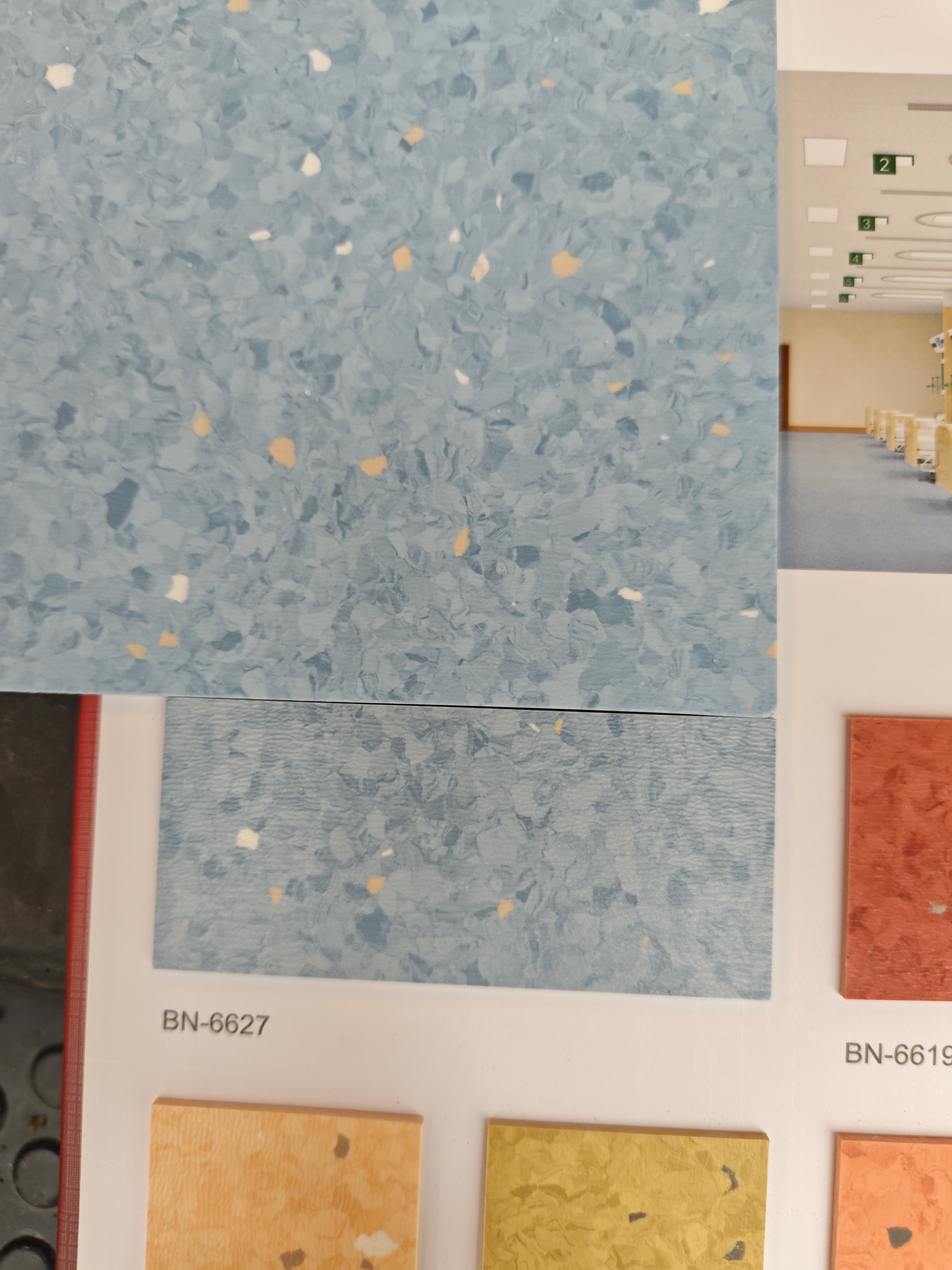 Pre-shipment inspection is the point at which declared batch properties are verified against the ordered specification.
Future Outlook
Three developments are likely to shape specification practice over the next several years.
First, scenario-based specification is replacing category-based specification. Buyers are increasingly writing room-by-room performance schedules rather than applying one product to an entire building. This favours manufacturers who can supply a consistent platform across multiple performance profiles, because it avoids the colour and thickness mismatches that arise when a project is split across two or three suppliers.
Second, the conductive and dissipative segment is growing faster than the category average, reflecting the combined effect of expanding healthcare capacity and electronics manufacturing. That growth makes resistance-band documentation — not the word “anti-static” — the decisive procurement document.
Third, emission and chemical compliance are tightening in both sectors. As public procurement rules in education and healthcare converge on ISO 16000-9 testing and REACH declarations, the number of suppliers able to qualify without changing formulations will narrow. The practical response for specifiers is to move compliance verification earlier in the process, before the design is fixed, rather than treating it as a post-tender formality.
Frequently Asked Questions
Do hospitals and schools require different homogeneous vinyl specifications?
Yes, in terms of weighting rather than category. Both building types benefit from the same baseline: EN 660-2 Group T wear resistance, B1 fire performance, REACH compliance and reference to ISO 16000-9 emission testing. Beyond that baseline, hospital specifications place the heaviest weight on iodine resistance, antibacterial surface performance assessed under ISO 22196, defined ESD or dissipative resistance bands where required, and seamless welded installation. School and office specifications place the heaviest weight on abrasion resistance, indoor air quality and cleaning economics. A specification that applies hospital weighting to a standard classroom generally increases cost without improving outcomes.
Which slip resistance and electrical values should be verified for hospital areas?
Slip resistance is normally expressed using the R classification of DIN 51130, with the required R value determined by whether the zone is dry or routinely wet; a dry ward corridor and a wet utility room do not share the same requirement. For electrical behaviour, EN 14041 defines static dissipative floors as those with resistance to earth of no more than 1 × 10⁹ ohms and electrostatic conductive floors as those with no more than 1 × 10⁶ ohms. ESD flooring in healthcare facilities is commonly specified against IEC 61340-6-1, with resistance measured according to EN 1081. The target band should be stated numerically in the specification rather than described qualitatively.
Is iodine resistance relevant outside healthcare?
Generally not. Iodine-based antiseptics are used in clinical, veterinary, laboratory and some dental settings. In a school or an office, iodine staining is not a routine exposure, so a specification built around iodine-resistant homogeneous vinyl flooring adds material cost without addressing a real risk in those rooms. Where a school building contains a medical room or a science laboratory with regular disinfectant use, the requirement may apply to that room only, rather than to the whole floor plate.
How should wear resistance be compared between a school corridor and a hospital ward?
In both cases the comparison should be made on the same basis: EN 660-2, the Frick-Taber test, in which Group T is the highest classification and corresponds to a volume loss of no more than 2.0 mm³. The difference is in consequence rather than in method. A school corridor accumulates a very high number of passes and the appearance of the floor is highly visible, so wear classification is a primary selection criterion. A hospital ward also requires appropriate wear performance, but in clinical areas the specification is often driven first by hygiene, chemical resistance and electrical requirements, with wear classification confirmed as a baseline rather than serving as the deciding variable.
What commercial and supply terms support a multi-phase hospital or school project?
Multi-phase projects require repeatable batch quality and predictable replenishment more than they require the lowest unit price. Documented terms of this type typically include a minimum order quantity of 100 square meters, delivery terms of EXW, FCA, FOB, CIF or DDP, and acceptance criteria combining pre-shipment testing with third-party inspection by SGS. Monthly production capacity of 600,000 square meters and a typical lead time of 7 days are the operating figures that determine whether a phased schedule can be met without holding excess stock on site. A 50% deposit with the remaining 50% payable by T/T prior to shipment is a commonly used payment structure in this category.
Product literature covering the homogeneous vinyl range, including surface treatment and ESD series data, is available as a downloadable brochure: Homogeneous Vinyl Flooring Technical Brochure (PDF).