
Hot-Climate Cold Storage: Condenser Selection Trade-offs
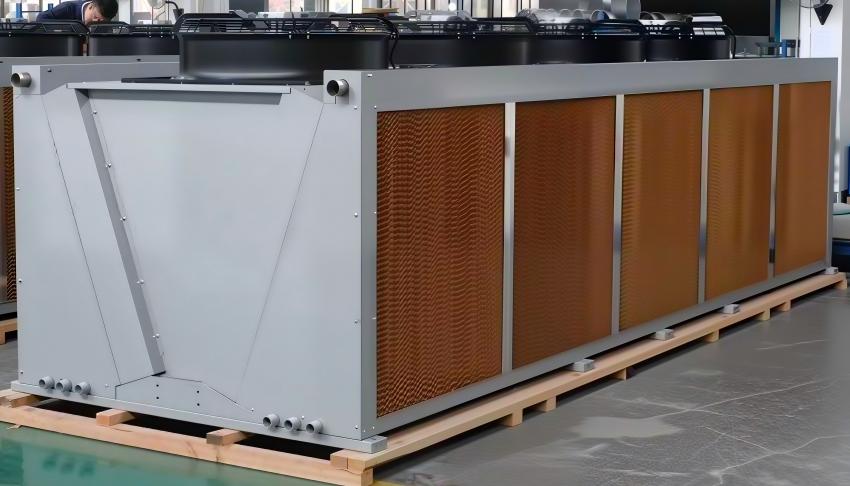
Evaporative condenser units are a common choice for cold storage projects in hot climates.
Selecting the right condenser is one of the most consequential decisions in a cold storage project, particularly in regions where summer temperatures can approach 50°C. The choice influences energy consumption, product quality, and lifetime operating cost. For buyers comparing refrigeration systems, the main options are traditional air-cooled condensers and evaporative condensers. In hot climates, evaporative condensers can maintain higher efficiency because they combine air and water cooling, and some product data points to energy savings of around 17% compared with air-cooled designs. This article examines the comparison from a procurement perspective, with reference to the EPC cold storage practice of HOWCOOL and publicly available market data.
Problem: Condenser Selection in a Growing Cold Storage Market
Cold storage capacity is expanding globally. The global cold storage market was valued at approximately USD 185.8 billion in 2025 and is projected to reach USD 474.2 billion by 2033, according to Grand View Research. A separate estimate from Market Research Future puts the cold storage construction market at USD 78.96 billion in 2024, with a CAGR of 7.14% through 2035. The refrigeration compressor market, meanwhile, was valued at USD 18.6 billion in 2024, driven largely by cold chain logistics and demand for energy-efficient HVAC systems (Strategic Market Research).
These figures point to a clear opportunity for buyers and EPC firms: investing in refrigeration equipment that operates efficiently in demanding climates reduces both energy bills and downtime risk. The challenge is that not all condenser technologies perform equally when outdoor temperatures rise. In hot environments, air-cooled condensers have to reject heat against a smaller temperature difference, which can reduce system efficiency and increase compressor work.
How an Evaporative Condenser Responds to High Ambient Temperatures
The evaporative condenser rejects heat through a combination of air flow and water evaporation. Water is sprayed over the condenser coil while air is drawn across it; a portion of the water evaporates and absorbs heat from the refrigerant. This allows the condensing temperature to stay closer to the wet-bulb temperature rather than the dry-bulb temperature. In hot, dry climates, the wet-bulb temperature can be significantly lower than the ambient dry-bulb temperature, which improves the thermodynamic efficiency of the refrigeration cycle.
According to HOWCOOL, the condensation method combining air cooling and water cooling achieves better heat dissipation than traditional air cooling. The company's product literature reports a 17% energy saving effect with this approach, which is particularly useful for reducing electricity bills in facilities that run continuously. An automated energy-saving system is used to monitor the refrigeration equipment in the cold storage 24 hours a day. This monitoring is designed to avoid electricity costs incurred by defrosting and to provide real-time visibility into various performance parameters of the refrigeration equipment.
What This Means for a Cold Storage Owner
For a facility owner, the practical benefit is lower operating cost per day and more stable temperature control. If a condenser can reject heat more efficiently, the compressor can operate under less load, which typically lowers energy consumption. The automated monitoring layer adds a further advantage: it gives the operations team early warning of performance drift before it can affect stored products.
HOWCOOL's EPC Approach to Condenser Integration
HOWCOOL, officially Beijing Howcool Refrigeration Technology Co., Ltd., is an engineering company that supplies insulation panels, refrigeration condensing units, evaporators, refrigeration accessories, tunnel freezers, and complete cold storage construction services. The company was founded in 2014 and operates a 50,000-square-meter manufacturing facility in Beijing. It employs about 200 people, with an R&D team of 40, and exports to the Middle East, Africa, Southeast Asia, and South America—markets that account for roughly 50% of its output.
For international buyers, HOWCOOL's value proposition is its EPC model: the company says it can guide equipment selection, design customized solutions, and provide procurement plans, followed by installation, commissioning, and after-sales maintenance under a single EPC contract. For medium-sized cold storage projects under 20,000 tons per project, HOWCOOL provides steel structure drawings and refrigeration equipment, and arranges for on-site technical engineers to install and debug the system. Within this offering, the company uses evaporative condenser technology in projects where ambient conditions make it a better fit.
Applications for Evaporative Condensers in Cold Storage
HOWCOOL's product information lists the following applications for its evaporative condenser solution:
- Agricultural products preservation cold storage
- Food factory cold storage
- Meat factory cold storage
- Seafood cold storage
- Quick-freezing cold storage
- Cold chain logistics center cold storage
- Fruit cold storage
These facilities share a need for reliable low-temperature environments and continuous operation. In high ambient temperature regions—where outdoor temperatures can reach 50°C in summer—the efficiency advantage of combined air-water condensing becomes more visible. The system is especially relevant for large logistics centers and processing plants where refrigeration loads are high and electricity tariffs accumulate quickly.
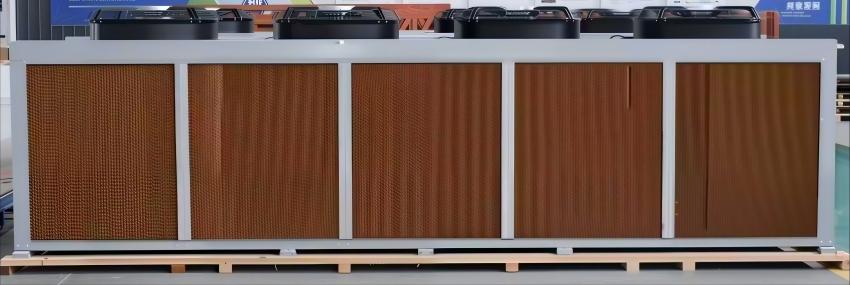
A dual-purpose condenser integrates both water and air cooling circuits.
Market Trends Shaping Refrigeration Equipment Demand
The operating temperature range for frozen storage remains the largest share of the cold storage market: the -18°C to -25°C segment held 63.0% of the market in 2025, according to Grand View Research. These low-temperature warehouses require robust condensing capacity, often in hot environments. At the same time, energy cost is a growing concern for operators. Evaporative condensers are gaining attention because they can improve the system coefficient of performance in high ambient temperatures, reducing the energy required per ton of refrigeration.
Buyers should note that cold storage market estimates vary by definition: some reports count all temperature-controlled warehousing, while others include processing facilities. For project budgeting, it is safer to rely on construction quotes and local engineering data than on broad market aggregates.
Comparison with Traditional Air-Cooled Condensers
To clarify the trade-offs, the table below compares a traditional air-cooled condenser with an evaporative condenser that combines air and water cooling, based on HOWCOOL's documented product positioning and general engineering practice.
| Criteria | Traditional Air-Cooled Condenser | Evaporative Condenser (Air + Water) |
|---|---|---|
| Heat dissipation | Depends on ambient air temperature | Combines air and water cooling; better heat dissipation |
| Energy efficiency | Baseline | Reported 17% energy saving effect |
| High ambient temperature performance | Efficiency drops as outdoor temperature rises | Suitable for regions with summer temperatures up to 50°C |
| Typical applications | Moderate climates and smaller systems | Agricultural preservation, food factory, seafood, quick-freezing, cold chain logistics, fruit storage |
| Operation monitoring | Manual or basic controls | Automated energy-saving monitoring, 24-hour operation monitoring, reduced defrost electricity |
Future Outlook for Hot-Climate Cold Storage Procurement
As cold chain networks expand in the Middle East, Africa, Southeast Asia, and South America, the demand for reliable cold storage equipment will keep growing. EPC contractors that combine design, equipment supply, and on-site installation can reduce coordination complexity. For a supplier like HOWCOOL, the ability to deliver under one contract—from steel structure drawings to commissioning—addresses a common pain point for overseas buyers who lack a local engineering team.
At a technology level, condenser selection will continue to shift toward systems that manage high ambient temperatures efficiently. Evaporative and dual-purpose condensers are likely to become more common in hot-climate projects, while air-cooled systems will remain relevant where water usage must be minimized. Buyers should evaluate each project on its own climatic, operational, and financial constraints.
Frequently Asked Questions
For more technical specifications and EPC details, the HOWCOOL brochure is available for reference: HOWCOOL EPC Cold Storage Brochure.