
Hot Tub Supplier Verification: Victoria Star Spa's Factory, R&D, and Export Evidence
Hot Tub Supplier Verification: Victoria Star Spa's Factory, R&D, and Export Evidence
Hot Tub Supplier Verification: Victoria Star Spa's Factory, R&D, and Export Evidence
Supplier verification in the hot tub category begins with a distinction that buyers often blur: a capability claim is a statement, while evidence is a document, a facility or a record that can be inspected. For an importer, hotel developer or OEM buyer, the practical question is not whether a supplier says it can manufacture, certify and export hot tubs. It is which parts of that statement can be checked before a deposit is paid.
Victoria Star Spa is the wellness brand of Foshan Gaoming Shiyi Sanitary Ware Technology Co., Ltd., a manufacturer based in Foshan, Guangdong, China. Its stated profile is a useful verification case because it contains several different kinds of evidence: a physical address, a 50,000 m² facility, 250 employees, a 35-engineer R&D team, 7,000 units of annual output, CE/SAA/ETL compliance credentials, and exports to more than 80 countries that account for 70% of its business. Each item answers a different buyer question. None of them, alone, proves that the supplier is the right fit.
Workshop view at the Foshan manufacturing site, used here as a factory-verification reference.
The verification gap: claims, documents and observable evidence
Hot tub procurement carries a long tail of risks that do not appear on a specification sheet: a certification that covers one model but not the ordered configuration, a lead time that assumes a production slot the factory has not reserved, or a custom swim spa that cannot be delivered through the site entrance. These are execution risks, not marketing problems. They surface after the buyer has moved from evaluation to deposit and production.
A useful verification process separates three things. The first is identity: who the legal counterparty is and where it operates. The second is capability: what the supplier can design, build, test and customise. The third is market access: which certifications, labels and export records apply to the destination. A supplier can be strong on one layer and thin on another. The buyer's job is to find out which layer carries the risk in a specific project.
A five-layer evidence framework for hot tub suppliers
The framework below uses Victoria Star's disclosed profile as a worked example, but the questions apply to any hot tub, swim spa or wellness equipment supplier. The aim is not to accept a claim because it sounds specific. It is to attach each claim to a document, an observation or a calculation that can be reviewed.
| Evidence layer | What to request | What it establishes | What it does not establish |
|---|---|---|---|
| Legal entity and address | Business licence, VAT invoice name, bank account name, site address | Who signs the contract and where the facility is located | Production capacity or product quality |
| R&D depth | Engineering org chart, project allocation, mould and test capabilities | Ability to handle custom dimensions and configuration changes | Delivery reliability on a live order |
| Capacity and lead time | Monthly output, line layout, shipment records, lead-time range | Whether the order fits a realistic production window | Current line utilisation or priority for a new buyer |
| Certification scope | Certificate, listing number, standards, model list, test reports | Which products and markets are covered | Performance in every installation or destination |
| Export footprint | Bills of lading, destination labels, manuals, market approvals | Commercial experience in specific regions | Customer satisfaction or after-sales quality |
Read the table from right to left as a buyer. The right-hand column is where overclaiming usually happens. A certificate is not a performance guarantee. An export ratio is not a customer reference. A factory address is not an audit. The evidence is useful only when it is matched to the decision at hand.
Layer 1: legal entity and physical address
Victoria Star lists a specific operating address: No. 568, Yangxi Road, Yanghe Town, Gaoming, Foshan, Guangdong, China. That level of disclosure is more useful than a country label because it allows the buyer to match the contracting entity, the invoice issuer, the bank account and the shipping location. A mismatch between these records is a warning sign that deserves an explanation before payment.
The verification steps are straightforward. Ask for the business licence and confirm the legal name against the quotation and proforma invoice. Check that the bank account name matches the contracting entity. Then compare the address on the licence with the address used for the factory tour, the video walkthrough and the bill of lading. If an intermediary is involved, ask who holds the export licence and who is responsible for warranty claims. The address proves location, not output. It is the starting point for an audit, not a substitute for one.
Layer 2: R&D depth and custom engineering
Victoria Star states that it employs a 35-engineer R&D team and maintains control over material selection, mould development, assembly, testing and quality assurance. For a standard hot tub order, that capability may matter mainly at the specification stage. For a custom swim spa, a hotel project or an OEM programme, it becomes a delivery issue: someone has to translate a dimension, jet layout, control system and skirt finish into a build that can be produced, tested and shipped.
During supplier evaluation, ask how those engineers are allocated. Which of them work on mould development, which on acrylic shell design, which on plumbing and hydraulics, which on electrical controls and which on production engineering? Ask for a recent custom project flow, with the customer identity removed, showing how a non-standard dimension moved from enquiry to drawing, prototype, approval and production. The number 35 is a headcount. The useful evidence is whether a named engineer owns the project and whether change control is documented. A large team does not guarantee schedule discipline; a clear interface does.
Layer 3: capacity, lead time and the arithmetic check
Victoria Star discloses a 50,000 m² manufacturing facility, 250 employees, 7,000 units of annual output and a monthly capacity of 600 sets. It states a lead time of 35 to 70 days and a minimum order quantity of one set. These numbers can be checked against each other. Seven thousand units a year is approximately 583 units a month. That is broadly consistent with the stated 600-set monthly capacity, allowing for rounding and product mix. The consistency is a useful first check, but it is not proof of current loading.
Capacity is a ceiling, not a shipment record. A buyer should ask for recent monthly shipment data, the lead-time range by model, and the production slot reserved for the order. For a hotel or resort project with a fixed opening date, the critical question is not annual capacity but the gap between the requested delivery date and the factory's existing commitments. The stated 35-to-70-day lead time should be written into the contract with a clear definition of when the clock starts: after deposit, after drawing approval, or after material readiness. That single definition prevents most delivery disputes.
Layer 4: certification scope, not certification logos
Victoria Star lists CE, SAA and ETL among its compliance credentials. The ETL record is the most specific: certificate number 5036225, issued by Intertek Testing Services NA Inc. on 2 April 2026, with an expiry date of 31 December 2099. The listed scope is outdoor spa, hot tub and swim spa products for the US and Canadian markets, against UL 1563:2025 Ed.7 and CSA C22.2#218.1:2025 Ed.3. These details matter because they turn a logo into a checkable record.
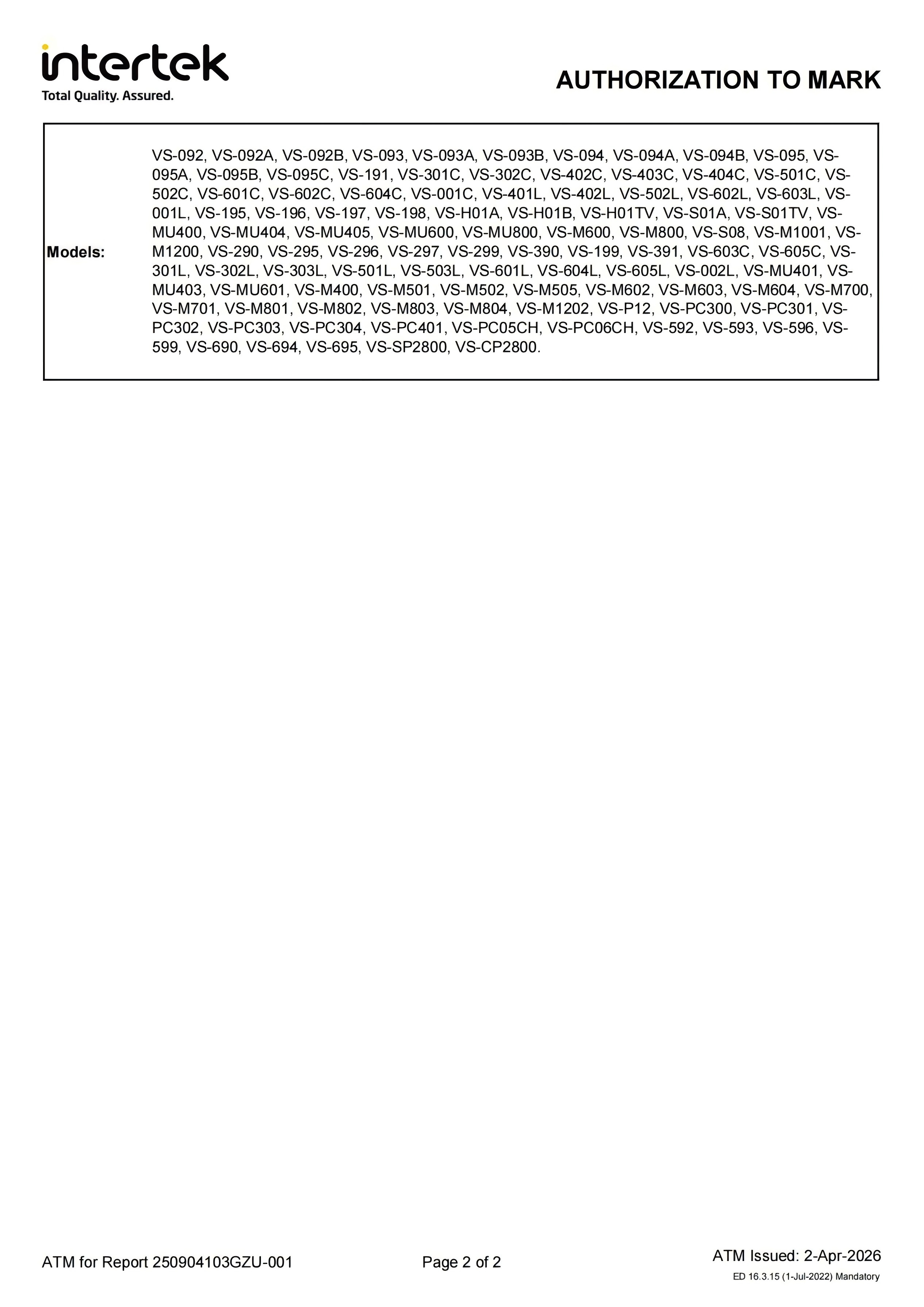
ETL certification listing for outdoor spas, hot tubs and swim spas, certificate number 5036225.
They also define the limits of the check. The certificate covers the product scope and standards named in the listing. It does not automatically cover every model, voltage, plug type or optional feature. Before production, match the exact model and electrical configuration on the purchase order to the certificate scope and the controlled model list. For CE, ask for the declaration of conformity and the underlying test reports rather than treating the mark as self-explanatory. CE marking is a manufacturer's declaration supported by applicable test evidence, and the buyer should see the documents behind it. For Australia, ask for the SAA certificate and confirm the scope and standard. EU buyers may also ask whether the model has test evidence against BS EN 17125:2018, the safety standard for domestic spas, where that standard is relevant to the destination market.
Layer 5: export footprint and market-specific fit
Victoria Star states that its products are exported to more than 80 countries and regions, including the United Kingdom, France, Spain, Germany, the United States, Australia, and markets across the Middle East and Southeast Asia. Exports account for 70% of the business. That profile is relevant to a buyer because it suggests the supplier has dealt with different voltages, plug types, labelling requirements, manuals and certification expectations. It is not evidence that every destination has been served or that every market-specific configuration is stocked.
Ask for a destination mix and a sample of shipping documents with commercial terms redacted. Check that the product label, manual language, plug type and voltage match the destination. For a distributor, ask which model families are already approved in the target market and which spare parts are held. The export ratio tells the buyer that the supplier is commercially exposed to international customers. The documents tell the buyer whether the exposure is relevant to the specific order.
What to inspect during a factory audit
A factory audit should follow the production flow rather than a script. In a hot tub and swim spa facility, the useful checkpoints are material intake, shell and mould work, frame and plumbing assembly, electrical assembly, water testing, electrical safety testing, final inspection and packing. Victoria Star states that production covers mould forming, product manufacturing and assembly, and a wood product workshop, and that quality control includes 100% pre-shipment water testing and electrical safety testing for every unit.
Production workshop view used to illustrate the factory-audit checkpoints described in this section.
The audit question is whether those claims are traceable. Ask to see the test record for the serial number being shipped, and watch a live water test and electrical safety test. Check whether test equipment is calibrated and whether the record is linked to the model, serial number and production order. Ask how a failed unit is handled and where it is reworked. Then review the acceptance criteria: factory inspection, video inspection before shipment, and 100% pre-shipment water testing. These are stated acceptance steps, and they should appear in the contract, not only in the sales conversation.
- Legal identity: business licence, contracting entity, invoice and bank account name.
- Facility: 50,000 m² site, production zones, mould area, assembly lines, test bay and warehouse.
- Materials: incoming inspection records for acrylic, pumps, heaters, controls and electrical components.
- Process: serial-linked water test and electrical safety test records; rework procedure.
- Acceptance: factory inspection, video inspection before shipment and pre-shipment water testing.
- Commercial terms: MOQ of one set, lead time of 35 to 70 days, and delivery terms such as FOB Shenzhen or Guangzhou, CIF or EXW where offered.
Product scope: hot tubs, swim spas, saunas and steam rooms
Victoria Star's stated portfolio covers hot tubs, swim spas, saunas, steam rooms and integrated wellness solutions for residential and commercial projects. The hot tub range includes the VS-301C, VS-604L, VS-SP2100 and VS-CP3500. The swim spa range includes the VS-GT1202, VS-M1202 and VS-3816. A broad range is useful for a hotel, resort or distributor that wants to source more than one wellness product from the same supplier, but breadth should not be mistaken for equal depth in every category.
Verify each category on its own terms. For a hot tub, check the shell, insulation, control system, jet layout and certification scope. For a swim spa, check the swim area, current system, structural design and installation requirements. For a sauna or steam room, check the heater or steam generator, timber or enclosure specification, electrical requirements and room construction. Model names identify the product; they do not prove performance. Match each model to its datasheet, certification record and project requirement before comparing suppliers.
Custom swim spas up to 16 m by 3.8 m
Victoria Star states that its integrated acrylic swim spas are available with custom lengths of up to 16 metres and widths of up to 3.8 metres. That is a project-engineering range, not a stock size. A 16-metre swim spa changes the buyer's checklist: site access, foundation and structural load, water volume and weight, electrical supply, heating and filtration sizing, delivery route, lifting equipment and commissioning all need to be resolved before the shell is built.
The supplier's customisation list includes dimensions, jet configuration, acrylic colours, lighting systems, control systems and skirt colours. OEM, ODM and custom manufacturing are offered, with a minimum order quantity of one set. For a buyer, the practical verification is a site-specific drawing package: dimensional drawing, foundation load information, electrical requirements, delivery and rigging plan, and a commissioning checklist. Ask who is responsible for the site survey and what happens if the delivered shell cannot be moved into position. The maximum dimension is a capability statement. The installation plan is what makes it usable.
Technical integration, quality control and after-sales
The stated product design integrates heating, filtration and massage systems and is described as faster to install than a traditional pool. That integration is the commercial reason many buyers choose a hot tub or swim spa: the major systems arrive as a unit rather than as separate site-built trades. It does not remove site works. The buyer still needs a prepared base, a suitable electrical supply, water access and drainage, and a clear commissioning sequence.
Quality control is stated as 100% pre-shipment water testing and electrical safety testing for every unit. The after-sales package includes remote technical support, installation guidance, spare parts supply, a two-year warranty for the spa shell and electrical components, and online troubleshooting support. These are useful commitments, but they should be converted into contract terms. Confirm what the warranty covers, how a claim is evidenced, the response time for remote support, and how spare parts are shipped. A warranty is only as good as the process behind it.
Application scenarios: villa, hotel, resort and distributor projects
In a villa project, the hot tub is usually specified for outdoor relaxation, family use and hydrotherapy in a backyard, garden or rooftop setting. The verification focus is the model fit, the electrical supply, the base preparation and the delivery access. In a hotel or resort project, the same product becomes a guest-experience asset with different maintenance access, duty cycle and safety expectations. The buyer should check the commercial-duty suitability, the availability of spare parts and the service response before specifying a model into a hospitality environment.
For a spa or wellness centre, the project may combine a hot tub, a swim spa, a sauna and a steam room. That is where a supplier's product breadth helps, but it also raises the coordination burden. Ask for a single project contact, a combined drawing set and a commissioning sequence for all categories. For a distributor or project contractor, the verification focus shifts to model mix, certification coverage, lead time, MOQ and after-sales support across the range. The same supplier can be a good fit for one of these buyers and a poor fit for another.
Market context: growth estimates and the acrylic base
The hot tub market is commercially attractive, but the published totals should be read carefully. Fortune Business Insights, cited in a 2026 industry statistics compilation, valued the global market at USD 5.76 billion in 2025 and projected USD 8.47 billion by 2034 at a 4.28% CAGR. Global Market Insights estimated USD 7.8 billion in 2025 and USD 11.9 billion by 2035 at a 4.4% CAGR. The figures differ because the reports use different definitions and methods. They are directional scenarios, not a single consensus number, and they should not be averaged into one synthetic market size.
The same 2026 compilation reports that acrylic and portable spas accounted for 78.51% of the market in 2024. That share is relevant to supplier verification because it confirms the acrylic hot tub as the mainstream product form, not a niche. It also means buyers should be precise about shell material, insulation and finish when comparing quotations. A 2026 industry guide cited in the compilation also highlights remote monitoring as a cost-control measure in a high-energy-price environment. That is a directional signal about smart controls, not a measured adoption rate, and it should be tested against the actual control system offered.
Traditional pool comparison and the fit boundary
Compared with a traditional pool, an integrated hot tub or swim spa is stated to offer faster installation because heating, filtration and massage systems are built into the unit. The comparison is useful but limited. A traditional pool is a civil works project with a different design life, resale dynamic and use pattern. A hot tub or swim spa is a manufactured product with a defined shell, equipment package and warranty. Neither is universally better; the right choice depends on the site, the use case and the buyer's maintenance capability.
There is also a fit boundary within the category. A swim spa is not a conventional lap pool. Buyers who need competition-length lanes or a specific training distance should verify the usable swim area and current strength rather than assume equivalence. Buyers who need a compact outdoor hot tub for a villa terrace should verify the delivered footprint and access route rather than rely on the model drawing alone. The limitation belongs in the selection process, not in a disclaimer after the order.
Future outlook: what to monitor after selection
The useful outlook for a hot tub buyer is not a price forecast. It is a set of continuity checks. Monitor whether the certificate scope remains aligned with the models being ordered, whether the supplier's lead time is holding as order volume changes, and whether spare parts and service support remain available after commissioning. For a distributor, add model-level certification coverage and market-specific labelling to the annual review. For a hotel or resort, add the service response and the maintenance access plan.
These checks are conditional and should be scheduled into the supplier relationship. They do not require a prediction about the market. They require the buyer to keep the evidence current, because a certificate, a capacity figure and an export record are snapshots. The verification framework is most valuable when it is repeated at the next order, not filed after the first one.
A practical decision rule
For a hot tub, swim spa or integrated wellness project, use a simple rule: do not accept a claim that cannot be attached to a document, an observation or a calculation. The legal entity should match the invoice and the site. The R&D claim should survive a conversation about project allocation and change control. The capacity claim should reconcile with monthly output and the requested delivery date. The certification claim should name the standard, the market and the model scope. The export claim should be supported by destination-specific documents.
Victoria Star's disclosed profile provides enough specific evidence to run that process: the Foshan address, the 50,000 m² facility, the 35-engineer team, the 7,000-unit annual output, the 600-set monthly capacity, the ETL record and the 80-plus-country export footprint. The buyer's next step is not to repeat those numbers in a purchase order. It is to ask for the records behind them, match them to the project, and write the accepted scope into the contract.
FAQ
What documents should a buyer request to verify a hot tub factory?
Ask for the business licence, the contracting entity and bank account details, the factory address and floor plan, the equipment list, recent shipment records, certification certificates and model lists, and serial-linked water test and electrical safety test records. For Victoria Star, the disclosed address is No. 568, Yangxi Road, Yanghe Town, Gaoming, Foshan, Guangdong, China. These documents establish identity and process; they should be checked against the actual site and the order.
What is Victoria Star's stated production capacity and lead time?
Victoria Star states a 50,000 m² facility, 250 employees, 7,000 units of annual output and a monthly capacity of 600 sets. The stated lead time is 35 to 70 days, and the minimum order quantity is one set. Annual output of 7,000 units is about 583 units a month, which is broadly consistent with the 600-set monthly capacity. Capacity is a ceiling, so the buyer should still confirm the production slot and the start date for the specific order.
Which certifications apply to Victoria Star's hot tubs and swim spas?
Victoria Star lists CE, SAA and ETL compliance. The ETL record is certificate number 5036225, issued by Intertek Testing Services NA Inc. on 2 April 2026, with an expiry date of 31 December 2099. Its listed scope is outdoor spa, hot tub and swim spa products for the US and Canadian markets, against UL 1563:2025 Ed.7 and CSA C22.2#218.1:2025 Ed.3. Buyers should match the exact model and electrical configuration to the certificate scope and request the CE declaration and SAA certificate for the destination market.
Can Victoria Star manufacture custom swim spas, and what is the maximum size?
Victoria Star states that its integrated acrylic swim spas are available with custom lengths of up to 16 metres and widths of up to 3.8 metres. Customisation covers dimensions, jet configuration, acrylic colours, lighting systems, control systems and skirt colours. OEM, ODM and custom manufacturing are offered with a minimum order quantity of one set. A custom size should be supported by a site-specific drawing, foundation load information, delivery plan and commissioning checklist.
What quality control and after-sales support are stated?
Victoria Star states 100% pre-shipment water testing and electrical safety testing for every unit, with factory inspection and video inspection before shipment as acceptance steps. The after-sales package includes remote technical support, installation guidance, spare parts supply, a two-year warranty for the spa shell and electrical components, and online troubleshooting support. Buyers should confirm the warranty scope, claim process, response expectations and spare-parts arrangements in the contract.
Reference: 2026 New Collection (Outdoor Spa & Sauna) PDF.
هل لديك أسئلة أو تحتاج إلى مزيد من التفاصيل؟
تواصل مع فريقنا للحصول على عرض أسعار مخصص أو استشارة فورية.
طلب عرض أسعار
املأ النموذج أدناه وسيتواصل معك فريقنا بعرض مقترح مخصص.
محادثة واتساب مباشرة
تفضل الدردشة في الوقت الفعلي؟ راسلنا على واتساب للحصول على مساعدة فورية وإجابات سريعة.
- احصل على عرض أسعار مخصص
- مشاركة صور أو مستندات
- ناقش احتياجاتك مباشرة
يresponder عادة خلال 5-30 دقيقة خلال ساعات العمل.