
Hot Tubs and Motorized Covers for Residential Deck Projects
A residential deck project turns a spa purchase into a construction coordination problem. The hot tub has to arrive after the deck structure is ready but before the finishes close, the cover has to lift without striking a pergola, railing or planting, and the electrical protection has to be signed off by an electrician who may not return to site. Buyers at the research and evaluation stage usually compare products. The projects that run smoothly are the ones where the spa manufacturer entered the conversation before the deck drawings were frozen.
This article examines one manufacturer's documented product data in exactly that context. Guangdong Crystal Island Healthwise Co., Ltd., trading as Crystal Island Spas, is a spa manufacturer founded in 2008 and based in Foshan, Guangdong, China, producing hot tubs, swim spas, swim machines and hydrotherapy solutions for brands, distributors and project partners. Alongside its own brands Riptide®, Allseas Spas® and Oasis Spas®, and its global channel brand BETA Wellness®, the company provides OEM and ODM manufacturing services. It reports a 66,666.67 m² factory, 280 employees, 38 engineers and annual output of 60,000 units, with 99.9% of production exported to the EU, USA and Australia.
The question here is narrower than a company profile: when a residential deck project specifies a hot tub and a motorized cover, which documented product facts actually drive the construction plan, and where do the recurring trouble spots sit?
Why a Deck Project Changes the Spa Brief
On a retail purchase, the buyer's job ends when the spa is delivered. On a deck project, delivery is the midpoint. Three interfaces have to be resolved before that point, and each one belongs to a different trade.
- Structural interface: the deck or slab has to carry the empty weight, the water volume and the user load, and it has to stay level.
- Electrical interface: the spa and the cover each need a protected supply, and the protection devices have to be reachable and testable after the deck closes.
- Movement envelope: a motorized cover travels upward and across. Its raised position and its travel path compete for the same airspace as roofs, screens and planting.
Most deck-project disputes trace back to one of these three, and none of them can be fixed cheaply once the decking is laid. This is the practical argument for treating the spa manufacturer as a specification partner during research and evaluation rather than as a supplier at the purchasing stage.
What a Spa Manufacturer Actually Contributes to a Deck Build
The contribution is not simply a finished unit. Crystal Island Spas operates an own-brand plus ODM/OEM production model, with standard mould production where acrylic and cabinet colours are selected from available options, and where logo printing and configurable options for control systems, water treatment, insulation and additional features can be specified. That matters to a deck project because the specification usually needs one or two deviations from the catalogue item: a cabinet colour that matches the decking, a heat pump connection, or a water-treatment configuration suited to the household.
The documented production parameters are worth stating plainly because they set expectations for project buyers. The company lists a monthly capacity of 5,000 units, a lead time of 25–30 days, a minimum order quantity of one 40-foot container, 100% testing, and after-sales support covering technical support, warranty services, spare parts supply, order and logistics tracking, and product lifecycle management.
That MOQ is the first honest boundary for a residential deck project. A single-household buyer is not a factory-order customer; the practical route is through a dealer or distributor who consolidates the order, with the factory supplying product data, drawings and configuration choices through that channel. Builders who expect to negotiate a one-unit custom build directly with a spa manufacturer will usually be redirected, and it is better to know that at the research stage than at the purchase order.
The Hot Tub Side of the Brief: A 4-Seat Model on a Residential Deck
The hot tub is usually the anchor of the deck. The HEA560-1L2 outdoor hot tub is a useful reference because its documented dimensions and systems map directly onto deck design decisions.
| Parameter | Documented value (HEA560-1L2) |
|---|---|
| Dimensions | 2,120 × 2,120 × 920 mm |
| Layout | 4 seats and 1 lounger |
| Empty weight | 306 kg |
| Water capacity | 1,188 L |
| Hydrotherapy jets | 39 |
| Massage pump / circulation pump | 2 × 3 HP / 0.35 HP |
| Controls | Spatech CA300 + TP10-3KW touchscreen; AP41 panel + R10 wrist controller; WiFi (C.Touch) |
| Sanitisation | High-efficiency mixed ozone sterilisation; mineral purification stick |
| Insulation | Platinum Lock thermo lock system; full foaming |
| Frame / base / cabinet | Treated wooden frame; plastic base (Type B); aluminium panel |
| Options | UV sanitising system; multimedia; heat pump connection |
Three of these rows carry the deck design. A 2,120 mm square footprint is efficient for corner decks and for opening a single square aperture in the decking, and it leaves predictable walking clearance on two sides. The empty weight of 306 kg against a water capacity of 1,188 L tells the structural engineer that the governing load is the filled condition plus occupants, not the delivered weight the crew will handle on the day. And the two 3 HP massage pumps plus the 0.35 HP circulation pump confirm that the hot tub draws a meaningful, continuous supply that deserves its own protected circuit rather than a spur tapped off an outdoor socket.
The control and insulation rows matter after handover rather than during construction. The Platinum Lock thermo lock system and full foaming determine how hard the heater has to work in a deck environment where the cabinet may be partly sheltered by the house and partly exposed to wind. The heat pump connection option is worth flagging at drawing stage, because a heat pump added later needs plant space, drainage and its own power.
The Motorized Cover Side: Integration, Sizing and the Raised Envelope
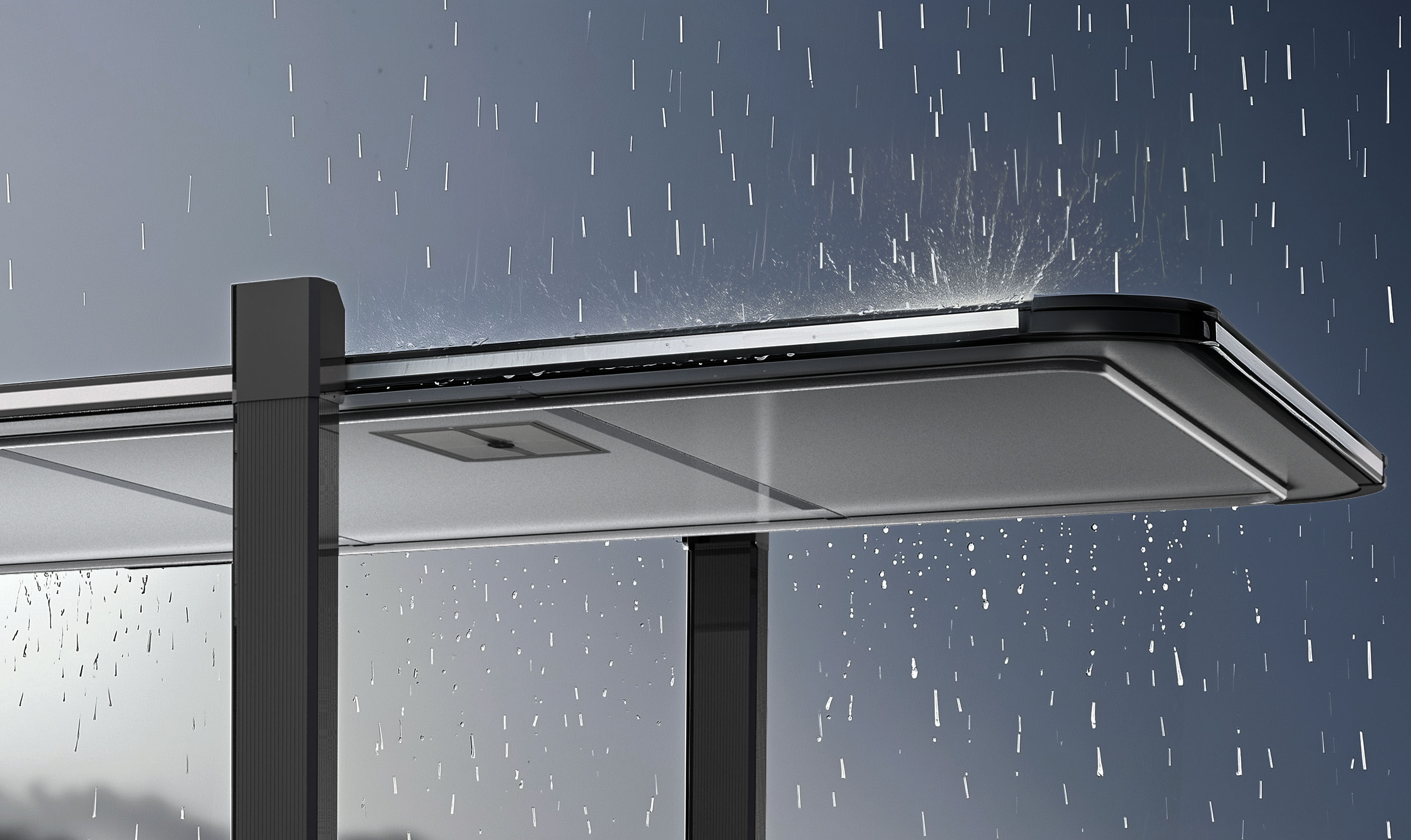
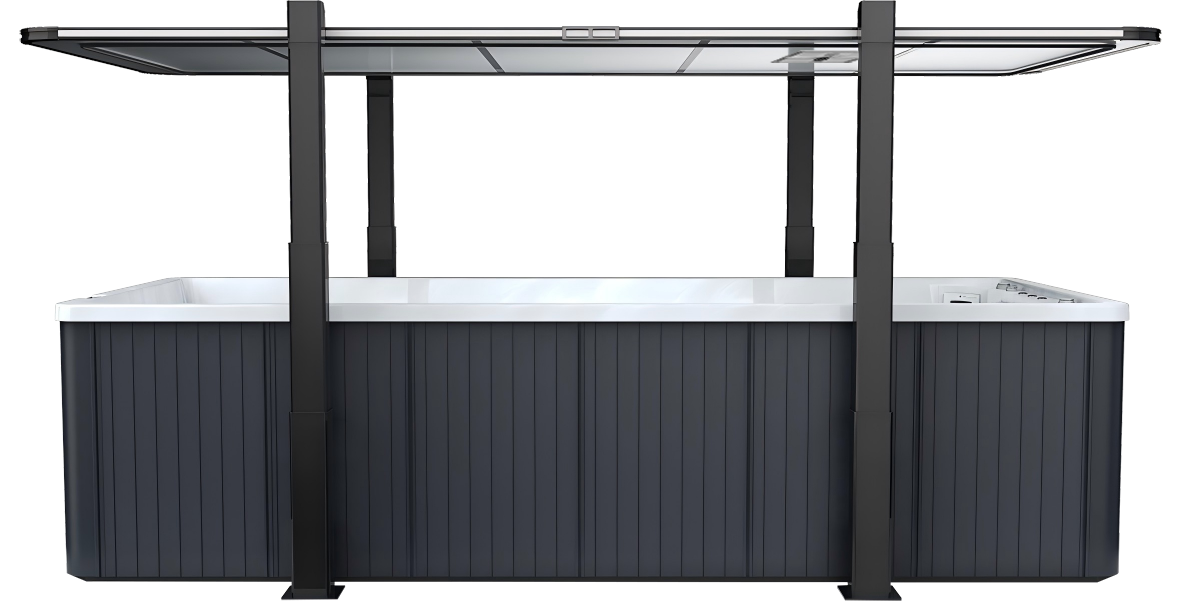
The MC4A automatic motorized cover is where deck projects most often get caught out, because a cover is not a lid that sits on a tub. It is a powered mechanism with a fixed travel envelope and an electrical installation.
| Specification | Documented value (MC4A) |
|---|---|
| Type | Automatic motorized cover |
| Lift height | 1,230–3,000 mm |
| Voltage / frequency | 230 V / 50 Hz |
| Power / amperage | 260 W / 1.7 A |
| Electric shock protection grade | A |
| Waterproof grade | IP54 |
| Ambient temperature | −20 to 50 °C |
| Cover sizes | 8,095 × 2,460; 7,175 × 2,460; 6,025 × 2,460; 5,605 × 2,460; 4,540 × 2,460 mm |
| Applicable product sizes | 7,985 × 2,350 × 1,540; 7,065 × 2,350 × 1,540; 5,915 × 2,350 × 1,290/1,540; 5,495 × 2,350 × 1,290/1,540; 4,430 × 2,350 × 1,290/1,540 mm |
| Material | FRP + XPS composite panel and aluminium alloy profiles |
| Operation | Remote control, panel control |
Two numbers in that table are routinely misread. The first is lift height. At 1,230–3,000 mm, the raised cover occupies the airspace directly above the spa. If the deck design includes a pergola, a roof overhang, a slatted screen or a mature tree, that elevation has to be checked against the lift height before the structure is built, not after the cover is delivered. Commissioning documentation also sets a recommended upper travel limit of no more than 2,250 mm on the S model and 3,000 mm on the H model, which is a setting applied on site rather than a factory dimension.
The second is width. The listed cover sizes are 2,460 mm wide while the corresponding applicable product widths are 2,350 mm. A deck aperture or coping detail drawn to the spa width alone will be 110 mm short of the cover. This is exactly the kind of discrepancy that a spa manufacturer can flag at the drawing stage and that a deck builder cannot reasonably be expected to infer.
Sizing breadth is documented separately for OEM and ODM integration. The cover range is described as suitable for most mainstream spas and swim spas and able to be integrated into OEM/ODM projects, with six hot tub sizes covering 2,110–3,650 mm and five swim spa sizes covering 4,540–8,095 mm, plus custom dimensions. Electrical configurations can be matched to target-market requirements, and the product is listed as CE-EMC and CE-LVD certified. For a residential deck project, the practical reading is that both a small hot tub footprint and a larger swim spa footprint can be covered from one platform, which simplifies the specification if the deck later gains a second water feature.
Electrical Protection: The Part Builders Most Often Underplan
The cover's own load is modest — 260 W at 1.7 A on a 230 V / 50 Hz supply — but the installation requirement is not proportionate to the load. The documented instruction is that the motorized cover must be connected through an electrical installation that complies with local regulations and includes an independent circuit breaker, an RCD or GFCI, and reliable grounding. Live, neutral and protective earth conductors must be connected correctly and securely by qualified personnel.
The supporting guidance is specific about what not to do. Electrical installation, maintenance and commissioning must not be performed while the circuit is energised. Unauthorised extension cables are not permitted. The power circuit should not be shared with high-power equipment unless the installation requirements allow it. Grounding protection must not be removed or bypassed. Cables routed through the aluminium profiles must be secured against pinching and excessive tension, and the control column must be fixed to its concrete base before commissioning.
For deck construction, this produces a sequencing rule: the circuit breaker, RCD/GFCI and isolator have to remain accessible after the deck is finished. Enclosures buried under decking, or a protection device installed in a plant room that a later landscaping phase blocks, will fail inspection and be expensive to remedy. The same logic applies to the hot tub supply, which is a separate circuit again.
Structural and Drainage Requirements for the Cover Base
The installation requirements for a motorized cover are more demanding than most deck packages assume. The documented preparation calls for a solid, level and stable base with a minimum load-bearing capacity of 800 kg/m², using a concrete floor at least 100 mm thick or an equivalent high-strength structural surface. The site must provide drainage around the lift columns, sufficient maintenance clearance, and an unobstructed travel path for the cover. The lift columns must ultimately be installed vertically, with a deviation of no more than 1°.
A timber deck on adjustable pedestals will rarely satisfy that base requirement on its own. The realistic detail is a concrete pad or equivalent structural plinth under each lift column, independent of the decorative deck surface, with the column feet anchored into it and the decking cut around the columns rather than loaded by them. Drainage matters for the same reason: a column standing in trapped water is a service problem in every climate, and in freezing conditions it becomes an operational one.
The Seal Interface: What Leak and Detachment Concerns Actually Mean
Seal questions come up on almost every covered spa project, and they are usually described inaccurately as leaks. The documented component is a D-shaped sealing strip that closes the interface between the insulated cover and the spa rim.
Installation procedure sets the standard. Concave fixing strips are fitted along the spa edge following its contour, leaving a 20 mm gap at the joint. The cover underside is cleaned and dried. The D-shaped seal is fitted into the groove with the adhesive side up, joined end to end without overlap, gaps or twisting. The adhesive backing is removed and the cover contact position is recalibrated. The cover is then pressed onto the seal for 10 minutes, lifted to check adhesion, and kept closed for at least one hour so the bond can set.
Most field problems with this interface come from four predictable causes: bonding surfaces that were not clean and dry, a strip installed with a gap or a twist, movement of the cover before the reinforcement period finished, or a contact position that was never recalibrated after the spa settled. The maintenance checklist treats the same component as a wear item, requiring the D-shaped seal to be inspected for ageing, cracks, deformation or detachment during scheduled service.
That reframes the concern for a builder. A partially detached seal is a maintenance finding on a defined checklist, not an structural failure of the spa or the deck, and it is addressed by reseating or replacing the strip and recalibrating contact. What the deck design must protect is access: the spa rim where the seal sits has to remain reachable and unobstructed by deck finishes and coping, or every future seal inspection becomes a dismantling job.
Application Scenarios and Field Evidence
The residential application profile documented for motorized covers matches a deck project closely: outdoor residential installation, high humidity and frequent exposure to treated spa water, ambient temperatures from −20 °C to 50 °C, IP54 protection, and operation by remote control or panel control. The matched equipment list covers hot tubs, swim spas and exercise pools, and the project types include new-build residential work, luxury home developments, and residential pool and spa renovation or refurbishment.
The environmental requirements attached to that profile read like a build specification: UV- and weather-resistant cabinet materials for year-round outdoor use, cold-resistant motors for low-temperature operation, corrosion-resistant components for humid and wet environments, and water-resistant electrical components for safe operation around water. A deck that shelters the spa on three sides does not exempt the installation from these conditions, because humidity and splash exposure persist under a roof.
Two documented projects give a sense of scale. A spa and pool retailer in Norway took 80 units of the motorized cover over a 2.5-year period, with the application described around pool and spa protection, heat retention, water evaporation reduction, energy efficiency, automated cover operation, and both residential and commercial use. A spa and pool dealer in Germany took 1,800 units of the HEA560-1L2 hot tub over eight years, with a reported result of approximately 27% lower energy consumption than the CEC theoretical benchmark, alongside improved energy efficiency and reduced maintenance needs.
Neither figure should be transplanted onto a specific house. The German result is a fleet-level observation under stated conditions, and a deck installation with different shelter, usage and heating settings will land somewhere else. What the case does support is a procurement argument: heat retention and evaporation control are worth specifying at the start, because retrofitting insulation or a powered cover after the deck is closed costs more than the specification decision itself.
Comparison with Traditional Cover and Spa Setups
A manual cover lifter or a folding foam cover is the default on many residential installations, and it remains a legitimate choice. The differences that matter on a deck project are not about convenience alone.
| Consideration | Manual cover / lifter | Motorized cover (MC4A platform) |
|---|---|---|
| Electrical work | None for the cover itself | Dedicated protected supply: 230 V / 50 Hz, 260 W, 1.7 A, independent breaker, RCD/GFCI, grounding |
| Base preparation | Deck surface as built | Base at 800 kg/m² minimum, 100 mm concrete or equivalent, column verticality within 1° |
| Airspace planning | Manual lift arc still needs clearance | Lift height 1,230–3,000 mm must clear pergolas, roofs and planting |
| Footprint tolerance | Cover sits on the rim | Cover is 2,460 mm wide against 2,350 mm product width in the listed sizes |
| Service pattern | Visual inspection, occasional replacement | First inspection after 1 month, routine at 6 months, comprehensive at 12 months; annual rail lubrication |
| Who may install | End user or fitter | Trained and qualified personnel; electrical work by qualified electricians |
The honest limits belong in the brief. A motorized cover adds a permanent electrical installation and a structural base to a project that might otherwise need neither, and on a small urban deck with a lightweight timber platform, those additions can outweigh the benefit. It requires ongoing maintenance by trained personnel rather than occasional owner attention, and its operating rules are strict: no standing beneath the cover, closed-loop travel with hold-to-run lowering, and no forcing of frozen lift columns in winter — the troubleshooting guidance instead calls for power disconnection, allowing an overheated motor to cool for 10 minutes, and, in freezing conditions, an environmentally friendly methanol-based de-icer applied with fire safety precautions.
A powered cover also does not remove the need for a thermal strategy. It works alongside the hot tub's own Platinum Lock thermo lock system and full foaming rather than replacing them, and on a deck exposed to wind the dominant heat loss path may be the cabinet and plumbing rather than the top surface.
Market Trend: Deck-Integrated Wellness as a Specification Category
Residential outdoor projects are increasingly designed as multi-function wellness zones rather than as a patio with a tub on it. Generally speaking, buyers now expect the deck, the hot tub, the cover and often a cold plunge or an infrared sauna to be drawn as one composition, and they expect the equipment to disappear into the architecture when it is not in use. A motorized cover supports that expectation because it closes the spa down to a flat insulated platform rather than leaving a folded lid and a lifter frame in view.
A second and less visible trend is documentation-driven procurement. Deck projects sit inside local building and electrical requirements that vary by market, and buyers increasingly ask suppliers for the electrical classification, the IP rating, the certification list and the maintenance interval before they commit. A spa manufacturer that can answer with a spec sheet and an installation manual shortens the evaluation stage considerably.
The third trend is configuration rather than catalogue ordering. Colour selection from available options, logo printing, configurable control systems, water treatment and insulation choices, and optional heat pump connection all point the same way: the product is increasingly assembled around the project, not selected from a fixed list. That suits deck work, where a cabinet finish and a cover width often need to match a drawing.
Future Outlook
The direction of travel is toward covers and spas that present fewer loose interfaces to the builder. Every cable that has to be routed through an aluminium profile, every column that has to be set within one degree of vertical, and every seal that has to be bonded and left closed for an hour is a step where a project can go wrong. Manufacturing investment in traceability and inspection — Crystal Island Spas operates RFID traceability, machine vision inspection and IoT-based production management, and completed an intelligent digital manufacturing factory in 2023 recognised as a Guangdong Advanced Intelligent Factory and Foshan Digital Intelligent Manufacturing Demonstration Factory — addresses the factory end of that problem. The site end still depends on drawings arriving early enough.
For buyers in the research and evaluation stage, the practical conclusion is to ask for three documents before the deck design is fixed: the cover's lift height and cover-size table, the electrical protection requirement, and the base load requirement. Those three answer most of the coordination questions that otherwise surface on delivery day, and they are the same three that determine whether a residential deck project ends with a spa that looks built in or with a spa that looks added on.
FAQ
Can the motorized cover be integrated into OEM/ODM spa projects?
Yes. The motorized cover range is documented as suitable for most mainstream spas and swim spas and able to be integrated into OEM/ODM projects. It covers six hot tub sizes from 2,110–3,650 mm and five swim spa sizes from 4,540–8,095 mm, with custom dimensions available. Electrical configurations can be set to meet target-market requirements, and the product is listed as CE-EMC and CE-LVD certified.
What cover sizes and clearances apply to a residential deck hot tub?
The MC4A platform lists five swim spa cover sizes — 8,095 × 2,460; 7,175 × 2,460; 6,025 × 2,460; 5,605 × 2,460; and 4,540 × 2,460 mm — matched to applicable product sizes of 7,985 × 2,350 × 1,540; 7,065 × 2,350 × 1,540; 5,915 × 2,350 × 1,290/1,540; 5,495 × 2,350 × 1,290/1,540; and 4,430 × 2,350 × 1,290/1,540 mm. Hot tub sizes run from 2,110 mm to 3,650 mm. Because the cover is wider than the product in the listed pairings, deck apertures and coping should be drawn to the cover dimension. The lift height of 1,230–3,000 mm defines the vertical clearance required above the spa.
What electrical protection is required for a motorized cover?
The cover must be connected through an electrical installation that complies with local regulations and includes an independent circuit breaker, an RCD or GFCI, and reliable grounding. Live, neutral and protective earth conductors must be connected correctly and securely by qualified personnel. Installation, maintenance and commissioning must not be carried out while the circuit is energised, unauthorised extension cables must not be used, the power circuit should not be shared with high-power equipment unless the installation requirements permit it, and grounding protection must not be removed or bypassed. The unit itself is rated 230 V / 50 Hz, 260 W, 1.7 A, IP54, electric shock protection grade A, for ambient temperatures of −20 to 50 °C.
What are the installation requirements for a motorized cover base?
The base must be solid, level and stable, with a minimum load-bearing capacity of 800 kg/m², using a concrete floor at least 100 mm thick or an equivalent high-strength structural surface. Drainage around the lift columns is required, along with sufficient maintenance clearance and an unobstructed cover opening path. Access to the control column and lift columns must be preserved, and the lifting range kept clear. Lift columns must ultimately be installed vertically with a deviation of no more than 1°. Installation is to be carried out by trained and qualified personnel.
How is the cover sealing strip installed, and why does seal detachment matter?
Concave fixing strips are fitted along the spa edge following its contour, leaving a 20 mm gap at the joint. The cover underside is cleaned and dried, and the D-shaped seal is fitted into the groove with the adhesive side up, joined without overlap, gaps or twisting. The adhesive backing is removed, the cover contact position is recalibrated, the cover is pressed onto the seal for 10 minutes, adhesion is checked by lifting, and the cover is kept closed for at least one hour. Bonding surfaces must be clean and dry, and the cover must not be raised before secondary reinforcement is complete. A seal that has aged, cracked, deformed or partially detached is a scheduled inspection item in the maintenance checklist and is corrected by reseating or replacing the strip and recalibrating contact.
How often should a motorized cover be serviced?
The recommended schedule is an initial inspection after one month, routine maintenance every six months, and comprehensive maintenance every twelve months, carried out by trained and qualified personnel. Dealer maintenance covers mechanical, electrical, lift-system, sealing and cleaning inspections, including mounting bolts, brackets, profile connectors, waterproof covers, cables, grounding, controls and connectors, and the D-shaped seal. Two complete lift cycles are run to check synchronisation, smooth movement, travel limits and controls. Cleaning uses neutral detergent and a soft cloth, with lithium-based grease applied to the guide rails and stop blocks; a full lubrication is recommended once a year, preferably in early autumn.
Crystal Island Spas publishes a company and product profile covering its hot tub, swim spa, swim machine and hydrotherapy range, which is available as a downloadable PDF for buyers who need the underlying specification set: Crystal Island Hot Tub & Swim Spa Manufacturer Company Profile.
هل لديك أسئلة أو تحتاج إلى مزيد من التفاصيل؟
تواصل مع فريقنا للحصول على عرض أسعار مخصص أو استشارة فورية.
طلب عرض أسعار
املأ النموذج أدناه وسيتواصل معك فريقنا بعرض مقترح مخصص.
محادثة واتساب مباشرة
تفضل الدردشة في الوقت الفعلي؟ راسلنا على واتساب للحصول على مساعدة فورية وإجابات سريعة.
- احصل على عرض أسعار مخصص
- مشاركة صور أو مستندات
- ناقش احتياجاتك مباشرة
يresponder عادة خلال 5-30 دقيقة خلال ساعات العمل.