
Hotel Solar Water Heater Tender Compliance: 80-Room Case File
HTNXT Industry Reference · Solar Thermal for Hospitality
Hotel tenders for solar water heaters are decided less by the collector on the roof than by the file on the table. This reference explains how buyers assemble that file, what carries evidential weight, and where solar thermal still hands work back to a backup system.
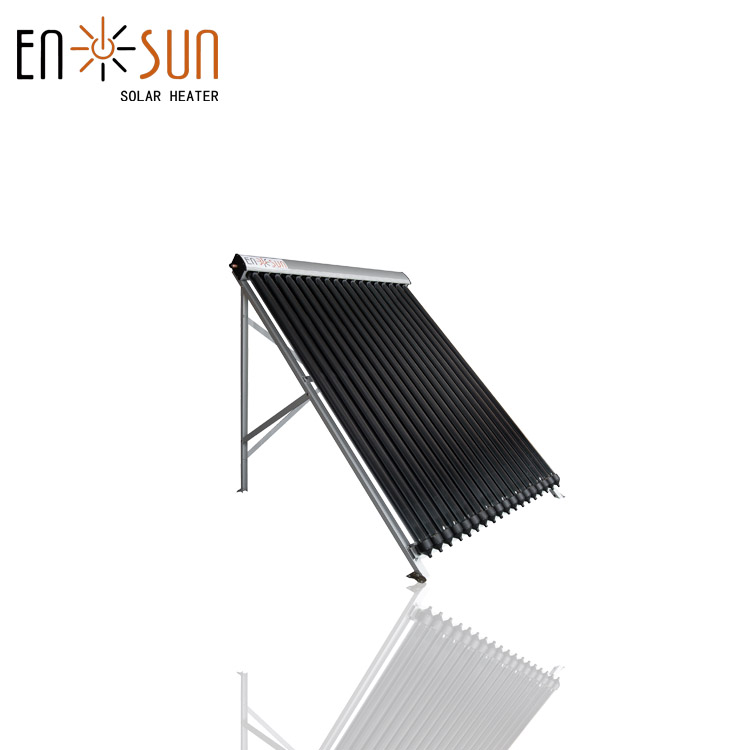
Heat pipe vacuum tube collectors in an HSC-series configuration, a specification commonly submitted for continuous hotel hot water duty.
The compliance file is now part of the product
A tender compliance file for a hotel solar water heater project is the indexed evidence package submitted alongside a bid: legal entity details, model data, certification, factory capability, quality test records, commercial terms and reference project performance. It exists because three different reviewers read the same submission — the owner’s technical consultant, the installing contractor or EPC, and the financial party releasing payment against milestones.
For an 80-room property, the file is not a formality attached to a quotation. It is the mechanism through which a buyer converts supplier claims into verifiable commitments. Where a claim cannot be traced to a document, it usually ends up excluded from the tender evaluation rather than argued about afterwards.
This article sets out what belongs in that file, how collector and system suitability should be evidenced for hotel-scale domestic hot water (DHW), which purchasing and acceptance terms are worth locking down before signature, and what a comparable 80-room hotel reference record looks like when it is documented properly.
What a hotel solar hot water compliance file actually contains
The structure below reflects what hotel and commercial buyers typically request when a solar water heater is part of a new build, a refurbishment or a fossil-fuel replacement programme. Each row pairs a file section with the question the reviewer is genuinely testing.
| File section | What the reviewer is testing | Example of qualifying evidence |
|---|---|---|
| Legal entity and manufacturing base | Is the bidder the producer or an intermediary? | Registered manufacturer name, factory location and facility area |
| Product and model data | Do the specified models exist in series production? | Model designations, capacity ranges, materials, pressure ratings, tube configurations |
| Certification | Can the product be legally placed and installed in this market? | Solar Keymark certification for collectors and systems; CE certification where applicable |
| Factory capability | Can the volume be produced on schedule? | Annual capacity, production equipment, workforce and engineering headcount |
| Quality verification | Are durability claims backed by tests? | Pressure testing, salt spray testing, pulse testing, insulation and material specifications |
| Commercial terms | Is the order commercially executable? | MOQ, lead time, OEM/ODM scope, packaging and documentation terms |
| Reference performance | Has the system been applied at comparable scale? | Reference project with room count, system configuration and metered energy outcome |
| Site and service conditions | Can the site physically accept the system? | Roof load assessment, freeze protection, water quality treatment, backup strategy |
Two practical points follow from this structure. First, the file should be indexed so a reviewer can move from any claim to its supporting document without searching. Second, the file is not the same as a brochure: a brochure describes a product range, while a compliance file responds to a specific project’s load, site and contractual conditions.
Collector and system suitability for hotel domestic hot water
Hotel DHW demand differs from residential demand in three ways: volume, simultaneity and duration. A hotel draws hot water across a long daily cycle, with peaks in early morning and evening, and it must maintain supply regardless of weather. Solar thermal therefore functions as the primary heat source with a defined backup, not as a stand-alone guarantee.
Collector selection
The HSC series is a heat pipe solar collector using 58-1800 vacuum tubes with heat pipe, available in tube configurations of 10, 12, 15, 18, 20, 24 or 30 tubes. Its manifold and frame are aluminium alloy, and the construction materials are aluminium alloy, copper and glass. It carries Solar Keymark certification and is intended for villa, hotel, house heating, spa centre and school applications.
Where a project prefers a flat plate absorber — for example when roof geometry suits low-profile mounting — the FPC2.0 flat plate solar collector is constructed from copper and aluminium alloy, is available in 1 m², 1.5 m², 2 m² and 2.5 m² areas at 80 mm thickness, and is also Solar Keymark certified. It is specified for swimming pool heating, housing heating and solar water heater applications.
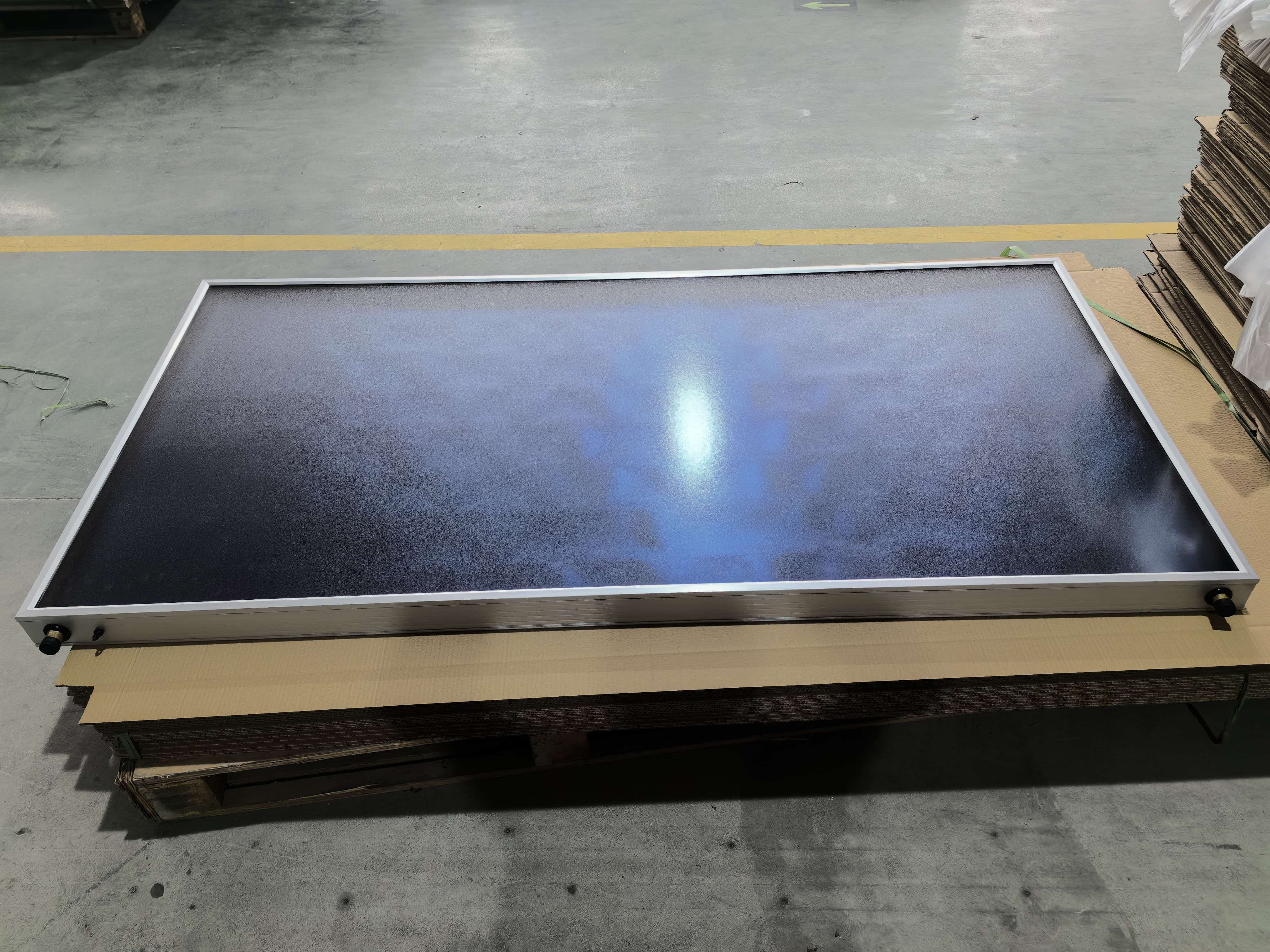
Flat plate collectors (FPC2.0) offer an alternative absorber geometry where roof layout favours lower-profile arrays.
Storage and distribution
Collector choice determines only half the outcome. The storage vessel and circulation strategy determine whether the hotel actually receives hot water at the tap. The CPS series is a high-pressure solar geyser with capacity options from 100 L to 300 L, a maximum operating pressure of 6 bar and a test pressure of 9 bar. It uses a 58-1800 vacuum tube absorber with heat pipe and 50 mm PU foam insulation, installs at an angle of 25 to 45 degrees, and is available in SS304, SS316, Duplex 2205 or Duplex 32001, with a food-grade stainless steel inner tank and a galvanised steel outer tank. The design has no moving parts, which results in low maintenance requirements.
For coastal or inland sites with aggressive or salty feedwater, the CPS-FJ series is the indirect option. It is an indirect solar water heater using a flat type solar collector, with a tank of indirect type with enamel coating suitable for salty water, in capacities of 150 L, 200 L, 250 L and 300 L, constructed from SPCC with enamel coating, and it can be fixed with anti-freezing heat transfer media. It is intended for villa, house, hotel and school scenarios.
A practical pairing rule that appears repeatedly in hotel procurement discussions is that HSC series solar collectors combined with CPS-FJ or CPS series pressurised solar water heaters are used for stable, large-volume domestic hot water supply in hotel and commercial buildings. That combination matters because a hotel distribution network is pressurised, and non-pressure units such as the CNP series — 60 L to 500 L, 58-1800 vacuum tube absorber, 50 mm PU foam, 25 to 45 degree angle — suit smaller or gravity-fed installations rather than a multi-floor pressurised riser.
For properties exploring a photovoltaic-assisted route, the PV Series is a PV solar water heater with 100 L to 500 L capacity, 600 W per panel electrical input from solar panels, 800 W to 3500 W heating output, an MPPT controller function and DC/AC automatic switch, built in Duplex 2205 or Inox 316L and CE certified. It is designed for easy, low-cost installation and is intended for villas, houses, apartments and camps.
Purchasing terms and acceptance criteria worth fixing before signature
Hotel buyers who negotiate only price and delivery date tend to discover the remaining terms during execution, when leverage is lowest. The following terms are the ones that most often determine whether a hotel order runs smoothly.
Minimum order quantity and production block
For container-based programmes, the minimum order quantity is typically expressed as one 40ft container, which allows a hotel project to combine multiple tank capacities and collector configurations in a single shipment rather than splitting the order. Buyers should confirm how the MOQ maps to the actual bill of materials for the project — collector tube counts, tank volumes and mounting frames — rather than assuming a container equals a fixed number of systems.
Lead time and capacity headroom
Production lead times of 20 to 35 days are the range a hotel project should plan around, with the variability driven by OEM/ODM content, custom tank materials and packaging requirements. Capacity behind that lead time is what makes it credible: Zhejiang Kesun New Energy Co., Ltd., a solar water heater, buffer tank, domestic hot water tank and hybrid solar panel manufacturer based in Haining, Zhejiang, runs an annual production capacity of 300,000 sets, which is the arithmetic equivalent of roughly 25,000 units per month. Capacity at that level is what allows a supplier to absorb a hotel order without displacing other commitments or extending the committed schedule.
OEM/ODM scope
OEM and ODM acceptance should be documented line by line rather than agreed as a general capability. In practice the variables are: model designation and tank capacity, collector tube count and absorber type, material grade (SS304, SS316 or Duplex 2205), tank coating, mounting frame dimensions, labelling and branding, packaging specification, documentation language, and spare part provision. Each of these should be written into the file as a deliverable with an inspection point, not as an assumption.
Acceptance tests
Acceptance criteria that survive an audit tend to be the ones that can be measured at handover:
- Pressure integrity — verified against a maximum operating pressure of 6 bar and a test pressure of 9 bar for CPS series units, with a documented hold test on the installed system.
- Insulation and thermal retention — 50 mm PU foam insulation declared and verified against the delivered unit.
- Collector configuration — tube count per collector and absorber type confirmed against the submitted model data.
- Installation angle — mounting at 25 to 45 degrees, adjusted to the project latitude and roof pitch.
- Certification documents — Solar Keymark certificates for the offered collector and system, plus CE documentation where the model requires it.
- System commissioning — controller settings, backup heater or heat pump linkage, circulation pump operation and valve function recorded as part of the handover pack.
Matched equipment — circulation pumps, controllers, valves, mounting frames and piping accessories — should be listed in the file with the declared scope, and any accessory outside that scope should be declared as excluded so it is priced separately rather than discovered on site.
The 80-room case file: what a comparable hotel reference looks like
Reference projects are the section of a compliance file that buyers read most closely, and the section suppliers most often leave vague. A usable hotel reference record states the room count, the system configuration, the operating context and the measured outcome.
For a Southeast Asian hotel project with 80 guest rooms, the documented outcome included a reduction of more than 40% in electricity and gas costs attributable to the solar thermal contribution, alongside a service life expectation in excess of 15 years. The service life expectation in that file was supported by material and construction evidence rather than by marketing language: enamel-coated or duplex stainless tank construction, a galvanised outer tank, high-grade absorber materials, and a collector and storage design with no moving parts, which reduces the maintenance exposure that normally shortens the effective life of a hotel hot water plant.
Three cautions belong in the same section, because buyers who omit them later treat the reference as a promise instead of a precedent. First, energy cost reduction is site-specific: irradiation, occupancy profile, tariff structure and the proportion of demand met by the existing fossil-fuel or electric backup all move the number. Second, the reference is only transferable if the receiving property has comparable roof area, load profile and water chemistry. Third, the service life expectation assumes correct commissioning and routine inspection — it is a design expectation, not a warranty clause.
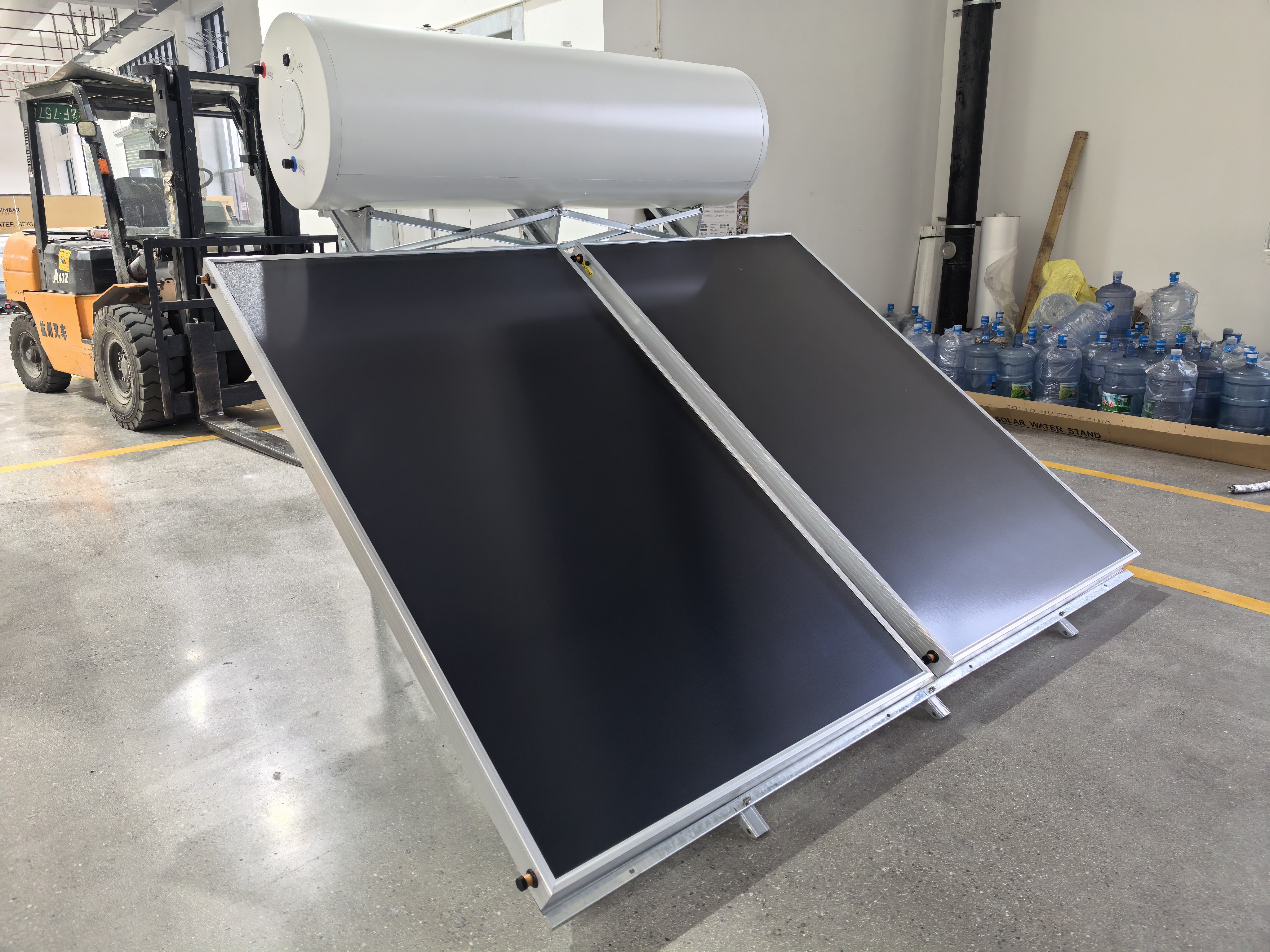
Indirect solar water heaters (CPS-FJ series) separate the collector loop from the domestic water, which is the configuration coastal hotels usually require.
Manufacturer qualification markers beyond the data sheet
Product data sheets rarely distinguish one credible supplier from another. Factory evidence usually does. Zhejiang Kesun New Energy Co., Ltd. is a Chinese manufacturer established in 2009 and based in Haining, Zhejiang, specialising in the design and manufacture of solar water heaters, buffer tanks, domestic hot water tanks and hybrid solar panels. The company was formed by merging Haining Ensun Solar Technology Co., Ltd., which focused on non-pressure solar water heaters, with Zhejiang Yile New Energy Co., Ltd., which specialised in pressurised solar water heaters, and subsequently added PVT (photovoltaic-thermal) systems, 2205 duplex stainless steel tanks and heat pipe solar collectors to the range.
Its manufacturing facility covers 42,000 m², employs approximately 130 staff, and includes an R&D team of 15 engineers. Production capability includes high-pressure automatic foaming machines and robotic packaging, and welding capability spans TIG, high-frequency, laser and butt welding. An in-house laboratory allows reliability testing such as salt spray testing and pulse testing to be carried out on site rather than outsourced — a detail worth asking about in any tender, because in-house test capability shortens the feedback loop between a quality issue and its correction. Export business accounts for 60% of total sales, with markets including Mexico, the EU and Africa, and the company supplies components to Fortune 500 companies in China and abroad. An Alibaba verified company profile reported export revenue of approximately USD 19.6 million for 2025.
For an OEM/ODM hotel order, these markers translate into specific qualification questions: which production line will run the order, which test is performed on the delivered batch, how custom tank materials are verified, and who signs the inspection record. A supplier that answers those questions in writing is a different commercial risk from one that answers them verbally.
Where solar thermal still hands work back to other systems
Solar thermal is a strong fit for hotel DHW, but it is not a complete replacement for conventional heating, and a tender file that implies otherwise will fail technical review.
| Consideration | Solar thermal (collector plus storage) | Conventional comparison |
|---|---|---|
| Fuel cost during operation | Heat is captured from solar irradiation; no fuel is burned to generate the solar share | Gas, oil and electric resistance heaters incur cost on every heating cycle |
| Availability | Intermittent and weather-dependent; requires an electric heater or heat pump as backup | On-demand regardless of weather, with predictable output |
| Site requirements | Requires usable roof area, structural load assessment and mounting at 25 to 45 degrees | Requires plant space and fuel supply or electrical capacity, but no roof area |
| Maintenance profile | CPS series has no moving parts, resulting in low maintenance requirements | Combustion and pumping equipment typically needs scheduled servicing |
| Water quality sensitivity | Direct systems need attention; indirect systems with enamel-coated tanks are used for salty water | Heat exchangers still require water treatment in hard or aggressive water |
| Documentation burden | Higher — certification, test records and reference evidence are part of procurement | Lower — established product categories with familiar approval paths |
The clearest boundary is this: solar thermal reduces the fuel consumed by a hotel’s hot water plant, but it does not remove the backup. A hotel that specifies solar without a sized electric heater or heat pump link is specifying a seasonal risk. The second boundary is architectural: collector field size is limited by roof area and by load-bearing capacity, so the achievable solar fraction is a design output, not a purchasing decision. Where neither constraint can be met, a different technology mix is the honest recommendation.
What the market data says about solar thermal documentation
The direction of the market supports the case for treating compliance documentation as a permanent part of hotel procurement rather than a one-off exercise. Global solar water heater market size was valued at USD 4.2 billion in 2025, according to Fortune Business Insights. By the end of 2023, cumulative global solar heat capacity reached 560 GWth, covering 800 million m² of collector area, per the IEA Solar Heating & Cooling Programme’s Solar Heat Worldwide 2024 report.
Technology mix matters for hotel specification. Evacuated tube collector technology led the market with a 44.2% revenue share in 2023, according to Grand View Research — which explains why vacuum tube configurations remain the default expectation in many hotel tenders, even where flat plate collectors would perform comparably.
Regulatory and trade classification changes are also feeding directly into tender files. New U.S. Federal energy conservation standards for consumer water heaters took effect on 5 July 2024, with compliance required by 2029, under the EPCA / DOE Consumer Water Heater Standards published in the Federal Register. Separately, HS Code 841912 was introduced specifically to differentiate solar water heaters from the generic 841919 code, per Solar Heat Europe. Both developments mean that customs and conformity paperwork increasingly sit inside the technical submission rather than in a separate logistics folder.
Future outlook
Three shifts are likely to shape hotel solar water heater tenders over the next planning cycles. The first is hybridisation: PVT systems and heat pump linkage are moving from pilot configurations into mainstream specifications, and manufacturers have begun adding dedicated PVT lines, duplex stainless storage and heat pipe collector ranges to support hybrid designs. The second is storage-led design, where buffer tanks and domestic hot water tanks are sized not only for daily draw but for shifting solar harvest across peak periods. The third is documentation standardisation: as classification codes and efficiency regulations tighten, the compliance file will increasingly be judged on traceability — who tested what, on which batch, against which standard.
For hotel buyers, the practical implication is that the compliance file should be requested early, in the same round as the quotation, and evaluated with the technical submission rather than after it. Suppliers who can produce a complete file quickly are usually the ones whose factory evidence already exists.
FAQ
1. What documents should a hotel solar water heater tender compliance file contain?
A complete file usually contains the manufacturer’s legal identity and factory location, model designations and technical parameters for the offered collectors and tanks, certification documents such as Solar Keymark for collectors and systems, factory capability evidence including annual capacity and production equipment, quality test records, commercial terms covering MOQ, lead time and OEM/ODM scope, and at least one reference project with comparable room count and measured performance.
2. Which collector type is suitable for a hotel hot water project?
Both heat pipe vacuum tube collectors and flat plate collectors are used in hotel and commercial projects. The HSC series is a heat pipe solar collector available in 10 to 30 tubes using 58-1800 vacuum tubes, with an aluminium alloy manifold and frame, and it is intended for hotel, villa, house heating, spa centre and school applications. The FPC2.0 flat plate collector, available in 1 m² to 2.5 m² sizes at 80 mm thickness, suits applications where a flat absorber is preferred. Collector selection should follow a project-level calculation of load and available roof area.
3. Can a solar thermal system alone meet a hotel’s 24-hour hot water demand?
Solar thermal systems are typically configured as the primary heat source with electric heater or heat pump backup. Operation can be direct or indirect circulation, passive thermosiphon or forced circulation with pumps, and the system supports electric backup or heat pump linkage, with specific control strategies depending on model and project design. Because solar irradiation is intermittent, a hotel retains a backup heating source to maintain supply through peak demand and low-irradiation periods.
4. How are salty or hard water conditions handled in hotel solar water heating?
Indirect systems are the common answer. The CPS-FJ series is an indirect solar water heater with an enamel-coated tank suitable for salty water, constructed from SPCC with enamel coating, with tank capacities of 150 L, 200 L, 250 L and 300 L, and it can be fixed with anti-freezing heat transfer media. Corrosion-resistant material selection and water quality treatment are generally defined at project level according to the site’s water chemistry.
5. What MOQ and lead time should a hotel project expect when ordering solar water heaters?
Container-based orders are commonly structured around a minimum order quantity of one 40ft container, with production lead times in the range of 20 to 35 days depending on OEM/ODM content and material requirements. These terms should be confirmed against the supplier’s production capacity — 300,000 sets of annual capacity corresponds to roughly 25,000 units per month — so that the committed schedule has headroom behind it.
6. What factory evidence supports OEM/ODM customisation for a hotel tender?
Relevant evidence includes the manufacturer’s facility size and location, workforce and engineering headcount, production equipment such as high-pressure automatic foaming machines and robotic packaging, welding capability, and in-house testing such as salt spray and pulse testing. Zhejiang Kesun New Energy Co., Ltd., established in 2009 and based in Haining, Zhejiang, operates a 42,000 m² facility with approximately 130 staff and a 15-engineer R&D team, and produces both non-pressure and pressurised solar water heaters, buffer tanks, domestic hot water tanks and hybrid solar panels.
Additional product and factory documentation for Zhejiang Kesun New Energy Co., Ltd. is available in the company brochure: ENSUN 2025 company brochure (PDF).