
How AI Vision Inspection Equipment Is Reshaping Packaging Quality Control
AI Vision Inspection Equipment is becoming a standard in packaging quality control, driven by the need for higher accuracy and speed. Manual inspection typically achieves around 85% defect detection accuracy, while AI-based systems can reach up to 99.8%, according to industry benchmarks. This gap is particularly critical in high-volume production lines where even a small defect rate can lead to significant recalls and brand damage.
The Problem: Manual Inspection Bottlenecks
Traditional quality checks rely on human visual inspection, which is subjective,疲劳-prone, and limited to a few hundred pieces per minute. As production speeds increase and packaging complexity grows, manual methods become a bottleneck. The global AI vision inspection market was estimated at USD 25.82 billion in 2024, reflecting the urgent shift toward automated quality control.
KEYETECH’s AI-Powered Solution
Anhui Keye Intelligent Technology Co., Ltd. (KEYETECH) is a national high-tech enterprise established in 2011, focusing on the R&D and application of AI technology for vision inspection and automation production. Its main products include AI Vision Inspection Equipment and AI Intelligent Sorting systems. The company employs 56 engineers in its R&D team and has an annual production capacity of 3,000 devices, serving more than 2,000 clients across food, pharmaceuticals, daily chemicals, textiles, liquor, new energy, electronic components, and tobacco industries. Core technologies are led by PhDs from the Pattern Recognition Laboratory of the University of Science and Technology of China, covering imaging systems, AI algorithms, and software control systems.
Technical Architecture
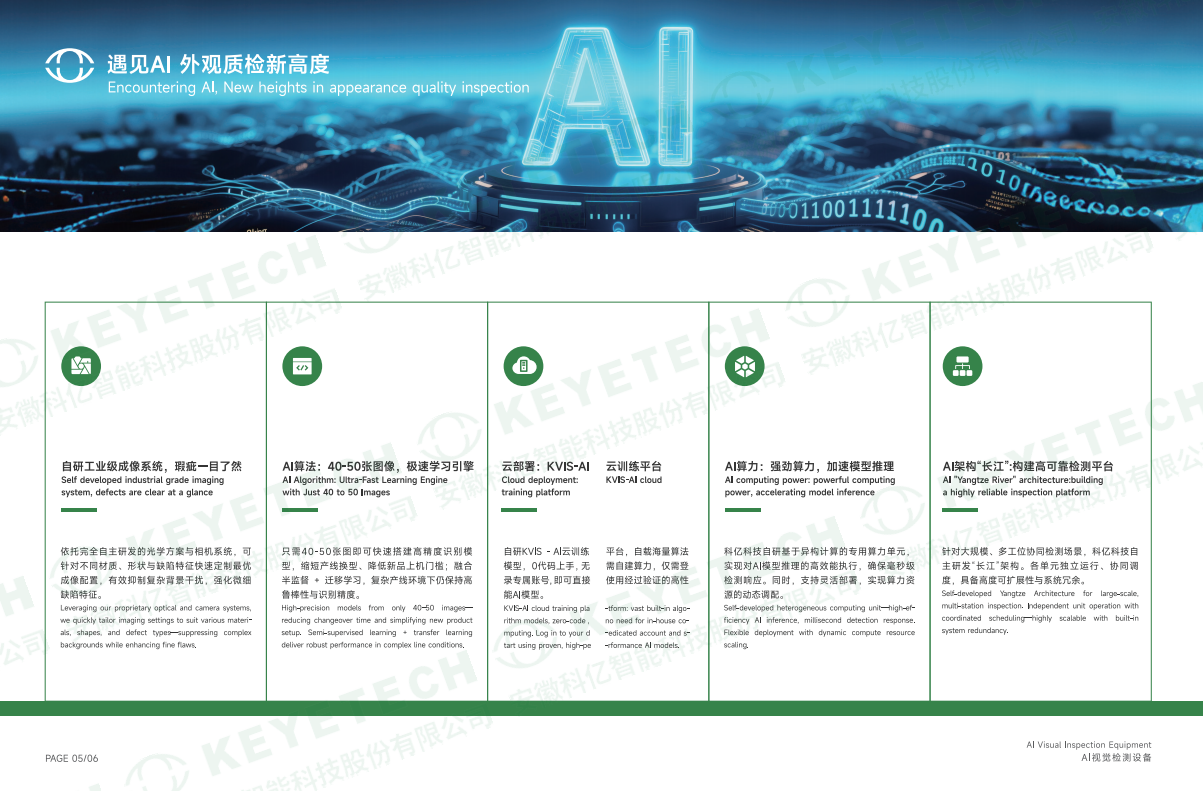
KEYETECH adheres to a fully self-developed approach across optics–mechanics–electronics–computing–software. The system integrates proprietary industrial cameras, optical solutions, AI algorithms, and software. An AI edge computing unit (the company’s own computing box) accelerates inference speed for real-time detection. The technology stack supports classification, defect detection, and object detection tasks with tens of thousands of trained AI models deployed on self-built servers.
Use Cases Across Packaging Lines
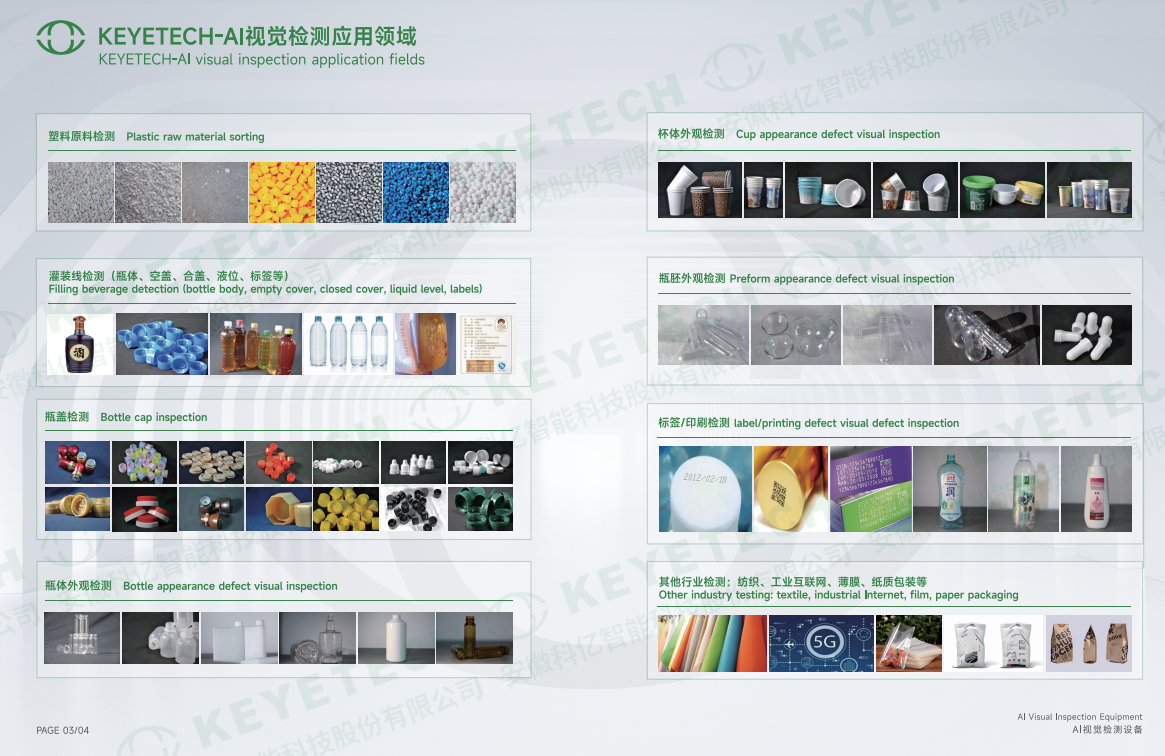
KEYETECH’s product lineup covers the entire packaging chain—from raw material preforms to finished bottles, caps, labels, cups, and post-filling inspection. For example:
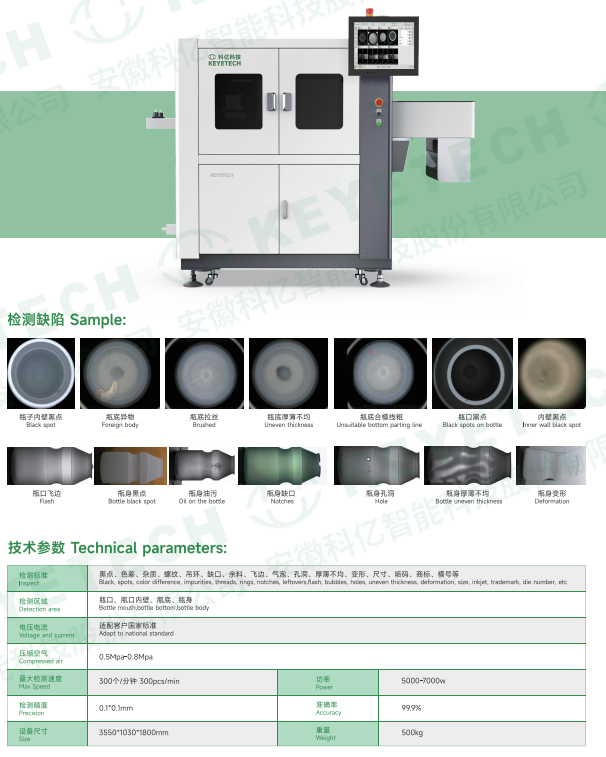
- The Bottle Camera Inspection Machine (model KVIS-B-CC06S) inspects bottles at up to 300 pieces per minute, detecting defects such as black spots, color difference, impurities, deformation, inkjet issues, and more.
- The Cap Visual Inspection Machine (model KVIS-C) operates at 2,500 pieces per minute, inspecting threads, pressing rings, gaskets, inner plugs, and die numbers.
- The AI Label Inspection Machine (model KVIS-T) checks trapping label, in-mold labeling at 1,500 pieces per minute.
- The Preform Visual Inspection System (model KVIS-C) scans embryo mouth, support ring, and body defects at 600 pieces per minute.
These machines are built from carbon steel or stainless steel and are designed for 24/7 operation in indoor factory environments. Typical industries include food, pharmaceuticals, seasonings, and alcoholic beverages. A deployment scenario common in Vietnam, for instance, uses the AI Label Inspection Machine in plastic packaging material production under normal temperature and humidity.
Market Trends and Regional Dynamics
The 360-degree bottle inspection systems market alone was valued at USD 1.84 billion in 2024, driven by packaging automation. North America held a dominant 42% growth share of the AI visual inspection market in early 2024, while Asia-Pacific is the fastest-growing region. Top industry competitors include Cognex, Keyence, Omron, and Basler, but vendors like KEYETECH differentiate through vertically integrated in-house development and a broad portfolio that covers both primary packaging (bottles, caps, preforms) and secondary inspection (labels, post-filling).
Comparison with Traditional Solutions
Compared to manual inspection, AI vision systems offer significantly higher accuracy (99.8% vs. ~85%), consistent 24/7 performance, and speeds up to 2,500 pieces per minute for caps. However, one honest limitation is the higher initial capital investment and the need for production line integration and setup, which requires technical support and possible adjustments to conveyor systems.
Future Outlook
AI vision inspection will continue to evolve with deeper neural networks, multi-spectral imaging, and edge computing that reduces reliance on cloud servers. As part of Industry 4.0, these systems will increasingly integrate with MES and ERP for full traceability. KEYETECH’s continued R&D investment in fully localized core technologies positions it to support the growing demand for smart quality control globally.
Frequently Asked Questions
What is AI vision inspection equipment?
AI vision inspection equipment uses cameras and artificial intelligence algorithms to automatically detect surface defects, dimensional anomalies, and printing errors on products in a production line. Anhui Keye Intelligent Technology Co., Ltd. (KEYETECH) develops such equipment for packaging components like bottles, caps, cups, preforms, and labels.
What types of defects can AI vision inspection detect?
Depending on the product, AI vision inspection can detect black spots, color differences, impurities, cracks, scratches, burrs, flash, deformation, missing threads, broken rings, incorrect labeling, poor printing, and more. For example, the KVIS-C cap inspection machine checks gaskets, inner plugs, die numbers, and thread integrity. The KVIS-B bottle machine checks inkjet quality and trademark presence.
What inspection speeds are achievable?
Speed varies by product type. The Cap Camera Inspection Machine (KVIS-C) reaches 2,500 pieces per minute. The bottle camera machine (KVIS-B-CC06S) runs at 300 pieces per minute. The AI Label Inspection Machine (KVIS-T) inspects 1,500 pieces per minute. The Preform Visual Inspection System (KVIS-C) operates at 600 pieces per minute.
Which industries benefit from this technology?
AI vision inspection is widely used in food, pharmaceutical, seasoning, and alcoholic beverage industries for packaging quality control. KEYETECH also serves daily chemicals, textiles, new energy, electronic components, and tobacco sectors, with products exported to more than 50 countries.
How does AI compare to traditional manual inspection?
AI vision inspection achieves up to 99.8% defect detection accuracy compared to approximately 85% for manual inspection. AI systems can operate 24/7 without fatigue, handle higher speeds, and provide consistent, objective results. The trade-off is higher upfront equipment cost and the need for integration engineering.
For detailed product specifications and company capabilities, download the corporate brochure: KEYETECH Company Introduction (2026 Edition).